Tag: Space

Solace.

The stranger the times the more we need to ‘ground’ ourselves.

Without doubt these are incredibly strange and unsettling times. For the United Kingdom, for the USA, for the British Commonwealth, for Scotland, for Gibraltar; and for many other places.

When we are faced with unsettling periods then it is essential to ‘ground’ ourselves, and there are many effective ways of doing this.

One way that always works for me is to gaze into a clear, night sky. The night sky over one’s head is captivating beyond words. Perhaps I should have written that it is captivating beyond my words.

Not so for Sue Dreamwalker. Just read this most beautiful poem that Sue published a little over two weeks ago. Republished here with Sue’s kind permission.

(And to demonstrate how your’s truly is becoming a forgetful old fart when I read this out to Jeannie last night she reminded me that I had already published it! It’s worthy of another showing!)

ooOOoo

Mother Gaia ~ The Blue Dot.

11 Jun 2016

Three Sisters Glen Coe Scotland

How many times have you gazed at the stars?

To ask the question of whom we are

This Blue Dot in the vastness of space

Have you questioned the existence of the Human Race?

~~

Did we really evolve from Neanderthal Man?

From Ape to Human imagine if you can

Woolly Mammoths along with Sabre Tooth Tigers

Ice Ages and Floods, Volcanoes and Fires

~~

Mountains crashing, rising from ocean floors

Fossils created into stony forms

Petrified wood in glaciers saved

While Crystals grow beneath deep dark cave

~~

How many times have you asked ‘Who am I?’

As you gaze longingly at the starlit sky

So many treasures now upon this Blue Dot

So sad that we’ve evolved, but we also forgot

~~

That we Humans just like the Dinosaur race

Could soon disappear without a trace

As our superior brains seemed to have lost the plot

Of our coexistence within this amazing Blue Dot

~~

As we pollute our Mother who brings such life

While we rage in greed creating more strife

We poison our land modifying crops

Caring less and less until the last Bee drops

~~

Long after we’re gone as the planets realign

A new dawn will break over the memory of mankind

His legacy I’m sure one day will be discovered

As some future traveller his fossils will uncover.

~~

But it’s never too late to alter our future

When we live in harmony and learn to nurture

Holding onto LOVE and Letting go of Hate

We can all help our Blue Planet Regenerate.

Copyright Sue Dreamwalker 2016.

ooOOoo

Just meditate on those thoughts for a while without doing anything else.

Be entranced

Our beautiful planet home; the only one we have.

With great thanks to Dan G. for sending me the link.

Science educator James Drake built this amazing timelapse video from the perspective of the International Space Station as it flew over North and South America. He created this video by downloading a series of 600 photographs that were available online at theGateway to Astronomy Photograph of Earth, and then stitching them together into a complete video. You can see more of James work at his blog: infinity imagined.

It’s all we have!

A bit tight on time for today’s Post so just feast your eyes on this image.


Earthrise, from the cabin of Apollo 8


This view of the rising Earth greeted the Apollo 8 astronauts as they came from behind the Moon after the lunar orbit insertion burn. The photo is displayed here in its original orientation, though it is more commonly viewed with the lunar surface at the bottom of the photo. Earth is about five degrees left of the horizon in the photo. The unnamed surface features on the left are near the eastern limb of the Moon as viewed from Earth. The lunar horizon is approximately 780 kilometers from the spacecraft. Height of the photographed area at the lunar horizon is about 175 kilometers.

The Apollo 8 mission was the first time man had left the orbit of the Earth.

The photograph was taken on the 24th December 1968 by NASA astronaut William Anders.  Within 18 months of this image being published, the environmental movement had started. Wilderness photographer Galen Rowell called it “the most influential environmental photograph ever taken.”


Happy Birthday, Hubble!

The Hubble Space Telescope (HST) has been in space for 20 years!

This week, twenty years ago, the HST was launched into orbit.  There’s much online if you want to read about it both on WikiPedia and on the Hubble web site so this post is going to offer just two items.

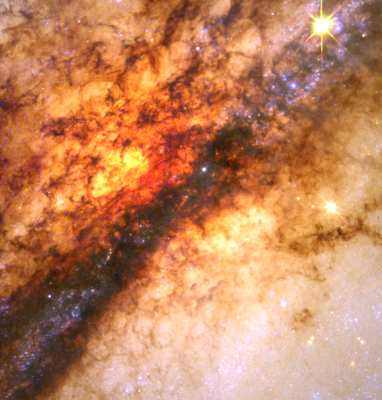
A beautiful picture

Nucleus of Galaxy Centaurus A

And an interesting audio slideshow tribute from the BBC – click here, introduced thus:

Take a look at some of the sights it has seen in that time with Professor Alec Boksenberg from the Institute of Astronomy in Cambridge – who was on the European team that helped build Hubble.

By Paul Handover (in awe of what is beyond our skies)

Man on the moon

How many remember this?

Very early on in the life of this Blog, indeed on the second day, I wrote a short article about the NASA mission to the moon, some 40 years after the event.  You see, for me that has been the historic event of my lifetime.

I believe that this nation should commit itself to achieving the goal, before this decade is out, of landing a man on the Moon and returning him safely to the Earth. No single space project in this period will be more impressive to mankind, or more important in the long-range exploration of space; and none will be so difficult or expensive to accomplish.
Apollo 11 badge

That speech before Congress by President Kennedy was on the 25th May, 1961.  I was 16 and was enthralled by the idea of being alive when man first set foot on another planetary body.  That came about on July 20th, 1969 at which time I was living and working in Sydney, Australia.  I took three days off work, rented a TV and watched every minute of the event.

Exploration is a core need of man.  By pushing out the boundaries of our knowledge we continue to offer hope to mankind.

So it is with great disappointment that it has been announced by President Obama that the manned mission programs to the moon are to be severely curtailed – that sounds terribly like political speak for cancelled!

As Eugene Cernan (last astronaut to set foot on the moon) said:

I’m quite disappointed that I’m still the last man on the Moon. I thought we’d have gone back long before now.
I think America has a responsibility to maintain its leadership in technology and its moral leadership… to seek knowledge. Curiosity’s the essence of human existence.

Curiosity is indeed the essence of human existence.

That curiosity and the investment in space exploration by NASA on behalf of the whole world has shown us some remarkable findings about Saturn and it’s majestic rings.  Just watch the video segments in this piece from the BBC.

The one-time cost of Cassini-Huygens mission was $3.26 billion. Just 0.3% of the cost of one year’s expenditure on U.S. defense spending.

Science missions like Cassini enhance cooperation between nations, and greatly contribute to scientific progress which benefits everyone.

Perhaps the big Banks would like to pick up the cost of further manned missions to the Moon?

By Paul Handover

Dark Matter

Not really understanding but knowing it’s important!

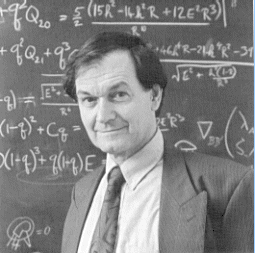
I recently read a glowing review of the latest book by Sir Roger Penrose, the eminent mathematical physicist, called The Road To Reality. Having previously read his book The Emperors’ New Mind and just understanding it, I thought

Roger Penrose

his next one would be a welcome companion for long winter evenings.  Wrong!

I managed to the bottom of the third page of the preface before “According to the mathematician’s “equivalence class” notion …..” had me grasping for meaning.  Well over a 1,000 pages of content was destined to gather dust on the bookshelf.

But wrong again!

The idea of matter out there in the universe that is essential to the universe as we know it but is unseen has been sufficiently fascinating for the popular media to refer to it from time to time.  Most people are familiar with the term even if like me don’t really have a clue as to what dark matter is all about.

So a recent press release in a popular English newspaper suggesting that dark matter has been ‘discovered’, if discover is the appropriate term, had me reaching out for Penrose’s book again.  There under the chapter headed Speculative theories of the early universe was, on page 773, a few sentences that almost made sense.  Let me quote them:

For many years, it had become clear that the dynamics of stars within galaxies does not make sense, according to standard theory unless there is a good deal of more material in the neighbourhood of the galaxy than is directly seen in stars.  A similar comment applies to the dynamics of individual galaxies within clusters.  Overall, there seems to be about 10 times more matter than is perceived in ordinary baryonic form.  This is the mysterious dark matter whose actual nature is still not agreed upon by astronomers, and which may even be of some material different from any that is definitely known to particle physicists – though there is much speculation about this at the present time.

Read more about Dark Matter

The Moon and water!

NASA reveals that there is a significant amount of water on the Moon.

In a rather awful pun, NASA published update on the LCROSS Mission starts with the words, “The argument that the moon is a dry, desolate place no longer holds water.

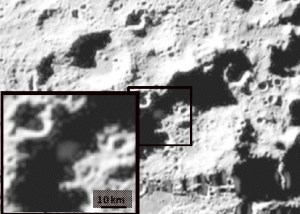
LCROSS
The visible camera image showing the ejecta plume at about 20 seconds after impact.

Anyway, the significance of the update is enormous.  As the NASA release goes on to say,

Scientists have long speculated about the source of vast quantities of hydrogen that have been observed at the lunar poles. The LCROSS findings are shedding new light on the question of water, which could be more widespread and in greater quantity than previously suspected.

Permanently shadowed regions could hold a key to the history and evolution of the solar system, much as an ice core sample taken on Earth reveals ancient data. In addition, water, and other compounds represent potential resources that could sustain future lunar exploration.

The BBC also reports the NASA data but, I am bound to say, in a rather more reader-friendly format.

By Paul Handover

Things aviation and the ‘wow’ effect.

Some stunning pictures.

Of the six active authors on this Blog, four have been or still are pilots.  Of course, only young Bob Derham is a ‘real’ pilot having been an Air Transport pilot for almost as long as Pontious Pilate (sorry, that’s an awful pun!).

Anyway, there has been a growing collection of some incredible photographs from odd sources around the Web and it seemed time to share a few.

Here’s a wonderful picture of an F-15C Eagle Fighter circling over the Kennedy Space Centre in Florida with Shuttle Mission STS 108 on the launch pad.

011129-F-1279W-025

See more aviation pictures

Integrity: adding up to something

Integrity as an idea that can deliver more than the sum of the parts

People who add up to something are remarkable, while at the same time being more common than we might think.

As I’ve discussed elsewhere, integrity is also about “wholeness”. The “adding up” aspect is relevant, because it links the parts to the whole. Many people achieve extreme and, sometimes, amazing feats; these are typically formed from many steps. But then to do that repeatedly, and continually exceeding one’s earlier achievements, has the effect of generating an overall record of achievement which is much greater than the sum of its parts.

Read more about the wholeness of integrity

The International Space Station

Almost taken for granted by so many of us.

Thanks to Dan for passing me the link to a fascinating graphic that was recently published in USA Today showing the

As seen by STS 128
As seen by STS 128

time-line of the International Space Station.  It has been orbiting above our heads for over a decade!  Do click on the link because you will be surprised, unless you work for NASA, how large and complex the ISS now is.

It’s an interesting to consider what has happened since the launch of the first module, Zanya, on the 20th November, 1998.  Bill Clinton was then President of the USA; Tony Blair had been British Prime Minister since May, 1997.  How times change!

But steadily a group of Nations has worked together to keep this project going and now the end of this magnificent enterprise is within sight.  As the NASA web site summarises:

The International Space Station is a partnership of the US, Russian, European, Japanese, and Canadian Space Agencies. The station has been continuously human occupied since Nov 2, 2000. Orbiting 16 times per day at 17,500 miles per hour 250 miles above the ground, it passes over 90% of the world’s surface. When complete in 2010, it will weigh over 800,000 pounds and have a crew of 6 conducting research and preparing the way for future exploration to the moon and beyond.

By Paul Handover