Conclusive evidence that mankind is part of nature!
Subtext = There are times when our arrogance and mindlessness beggars belief.
Sorry, if you pick up on a degree of emotion in today’s post. It’s impossible to hide!
Here’s what has fed that.
A few days ago, I came across some stunning images of bees, over on the Flickr website. Particularly, I was here and offer below a small sample of what was seen:

oooo

Much more may be learned about bees by going to the USGS Bee Inventory and Monitoring Lab (BIML). The BIML website is here.
Then coincidentally (seems to be happening much of this week!) Jean and I watched the latest TED Talk by Marla Spivak. It was called: Why bees are disappearing.
Marla’s talk is just 15-minutes long, and I beg of you to watch it because the ramifications for all of warm-blooded life on this planet are frightening if we don’t amend our ways – and amend them pretty damn soon!
Honeybees have thrived for 50 million years, each colony 40 to 50,000 individuals coordinated in amazing harmony. So why, seven years ago, did colonies start dying en masse? Marla Spivak reveals four reasons which are interacting with tragic consequences. This is not simply a problem because bees pollinate a third of the world’s crops. Could this incredible species be holding up a mirror for us?
Marla Spivak researches bees’ behavior and biology in an effort to preserve this threatened, but ecologically essential, insect. Full bio »
You may also want to go across to the University of Minnesota‘s Bee Lab website, where there is much more from Marla about our bees.
What next? Well may you ask!
I came across an article in the San Francisco Chronicle about a “Report links antibiotics at farms to human deaths“. Here’s a taste of that article:
Washington — The Centers for Disease Control on Monday confirmed a link between routine use of antibiotics in livestock and growing bacterial resistance that is killing at least 23,000 people a year.
The report is the first by the government to estimate how many people die annually of infections that no longer respond to antibiotics because of overuse in people and animals.
CDC Director Thomas Frieden called for urgent steps to scale back and monitor use, or risk reverting to an era when common bacterial infections of the urinary tract, bloodstream, respiratory system and skin routinely killed and maimed.
“We will soon be in a post-antibiotic era if we’re not careful,” Frieden said. “For some patients and some microbes, we are already there.”
The SFC report later goes on to say:
At least 70 percent of all antibiotics in the United States are used to speed growth of farm animals or to prevent diseases among animals raised in feedlots. Routine low doses administered to large numbers of animals provide ideal conditions for microbes to develop resistance.
“Widespread use of antibiotics in agriculture has resulted in increased resistance in infections in humans,” Frieden said.
It concludes, thus:
Legislation goes nowhere
Organic certification prohibits antibiotic use, but raising such animals is costly, he said.
Rep. Henry Waxman, D-Los Angeles, first introduced legislation in 1980 to restrict antibiotic use in livestock. For the past decade, Rep. Louise Slaughter, D-N.Y., has introduced similar bills, joined in recent years by Sens. Dianne Feinstein, D-Calif., and Kirsten Gillibrand, D-N.Y., but the measures have gone nowhere.
“We constantly hear from the pharmaceutical and livestock industry that antibiotic use in livestock is not a problem and we should focus on human use,” said Avinash Kar, a staff attorney at the San Francisco office of the Natural Resources Defense Council, an environmental group that has sued the FDA to force it to ban using antibiotics to promote growth in livestock. The case is now pending before the 2nd U.S. Circuit Court of Appeals.
Carolyn Lochhead is the San Francisco Chronicle‘s Washington correspondent.clochhead@sfchronicle.com
See what I mean about mankind’s collective madness!
But I’m still not finished!
Because over at Alternet.org was this piece:
Americans Are 110 Times More Likely to Die from Contaminated Food Than Terrorism
September 17, 2013 – This article first appeared on Truth-Out.org.
One of the most important revelations from the international drama over Edward Snowden’s NSA leaks in May is the exposure of a nearly lunatic disproportion in threat assessment and spending by the US government. This disproportion has been spawned by a fear-based politics of terror that mandates unlimited money and media attention for even the most tendentious terrorism threats, while lethal domestic risks such as contaminated food from our industrialized agribusiness system are all but ignored. A comparison of federal spending on food safety intelligence versus antiterrorism intelligence brings the irrationality of the threat assessment process into stark relief.
In 2011, the year of Osama bin Laden’s death, the State Department reported that 17 Americans were killed in all terrorist incidents worldwide. The same year, a single outbreak of listeriosis from tainted cantaloupe killed 33 people in the United States. Foodborne pathogens also sickened 48.7 million, hospitalized 127,839 and caused a total of 3,037 deaths. This is a typical year, not an aberration.
See what I mean about our mindlessness! That article continues:
We have more to fear from contaminated cantaloupe than from al-Qaeda, yet the United States spends $75 billion per year spread across 15 intelligence agencies in a scattershot attempt to prevent terrorism, illegally spying on its own citizens in the process. By comparison, the Food and Drug Administration (FDA) is struggling to secure $1.1 billion in the 2014 federal budget for its food inspection program, while tougher food processing and inspection regulations passed in 2011 are held up by agribusiness lobbying in Congress. The situation is so dire that Jensen Farms, the company that produced the toxic cantaloupe that killed 33 people in 2011, had never been inspected by the FDA.
I can’t stomach any more (whoops, pardon the pun!) so if you want to read to the end, it’s here.
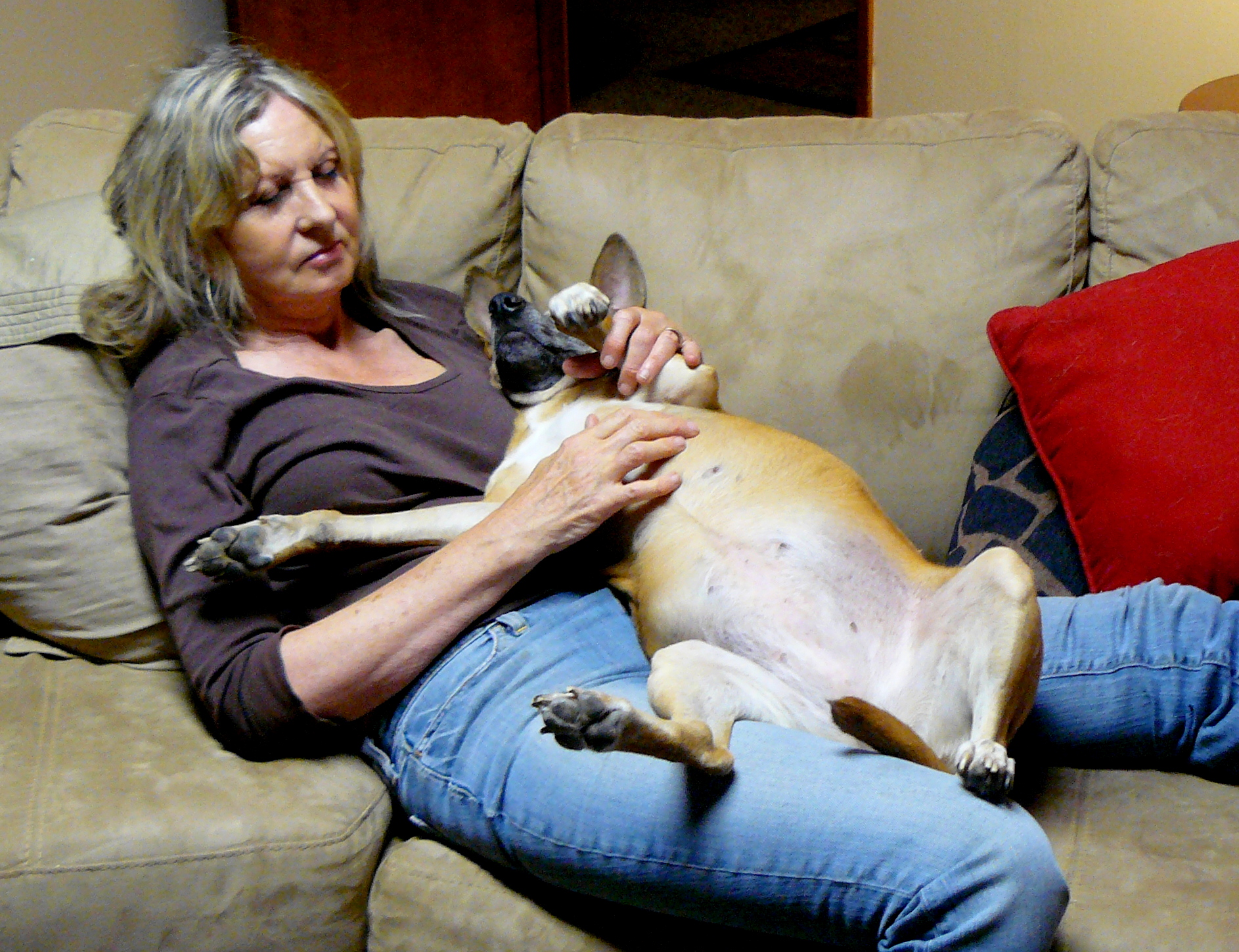
OK, sufficient for today! Need to find a dog to curl up with.
Damn, Jean’s beaten me to it!

 Learning from Dogs