Tag: San Diego

Light speed

There is more to this topic that many of us do not know.

Photons are massless. They travel at a speed that 99% of us do not really comprehend. But over to Prof. Jarred Roberts who does comprehend the subject.

ooOOoo

Do photons wear out? An astrophysicist explains light’s ability to travel vast cosmic distances without losing energy

Light, whether from a star or your flashlight, travels at 186,000 miles per second. Artur Debat/Moment via Getty Images

Jarred Roberts, University of California, San Diego

My telescope, set up for astrophotography in my light-polluted San Diego backyard, was pointed at a galaxy unfathomably far from Earth. My wife, Cristina, walked up just as the first space photo streamed to my tablet. It sparkled on the screen in front of us.

“That’s the Pinwheel galaxy,” I said. The name is derived from its shape – albeit this pinwheel contains about a trillion stars.

The light from the Pinwheel traveled for 25 million years across the universe – about 150 quintillion miles – to get to my telescope.

My wife wondered: “Doesn’t light get tired during such a long journey?”

Her curiosity triggered a thought-provoking conversation about light. Ultimately, why doesn’t light wear out and lose energy over time?

Let’s talk about light

I am an astrophysicist, and one of the first things I learned in my studies is how light often behaves in ways that defy our intuitions.

A photo of outer space that shows a galaxy shaped like a pinwheel.
The author’s photo of the Pinwheel galaxy. Jarred Roberts

Light is electromagnetic radiation: basically, an electric wave and a magnetic wave coupled together and traveling through space-time. It has no mass. That point is critical because the mass of an object, whether a speck of dust or a spaceship, limits the top speed it can travel through space.

But because light is massless, it’s able to reach the maximum speed limit in a vacuum – about 186,000 miles (300,000 kilometers) per second, or almost 6 trillion miles per year (9.6 trillion kilometers). Nothing traveling through space is faster. To put that into perspective: In the time it takes you to blink your eyes, a particle of light travels around the circumference of the Earth more than twice.

As incredibly fast as that is, space is incredibly spread out. Light from the Sun, which is 93 million miles (about 150 million kilometers) from Earth, takes just over eight minutes to reach us. In other words, the sunlight you see is eight minutes old.

Alpha Centauri, the nearest star to us after the Sun, is 26 trillion miles away (about 41 trillion kilometers). So by the time you see it in the night sky, its light is just over four years old. Or, as astronomers say, it’s four light years away. Imagine – a trip around the world at the speed of light.

With those enormous distances in mind, consider Cristina’s question: How can light travel across the universe and not slowly lose energy?

Actually, some light does lose energy. This happens when it bounces off something, such as interstellar dust, and is scattered about.

But most light just goes and goes, without colliding with anything. This is almost always the case because space is mostly empty – nothingness. So there’s nothing in the way.

When light travels unimpeded, it loses no energy. It can maintain that 186,000-mile-per-second speed forever.

It’s about time

Here’s another concept: Picture yourself as an astronaut on board the International Space Station. You’re orbiting at 17,000 miles (about 27,000 kilometers) per hour. Compared with someone on Earth, your wristwatch will tick 0.01 seconds slower over one year.

That’s an example of time dilation – time moving at different speeds under different conditions. If you’re moving really fast, or close to a large gravitational field, your clock will tick more slowly than someone moving slower than you, or who is further from a large gravitational field. To say it succinctly, time is relative.

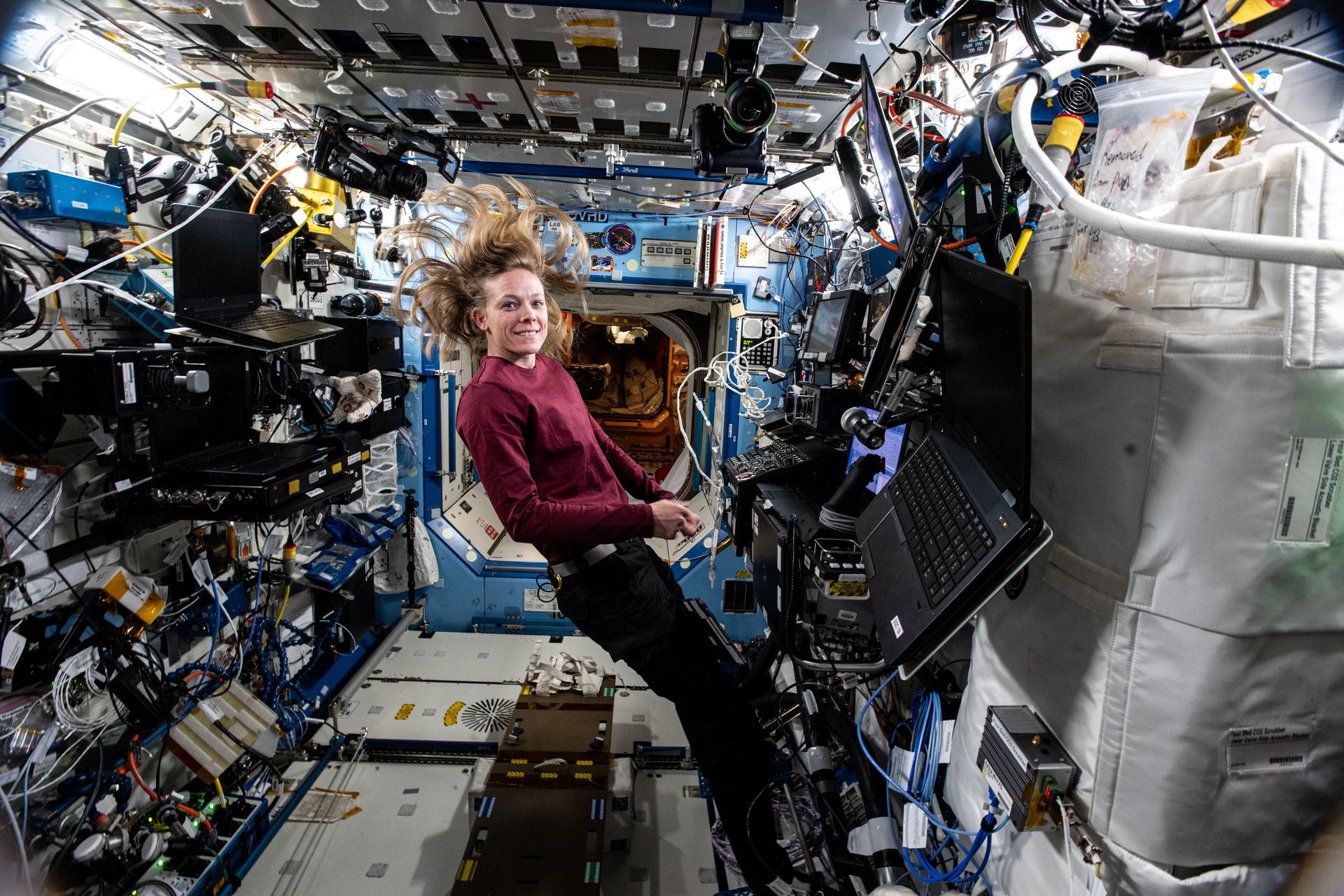
An astronaut floats weightless aboard the International Space Station.
Even astronauts aboard the International Space Station experience time dilation, although the effect is extremely small. NASA

Now consider that light is inextricably connected to time. Picture sitting on a photon, a fundamental particle of light; here, you’d experience maximum time dilation. Everyone on Earth would clock you at the speed of light, but from your reference frame, time would completely stop.

That’s because the “clocks” measuring time are in two different places going vastly different speeds: the photon moving at the speed of light, and the comparatively slowpoke speed of Earth going around the Sun.

What’s more, when you’re traveling at or close to the speed of light, the distance between where you are and where you’re going gets shorter. That is, space itself becomes more compact in the direction of motion – so the faster you can go, the shorter your journey has to be. In other words, for the photon, space gets squished.

Which brings us back to my picture of the Pinwheel galaxy. From the photon’s perspective, a star within the galaxy emitted it, and then a single pixel in my backyard camera absorbed it, at exactly the same time. Because space is squished, to the photon the journey was infinitely fast and infinitely short, a tiny fraction of a second.

But from our perspective on Earth, the photon left the galaxy 25 million years ago and traveled 25 million light years across space until it landed on my tablet in my backyard.

And there, on a cool spring night, its stunning image inspired a delightful conversation between a nerdy scientist and his curious wife.

Jarred Roberts, Project Scientist, University of California, San Diego

This article is republished from The Conversation under a Creative Commons license. Read the original article.

ooOOoo

This remark jumped out at me when I first read the article: ‘In the time it takes you to blink your eyes, a particle of light travels around the circumference of the Earth more than twice.’

The following photograph is the Milky Way.

The image is from Geography Realm.

Despite the fact that the article is far from me understanding it, it doesn’t reduce the wonder and the awe for me of outer space.

Another life-saving dog!

There’s no end to how dogs protect us!

Last Tuesday, I published a guest post that had been sent to me by my sister, Eleanor, who lives in Johannesburg in South Africa.

Then a day later I read on the Care2 site about a therapy dog that alerted a group of schoolchildren to potentially very unsafe drinking water.  I must share that with you as well.

ooOOoo

Therapy Dog Helps Alert School District to Lead in Water

A therapy dog belonging to a San Diego elementary school teacher proved to be a potential lifesaver – but not for what you might think.

When the teacher filled his bowl with water from the classroom sink on Jan. 26, the dog refused to drink it. The teacher took a good look at the water in his bowl and noticed a sheen on its surface. Concerned, she notified school officials.

After testing samples from around Emerson-Bandini Elementary and the San Diego Co-Operative Charter School 2, which share a campus, results showed the water was contaminated with lead, exceeding the allowable level in the state of California.

School officials contacted the City of San Diego Public Utilities Department, which supplies the water. Because that therapy dog that refused to drink it, the city is now testing the water at each of the school district’s 187 campuses.

The tests, however, won’t begin until April 4, San Diego Unified Chief Operations Officer Drew Rowlands announced last week. In the meantime, students are getting bottled drinking water.

A notice sent to the schools’ staff and parents said the water is safe for handwashing. Since cafeteria meals aren’t prepared on campus, they’re not affected by the contaminants in the water, according to the notice.

The testing of the water, which is expected to be completed by the end of the school year in June, will take place early in the morning, before school starts. At each campus, up to five samples will be taken from water fountains and cafeterias where food is prepared. The test results will be posted online.

If excessive lead is discovered, the contamination source will be determined and school district staff will take “appropriate action on a case-by-case basis,” said San Diego Unified Chief Operations Officer Drew Rowlands. Those appropriate actions could include replacing plumbing fixtures and making repairs.

Making Drinking Water Safe for Schoolchildren

Coincidentally, just one month before the therapy dog refused to drink the San Diego school’s water, the State Water Resources Control Board (SWRCB) Division of Drinking Water launched a program that requires water providers to test for lead in the drinking water at all K-12 schools in California.

“Recent events in the United States have shown that lead in drinking water remains an ongoing public health concern, particularly for children,” the SWRCB stated on its website.

How does lead end up in school water fountains? Although lead rarely occurs naturally in California’s drinking water sources, it can contaminate water that flows through old plumbing fixtures or the solder connecting them. It’s less likely that the water came from a contaminated source, as was the case in Flint, Mich.

Children younger than six are especially susceptible to the effects of lead poisoning. According to the Centers for Disease Control (CDC), about half a million children between the ages of one and five have blood lead levels above 5 micrograms per deciliter, the level at which the CDC recommends the initiation of public health actions – although no “safe” blood lead level in children has been identified.

A problem with lead poisoning is that there are no obvious symptoms. By the time children show the signs, such as weight loss, irritability and lack of appetite, dangerous amounts of lead may have accumulated in their bodies.

This is a compelling reason for more states to follow California’s lead and require water to be tested in schools. Thanks to a teacher’s therapy dog, students at two San Diego schools got a jump start on having safer water available.

Photo credit: Irisdepiris

ooOOoo

 There is no end to the way that dogs love us, protect us and make us better persons!

Our incredible dogs.

Dog lost at sea is found – five weeks later!

This story has been widely reported and for good reason. The source of my post is here.

ooOOoo

Dog presumed lost at sea shows up 5 weeks later, wagging her tail

Mary Jo DiLonardo March 17, 2016

Luna likely survived on dead fish and mice, as well as fresh water that was shipped in for Navy employees. (Photo: U.S. Navy - Naval Base Coronado)
Luna likely survived on dead fish and mice, as well as fresh water that was shipped in for Navy employees. (Photo: U.S. Navy – Naval Base Coronado)

When Nick Haworth’s dog, Luna, fell off his fishing boat a couple miles off the shore of San Clemente Island in the Pacific Ocean, he thought there was a good chance she’d swim for land.

“Nick was pretty certain she would make for shore because she was a very strong swimmer,” says Sandy DeMunnik, public affairs officer for the U.S. Navy’s Naval Base Coronado, which includes the island. “He asked if he could have permission to come ashore to get her.”

San Clemente Island is a weapons training facility where they work with bombs and offshore bombardment, so they had to shut off one of the artillery ranges to look for the 1 1/2-year-old German shepherd/Husky mix. The staff helped Haworth search for her to no avail. He stayed in the area for two more days and couldn’t find her.

“After about a week, it was presumed she had never even made it to shore because they hadn’t seen a sign of her,” says DeMunnik. “They presumed she was lost at sea.”

Fast forward five weeks to March 15 when Navy staff arrived on the island for work.

“She was sitting on the side of the road just wagging her tail,” says DeMunnik. The staff members knew immediately that this was the dog they had been searching for. They opened their door, whistled and Luna jumped right in the truck.

After more than a month of being gone, Luna takes a well-deserved nap. (Photo: U.S. Navy - Naval Base Coronado)
After more than a month of being gone, Luna takes a well-deserved nap. (Photo: U.S. Navy – Naval Base Coronado)

They immediately called Haworth and let him know the happy news. Luna was examined by the island’s wildlife biologist, who said she likely wasn’t seen for five weeks because her tan-and-black coloring let her blend in with the island’s landscape. Miraculously, except for having lost a little weight, she was OK.

“Amazingly for being lost for five weeks in a very dangerous and treacherous environment, she was fine,” says DeMunnik. “During that time, there was bombardment training, weapons training … there was a lot of very loud, very dangerous training going on, and we had some very severe El Nino storms.”

Those storms probably helped keep the dog alive because fresh water was brought to the island by barge for the staff during the storm. They determined that Luna had survived by eating dead fish and rodents.

Because her owner, a commercial fisherman and student at San Diego State University, was away on a fishing trip, he sent his best friend, Conner Lamb, to meet Luna’s plane. When the plane doors opened, she leapt into Lamb’s arms and he fought back tears. On her first night home, he made her a steak for dinner.

The commanding officer of the base sent Luna home with a keepsake of her time spent on the island: her own set of military dog tags. They are engraved with her name, the dates she was missing, and “Keep the faith.”

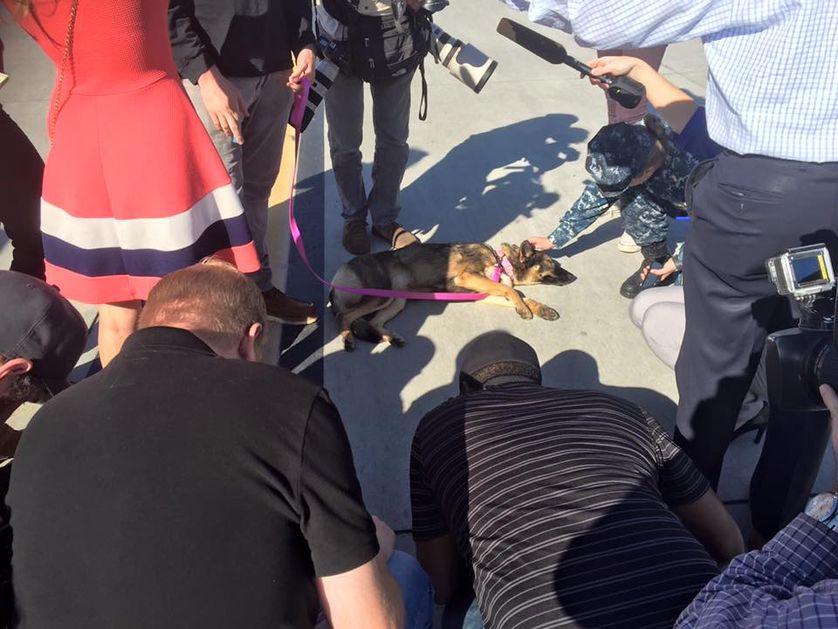
Luna is greeting by paparazzi — but it's clear that's she's had enough media coverage for the day. (Photo: U.S. Navy - Naval Base Coronado)
Luna is greeting by paparazzi — but it’s clear that’s she’s had enough media coverage for the day. (Photo: U.S. Navy – Naval Base Coronado)

ooOOoo

Two more pictures to reinforce this wonderful story.

The first from US News:

Luna was found Tuesday on San Clemente Island, a Navy-owned training base 70 miles off San Diego.

And the second from Eye Witness News on abc:

Nick Hawarth and Lucky Luna.
Nick Haworth and Lucky Luna.

Well done everyone!


Playing in the sand!

Now this is what I call making sand-castles!

Apologies to the person that sent me the link to: PHOTOS OF WORLD-CLASS SAND SCULPTORS AT WORK!  Their name has slipped my mind.

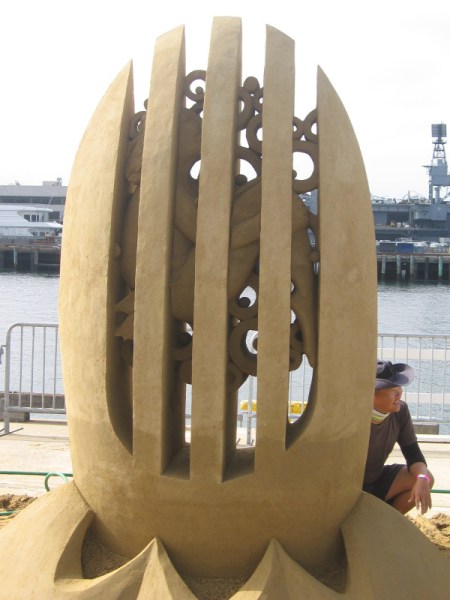
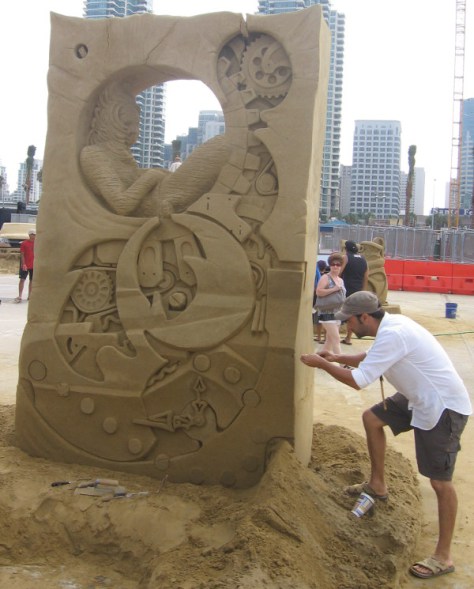
The event was the 2014 US Sand Sculpting Challenge and 3D Art Exposition held recently in San Diego, California.

In any case, I wasn’t going to reblog the whole article because it’s much, much better if you go and read about the talented artists directly. Artists who produced this:

sand1

and this:

sand2

not overlooking this:

sand4

or this:

sand3

No, you absolutely have to drop into this place and read about these most talented artists.

Now how far is it to the nearest beach? …..

Must start practising …. wonder how long it would take me to build this:

sand5