Tag: Roger Penrose

Dark Matter

Not really understanding but knowing it’s important!

I recently read a glowing review of the latest book by Sir Roger Penrose, the eminent mathematical physicist, called The Road To Reality. Having previously read his book The Emperors’ New Mind and just understanding it, I thought
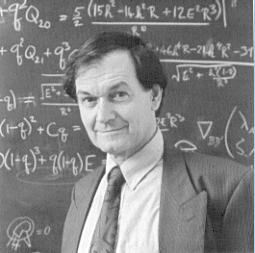
Roger Penrose

his next one would be a welcome companion for long winter evenings.  Wrong!

I managed to the bottom of the third page of the preface before “According to the mathematician’s “equivalence class” notion …..” had me grasping for meaning.  Well over a 1,000 pages of content was destined to gather dust on the bookshelf.

But wrong again!

The idea of matter out there in the universe that is essential to the universe as we know it but is unseen has been sufficiently fascinating for the popular media to refer to it from time to time.  Most people are familiar with the term even if like me don’t really have a clue as to what dark matter is all about.

So a recent press release in a popular English newspaper suggesting that dark matter has been ‘discovered’, if discover is the appropriate term, had me reaching out for Penrose’s book again.  There under the chapter headed Speculative theories of the early universe was, on page 773, a few sentences that almost made sense.  Let me quote them:

For many years, it had become clear that the dynamics of stars within galaxies does not make sense, according to standard theory unless there is a good deal of more material in the neighbourhood of the galaxy than is directly seen in stars.  A similar comment applies to the dynamics of individual galaxies within clusters.  Overall, there seems to be about 10 times more matter than is perceived in ordinary baryonic form.  This is the mysterious dark matter whose actual nature is still not agreed upon by astronomers, and which may even be of some material different from any that is definitely known to particle physicists – though there is much speculation about this at the present time.

Read more about Dark Matter

Black holes, colliders and paradoxes

This is a very strange world that we live in.

It would be fair to say that my knowledge about what I am writing in this Post is minimal to the point of total ignorance.  So why open my mouth and prove it!  Because the conquest of fundamental questions about our world is not only an example of mankind at its greatest but also something of broad appeal.

That is proved by the continuing popularity of the BBC Television Series – Horizon.  In that series there have recently been two fascinating programmes: Who’s afraid of a big Black Hole? and How long is a piece of string? (Readers outside the UK will not be able to view these programmes.)

Here are the programme summaries:

Black holes are one of the most destructive forces in the universe, capable of tearing a planet apart and swallowing an entire star. Yet scientists now believe they could hold the key to answering the ultimate question – what was there before the Big Bang?

The trouble is that researching them is next to impossible. Black holes are by definition invisible and there’s no scientific theory able to explain them. Despite these obvious obstacles, Horizon meets the astronomers attempting to image a black hole for the very first time and the theoretical physicists getting ever closer to unlocking their mysteries. It’s a story that takes us into the heart of a black hole and to the very edge of what we think we know about the universe.

and

Alan Davies attempts to answer the proverbial question: how long is a piece of string? But what appears to be a simple task soon turns into a mind-bending voyage of discovery where nothing is as it seems.

An encounter with leading mathematician Marcus du Sautoy reveals that Alan’s short length of string may in fact be infinitely long. When Alan attempts to measure his string at the atomic scale, events take an even stranger turn. Not only do objects appear in many places at once, but reality itself seems to be an illusion.

Ultimately, Alan finds that measuring his piece of string could – in theory at least – create a black hole, bringing about the end of the world.

Read more of this strange world