Tag: Rob Hopkins

The story of transition, part three

Final four short films about Transition.

PLEASE read the closing comment by Rob Hopkins!

A series of 10 delightful short films, courtesy of Transition Culture – For the introduction and the first three films, click here, for the next three click here.

Film Seven – Transition Town Totnes’s Transition Streets Origin: Transition Town Totnes

In December 2009, Transition Town Totnes, the UK’s first Transition initiative, was chosen as one of 20 community  groups in England and Wales to win the ‘Low Carbon Communities Challenge’. Its project, ‘Transition Streets’, was awarded £625,000. In the last 18 months, nearly 500 households have participated in Transition Streets, each, on average, cutting their carbon emissions by 1.5 tonnes.

About a third of those have gone on to install solar photovoltaic systems. However, the main benefits that people who have participated talk about are the social connections they have made and how they now feel so much more a part of their community. It has also acted as a platform for all kinds of other initiatives as neighbours start to get a taste for working together.

Film Eight – A Small Pennant Flag Origin: Transition Town Monteveglio (Bologna, Italy)

Transition Town Monteveglio (TTM) was the first Italian Transition initiative. In 2009 its local Comune (local Council) passed an amazing resolution that offers a stateof-the-art taste of what it looks like when a council really ‘gets’ peak oil and climate change, stating: “… a view of the future (the depletion of energy resources and the significance of a limit to economic development), methods (bottom-up community participation), objectives (to make our community more resilient, i.e. better prepared to face a low energy future) and the optimistic approach (although the times are hard, changes to come will include great opportunities to improve the whole community’s quality of life)”.

It has led to all kinds of initiatives and projects, including a local currency and renewable energy installations. Our object here is the Comune’s official pennant.

Film Nine – A Small Bag of Topsoil Origin: Transition Norwich’s food initiatives

It is one thing to start local food projects, but quite another to think strategically about how those projects sit in the larger context of the intentional relocalisation of the area. Transition Norwich, together with East Anglia Food Link, produced a study called ‘Can Norwich Feed Itself?’ which worked out that it could, albeit with a simpler diet, but that it would need certain new infrastructures put in place. This included a new mill to enable locally produced grains to be milled, two CSA farms (hence our object, a soil sample from their first CSA site), community gardens and research into varieties of beans and oats that will grow well in the area.

A successful application to the Local Food Fund enabled these to become a reality. It is a fascinating example of why we need to think strategically about the localisation of food. As Tully Wakeman, one of the co-ordinators, told me: “A trap a lot of NGOs fall into is over-thinking about vegetables (yet) only one tenth of what we consume, in calorific terms, comes from fruit and vegetables… where is the other 90% going to come from? Growing vegetables in gardens, allotments, community gardens and so on offers a degree of food security and can happen relatively rapidly.

However the other 90% requires the rebuilding of the infrastructure required for growing, processing, cleaning, storing, milling and distributing grains and cereals, and that takes longer and requires more planning”.

Film Ten – Beer, A Bottle of Sunshine Ale Origin: The Lewes Community Power Station

The Ouse Valley Energy Service Company (OVESCO) is one of the offshoots of Transition Lewes focused on the installation of renewables in and around the town as well as promoting energy conservation and local economic resilience. In 2011 it took on its most exciting and ambitious project to date installing a 98kW solar photovoltaic array on the roof of local brewery, Harveys. This will turn the building into one of the first community-owned solar power stations in the country.

The 544 photovoltaic (PV) panels will generate 93,000kWh of green electricity each year – enough to save more than 40 tonnes of CO2 annually.

A community share launch event took place in April 2011 attended by 300 people. Within five weeks the target of £307,000 had been reached. Money invested will be repaid in full at the end of the 25 year scheme, or earlier at the request of the investor and subject to conditions. While the investment is held a dividend will be paid after the first year which is expected to be around 4%.

Our object is a bottle of ‘Sunshine Ale’, a special commemorative beer brewed to celebrate the launch of the scheme. Very nice it is too.

A final few words from Rob Hopkins.

Whittling down to these 10 objects has been very difficult but I hope what you have gained is a sense of something infectious, reaching beyond the idea of small individual initiatives, and arguing that localisation is the best way for the places in which we live to return to health. Various learned writers and academics have tried to encapsulate what Transition is, but I still think the best description of its spirit comes from Tove Jansson in Comet in Moominland in 1946, who wrote: “It was a funny little path, winding here and there, dashing off  in different directions, and sometimes even tying a knot in itself from sheer joy. (You don’t get tired of a path like that, and I’m not sure that it doesn’t get you home quicker in the end).”

Rob Hopkins is the co-founder of Transition Town Totnes and Transition Network and blogs at www.transitionculture.org

The story of transition, part one

A fun collection of short films about Transition.

I shall avoid the temptation of writing about our need for transition, well for now that is, and just go straight to this recent article that appeared on the Transition Culture website.

As part of the promotion of ‘The Transition Companion‘, Emilio Mula made these 10 short films of different stories from the book.  The recent BBC series ‘A History of the World in 100 Objects’ beautifully told the story of the evolution of human history illustrated by 100 objects chosen from the British Museum’s collection. We used a similar approach to tell the story of the emerging and unfolding Transition movement, which in its short life has spread to 35 countries around the world from its humble beginnings in Kinsale, Ireland.  You can read more about these stories here, and here are the films…

So the first three of the films today and some more tomorrow.

Film One – A Really Quite Horrible Jumper  Origin: Transition Taunton Deane

Between July and September 2009, Transition Taunton Deane ran a series of workshops with their local council looking at peak oil, climate change and resilience. What was extraordinary was that every one of the Council’s 375 employees attended, from CEO to car park attendants.

This was written up as ‘Towards a resilient Taunton Deane’ and the whole process deeply impacted the Council. They set up a Green Champions team, every department now has an energy charter, it has cut its electricity use by 14%, set up a car club and is now installing PV and insulating its buildings. After the initial workshop, a planning officer and a car park attendant got together and planted a new community orchard on public land.

Chrissie Godfrey from TTD told me “our main role is to keep telling them how brilliant they are… it just goes to show how powerful a catalyst Transitioners, in the right place at the right time, can be”.

The jumper? In 2010, the Council held a ‘Turn the Heat Down’ day where the heating in their offices was turned down and staff were invited to wear the most revolting jumper they could find to work, and prizes were awarded for the most hideous.

Film Two – Bertie & Gertie Origin: Transition Town Tooting’s Trashcatchers’ Carnival

In July 2010, Tooting was the setting for the Trashcatchers’ Carnival, the first Transition project to get Arts Council funding. Together with Project Phakama and Emergency Exit Arts, Transition Town Tooting (TTT) created a street carnival celebrating the Earth using entirely recycled materials. Over 800 people took part, including local schools, mosques and temples, and over one million plastic bottles and shopping bags, half a million crisp packets, half a ton of renewable willow and half a ton of materials were collected over a six month period to create this extravaganza, which included several structures over 6m (20ft) high.

On the day, thousands turned out, the sun shone, local restaurants fed over 1,000 people for free at the end of the event, and the community was left with the feeling of ‘if we can do that we can do anything’.

Bertie and Gertie were made entirely from recycled plastic bags by members of Tooting Bec Lido as part of their float, and represent the real Bertie and Gertie, who are often to be found swimming in the Lido.

Film Three – A Gas Lamp Bulb Origin: Transition Malvern Hills’ ‘Gasketeers’

Malvern is home to 109 Victorian gas lamps, which provided C.S. Lewis with the inspiration for the lamp that first greets Lucy in The Lion, the Witch and the Wardrobe. They are listed, part of the identity of the place, but are also hugely inefficient. At the moment each lamp costs £130 to maintain per year and £450 to maintain.  They don’t even create that much light, and as local council budgets tighten, there is a risk that they will be turned off altogether.

Enter Transition Malvern Hills’ energy group, known locally as the ‘Gasketeers’. The group brought together experts in gas lighting from the local area and also from further afield. They have now started making the lamps over; their changes will mean that each lamp will now cost just £14 a year in gas and £40 a year in maintenance, reducing carbon emissions by 84%. They will also be 10 times brighter, and produce no light pollution at all. They are maintained by Lynn, the UK’s first qualified female gas lamp technician, who performs all her maintenance with a bicycle and trailer.

The Versatile Blogger Award

My rather slow response to my Versatile Blogger award!

Last Friday morning, the 16th, I turned on my PC to discover that lovely Kathryn Johnston of 4amWriter had nominated Learning from Dogs for the Versatile Blogger Award.  I was blown away especially as since then the connections I have made with other writers have been wonderful.

However, a more prompt acknowledgement on LfD seems to have escaped me until today.  I quickly learnt that there is a proper protocol associated with the response to the award.

  1. Thank the award-giver and link back to them in your post.
  2. Share 7 things about yourself.
  3. Pass this award along to 15 blogs you enjoy reading.
  4. Contact your chosen bloggers to let them know about the award.

So here goes!

Award logo

So first, a very big thank you to Kathryn of 4amWriter for including me in her list.  As she said on her post, “This title says it all! If you love dogs, this is a must-visit!”  That’s generous of Kathryn.  Dogs are a very powerful reminder of an uncomplicated way to live, as described on the Home Page.  The Vision behind the Blog is:

  • Our children require a world that understands the importance of faith, integrity and honesty
  • Learning from Dogs will  serve as a reminder of the values of life and the power of unconditional love – as so many, many dogs prove each and every day
  • Constantly trying to get to the truth …
  • The power of greater self-awareness and faith …

Seven things about me!

H’mm, what to say.

  1. Born in London 6 months before the end of WWII,
  2. Been a business-to-business salesman most of my life,
  3. Started my own business in 1978 and remained in ‘self-employment’ until quite recently,
  4. Lived on my own boat, based in Larnaca, Cyprus, for 5 years,
  5. A keen glider pilot for many years at Rattlesden Gliding Club in Suffolk, later a private pilot,
  6. Always wanted to write,
  7. And, finally, happier than I have ever been being married to Jean, having met in Mexico in 2007, moving out there with Pharaoh, my GSD, in 2008 and subsequently arriving in Payson, Arizona in 2010 with 11 dogs and 6 cats!

So here are the 16 Blogs (I use that description loosely) that I wish to pass this award to:

  • Yves Smith of Naked Capitalism.  How Yves finds the time to produce the huge volume of articles and website links every day is beyond me.
  • James Kwak and Simon Johnson of Baseline Scenario.  James and Simon were, for me, an early source of openness about the key issues affecting the global economy that slammed into our collective faces in 2008.
  • Patrice Ayme of the Blog of his own name.  Patrice’s sub-heading on his Blog reads, “Intelligence at the core of humanism.”  Again, a prolific writer with a huge intellect that he puts to wonderful use.  Just pick anything that he has written to see that proved in spades.
  • Patrick Smith of Patrick Smith Photography. Just breath-taking photographs.  Do visit his website.
  • Bill McKibben of 350.org.  The headline on the website says, “We’re building a global movement to solve the climate crisis.”  Say no more!
  • Michelle of Dog Kisses’s blog.  Wonderful blog – just go there and enjoy it.
  • Sue of Sue Dreamwalker. Again, just a wonderful Blog – do please visit.
  • Vlatko, the owner of Top Documentary Films.  We do not subscribe to any television channels at home so Vlatko’s resource is so valuable for us.  Huge selection of free documentary films to watch.
  • Deanna Raeke and Andrea Rosebrock of the Blog For The Love of a Dog.  Very active in fighting all corners on behalf of man’s oldest companion.
  • Rob Hopkins and his team at Transition Network.  Rob is one of the leading voices for changing to a sustainable relationship with this planet.  He is based in Totnes, Devon, my local town for many years when I lived in the village of Harberton.  His books on Transition are masterpieces.
  • Victoria Brown, Daniel Honan and team at Big Think.  As their headline says, “A forum where top experts explore the big ideas and core skills defining the 21st century.”  Fabulous resource.
  • All the Directors and team at Sustainable Arizona.  As is described on their site, Sustainable Arizona is about, “Our nonprofit organization is made up of volunteers and professionals committed to making sustainable development possible. We accomplish this by encouraging businesses that add true value to our communities while preserving the environment.
  • Anthony Watts of Watt’s Up With That. With over 9,000 followers and over 98 million viewers this very reasonably can be regarded as the world’s most viewed climate website.  Anthony’s 3 million monthly visitors puts my 40,000 into perspective!
  • The whole team at the US-based National Wildlife Federation.  Their MissionAs America’s largest conservation organization, National Wildlife Federation works with more than 4 million members, partners and supporters in communities across the country to inspire Americans to protect wildlife for our children’s future!
  • Peter Russell of Spirit of Now.  Peter writes on his Blogsite, “There are many observations I make in daily life—some profound, some mundane—mostly concerning the natural world around, or the nature of the inner world of mind. Some incline us to wonder and awe. Others make us think, and question our assumptions.”  Never before have we needed so much to think about the way we think!
  • Nakibul Hoq, blogging from Bangladesh in the city of Dhaka under the Blog name of Freedom to Survive.

I shall be passing on the ‘award’ to all bloggers today.

Let me close again by saying such a big thank you to Kathryn of 4amWriter and, from that, how quickly I came across Limebird Writers who, I know, will be a great source of support as I face 2012 and ‘the novel’!

I must down to the seas again

History repeating itself in terms of the commercial sailing ship.

Tea clipper 'Cutty Sark'

Most Brits have heard of the tea clipper Cutty Sark.  As the Cutty Sark website explains,

Cutty Sark has travelled across the world, sailing under both the Red Ensign and the Portuguese flag, visiting every major port in the world through the course of her working life. In admiration of her beauty and in recognition of her fame, she was preserved for the nation by Captain Wilfred Dowman in 1922.

Since then, the old clipper has been berthed in Falmouth and Greenhithe, finally arriving at her current resting place in Greenwich in 1954.

And elsewhere on that website,

Cutty Sark matters because:
  • She is the epitome of the great age of sail.
  • She is the only surviving extreme clipper, and the only tea clipper still in existence.
  • Most of her hull fabric survives from her original construction and she is the best example of a merchant composite construction vessel.
  • She has captured the imagination of millions of people, 15 million of whom have come on board to learn the stories she has to tell.
  • She was preserved in Greenwich partly as a memorial to the men of the merchant navy, particularly those who lost their lives in both world wars.
  • She is one of the great sights of London.

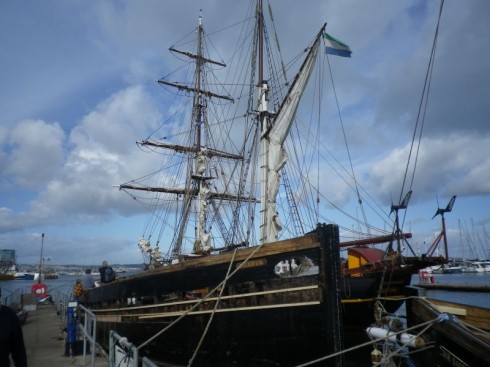
I mention the Cutty Sark because it seems a historic connection with something very relevant to today’s world that was the subject of a recent item on Rob Hopkin’s Transition Culture blogsite.  In it Rob presents his first podcast, the topic being the sailing ship Tres Hombres, that is being used for commercial sea transport.  The link to the Transition Culture story is here, and the podcast follows, (just click on the link to listen to the fascinating 14 minutes audio story about the ship Tres Hombres.)

Tres Hombres podcastfinal

Sailing ship Tres Hombres

The first Transition podcast! A visit to the Tres Hombres, tasting a revolution in shipping

Last week I did a course with the Media Trust on how to make podcasts (highly recommended).  So, here, with some fanfare, is the first ‘Transition podcast’, I hope you like it.  If so, do embed it in other places.  It means I spent the time I would spend writing editing pieces of audio.  Let me know what you think.  So, the podcast is about a fascinating morning I spent visiting the sailing ship Tres Hombres which visited Brixham earlier this week.  It explores the potential of sail-powered shipping as the price of oil rises and the economy tightens.  It’s an exciting story.

Finally, let me close with a very well-known poem about sailing the big ships.

“Sea-Fever”

I must down to the seas again, to the lonely sea and the sky,
And all I ask is a tall ship and a star to steer her by,
And the wheel’s kick and the wind’s song and the white sail’s shaking,
And a grey mist on the sea’s face, and a grey dawn breaking.

I must down to the seas again, for the call of the running tide
Is a wild call and a clear call that may not be denied;
And all I ask is a windy day with the white clouds flying,
And the flung spray and the blown spume, and the sea-gulls crying.

I must down to the seas again, to the vagrant gypsy life,
To the gull’s way and the whale’s way where the wind’s like a whetted knife;
And all I ask is a merry yarn from a laughing fellow-rover
And quiet sleep and a sweet dream when the long trick’s over.

By John Masefield (1878-1967).
(English Poet Laureate, 1930-1967.)

Food, growing your own!

The powerful story about how food could change

Yesterday, I referred to a piece on the Chris Martenson blog about Joel Salatin, proprietor of Polyface Farms.  I want to stay with the theme of food, and the growing thereof, as this is yet another critically important aspect of how we all have to change our attitudes and behaviours in the face of a growing ecological disaster.

I’m using a recent item presented by Rob Hopkins of Transition UK fame.  The link to the full piece is here but I am presenting some extracts and further links in this article.

A while ago I was sent a book called ‘SPIN farming basics: how to grow commercially on under an acre’ by Wally Satzewich and Roxanne Christensen.  The book describes itself as a “step-by-step learning guide to the sub-acre production system that makes it possible to gross $50,000+ from a half-acre”.  SPIN, which stands for ‘SmallPlot Intensive’ (their website is here), has the feel of an important, big, and timely idea, and it is one that fits into Transition beautifully.  So what is it?

At the moment, when contemplating urban food production, the models that are used tend to be allotments, community gardens, planting productive trees or forest gardens, private gardens or even, perhaps, rooftop gardens.  Commercial urban market gardens tend to be thought of as needing to be on a larger scale and requiring significant infrastructure.  SPIN is based on the idea of ‘patchwork farming’, of seeing unused areas of urban land as having the potential to be worked commercially, viewed through the eyes of a commercial grower rather than someone growing for a hobby.  This is a profound shift of emphasis and one that I find very exciting.  Here is a short talk by SPIN farmer Paula Sobie of City Harvest which gives her take on what SPIN farming is:

Let me quote how that article from Rob concludes,

‘SPIN farming basics’ is just one of the books that SPIN produce.  It isn’t a step-by-step growing guide, rather it is an overview book on how to run such an operation.  I have no way of gauging whether their figures are accurate and how they might translate into the UK context.  I’m also not sure what they do about slugs.   There is also, I guess, a distant danger that should this really take off it might edge out more egalitarian forms of urban land use, such as allotments and community gardens.  But even if they are only half right  about their potential yields, it is still an impressive approach, and it calls for a powerful shift in focus for urban growers.  In the wake of the recent riots in a number of English cities, I am struck by the potential of this approach to shift thinking about how to create viable social enterprises and a sense of purpose for young people.  It has certainly got my brain ticking over pretty rapidly.

As the authors put it, “once you put on SPIN glasses, you start seeing dollar signs all over vacant and underutilised patches of land”.  As economic contraction worsens, and peak oil starts to bite, this form of land use will become the norm, as it has done every time in history that societies have faced similar sets of circumstances.  The obstacle to getting started has always been how to make this stuff viable.  That obstacle, thanks to the work of the SPIN folks, would appear to no longer exist, or at least to be greatly diminished.   If you don’t do it someone else will, and they likely won’t do it in a way rooted in social justice, community benefit, food security and Transition.  This is an important window in time to get moving on this.

This is a revolutionary text, an incendiary call to rethink urban land use in a way that ticks everyone’s boxes.  I can’t recommend it too highly.

It is rather hard to tell from the SPIN website which of the books they offer is this one… so for the last time ever, here is a link to the book on Amazon…. it is quite pricey, but one to get and share with as many people as you can…

The SPIN Farming website is chock full of fantastic ideas, advice and guidance.  Website is here. From which you will understand,

THINKING OF FARMING? THINK AGAIN.

There’s a new way to farm. It’s called SPIN, and it is causing people to re-think not only how to farm, but what it means to be a farmer today.

  • Some practice SPIN in their backyards in the city. Others do it on front lawns in the suburbs.
  • Some do it part-time, others full-time.
  • Some are young and just starting out, while others are older and on their third or fourth careers.
  • Some have more money than they know what to do with, and others have less than they need.
  • Some are convinced the world is doomed, while others are trying to save it.

What unites them all is a calling to farm.

If you want to follow your calling, follow the system that shows you how to make money farming.

It’s one of the many beams from that wonderful rainbow just over the horizon!