“The price of greatness is responsibility.”
So said Sir Winston Churchill. It applies equally to the price of power.
There was an essay recently written and published by Hariod Brawn over on her blog Contentedness.net that was incredibly thought-provoking and very beautiful besides. Hariod has given me permission to republish it and it follows shortly.
I have no doubt that Hariod’s essay was, in part, inspired by that terrible photograph that has been circulated and commented upon by thousands around the world.
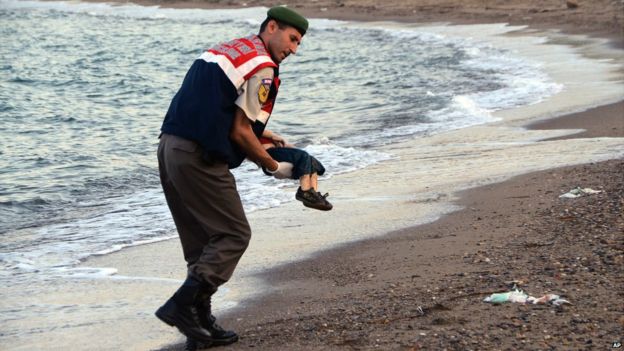
In the words of the BBC, “The pictured boy is reported to be three-year-old Aylan, who drowned along with his five-year-old brother Galip and their mother, Rihan. Their father, Abdullah Kurdi, survived.”
The emotions created by this and other tragic photographs are disturbing, and I am no exception to having those same emotions. But as friend, Chris Snuggs, mentioned in a telephone call between us yesterday morning, what has been happening in Syria is no less terrible, perhaps even more so when one looks at the blood that is, metaphorically, on the hands of a number of western governments. The old saying of reaping what we sow comes to mind.
None of which takes away the intense beauty of Hariod’s essay: Empathetic apes.
ooOOoo
Empathic apes
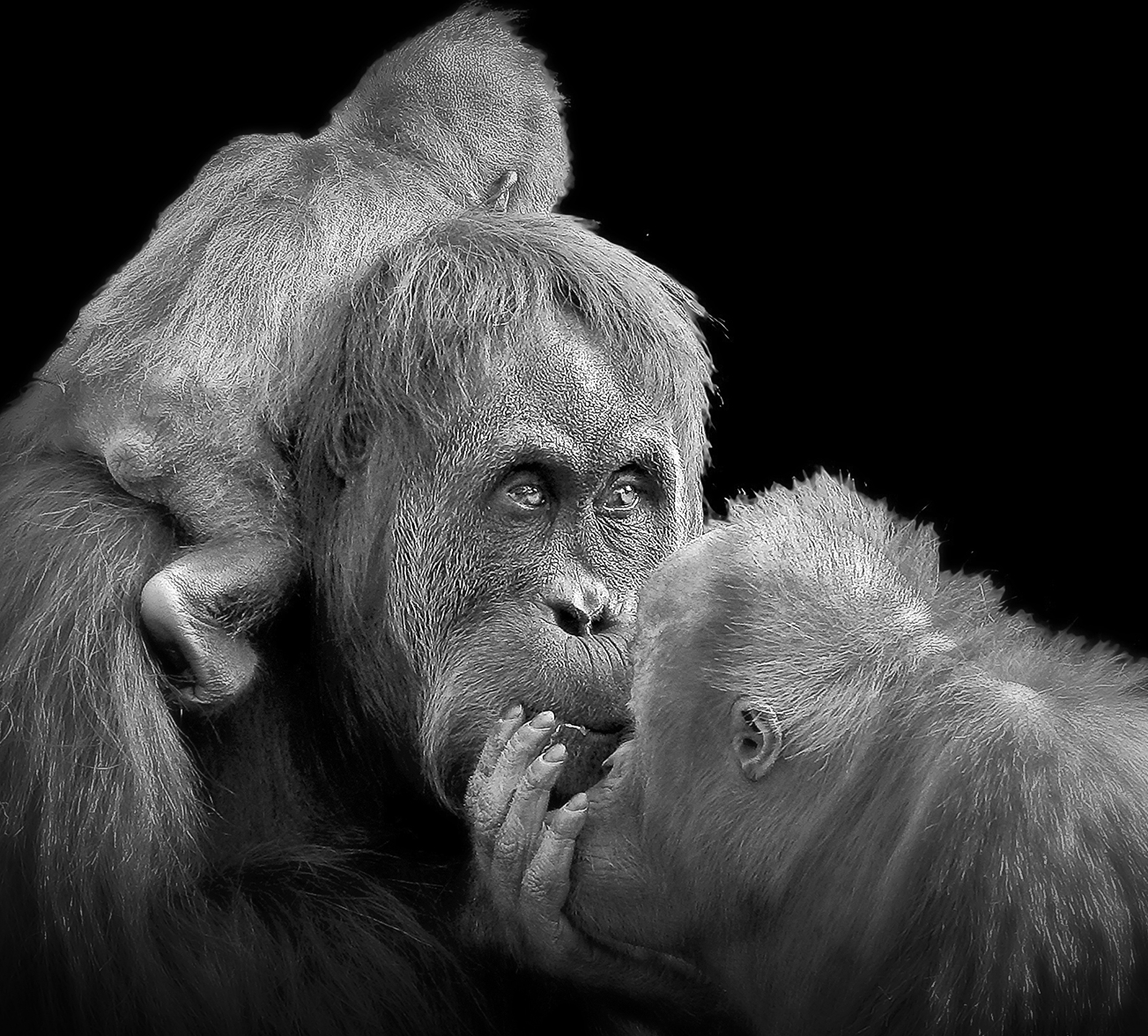
The year is 1955, and far from the nearest village, somewhere within the Northwestern jungle region of Thailand, a 48 year-old Englishman and ordainee to the Buddhist monkhood sits quietly in studious attention. A few feet away, a female ape sits, arms carefully wrapped around some precious possession. The monk first chanced upon her the previous day, and due to the curiosity roused in observing her melancholic countenance, has remained respectfully nearby to her. A trust has developed, the ape sensing the monk’s gentle disposition and harmlessness. He really ought to be making his way to the village for alms, yet somehow senses that he should stay. A silent, palpable communication has developed between the two, and slowly, carefully and deliberately, the ape, her sadness still etched upon her face, finally unfolds her arms and offers a first sight of what she has been protecting. The monk slowly approaches to within a pace or two, sensing the invitation, only to catch sight of her lifeless and terribly deformed baby.
Two empathic apes, ancestrally and psychologically speaking, separated by little more in this moment than a distant, lineage-splitting, speciation event. Opposable thumbs, one hers and one his, in turn chase away a monk’s tear and a delicately mottled butterfly as it alights from the baby’s forehead, though cannot do the same for their conjoined feelings. Eyes meet, evincing as they do a deepening rush of sadness. Nothing can be done – is this what she is thinking in her way? In his unknowing, the saffron-robed wanderer radiates compassion, yet knows he has nothing to do with it; an offering from wisdom, not from the self. All that need be known arrives in the fullest of measures. What use now the venerable elder’s sagacity, his knowledge of emptiness, renunciation, equanimity, the void? She inhabits the void, is the void, her bleak knowing piercing its veils. Without turning, the monk slowly retreats, still reverently holding her gaze alongside a shared understanding. A slight suggestion of a bowing head betokens what passes between them.
It is the ability to empathise which in part distinguishes the psychopathic mind from its otherwise healthy state, and the primary orbit of empathy is that of feeling, not the mere gyrations of intellect. This is why many species of sentience can empathise, and we human animals are but one of them. We may erroneously presume that an ability to reflect upon others’ situations facilitates human empathic capacity; yet the state of those others and their situations need not be known as verbally abstracted objects in the mind – little stories packaged in words. We may just as well occupy others’ frames of reference by intuited means; and vitality, morbidity, distress and joy may all be recognised across species in differing ways; one need not indulge any anthropomorphisation, for clear evidence abounds. What is intuited here, or instinctively known, is the nature of the other’s felt emotional condition; and in this way, 60 years ago, the grieving mother ape and mendicant monk shared that intense experience – a wordless world of deep, primate feeling.

Was the mother ape empathic? Well, she came to appreciate the monk’s amity; she felt able to extend trust; she intuited the monk’s concern for her as well as his desire for understanding as to the reasons for, and significance of, her sadness; and finally, she recognised that the monk would feel something of that sadness in revealing its causes to him. This is all to say that she significantly placed herself within the monk’s frame of reference and innately understood that emotions can be matched in shared experience – the personal does not expire at the boundary of the body. Her empathic appreciation was sophisticated, certainly moreso than any psychopathic human ape. Now, one way to cheat the system is to mimic expressions and gestures, which results in a like proprioceptive sense. This means our feelings echo the other’s, so affecting an emotional contagion of sorts, whether volitionally induced or not. Yet neither jungle dweller did so, their empathic link being forged in mind purely intuitively, and silently.
Empathy subsists in knowledge; it is in part to know the mind of the other, and whilst its currency is both cognitive (knowing) and emotional (feeling) in nature, it is the latter that strengthens the connective link to altruistic and prosocial leanings, as well as ameliorating aggressive traits. Primates’ mirror-neuron systems help forge innate empathic leanings, with research suggesting that empathy evolved in part as a survival mechanism. Right now, tens of thousands of refugees are fleeing war-torn regions of Africa and the Middle East so as to seek sanctuary, and survival, in Europe. A few hours ago, a three year-old Syrian boy, Aylan Kurdi, drowned and was washed up on the shores of the Greek island of Kos. Equally tragically, his five year-old brother met a similar fate. Whilst Europe’s politicians exhibit an ongoing empathy gap, innocent children are dying. We live, not literally, though metaphorically, in a jungle, sharing the empathic faculties of the monk and bereaved mother ape. Are we wise enough to nurture the same?
ooOOoo
We need leaders who understand the integrity that is required from them. We need leaders that accept and understand the responsibilities that they have embraced, indivisible from the power that society has lent to them. We need leaders that understand a different aspect of their power, the power of those unanticipated consequences from their actions.
Until we the people understand that electing leaders who do not embrace integrity then Aylan Kurdi and thousands of others in those ‘hot spots’ around the world will continue dying in vain.
Integrity equates to being truthful, to being honest. It doesn’t mean being right all the time, of course not, but integrity does mean accepting responsibility for all our actions, for feeling remorse and apologising when we make mistakes. Integrity means learning, being reliable, being a builder rather than a destroyer. It means being authentic. That authenticity is precisely and exactly what we see in our dogs.
The starting point for what we must learn from our dogs is integrity.
 Learning from Dogs