Yet more fabulous pictures from Bob D.

oooo

oooo

oooo

oooo

oooo

oooo

oooo

oooo

oooo
If you missed the first set or just fancy looking at the pictures again, then click here.
Dogs are animals of integrity. We have much to learn from them.
Tag: Reflections
Yet more fabulous pictures from Bob D.
oooo
oooo
oooo
oooo
oooo
oooo
oooo
oooo
oooo
If you missed the first set or just fancy looking at the pictures again, then click here.
More wonderful pictures courtesy of Capt. Bob Derham.

oooo

oooo

oooo
oooo

oooo

oooo

oooo

oooo

oooo
Possibly, some of these pictures have appeared previously on Learning from Dogs; but so what! They are so gorgeous they warrant multiple viewings.
A collection of essays and ideas that unite in a common theme.
Back in those times before dogs became the domesticated friends of man, the leader of the pack, the alpha female, had two key pack roles. One of them was having first pick of the males, for mating purposes, and the other was knowing when their territory was no longer conducive to her pack’s interests. When that happened the ‘boss lady’ was the one to signal that the pack had to find another, more beneficial, homestead.
While mankind is in desperate need of learning so many of the qualities of dogs the one example that is beyond us is finding a new homestead. This planet is the only homestead we have.
This basic and fundamental concept seems to be missing from the minds of leaders and power-brokers. Missing big time!
Coincidentally, over recent days there have been three essays from three different authors that scream out the madness, to put it nicely, of the way of our world just now. Let me dip into those three essays.
First, to a recent essay from Tom Engelhardt over at TomDispatch.
American Jihad 2014
The New Fundamentalists
By Tom EngelhardtIn a 1950s civics textbook of mine, I can remember a Martian landing on Main Street, U.S.A., to be instructed in the glories of our political system. You know, our tripartite government, checks and balances, miraculous set of rights, and vibrant democracy. There was, Americans then thought, much to be proud of, and so for that generation of children, many Martians were instructed in the American way of life. These days, I suspect, not so many.
Still, I wondered just what lessons might be offered to such a Martian crash-landing in Washington as 2014 begins. Certainly checks, balances, rights, and democracy wouldn’t top any New Year’s list. Since my childhood, in fact, that tripartite government has grown a fourth part, a national security state that is remarkably unchecked and unbalanced. In recent times, that labyrinthine structure of intelligence agencies morphing into war-fighting outfits, the U.S. military (with its own secret military, the special operations forces, gestating inside it), and the Department of Homeland Security, a monster conglomeration of agencies that is an actual “defense department,” as well as a vast contingent of weapons makers, contractors, and profiteers bolstered by an army of lobbyists, has never stopped growing. It has won the undying fealty of Congress, embraced the power of the presidency, made itself into a jobs program for the American people, and been largely free to do as it pleased with almost unlimited taxpayer dollars.
The expansion of Washington’s national security state — let’s call it the NSS — to gargantuan proportions has historically met little opposition. In the wake of the Edward Snowdenrevelations, however, some resistance has arisen, especially when it comes to the “right” of one part of the NSS to turn the world into a listening post and gather, in particular, American communications of every sort. The debate about this — invariably framed within the boundaries of whether or not we should have more security or more privacy and how exactly to balance the two — has been reasonably vigorous. The problem is: it doesn’t begin to get at the real nature of the NSS or the problems it poses.
If I were to instruct that stray Martian lost in the nation’s capital, I might choose another framework entirely for my lesson. After all, the focus of the NSS, which has like an incubus grown to monumental proportions inside the body of the political system, would seem distinctly monomaniacal, if only we could step outside our normal way of thinking for a moment. At a cost of nearly a trillion dollars a year, its main global enemy consists of thousands of lightly armed jihadis and wannabe jihadis scattered mainly across the backlands of the planet. They are capable of causing genuine damage — though far less to the United States than numerous other countries — but not of shaking our way of life. And yet for the leaders, bureaucrats, corporate cronies, rank and file, and acolytes of the NSS, it’s a focus that can never be intense enough on behalf of a system that can never grow large enough or be well funded enough.
It’s a long, deeply thoughtful essay that deserves your full read. This is how it closes:
After 12 long years in Afghanistan and an Obama era surge in that country, the latest grim National Intelligence Estimate from the U.S. intelligence community suggests that no matter what Washington now does, the likelihood is that things there will only go from bad enough to far worse. Years of a drone campaign against al-Qaeda in the Arabian Peninsula hasstrengthened that organization; an air intervention in Libya led to chaos, a dead ambassador, and a growing al-Qaeda movement in northern Africa — and so it repetitively goes.
Similarly, intelligence officials brag of terrorist plots — 54 of them! — that have been broken up thanks in whole or in part to the National Security Agency’s metadata sweeps of U.S. phone calls; it also claims that, given the need of secrecy, only four of them can be made public. (The claims of success on even those four, when examined by journalists, have proved less than impressive.) Meanwhile, the presidential task force charged with reviewing the NSA revelations, which had access to a far wider range of insider information, came to aneven more startling conclusion: not one instance could be found in which that metadata the NSA was storing in bulk had thwarted a terrorist plot. “Our review,” the panel wrote, “suggests that the information contributed to terrorist investigations by the use of section 215 telephony meta-data was not essential to preventing attacks.” (And keep in mind that, based on what we do know about such terror plots, a surprising number of them were planned or sparked or made possible by FBI-inspired plants.)
In fact, claims of success against such plots couldn’t be more faith-based, relying as they generally do on the word of intelligence officials who have proven themselves untrustworthy or on the impossible-to-prove-or-disprove claim that if such a system didn’t exist, far worse would have happened. That version of a success story is well summarized in the claim that “we didn’t have another 9/11.”
In other words, in bang-for-the-buck practical terms, Washington’s national security state should be viewed as a remarkable failure. And yet, in faith-based terms, it couldn’t be a greater success. Its false gods are largely accepted by acclamation and regularly worshiped in Washington and beyond. As the funding continues to pour in, the NSS has transformed itself into something like a shadow government in that city, while precluding from all serious discussion the possibility of its own future dismantlement or of what could replace it. It has made other options ephemeral and more immediate dangers than terrorism to the health and wellbeing of Americans seem, at best, secondary. It has pumped fear into the American soul. It is a religion of state power.
No Martian could mistake it for anything else.
Tom Engelhardt, a co-founder of the American Empire Project and author of The United States of Fear as well as a history of the Cold War, The End of Victory Culture, runs the Nation Institute’s TomDispatch.com. His latest book, co-authored with Nick Turse, is Terminator Planet: The First History of Drone Warfare, 2001-2050.
Follow TomDispatch on Twitter and join us on Facebook or Tumblr. Check out the newest Dispatch Book, Ann Jones’s They Were Soldiers: How the Wounded Return From America’s Wars — The Untold Story.
Copyright 2014 Tom Engelhardt
Now let’s move from the USA to the UK. George Monbiot penned an essay on the 6th January about the growing loss of freedoms in my old home country. He opens:
Dead Zone
January 6, 2014
A shocking new bill threatens to make this country feel like a giant shopping mall.
By George Monbiot, published in the Guardian 7th January 2014
Until the late 19th Century, much of our city space was owned by private landlords. Squares were gated, streets were controlled by turnpikes. The great unwashed, many of whom had been expelled from the countryside by acts of enclosure, were also excluded from desirable parts of town.
Social reformers and democratic movements tore down the barriers, and public space became a right, not a privilege. But social exclusion follows inequality as night follows day, and now, with little public debate, our city centres are again being privatised or semi-privatised. They are being turned by the companies that run them into soulless, cheerless, pasteurised piazzas, in which plastic policemen harry anyone loitering without intent to shop.
Streetlife in these places is reduced to a trance-world of consumerism, of conformity and atomisation, in which nothing unpredictable or disconcerting happens, a world made safe for selling mountains of pointless junk to tranquilised shoppers. Spontaneous gatherings of any other kind – unruly, exuberant, open-ended, oppositional – are banned. Young, homeless and eccentric people are, in the eyes of those upholding this dead-eyed, sanitised version of public order, guilty until proven innocent.
Then a few paragraphs later, the essay continues:
The existing rules are bad enough. Introduced by the 1998 Crime and Disorder Act, anti-social behavour orders (Asbos) have criminalised an apparently endless range of activities, subjecting thousands – mostly young and poor – to bespoke laws. They have been used to enforce a kind of caste prohibition: personalised rules which prevent the untouchables from intruding into the lives of others.
You get an Asbo for behaving in a manner deemed by a magistrate as likely to cause harassment, alarm or distress to other people. Under this injunction, the proscribed behaviour becomes a criminal offence. Asbos have been granted which forbid the carrying of condoms by a prostitute, homeless alcoholics from possessing alcohol in a public place, a soup kitchen from giving food to the poor, a young man from walking down any road other than his own, children from playing football in the street. They were used to ban peaceful protests against the Olympic clearances.
Inevitably, over half the people subject to Asbos break them. As Liberty says, these injunctions “set the young, vulnerable or mentally ill up to fail”, and fast-track them into the criminal justice system. They allow the courts to imprison people for offences which are not otherwise imprisonable. One homeless young man was sentenced to five years in jail for begging: an offence for which no custodial sentence exists. Asbos permit the police and courts to create their own laws and their own penal codes.
All this is about to get much worse. Tomorrow the Anti-social Behaviour, Crime and Policing Bill reaches its report stage (close to the end of the process) in the House of Lords. It is remarkable how little fuss has been made about it, and how little we know of what is about to hit us.
The bill would permit injunctions against anyone of 10 or above who “has engaged or threatens to engage in conduct capable of causing nuisance or annoyance to any person.” It would replace Asbos with Ipnas (Injunctions to Prevent Nuisance and Annoyance), which would not only forbid certain forms of behaviour, but also force the recipient to discharge positive obligations. In other words, they can impose a kind of community service on people who have committed no crime, which could, the law proposes, remain in force for the rest of their lives.
The bill also introduces Public Space Protection Orders, which can prevent either everybody or particular kinds of people from doing certain things in certain places. It creates new dispersal powers, which can be used by the police to exclude people from an area (there is no size limit), whether or not they have done anything wrong.
Please read the original essay in full as well as refer to background links that were included in that original. I will offer the closing paragraphs.
The Home Office minister, Norman Baker, once a defender of civil liberties, now the architect of the most oppressive bill pushed through any recent parliament, claims that the amendments he offered in December will “reassure people that basic liberties will not be affected”(11). But Liberty describes them as “a little bit of window-dressing: nothing substantial has changed.”(12)
The new injunctions and the new dispersal orders create a system in which the authorities can prevent anyone from doing more or less anything. But they won’t be deployed against anyone. Advertisers, who cause plenty of nuisance and annoyance, have nothing to fear; nor do opera lovers hogging the pavements of Covent Garden. Annoyance and nuisance are what young people cause; they are inflicted by oddballs, the underclass, those who dispute the claims of power.
These laws will be used to stamp out plurality and difference, to douse the exuberance of youth, to pursue children for the crime of being young and together in a public place, to help turn this nation into a money-making monoculture, controlled, homogenised, lifeless, strifeless and bland. For a government which represents the old and the rich, that must sound like paradise.
The last of the three essays was about Europe, being an essay on Naked Capitalism two days ago.
Written by Don Quijones, a freelance writer and translator based in Barcelona, Spain who also publishes the blog Raging Bull-Shit, the essay was originally posted at Testosterone Pit.
Death By A Thousand Cuts: The Silent Assassination Of European Democracy
As is gradually dawning on more and more people across the old continent, the European Union is riddled with fatal flaws and defects. Chief among them is the single currency which, rather than serving as the Union’s springboard to global dominance, could well be its ultimate undoing.
Another huge problem with the EU is its acute lack of transparency. Staggering as it may seem, in the last 20 years the Union has not passed a single audit. Indeed, so opaque is the state of its finances that in 2002 Marta Andreasen, the first ever professional accountant to serve as the Commission’s Chief Accountant, refused to sign off the organization’s 2001 accounts, citing concerns that the EU’s accounting system was “open to fraud.” After taking her concerns public, Andreasen was suspended and then later sacked by the Commission.
However, by far the EU’s greatest — and certainly most dangerous — structural flaw is its gaping democratic deficit. To paraphrase Nigel Farage, the stridently anti-EU British MEP, not only is the EU undemocratic, it is fundamentally anti-democratic.
Yet again, the essay must be read in full. As with the others, I will include the closing paragraphs:
Of course none of this would be possible if it weren’t for the abject failure of modern nation-state democracy — not only in Europe, but across the globe. As Mair wrote in the first paragraph of his book, although the political parties themselves remain, “they have become so disconnected from the wider society, and pursue a form of competition that is so lacking in meaning, that they no longer seem capable of sustaining democracy in its present form.”
The European elites have masterfully exploited this crisis of representative democracy and the resultant voter disaffection and apathy to enshrine a new system of rule by bureaucrats, bankers, technocrats and lobbyists (as I reported in Full Steam Ahead For the EU Gravy Train, Brussels is home to the second biggest lobby industry in the world, just behind Washington). If anything, we can expect this trend to accelerate in 2014 as the Eurocrats seek to consolidate their power grab through the imposition of EU-wide banking and fiscal union. Once that’s done, the quest for the holy grail of full-blown political union will begin in earnest.
Whether the EU is able to pull of this ultimate coup de grace in its decades-long coup d’état will depend on two vital factors: its ability to continue preventing economic reality from impacting the financial markets; and the willingness of hundreds of millions of European people to be herded and corralled into a new age of technocracy.
oooo
“the abject failure of modern nation-state democracy — not only in Europe, but across the globe.”
Don Quijones wrote that with a focus on Europe. But also a recognition that right across the world the rights and safeguards of everyday citizens are being dangerously undermined. I will return tomorrow with Part Two and an insight into the growing power of those everyday citizens.
How time flies!
Yesterday, our internet connection was down for much of the morning and then slow and intermittent for some time later. It robbed me of the time to write a new post for today.
Hence the repeat. Prompted by a recent email from Martin Lack, he of Lack of Environment, it was a copy of something that was published on Learning from Dogs back on the 1st December, 2009; over four years ago (I must get out more!).
So here’s the repeat.
ooOOoo
Thanks to Daniel Caride for pointing us to this poem from an unknown author.
It is called Inner Peace.
If you can start the day without caffeine,
If you can always be cheerful, ignoring aches and pains,
If you can resist complaining and boring people with your troubles,
If you can eat the same food every day and be grateful for it,
If you can understand when your loved ones are too busy to give you any time,
If you can take criticism and blame without resentment,
If you can conquer tension without medical help,
If you can relax without liquor,
If you can sleep without the aid of drugs,
You are probably the family dog!
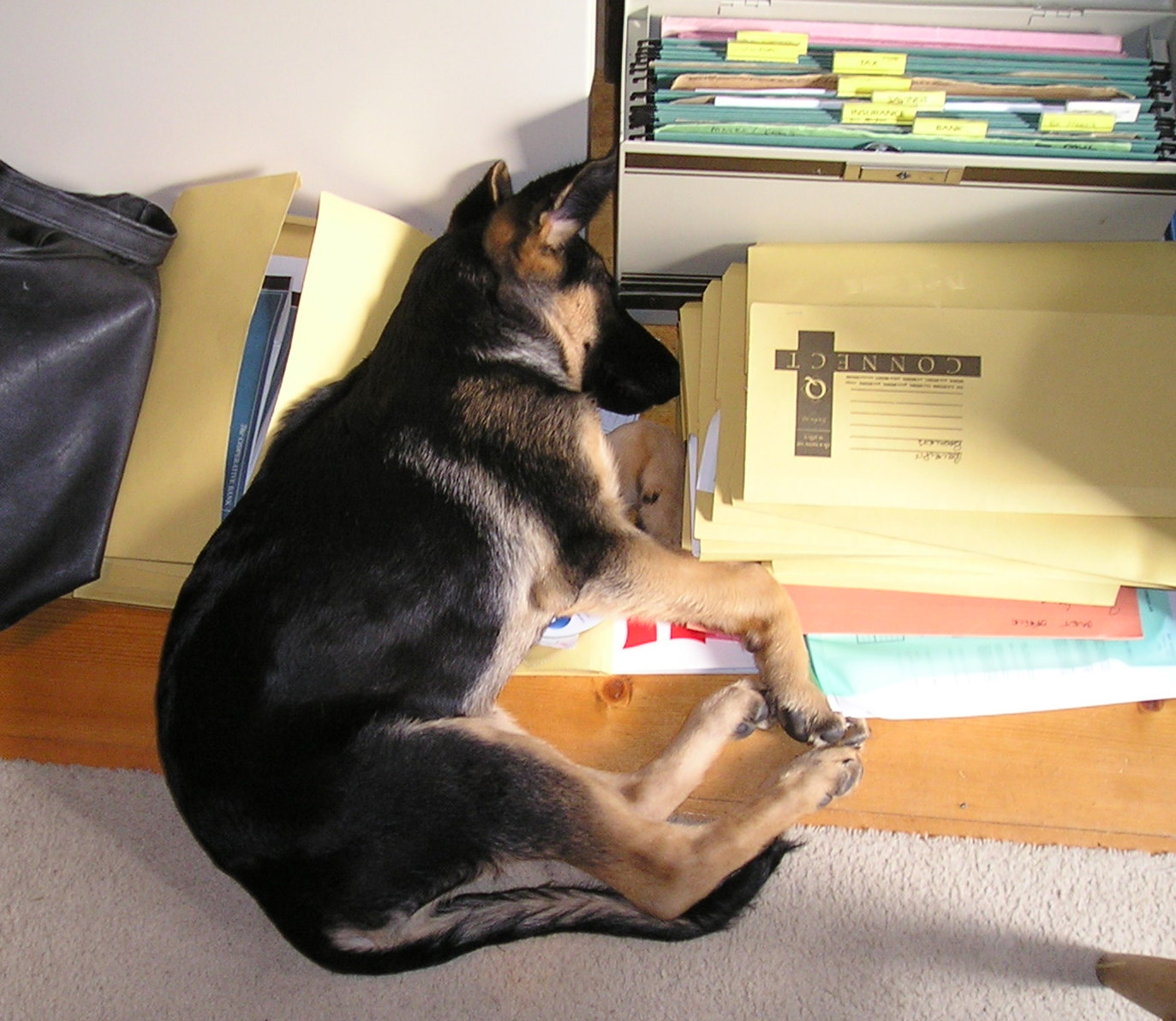
Yes, we certainly have much to learn from dogs!
By Paul Handover
ooOOoo
However, in Martin’s recent email he included a different dog picture and a closing remark.
Here they are.

Even today, still an amazing film
Jean and I watched this film the other evening. I have seen it a number of times but Jean just once before when it first was released in 1968! Yes, over 40 years ago!
What struck me watching it today was how beautifully slow the film was. I mean in the sense of camera and scene changes. I had forgotten just how beautiful the film was from a technical perspective. It held the eye and brain in a way that seemed so foreign to the way that films have been made in the last so many years.
WikiPedia has a very good summary of the film.
And there are more summaries on the INDB website, here’s an example:
“2001” is a story of evolution. Sometime in the distant past, someone or something nudged evolution by placing a monolith on Earth (presumably elsewhere throughout the universe as well). Evolution then enabled humankind to reach the moon’s surface, where yet another monolith is found, one that signals the monolith placers that humankind has evolved that far. Now a race begins between computers (HAL) and human (Bowman) to reach the monolith placers. The winner will achieve the next step in evolution, whatever that may be.

What is just as interesting is remembering the feelings that I had when I first saw the film, probably in 1968 or 1969, when I was living out in Australia, aged mid-twenties!
I was incredibly fascinated by the US expeditions out to the moon with the actual landing in July 1969. Indeed, I rented a TV and took a complete week’s holiday from work just to watch every minute of this historical event.
So the film, 2001: A Space Odyssey, seemed to capture, for me anyway, the feelings and mood of a brave new world reaching out beyond Planet Earth. The year 2001 felt like aeons away. It was obvious that when we eventually got to the 21st century, mankind would be unbelievably advanced in many exciting and positive ways.
Ah, the dreams of the naive young!
Now here we are heading towards the year 2011 and the world, I mean mankind, seems to be going where? Here’s Jon Lavin’s rather sombre view:
Have been musing about the part failure of the Russian grain harvest and the resultant speculation, that has forced the grain price up astronomically, the impact on bread/food/beer etc., evidence of the same mentality that kicked the banks/investments recession off.
Also, the fact that Lloyds TSB are 43% owned by the British people and are charging interest on non-approved loans of 165% and have a bonus fund of half billion pounds that certainly they have not asked my permission about.
This continuing lack of integrity, in the face of food shortages, untold hardship for millions of people, just goes to show that until an absolute calamity strikes to stop the whole of mankind in our tracks, it’s business as usual for the financially-led people and get-rich-on-the-back-of-anything-and-anybody crowd.
Are we still at consciousness level 204 or have we crossed back below the threshold, back below integrity 200, where falsehood rules?
The answer is to retain faith in the future, faith in the power of love and compassion, and faith in the fact that being the best that we can be today, now, in the present, just as dogs are so wonderful at doing, will bring us the better tomorrows we all dreamed about in 1968. Here’s a reminder:
By Paul Handover
P.S. Serendipity at work. Saw this from the BBC less than 5 minutes after completing this Post!
The beauty of wild deer.
Apologies for a ‘thin’ posting – here’s why.
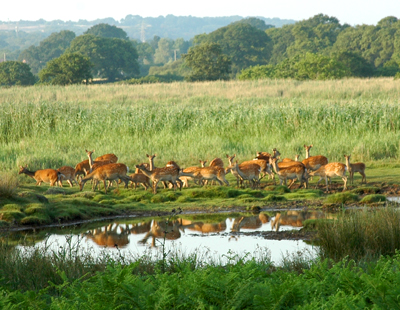
Julie has gone on ahead, but returns to tell me that the sika deer are feeding in the reed beds ahead of us. (These are one of two types of deer found at Holton Lee.) She offers to stay with Genie while I go and photograph them, so that Genie won’t frighten them off. They see me, but continue feeding whilst remaining alert.
It really is a magical sight – I am quite converted from my original anxiety about deer leaping out in front of the car!
There is something extremely primeval about deer, which is probably not surprising as their bodies have provided everything from meat and clothing to fish hooks and sinews for many indigenous people, while still remaining wild. It is hard to see why anyone would hunt them simply for sport, though, and I fear that Walt Disney has spoilt me for enjoying venison – ancient, organic, sustainable, non-farmed food source or not, it would be like eating Bambi!
Taken from Ju’s Holton Lee blog.
By Paul Handover
A couple of Posts from last September.
The wonderful news that US Gray Wolves are now back under protection reminded me of the beautiful story of Tim and his ‘pet’ wolf Luna that was published on Learning from Dogs September, 2009.
The first article opened up as follows:
An amazing true story of a relationship between a wild wolf and a man.
This is a story of a particular event in the life of Tim Woods told to me by his brother, DR. It revolves around the coming together of a man sleeping rough, with his dog, on Mingus Mountain, and a fully grown female Gray or Grey Wolf. Mingus is in the Black Hills mountain range between Cottonwood and Prescott in Arizona, USA
You can read the full Post here.
But then I added a postscript which I am going to reproduce in full again.
The story of Luna has some interesting connections.
The person taking the picture in the Post about Tim Woods was Willie Prescott. He just happens to be the grandson of William H. Prescott from whom the town of Prescott is named. Here’s that picture again.

A Guest Post from Daniela Caride. Daniela writes the Blog The Daily Tail
Something about being a dog dazzles me. Maybe it’s the freedom. Dogs don’t care what others think of them. They do whatever pleases them most without guilt or worries.
This morning, it became so clear to me. My walk around Fresh Pond Reservation in Cambridge didn’t feel very pleasant. I was worried about my mother’s persistent headache.
Today promised to be the hottest day of the summer, and the heat was not helping my mood. It was only 9 a.m., and I was already convinced something had changed in our constellation, and the sun was about to barbeque the Earth.
But my dogs, Frieda, Geppetto and Lola, were oblivious to anything going on outside Fresh Pond. They trotted happily to the doggie pond awaiting them less than a mile away, stopping only to sniff around and greet other dogs.
At the pond, they refreshed themselves in the water, not minding that the water gets dirtier as the summer wears on. They love that stinky pond, from the day the ice starts cracking and we can finally see our reflections in the moving water, to the beginning of winter when the water turns into ice again.
We completed our lap and approached my car, parked in front of a huge grassy area, where dogs are not allowed. One

of the landscaping employees was testing the park’s brand new lawn sprinklers. He turned them on and watched as half a dozen sprinklers soaked the grass.
Geppetto ran toward the spinning sprinklers, ignoring leash laws, of course. He was dying for a sip. The water flowed so strong that Geppetto had to close his eyes when trying to get the spray into his mouth again and again.
Frieda and Lola followed him, first exploring the artificial rain until they felt comfortable enough to play beneath it. Soon they were romping under the sun without feeling the effects of the boiling heat.
I watched the beauty of that canine dance with envy. My dogs were free, living the moment, unfettered of any concern. Then I asked myself why we humans don’t act more like them, especially in situations like this, in which no harm would be done.

First, I went into one of the sprinklers, wetting my hair and face. Then another sprinkler surprised me, showering me head to toe with a refreshing jet. I raised my arms to let the water reach the rest of my body.
Park regulars watched their dogs and me from careful distance, not wanting to get wet. I didn’t care any more. I felt whole.
Whole like a dog.
By Daniela Caride
A modern Greek tragedy – that could have been foreseen.
As I tried to point out in a recent Learning From Dogs post, foreign policy is an extremely complicated thing. This sounds self-evident, but it’s amazing the extent to which certain officials think they can control events occurring around the world.
I like to characterize US foreign policy in the Middle East as throwing rocks at a hornet’s nest, and then expecting to be
able to control the hornets when they emerge. The consequences of intervention are so many, so widespread, so complicated, and so unforeseen that no one can hope to be able to manage them, without inevitably intervening even more and thus fueling even more unintended consequences. (You can see a strong parallel between the overconfidence of government officials in the area of foreign policy and their attitude in areas of attempted economic control. But, that’s a separate discussion.)
Thanks to the wonderful (in my opinion) people at WikiLeaks, we have been able to see a much more realistic picture of the war in Afghanistan than has so far been available. CNN reports on one element of these reports that is none other than one of these most unintended of consequences — some of the most advanced military technology in our country’s arsenal falling into the hands of…well we’re not really sure who. CNN reports:
When unmanned aircraft crash in Afghanistan, scavenger hunters frequently aren’t far behind, U.S. military incident reports published by WikiLeaks suggest.
On several occasions, military units sent to recover the aircraft — known as tactical unmanned aerial vehicles — have arrived to find the aircraft stripped of valuable parts.
In April 2007, a parachute deployed on one that had maintenance issues, one report says. Troops sent to recover the aircraft couldn’t reach it until the next day, when they discovered it was missing some of its electronic components and its payload.
Is this a surprise? For me, no!
For those who oversimplify foreign policy to international powers moving on a chess board, yes. Government officials often forget that at the end of the day we are not dealing simply with “the Taliban” or “Al Qaeda” — we are dealing with individual human beings.
And while the Taliban and Al Qaeda as groups may seem predictable, individual human beings are essentially the most advanced supercomputers ever to exist on this planet. To think that one can predict the actions of human beings on the other side of the world, especially human beings whose culture and background one hardly understandings, is nothing but the highest form of hubris.
And, just like in Greek tragedy, the hubris comes just before the fall, when it turns out that the prideful character did not have everything under control, and in fact is the victim of consequences that he was too prideful to foresee or even consider as a possibility.
By Elliot Engstrom
Let’s be real about Realism.
Usually when I talk with supporters of America’s current wars in the Middle East, those who discover that I am vehemently opposed to an American presence in the region find me to be naïve. In their minds, I just do not understand realism or how power politics actually functions. My anti-war sentiments are the idealistic notions of an inexperienced youth who thinks that everyone should just get along.
The great irony here is that when followed to its logical end, the realist school of internationalist relations which so

many use to justify the American presence all over the world is in fact one of the greatest arguments against our current foreign policy. I do not argue against America’s wars in Iraq, Afghanistan, and Pakistan because I think that we would all just get along if these wars ceased to happen. I argue against these wars because I come from a perspective that sees the people we are fighting as human beings with the same base motivations as myself, and when these people see their livelihood threatened, they take the best course of action that they can find, which unfortunately often involves siding with whatever group holds the most regional power.
The great mistake in logic made by many advocates of an interventionist foreign policy is to merely think of the world in terms of the international stage. Such people look at the world in terms of what Iran, Al Qaeda, Russia, China, OPEC, or other entities have done or might do, rather than considering actions based on their effects on individuals, and what these individuals are likely to do in response.
 Learning from Dogs