Tag: Reflections

Letter from Payson – The Farmers Market

A foreigner but not a foreigner!

Despite the fact that we have now been living in Payson, Arizona, since the end of February and, therefore, a degree of familiarity exists in both directions, the local Saturday Farmers Market prompted this thought.

Why do I not feel a foreigner here?

There is no question that America, in general, and Arizona, in particular, is very different to England.  In many ways the differences are far greater than, say, England and Australia, or England and New Zealand (I’m picking other English speaking countries to avoid to obvious difference between countries of different languages).

Local goats' cheese

I love Farmers Markets.  They seem to encapsulate the wholeness of locals growing meat and produce for other locals. They seem to serve as a reminder of the integrity that is needed just as much in food as in all other areas of life.

Of course, I am not so naive to think that we could wind the food revolution back to before the days of supermarket chains – food is wonderful value nowadays especially for those families on tight incomes.

But I can’t be the only one that ponders what the long term effect of all those

Local jellies (jams to Brits!)

E-numbers and other strange ingredients that one reads on most packets of most items, and whether or not fruit is sprayed with anything that we should know about, and so on and so forth.

That’s why that place in my psyche is ‘stroked’ so well by wandering around the Farmers Market.

One would expect if there was going to be any place where yours truly, dressed and sounding like the Englishman that he is, is going to feel foreign, it would be at the Payson Farmers Market.  I don’t even try to hide my origins, responding to a “Howdy folks” from the stall-holder with a quintessentially English “Good Morning!

Inevitably there are reasons why I am made to feel welcome here in Payson, my hunch is that it is much to do with this being a pioneering town for most of the last 100 years, and therefore co-operation, collaboration and a welcoming attitude were key elements of sustaining a way of life, but, in the end, analysis is pointless.

What matters is how we are made to feel, and we are made to feel very welcome.

Indeed, Payson with it’s predominance of right-wing, independent thinking, tough ‘cow-boy’ inhabitants echoing a recent past, may have an important lesson for all of us, across the globe, as the forces of disconcerting change build and build: be local, think local, preserve local.

I’m very proud to be slowly but surely turning into a Payson local.

By Paul Handover
A Way Forward?

Removing the fear of the unknown

I’ve been working with most of my clients recently through painful transformations brought about by the economic downturn.

An interesting metaphor really because since the first wave of uncertainty triggered panic, first noticed in the UK banking system, I have been picking up on that uncertainty that feels like it’s stalking the globe at the moment.

Interestingly, I, too, have been aware of an underlying fear that was difficult either to name or source.

It has been rather like a deep river in that whilst the surface feels slow moving, currents are moving things powerfully below.

So this ‘fear’ has caused a few household changes.

We now are the proud owners of 9 chickens. Our youngest son, Sami, and I have dug up the back lawn and planted vegetables and built a poly-tunnel.

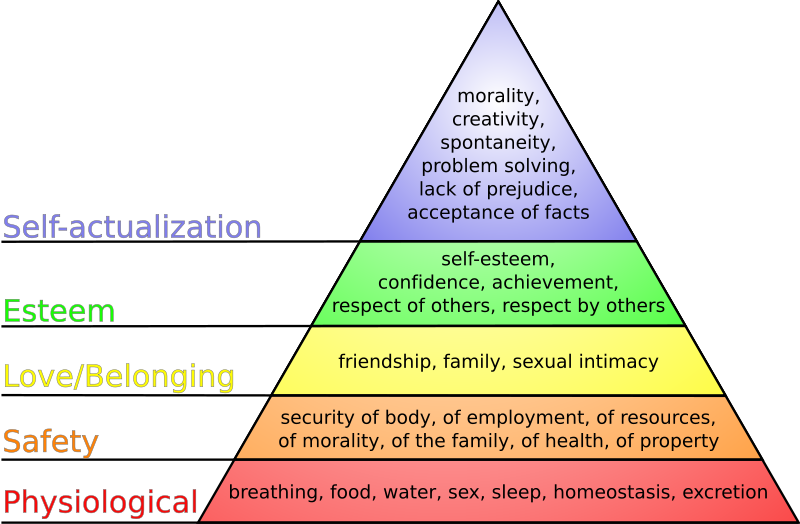
We have also installed a wood burning cooker. Right back down to the base of Maslow’s triangle really!

Maslow’s triangle of needs

These feelings have brought about such change everywhere and I wonder seriously whether we will ever return to what was; indeed would we want to?

I might not have mentioned it in previous blogs but as well as an engineering background, in latter years, I have focused on how interpersonal success in business is linked directly to relationships, integrity and vitally, self-awareness.

To inform this, some 7 years ago, I embarked on an MA in Core Process Psychotherapy, primarily to work on myself so that I could be the best I could be in my relationships, in and out of work.

The point I’m trying to make is that the same panic I notice in many of the companies I work in, and in me, is based on fear of the unknown and on a lack of trust in all its forms.  I’ve deliberately underlined that last phrase because it is so incredibly important.

The truth is that we get more of what we focus on.

So we can choose to focus on the constant news of more difficulties, hardship and redundancies, or we can focus on what is working.

In the workplace this positive focus has been pulling people together across functions and sites and pooling resources and ideas.

A farm evening

When we realise we’re not doing this alone it’s amazing how much lighter a load can feel and how much more inspired we feel.

I also notice how humour begins to flow and what a powerful antidote for doom and gloom that is.

Transformation is never easy but the rewards far exceed the effort put in ten fold.

So what is it going to be? Are we all going to bow down to the god of Doom & Gloom, fear and anxiety, heaping more and more gifts around it, or are we going to start noticing and focusing on the other neglected god – that of relationship, joy, trust, abundance and lightness?

Whatever the future holds for us all a belief in our inherent ability to adapt and change and focus on the greater good rather than fear, anxiety, greed and selfishness is the only sustainable way forward.

By Jon Lavin

[If you have been affected by this Post and would like to contact Jon, he would be delighted to hear from you. Ed.]

Elliot’s Schooling

So where does this all end up?

Well, I am finally back from an eventful break from writing at Learning From Dogs that has entailed my graduation from Wake Forest University, some final preparations for the University of Georgia School of Law and my move to Athens, and the unfortunate passing of my grandfather, Paul Norman Engstrom.

Therefore, it has been quite some time since I wrote my original post — which at that point was posted by Professor Jarrell with me as a guest author — in which I laid out my goals pertaining to a discussion of the United States’ education system.  Since then I have discussed the positives of our system, the negatives of our system, and pointed out the view of Sir Ken Robinson, who believes that creativity should be given the same status as literacy in education systems.

We are often surprised after researching a topic to find our conclusions to be in opposition with our previous line of thought.  However, sometimes it can be equally as surprising to do a great deal of research and then wind up back where you started, simply with a larger factual foundation behind.  This has been the case for me throughout this entire discussion of the United States’ education system.  Despite the attempt I have made to challenge my own viewpoint and think critically about my own biases, I continue to see the costs of the United States’ education system as far greater than its benefits.

Brick and mortar school building

As I have stated before, there is a great difference between formal education and learning.  Or, to be more precise, perhaps I should say that formal education is merely one part, and perhaps not even that large a part, of what “learning” entails.  I would suggest that the problem is not so much that the United States’ education system is damaging merely because of its existence, but rather that the greatest damage comes from society expecting far too much from this system.  School is no replacement for the learning that entails integration into a complex and competitive global society that necessitates human interaction, critical thinking skills, and creativity.  Sure, one can force youths into cinder block rooms and force them to learn multiplication tables and historical dates.  And, to an extent, I think this is necessary in a mass society as we have today.  However, this formula of forcing youths to learn facts and then having these facts regurgitated has been entrusted with far too much of what we today consider “learning,” and if we are ever to have a positive shift in our society from one of idea-accepters to idea-creators, this must change.

Learning the multiplication tables

Perhaps high school could integrate into their programs a larger degree of extracurricular internships that count for course credit — I am sure that this is an experiment that could be undertaken by a few school districts quite easily, and then expanded if it proves successful.  Perhaps also school curriculum could be altered to include more classes on philosophy and economics, which I see as foundational for a solid understanding of our world.  However, this alteration of core curriculum would be a much more difficult task to accomplish, and would require some serious time and thought.

by Elliot Engstrom

Basel

The Basel Committee on Banking Supervision

I suspect that you, like me, know diddly-squat about the Basel Committee.  As the Bank of International Settlements puts it:

The Basel Committee on Banking Supervision provides a forum for regular cooperation on banking supervisory matters. Its objective is to enhance understanding of key supervisory issues and improve the quality of banking supervision worldwide. It seeks to do so by exchanging information on national supervisory issues, approaches and techniques, with a view to promoting common understanding. At times, the Committee uses this common understanding to develop guidelines and supervisory standards in areas where they are considered desirable. In this regard, the Committee is best known for its international standards on capital adequacy; the Core Principles for Effective Banking Supervision; and the Concordat on cross-border banking supervision.

The Committee’s members come from Argentina, Australia, Belgium, Brazil, Canada, China, France, Germany, Hong Kong SAR, India, Indonesia, Italy, Japan, Korea, Luxembourg, Mexico, the Netherlands, Russia, Saudi Arabia, Singapore, South Africa, Spain, Sweden, Switzerland, Turkey, the United Kingdom and the United States. The present Chairman of the Committee is Mr Nout Wellink, President of the Netherlands Bank.

OK, that’s clear then!

Pers Kurowski

Well, according to a good supporter of and Guest contributor to Learning from Dogs, Pers Kurowski, we really ought to know much, much more about this ‘committee’.

Pers has a Blog called Tea with FT (as in the Financial Times) and there is much to read there that helps us understand why we are in so big a mess with the banks.  Here’s his piece from the 4th May.

Basel Committee, why don´t you just shut up!

Sir who do these Basel Committee regulators really think they are bullying us around with an arrogant “the banks should be sensible and realise that it might backfire if they protest too much”? as reported by Brooke Masters, May 4.

They themselves are the ones who thought everything would be fine and dandy if they just had some few credit rating agencies determine default risks and then gave the banks great incentives, by means of different capital requirements, to follow those credit risk opinions. They themselves are the ones who believing in the abundance of safe triple-A rated lending and investments, caused the world to stampede and fall over the subprime mortgages. They themselves should shut up, because rarely has the world seen such a gullible naive and outright stupid bunch of regulators.

Now the banks, in the midst of a crisis, need to build up the equity they do not have precisely because the Basel Committee did not require them to have; precisely when we need the most the banks to lend. The regulators, instead of bullying banks, should busy themselves day and night finding ways for severely capital stretched banks to be able to lend to those small businesses and entrepreneurs who have had to pay the cost of higher capital requirements but who had absolutely nothing to do in generating this crisis.

And just in case, for the record, I am no banker, only a citizen, very upset with the fact that in the 347 pages of the regulations known as Basel II, there is not one single word that describes the purpose of those regulations. Basel Committee why do you not start defining a purpose for what you are doing? Is that too much to ask?

By Paul Handover

Radio Caroline

A real blast from the past!

Recently we rented the film, Pirate Radio, a somewhat ‘true’ story about the days of broadcasting rock and roll from a ship moored just outside British waters.  Here’s the official trailer of the film (somewhat glitzy as is the manner of Hollywood):

Anyone of my sort of vintage living in England during the 1960s will recall the fun and excitement of Radio Caroline, the name of the radio station that started up in 1964.

Here’s a good extract from the WikiPedia entry:

Radio Caroline is an English radio station founded in 1964 by Ronan O’Rahilly, to circumvent the tight hold the record companies had on the broadcast of popular music in the UK. It originally commenced transmissions as an offshore radio station broadcasting from a ship anchored in international waters off the coast of South East England. Originally unlicensed by any government, for the majority of its early life, it was labelled as a pirate radio station.

Radio Caroline

Amazingly, at its peak Radio Caroline had an audience of 23 million listeners.  In a very real way Radio Caroline was another symbol of what became known as the Swinging Sixties, a transformation period for post-war Britain.

Tony Blackburn was just one of many famous disk jockeys who started life out on Radio Caroline, with Tony being the first presenter of the BBC’s Radio 1 station, broadcasting popular music, when it came on air on the 30th September, 1967.

Tony Blackburn, some while ago!

Anyway, if you are nostalgic towards the ‘good’ old days of the sixties, do watch the film.

By Paul Handover

3 mins of pure nostalgia

Wonderful short film of the P-38 Lightning (thanks to Steve).

The Lockheed P-38 Lightning was a WWII American fighter aircraft. Equipped with droppable fuel tanks under its wings, the P-38 was used as a long-range escort fighter and saw action in every major combat area of the world.

A very versatile aircraft, the Lightning was also used for dive bombing, level bombing, ground strafing and photo reconnaissance missions.

The Lockheed team chose twin booms to accommodate the tail assembly, engines, and turbo superchargers, with a central nacelle for the pilot and armament. The nose was designed to carry two Browning .50 machine guns, two .30″ Brownings and an Oldsmobile 37 mm cannon.

The P-38 was the only American fighter aircraft in active production throughout the duration of American involvement in the war, from Pearl Harbor to VJ Day.
Music: Benny Goodman with Helen Forrest – ‘It’s Always You’.

The WikiPedia entry is here.

P-38 Lightning

By Paul Handover

Question for Elliot About Public Education

Hello Elliot!

I’d love to engage in a discussion with you — and interested others — about the appropriate role of government in education.

The Federalist Papers made it clear, to me at least, that our founding fathers believed that the government, our federal government in particular, should have nothing to do with educating the populace.

The government providing public education? How did THAT happen?

I realize it sounds a bit radical now, but I believe that any discussion of what is right and wrong about public education today must begin with a healthy debate about whether the federal government should be involved in public education at all.

Your thoughts?  Thanks!

by Sherry Jarrell

The Dust Settles

Who dares, Wins!

The new British Conservative & Liberal-Democrat Cabinet

I can’t remember a more momentous week in British politics. It seemed silly to comment as events unfolded so swiftly – one would have risked being out of date before finishing the article – but it is perhaps time to summarize what has happened:

  • The outcome was in retrospect the best possible, even if none of the parties might think of it that way.
  • We have a stable government locked into a coalition that commands a large majority in the House of Commons and a considerable majority of the popular vote. Nobody can deny this coalition “the right to govern”, whichever way you regard the statistics.
  • The country’s finances are in a terrible mess and a stable government was essential to put things right and recover confidence.
  • Yes, there will be strains and stresses in each party, but both have now invested so much in this that  neither can afford to rock the  boat and risk another general election to let Labour back in under a new and more charismatic leader.
  • Both parties have shown a spirit of compromise and both have had to ditch some of their cherished (and more wacky) policies.
  • “First Past the Post” has taken a lot of stick and it seems the time of electoral reform has arrived. The Lib-Dems have a firm commitment to a referendum on the Alternative Vote (not optimal, but an improvement) plus other essential elements – long-delayed by the previous Labour dinosaur – such as fixed term parliaments, a redistribution of votes per constituency and a reduced number of MPs.
  • The country has seemed fragmented and divided in recent years, with much bitterness and a sense of drift and failure. The coalition has brought fresh hope, though it is born in very difficult times. But as a coalition it is perhaps better-placed than one single party to make the very difficult decisions needed. A single party would have had to make the same decisions but with the risk of losing a vote in the HOC and a lurch to the other side to start all over again.
  • The wretched previous government is gone. The most pleasing aspect of this is that those architects of spin and PR, the unelected Lord Mandelson and the unelectable Alistair Campbell, have seen their stars not only wane but disappear into a black hole. Their last-ditch attempt to stagger on in a Lib-Lab coalition was effectively torpedoed by their own back-benchers and party Grandees, who found the whole process undignified. It is indeed the end of Noo Labour, and few will regret its passing.
  • Last but not least, the Labour Party survives, whereas there was a time when it seemed it might be humiliated and destroyed. The extent of the defeat could not be spun – even if Mandelson et al had a go at it – but it survives as an essential part of the British political scene. Moreover, though Brown rightly had to go, he was not humiliated either and was able to depart with grace and dignity. One is far from sad to see him retire to the back benches, but the bad feeling that anything worse might have produced has been avoided.

The change has been momentous. Politics is unpredictable, so who can tell if this bold experiment will work. But “Who dares, Wins”, and they should have the best wishes of all who love their country.

By Chris Snuggs

I am scared!

Guest author, Per Kurowski, on a rather sobering topic!

I do not know what worse, the arrogance of the regulators thinking they can squeeze out the risk in banking by imposing different and completely arbitrary capital requirements based on the opinions of some few human fallible credit rating agencies, or their childish innocence not knowing this creates systemic risks of gigantic proportions.

What I do know is that an amazing number of intelligent people have fallen for this absurd and extremely dangerous regulatory paradigm. Honestly… I am truly scared!

How could I not be with regulators who can authorize banks to leverage up 62.5 to 1 on public debts like Greece’s while at the same time placing a 12.5 to 1 ceiling on the lending to the small businesses and entrepreneurs whom we depend so much on for our jobs.

Better hope they don't need funding!

All those financial and regulatory experts who kept mum when they should have spoken out on the financial crisis about to happen are now, quite effectively, circling their wagons in order to promote the myth that no one knew. False many did! In order to benefit from the lessons we must learn, they should not be allowed to succeed.

On October 19, 2004, as an Executive Director of the World Bank (2002-2004) I presented a written formal statement at the Board and that included the following:

We [I] believe that much of the world’s financial markets are currently being dangerously overstretched through an exaggerated reliance on intrinsically weak financial models that are based on very short series of statistical evidence and very doubtful volatility assumptions.

And I was no investment banker, nor a regulator, nor an investor, and so to me it is clear that all of them, had they done their job right, should have known… and that this crisis should have been nipped in the bud much earlier, as

Per Kurowski

the real explosion in truly bad mortgages took off in 2004, when the SEC in April delegated the setting of the capital requirements for the investment banks to the Basel Committee, and the G10 in June approved Basel II.

In order to understand it all don’t follow the money… follow the AAAs.  In case you missed “The Financial Crisis explained to dummies, non-experts and financial regulators” you can read it here.

By Per Kurowski

PS. I have put up a document that resumes most of what I said before and during my term as an Executive Director.

Is there a positive side to communitarianism?

Rethinking the State

I have a new article up at Rethinking the State — which now has several new authors including Nathan Fox-Helser,

Prison - Norway style

Andrew Butler, and Paul Monroe — about the positive aspects of communitarian systems.

I’m not sure exactly what the political leanings are of the Learning From Dogs readership — I would hope that a variety of viewpoints are represented — but I know that often communitarian philosophies are held in contempt in libertarian or free market circles because of their association with historical attempts at socialism and communism.

Regardless, I’d love to hear your thoughts, as it’s a philosophy I’ve been thinking about a lot recently.  I write:

…I have to admit that one of the key flaws I see in communitarian political philosophies is not so much the non-cohesive nature of the doctrines themselves, but rather the level at which they are prescribed.  If communitarianism was only applied at the local level, could it really survive without an element of voluntarism?  I feel that capitalist leaning nation-states are begging the question in saying that ideologies like socialism don’t work, because they are assuming that they must be applied at the nation-state level.

This involves the idea that the strictness of economic laws tends to lessen as they move further away from large-scale application, so anti-communitarian claims like the lack of an adequate price mechanism and lack of adequate information tends to become less of a problem for local communities because the nature of economic communication changes as the distance between actors closes.  It also involves the idea put forth by such philosophers as David Hume that human beings are naturally sociable creatures, and a communitarian system at the local level would be able to use this sociability to its advantage.

The full article is reproduced below:

Continue reading “Is there a positive side to communitarianism?”