Tag: Piper Super Cub

Nostalgic times.

Flying the Piper Super Cub

Last Saturday, I posted an item that included a great video about the Air-Cam sports aircraft.  I succumbed to a bout of nostalgia in that I dipped into both my old gliding and flying log-books.  As I wrote:

 My last (powered) flight was in a Piper Super Cub, registration R-151, a flight of 1 hr 40 mins from Kemble returning to Watchford Farm, where the Cub was based.

I ‘warned’ readers that today’s post would offer some more about that wonderful aircraft; Piper Super Cub R-151.

ooOOoo
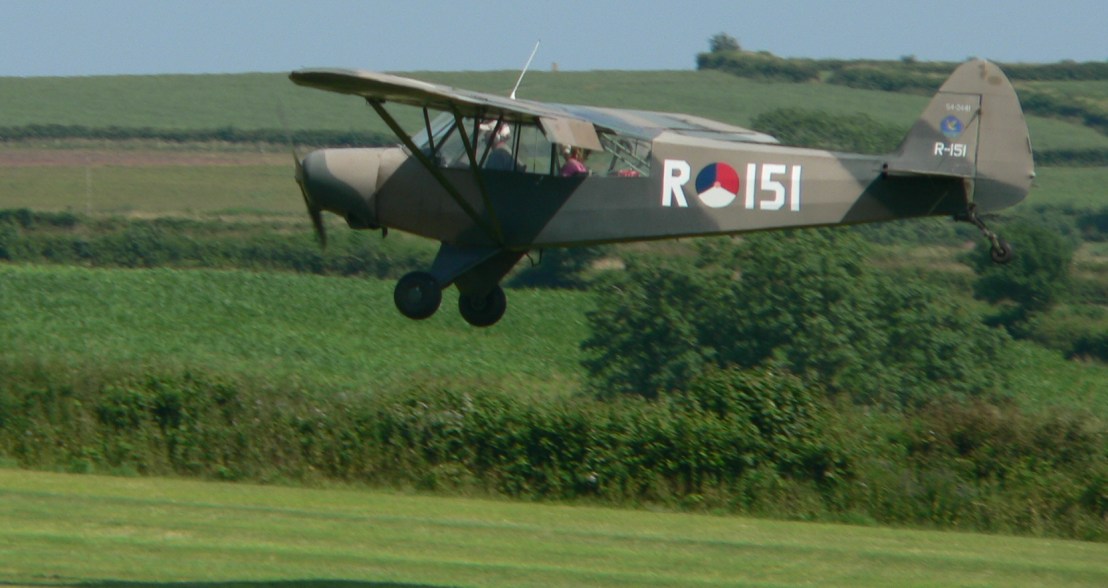
Approaching home in South Devon, England
Approaching home airfield in South Devon, England

Piper Super Cub, L-21B, R-151

A/C Construction No. 18-3841, Frame No. 18-3843

Original Engine, Lycoming 135 Type 0-290-D2, 54/2441

R-151 was one of a batch of 298 L-21’s delivered in 1954. There were 584 L-21B’s produced by Piper for military use, the ‘L’ standing for Liaison. The L-21B’s were PA-18-135’s with civil Lycoming 0-290-D2 engines, glasswork as most L-21A’s and L-18’s and a gross weight of 1760 lbs.

This aircraft was delivered to Koninklijke Luchtmacht, Dutch Air Force, on the 1st July, 1954 and registered R-151. After various homes, R-151 transferred to the Dutch civil register as PH-GER, on the 1st April 1976 with 4,458 hours. Shortly thereafter the aircraft was registered to Vliegclub Hoogeveen, Certificate Number 2380.  Amazingly, the club is still in existence as their website shows.

On the 27th March, 1981 the aircraft was delivered to the UK with a total time of 5,043 hours and in September, 1981 became G-BIYR. In April, 1983 G-BIYR was the first of type to be given a Public Transport CofA (Certificate of Airworthiness) and was used for training at Tollerton; Nottingham. G-BIYR reverted to a Private CofA in January, 1984 when purchased by Mike and Barbara Fairclough from Devon at 5,120 hours.

In 1992, the aircraft was re-engined with a Lycoming 150HP, 0320-A2B No. L49809-27A (zero hours). Finally on the 2nd June, 1995 the aircraft was repainted in original Dutch insignia and given CAA (UK Civil Aviation Authority) permission to use the original call-sign, Romeo 151.

The aircraft is based in South Devon, England and owned by the five members of the Delta Foxtrot Flying Group.

More pictures.

Flying in the French Alps, Mt Blanc in sight

oooo

9,300 ft up in the French Alps

oooo

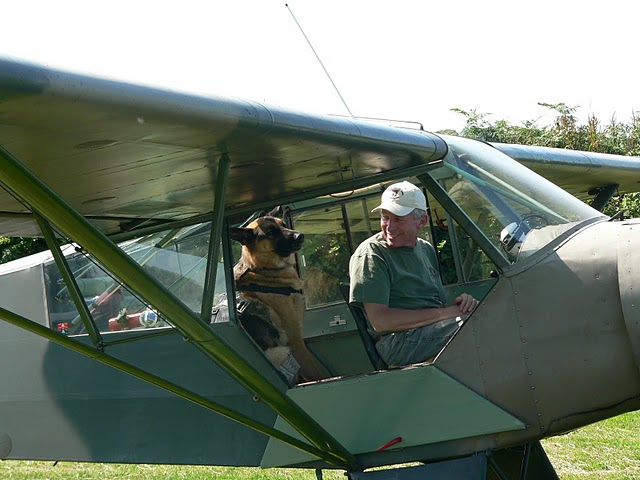
This last photograph was taken shortly after Pharaoh decided to jump into the passenger’s seat.  The year was 2006 when Pharaoh was 3 years old.  As much as I was tempted, I resisted the urge of taxying him around the airfield!

P1000357.s
Rather like the view from here, Dad!

Now for something completely different!

Echoes of a past life.

A few days ago, dear friend Suzann, sent me an item about a wonderful new light aircraft.  (It was Su and Don who invited me to Mexico in December, 2007 that resulted in me and Jeannie meeting!)

Before I explain what Su sent me, allow me a few moments of nostalgia.

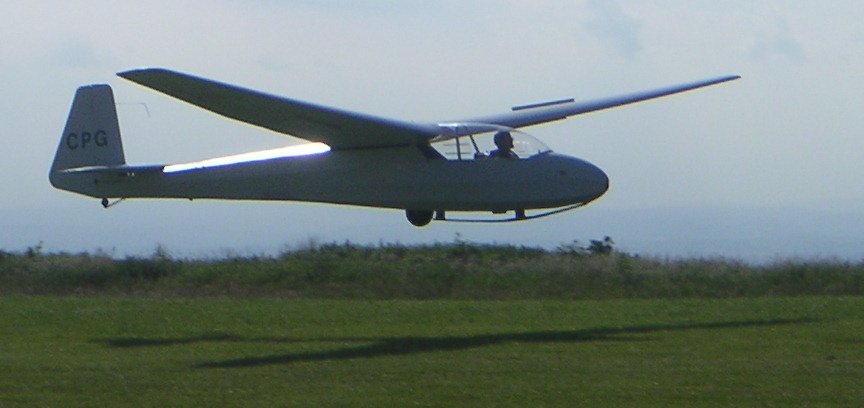
'K7' glider.
‘K7’ glider.

I have a gliding (sailplaning in US speak) log book that has the following entry at the top of page 1:

Flights 1 & 2. June 7th 1981. K7 dual seat glider. Rattlesden Gliding Club, Suffolk. Winch launch. Total flight time 12 minutes.

Those flights started a love affair with flying.

I have a powered-flight log book that has the following entry at the top of page 1.

March 3rd, 1984. Cessna 150. Reg: G-BGAF. Capt: Martin Lowe. Ipswich Airport – local flight 1325 – 1355. Exercises 4,5.

I continued glider flying, becoming an instructor along the way, until my last flight, flight number 1,424, on the 19th December, 1992; again from Rattlesden.

I continued power flying until the 4th August, 2008, a short time before I left the UK to be with Jean in Mexico.  My last flight was in a Piper Super Cub, registration R-151, a flight of 1 hr 40 mins from Kemble returning to Watchford Farm, where the Cub was based.

My son, Alex, shared my love of flying as a young man and is now a Senior Captain with a British airline.

G-EWFN, a Socata TB20.

Anyway, all of which is a rather long preamble to this.

What a fabulous aircraft!  The relevant website is, unsurprisingly, the Air-Cam site.

(Come back on Monday for some more recollections about flying the Piper Super Cub!)

Extreme weather events

Nature is really starting to speak to mankind!

I started writing this post back on the 25th September.  Why so far back?  Because that day something came into my in-box that deserved the widest circulation.  It’s an event being held just under a month from today, November 14th.  But it seemed worthwhile to give this amount of notice.  However, the reason why I wanted to start it back in September was because in the last 24 hours of that day, the 25th, the UK offered very good evidence of the significant increase in severe weather.

From the UK’s Met Office blog on the 25th September, 2012, (I have included the inches equivalent of the mm figures)

Rainfall figures: over a month’s worth of rain in two days

Rainfall totals for the past few days – from 1:00 am Sunday morning to 8:00 am this morning [Tuesday] – show some areas have already had more than twice their usual September rainfall. Ravensworth, in North Yorkshire, has seen the highest total, with 107.8 mm [4.24 in] falling, over 200 % of its average September rainfall.

The rainfall has been widespread, with many areas across the United Kingdom receiving large totals. Killylane, in Antrim Northern Ireland saw 98.2 mm [3.87 in], and high totals were also recorded in the south-west, with 72.4 mm [2.85 in] in Filton and 65.2 mm [2.57 in] at Dunkeswell Aerodrome.

Dunkeswell Aerodrome in Devon was where I used to fly our group-owned Piper Super Cub, still in military markings.

Piper Super Cub at Dunkeswell Aerodrome
A carriage made for two!

Anyway, back to the plot!

Also on that day (September 25th) the website Think Progress released this item,

Markey/Waxman Report: Carbon Pollution Creating A ‘Cocktail Of Heat And Extreme Weather’

By Climate Guest Blogger and Stephen Lacey on Sep 25, 2012 at 3:31 pm

by Katie Valentine and Stephen Lacey

Two House Democrats have released a report that aims to connect the dots on climate change and extreme weather events.

The staff report, issued by Henry Waxman (D-Calif.) and Edward Markey (D-Mass.), outlines the past year’s record-setting temperatures, storms, droughts, water levels and wildfires, and is being circulated in an attempt to rebuild congressional momentum to address climate change.

“The evidence is overwhelming — climate change is occurring and it is occurring now,” said Rep. Waxman, a Ranking Member of the Energy and Commerce Committee, in a statement.

The report outlines the stunning array of record-breaking extreme weather events throughout 2012 within five categories:

Extreme temperatures

  • July was the hottest month ever recorded in the continental U.S.  Some areas were 8 degrees warmer than average, with the average temperature in the lower 48 states at 77.6 degrees Fahrenheit, 3.3 degrees above the 20th century average.
  • Spring 2012 saw the warmest March, third-warmest April and second-warmest May in history, and was approximately 5.2 degrees Fahrenheit above average overall.
  • Through late June 2011, daily record highs were outnumbering daily record lows by 9-to-1.

Drought

  • As of September, 64 percent of the continental U.S. is experiencing drought, with August and September 2012 comparable to the worst months of the 1930s Dust Bowl.
  • By the beginning of August, more than half the counties in the U.S. had been designated disaster zones because of drought.
  • As of August, 51 percent of corn and 38 percent of soybeans grown in the U.S. were rated as poor or very poor by the U.S. Department of Agriculture. Some states’ corn fared worse – Indiana had 70 percent of its corn rated as poor or very poor, and Missouri had 84 percent.

Wildfires

  • This fire season 8.6 million acres – roughly the size of Connecticut and New Jersey combined – have burned in the U.S., with fires still burning in parts of the West.
  • Wildfires in Colorado have killed six people, destroyed 600 homes and caused about $500 million in property damage.
  • There has been nearly a four-fold increase in large wildfires in the West in recent decades, with fires burning longer and more intensely and wildfire seasons lasting longer.

Storms

  • Tropical Storm Debby caused Florida to have its wettest June on record. The storm killed at least seven people and also damaged more than 7,500 homes and businesses.
  • In July, the “derecho” storm system killed at least 23 people and left more than 3.7 million people without power.
  • In August, Hurricane Isaac caused storm surges of up to 15 feet in some places and contributed to Louisiana and Mississippi experiencing their second-wettest August on record and to Florida experiencing its wettest summer on record.

Extreme water levels and water temperatures

  • In July, water in the Great Lakes reached temperatures of 60 and 65 degrees Fahrenheit – more than 10 degrees warmer than the same time last year.
  • In August, water temperatures of up to 97 degrees and low water levels caused tens of thousands of fish to die in Midwestern lakes and rivers.
  • Low water levels in the Mississippi watershed have caused some barge companies to reduce their loads by 25 percent and have caused harbor closures in Tennessee, Missouri, Arkansas and Mississippi.

According to the report, 2012 natural disasters (not including wildfires or drought) have caused $22 billion in insured losses and more than 220 deaths as of August. The full cost of 2012’s extreme weather events isn’t yet known, but it’s expected to rival 2011’s record-breaking $55 billion.

The document outlines what scientists following the link between extreme weather and climate change have been saying for years: more carbon pollution adds extra energy in the atmosphere, thus warming the planet and making extreme weather events more likely.

Read the full report here.

So what came into my in-box?  An announcement from The Climate Reality Project: 24 HOURS OF REALITY: The Dirty Weather Report.

NOVEMBER 14-15, 2012

A lot can change in a day. This November 14, we hope you can help us make big change happen.

Join The Climate Reality Project for 24 Hours of Reality: The Dirty Weather Report. This will be our second annual, online event showing how global climate change is connected to the extreme weather we experience in our daily lives. The entire 24-hour event will be broadcast live over the Internet.

We’ll move between our home studio in New York City and into each region of the world, bringing voices, news and multimedia content across all 24 time zones. We’ll feature videos from around the globe, man-on-the-street reports, music, and most importantly, stories from communities moving forward with solutions.

Most of all, we’ll generate new energy and urgency around the fact that we must — and we can — work together to address the climate crisis.

GET INVOLVED

Sign up today to be a part of the global community taking part in 24 Hours of RealityRSVP on Facebook. Share this event with your friends. Submit your own video about the impacts of climate change where you live. And keep checking this page: We’ll post further details as the event draws closer.

Millions of people around the world know that the weather, their climate is changing.  But if you can take some more powerful evidence of just how it’s all changing then go and read a recent report on the Grist website, entitled ‘Deadly connection: New report on extreme weather and climate change’

So one more video to close.

Man, dog and Piper Cub

Excuse the self-indulgence!

While going through previously published Posts, I came across two, first shown on the 17th & 18th August, 2009, that seemed a better fit being rolled into one.

So here they are.

oooOOOooo

This is not my dog but it brings out the same feelings in me as if I was looking at my German Shepherd.

german-shepherd-puppy

And this is my German Shepherd!  The photograph was taken in 2006 when Pharaoh was 3 years old.  The aircraft, by the way, is an L21B, the military variant of the Piper Super Cub.  The aircraft was originally delivered to the Dutch Air Force in 1954 and has dispensation from the UK CAA to retain the original registration and callsign of R151.

P1000357.s

oooOOOooo

More on the aircraft.

Originally when the first half of today’s Post was published separately readers asked for more information on the aircraft.

So here it is.

Piper Super Cub, L-21B, R-151

A/C Construction No. 18-3841, Frame No. 18-3843

Original Engine, Lycoming 135 Type 0-290-D2, 54/2441

Romeo 151 was one of a batch of 298 L-21’s delivered in 1954. There were 584 L-21B’s produced by Piper for military use, the ‘L’ standing for Liaison. The L-21B’s were PA-18-135’s with civil Lycoming 0-290-D2 engines, glasswork as most L-21A’s and L-18’s and a gross weight of 1760 lbs.

This aircraft was delivered to Koninklijke Luchtmacht, Dutch Air Force, on the 1st July, 1954 and registered R-151. After various homes R-151 transferred to the Dutch civil register as PH-GER, 1st April 1976 with 4,458 hours and shortly thereafter was registered to Vlieclub Hoogeveen, Certificate Number 2380.

On the 27th March, 1981 the aircraft was delivered to the UK with a total time of 5,043 hours and in September, 1981 became G-BIYR. In April, 1983 YR was the first of type to be given a Public Transport CofA and was used for training at Tollaton. YR reverted to a Private CofA in January, 1984 when purchased by Mike and Barbara Fairclough at 5,120 hours.

In 1992 YR was re-engined with a Lycoming 150HP, 0320-A2B No. L49809-27A (zero hours). Finally on the 2nd June, 1995 the a/c was repainted in original Dutch insignia and given CAA (UK Civil Aviation Authority) permission to use the original call-sign, Romeo 151.

The aircraft is based in South Devon, England and owned by the five members of the Delta Foxtrot Flying Group.

A few photos of the aircraft.

Approaching home in South Devon, England
Approaching home airfield in South Devon, England
Flying in the French Alps, Mt Blanc in sight
9,300 ft up in the French Alps

Really takes me back does this!

And now for something completely different!

Keeping a balance on one’s state of mind.

Don’t know about you but I find that it is all too easy to get wound up by so much that is going on in this crazy world.  That’s not to marginalise the threats to society that are all around us and there are some powerful writers out there who work so hard to inform the world as to the truth of those threats.  (As an aside, one of my favourite authors is this context is Patrice Ayme, just see this recent Post of his as an example of his depth of analysis.)

But my dear friend of over 40 years, Dan Gomez, recently sent me a link to a video of the 10 most extreme airports in the world.  That stirred some memories from my own flying days.

First settle back and enjoy 7 minutes of reasons why you don’t want to think about flying! 😉

The YouTube video has this information, which I republish below,

Pictures and videos of the top 10 most extreme airports in the world!

San Diego: Busy airspace lots of buildings on approach
Madeira: Difficult approach and did have a short runway
Eagle Vail: High altitude, short runway & mountainous approach & departure
Courchevel: Short runway, bumpy runway, high altitude
Kai Tak: Difficult approch, fly through tall buildings, short runway
Gibraltar: Short runway, building on approach, winds from the Gibraltar rock
St Maarten: Short runway, has to fly over the beach with alot of people on there, steep takeoff because of mountains
St Barts: Short runway, has to dive.
St Barts: To land, the low approach on that hill thingy
Toncontin: Difficult approach, short runway
Lukla, short runway, only was cemented a few years ago, no go around, if land too low you land into a cliff

First song: La Perla by Kobojsarna

Second song: Feel It – Explicit Album Version by Three 6 Mafia vs Tiesto with Sean Kingston and Flo Rida

Now to a personal recollection.

I was a private pilot for many years, first learning to fly at the Suffolk Aero Club at Ipswich Airport in Suffolk, England.  My first lesson was on the 3rd March, 1984!

Some twenty years later, on the 13th August 2004 to be exact, I was checked out to land at Courchevel Airport in an aircraft type known as a TB20, a French-built aircraft.  Here’s the page from my log book with the necessary authorisation stamp affixed.

Cleared to land at Courchevel, LFLJ!

The following year, 19th July, 2005, I added my wonderful Piper Super Cub to that authorisation.  (See here for a part picture of the aircraft.)

So thanks to YouTube as someone has uploaded a film of a light aircraft operating into Courchevel.  It really is rather thrilling!

Finally, back to Dan.  Here’s his recollections included in the email that he sent with that first film.

Just found this.  I’ve landed at two of these.  Eagle Vail was a piece of cake compared to Toncontin as Marty and Bruce know. BAE146 and small Boeing jets.  I flew in and out of Toncontin 5 times in the 90’s and had no idea it was as scary as it was.  That is to say, I knew it was scary because my palms sweated and heartbeat was about 140 but when I look at it now I go “what was I thinking?”

Take offs were like Orange County, Full brake power straight up. The big difference was you were shuttling along the runway and then down the runway and finally, up the runway to get the wheels up.

One time, on a connecting flight from Medellin, we taxied in, were boarded by military police with drug dogs who sniffed their way through the aisle.  Bags were searched while everyone waited in intense heat. It took about 2 hours, three time longer than necessary. Then the interior was fumigated with everyone aboard. All the big machine guns too. Nobody said a word!

There’s one thing about flying a light aircraft, especially into ‘interesting’ airfields, you don’t have a moment to worry about the state of the world!

Welcome Doctor Barkman!

A delightful contribution from a guest author.

Dear readers, from time to time I am approached by other authors who have flattered me by asking if I would like to publish their Blog posts from time to time.  So I have been doubly flattered by having two authors contact me in the last week.

So to the first.  It is with great pleasure that I welcome Jane Brackman, Ph.D., author of the blog Doctor Barkman Speaks who will, from time to time, republish her posts on Learning from Dogs. I have no doubt that you will enjoy her scientific expertise regarding dogs

So today, please enjoy …

oooOOOooo

HOW DOGS THINK – NEW SCIENCE LOOKS INSIDE THEIR MINDS WITH MRI IMAGING

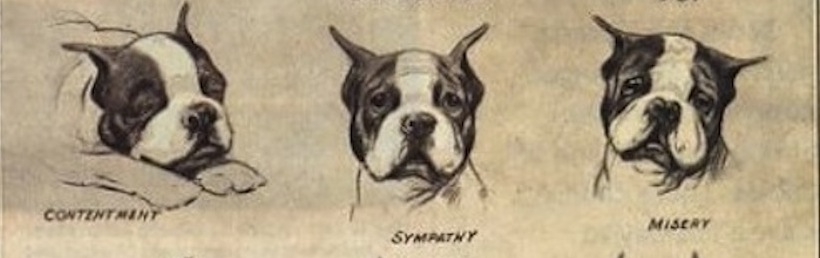
Canine illustrator Robert Dickey assigned thoughts and feeling to his Boston Terrier based on the dogs’s expressions. Here he illustrates contentment, sympathy and misery.  (Dogs from Life, Page & Co., 1920)
**
Are you gonna eat that? Are you gonna eat that?  I’ll eat it.”
Is this what dogs think?  Or do they experience more complex thoughts?  Apparently science is getting pretty close to figuring it out. If not exactly WHAT they’re thinking, then where in the brain the thoughts are coming from.  Since brains are pretty much the same across mammal species, if researchers identify which parts of the the brain light up, based on what humans have said, they can guess what the dogs’ thoughts are, too.

A couple of smart guys, Gregory Berns and Andrew Brooks of Emory University, watching a military dog assist Navy Seals as they overran the Osama Bin Laden compound, got a brilliant idea.  If you can teach dogs to jump out of helicopters, surely dogs could be trained to enjoy themselves inside an fMRI machine while scientists calculate what the dogs are thinking by scanning their brains.

The researchers, who are dog-lovers, explained, “We want to understand the dog-human relationship, from the dog’s perspective.  From the outset, we wanted to ensure the safety and comfort of the dogs.  We wanted them to be unrestrained and go into the scanner willingly.

So they recruited a professional dog trainer, Mark Spivak, and two companion dogs, a Feist Terrier named Callie and a Border Collie named McKenzie.  The team said that both dogs were trained over several months to walk into an fMRI scanner and hold completely still while researchers measured their brain activity.

In the photo below Callie wears ear protection as she 
prepares to enter the scanner.  The research team 
includes, from left, Andrew Brooks, Gregory Berns and Mark Spivak.  
(Credit: Photo by Bryan Meltz)

This is what the researchers wrote in the journal article that was published in PLOS last week:

Because of dogs’ prolonged evolution with humans, many of the canine cognitive skills are thought to represent a selection of traits that make dogs particularly sensitive to human cues. But how does the dog mind actually work? To develop a methodology to answer this question, we trained two dogs to remain motionless for the duration required to collect quality fMRI images by using positive reinforcement without sedation or physical restraints. The task was designed to determine which brain circuits differentially respond to human hand signals denoting the presence or absence of a food reward.

Eventually they hope to answer the more profound questions we all ask:  Do dogs have empathy? Do they know when we are happy or sad?  How much language do they really understand?”  (And here’s one from me- When they pee on the carpet and we don’t find it until the next day, when we scold them do they know why we are scolding them?)

Do dogs feel guilt?
You can read a brief summary of the project here:  What is Your Dog Thinking? Brain Scans Unleash Canine Secrets.

Or read the entire scholarly article here:

Berns, Gregory, Brooks, Andrew and Spivak, Mark, Functional MRI in Awake Unrestrained Dogs (April 27, 2012). 

Jane Brackman, Ph. D.

oooOOOooo

Well, I don’t know about you but I found this a most fascinating article.  All of us who live around dogs, both physically and emotionally, sense the closeness, may I use the word ‘magic’, of the relationships.

Take a look at the photograph below.  Until I left the UK in 2008, a few of us owned a lovely old Piper Super Cub.  It was a joy to fly.  I used frequently to take Pharaoh to the grass airfield, Watchford Farm, up on the Devon moors.  One day he showed such interest in the aircraft that I lifted him up to the passenger’s seat, strapped him in and taxied all over the grass airfield.  This picture shows something that is difficult to explain otherwise – Pharaoh’s real joy at sharing the adventure.  Of course, I didn’t fly with him, that would have been a step too far, but we did taxi almost up to take-off speed.  Dr. Barkman, what do you make of that?

Watchford Farm, Devon, July 2006.


I am your dog!

A story about the bond between a dog and a human.

Introduction

I was clearing my desk yesterday (yet again) and came across an article that I wrote in 2007.  It’s a message of love; the love of a dog for a human.  But before going to that article, look at the photo below.  It’s a wonderful example of the joy of having Pharaoh in my life.  It was taken in July 2006 at the airfield in Devon, SW England, where a group of us shared a Piper Super Cub, about which I wrote in Learning from Dogs in August 2009.

If you think Pharaoh is smiling, I’m not going to argue with you.  First time in the Cub, first time strapped in to the rear seat, everything utterly strange and Pharaoh is clearly more joyful than the pilot!

Happiness is sharing life with your dog!

Anyway, to the article.  I wrote it in September, 2007, based on something that was sent to me from an unknown author, and modified to reflect the special relationship that I had, and still have, with my then four-year-old German Shepherd, Pharaoh.

I am your dog and have something I would love to whisper in your ear.

I am your dog and have something I would love to whisper in your ear.

I know that you humans lead busy lives. Some have to work, some have children to raise, some have to do this alone.  It always seems like you are running here and there, often much too fast, often never noticing the truly grand things in life.

Look down at me now. See the way my dark brown eyes look at yours.

You smile at me.  I see love in your eyes.  What do you see in mine?  Do you see a spirit? A soul inside, who loves you as no other could in the world? A spirit that would forgive all trespasses of prior wrongdoing for just a simple moment of your time?

That is all I ask. To slow down, if even for a few minutes, and be with me.

So many times, you have been saddened by others of my kind, passing on.  Sometimes we die young and oh so quickly, so suddenly it wrenches your heart out of your throat.  Sometimes, we age so slowly before your eyes that you may not even seem to know until the very end, when we look at you with grizzled muzzles and cataract-clouded eyes.  Still the love is always there, even when we must take that last long sleep dreaming of running free in a distant, open land.

I may not be here tomorrow.  I may not be here next week.  Someday you will shed the water from your eyes, that humans have when grief fills their souls, and you will mourn the loss of just ‘one more day’ with me.  Because I love you so, this future sorrow even now touches my spirit and grieves me. I read you in so many ways that you cannot even start to contemplate.

We have now together.  So come and sit next to me here on the floor and look deep into my eyes. Do you see how if you look deeply at me we can talk, you and I, heart to heart. Come not to me as my owner but as a living soul.  Stroke my fur and let us look deep into the other’s eyes and talk with our hearts.

I may tell you something about the fun of working the scents in the woods where you and I go.  Or I may tell you something profound about myself or how we dogs see life in general.  I know you decided to have me in your life because you wanted a soul to share things with.  I know how much you have cared for me and always stood up for me even when others have been against me.  I know how hard you have worked to help me to be the teacher that I was born to be.  That gift from you has been very precious to me.  I know too that you have been through troubled times and I have been there to guard you, to protect you, to be there for you always.

I am very different to you but here I am.  I am a dog but just as alive as you.

I feel emotion.  I feel physical senses.  I can revel in the differences of our spirits and souls. I do not think of you as a dog on two feet; I know what you are. You are human, in all of your quirkiness, and I love you still.

So come sit with me on the floor. Enter my world and let time slow down if only for a few minutes.  Look deep into my eyes and whisper in my ears. Speak with your heart and I will know your true self.

We may not have tomorrow but we do have now.

Postscript.

Just three months after writing the above, on December 17th, 2007, I flew in to Hemosillo Airport in Mexico to spend Christmas with Suzann, sister of dear friend Dan Gomez, and her husband Don down in the coastal town of San Carlos.  That’s when I met Jean, leading to me and Jean falling in love.  Jean then came to England and I came back to Mexico in June, 2008.  In September, 2008 Pharaoh and I left England permanently and travelled out to San Carlos to be with Jean and her dogs.  In February, 2010, Jean and I, Pharaoh and twelve other dogs, and six cats all moved to Payson, Arizona.

In November, 2010 Jean and I were married.  So the miracle for me and Pharaoh is that when I wrote that piece back in 2007 this most beautiful future was yet to unfold.    I never miss a day when I don’t, “… come sit with me on the floor. Enter my world and let time slow down if only for a few minutes.  Look deep into my eyes and whisper in my ears. Speak with your heart and I will know your true self.”  Now not just with Pharaoh but with Hazel, Dhalia, Sweeny, Casey, Loopy, Lilly, Ruby, and all the other beautiful dog souls.

Jean and me, Yecora, Sonora, Mexico. June 2008

Not your average airport!

The world’s 18 strangest airports

The American magazine Popular Mechanics had an interesting piece on some of the more bizarre airports around the world.  As the article says,

Engineers tasked with building an airport are faced with countless challenges: The ideal location needs ample space, endless flat ground, favorable winds and great visibility. But spots in the real world are rarely ideal, and engineers are forced to work with what they have, making sure that the end product is the safest possible structure for pilots. A survey of airports around the world turns up a mixed bag, ranging from dangerous and rugged landing strips to mega-size facilities that operate like small cities.

Apart from the general interest in these airports, there is also a personal resonance as three of them are in my aviation log-book: Barra; Gibralter; Courchevel.  Indeed my experiences of flying into Barra were the subject of a Post on this Blog a few months ago.

Courchevel in the French Alps is, for all pilots, one of the most amazing, butt-clenching arrivals one could ever imagine.

As Wikipedia puts it:

Courchevel’s airport also has a certain degree of infamy in the aviation industry as home to one of the shortest runways in the world, with a length of 525 metres and a gradient of 18.5% in order to help slow landing aircraft. The airport has a dangerous approach through deep valleys which can only be performed by specially certified pilots. On landing there is no go-around procedure, as most of the worlds airports have – there is merely a very steep hill which has seen a few accidents since the airport first opened.

Quite so!

Here’s an interesting video from YouTube

and a few personal memories:

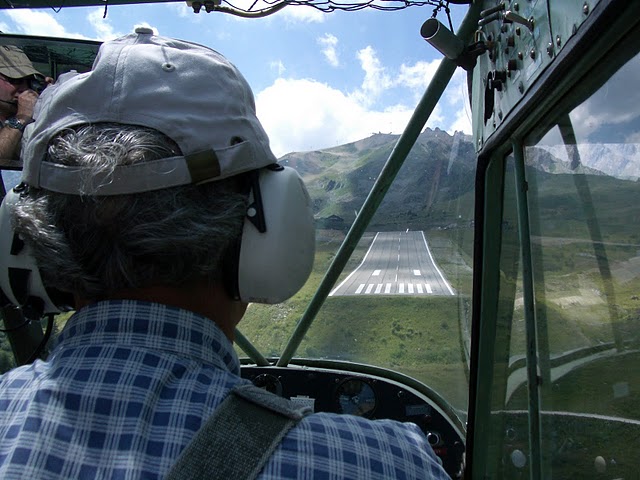
Start of the approach into Courchevel
'short final' Courchevel
Author & aircraft on the apron - Courchevel

By Paul Handover

Crazy flying

This is not your usual air-show display

Author & author's dog in Piper Super Cub, R151

Three of the authors on Learning from Dogs are or have been pilots although only one, Bob Derham, is a real pilot!  I.e. he does it for a living!

Most pilots and many wannabes love the atmosphere of a good air show but after a few visits they can become rather predictable and that applies as much to the flying displays.  After all there is only so much that one can do to an aeroplane.

Not so the good people who comprise the Franklin’s Flying Circus.

Here’s a YouTube video showing Kyle Franklin ‘stealing’ a Piper Cub.  As a past owner of a Piper Super Cub, I have to tell you that the skills being used in this display are supremely clever.

Enjoy!

By Paul Handover