Tag: Patrice Ayme

Written with a heavy heart!

Such a need to learn from our dogs!

A couple of items that recently landed in my ‘in-box’ had me in pain; emotional pain that is. I agonised over republishing them but then thought it felt like a duty to promulgate this particular terrible aspect of life. Trust me, today’s post is going to generate a deal of passion (see reference to TIME magazine at the end of the post). Also it is not something that should be read by a young person under the age of sixteen.

The first item was an email sent to me by dearest Suzann and is republished here with Suzann’s kind permission.

(For those that may not know or recall, Suzann, and her husband Don, invited me to spend the Christmas of 2007 with them at their home in San Carlos, Mexico. Suzann and Jean, who then lived in San Carlos, had been good friends for many years working together to rescue the many feral dogs found on the streets in San Carlos and surrounding areas. Indeed, Suzann continues to rescue those needy dogs and find loving homes for them. Out of the 9 dogs here at home in Oregon, 6 are ex-rescue dogs from Mexico.)

This is what Suzann sent:

I am so sorry to have to send this to you, but it needs to get out there for people to know.
What can we do?
1. Make others aware of this atrocious and vile assault on innocent people, so people will WAKE UP to the evil that is happening in this world!
2. PRAY!
3. If you are not a believer, send to others that you know who are, so they can send it on.
The whole world needs to see this!!
Thank you.
suzann

YOUR PRAYERS ARE THE NEED OF THE HOUR.

PLEASE SEND THIS TO AS MANY AS YOU CAN.

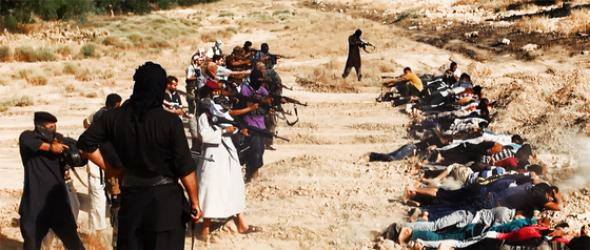
PLEASE LOOK AT THESE PICTURES. ISIS IS KILLING CHRISTIAN CHILDREN. ONE WAS CRUCIFIED. PLEASE PRAY.
Be sure to see the 4 photos below. The whole world needs to see what kind of people these ISIS terrorists are.

Su1

oooo

Su2

oooo

Su3

oooo

Su4

Here is an urgent prayer request for all of us!!
She asked that it be forwarded ASAP to as many people possible:

Dear Friend: Just a few minutes ago, I received the following text message on my phone, from Sean Malone who leads Crisis Relief International (CRI), We spoke briefly on the phone, and I assured him that we would share this urgent prayer need with all our contacts.
We lost the city of Queragosh. It fell to ISIS and they are beheading children systematically. This is the city we have been smuggling food to. ISIS has pushed back Kurdish Forces, and is within 10 minutes of where our CRI team is working. Thousands more fled into the city of Erbil last night. The UN evacuated its staff in Erbil. Our team is unmoved and will stay. Prayer cover needed!!!.

Please pray sincerely for the deliverance of people of northern Iraq from the terrible advancement of ISIS and its extreme Islamic goals for mass conversion or death for Christians in this area.

May I plead with you not to ignore this email? Do not forward it before you have prayed through it. Then send it to as many people as possible.
Send it to friends and Christians you know. Send it to your prayer group. Send it to your pastors. Any one you can think of. We need to stand in the gap for our fellow Christians.
I was still struggling to ground, as it were, my emotional response to Suzann’s item when a second item came into my ‘in-box’. It was a new post over on Patrice Ayme’s blogsite. This, too, is republished in full with Patrice’s kind permission.

ooOOoo

Savage, The Franks? Islam Is Worse

Our friend the half-philosophers may start to huff and puff, as “Franks” were citizens of a federation (actually two of them, the one of the Sea, and the one of the River; the one of the Sea, or more exactly, Salt, is now known as Salian, or Salic).

Whereas “Islam” is a thought system, devised by some Arab warriors (PBUH), who got a good gig going for themselves.

To put in the same basket an ethnicity and a religion is what some half-philosophers would love to call a “category mistake”. The irony is that I know (the basics of) Category Theory, and they don’t.

In Category Theory, there is a concept called a functor, which allows to go from one category to another.

islamists

In other words, because I know of functors, I can mix and match different categories such as Franks and Islam, and be relaxed about it (instead of being all gripped and unimaginative, as is the average constipated half-philosopher. Notice in passing that the concept “functor” was invented by the philosopher Carnap in linguistics).

The historian Pirenne, long ago, suggested the thesis that the collapse of the economy in the High Middle Ages was caused by the Islamists (Islam confiscated most of the Roman empire, and imposed a total embargo, cutting not just the Paper route, but the Silk Road as well).

In other news, On Fascism, Russian & Islamist Edition, Feb 26, 2015, a plan surfaced for the invasion of Ukraine, written more than a year ago, by some major Russian plutocrats, who have influence on Putin and are best buddies with the leadership of the Russian “Orthodox” Church.

Don’t worry, anybody involved will soon die, and things will calm down; this is Putin’s way.

There is a clear self-censorship going on throughout the West right now, because people are scared of these fanatics, the Putinists, and the Islamists. This, in turn, is deleterious to any critical mood, thus discourse, thus adverse to fixing any problem.

One cannot have a sane public discourse if one cannot even draw a human being. Having public insanity in place of public discourse will affect the Republic, to the point it will die, and that is why it died in all and any nation that submitted to Submission (aka “Islam”).

TODAY’S ISLAMISTS: MORE BARBARIAN THAN THE FRANKS, SIXTEEN CENTURIES AGO:

As it rose, Christianism destroyed the Roman Republic (or what was left of it). In 363 CE, under fanatical emperor Jovian, an ex-general, a systematic policy of burning libraries got started (Jovian may have been behind the assassination of laic emperor Julian; I am speculating). In 381 CE under ex-general Theodosius, then emperor, laws were passed to enact a “War Against the Philosophers“. Heresy (“making a choice”) became punishable by death.

The Roman empire, which still had many characters of a Republic (which officially it was… Now a “Christian” Republic) exploded.

However, in the next century, in the West, the Franks took control and build a Catholicism so moderate that it made Paganism, Judaism, and Apostasy all legal (and conversions in all directions).

Interestingly, the Franks, who soon built what they called “Europe”, as an empire, have the reputation of uncouth savages. “Frank” means Ferocious, not just Free.

But the Franks had no problem with Catholics becoming Jews, entire villages converted, until the priest was the only Christian in town. Charlemagne himself, four centuries after the Franks acceded to power, had his friends call him “David”, because he wanted to be like Israel’s King David (not a friend of God, according to the Bible).

Compare with the savagery of Islam: Somebody who leaves Islam is to be killed, say the Hadiths.

So what of the supposed great intellectual tradition of “Islam”? That sounds strange, on the face of it. What about the great intellectual tradition of Christianism? Well, the answer is that there is no such a thing. As soon as he became a fanatical Christian, Pascal produced nothing. All great “Christian” intellectuals are intellectuals first, and, second spent the reminder of their mental capabilities avoiding the fire in which the church wanted to throw them.

In France alone, around the year 1530 CE, three major philosophers were burned alive for having contradicted Catholicism. This explains why Descartes, a century later, preferred to live in the Netherlands.

Contrarily to repute, the situation with Islam was even worse. At least, in the West, intellectuals could engage the Church in full combat, and they often won. This is a direct consequence of the Frankish leadership submitting the Christian leadership, starting in the Fifth Century. After that time, the Church was never again the government of the West (except inside the Papal states, a gift of Charlemagne, later de facto rescinded).

Famously, around 1300 CE, Philippe IV of France and his vassal the English king engaged in full submission of the Pope and his army. The Pope and the Templars both ended judged, dead, and, more importantly, taxed.

So what of these great Muslim thinkers? The answer is that most of them were, truly Jewish or Christians, or very recently “converted”, or then did not finish too well.

ISLAMIST SCHOLARS WANT TO KILL YOU:

The fact is, the greatest Muslim university, Al Azhar in Cairo, is definitively founded on what the Franks, 15 centuries ago, would have viewed as barbarian principles. It actually refused to condemn the “Islamist State” as not conforming to Islam.

Al Azhar has decided that those who renounce Islam and their children ought to be killed:

“In the name of Allah Most Gracious Most Merciful

Al-Azhar

Fatwa Committee

A question from Mr. Ahmed Darwish who presented the question through Mr. (Blanked out) of German nationality:

A Muslim man of Egyptian nationality married a Christian woman of German nationality. The two spouses agreed that the aforementioned Muslim man would enter the Christian religion and join the Christian creed.

What is the ruling of Islam regarding this person’s situation?
Are his children considered Muslims or Christians and what is their ruling?
The Answer:

All praises are due to Allah, lord of all the worlds. And peace and blessings be upon the greatest of all messengers, our master Muhammad and upon his family and companions all together. As for what follows:

We inform that he has apostatized after having been in a state of Islam, so he should be asked to repent. If he does not repent, he should be killed according to the sharia.

As for his children, so long as they are small they are Muslims. After they have attained maturity, if they remain in Islam then they are Muslims. If they leave it, then they should be asked to repent. If they do not repent, they should be killed. And Allah knows best.

President of the Fatwa Committee of Al-Azhar

Seal of the Committee

September 23, 1978”

http://www.councilofexmuslims.com/index.php?topic=24511.0

Our civilization was founded on rejecting this sort of savagery on the part of Christianism. When the Islamists appeared, the Franks considered them to be a Christian sect, the Sons of Sarah (Saracens). Let’s persist in rejecting the savagery.

Antique Greece was not just defined by what it built, but what it rejected: the Barbarians (those whose talk sounded animal-like: barr… baa). One cannot be positive all the times, otherwise positivity itself loses meaning.

Patrice Ayme’

PS: After publishing the preceding essay, it came to light that the Islamist State, applying literally the savage texts that guide them, destroyed Mesopotamian art more than twice older than the invention of Islam by the raiders (Muhammad and the father of his six-years-old child bride, etc.). 

There is no savagery but savagery, and Islam is its prophet?

ooOOoo

Not to have upsetting reactions to these items from Suzann and Patrice would be abnormal. Both Su’s item and the post from Patrice had me going round in emotional circles. Ranging from seeing our species as cruel, barbarous creatures to thinking that maybe there are times when the only proper course of action is to take up arms against savages. Along the lines of that quote about the only thing that evil needs to succeed is for good people to do nothing.

Finally, it was the editorial in the latest (March 9th.)  TIME magazine, written by the Editor, Nancy Gibbs, that had my head nodding.  Here’s a little of what Nancy Gibbs wrote:

Analyzing a threat as complex and diffuse as ISIS requires a global effort, and so our special report reflects the work of dozens of journalists on three continents with decades of experience reporting on the Middle East.

………

We invited Max Boot of the Council on Foreign Relations and Karl Vick, our former Jerusalem bureau chief, who is now based in New York City, to argue the case for and against the U.S.’s sending ground troops into the fight.

It was the next sentence that underlined for me why I had so many conflicting emotions (my emphasis).

The hardest thing about confronting a group like ISIS,” Karl observes, “is seeing past the fear they delight in projecting to discern the threat it actually presents. But they make dispassion really difficult.

Makes our dogs look like profoundly straightforward, loving animals! Why, oh why, can’t the human race essentially be as straightforward and loving!
Voting for hope.

Considered reflections to yesterday’s post.

Yesterday, I published Bitter Lake ripples, a post that, in turn, was my response to the fabulous comments left by readers of my earlier post Oil, money, banks, guns and blood.  The overall feeling I read in those comments was one of terrible uncertainty about these present times. Or in the words of Sue Dreamwalker in response to a comment left by Patrice Ayme.

I have to say Patrice.. I agree with your comment here… And yes people are not understanding the whole of what is going on.. The Truth of it would seem unbelievable..

Patrice, in a post published on Monday entitled Arm Ukraine, Disarm Bankers sent shivers down my spine with the suggestion, the strong suggestion, that Ukraine, if not handled properly by ‘the West’ could be a tipping point into another major war between Europe (and the USA?) and Russia.  Here’s an extract from Patrice’s post:

The way it was said, in conjunction with Putin’s recent admission that Russian “volunteers” were fighting in Ukraine, is basically a declaration of war. On top of this, the head of the Eastern Ukraine rebels declared that he was raising a 100,000 men army. This means he expect tens of thousands of Russian troops (Putin’s “volunteers”) to cross the border.

This is not contained. Putin is billowing out of control, all by himself. One has to see what the combination of Putin’s dictatorial powers, media control, psychology and sinking economy leads to. Let me spell it out.

Once Putin has conquered Ukraine, he will push for more: he is already partly occupying Moldavia, WEST of Ukraine. Putin is also messing up with Hungary: there were street demonstrations about this, just yesterday, in Budapest. Putin uses the fact that Hungary is extremely dependent upon Russia’s fossil fuels. Merkel, who desperately wants to avoid war with Putin, flew to Budapest in emergency, to sort the situation out.

Patrice continues the warning of possible terrible times ahead in a subsequent post: Mental Inertia, Evil’s Friend, published yesterday.

Just as it takes a long time to erect, or change a vast building, so it is with the brain. The brain has inertia. Thus psychological inertia.

This mental inertia is why human beings tend to go on with a task, or with an attitude, once they got launched into it (a Jihadist laden with explosives just flew by).

Once a force is applied to an object, for example a propaganda to a brain, it tends to gather momentum, and develop ever more inertia.

Putin of course creates his own propaganda, and then can listen to it, reinforcing his deviance, in a self-reflective way. It’s all the more efficient if others repeat his ideas, and he listens to them. Actually that’s not just a problem with Putin, but with all Great Leaders. (And that’s one reason why Great Leadership has to be discontinued, and replaced by Direct Democracy.)

This amplifies the inertia.

By not fiercely opposing Putin, one collaborates with him. It is not just a question of sanctions. Putin is a liar, and an aggressive one, he should be publicly called for what he is.

Thus in terms of my own personal ideas, I freely admit to struggling to see things clearly.  Simply because I find it very difficult to get to the heart of these international issues through not having access to clear, impartial commentators who know what they are speaking about. As Patrice infers much of the media is corrupted by self-serving agendas.

However, on balance, despite Patrice Ayme being a ‘nom-de-plume’ and me having no idea who the person behind the label really is, I do trust his (?) writings and believe that Patrice writes from a position of having very good access to the inner workings of the US Government. (I am not privy to anything to support my proposition; just my guess.)

The other commentator whose opinions and judgements are trusted by me in equal fashion is George Monbiot. Mr. Monbiot has been gracious to grant permission to me for his essays to be republished here on Learning from Dogs.

On the 28th January, Mr. Monbiot published an essay that in words better than I could write encapsulates my response to the comments left on my Bitter Lake ripples post. Here is that post from George Mobiot.

ooOOoo

The Lamps Are Coming On All Over Europe

28th January 2015

By George Monbiot, published in the Guardian 28th January 2015

Here is the first rule of politics: if you never vote for what you want, you never get it. We are told at every election to hold our noses, forget the deficiencies and betrayals and vote Labour yet again, for fear of something worse(1). And there will, of course, always be something worse. So at what point should we vote for what we want, rather than keep choosing between two versions of market fundamentalism? Sometime this century? Or in the next? Follow the advice of the noseholders and we will be lost forever in Labour’s Bermuda triangulation.

Perhaps there was a time when this counsel of despair made sense. No longer. The lamps are coming on all over Europe. As in South America, political shifts that seemed impossible a few years earlier are now shaking the continent. We knew that another world was possible. Now, it seems, another world is here: the sudden death of the neoliberal consensus. Any party that claims to belong to the left but does not grasp this is finished.

Syriza, Podemos, Sinn Fein, the SNP; now a bright light is shining in England too, as the Green party stokes the radical flame that Labour left to gutter. On Tuesday morning, its membership in England and Wales passed 50,000(2); a year ago it was less than 15,000. A survey by the website voteforpolicies.org.uk reports that in blind tests (the 500,000 people it has polled were unaware of which positions belong to which parties), the Green Party’s policies are more popular than those of any other. If people voted for what they want, the Greens would be the party of government.

There are many reasons for this surge, but one of them must be a sense of popular ownership. Green party policies are determined democratically. Emerging from debates led mostly by younger members(3), they feel made for their time, while those of the major parties appear trapped in the 1980s.

Let me give you a flavour of the political transformation the Green Party seeks. There would be no prime minister of the kind we have today, no secretaries of state. Instead, Parliament would elect policy committees which in turn appoint convenors(4). It would also elect a First Minister, to chair the convenors’ committee. Parliament, in other words, would be sovereign rather than subject to the royal prerogative prime ministers abuse, leaders would be elected by the whole body and its various parties would be obliged to work together, rather than engage in perennial willy-waving.

Local authorities would set the taxes they chose. Local currencies, which have proved elsewhere to have transformative effects in depressed areas (see Bernard Lietaer’s book The Future of Money(5)) would become legal tender(6). Private banks would no longer be permitted to create money(7) (at the moment they issue 97% of our money supply, in the form of debt). Workers in limited companies would have the legal right, following a successful ballot, to buy them out and create cooperatives(8), with funding from a national investment bank.

The hideously unfair council tax system would be replaced by land value taxation(9), through which everyone would benefit from the speculative gains now monopolised by a few. All citizens would receive, unconditionally, a basic income(10), putting an end to insecurity and fear and to the punitive conditions attached to benefits, which have reduced recipients almost to the status of slaves.

Compare this vision of hope to Labour’s politics of fear. Compare it to a party so mesmerised by the City and the Daily Mail that it has promised to sustain the Tory cuts for “decades ahead”(11) and to “finish that task on which [the Chancellor] has failed”: eradicating the deficit.

Far too late, a former Labour minister, Peter Hain, now recognises that, inasmuch as the books need balancing, it can be done through measures like a financial transaction tax and a reform of national insurance(12), rather than through endless cuts. These opportunities have been dangling in front of Labour’s nose since 2008(13), but because appeasing the banks and the corporate press was deemed more important than preventing pain and suffering for millions, they have not been taken. Hain appears belatedly to have realised that austerity is a con, a deliberate rewriting of the social contract to divert our common wealth to the elite. There’s no evidence that the frontbench is listening.

Whether it wins or loses the general election, Labour is probably finished. It would take a generation to replace the sycophants who let Blair and Brown rip their party’s values to shreds. By then it will be history. If Labour wins in May, it is likely to destroy itself faster and more surely than if it loses, through the continued implementation of austerity. That is the lesson from Europe.

Fearful voting shifts the whole polity to the right. Tony Blair’s obeisance to corporate power enabled the vicious and destructive policies the Coalition now pursues(14). The same legacy silences Labour in opposition, as it pioneered most of the policies it should oppose. It is because we held our noses before that there is a greater stink today. So do we keep voting for a diluted version of Tory politics, for fear of the concentrate? Or do we start to vote for what we want? Had the people of this nation heeded the noseholders a century ago, we would still be waiting for the Liberal Party to deliver universal healthcare and the welfare state.

Society moves from the margins, not the centre. Those who wish for change must think of themselves as the sacrificial margin: the pioneering movement that might not succeed immediately, but that will eventually deliver sweeping change. We cannot create a successful alternative to the parties that have betrayed us until we start voting for it. Do we start walking, or just keep talking about the journey we might one day take?

Power at the moment is lethal. Whichever major party wins this election, it is likely to destroy itself through the pursuit of policies that almost no one wants. Yes, it might mean five more years of pain, though I suspect in these fissiparous times it won’t last so long. And then it all opens up. This is what we must strive for; this is the process that begins in May by voting, regardless of tactical considerations, for parties offering a genuine alternative. Change arises from conviction. Stop voting in fear. Start voting for hope.

http://www.monbiot.com

References:

1. http://www.theguardian.com/commentisfree/2014/dec/09/labour-tories-vote-osborne

2. Green Party office, by email, 27th January 2015

3. http://bright-green.org/green-movement/how-the-green-party-changed-itself-to-make-the-greensurge-possible/

4. http://policy.greenparty.org.uk/pa.html

5. http://www.lietaer.com/writings/books/the-future-of-money/

6. http://policy.greenparty.org.uk/ec.html#EC678

7. http://policy.greenparty.org.uk/ec.html

8. http://policy.greenparty.org.uk/in.html

9. http://policy.greenparty.org.uk/ec.html

10. http://policy.greenparty.org.uk/ec.html

11. http://press.labour.org.uk/post/87284550049/long-termism-in-public-finance-speech-by-chris

12. http://www.theguardian.com/politics/2015/jan/22/labour-radical-counter-greens-peter-hain

13. I was not the first to propose these alternatives to austerity Peter Hain has just discovered, but even I had got there by 2011: http://www.theguardian.com/commentisfree/2011/mar/06/march-26-protest-aims-first-draft

14. http://www.monbiot.com/books/captive-state/

ooOOoo

I said that Mr. Monbiot’s words were much finer than my own. No better illustrated than by his closing three sentences:

“Change arises from conviction. Stop voting in fear. Start voting for hope.”

Bitter Lake ripples.

Reflections on last Thursday’s post.

Last Thursday, I published a post under the title of Oil, money, banks, guns and blood. It was such a departure from my normal style of blog post that I anticipated that it would slide by without any comment. Wrong! It had the highest readership of the week and attracted some powerful and insightful replies. So much so that I expressed the desire to reflect on those replies before responding. Thus, today’s post is my response to your comments and feelings.

First, Hariod Brawn of the blogsite Contentedness responded, in part:

Now, where are we? Val’s words are a good place to begin: “Nothing is what is seems, or will ever be the same again.” Nobody knows for sure, but piecing together fragments of world events, my instinct (fwiw) tells me that we are in the incipient stages of the collapse of the 20th.c. paradigm. Neoliberalism has failed; further than that, Capitalism has failed – we have no free markets where it counts; they’re all rigged. Politics has failed too, having been bought out by the corporates. [There are over 30,000 lobbyists in Washington alone] All that Western Governments have to offer is a doomed re-run of failed practices (same with Japan actually). Worse still, they have gone down on their knees and begged the financial sector to create a fix. The private banks have been given access to vast sums of QE cash at virtually zero interest in order to continue rigging markets (via their agents) all to their benefit whilst also creating huge market distortions in asset bubbles. Has the wealth they created trickled down? Has it hell. Whilst all this is going on, and as the film so clearly demonstrates, the Middle East looks like fulfilling its promise of the last century as being the flashpoint for warfare on a vast scale. And of course, if by some miracle we escape financial collapse, and world peace is not threatened by warfare, then the environment is going down the pan because – guess what? – our politicians have failed us once again. I have said enough on this.

Hariod then went on to recommend the films of Chris Hedges that will be featured on Learning from Dogs at a future date.

Then Val Boyco, her blogsite being Find Your Middle Ground, wrote a response before viewing the film:

Without being informed yet … my thinking is that the world we live in is so complex, stressful and fast that we can’t absorb everything that happens. We simplify and label, in order to make sense. We chop and segment in order to understand, but we miss the full story and many have lost the ability to grasp the bigger picture…. or are too fearful of going against the expectations of others and becoming one of “them” instead of one of “us”.

Then reinforced by her comment after watching the film:

I just watched the movie Paul. It is powerful and very disturbing. As you say, it undermines what we believe is real. It also reveals the complexity – misunderstanding – manipulation – corruption – opium, oil and the struggle for power – naivety – chaos.
In the dualistic fairy tale world of good vs evil it has created a nightmare of errors.
Nothing is what is seems.
Or will ever be the same again.

There was a comment from Patrice Ayme:

Giant American global corporations, the 200 largest ones, do 100 billion dollars of tax evasion through Luxembourg alone. Each year. Many are media companies. Wonder why stories make no sense?

Juncker directed that. Now he is head of the European Commission, and insist Greece shall pay every single penny.

As it happened, my dad was among a European group of geologists working for the Afghan government, who discovered Afghanistan’s riches… In the 1970s. All hell broke loose shortly thereafter.

I write about these sorts of things, day in, day out. But most people prefer the opium of feel-good…

Patrice then went further in offering a post over on his own blog that carried the specific title of Great Bitter Lake. Let me quote a little from that:

“Bitter Lake” is about the conspiracy between American plutocracy and Saudi plutocracy. Plutocrat Roosevelt was freshly flown from Yalta, to the Great Bitter Lake, on the Suez Canal. The idea was to steal the Maghreb, and the Middle East from the French and the British, by making a theocratic alliance.

At Yalta, Roosevelt had given half of Europe to his Comrade Stalin. (Plutocrats of the world naturally unite!)

Never mind that Poland had fought the Nazis courageously the Nazis, at a time when the USA was militarily and diplomatically collaborating… with the Nazis (or maybe, precisely, the Poles had to be punished!) Roosevelt had to be strict: the French had successfully escaped from the military occupation (AMGOT) he had set-up for them.

The movie “Bitter Lake” exposes (some) of the American plutocracy led conspiracies which led to the devastation, among other things, of Afghanistan, and other constituencies, thanks to the Wahhabist Islam it unleashed on the world.

Readers of this site will be familiar with the general ambiance.

One caveat: all what is in the documentary and makes American plutocrats (Roosevelt) and their servants (Reagan) look bad, is correct. However the real situation, the real badness is way worse. (For example the secret, official USA intervention in Afghanistan was under Carter, on July 3, 1979. However the real even more secret intervention, through the Pakistani ISI was even earlier and even more vicious.

So what is my response?

It is this:

In 1887, Oscar Wilde said, referring to the differences between the British and the Americans: “We have really everything in common with America nowadays, except, of course, language.

By way of example there is a saying back in my old country that when something is “… going to the dogs”, it means an irreversible decline in standards; the phrase usually aimed at an organisation or even a country.

Many, especially those of my age, might nod sagely and reflect that something ‘is going to the dogs‘ in terms of the wider Western world.

Let me be specific. There are destructive and dysfunctional issues in modern societies that I would list as: Selfishness; Power & Corruption; Short-termism; Materialism; Population growth; Greed, inequality and poverty. It’s not an exhaustive list!

Now many would argue the ‘whys’ and ‘wherefores’ about what precisely is wrong with Western societies in this 21st century but far fewer would argue with the underlying premise; that something is fundamentally wrong with today’s world.

Indeed, one of the things that is impossible to miss is the body language, the look on a face, the shrug of a shoulder, when one casually remarks that these are interesting times! From strangers and friends alike.

There is no question that what mankind has ‘enjoyed’ these last fifty years or so cannot be continued for very much longer. That the era since the 1960s of growth, materialism and consumption is running one very basic and fundamental resource dry. You know the one I am referring to: Planet Earth.

My hope is that the widely-felt feelings that something is fundamentally wrong with today, are the feelings man has always experienced, since time immemorial, when mankind has passed through the threshold between two eras.

My hope is that the new era, one that we quite possibly may now just be entering, a new era of sustainable living on this planet, of social and political changes to replace extreme levels of inequality, of stronger communities of like-minded persons, will be obvious to all, but especially obvious to our next generation, within the next ten years; possibly fewer than ten years.

One thing is for sure. The sharing of ideas and feelings as is the style of modern blogging is critical to the forming of the opinions that precede the changes that so many now see as unstoppable.

Wherein lays the truth?

It is said that the first casualty in war is truth!

Ansel Adams

In yesterday’s post Vested interests, perhaps, I featured an article brought to my attention by dear friend, Dan Gomez. Namely an article featured in the UK’s Daily Mail newspaper that was headlined: ‘There is NO climate crisis’: Man-made global warming is a lie and not backed up by science, claims leading meteorologist.

Dan’s strong belief is that labelling the natural change in the world’s climate as anthropogenic global warming (AGW) serves governments and many large institutions incredibly well because it offers greater leverage to raise taxes.  In other words, Dan has no doubt that the climate is changing, but as a result of natural forces that go back long before the days of man.  In other words, it is being ‘sold’ as the direct result of man’s activities because it makes it easier to apply taxes and levies for purposes not related to climate matters.

As John Coleman was reported as saying:

John Coleman, who co-founded the Weather Channel, claims that the belief humans are causing climate change is not backed up by science.

In an open letter attacking the UN, the 80-year-old from San Diego, said that what ‘little evidence’ there is for global warming points to natural cycles in temperature.

‘There is no climate crisis,’ he wrote. ‘The ocean is not rising significantly. The polar ice is increasing, not melting away. Polar bears are increasing in number. ‘Heat waves have actually diminished, not increased. There is not an uptick in the number or strength of storms.

‘I have studied this topic seriously for years. It has become a political and environment agenda item, but the science is not valid.’

Now I am as sceptical about the workings of governments as the next man. But I find it incredibly difficult to believe that AGW is a myth, hoax or conspiracy.  There is a wall of science to say that we, as in man, are dangerously close to going over the edge, going beyond ‘tipping points’ from which there is no returning.

A quick dip into Wikipedia tells us [my emphasis]:

Scientific understanding of the cause of global warming has been increasing. In its fourth assessment (AR4 2007) of the relevant scientific literature, the Intergovernmental Panel on Climate Change (IPCC) reported that scientists were more than 90% certain that most of global warming was being caused by increasing concentrations of greenhouse gases produced by human activities. In 2010 that finding was recognized by the national science academies of all major industrialized nations.

Affirming these findings in 2013, the IPCC stated that the largest driver of global warming is carbon dioxide (CO2) emissions from fossil fuel combustion, cement production, and land use changes such as deforestation.

Only last Wednesday there was an item on Naked Capitalism that opened [again, my emphasis]:

J.D. Alt: Have We Passed the Tipping Point of Biological Collapse?

alt1The squiggle illustrated here may look like the Ebola virus, but it isn’t. The resemblance is just an eerie coincidence. It’s actually a graphical snapshot of the classic “Predator-Prey Model.” This mathematical exercise, first developed in the 1920s, serves as the introductory basis for a more recent NASA funded effort which produced—amidst a brief flurry of news and commentary last spring—the startling conclusion that a complete collapse of modern civilization may now be “irreversible.”

The NASA study involved the creation and running of a more elaborate model—HANDY (Human and Nature Dynamics)—which simulates the human consumption of naturally replenishing systems, as well as (intriguingly, given today’s news cycle) wealth and income inequality between two classes of citizens: “Elites” and “Commoners.” Now a new study, just released by the World Wildlife Fund, reports a grim statistic suggesting the abstract mathematics of the HANDY Model may be more than just a theoretical exercise. According to the WWF, in the last forty years—from 1970 to 2010—the Earth has lost over HALF (52%) of its wildlife population.

There are yards and yards of solid information all over the internet about our changing climate. The loss of wildlife, the destruction of forests and wild lands is beyond argument, and those aspects of this ‘modern’ world are most certainly the direct result of man’s activities!  Our inability to stop growing as a global population is insane.  Our inability to stop seeing continual economic and material growth as a ‘good thing’ is insane. We need massive change  – now!

Therein lays the problem.  Because, whether or not there is an approaching climate catastrophe as a result of man’s activities is, in a very real sense, irrelevant. If that seems a bizarre thing to write, I mean it is irrelevant in terms of what you and I, ordinary people trying to lead civilised lives, can do to make a difference.

Patrice Ayme recently published a post under the title of Total Plutocracy covering the death of Christophe de Margerie when his jet hit a snow plough on a Moscow runway at midnight, flipped on its back, caught fire, and skidded across. All four on board died.

Now the accidental death of any person is a tragedy, make no mistake, but as Patrice revealed in his post, this particular accident did raise some interesting aspects.  Here’s a little of what Patrice wrote:

With 200 billion Euros in revenue, TOTAL SA is not far behind the French government budget. TOTAL’s profits are 14 billion Euros (“Soyons serieux!” laughed Margerie). It pays nearly no tax in France, having concentrated there its money losing refineries.

Other countries get nearly all their fuel from French refineries; TOTAL has also a green light to frack in Britain. So this is not just a French situation. TOTAL is one of the five great oil companies concentrating the fossil fuel firepower. Those companies have the best technology. Some of TOTAL’s specialties are very deep water drilling, and using steam to extract tar oil in Canada.

What was de Margerie doing at midnight? Flying back to France, after meeting with Putin and Medvedev, late at night.

That’s how these guys are: great fun. Putin was recently invited to Milan for a big time European meeting. He arrived several hours late to visit with Merkel, who was not amused. After keeping her up past midnight, he motored to Berlusconi’s mansion, and the two plutocrats reveled together until 4 am. (We don’t know how many female teenagers were in attendance to further their studies.)

The next European meeting was at 8am, and Putin showed up.

Supposedly Margerie had just told Medvedev and Putin to cool it with Ukraine. At least that’s the massaging message Margerie’s minions floated after his death.

Why was Margerie so important to the Russian dictators? Because the six “supermajor” oil companies have the advanced technology. After all, they recruit from the best universities in the world (that’s paid by taxpayers). TOTAL SA was the spearhead of high tech development for hydrocarbon production in Russia. Among other things, it’s helping to build a gas liquefaction plant in the far north, to load special ships with methane (something TOTAL does with Qatar, in the world’s largest such installation).

Once a ship is fully loaded, it has several times the explosive power deployed at Hiroshima (such a catastrophic accident has not happened yet, but it’s just a matter of time).

When citizen Lambda dies, Mr. Anybody, nobody official cares. When a major plutocrat dies, our leaders, even our socialist leaders, weep, and present the accident as a national, even international tragedy.

Is the death of a plutocrat worth that much more, that all this public weeping has to occur?

And, by the way, who and what has authorized Mr. Margerie to lead his own foreign policy? Who authorized him to make nice with thermonuclear dictators? To the point of allowing their survival?

I recommend that you read it in full for it says so much about what is wrong with these present times: so much inequality and so many abuses of power.

Just the other day the Guardian newspaper published an article under the title of: Richest 1% of people own nearly half of global wealth, says report.

The richest 1% of the world’s population are getting wealthier, owning more than 48% of global wealth, according to a report published on Tuesday which warned growing inequality could be a trigger for recession.

According to the Credit Suisse global wealth report (pdf), a person needs just $3,650 – including the value of equity in their home – to be among the wealthiest half of world citizens. However, more than $77,000 is required to be a member of the top 10% of global wealth holders, and $798,000 to belong to the top 1%.

“Taken together, the bottom half of the global population own less than 1% of total wealth. In sharp contrast, the richest decile hold 87% of the world’s wealth, and the top percentile alone account for 48.2% of global assets,” said the annual report, now in its fifth year.

On October 8th, George Monbiot published an essay in The Guardian newspaper under the title of The Toll-Booth Economy.  The opening lines set the theme.

Corporate power is the real enemy within, but none of the major parties will confront it.

The more power you possess, the more insecure you feel. The paranoia of power drives people towards absolutism. But far from curing them of the conviction that they are threatened and beleaguered, it becomes only stronger.

On Friday, the Chancellor of the Exchequer, George Osborne, claimed that business is under political attack on a scale it has not faced since the fall of the Berlin wall. He was speaking at the Institute of Directors, where he was introduced with the claim that “we are in a generational struggle to defend the principles of the free market against people who want to undermine it or strip it away.” A few days before, while introducing Osborne at the Conservative party conference, Digby Jones, formerly the head of the Confederation of British Industry, warned that companies are at risk of being killed by “regulation from Big Government” and of drowning “in the mire of anti-business mood music encouraged by vote-seekers.” Where is that government and who are these vote-seekers? They are a figment of his imagination.

Read the full essay here.

Yes, one could go on and on.

Indeed, I will. Go on with just one more reference.  From the Smithsonian. An article that started, as follows:

Five Conflicts and Collapses That May Have Been Spurred by Climate Change

Earth’s changing climate has been a spectre in centuries of civil conflict and, at times, the collapse of whole civilizations

By Natasha Geiling
smithsonian.com
October 20, 2014

Is climate change a matter of national security? In a warming world, sea-level rise, drought and soil degradation are putting basic human needs such as food and shelter at risk. In March, the U.S. Department of Defense called climate change a “threat multiplier,” saying that competition for resources “will aggravate stressors abroad such as poverty, environmental degradation, political instability and social tensions—conditions that can enable terrorist activity and other forms of violence.”

Connecting climate change to a global increase in violence is tricky, and attempts to make such a link receive a fair amount of criticism. A hotter planet doesn’t automatically become a more conflict-ridden one. The 2000s, for instance, saw some of the highest global temperatures in recorded history—and some of the lowest rates of civil conflict since the 1970s.

But there are historical examples of civilizations that did not fare well when faced with drastic environmental change, and those examples may offer a window into the future—and even help prevent catastrophe. “We can never know with 100-percent certainty that the climate was the decisive factor [in a conflict],” says Solomon Hsiang, assistant professor of public policy at the University of California, Berkeley. “But there’s a lot of cases where things look pretty conspicuous.”

Read the five historical examples and realise that we are not immune.

Earlier on I ventured the idea that whether or not an approaching climate catastrophe was a result of man’s activities was, in a very real sense, irrelevant.  Because of the lack of individual power to make a real difference, especially a political difference.

What is relevant is improving the way we govern ourselves. The abuses of money and power are too widespread to be ignored.  We need to start with strong local democracies and thence building a system of global governance that really is of the people by the people for the people.

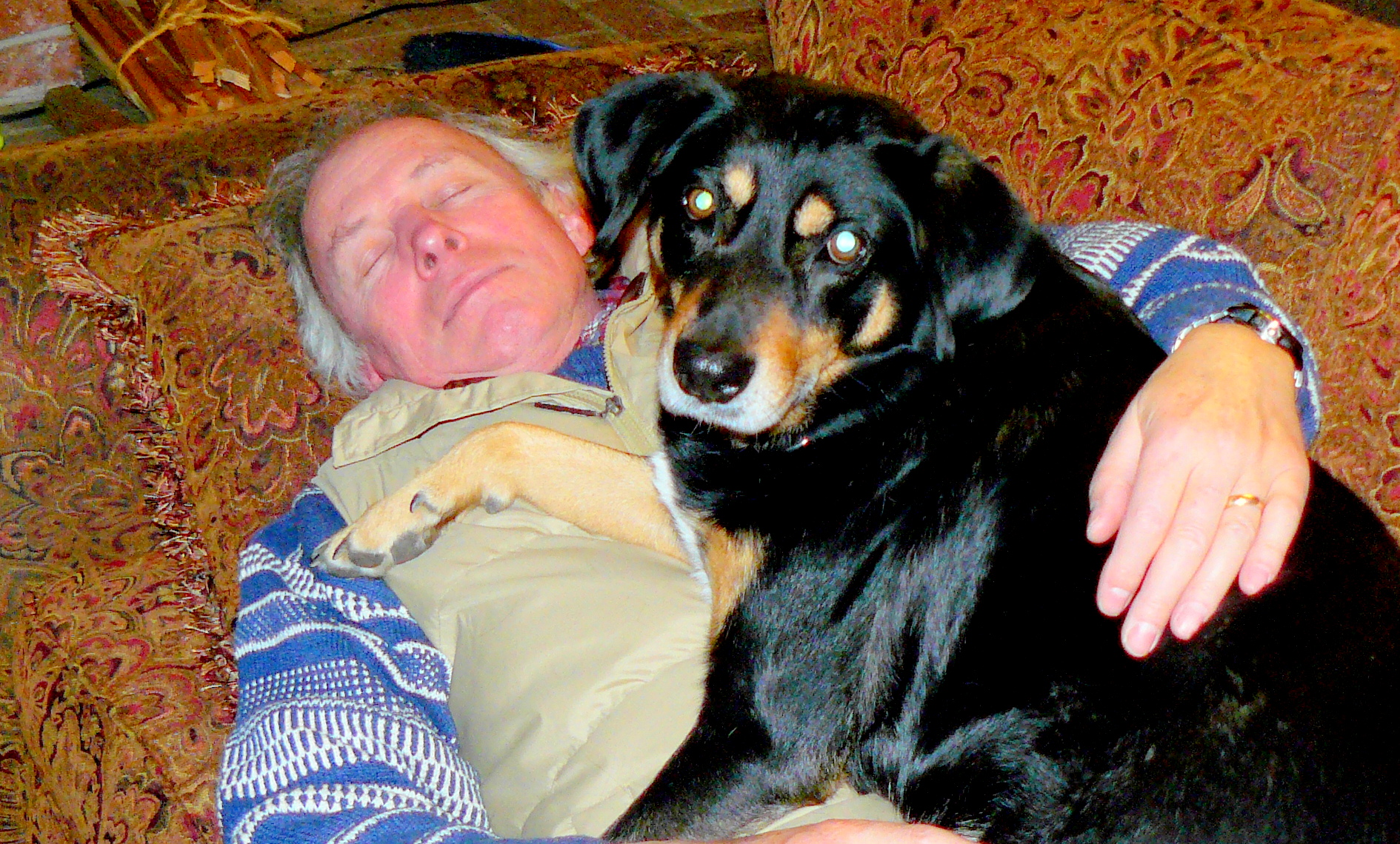
Phew – I need a dog to hug!

The truest of love between a man and a dog!
Hazel providing the ‘love-in’.

Quietening one’s self down.

Not without a touch of serendipity.

I’m speaking of meditation.

That is all I seem to do when I approach the subject: speak and think about it but never do it!

However, I think I may be approaching a turning point. All thanks to a follower of Patrice Ayme’s blog.  It was a comment from ‘R.’ in response to my question on this PA post.  Here’s how the comments flowed (hope this isn’t too long-winded but I wanted to select all that seemed appropriate to the post):

R:

I run 5d/wk, and I notice my thinking/contemplation is “heightened” during cardio. I believe this is no different than the “high” you get when taking some drugs (mushroom, weed, etc).

Physical exercise also helps keep my rest of the day sharp. But this is just keeping the engine (physical body) fit, thus helps thinking straight. Nothing more.

Meditation/awareness is the main key. And you need some way to be in it 24/7, not just during (or little while after) exercise . And “calm and collected” is the way for it. You can sustain this through out the day, and even during sleep/dream states (according to advanced meditators). “Calm” not as in “looking at navel”; calm as in “focused, in control, zen-like”. This involves moral conditioning too, as it’s hard to be calm if you have any shred of fear. And the way to lose fear, is through ideal morals (aka dharma, natural law).

There are higher meditative states (permanent, sustained), humans can get into. Temporary highs are just that.

—-

Patrice:

R: To be answered mostly in a separate comment. Meditative states are numerous. They are even necessary to some physical activities. It can be called concentration in some cases. Deep diving in apnea is an example. There is a case when meditation is life saving. Miss the meditation, miss the resuscitation.paul, like any new habit, meditation takes time to cultivate. It is after all a life long endeavor of “understanding one’s self”. It is easier if we dont view it as some new task (or half-hour daily exercise in navel-gazing).

—-

Me:

Having re-read the essay and others’ comments, causes me to speak a little about my own short-term memory failings. I’m 70 later this year and in the last, oh I don’t know ( can’t remember 😉 ), 2 or 3 years, my ‘event’ memory has declined dreadfully. But it’s not uniform. Even after 2 years, I still struggle to find certain shops in nearby Grants Pass but do recall clearly when our bridge washed out after we moved into the house in October, 2012.

There is no discernible pattern, and other men of my general age frequently suffer the same way.

If there were mental exercises that helped stem this problem, I would love to know more; assuming I could remember the details!

—-

R:

If i may, try meditation. A simple meditation exercise is just to be aware of yourself in all activities you do (initially we find ourselves lost often, but if you keep at it, soon % of being with yourself greatly exceeds losing self. calm, control and clarity is developed.). A good barometer/progress is to see if the daily activities drive you, or you drive the daily activities.

Of course physical exercises/fitness are absolute minimum. For old-age i would recommend yoga (fancy word for stretching and proper breathing)

Meditation while doing yoga with proper breathing (pranayama) gives out of this world results (this whole process is collectively called “yoga”).

And you can “be in it” 24/7 (as yoga includes sitting, sleeping poses too; It just an art of proper physical + mental positioning through out the day).

If eastern keywords are disturbing, ignore those. Just like everything else, the more you do something, the more you become that. This is particularly (exponentially) true for mind stuff.

—-

Patrice:

R: Paul is obviously a very reflective person. I do not exactly know what would be the distinctive definition(s?) between reflective and meditative states. I do know, though, that some sports (solo climbing and apnea) require total neurological control.

R:

Reflection/contemplation/meditation all of these help in mind (habits, inertia, anything thats limiting/holds-back) transformation.

Meditation is reflection on self. Reflection on daily activities takes time away from reflection on self. Increasing self awareness makes apparent all blind spots (wisdom).

If you are a physically able, healthy human, almost all your problems (aka “suffering”) are mind related. Physical body (including physical brain) just needs basic (of course healthy) sustenance.

Me:

R, yes I concur entirely about the majority of ‘problems’ being mind related. I have on my bookshelf next to me Roy Masters’ book ‘How Your Mind Can Keep You Well – An Introduction to Stress Management.

But if there’s one thing I would like to crack is starting and maintaining a programme of meditation. So many have recommended this approach and, rationally and emotionally, I know it will offer benefits. However, for some reason I can’t translate that ambition into actually starting.

Would love to listen to your advice about how to get started. You don’t have a blog do you? If not, fancy writing a guest post for Learning from Dogs! 😉 Contact details on the home page.

(Sorry Patrice – didn’t mean to hog the channel!)

Patrice:

Hog all you want, Paul. Even when I disagree with you, I find you interesting. Meditation and memory are vast questions. I pointed out that too much memory could be bad,  basically. The first thing to get good memory, is to stop stressing about it, and thinking about what we really care about, without getting drawn to, and drowned, in formalism.
PA

R:

Paul, If you are just looking for basic stress relieving meditation, this one looks good.

‘R’ then very kindly sent me the following:

To permanently establish this habit, first our mind needs to be convinced of the benefits.

Like any hobby, we need to develop an interest in the topic. And this means reading up on theory, on what is mediation, why do we need it, what happens if we pretend it doesn’t exist.

There are different styles of meditation, and different end goals, different schools of thought.

Self-inquiry is my preferred approach, as it’s the only thing you can rely on (your own self). There is a lot of literature on this. But all of this is just food for thought, nothing more.

There is also vast Buddhist literature: you can ignore all the theology and just focus on basics. Theory becomes a burden , so all conceptual knowledge has to be discarded. So I don’t advocate any philosophy or sect or schools of thought: Only believe in your realisations.

The end-goal of all this is full wisdom; reality as-is; liberation (end of suffering); control of one’s self; “the world is truly yours”; you are capable of handling anything; you can exercise “real free-will”; you are at ease being you; your knowledge will be flaw-less; and, finally, you will naturally empathise with others (as you will be aware what others are going through).

This is not some mumbo-jumbo, you will realize and experience it for your self.

This is about wisdom as in practical common-sense.

I am totally convinced by those heartfelt words. I’m sure there are others who, like me, have talked about meditation but done no more, hence me sharing this with you.

Anything to learn from dogs?

Are you kidding!

Cleo deep in meditation.

oooo

Pharaoh demonstrating the art of contemplation.

oooo

Cleo, deep in meditation.
Young Oliver, learning new ways in meditation.

My case rests!

Vive la différence.

It is the differences between us that are to be praised.

On the 10th August, Alex Jones, he of The Liberated Way, published a post under the title of Wisdom comes out of calm.  I read it and approved of the sentiments expressed.  Here’s a flavour of what Alex wrote:

My attitude towards dogs, and everything I do, is it is better to act in harmony with my world than impose violent control upon it. Nature is my teacher, and calm is one of its teachings. Calm is the sister of patience and tolerance, letting nature flow at its own pace and in its own way. When I planted acorns, I was unable to force them to grow, they acted in their own timing, at their own pace. I am like a parent rather than the master of eight strong oak saplings. I provide my saplings with opportunity through water, sun and good soil; protecting them from caterpillar and fungus; they follow their own nature in becoming fast growing little trees.

Then dear Patrice, he (or is it she?) of the blog Patrice Ayme’s Thoughts went on to write his own essay Calmly Thinking Up A Storm reflecting on Alex’s musings. One of the comments to me was:

Well, Paul, the entire essay answered why it’s wrong to equate calm with wisdom, as Alex does. If it was only him, it would be an interesting quirk. However, it’s pretty much a mass mood.

That philosophy of boiled vegetable leaves the plutocrats free to do a home run, home being, for them, hell. Part of the program is biospheric annihilation.

I didn’t agree with Patrice and my immediate reaction was try and take sides. Yet both writers were the authors of many fine essays. What to do?  As I expressed to Alex:

I have read both posts and, frankly, are bemused. It feels as though each is describing something utterly different to the other. I have a number of hours of electrical work today but will also give the matter a ‘coating of thought’ while working and offer my humble conclusions later on.

Serendipitously, the answered then arrived.

I’m about a third of the way through an audio course on Building Great Sentences delivered by Professor Brooks Landon, Professor at the University of Iowa English Department. Professor Landon talks about style and how difficult it is to define a particular author’s style.

It was at that moment that a flashbulb went off in my mind.  Wouldn’t literature be incredibly plain and boring if there were no real differences in the styles of all the many authors; past and present!

It brought me back to Patrice and Alex and, by default, hundreds of other authors of blogs right across the ‘blogosphere’.  Of course they express themselves differently! Of course they hold different opinions! It is those differences that are critical, utterly so, to each and every reader coming to their own conclusions; conclusions to a wide range of subjects and topics.

This was hammered home to me as I watched our dogs playing so well together.  The differences in each dog’s backgrounds and experiences contributed to the wonderful, unconditional way that they played and lived together.  The power of their unconditional love.

It is those differences that offer us insight into our own beliefs and prejudices.  It is those differences that allow us, and dogs, to make sense of ourselves. One might argue that it is the differences that deliver truth.

That feels much better! 🙂

Clouds above, and even farther away.

The second, and last, episode of the BBC Clouds Lab programme offers an intriguing message.

On Monday, I published a post under the title of The clouds above us.  The second episode demonstrated that even in atmospheric conditions of near vacuum, intense cold and very low humidity, conditions that would kill a human in seconds, there was microscopic bacteriological material to be found.

 Exploring the troposphere

The troposphere is a turbulent layer of air that begins at the Earth’s surface and ranges from 23,000-65,000 feet above sea level, depending on the latitude, season and the time of day. Its name originates from the Greek word tropos, meaning change. It’s now known that bacteria actually exists in clouds and scientists believe that it plays a significant part in the creation of rain but little is known about life higher up. Microbiologist Dr Chris Van Tulleken has discovered that living bacteria can exist well above 10,000ft in a hostile environment with low pressure, increased UV radiation, freezing temperatures, high winds and no oxygen or water.

There is an interesting set of clips to be watched on that BBC Cloud Lab website.

What I took away from watching the programme was that the minimum conditions necessary for living bacteria were far more harsh than one might expect.  In other words, finding living bacteria in other solar systems might not be such a science-fiction idea.

With that in mind, I’m republishing an essay that Patrice Ayme wrote in 2013.  I’m grateful for his permission to so do.

ooOOoo

40 Billion Earths? Yes & No.

Up to twenty years ago, a reasonable opinion among scientists was that there might be just one solar system. Ours. Scientists like to project gravitas; having little green men all over didn’t look serious.

However, studying delicately the lights of stars, how they vary, how they doppler-shift, more than 1,000 planets have been found. Solar systems seem ubiquitous. Astronomers reported in 2013 that there could be as many as 40 billion habitable Earth-size planets in the galaxy. However, consider this:

Centaurus A: Lobes Of Tremendous Black Hole Explosion Fully Visible.

Yes, that’s the center of a galaxy, and it has experienced a galactic size explosion from its central black hole.

One out of every five sun-like stars in our galaxy has a planet the size of Earth circling it in the Goldilocks zone, it seems — not too hot, not too cold — with surface temperatures compatible with liquid water. Yet, we have a monster black hole at the center of our giant galaxy, just like the one exploding above.

The Milky Way’s black hole is called Sagittarius A*. It exploded last two million years ago. Early Homo Erectus, down south, saw it. The furious lobes of the explosion are still spreading out, hundreds of thousands of light years away.

We are talking here about explosions potentially stronger than the strongest supernova by many orders of magnitude (depending upon the size of what’s falling into Sagittarius. By the way, a cloud is just heading that way).

Such galactic drama has a potential impact on the presence of advanced life. The richer the galaxy gets in various feature the situation looks, the harder it looks to compute the probability of advanced life.

The profusion of habitable planets is all the more remarkable, as the primitive methods used so far require the planet to pass between us and its star.

(The research, started on the ground in Europe, expanded with dedicated satellites, the French Corot and NASA’s Kepler spacecraft.). Sun-like stars are “yellow dwarves”. They live ten billion years.

From that, confusing “habitable” and “inhabitated”, the New York Times deduced: “The known odds of something — or someone — living far, far away from Earth improved beyond astronomers’ boldest dreams on Monday.

However, it’s not that simple.

Primitive bacterial life is probably frequent. However advanced life (animals) is probably very rare, as many are the potential catastrophes. And one needs billions of years to go from primitive life to animals.

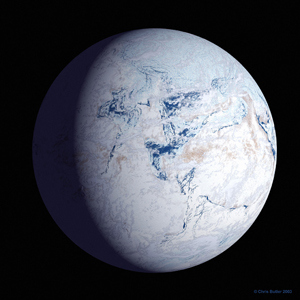
After life forms making oxygen on Earth appeared, the atmosphere went from reducing (full of strong greenhouse methane) to oxidizing (full of oxygen). As methane mostly disappeared, so did the greenhouse. Earth froze, all the way down to the equator:

When Snowball Earth Nearly Killed Life.

Yet volcanoes kept on belching CO2 through the ice. That CO2 built up above the ice, caused a strong greenhouse, and the ice melted. Life had survived. Mighty volcanism has saved the Earth, just in time.

That “snowball Earth” catastrophe repeated a few times before the Earth oxygen based system became stable. Catastrophe had been engaged, several times, but the disappearance of oxygen creating life forms had been avoided, just barely.

Many are the other catastrophes we have become aware of, that could wipe out advanced life: proximal supernovas or gamma ray explosions.

Cataclysmic eruption of the central galactic black hole happen frequently. The lobes from the last one are still visible, perpendicularly high off the galactic plane. The radiation is still making the Magellanic Stream simmer, 200,000 light years away. Such explosions have got to have sterilized a good part of the galaxy.

In 2014 when part of the huge gas cloud known as G2 falls into Sagittarius A*, we will learn better how inhospitable the central galaxy is for advanced life.

Many of the star systems revealed out there have surprising feature: heavy planets (“super Jupiters“) grazing their own stars. It’s unlikely those giants were formed where they are. They probably swept their entire systems, destroying all the rocky planets in their giant way. We don’t understand these cataclysmic dynamics, but they seem frequent.

Solar energy received on Earth fluctuated and changed a lot, maybe from one (long ago) to four (now). But, as it turned out just so that Earthly life could survive. Also the inner nuclear reactor with its convective magma and tectonic plates was able to keep the carbon dioxide up in the air, just so.

The Goldilocks zones astronomers presently consider seem to be all too large to allow life to evolve over billions of years. They have to be much narrower and not just with red dwarves (the most frequent and long living stars).

One of our Goldilocks, Mars, started well, but lost its CO2 and became too cold. The other Goldilocks, Venus, suffered the opposite major technical malfunction: a runaway CO2 greenhouse.

Mars’ axis of rotation tilts on the solar system’s plane enormously: by 60 degrees, over millions of years. So Mars experiences considerable climatic variations over the eons, as it goes through slow super winters and super summers (it’s imaginable that, as the poles melt, Mars is much more habitable during super summers; thus life underground, hibernating is also imaginable there).

Earth’s Moon prevents this sort of crazy hyper seasons. While, differently from Venus, Earth rotates at reasonable clip, homogenizing the temperatures. Venus takes 243 days to rotate.

It is startling that, of the four inner and only rocky planets, just one, Earth has a rotation compatible with the long term evolution of advanced life.

Earth has also two striking characteristics: it has a very large moon that store much of the angular momentum of the Earth-Moon system. Without Moon, the Earth would rotate on itself once every 8 hours (after 5 billion years of braking by Solar tides).

The Moon used to hover at least ten times closer than now, when earth’s days were at most 6 hours long.

The tidal force is the difference between gravitational attraction in two closely separated places, so it’s the differential of said attraction (which is proportional to 1/dd; d being the distance). Hence the tidal force is inversely proportional to the cube of the distance.

Thus on early Earth tides a kilometer high were common, washing back and forth every three hours. a hyper super tsunami every three hours, going deep inside the continents. Not exactly conditions you expect all over the universe.

Hence biological material fabricated on the continental margins in shallow pools would get mixed with the oceans readily. That would guarantee accelerated launch of life (and indeed we know life started on Earth very fast).

The theory of formation of the Moon is wobbly (recent detailed computations of the simplest impact theory do not work). All we know for sure, thanks to the Moon rocks from Apollo, is that the Moon is made of Earth mantle materials.

Somehow the two planets split in two. (Fission. Get it? It maybe a hint.)

Another thing we know for sure is that Earth has, at its core, a giant nuclear fission reactor, keeping Earth’s core hotter than the surface of the sun. An unimaginable liquid ocean of liquid iron deep down inside below our feet undergoes iron weather. Hell itself, the old fashion way, pales in comparison.

Could the Moon and the giant nuclear reactor have the same origin? This is my provocative question of the day. The Moon, our life giver, could well have formed from giant nuclear explosions, of another of our life givers, what became the nuke at the core. I can already hear herds of ecologists yelp in the distance. I present the facts, you pseudo-ecologists don’t decide upon them. It’s clear that nuclear fission is not in Drake equation: if nothing else, it’s too politically incorrect.

All the preceding makes this clear:

Many are the inhabitable planets, yet few will be inhabitated by serious denizens.

This means that the cosmos is all for our taking. The only question is how to get there. The closest stars in the Proxima, Beta and Alpha Centauri system are not attainable, for a human crew, with existing technology.

However, if we mastered clean colossal energy production, of the order of the entire present energy production of humanity, we could get a colony there (only presently imaginable technology would be fusion).

Giordano Bruno, professor, astronomer, and priest suggested that there were many other inhabitated systems around the stars. That insult against Islam meant Christianity was punished the hard way: the Vatican, the famous terrorist organization of god crazies, put a device in Giordano’s mouth that pierced his palate, and having made sure that way that he could not tell the truth, the terrorists then burned him alive. After seven years of torture.

The horror of truth was unbearable to theo-plutocrats.

Now we face something even worse: everywhere out there is very primitive life. It is likely gracing 40 billion worlds. But, if one has to duplicate the succession of miracles and improbabilities that made Earth, to earn advanced life, it may be just here that civilization ever rose to contemplate them.

Congratulations to India for launching yesterday a mission to Mars ostensibly to find out if there is life there (by finding CH4; while life is presently unlikely, Mars has much to teach, including whether it started there). That’s the spirit!

The spirit is to have minds go where even imagination itself did not go before.

If we sit back, and look at the universe we have now, from Dark Matter, to Dark Energy, to Sagittarius, to the nuclear reactor below, to billions of Earths, to a strange Higgs, to Non Aristotelian logic, we see a wealth, an opulence of possibilities inconceivable twenty years ago.

Progress is not just about doing better what was done yesterday. It’s also about previously inconceivable blossoms of entirely new mental universes.

***

Patrice Ayme

ooOOoo

Maybe, we are not alone!

Integrity and democracy.

“Democracy is when the indigent, and not the men of property, are the rulers.”

Thus said Aristotle.

Here’s another quote from more recent times.

“The supreme quality for leadership is unquestionably integrity. Without it, no real success is possible, no matter whether it is on a section gang, a football field, in an army, or in an office.”

So said President Dwight D. Eisenhower.

oooo

Today’s post started as an ill-defined idea in my head following me reading a recent essay over on Patrice Ayme’s blog.  It was his (her?) post of the 17th July in which was written, “Representative democracy has to be destroyed as an ideal.” and later,

Meanwhile the French People would be well advised to search for a new form of government more appropriate to the modern world, and the increasing democracy we all dearly need.

One does not have to look very far for inspiration: the Confoederatio Helvetica next door, an independent, and central part of the Franks’ Francia, is enjoying a much more direct form of democracy.

that caused me to leave a comment,

I read a deeper malaise in your essay, Patrice, and that is the failure of ‘representative’ democracy in country after country around the world. In fact, it’s inspiring me to write a post over on LfD about the possibilities for truly democratic government.

that, in turn, was replied to by Patrice:

Please go ahead, Paul, and keep me informed! ;-)! And you are completely right. Representative democracy is actually oligarchic representation. Athenians had 80,000 citizens, and 80,000 legislators. France has about 1,000 times more citizens, and one half of a thousandth (1/2,000) fewer legislators. That makes the French democratic index half of a million times less than the Athenians!

Let me step back for a moment.

Over the life of this blog, I have touched on the vulnerability of human life on this planet more than once.  It’s not being at all smart to say that mankind is crapping on its own doorstep and our future is in severe doubt.  The reason I say it’s not smart is simply because millions of people almost certainly think that or something pretty damn close.

Maybe the huge divide between what ‘the man in the street’ knows makes common sense and the terrible lack of common sense shown by so many of our governments is at the root of the problem.  In other words, our representative democratic system isn’t working.

Here’s a letter from the pages of the Tampa Bay Times from just last Tuesday.

Tuesday’s letters: Our democratic system is at risk

There are thoughtful, informed people who are worried that our democratic system of government is not working and the whole enterprise is at risk. I think there is only one solution to the problem: to elect people who have demonstrated the ability to work cooperatively with others and solve problems.

It is foolish to think that the personalities of members of Congress change when they arrive in Washington. A worrisome number were fools, buffoons and rigidly ideological before they were elected, and there is no realistic possibility that anyone or anything can change their personalities after they are elected and while they are in office.

It is a crisis long in the making. Most students finish high school with little or no understanding of American history or the way their government works. There is no understanding of the idea of citizenship and the heavy responsibility imposed on citizens who live in a democratic republic. There has never been so much information so easily available that could allow people to make wise use of their votes. But without the perspective of education and a deep understanding that voting is everything in our system of government, it all may slip away.

Roger C. Benson, St. Petersburg

to elect people who have demonstrated the ability to work cooperatively with others and solve problems.

I wouldn’t argue at all with the wisdom in those words.  But I would add to it.

It’s my sense that many citizens in many countries feel that the whole business of government has got to large, too complicated, too remote and, frankly, has less to do with working “cooperatively with others and solve problems” than with feeding its own mouth.  Take voter turnout.

Graph of voter turnout percentage from 1824 to 2008.
Voter turnout in the USA; 1824 – 2008

Why such high levels of absenteeism; for want of a better description?

Let’s go back to the Athenians as Patrice mentioned.  Plenty on the web to read but this article caught my eye.

Athenian Democracy: a brief overview

Christopher W. Blackwell, edition of February 28, 2003

· Summary ·

This article was originally written for the online discussion series “Athenian Law in its Democratic Context,” organized by Adriaan Lanni and sponsored by Harvard University’s Center for Hellenic Studies. Its purpose is to introduce, very briefly, the institutions of the Athenian democracy during the late 5th century BCE through the end of the radical democracy in the late 4th century. This is a companion-piece to “The Development of Athenian Democracy,” also written for the CHS’s discussion series.

· Introduction ·

The city of Athens lived under a radically democratic government from 508 until 322 BCE. Before the earlier date there was democracy to be found here and there in the government of Athens, and democratic institutions survived long after the latter date, but for those 186 years the city of Athens was self-consciously and decidedly democratic, autonomous, aggressive, and prosperous. Democracy in Athens was not limited to giving citizens the right to vote. Athens was not a republic, nor were the People governed by a representative body of legislators. In a very real sense, the People governed themselves, debating and voting individually on issues great and small, from matters of war and peace to the proper qualifications for ferry-boat captains (for the latter, see Aeschin. 3.157).1 The Athenian democracy was not, of course, a free-for-all of mob rule. The Athenians understood the value of checks and balances and of enforcing time for reflection before acting. They understood that professionalism is necessary in certain jobs, that accountability was necessary of most jobs, and that some jobs required absolute job-security. The system evolved over time, suffered two complete breakdowns in the 5th century, and is certainly open to criticism at many points during its history. Nevertheless, it was coherent enough during those two centuries that we can describe it, in general terms, without being too far wrong on any point. And despite its moments of imprudence, injustice, and indecision, it was an experiment remarkable enough to deserve our attention.

The early history of Athenian Democracy and its development is the subject of another article in this series. This general description of how the Athenians governed themselves will focus on the 4th century BCE, both because the democracy was most fully developed during that time and because the majority of our evidence either comes from that period, or describes the the Athenian government during that period.

Now there’s much more to read here for those so interested but I want to highlight a section from the above.  This section:

In a very real sense, the People governed themselves, debating and voting individually on issues great and small, from matters of war and peace to the proper qualifications for ferry-boat captains. The Athenian democracy was not, of course, a free-for-all of mob rule. The Athenians understood the value of checks and balances and of enforcing time for reflection before acting. They understood that professionalism is necessary in certain jobs, that accountability was necessary of most jobs, and that some jobs required absolute job-security.

So from 322 BCE to 2014 AD!

A few days ago, Jeannie needed to change some details regarding her US Social Security payment.  We saw that it could be done online.  As one would expect, setting up online access for Jean meant jumping through a number of security hoops.  All more or less sorted in 20 minutes.

It was clear that it would be incredibly difficult for someone to fraudulently break into her online SSA account. Think of the millions who perfectly happily manage their bank accounts online.

Ergo, there are no technical issues why every single eligible voter in the USA (and many other countries) couldn’t move towards governing themselves in a direct manner just like the Athenians. Indeed, voting in the USA at times of Presidential elections is permitted. But all that is doing is participating in a system that isn’t delivering real democracy.

We need to govern ourselves: “debating and voting individually on issues great and small, from matters of war and peace to the proper qualifications for ferry-boat captains.” Because humanity is facing some issues that are very great indeed!

Or have I missed something bloody obvious?

oooo

I opened today’s post with two quotations.  I shall close by offering another two.

“If we don’t hang together, we most assuredly will hang separately.”

Benjamin Franklin advising the original continental congress of what became the United States of America.

“A key political question today is: Do you support the well-being of the Earth and the life that the Earth supports?

From a good friend and supporter of this blog who chooses to remain anonymous.  Who then added: “This question has spiritual, natural and rational implications which frame the debate in terms of human values greater than money.”

Morality, intelligence and humanism.

An open letter reply to Patrice Ayme.

Two days ago I published a rather introspective post called The temptation to turn ever inwards. It was the result of reading three disturbing essays about the ‘affairs of man’; essays by Tom Engelhardt, Jim Wright and George Monbiot.  Frankly, I wasn’t expecting a great response either in the form of ‘Likes’ or written replies.  However, the first reply, a long reply, came in from Patrice Ayme.  I made the decision to reply to Patrice via a new post; ergo today’s post. Since making that decision a further comment came in from Sue Dreamwalker, also republished today.

What I am going to do is to reproduce Patrice’s comment but interspersed with my replies.

oooo

The biosphere evolved over billions of years. Now it is taken over by critters who live for just a few years. Solution? Make it so that said critters live longer, thus attaching a greater value upon survival.

I presume that the ‘said critters’ refer to humans? The average lifespan of humans has increased hugely. From a life expectancy of 30 years [1] at birth in Medieval Britain, back in the 13th Century, to an average of 67.2 years for humans worldwide in 2010. [2]

That’s an increase of 124% in a little over 700 years.  Yet despite that incredible increase in lifespan, humans have shown no interest in attaching a greater value to their survival: far from it!  One might even muse that humans have attached a greater value to those things that actively harm our survival.

For all the (over-) elaborate set-up of dear Monbiot, it’s simpler than that. Instead of going back to Baby Thatcher, Baroness god save the queen knows what, let’s grab a clear and present example.

I’m unclear as to what is meant by “the over-elaborate set-up” but as a long-time reader of Mr. Monbiot‘s essays I applaud both his commitment to the highest standards of journalism and to the UK’s Guardian newspaper for publishing so many of them over the years.  I would invite Patrice to give an example of over-elaboration coming from the pen of George Monbiot.

Britain, and many of the Brits, say our dear friend Chris Snuggs, a participant to your, and my, site, have said that they hated Europe, because Europe was not democratic enough. However, one of the latest improvement of the European Constitution is now effective: the head of the EC, the European Commission, is now to be elected by the just elected European PARLIAMENT. Guess what?

Chris Snuggs is more than a participant to Learning from Dogs, he is a close friend of many years.  Yes, he has strong views about Europe but those views are expressed in a declared, personal manner.

Chameleon Cameron, came out of the woodworks to bark, in the clearest way, that it was out of the question to do things differently from before, and now dare to have the European Parliament to elect (what is basically) the European Prime Minister.

Never mind that Britain voted for that European Constitutional change.

Never mind that in representative democracies, the leaders of the executive are elected by Parliament.

So what do we see here?

Contradiction within moods and thoughts systems (Britain agreed to the democratic change, and now does not). We also see erroneous ideas imposed (leaders of the executive says Cameron should be nominated undemocratically, that’s erroneous).

The same sort of things is also perking up in Iraq: the USA caused the mess there, committing several major war crimes in the process. Precisely because those war crimes were not prosecuted, a strong push has been exerted on Obama to duplicate Bush, and go back to attack Iraq some more.

Thus, it is simple: there bad ideas out there, and they need to be destroyed. And bad moods too (an example of bad moods is the enormity that the American population was made, by Bush, Cheney, Rumsfeld, etc., into an accomplice of the most major war crime there is, war of aggression. Now that this war is in the process of being lost, some clamor to have the war pursued with renewed vigor.

We are now the stewards of the biosphere, whether we like it, or not. We can’t just sit on our rumps, strokes dogs, and whine we will attend to our garden (Voltaire style). By doing nothing, we leave criminals such as Bush, or their spirit, or their mood, in power. And thus we become accomplices.

There is total agreement for the idea that humans are the stewards of the biosphere.  But if the “sit on our rumps, strokes dogs and whine we will attend to our garden” is aimed at me, as it appears to be, then I strongly disagree.  Living as simple a life as we can is a long way from “doing nothing”.

So go out there, and engage in combat, bad moods, and bad ideas. That’s what even very old alpha monkeys, covered with age spots, do. We don’t want to let very old monkeys be examples of moral rectitude we cannot emulate.

A last point: Monbiot does not realize the contradiction he engages in. In the guise of criticising the opposition, he puts it on a pedestal, and engages in its very propaganda. Monbiot, and many like him, bemoan a “shift towards conservatism”. Nothing could be more false. People who destroy the biosphere are NOT conservatives. They play conservatives on TV. In truth, they are just the opposite. They are destructionists.

I am of the opinion, totally so, that George Monbiot is not playing at conservatism.

oooo

So, dear reader, there is little in the comment from Patrice that has me nodding my head.  Don’t get me wrong! Patrice Ayme is an individual of extreme intellect as even a dip into his blog will confirm. I am a regular reader of the writings over at that place.

However, there is one major stumbling block for me, one that I have communicated privately to the said Patrice, and that is the issue of anonymity. Because Patrice Ayme is a nom-de-plume.  Despite following ‘his’ writings for some time and sharing the occasional private email, I have almost no idea about who the person is. Yes, ‘his’ writings are often very strong and highly critical of many aspects of modern life, especially the American political system.  But that is not unique.  There is a long line-up of writers doing the same, and doing the same over their signatures: Tom Engelhardt, Jim Wright and George Monbiot and many, many others

For me, hiding one’s identity so securely behind a ‘virtual’ mask yet writing so passionately about many of the issues critically affecting the future of mankind, doesn’t work.  If one can’t or won’t be honest about who they are, then better, perhaps, that they keep their thoughts and ideas close to them.  There is no shortage of people openly being critical about the American Government and much else across the world, and being critical openly.

Later, Sue of Sue Dreamwalker added a comment.  That resonated perfectly with me and it, too, is reproduced in full.

Paul sometimes I despair at how Mankind plays out his life in the world Paul… We bemoan lots as we sit in our homes as the virus of hate, greed, and disaster pours into our living rooms via the BLACK BOX of FEAR tricks… Which helps depress, make us anxious, fearful,…. It insights anger, aggression and the spiral of thought escalates out via the Web… Internet at our fingertips- instant reactions…

Some times I wonder as I ponder… at the soup being remixed… as only this week we hear of ISIS another branch of the terrorists we are now supposed to fear… As the UK now makes friends with its long time enemy Iran.. reinstating diplomatic relationships again.. The Saga runs on an on… With Oil as the major players .

That’s why turning inward is sometimes Paul the only thing we can do… As we can only live our lives… While I so want to save the world.. The world has also got to want to save itself…

I can only live my own life and stop the petty squabbles, the judgements, the criticisms as I mend my own world to live at peace within it…
Once we all realise its our thoughts which in fact we send out, in fear, in anger, as we judge and condemn that are reflected back …

WE create the world.. We consume its products, We want to live in the lifestyles that demand this World to exploit others for riches.. And yet condemn the conditions of the haves and have nots…

We have lost sight of our basic values in life Paul…

So yes I often retreat inwards… I have too.. Because I worry too much about the kind of Earth we are leaving our Grandchildren to grow up in…
~Sue

In final reply to Patrice, I shall reproduce this well-known quotation [3]:

I disapprove of what you say, but I will defend to the death your right to say it.

References:

1. “A millennium of health improvement“. BBC News. 1998-12-27.

2. CIA Factbook.

3.This saying is widely attributed to Voltaire, but cannot be found in his writings. With good reason. The phrase was invented by a later author as an epitome of his attitude. It appeared in The Friends of Voltaire (1906), written by Evelyn Beatrice Hall under the pseudonym Stephen G. Tallentyre.

Running on empty!

Is it just me?

It is my usual pattern to awake around 5am, sit upright in bed and browse the latest news on my tablet computer. Jean sleeps on most times next to me.

Thus it was last Friday morning that I am sitting in bed reading the latest goings on around the world.

But, unusually, that morning’s wanderings left a bleak mark on me. See if you feel the same way when I share the stories that I read.

From Naked Capitalism.

The Tragedy of the Soma Mine-Workers: A Crime of Peripheral Capitalism Unleashed

Posted on May 16, 2014 by Yves Smith

Yves here. This post explains how the horrific mine explosion in Western Turkey, which has officially claimed nearly 300 lives as the death count continues to rise, was not an accident but the direct result of privatization and circumvention of safety standards. And unlike the West, where industrial and mining accidents are met with short-term sympathy but little if any real change in working conditions, protests have broken out, not just in the mine town of Soma but also in major cities. As Mark Ames has pointed out, American has airbrushed out much of the history of labor’s struggles for safe workplaces and better pay. Violence against efforts to organize workers was common. Henry Ford had a private army of thugs for just this purpose. The tragedy in Turkey should serve as a reminder of what has been won, and how fragile those gains are.

By Erinç Yeldan, Dean of the faculty of Economics and Administrative Sciences, Yasar University and an executive directors of the International Development Economics Associates. Cross posted from Triple Crisis

One of the greatest work-crimes in mining industry occurred in Soma, a little mining village in Western Turkey. At noon-time on Tuesday, May 13, according to witnesses, an electrical fault triggered a transformer to explode causing a large fire in the mine, releasing carbon monoxide and gaseous fumes. (The official cause of the “accident” was still unknown, at this writing, after nearly 30 hours.) Around 800 miners were trapped 2 km underground and 4 km from the exit. At this point, the death toll has already reached 245, with reports of another 100 workers remaining in the mine, yet unreached.

Turkey has possibly the worst safety record in terms of mining accidents and explosions in Europe and the third worst in the world. Since the right-wing Justice and Development Party (AKP) assumed power in 2002, and up to 2011, a 40% increase in work-related accidents has been reported. The death toll from these accidents reached more than 11,000.

(Read the rest here.)

From the BBC News website:

In just over five years Britain will have run out of oil, coal and gas, researchers have warned.

A report by the Global Sustainability Institute said shortages would increase dependency on Norway, Qatar and Russia.

There should be a “Europe-wide drive” towards wind, tidal, solar and other sources of renewable power, the institute’s Prof Victor Anderson said.

The government says complete energy independence is unnecessary, says BBC environment analyst Roger Harrabin.

The report says Russia has more than 50 years of oil, more than 100 years of gas and more than 500 years of coal left, on current consumption.

‘Decisive action’

By contrast, Britain has just 5.2 years of oil, 4.5 years of coal and three years of its own gas remaining.

France fares even worse, according to the report, with less than year to go before it runs out of all three fossil fuels.

(Read the rest here)

Again from Naked Capitalism:

UK Survey Finds High Levels of Depression and Desperation Among the Young

Posted on May 16, 2014 by Yves Smith

If you’ve been keeping half an eye on economic news, the UK has of late been looking pretty spiffy relative to its advanced economy peers, with 2014 growth forecast at 3%. Even though unemployment in the UK is at its lowest level in five years, the young and the long-term unemployed haven’t benefitted to the same degree.

One issue that doesn’t get the attention that it merits is the destructive psychological impact of being out of work. Work doesn’t just provide money, as critical as that is. It provides a way of organizing your time, social interaction, and a place in society, even if that place is not really where you’d like to be. Being unanchored is extremely taxing. Recall that the Japanese get people to quit by giving them a desk and nothing to do. The lack of legitimacy, the implicit shaming of being isolated is sufficiently punitive as to induce workers to give up their pay and being able to tell their families they have a job.

The BBC reports on the results of a survey by the Prince’s Trust called the Macquarie Youth Index, which is based on a survey of roughly 2200 16 to 25 year olds. 13% were what the survey called Neet: not in employment, education, or training.

I will return to the terrible implications of this report after I declare a past interest.  Before I left England in 2008, I was an active volunteer with the Prince’s Trust. My years of being associated with the Trust taught me that helping young persons discover their strengths, enable them to maintain and defend a positive self-image, and offer them real hope for their future lives, was and is the most important role of society; without doubt!

Now back to that report:

The survey found high levels of suicidal thoughts and self harm among this group, and high levels of stress among the young generally. Key excerpts from the article:

The report found 9% of all respondents agreed with the statement: “I have nothing to live for”…

Among those respondents classified as Neet, the percentage of those agreeing with the statement rose to 21%.

The research found that long-term unemployed young people were more than twice as likely as their peers to have been prescribed anti-depressants.

One in three (32%) had contemplated suicide, while one in four (24%) had self-harmed.

The report found 40% of jobless young people had faced symptoms of mental illness, including suicidal thoughts, feelings of self-loathing and panic attacks, as a direct result of unemployment.

Three quarters of long-term unemployed young people (72%) did not have someone to confide in, the study found.

Martina Milburn, chief executive of the Prince’s Trust, said: “Unemployment is proven to cause devastating, long-lasting mental health problems among young people.

(Read the full report here and the BBC report here.)

Then there was the report from the NASA study team that key glaciers in West Antarctica are in an irreversible retreat. First seen by me on the BBC News website, from where the following photograph was taken.

Thwaites Glacier is a huge ice stream draining into the Amundsen Bay.

To really understand the message that Planet Earth is sending out to us humans, I would recommend reading Antarctica’s Glaciers Disintegrating over on Patrice Ayme’s blog.  Here’s how Patrice finishes that essay:

We imparted acceleration to the biosphere. We are pushing the biosphere around. And we know that the force we are applying is only augmenting. That means the acceleration, and even more the speed of the change, is going to get worse quick. That’s basic dynamics, first quarter of undergraduate physics.

Of course, neither the leaders of France, Great Britain, or the USA has taken such a course: they are basically ignoramuses at the helm (and Angela Merkel, who knows plenty of physics, made a risky bet she seems to be losing).

Clearly, we should instead apply the brakes to the maximum (instead of flooring the accelerator). What would be the price of this cautious? None, for common people: hard work to de-carbonize the world economy would require dozens of millions to be employed that way, in the West alone.

That, of course, is a scary thought for plutocrats, who much prefer us unemployed, impotent, and despondent.

Patrice Aymé

All of this is sending out a message. The message that if we are not very, very careful this could be the end-game for human civilisation on this Planet.

But do you know what really puzzles me?

It’s that this message is increasingly one that meets with nods of approval and words of agreement from more and more people that one sees going about one’s normal life.  Perhaps, because there’s more and more reporting from a wider and wider range of sources. Like The Permaculture Research Institute website recently publishing This Collapse is a ‘Crisis of Bigness’.  Like Grist publishing Walmart is the last place Obama should be making a clean energy speech.

Like Ian Welsh publishing Equal Rights to Profit from Impoverishing People and Causing a Great Extinction Event. Like Patrice in an essay last Friday about the way in which Main Stream Media is Manipulated. Viz:

Main Stream Media (MSM) has been the instrument of control of the People ever since there were oligarchies. It used to be about temples and priests, now it’s more about controlling papers, radio, TV, and the Internet.

and later on:

This crudeness, and vigilance of censorship by the owners [of the New York Times], is why the Obamas, Clintons, Krugmans, and Stiglitzs have to be careful. After all, they are just employees enjoying the perks of the system. Yes, they don’t own it. Ownership is everything. If the servants want to keep on thriving, those “leaders” will have to please the owners. So they “lead” where the real owners are willing us all, the herd, to be led.

Patrice rounds his essay off, thus:

The plutocracy focuses on direct control of the world imperial system, and that means controlling the giants (especially the three military leaders of the West). This is where the propaganda is the thickest.

The New York Times is considered to be the “newspaper of record” in the USA. However, the bottom line is that this is the third century during which it is owned and controlled by a particular family. How can these two elements be compatible? Why is that particular family “of record”?

Even in the Middle Ages, the most absolute kings there were, those of France, actually owned relatively little property. Francois I himself may have worn expensive clothes, but Italian bankers paid for his trips around France. Francois I did not own the media of the time.

What we have now is different. We have an ascending plutocracy that tries to grab the minds ever more. What Putin is doing in Russia is just a particular case, part of a whole.

Hopefully, people will see through this, and get their news from somewhere else than plutocratically owned media, thus bankrupting the MSM (the Internet can support journalists directly: see the successful Mediapart in France).

But I haven’t answered my earlier rhetorical question.  “But do you know what really puzzles me?” Implying that a growing number of people sense there is a problem with today’s world.

That question will be answered tomorrow. Do please return.