Tag: Patrice Ayme

Keep shouting it out!

The force of public opinion has never been more important; critically so!

As you all know this world of blogging: authors; followers; readers, is a great number of wonderful communities right across the planet. It is nothing like the traditional media, now owned and controlled by just a handful of large corporations, because the vast majority of blogging participants are free to say what they want, when they want.

Here’s an example.

Martin Lack is an Englishman who is the author of the blog Lack of Environment. As his home page quietly states:

Although scientificly trained (with degrees in Geology and Hydrogeology – see my About page), this blog arises from my having also got an MA in Environmental Politics and, as such, as the tagline indicates, is a blog on “the politics and psychology underlying the denial of all our environmental problems”… I hope you will take this on board; and enjoy the discussion.

“There is something fundamentally wrong in treating the Earth as if it were a business in liquidation” – Herman E. Daly (former World Bank economist).

The science about the chemistry of climate change especially the new danger of methane is clear. The commitment of our political leaders is less clear. But that doesn’t mean that we shouldn’t keep shouting out loud.

As Martin Lack did recently.

ooOOoo

Open Letter to David Cameron

29 March 2016

The Rt. Hon. David Cameron MP

The Prime Minister
10 Downing Street
London, SW1A 2AA

Dear Prime Minister,

Whatever happened to the greenest government ever?

Given my experience of working in environmental consultancy or regulation, I understand the importance of making pragmatic, risk-based decisions (as opposed to dogmatic, opinion-based ones).  I therefore believe that government policy should be formulated this way.  Unfortunately, however, this does not always seem to be the case.

As a pragmatic scientist, I am not ideologically opposed to nuclear power.  However, I do question the logic of pursuing ‘Hinkley Point C’ when equivalent investment in distributed renewable technologies – from domestic solar PV to submarine tidal stream – could probably generate more electricity faster.  Indeed, as Greenpeace has recently pointed out, the UK could meet nearly all its electricity generation needs from renewable energy sources by 2030.[1]

With regard to risk, the scientific consensus is that, in order to minimise anthropogenic climate disruption (ACD), the World must now embark upon the fastest-possible transition to a zero carbon economy.  Therefore, I also question the logic of simultaneously promoting investment in shale gas; discouraging investment in renewables; and cancelling investment in Carbon Capture and Storage research.

It is now over 50 years since scientists started warning of the climatic implications of continuing to burn fossil fuels;[2] and 50 years since fossil fuel company executives started spending huge sums of money on being “Merchants of Doubt”.[3]  As such, along with their counterparts in the tobacco industry, they have clearly not acted in the long-term interest of humanity as a whole.

However, as with the individual health benefit of ceasing to smoke tobacco, the sooner we stop burning fossil fuels the greater the collective environmental benefit will be. Therefore, I am pragmatically opposed to shale gas exploration because burning it is not consistent with the need to transition away from fossil fuels as fast as possible.

I am certain that you would like to secure an enduring political legacy; and would therefore like to ask just one question:

What could be better than being remembered as the Prime Minister that committed the UK to meeting nearly all its electricity generation needs from renewable energy sources by 2030?

Yours sincerely,

Martin C. Lack

————
[1] See: http://www.greenpeace.org.uk/blog/climate/uk-can-be-almost-entirely-powered-renewable-energy-2030-new-study-shows-20150921.

[2] Nuccitelli, D. (2015), ‘Scientists warned the US president about global warming 50 years ago today’, Guardian newspaper, 5 November 2015: London.

[3] Oreskes, N. & Conway E. (2010), Merchants of Doubt,  New York: Bloomsbury. See: http://www.merchantsofdoubt.org/

ooOOoo

Let me finish today’s post by republishing an exchange between Patrice Ayme and Martin over on a recent PA essay, that I republished in full in this place: Runaway Antarctica.

Martin:

I know I am wasting my time writing letters to David Cameron; and I know my opinions are irrelevant. However, the facts of history are not; nor will they be in the future.

Patrice:

I know you are doing the right thing. Writing to Cameron is entirely correct. But of course, he is a guy with just a salary and a few “savings”, a few tens of millions dollars of savings, maybe, or maybe not, and knew nothing about his recently deceased father having a fund of around 50 million dollars sheltered by shell companies, out there, somewhere related to Panama, or the British Virgin Islands, or the Bahamas, or Bermuda, whatever…

OK, David’s wife, officially, has a fund of more than twenty million pounds….

Martin:

For the record: I am socially-conservative (i.e. as opposed to liberal) but under no illusion as to the folly of what has been called ‘money fetishism’ (Karl Marx); and ‘growthmania’ (Herman E. Daly).

Patrice:

Hi Martin, thanks for the comment. I spent a whole hour reading the hard cover version of the paper the electronic version of which I criticized above. It’s quite a bit different. They use RCPs (Reasonable Carbon Projections, or the like in meaning). Yet, they don’t explain what they consist of exactly. All I know is that we are around 500 ppmv, and they work with 400 ppmv, in the 130 K-115 K years BP, when orbital conditions were cooler than now.

Plus we are going to be at 550 ppmv within ten years, at the present rate. The earliest date they have for the failure of Larsen C in their worst RCP 8.5 is 2055 CE. I would be surprised if it did not fail within ten years.

However, the paper version is more insistent on the danger of AIR warming, not just subsurface.

Also the Hansen paper has a scenario, which is suitably apocalyptic, but not apocalyptic enough in my book. Temperatures over the Arctic were strikingly high this winter, of the order of 4 to 5 degrees Centigrade higher than normal, and sometimes more. Nobody expected this sort of jumps. Except for yours truly!😉

Martin:

Thanks for the explanation, Patrice. This is all very reminiscent of the position of (Arizona) Professor Guy McPherson, who believes most scientists are in denial about the consequences of multiple positive feedback mechanisms we can already see operating:
http://lackofenvironment.wordpress.com/2013/02/19/what-on-earth-are-we-doing/

You all have a wonderful weekend and keep hugging those dogs of yours!

Runaway Antarctica

Do you hear the turnstile about to click!

Not so long ago I wrote a series of three posts under the titles of Interconnections One, Interconnections Two and, yes you guessed it 😉 , Interconnections Three. They were about the consequences of rising sea levels.

Now one might argue that this has nothing whatsoever to do with Learning from Dogs but I would disagree. For as I declare in The Vision of this blog:

It seems to me that a Vision statement should encapsulate just why the owners of the enterprise are committed to that venture.  The author of Learning from Dogs is committed to this project; here is the Vision.

Our children require a world that understands the importance of faith, integrity and honesty

Learning from Dogs will serve as a reminder of the values of life and the power of unconditional love – as so many, many dogs prove each and every day

Constantly trying to get to the truth …

The power of greater self-awareness and faith; faith that the only way forward for us is through the truth …

For in a very real and devastating way even a small rise in global sea level is going to cause tens of thousands of dogs, and their loving owners, to become homeless. We are long overdue a commitment from our global leaders and power-brokers to that, “.. faith, integrity and honesty.”

However, championing that greater self-awareness is what blogger Patrice Ayme does almost all of the time. With his kind permission, I republish his latest post on the state of the Antarctic Ice.

ooOOoo

Runaway Antarctica

I have written for years that a runaway Antarctica was certain, with half the icy continent melting rather spectacularly on an horizon of two centuries at most, and probably much less than that. This rested on the fact that half of Antarctica rests on nothing but bedrock at the bottom of the sea. At the bottom of what should naturally be the sea, in the present circumstances of significant greenhouse gas concentrations.

Visualize this: until sometimes in the Nineteenth Century, GreenHouse Gas (GHG) concentration was 280 ppm (280 parts per million), including the man-made sort. Now we are close to 500 ppm, using a variety of exotic gases we produce industrially, among them, CO2. In CO2 alone we are at:  Week beginning on March 20, 2016: 405.62 ppm. Weekly value from 1 year ago: 401.43 ppm. Weekly value from 10 years ago: 382.76 ppm. So the CO2 alone is augmenting at a bit more than 1% a year. Thus we will be at an equivalent of 550 ppm in ten years (including the full panoply of all the other man-made greenhouse gases, not just CO2). There is evidence that, with just 400 ppm, disaster is guaranteed.

Now visualize this:

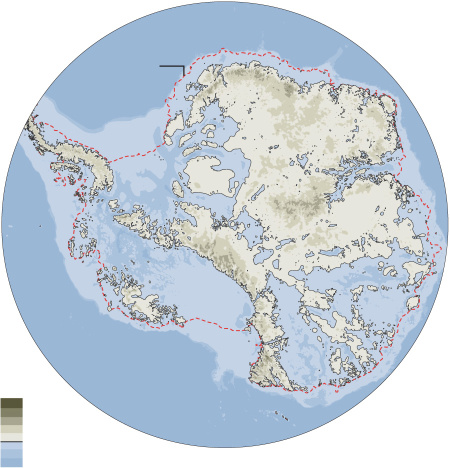
antarctica-truth-revealed-nyt-2016-450
How Antarctica would appear if its ice melted: it’s half under the sea.

Why so watery? Because the enormous glaciers, up to nearly 5,000 meter thick, press down on the continent with their enormous weight. Since the end of the last glaciation, 10,000 years ago, Scandinavia has been rising, and is still rising (I long used a picture with a similar information about Antarctica’s bedrock.)

A paper published on line in Nature on March 30, 2016, that is, two days ago, “Contribution of Antarctica to past and future sea-level rise” opines that:

Polar temperatures over the last several million years have, at times, been slightly warmer than today, yet global mean sea level has been 6–9 metres higher as recently as the Last Interglacial (130,000 to 115,000 years ago) and possibly higher during the Pliocene epoch (about three million years ago). In both cases the Antarctic ice sheet has been implicated as the primary contributor, hinting at its future vulnerability. Here we use a model coupling ice sheet and climate dynamics—including previously underappreciated processes linking atmospheric warming with hydrofracturing of buttressing ice shelves and structural collapse of marine-terminating ice cliffs—that is calibrated against Pliocene and Last Interglacial sea-level estimates and applied to future greenhouse gas emission scenarios. Antarctica has the potential to contribute more than a metre of sea-level rise by 2100 and more than 15 metres by 2500, if emissions continue unabated. In this case atmospheric warming will soon become the dominant driver of ice loss, but prolonged ocean warming will delay its recovery for thousands of years.

Notice that the scenario evoked in the last sentence is different from my  very old scenario, which is similar to the one advanced in November 2015 by the famous Hansen and Al. (I raised the alarm before Hansen, at least seven years ago). In my scenario, and Hansen’s the ice sheets melt from below, due to warm sea water intrusion.

The West Antarctic Ice Sheet is larger than Mexico.

Here is a taste of the paper (I have a Nature subscription):

“Reconstructions of the global mean sea level (GMSL) during past warm climate intervals including the Pliocene (about three million years ago)1 and late Pleistocene interglacials2, 3, 4, 5 imply that the Antarctic ice sheet has considerable sensitivity. Pliocene atmospheric CO2 concentrations were comparable to today’s (~400 parts per million by volume, p.p.m.v.)6, but some sea-level reconstructions are 10–30 m higher1, 7. In addition to the loss of the Greenland Ice Sheet and the West Antarctic Ice Sheet (WAIS)2, these high sea levels require the partial retreat of the East Antarctic Ice Sheet (EAIS), which is further supported by sedimentary evidence from the Antarctic margin8. During the more recent Last Interglacial (LIG, 130,000 to 115,000 years ago), GMSL was 6–9.3 m higher than it is today2, 3, 4, at a time when atmospheric CO2 concentrations were below 280 p.p.m.v. (ref. 9) and global mean temperatures were only about 0–2 °C warmer10. This requires a substantial sea-level contribution from Antarctica of 3.6–7.4 m in addition to an estimated 1.5–2 m from Greenland11, 12 and around 0.4 m from ocean steric effects10.”

So notice: when CO2 ppm per volume was at 280 130,000 to 115,000 years ago, sea level was up to ten meter higher than now. And now we are at 500 ppmv…

And notice again: When CO2 ppmv was at 400, sea level was up to 30 meters (100 feet) higher than today. And now we are at 500 ppm, and, in a blink, in ten years, at 550 ppm.

Here is another example from the paper. I said all of this before, but to have scientists paid to do research in this area write it black on white in the world’s most prestigious scientific magazine, will no doubt endow me with greater, and much desired, gravitas. So let me indulge, not so much for my greater glory, but because it should help taking what I have long said more seriously.

“Much of the WAIS sits on bedrock hundreds to thousands of metres below sea level (Fig. 1a)13. Today, extensive floating ice shelves in the Ross and Weddell Seas, and smaller ice shelves and ice tongues in the Amundsen and Bellingshausen seas (Fig. 1b) provide buttressing that impedes the seaward flow of ice and stabilizes marine grounding zones (Fig. 2a). Despite their thickness (typically about 1 km near the grounding line to a few hundred metres at the calving front), a warming ocean has the potential to quickly erode ice shelves from below, at rates exceeding 10 m yr−1 °C−1 (ref. 14). Ice-shelf thinning and reduced backstress enhance seaward ice flow, grounding-zone thinning, and retreat (Fig. 2b). Because the flux of ice across the grounding line increases strongly as a function of its thickness15, initial retreat onto a reverse-sloping bed (where the bed deepens and the ice thickens upstream) can trigger a runaway Marine Ice Sheet Instability (MISI; Fig. 2c)15, 16, 17. Many WAIS grounding zones sit precariously on the edge of such reverse-sloped beds, but the EAIS also contains deep subglacial basins with reverse-sloping, marine-terminating outlet troughs up to 1,500 m deep (Fig. 1). The ice above floatation in these East Antarctic basins is much thicker than in West Antarctica, with the potential to raise GMSL by around 20 m if the ice in those basins is lost13. Importantly, previous ice-sheet simulations accounting for migrating grounding lines and MISI dynamics have shown the potential for repeated WAIS retreats and readvances over the past few million years18, but could only account for GMSL rises of about 1 m during the LIG and 7 m in the warm Pliocene, which are substantially smaller than geological estimates.”

I said it before. Including the details. So the evidence was clear, and out there. The optimism (it will take 5 centuries for 50 feet of sea level rise) is not supported by evidence. Actually collapsing channels coming from inverted rivers running up on the bellies of ice sheets are now obvious on satellite pictures and collapse of major ice shelves is going to be a matter of years, not centuries.

But science is made by tribes and these tribes honor the gods (of plutocracy) who finance them, and their whims. So they don’t want to make their sponsors feel bad. So they say unsupported, optimistic stuff, contradicted by a first order analysis.

Science is good, metascience, better. Metascience includes the sociological reasons which explain why some scientists will take some “facts” for obvious (although, coming from another sociology, they are not).

Deep in the Nature paper, in the quote above, or in four drawings and graphs of future sea level rise, one can find projections according to what various models “predict”… 130,000 years ago (!) The “Old Physics” model predicts one meter rise of the sea (this is the official UN maximal prediction for 2100). The new model, again starting with the present conditions, predict more than a six meter rise (!) This is a case of metascience playing with sea level.

This way, the authors of the paper will be able to say, one day: we told you so. While at the same time not irritating their sponsors now (because to understand what they are really saying takes quite a while, and has to be understood as tongue in cheek, when they pretend to apply the analysis to 130,000 years ago… What they really mean is six meters now, not just one meter… Bye bye Wall Street. Punished by its own instruments…)

The question is not whether we will be able to avoid a twenty meter sea level rise: that’s, unbelievably, a given (barring unforeseeable, yet imaginable technological advances to extract quickly a lot of CO2 from the atmosphere). The question is whether we will avoid a 60 meter rise.

Patrice Ayme’

ooOOoo

Let me add a footnote.

Namely, that on Yves Smith’s Naked Capitalism blog on Saturday was an item under the heading of A Wake-Up Call on Climate Change and Clean Energy.

By Eric Beinhocker, Executive Director, INET Oxford. Originally published at the Institute for New Economic Thinking website

A stark warning from Institute researchers on the probability that ‘2°C capital stock’ will be reached in 2017

A new study from the Institute for New Economic Thinking at the Oxford Martin School and the Smith School for Enterprise and Environment, University of Oxford, shows that we are uncomfortably close to the point where the world’s energy system commits the planet to exceeding 2°C.

In the paper, to be published in the peer-reviewed journal Applied Energy, the authors calculate the Two degree capital stock – the global stock of electricity infrastructure from which future emissions have a 50% probability of staying within 2°C of warming. The researchers estimate that the world will reach Two degree capital stock next year, in 2017.

Read the full item here.

It’s enough to make us all feel angry and hopeless. That would be understandable but wrong.

Go and read my Inconnections Three for within that post is this:

Want to fight climate change? Here are the 7 critical life changes you should make.

For the sake of millions of us and our wonderful pets stay with it and demand change from our politicians and leaders in every way that you can.

Mature, healthy trees.

Continuing the metaphor that our trees offer us.

In yesterday’s post I offered up the idea that:

The analogy with planting trees is very apt. For any clown can plant the tree but parenting that young tree into a mature forty-foot high beauty takes professional management.

That post had been inspired by a recent essay over at Patrice Ayme’s Thoughts regarding the observation by Andy Grove, the founder of Intel, that promoting start-ups without the commensurate focus on growing those start-ups into viable commercial concerns was strategically and politically incorrect. Back to that essay for a further extract:

However, American-based manufacturing is not on the agenda of Silicon Valley or the political agenda of the United States. Venture capitalists actually told me it was obsolete (before stepping in their private jets). That omission, according to Mr. Grove, is a result of anotherunquestioned truism”: “that the free market is the best of all economic systems — the freer the better.” To Mr. Grove, or Mr. Trump, or yours truly, that belief is flawed.

Andy Grove: “Scaling used to work well in Silicon Valley. Entrepreneurs came up with an invention. Investors gave them money to build their business. If the founders and their investors were lucky, the company grew and had an initial public offering, which brought in money that financed further growth.” 

The triumph of free-market principles over planned economies in the 20th century, Mr. Grove said, did not make those principles infallible or immutable. There was room for improvement, he argued, for what he called “job-centric” economics and politics. In a job-centric system, job creation would be the nation’s No. 1 objective, with the government setting priorities and arraying the forces necessary to achieve the goal, and with businesses operating not only in their immediate profit interest but also in the interests of “employees, and employees yet to be hired.”

As even the New York Times now admits, the situation has degenerated since 2010. Although the employment rate halved, in a slave state, everybody is employed. But neither the economy, nor the society, let alone progress and civilization are doing better.

“Insecure, low-paying, part-time and dead-end jobs are prevalent. On the campaign trail, large groups of Americans are motivated and manipulated on the basis of real and perceived social and economic inequities.

Conditions have worsened in other ways. In 2010, one of the arguments against Mr. Grove’s critique was that exporting jobs did not matter as long as much of the corporate profits stayed in the United States. But just as American companies have bolstered their profits by exporting jobs, many now do so by shifting profits overseas through tax-avoidance maneuvers.

The result is a high-profit, low-prosperity nation. “All of us in business,” Mr. Grove wrote, “have a responsibility to maintain the industrial base on which we depend and the society whose adaptability — and stability — we may have taken for granted.” Silicon Valley and much of corporate America have yet to live up to that principle.”

If we return to that analogy of the tree, think how long and how much attention must be put into the conditions that will promote not only sustained growth of that young tree but growth to the point where it can propogate its own saplings.

As it is for young companies. The skills that company managers require to nurture that company to the point of self-sustaining maturity are many and varied. But they are underpinned by the need to be truthful and trustworthy, to be devoted to the employees of the company and to instill in all who work, and finance, that company to “love the customer”. Not just those customers that are the big spenders but also, and especially so, the many, many smaller clients that can make or break a company’s reputation.

So with that in mind let’s take a peek at USA LLC and UK Ltd.

Here are the closing paragraphs from Patrice’s essay:

Our corruption is not just an economic and social problem, a political problem, and a civilizational problem, as it was under Aristotle.  It is a problem for the entire planet.

We empowered a demagogue“, laments Mr. Kristof. His true calling, and that of the Main Stream Media, was to empower plutocrats, and their obsequious servants. How sad they are.

Patrice Ayme’

Then there is Richard Murphy in the UK who writes the blog Tax Research UK. In a recent post, entitled The Party Political Problem he opened, thus:

I like being outside the fray of party politics. I wasn’t born with a sufficient capacity for compromise to believe that any political party has all the answers to all questions. And yet, equally, I can admire those who can make the sacrifice to take part in this process. It is, for better or worse, at the heart of democratic politics.

That demands that it be done well. This requirement is predicated on three things. The first is a willingness to pretend you have the answer to all things. The second is a leadership that knows this is not true and which as a result respects its opponents. The third is an acute appreciation of the fact that compromise in pursuit of a higher goal, whilst saving face, is the ultimate political aim: nothing really happens without the accommodation of others.

He then closes his post:

Passion, dogma and steadfastness, come what may, are not what makes party politics.

Conviction based on wisdom, understanding and compassion does.

But these qualities remain in far too short supply, even if they’re not quite out of stock, yet.

And that’s the party political problem.

Many people both ‘sides of the pond’ would nod heads in agreement with that.

My final peek is into an essay that was recently published by the quarterly journal The Baffler. The essay was from David Graeber under the heading of Despair Fatigue. Opening:

Is it possible to become bored with hopelessness?

There is reason to believe something like that is beginning to happen in Great Britain. Call it despair fatigue.

For nearly half a century, British culture, particularly on the left, has made an art out of despair. This is the land where “No Future for You” became the motto of a generation, and then another generation, and then another. From the crumbling of its empire, to the crumbling of its industrial cities, to the current crumbling of its welfare state, the country seemed to be exploring every possible permutation of despair: despair as rage, despair as resignation, despair as humor, despair as pride or secret pleasure. It’s almost as if it’s finally run out.

and closing, thus:

Twenty-first century problems are likely to be entirely different: How, in a world of potentially skyrocketing productivity and decreasing demand for labor, will it be possible to maintain equitable distribution without at the same time destroying the earth? Might the United Kingdom become a pioneer for such a new economic dispensation? The new Labour leadership is making the initial moves: calling for new economic models (“socialism with an iPad”) and seeking potential allies in high-tech industry. If we really are moving toward a future of decentralized, small, high-tech, robotized production, it’s quite possible that the United Kingdom’s peculiar traditions of small-scale enterprise and amateur science—which never made it particularly amenable to the giant bureaucratized conglomerates that did so well in the United States and Germany, in either their capitalist or socialist manifestations—might prove unusually apt. It’s all a colossal gamble. But then, that’s what historical change is like.

In other words, it’s this!

One of the age-old maxims from professional company managers is:

It’s always a case of putting people before profits!

Putting people before profits should be in the front of the minds of all our leaders and masters; both sides of the ‘pond’.

Or in tree language investing in this:

Clown work! (This is a Red Maple, by the way!)
An American Red Maple sapling.

to achieve this:

A mature American Red Maple tree.

Come on good people, we really do need healthy, mature trees in our 21st C. societies.

Interconnections One.

The beat of a butterfly’s wings.

From Wikipedia:

The Butterfly Effect is a concept that small causes can have large effects. Initially, it was used with weather prediction but later the term became a metaphor used in and out of science.[1]

In chaos theory, the butterfly effect is the sensitive dependence on initial conditions in which a small change in one state of a deterministic nonlinear system can result in large differences in a later state. The name, coined by Edward Lorenz for the effect which had been known long before, is derived from the metaphorical example of the details of a hurricane (exact time of formation, exact path taken) being influenced by minor perturbations such as the flapping of the wings of a distant butterfly several weeks earlier. Lorenz discovered the effect when he observed that runs of his weather model with initial condition data that was rounded in a seemingly inconsequential manner would fail to reproduce the results of runs with the unrounded initial condition data. A very small change in initial conditions had created a significantly different outcome.

We all live in an interconnected world. Frankly, it’s such an obvious statement that one presumes that very few would not agree with the sentiment expressed within it.

But (and you knew there was a ‘but’ coming, didn’t you!) very few of us (and I include Jean and me to a very great extent) really understand, “A very small change in initial conditions had created a significantly different outcome.”

Take these few items; more or less randomly read over the last few days.

Such as this post over on Patrice Ayme’s blog.

Biblical Flood Starting Anew

Abstract: update on Sea Level Rise. The meat of the essay is at the end, in the section “THE SITUATION IS ACTUALLY CATACLYSMIC“.

Heard of The Flood? As in the Bible? Sea level rose 120 meters (400 feet), in the period centered around 10,000 years ago. The cause? More than half of Earth’s ice melted in a few millennia,  During the rest of the early Holocene, the rate of rise of the world’s ocean reached peaks as high as 60  millimeters (2.5 inches) per year. The melting of the ice happened because Earth’s positional and orbital parameters had made northern hemisphere’s summers too warm (most of the ice shields rested on the large continents of the north). Nowadays only two enormous ice shields are left: Greenland and Antarctica.

Those who enjoy catastrophes will love it: we have 75 meters of further sea rise to enjoy pretty soon, on our way to a Jurassic climate (the Jurassic was characterized by gigantic warm shallow seas on top of the continents). Here was the situation in the Miocene, when CO2 was at 500 ppm (where we will be at in ten years, see conclusion below).

Patrice said that the essence, the meat, of his essay was at the end. Here are his closing words:

Three scientific papers published in the last two months support my, admittedly drastic, point of view. One observed the collapse of a colossal glacier in northwest Greenland, eaten by a current at one degree C. It was a miniature reproduction of what to expect for entire ice shields. Two others observed the past, and that Antarctica was unstable at 500 ppm CO2. What they did not say is how dramatic the situation was. Indeed, sounding moderate is how they get funded by a benevolent, plutocratically ruled government (and by government, I also mean the corrupt Supreme Court, not just the latest elected buffoons). The scientists who evoked the 500 ppm of CO2 omitted two significant details, where the devil lurks. They claimed that it would take 30 years to get there. That’s not correct; at the present rate, we will add 100 ppm of CO2 within 25 years. But not just that: there are other man-made GreenHouse Gases (GHG): CH4, NOx, Fluorocarbons, etc. All these gases warm up the lower atmosphere much more than CO2. So the correct measurement is not CO2 ppm, but CO2 EQUIVALENT ppm.

We are right now ABOVE 450 ppm in EQUIVALENT CO2, and will be at 500 ppm within ten years. Let’s hope there will be more boats than on the Titanic.

Patrice Ayme’

P/S: If anything, the preceding is a conservative estimate. Indeed very serious scientists evaluated already the man-made greenhouse gases at 478 ppm in 2013. This means we will be above 500 ppm in CO2 equivalent within six years, in line with my previous analyses, such as “Ten Years To Catastrophe“. See:

http://oceans.mit.edu/news/featured-stories/5-questions-mits-ron-prinn-400-ppm-threshold

Now it’s not all ‘doom and gloom’ and there is much that each and every one of us can do. More of that in Interconnections Three on Thursday.

But to continue with this ‘wake up call’ I’m going to republish in full an item that was recently published over on Mother Nature Network: 11 alarming facts about sea-level rise. To stop today’s post being excessively long, I’m going to split that MNN article over today and tomorrow. Here are the first 5 alarming facts. (Don’t read them just before turning the light out when going to bed tonight!)

ooOOoo

11 alarming facts about sea-level rise

Russell McLendon,  February 26, 2016.
 Up to 216 million people currently live on land that will be below sea level or regular flood levels by 2100. (Photo: Shutterstock)
Up to 216 million people currently live on land that will be below sea level or regular flood levels by 2100. (Photo: Shutterstock)

The ocean is coming for us. Global sea levels are now rising by 3.4 millimeters per year, up from an average rate of 1.4 mm per year last century. In just 80 years, the ocean could be a full 1.3 meters (4.3 feet) taller than it is today.

That kind of planetary sea change can be hard to fathom — unless you live in a low-lying place like Miami, the Maldives or the Marshall Islands, where the effects of sea-level rise are already apparent. But within just a few decades, the problem will become unavoidable in major coastal cities around the world, from New Orleans, New York and Amsterdam to Calcutta, Bangkok and Tokyo.

We all know why this is happening. Rising seas are one of the most salient effects of man-made climate change, triggered by thermal expansion of seawater as well as the influx of melting glaciers. Yet many people still see it as a distant risk, failing to grasp how (relatively) quickly the sea is swallowing shores worldwide. And since half of all humans now live within 60 kilometers (37 miles) of a coast, this isn’t a niche issue.

To help put things in perspective, here’s a deeper look at the problem:

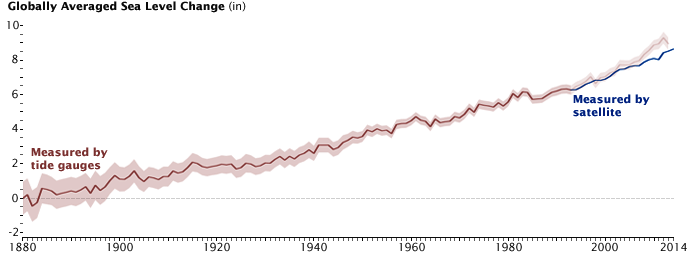
1. Global sea levels have already risen by 8 inches (200 mm) since 1880.

sea-level-rise-1880-2014

The chart above was produced by NASA’s Earth Observatory, based on data from the U.S. National Oceanic and Atmospheric Administration (NOAA) and Australia’s Commonwealth Scientific and Industrial Research Organization (CSIRO). Most of those historical data come from tide-gauge measurements, which are now complemented by satellite observations.

2. Not only are sea levels rising; the rate of their rise is rising.

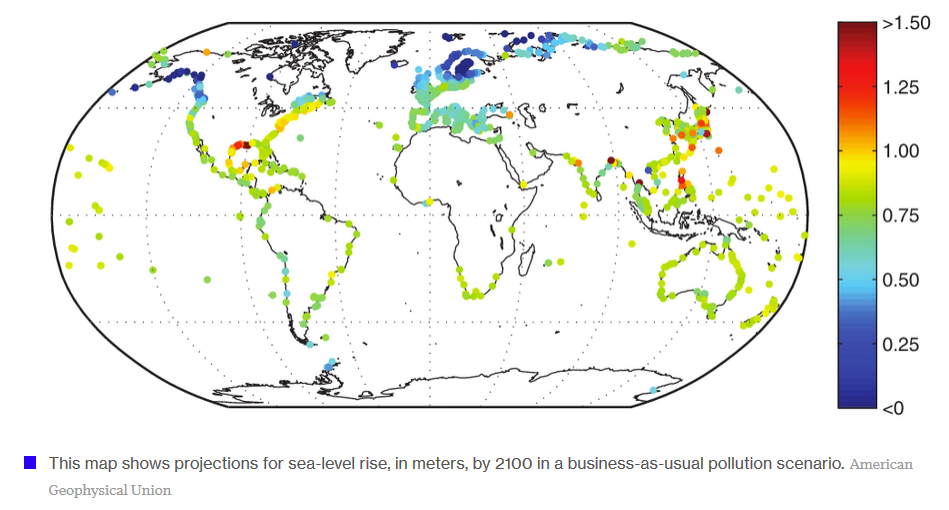
Average global sea-level rise is now 3.41 mm per year, but the rate varies widely by location. (Image: NASA GSFC)

On average, sea levels rose by 1.4 mm from 1900 to 2000. The yearly pace had surpassed 3 mm by 2010, and now it’s up to 3.4 mm per year.

3. That’s the fastest sea-level rise Earth has experienced in 3,000 years.

Cb5MxZ4WIAAAW06If not for surging carbon dioxide in the atmosphere, sea levels should have only risen about an inch or two last century, and might have even fallen. Instead, thanks to the highest CO2 levels at any point in human history, global sea levels rose by 5.5 inches (14 cm) between 1900 and 2000. That’s the fastest oceanic advance in 27 centuries, according to a study published Feb. 22, and it’s still speeding up.

“The 20th century rise was extraordinary in the context of the last three millennia — and the rise over the last two decades has been even faster,” says lead author Robert Kopp, a climate scientist at Rutgers University, in a statement.

“Scenarios of future rise depend upon our understanding of the response of sea level to climate changes,” adds co-author Benjamin Horton. “Accurate estimates of sea-level variability during the past 3,000 years provide a context for such projections.”

4. Every vertical inch of sea-level rise moves the ocean 50 to 100 inches inland.

Miami coastal flooding
Rising seas worsen regular flooding — like this 2015 high tide in Miami Beach — for many coastal cities. Miami is in the midst of a five-year, $400 million effort to upgrade its stormwater pump program. (Photo: Joe Raedle/Getty Images)

5. That’s already causing flood problems in many big coastal cities.

CLICK HERE TO SEE THE EFFECT ON BIG COASTAL CITIES

As the ocean invades coastal cities, the first signs of trouble are often urban saltwater floods. These can also happen naturally, though, so to determine the influence of rising seas, a new report by Climate Central models “alternative histories simulating the absence of anthropogenic climate change” at 27 U.S. tide gauges.

Out of 8,726 days since 1950 when unaltered water levels exceeded the National Weather Service thresholds for local “nuisance” floods, 5,809 didn’t exceed those thresholds in the alternative histories. “In other words,” the report explains, “human-caused global sea level rise effectively tipped the balance, pushing high-water events over the threshold, for about two-thirds of the observed flood days.”

Coastal flooding days have more than doubled in the U.S. since the 1980s, according to the report, in places ranging from Miami, Virginia Beach and New York to San Francisco, Seattle and Honolulu. According to a 2014 report, at least 180 floods will strike Annapolis, Maryland, during high tides every year by 2030 — sometimes twice a day. The same will be true for about a dozen other U.S. cities by 2045, not to mention many other low-lying urban areas around the world.

ooOOoo

To be continued tomorrow.

None so blind …

…. as those who choose not to see!

Note: This is a long and pretty depressing post yet one that contains a critically vital message. Just wanted to flag that up.

This is not the first time I have used this expression as a header to a blogpost. The first time was back in August 2013 when I introduced the TomDispatch essay: Rebecca Solnit, The Age of Inhuman Scale.

I am using it again to introduce another TomDispatch essay. Like the Solnit essay a further reflection on the incredible madness of these present global times.

But before getting to that essay let me refer to a recent Patrice Ayme post. It is called: New Climate Lie: Magical CO2 Stop Possible.

Patrice included this graph:

To Stay Below 2C, CO2 Emissions Have To Stop Now. We Are On The Red Trajectory: Total Disaster

Adding:

Tempo depended upon the CO2 concentration, pitch upon the Earth global temperature, distortion upon the energy balance on land in watts per square meter. The numbers used were past and anticipated. After 2015, the graphs became two: one was red, the bad case scenario, the other was blue, and represented the good scenario.

As I looked at the blue graphs, the optimistic graphs, I got displeased: the blue CO2 emissions, the blue temperature, and the blue power imbalance, had a very sharp angle, just in 2016. First a sharp angle is mathematically impossible: as it is now, the curves of CO2, and temperature are smooth curves going up (on the appropriate time scale). It would require infinite acceleration, infinite force. Even if one stopped magically any human generated greenhouse gases emissions next week, the CO2 concentration would still be above 400 ppm (it is 404 ppm now). And it would stay this way for centuries. So temperature would still rise.

The composer, who was on stage, had been advised by a senior climate scientist, a respectable gentleman with white hair, surrounded by a court, who got really shocked when I came boldly to him, and told him his blue graph was mathematically impossible.

I told him that one cannot fit a rising, smooth exponential with a sharp angle bending down and a line. Just fitting the curves in the most natural, smooth and optimistic way gives a minimum temperature rise of four degrees Celsius. (There is a standard mathematical way to do this, dating back to Newton.)

Read Patrice’s essay in full here.

However, I find the malaise gripping us in these times to be infinitely more difficult to understand than what is or is not mathematically possible. I just can’t get my mind around the possibility that we are in an era where greed, inequality and the pursuit of power and money will take the whole of humanity over the edge.

Why, for goodness sake, is the U.S., my adopted home country, pursuing gas exports? As I read here: United States On Path to Becoming Major Exporter of Natural Gas Despite Climate Impacts
Here’s a taste of this report from Julie Dermansky of Desmogblog:

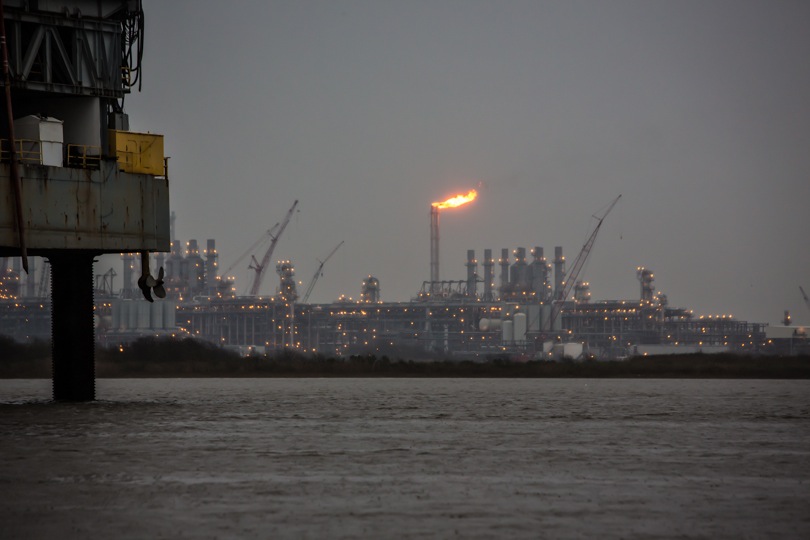
A flare at Cheniere Energy Sabine Pass LNG facility. ©2016 Julie Dermansky

But rather than acknowledging the climate risk posed by further expansion of LNG export infrastructure, the U.S. Congress and the Obama administration are moving in the opposite direction.

The natural gas export industry may grow even more rapidly if the first new bipartisan energy legislation drafted since 2007 passes. The Energy Policy Modernization Act of 2015, known as S. 2012, would expedite permitting for LNG export terminals.

The bill’s passage was considered imminent until it derailed with the introduction of an amendment that would provide emergency aid towards solving the lead-contaminated water crisis in Flint, Michigan. Now the passage of the bill hinges on whether the Senate will come to terms on aid to Flint.

Lobbying for the bill has been heavy. As DeSmog’s Steve Horn reported: “The list of lobbyists for S.2012 is a who’s who of major fossil fuel corporations and their trade associations: BP, ExxonMobil, America’s Natural Gas Alliance, American Petroleum Institute, Peabody Energy, Arch Coal, Southern Company, Duke Energy and many other prominent LNG export companies.”

I highlighted the name ExxonMobil in that extract because that company is the subject of Tom Engelhardt’s essay from Bill McKibben. Republished here with Tom’s kind permission.

ooOOoo

Tomgram: Bill McKibben, It’s Not Just What Exxon Did, It’s What It’s Doing

I am what I learn!

Reflections on the old and the new.

So here we are on the last day of 2015, the cusp of a new year and who knows what the next twelve months have in store.

All I am going to do is to reflect on the huge potential our modern ‘wired-up’ world offers for learning.

Most will know the saying, “You can’t teach an old dog new tricks.”

But it is wrong!

Here at home, where a number of the dogs are in their old age (Pharaoh is the equivalent in age of 100 human years; one dog year being approximately the same as eight human years) Jean and I see no difficulty in these elderly dogs learning new tricks.  Staying with Pharaoh, as an example, his hearing is pretty poor now but he has learnt a whole range of hand signals in recent months and he still communicates very well with us.

There is much in this new world that concerns me and I know I am not alone with this view. But the rewards of reading the thoughts of others right across the world are wonderful beyond measure.

Here’s a tiny dip into some fascinating items and articles that have graced my in-box in just the last twenty-four hours.

  • Eckhart Tolle’s Moment Reminder: “As far as inner transformation is concerned, there is nothing you can do about it. You cannot transform yourself, and you certainly cannot transform your partner or anybody else. All you can do is create a space for transformation to happen, for grace and love to enter.”
  • Val Boyco, “Everything comes to us that belongs to us, if we create the capacity to receive it.” ~ Rabindranath Tagore
  • John Zande in his Sketches on Atheism, “Theism’s most potent, pervasive, irresistibly enchanting gift to frightened but otherwise sane individuals is a belief—a promise—that upon their death they will go home.”
  • Mother Nature Network, “7 ways to meditate while you move – If you don’t have time for sitting meditation, give one of these active meditations a try.”
  • George Monbiot, (on the UK floods), “These floods were not just predictable. They were predicted. There were clear and specific warnings that the management of land upstream of the towns now featuring in the news would lead to disaster.”

and my final selection:

  • Patrice Ayme: (from an essay on Brain & Consciousness) “The best microprocessors you can buy in a store now can do 10 to the power 11 (10^11; one hundred billions) operations per second and use a few hundred watts,” says Wilfred van der Wiel of the University of Twente in the Netherlands, a leader of the gold circuitry effort. “The human brain can do orders of magnitude more and uses only 10 to 20 watts.  That’s a huge gap in efficiency.”

So here’s to a new year of wonderful new learnings.  And let me leave you with this additional message for 2016.

Namely that The Nation weekly journal are celebrating their 150 years of publishing the magazine. They recently published a 150th Anniversary edition and the front editorial is written by Katrina Vanden Heuval. There is a ‘break out’ to one side on Page 2 of that editorial that reads:

Change is inevitable, but the one constant in The Nation‘s history has been a faith in what can happen if you tell people the truth.

Finding out the truth and sharing it so we can all see what can happen is my wish for 2016.

Happy New Year to all of you, and to all of your friends and loved ones.

Forgive the introspection: Part Two

A good philosophical “coating of thought”.

In yesterday’s Part One, I focused on the hugely damaging effects of inequality in society. Reinforced only last Monday by an article by Professor Adam Levitin, a Professor of Law at Georgetown Law School. (Who also recently served on the Consumer Financial Protection Bureau’s Consumer Advisory Board and was Special Counsel to the Congressional Oversight Panel for the Troubled Asset Relief Program.) Levitin’s article was published by Naked Capitalism and opened with this statement:

A lot of Americans — right and left — are frustrated with what has happened to the middle class. The gap between the superrich and the rest of the country has widened, and it seems like everyone is having to work harder just to stay in place: wages have been stagnant, two-incomes are nearly mandatory (creating a subsidiary child care issue), and millions have lost their home equity in foreclosures. While there are a lot of people who bemoan the fate of the middle class, and even some want to do something about it, they don’t or can’t do the heavy lifting necessary to figure out why the system is broken and who wants to ensure it remains that way.

(I strongly encourage you to read the rest of the article.)

Trust me, as a good middle class Brit (albeit now living in America), it’s not just Americans who are frustrated!

However, one happening in this modern world is wonderful. I’m speaking of the ways that ideas can circulate around the world.

Better than that, the wonderful way we can “listen in” on the reflections of others in a manner that would have been impossible twenty years ago.

A few days ago, Patrice Ayme (PA) published a post called Human Kind, Yet Evil Rule. As so frequently happens, it attracted a clutch of fascinating responses.  One of those responses came from a PA reader who writes under the name of EugenR. EugenR offered in his response a fascinating dialogue between a group of persons, and I saw that dialogue as promoting the value of philosophising about the more challenging aspects of present life.

Eugene explained, “It was edited from a conversation in the past. I found it to be a relevant response to the essay.” It matters not the names of the people described by the initials, what matters so much more is the value of an introspective “coating of thought”.

ooOOoo

EugenR: The worst rule the world, because they are the worst.

GD: Not for long

EugenR: For ever

GD: What about Non Violent Civil Disobedience ?

EugenR: At the end the “Non Violent Civil Disobedience” is a human organization, and as such it will either die out, or in worse case will have an organizational structure in which the worst bullies will be on the top. There is nothing new under the sun.

GD: At the end the truth, that at the age of internet is a simple finger click away, will win.

EugenR: At the end the truth wins, the question is when and at what price. In between the lie and cruelty celebrates. Just remember the last century events (Hitler, Stalin, Mao Zedong, Pol Pot, Mugabe i mean Dr Mugabe, etc.). All of them are gone (except the least evil Dr Mugabe). Did you know Pol Pot studied in Paris? Don’t be upset by history but learn from it. And now you have the Islam fundamentalism, that is all about cultural and religious non tolerance, racism (Sudan, Darfur, etc.), legitimization of enslavement of the non Muslims, intellectual degradation of women, death penalty for apostasy (Under current laws in Islamic countries, the actual punishment for the apostate (or murtadd مرتد) ranges from execution to prison terms. Islamic nations with sharia courts use civil code to void the Muslim apostate’s marriage and deny child custody rights, as well as his or her inheritance rights for apostasy. Twenty-three Muslim-majority countries, as of 2013, additionally covered apostasy in Islam through their criminal laws.), etc.

GD: The real question is do we have less fear because we have more access to knowledge? Or more fear because the media has portrayed fear as the new normal? I am not sure that mass herd mentality works in modern society anymore. And that is how dictators ruled. The new fear is forced acceptance. It is worse. Or should I say financially forced acceptance.

AH: I believe that unarmed truth and unconditional love will have the final word in reality. This is why right, temporarily defeated, is stronger than evil triumphant. Take the example of Martin Luther King, Jr.

EugenR: Yes, they were in history few good leaders who won. Martin Luther King is among them, others are N.Mandela, M. Gandhi, V. Havel all of them won, but at what personal price. Two of them murdered, two served years in jail. And anyway after them came some scoundrels destroyed anyway their achievements. Still the strife for self evident justice (that’s what these leaders were after) must go on. But who are the new Mendelas, Gandhis, Kings or Havels? In the best case those who came after them are at the best Obamas.

AH: It is a process. In the last 500 years from time of Galileo (who was threatened by his Church for telling the truth about the nature of the planets) to today there has been tremendous progress on a global scale. We with progressive values and committed to the path of love, must remember that darkness is also part of human nature (perhaps an essential part) and remain vigilant — and hopeful.

EugenR: I assume you never lived in a country where the government terrorizes its citizens. Try to express your truth in one of the terror countries, like Saudi Arabia, Iran, Afghanistan, Pakistan, etc. Try to say there, it is wrong not to let women to have education (about 50% of them are illiterate). Try to say something about freedom of faith. Communism was wiped out only 20 year ago, its leftovers are regimes like the one in N. Korea but also Cuba. You say, ……darkness is also part of human nature…. The question is not if darkness is part……..it definitely is and nobody can deny it, but how do you fight it. In most of the cases the fight is with even more darkness.

AH: I have never lived in a terrorizing country. I did have terrorizing parents and an entrenched belief in a terrorizing Pentecostal God. I am a racial minority in a world that devalues everything I do because of my skin colour. We all have our challenges. In the end, it is arrogant for me to think you can make (force) people do what I think they should do or feel what I think they should feel. This is exactly the mindset of the dictator and I reject that thinking completely. The best I can do is look at my inner signaling. I seek to elevate my own consciousness and change myself for the better. The next step is the social conversation. I share my thinking and values with others in the hope that they too will be inspired to change themselves for the better.

Darkness cannot drive out darkness: only light can do that.
Hate cannot drive out hate: only love can do that.
Martin Luther King, Jr.

EugenR: Sorry Alexi, this time M.L.King had it wrong. The Nazis were defeated by Stalin, just because his cruelty did not have limits, while the Nazis limited their cruelty only to the non Germans. Without Stalin the Western powers would never stand against the Nazis.

AH: If you think about it carefully, the darkness of Hitler was replaced by the darkness of Stalin. This was true for the USSR, East Germany, East Berlin and most of East Europe. So Stalin did not drive out darkness, he just replaced it with his own dark shadow.
Alexi: Stalin was in control by 1923, ten years before Hitler (Lenin tried to stop him at the end of his life).

PA: The French started the nuclear bomb program in 1938. Nobel Laureate Irene Curie was certain that a bomb could be made. The program went to Manhattan, in total secret to the Nazis, and total opening to Stalin. Hitler would have been nuclear bombed into submission.

EugenR: If we speak about destiny probably Hitler would survive even the nuclear bomb, as he survived about 30 assassination attempts. If to believe in God here you have him. God is against humanism and humanity, and mainly against his “chosen people”. As he misled His Own People, some Jewish rabies made a trial of God in some extermination camp, and their verdict was, Death penalty. But then after the verdict they went to the next ceremonial pray. The religion is not about morality (mostly in contrary), not about reality or evidence, not about belief in truth (I know many skeptic believers), not even about tribalism since there are religious newcomers, who did not grow in the tribal tradition.

It is all this about some false answers to questions of eternal life? It can be right for some, but not for everyone. So tell me, what it is all about? The faith in communism did not include even belief in eternal life, and still it has so many followers. It seems religion or faith is a need of the human spices to believe in some fundamental dogma, be it even an obvious lie, all it needs is enough followers, and supporters of a false idea. In a way to be a football club fun is also a religion.

ooOOoo

As I said, I found the dialogue a compelling example of thinking ideas through.

The changing North Atlantic.

The vastness of the seas and the immensity of their influence over all of us.

This is an introduction, a rather long one I’m warning, to a republication of a recent post by Patrice Ayme. An introduction that offers a deeply personal memory of the Atlantic ocean.

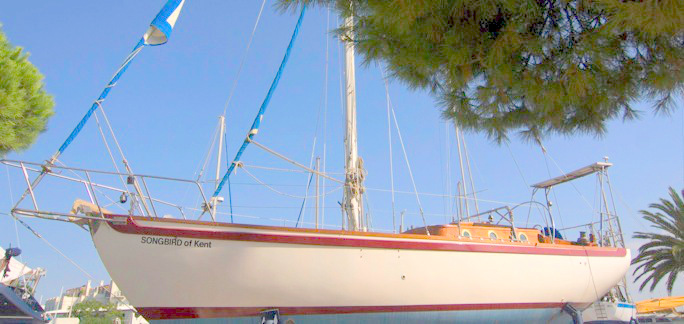
Many years ago, I spent 5 years living on a boat; a wonderful heavy-displacement ocean-going yacht of a type known as a Tradewind 33.

Tradewind 33 - Songbird of Kent.
My home for five years – Tradewind 33:  Songbird of Kent.

There is a place in my mind to which I can so easily travel; a memory of a dark night out in the Atlantic ocean one time in the Autumn of 1969. But first let me set the scene from almost fifty years ago.

The call of the open ocean

Those first few hours were utterly absorbing as I went through the whole business of clearing the yacht harbour at Gibraltar and heading out to the South-West hugging this unfamiliar coastline of Southern Spain. It was tempting to move out to deeper waters but the almost constant flow of large ships through the Straights of Gibraltar soon quashed that idea. Thankfully, the coastal winds were favourable for me and my single-masted sailing yacht.

After such a long time sailing in the relatively confined waters of the Mediterranean, it was difficult for me to imagine that in a few hours time the southern-most point of Spain would pass me by and the vastness of the Atlantic ocean would be my home for the next few weeks.

Soon the city of Tarifa was past my starboard beam and the Spanish coastline was rapidly disappearing away to the North-West. The horizon ahead of me was already approaching 180 degrees of raw, open ocean.  There was just a flicker of a thought that whispered across my mind: “Oh Paul, what have you gone and done” as slowly but persistently the coastlines of Spain to the North and of Africa to the South became more and more distant and fuzzy.  It was at 15:30 that I made an entry in my yacht’s log: “No land in sight in any direction!

Now was the time to make sure that my bunk was made up, flashlights to hand, and my alarm clock ready and set. Alarm clock? Set to go off every twenty minutes during the night! For this was the only way to protect me and my yacht from being hit by one of those gigantic container ships that seemed to be everywhere. It took at least twenty minutes from the moment a ship’s steaming lights appeared above the horizon to crossing one’s path!

It was in the early hours of my first morning alone at sea, when once again the alarm clock had woken me and I was looking around an ocean without a single ship’s light to be seen that more of Les’ words (see footnote) came to me. I remembered asking Les: “What’s the ­appeal of sailing?” Les replied without a moment’s hesitation: “It’s the solitude. When you’re out at sea on your own, there’s no government or bankers to worry about. You’re not ­responsible to anyone but yourself.

Yes, I could sense the solitude that was all around me but it was an intellectual sense not an emotional one. That would come later. Inside, I was still afraid of what I had let myself in for.

Remarkably quickly however, the pattern of solo life aboard a thirty-three-foot yacht became my world. Frankly, it staggered me as to how busy were my days. Feeding myself, navigating, trying to forecast the winds, staying in touch with other yachties via the short-wave radio, keeping the boat tidy and a zillion other tasks meant the first few days and nights just slipped by.

But it was a sight on my fourth night at sea that created the memory that would turn out to remain with me for all my life. The memory that I can go to anytime in my mind.

That fourth night I was already well into the routine of waking to the alarm clock, clipping on my harness as I climbed up the three steps that took me from my cabin into the cockpit, scanning the horizon with my eyes, checking that the self-steering had the boat at the correct angle to the wind and then, if no ships’ lights had been seen, slipping back down into my bunk and sleeping for another twenty minutes. Remarkably, I was not suffering from any long-term tiredness during the day.

It was a little after 3am that fourth night when the alarm clock had me back up in the cockpit once again. Then it struck me.

Songbird was sailing beautifully. There was a steady wind of around ten knots from the south-east, almost a swell-free ocean, and everything set perfectly.  Not a sign of any ship in any direction.

Then I lifted my eyes upwards. There was not a cloud in the night sky, not a single wisp of mist to dim a single one of the million or more stars that were above my head. For on this dark, moonless night, so far removed from any shore-based light pollution, the vastness, yet closeness of the heavens above was simply breath-taking. I was transfixed. Utterly unable to make any rational sense of this night splendour that glittered in every direction in which I gazed. This dome that represented a vastness beyond any meaning other than a reminder of the magic of the universe.

This magic of the heavens above me that came down to touch the horizon in all directions. Such a rare sight to see the twinkling of stars almost touching the starkness of the ocean’s horizon at night. A total marriage of this one planet with the vastness of outer space.

I heard the alarm clock go off again and again next to my bunk down below. But I remained transfixed until there was a very soft lightening of the skyline to the east that announced that another dawn was on its way.

I would never again look up at the stars in a night sky without being transported back to that wonderful night and the memory of a lonely sea and sky.

I did warn you it would be a long introduction!

ooOOoo

Non-Linear Cold Blob Rising Over North Atlantic

The reason life survived on Earth for so long, and blossomed into animals, and now mind, is that the planet is equipped with homeostatic mechanisms (homeo means similar in Greek, and stasis, standing still). However, those mechanisms tend to be geological.

Human civilization is now having an impact on the biosphere of a violence probably never seen before. The changes are faster than what geology, or even life, can accommodate.

Some will brandish the impact of the Yucatan asteroid, and claim that was worse; however that’s just a theory: the biosphere was clearly under stress at the time from the Deccan Traps eruptions, and had been under that stress for hundreds of thousands of years, if not millions. At its worst, the Asteroid was just the straw which broke the Camel’s back.

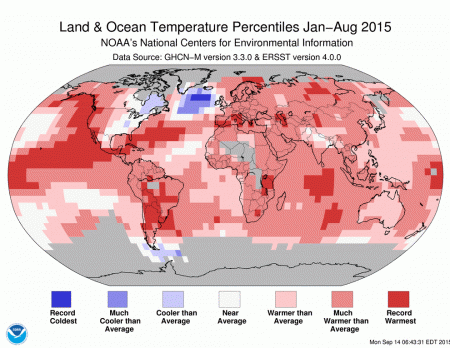
2015 will be the warmest year since the end of the Eemian, 115,000 years ago. So why are record low temperatures appearing just south of Iceland? Yes, record lows, lower than ever recorded.

While The Rest Of Planet Is At Record Warmth, Off Iceland, Record Colds Are Achieved!

That was fully expected, and a demonstration of Non-Linearity of the incipient global warming. A phenomenon is linear when it looks like a line. Global warming is not going up like a line, as some places are warming at a rate ten times higher than the average, and some regions are cooling (and some are cooling spectacularly, off Iceland and some seas around Antarctica, for reasons related to warming).

The Dryas events were extremely fast and pronounced cooling events which happened several times during the period 10,000 years to 15,000 Before Present. Some lasted around a millennium, others, just a century. They vanished as fast as they came. They are named after a tundra flower, the Dryas. In Scandinavia forests were replaced by tundra graced with Dryas (hence the name). In Britain, average temperature collapsed to minus 5 degree Celsius, and glaciers formed at elevation.

These spastic events of drastic cooling, while, overall, de-glaciation was going on, long remained a mystery. Overall, the great glaciation which had brought glaciers down to New York, was on its way out, the planet was globally, irresistibly warming. So why would temperatures collapse in some places around Greenland by 15 degrees Celsius? The solution to the Dryas events’ spastic glaciation riddle? The same as always! Warming is non-linear.

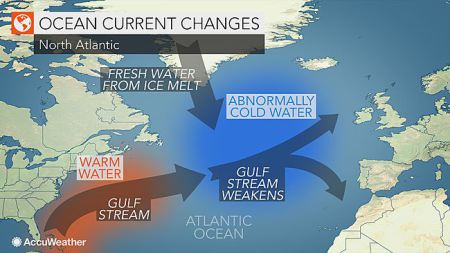
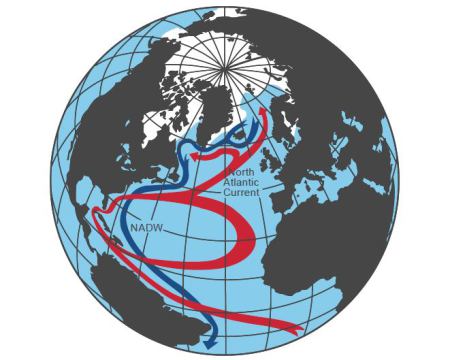
What’s the theory? The details are uncertain, but we know that the Gulf Stream (aka the North Atlantic “Conveyor”) shorted, literally: analyses of deep sea sediments have shown this. The conveyor sends an enormous current of warm tropical waters northward.

When the warm tropical waters become very cold between Iceland and Spitzbergen, they sink to the bottom of the sea, and head south. This sinking, plus the pushing by trade winds in the tropics, is what provides the energy of the Gulf Stream.

However, if the warm tropical waters are capped by a very cold, but light sweet(er) water lid, they will get cold early, and sink before Iceland. This is what happened in the Dryas events.

And It Is Happening Again, Albeit On A Smaller Scale.

Was it in response to a sudden influx of fresh water from Lake Agassiz and deglaciation in North America, and Greenland? Sudden freezing there would have removed the freshwater lid, hence the brutal switchback to warming after the brutal cooling. By the way, the sea level rising speed responded quickly, by a factor of three. After the typical Dryas cooling, oceanic rise rebounded to 18 millimeter per year right away (this shows that those who expect a slow rise of sea level rise are deluding themselves, or, more to the point, are trying to delude us!)

Nowadays a Dryas-like mechanism would have to rest on the melting of Greenland alone (that’s the only place with significant ice). This is, of course, insufficient, but summer 2015, cool and rainy over the northern North Atlantic is evidence that the effect is on. Scientific analysis confirms it. See: “Exceptional Twentieth Century Slow Down of Atlantic Ocean Overturning Circulation” (Nature, 23 March, 2015).

The exact nature of what is going on at this point is a matter of debate among experts. What is sure is that something is going on.

The Atlantic Conveyor Is A Subtle Thing, Yet Dominates Glaciation In The Arctic.

A similar situation beckons in Antarctica, where ice shield melting creates a freshwater lid all around which in turn freeze, extending the ice cap in the Austral winter.

When considering nonlinearity, subtlety and surprises are of the essence. This is true in physics, as it is in psychology, history, or politics.

And the morality in all this? The USA has played god. The European Union made a honest to goodness effort to reduce CO2 emission, while the USA, paying lip service to the opposite of what it was doing went right ahead, with its factory, the Plutocratic Republic of China, to use and abuse fossil fuels as never before.

So now what? Is god still American, as usual? At first it seems so: the USA started to frack massively and massive amounts of fossil fuels were extracted from the USA’s generous soil. When American companies tried the same in Poland, it failed: the underground god (Pluto?) did not cooperate: Polish soil is adverse to fracking.

Here comes the punchline: sea level has been rising fast along the Eastern seashore of the USA. Actually, three to four times faster than the world average. That’s more than one centimeter per year.

Why? Imagine a traffic jam. Or rather a crash ahead: things come to a halt, cars, water piles up behind. Maybe the Washington politicians will soon have to learn to swim, and not just against the tide of world public opinion.

The USA is going to be punished with its own instruments. Meanwhile 20 countries formed the V20, a group of twenty countries whose existence is immediately threatened by global warming, although they caused it not.

A Two Degree Celsius rise of temperature is indeed way too much: nonlinearity is upon us. Evil is always nonlinear.

Patrice Ayme’

ooOOoo

Footnote: The Les referred to is Les Powells, the yachtsman who sailed solo three times around the world. He and I became good friends when we met up at Larnaca Marina in Cyprus.


Les Powells book


The most beautiful dagger of them all!

This is the wake-up call that we humans simply can’t afford to sleep through.

img_9627-1024x768

This stunningly beautiful image is of an Antarctic iceberg, with a cavity. It belies the power of ice to destroy the world that we currently experience, and that “we” is not just humans but vast tracts of nature and, of course, our dogs.

So what has got “my knickers in a twist“? Answer: A reminder that the potential melting of the Antarctic ice sheet is a real and tangible threat; something that mankind has understand within the next few years.

First, let me share some of the material from the website of Antarctic Glaciers.

Ice shelves, icebergs and sea ice

Ice shelves

An ice shelf is a floating extension of land ice. The Antarctic continent is surrounded by ice shelves. They cover >1.561 million km2 (an area the size of Greenland)[1], fringing 75% of Antarctica’s coastline, covering 11% of its total area and receiving 20% of its snow.

The difference between sea ice and ice shelves is that sea ice is free-floating; the sea freezes and unfreezes each year, whereas ice shelves are firmly attached to the land. Sea ice contains icebergs, thin sea ice and thicker multi-year sea ice (frozen sea water that has survived several summer melt seasons, getting thicker as more ice is added each winter).

You can see the flat, floating ice shelf is almost featureless.
You can see this flat, floating ice shelf is almost featureless.

With this in mind, let me turn now to a recent post from Patrice Ayme in which he spells out very clearly the metaphorical dagger hanging above all our heads.

ooOOoo

Ice Sheets Melt: Academics Waking Up; New York Times In Denial

There has never been a more important moral, philosophical, military, civilizational, psychological, sociological and economic issue than the concerted holocaust of the biosphere by Homo Sapiens, presently passing one tipping point after another. Thus I will not present excuses for keeping abreast of any advance in understanding in the field. Even if it is just to confirm what I have long said.

The first scientific paper including computerized models of ice sheets melt predicts the obvious: if we burn all PROVEN fossil fuels reserves, ice will completely melt, all over Earth. Yet it is a big surprise to most scientists

This is humanity as a geologic force,” said Ken Caldeira, a researcher at the Carnegie Institution for Science in Stanford, California, an author of the paper. “We’re not a subtle influence on the climate system – we are really hitting it with a hammer.”

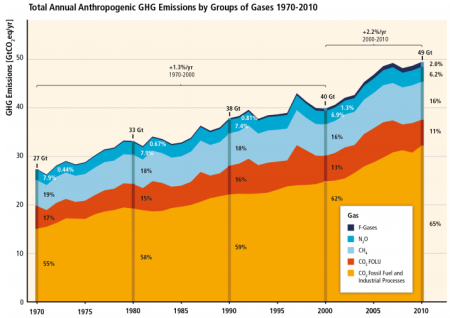
Nice to read. Nietzsche was doing philosophy with a hammer, we went further: we are doing climate with a hammer. Hopefully, it will crack soon: nothing like a great catastrophe to bring further fascism. Nihilism is bad thing, naivety, even worse. To please the powers that be, and thus to be taken seriously, serious climate scientists have made unwarranted, profoundly unscientific, over-optimistic declarations about the ice sheets. Now their time is up. In truth the GreenHouse emissions are completely out of control, and still increasing… At a geological scale, every year:

global_greenhouse_gas_emissions
50 Gigatons Per Year: This GreenHouse Is Bigger Than CO2 Alone.

I didn’t expect it would go so fast,” Dr. Caldeira said. “To melt all of Antarctica, I thought it would take something like 10,000 years.” Didn’t they all. Why? Because only then would one be invited at the White House. Thinking correctly means, first, to think in a way that pleases those with power.

“Combustion of available fossil fuel resources sufficient to eliminate the Antarctic Ice Sheet” [Ricarda Winkelmann, Anders Levermann, Andy Ridgwell,, Ken Caldeira]:

“The Antarctic Ice Sheet stores water equivalent to 58 meters in global sea-level rise. We show in simulations using the Parallel Ice Sheet Model that burning the currently attainable fossil fuel resources is sufficient to eliminate the ice sheet. With cumulative fossil fuel emissions of 10,000 gigatonnes of carbon (GtC), Antarctica is projected to become almost ice-free with an average contribution to sea-level rise exceeding 3 m per century during the first millennium. Consistent with recent observations and simulations, the West Antarctic Ice Sheet becomes unstable with 600 to 800 GtC of additional carbon emissions. Beyond this additional carbon release, the destabilization of ice basins in both West and East Antarctica results in a threshold increase in global sea level. Unabated carbon emissions thus threaten the Antarctic Ice Sheet in its entirety with associated sea-level rise that far exceeds that of all other possible sources.”

The famous Doctor Hansen and his collaborators upset the establishment two months ago by predicting a rise of three meters within 85 years (they use the reasoning I have used before, namely that paleontological data show sea level rise of 5 to 9 meters, with a rise of just one degree Celsius; actually the reasoning was obvious since 2009, when I pointed out that “2C Is Too Much“). The new paper potentially confirms Hansen’s findings. As I said, the new paper tries to NOT upset the powers that be (differently from yours truly, who view most individuals and institutions in power more than suspiciously, and it shows). Thus, one has to read between the lines to deduce that, from the paper itself, interpreting it optimistically is completely unwarranted.

The paper says: “Consistent with recent observations and simulations, the West Antarctic Ice Sheet becomes unstable with 600 to 800 GtC of additional carbon emissions.” Hmm… Let’s see, how long would that take, at the present increasing rate? Now emissions of CO2 itself are around 35 Gt, per year. That’s a number often brandished, but, left at that, it’s disinformation. With other GreenHouse Gases, we are at 50 Gigatons of CO2 equivalent emission, per year. Sorry for taxing the mathematical capabilities of our great leaders: 12 x 50 = 600. This fits perfectly my “Ten Years To Catastrophe” essay. Thus, the West and EAST Antarctic Ice Sheet becomes unstable in TWELVE YEARS (according to this paper; I obtained the same rough estimate with a paleoclimate approach).

The United Nations has said that the rise of the sea would not likely exceed three feet in this century. Some island nations will be wiped out (oops). Yet experts officially hope that major cities could be protected from it, in the richest countries that is (re-oops), though at a cost in the trillions of dollars (contemplate the enormous works to protect London or Venice).

The New York Times mentioned the paper above, which say the ice sheets will start melting irreversibly within a decade, to argue, in Politically Correct fashion, that ice sheets respond slowly enough to changes in the climate that it simply takes longer than a century for large-scale melting to begin. As if that notion was in the paper. It is not. Far from it. As I have argued before, that notion is ridiculous.

Indeed, warm water will rush below the ice sheets in West Antarctica, and East Antarctica’s immense Wilkes and Aurora subglacial basins.

antarctica-subglacial-basins
Subglacial Basins Are The Achilles’ Heel Of The Biosphere.

{WAIS = West Antarctica Ice Shelf; WB = Wilkes Basin; AB = Aurora Basin.]

Yet from that (tipping) point on, the paper found that thereafter, the sea would rise at the rate at a foot per decade, ten times faster than now, the New York Times admitted.

However the real text is much more alarming. Here is an extract:

The Antarctic Ice Sheet is severely affected by high carbon emissions through both the marine ice-sheet instability and surface elevation feedbacks. On the time scale of millennia, large parts of the ice sheet melt or drain into the ocean, raising global sea level by several tens of meters. Most of the ice loss occurs within the first millennium, leading to high rates of sea-level rise during this period (Fig. 3; for more details, see also fig. S6). Our simulations show that cumulative emissions of 500 GtC commit us to long-term sea-level rise from Antarctica of 1.15 m within the next millenium, which is consistent with the sensitivity of 1.2 m/°C derived with a different ice-sheet model (33, 34). Paleo data suggest that similar rates of sea-level rise have occurred during past warm periods (35). If the 2°C target, corresponding to about 600 GtC of additional carbon release compared to year 2010, were attained, the millennial sea-level rise from Antarctica could likely be restricted to 2 m. In our simulations, this would keep the ice sheet below the threshold for the collapse of the Wilkes Basin. However, if that threshold is crossed, the Antarctic ice cover is significantly reduced in thickness and area (Fig. 4). If we were to release all currently attainable fossil fuel resources, Antarctica would become almost ice-free. It is unclear whether this dynamic discharge would be reversible and, if so, on which time scales.”

As I already said, since 2010, we have added another 230 Gigatons. So we are within eight year of the Wilkes ice sheet, the largest in the world, to become unstable. The paper admitted that about half the Antarctic ice sheet would melt or fall into the sea in the first thousand years.”

The New York Times’ interpretation that it will take nearly a century for dramatic melting to start was obviously tainted. It is just driven by political Machiavellianism: let’s admit there is climate “change” just as there is sea level “change”, and misinform about the unfolding catastrophe (although Main Stream Media had to recently admit the snow pack in California last April was the lowest in at least 500 years). How do I know this? The scientific paper used computerized models of the huge ice sheets covering Antarctica and Greenland. It is the first paper to do so. Yet, according to the biased New York Times, it would have found exactly what the UN found, during this century… Although the UN did not incorporate the ice sheet melt models.

Once the ice sheet melting is incorporated, faster melting ought to have been predicted, for THIS century. However that grim prediction would have upset the powers that be. We don’t want that to happen. Now that they have the drone habit, killing throngs of people they know nothing about, who knows what’s coming next if one disparages them? Beheading and crucifixion at the most esteemed Saudi plutocracy?

For plutocrats, the Saudis are a model of Human Rights: thus they elected them to head the UN panel on Human Rights. And ice sheet melting is perfect: all great catastrophes call onto what Obama calls “leaders” (our masters). If a bit of engineered inflation could bring Hitler, imagine what an inflating ocean can bring! A great future for the few who rule us, tax free.

Patrice Ayme’

ooOOoo

Let me close with two pictures:

sea-ice
That is a very great deal of water locked up in that ice!

and this one that shows how at least one would have a wonderful view of the sea from your room at the Boston Harbour Hotel!

The dagger has fallen!

 Interesting times!

Smart thinking – something else to learn from our dogs?

Because some of the things we humans do are insanely stupid!

Here’s a picture of Oliver taken yesterday afternoon.

Becoming a dear, smart dog. (And those eyes!)

A few days ago, I was sitting in our living room on one of our settees (more or less where Oliver was sitting when the photograph above was taken) with my knees up against a low coffee table; the table separates our two settees.

On the settee to my left lay Cleo and on the floor across my feet slept Hazel.

It was clear that Oliver wanted to join me on the settee but couldn’t work out if there was room.  I shifted about two feet to my left leaving an Oliver-sized gap to my right. However, Oliver couldn’t come past my knees, from left to right as it were, because of Hazel. He very quickly worked out to run around behind the settee and jump up into the space I had newly created to my right.

Don’t worry if I lost you!

The point I am making is that Oliver, who has grown into the most delightful young adult dog, with a gorgeous temperament, demonstrates daily a keen intelligence and a nose for working things out quickly.

All of which is a preamble for me wondering if among the list of qualities that we humans should learn from dogs we should add intelligence.

For there’s been a few items around the ‘blogosphere’ that have highlighted how silly we can be.

Take this item that recently was featured on Grist.

Walmart’s new green product label is the most misleading yet.

A giant, 150-foot roll of bubble wrap may not be your idea of an environmentally friendly product, but over at Walmart.com this one-pound ball of plastic now boasts a special “Sustainability Leaders” badge. It’s one of more than 3,000 products tagged with this new green label, which Walmart executives unveiled last week, together with a web portal where shoppers can find these items.

Dozens of news accounts hailed the giant retailer’s move as a significant step toward clearing up the confusion and misleading information that often greet consumers trying to make ecologically responsible choices. “The world’s largest retailer took a major and important step toward helping all of us shop more smartly,” declared corporate sustainability consultant Andrew Winston in Harvard Business Review. Triple Pundit concurred: “It’s about to get a lot easier for Walmart.com shoppers to make the responsible choice.”

Actually, a green-minded online shopper is likely to find Walmart’s new badge confusing, murky, and downright misleading. I searched the bubble wrap’s product page high and low for its secret sauce, the invisible feature that makes it a smarter choice amid the many seemingly less harmful packing options available, but found no explanation.

It turns out that the key to this mystery lies in a remarkable disclaimer tucked into the middle of the home page of Walmart’s sustainability shopping portal: “The Sustainability Leaders badge does not make representations about the environmental or social impact of an individual product.” (my emphasis)

You can read the full item here, and you should! It’s unbelievably stupid, apart from being highly misleading, to my mind because when the word gets around it will damage the trust that all retailers need from their customers. And don’t even bring up the notion of integrity!

Then over on George Monbiot’s blogsite, there is a recent essay about the UN and progress on climate change. Here’s how it starts (and I’m republishing it in full tomorrow):

Applauding Themselves to Death

If you visit the website of the UN body that oversees the world’s climate negotiations, you will find dozens of pictures, taken across 20 years, of people clapping. These photos should be of interest to anthropologists and psychologists. For they show hundreds of intelligent, educated, well-paid and elegantly-dressed people wasting their lives.

The celebratory nature of the images testifies to the world of make-believe these people inhabit. They are surrounded by objectives, principles, commitments, instruments and protocols, which create a reassuring phantasm of progress while the ship on which they travel slowly founders. Leafing through these photos, I imagine I can almost hear what the delegates are saying through their expensive dentistry. “Darling you’ve re-arranged the deckchairs beautifully. It’s a breakthrough! We’ll have to invent a mechanism for holding them in place, as the deck has developed a bit of a tilt, but we’ll do that at the next conference.”

Humans have the potential to be incredibly smart thinkers, and down the ages there have been many such thinkers.

But!

Over on the Patrice Ayme blogsite there have been a couple of recent essays that highlight examples of both stupid thinking and the rewards that flow from smart thinking. In one essay, Added Value in the XXI Century, Patrice writes:

SUPERIORITY OF THE WEST?

Why did the West become so superior? Or China, for that matter?

Technology. Superior technology. Coming from superior thinking. Both the Greeks and the Chinese had colossal contempt for barbarians. (In both cases it went so far that the Greeks lost everything, and the Chinese came very close to annihilation).

Around the year 1000 CE, the Vietnamese (it seems) invented new cultivars of rice, which could produce an entire crop, twice a year. The population of East Asia exploded accordingly.

A bit earlier, the Franks had invented new cultivars of beans. The Frankish Tenth Century was full of beans. Beans are nutritious, with high protein.

Homo is scientific and technological. Thus, two million years ago, pelt covered (tech!) Homo Ergaster lived in Georgia’s Little Caucasus, a pretty cold place in winter. And the population was highly varied genetically (showing tech and travel already dominated).

A GREATER OBSESSION WITH FREEDOM MADE THE WEST SUPERIOR:

Here is the very latest. Flour was found in England, in archeological layers as old as 10,000 years before present. It was pure flour: there were no husks associated. The milling had been done, far away. How far? Well the cultivation of wheat spread to Western Europe millennia later. The flour had been traded, and brought over thousands of miles. Most certainly by boat. Celtic civilization, which would rise 5,000 years later, was expert at oceanic travel.

What’s the broad picture? Not just that prehistoric Englishmen loved their flat bread, no doubt a delicacy. Advanced technology has permeated Europe for much longer than is still understood now by most historians. Remember that the iceman who died in a glacier, 5,000 years ago, was not just tattooed, and had fetched in the lowlands a bow made of special wood. More telling: he carried antibiotics.

Then in a subsequent essay, What Is It To Think Correctly?, Patrice opens, thus:

What Is It To Think Correctly?

Some say that correct thinking has to do with avoiding “logical fallacies”. That is, of course, silly. Imagine a pilot in a plane. Suppose she avoids all logical fallacies. Where does the plane go? Nowhere. Thinking correctly is more than avoiding logical “fallacies”.

One needs more than logic, to proceed: one needs e-motion, or motivation (both express the fact that they are whatever gets people to get into action; the semantics recognizes that logic without emotion goes nowhere).

There is another, related, fallacy in thinking that correct thinking is all about avoiding “logical fallacies”.

I don’t have the answers to the conundrum of stupid thinking a la Walmart and the United Nations (not an exclusive list; by far) but I do believe that the only way for humanity to overcome what looks like a very dangerous era ahead is through smarter thinking!

Oh, nearly forgot.

Oliver will be happy to run classes on smart thinking!