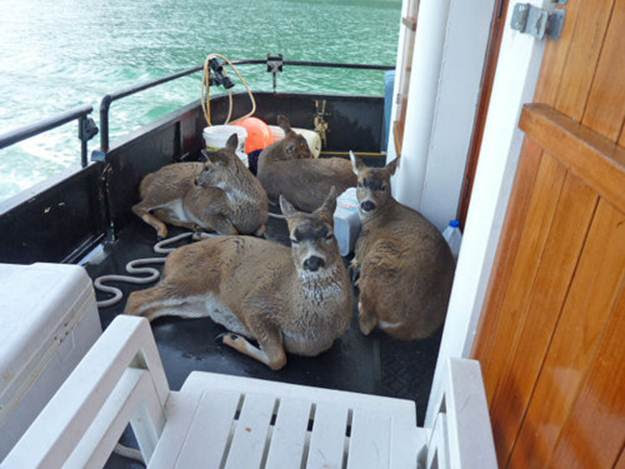
Huge numbers of you reacted so wonderfully to my post of last Tuesday, Afloat on a Sea of Kindness, in which I republished the account of the boat Alaska Quest saving the lives of four deer that were somehow cast into the water.
One of the many comments to that post was from Barb who writes the blog Passionate about Pets.
Barb left a comment to say that she had recently published an account of drowning kangaroos being saved and I thought all you good people would enjoy reading Barb’s post.
ooOOoo
Drowning Kangaroos Hitch Boat Ride
This photo of kangaroos hitching a boat ride touched my heart, and I felt I had to share it with you guys.
The photo was sent to me from friends during the recent evacuation of Theodore, a small country town in Queensland, Australia, which felt the full brunt of the recent floods.
Animal losses were high during the floods with farmers losing livestock, and wild animals were no exception – many got swept away in the flood waters and drowned – but these guys got lucky.
Under normal circumstances a kangaroo would normally panic and take a swipe at a human, easily tearing him to pieces with his long, strong claws. The feet and tail are even more powerful and dangerous.
So you can imagine how hard it would be to get wild kangaroos into, and then sit, in a boat under normal circumstances . . . this is not a sight you will see often . . . but then, these were not normal circumstances.
These desperate and drowning kangaroos willingly accepted human help and were quite happy to hitch a ride to dry land. Better than the alternative.
I think even wild animals recognize when a human is trying to help them and the compassion this kind man showed to these kangaroos certainly restores my faith in human nature.
That sub-heading was inspired by a comment left by Barb, author of the blog Passionate About Pets, in response to Maria Matthews’ story on Monday. This is what Barb wrote (my emphasis):
I loved Maria’s story, very uplifting and special. I can’t imagine my life without a dog, they give us so much and ask for little in return, just to be loved and cared for.
Yesterday, I mentioned that as well as Maria’s guest post there would be another today. In fact, the guest post will be in two parts. That guest is Peter Sonne.
Today, I am going to focus on the email that Peter sent to me and then on Thursday I will publish the article that accompanied Peter’s email. Peter also included pictures of Peggy that will be shared with you both today and tomorrow. So here’s Peter’s email:
ooOOoo
Hello Paul, I hope you all have been well.
I wanted to send you this little write-up and photos that Leslie put together for our little cattle dog, Peggy.
We had to let her go about a week ago. We had sent this out to all our animal friends and I thought of you as I have started to read your book. It is giving me a good deal of comfort, for I can relate to most everything. This one has been particularly hard on me.
Peggy was with me most everyday, and went just about everywhere with us. I think what stands out in my thoughts is that we know the first half of her life was pretty much a nightmare all around. When she was rescued, most of her hair was gone, her skin was in terrible shape, her teeth the same, etc. We quickly found that loud noises would send her running and she was a grubber for sure; food was her top priority, even up to the end.
I could see in her eyes when we first met her that she still had a spark, a desire if you will, to be a ‘good’ part of something; a pack.
She took to us, and to me right off she sensed a good change for her. Up until the end, however, when I would reach over to her to put my hand on her, she would always, always have a slight flinch – but followed through the connection.
I would catch her just staring at me many times while in the truck or in the house, just relaxing. You know, as I have mentioned to people before, if its dogs, cats, horses or what ever, if one takes that extra second to pay attention, to look at what’s happening when these beings see you each time, it’s really amazing. They do recognize you, and if one always tries to make that connection a positive one, that reward of seeing the reaction between that animal and you, time after time, can be extremely fulfilling for both, and that bond grows.
I think I felt more protective over her than all the others. That alone is a strong statement from me, as I have loved all those so dearly that have blessed us, by allowing us to be a part of their pack. Leslie was speaking with our cancer vet, whom we have worked with many times before, and mentioned this never gets easier only harder it seems.
Our vet said that is true and more so for us as we always have 3 to 5 dogs, and the odds of dealing with this loss are much, much higher for us. Most families have maybe 1 dog for 10 or so years and then something happens, and it’s time to let them go.
So with us, and others who always have multiple dogs, the need to deal with sickness and that final decision to let them go is greatly increased. It makes sense, but it is still very hard to deal with.
Didn’t mean to ramble, but it seems to help a little. Thanks again for writing that book! It helps as well.
ooOOoo
All dogs respond to our love and affection as does almost every species of warm-blooded animal, and a fair few humans as well!
But those dogs that are rescued truly appear to find a joyfulness, call it an inner happiness, that is just a tad richer than with dogs that were born straight into loving families.
It is not the first time that I have written on the theme of the importance of relationships. However, I am inspired by a number of separate and discrete outcomes in the last couple of days that compell me to return to this most important principle of all: We are what we think about most.
The first outcome was a lovely reply left by Hariod Brawn to yesterday’s post. This is what she wrote:
My GSD had hip dysplasia too, Paul – if that’s what you’re alluding to with Pharaoh. He still was able to die a natural death though, as his rear quarters became paralysed with the dysplasia and he felt no pain. There were plenty of other problems resulting from his immobility, but I wouldn’t have traded those difficulties and the incredible communication we shared as a result of them, for anything – his last few weeks were some of the most powerful and precious of my entire life.
Then after my response, Hariod went on to say:
It was a deeply profound time for me, and I honestly wouldn’t have believed anyone had they told me what I experienced, but experience it I did. It was not the product of fanciful imagination, much as it might sound so in words. The communication between the two of us was quite incredible, and which really was empathic in nature, in the deepest sense of the word. We always had great communication and understanding, which all dog lovers do with their charges, of course, but this was another level altogether. Some might call it ‘psychic’, as if that meant something mystical and woo-like, but it just means ‘of the mind’. The question is, does the mind have the psychical power to share in understanding across physical borders? You will doubtless know of J. Allen Boone:
I will return to that mention of J. Allen Boone at the end of the post.
Then later on there was a further reply to the post from Barb of Passionate About Pets :
Thanks for re-publishing Gina’s post here, I found it interesting because Poppy, my little shih-tzu is an old dame now – she will be 17 in two months time. She has developed serious separation anxiety in the last year and if I am working in the garden, she barks for me to get back inside even though my husband is inside with her – she wants us BOTH with her. She is weak in her back legs so her walks are shorter. All these signs of old age make me so sad. Just like you and Pharoah, old age is creeping up on us all.
A special thank you to Hariod for including that video clip of J. Allen Boone’s dog Strongheart and the very special connection they had; he was so wise about Strongheart’s qualities – they never die. It really resonated with me.
Thank you for a wonderful post.
You can see why I entitled today’s post Relationships!
Then earlier on in my day I had a call with Jon Lavin, a friend from my days when I lived in Devon, South-West England. Jon and I still speak on a regular basis and yesterday I was complimenting Jon on a wonderful post he had written on his own business blog The People Workshop.
Jon’s post was about relationships in the workplace, his area of professional experience, and I was struck by how far the messages were relevant to all of us, in all areas of our lives. But just as key it was another reminder of the importance of all of us who express themselves on blogs; both as authors and as commentators. Because those expressions make, build and maintain great relationships.
Jon’s post is republished here with his full permission.
When you look at how much of our lives we spend at work it’s really quite attention-grabbing. I did a very rough calculation based on 40 years and 40 hours a week – and I took out holidays and weekends. It works out approximately at 4900 hours. That’s a lot of hours, especially if you do lots of overtime and weekends. All of that time, you’re probably going to be mixing with people – usually, quite a large number of people.
We are ‘relationship seeking’, says Eric Berne, originator of Transactional Analysis. So for all of that time, we’re moving in and out of relationships with other people. So here, I’m categorising any interaction with another as ‘relationship’.
Then there’s what happens when we go home, another set of relationships, and where we came from – our parents and families.
So how we are in relationship with others is very important and has a major impact on the results we get generally and particularly in the context of this article, at work.
I hear a lot of talk about ’employee engagement’ at the moment. I believe that for employees to be ‘engaged’, so actively involved in what they’re doing, thinking about it, in the ‘here and now’, they’ve got to be in relationship with their manager and probably, the team they’re part of, at least, if the job is being done properly.
I see it as the role of the manager or team leader that they have the skills and ability to develop these relationships with as many team members as possible, any exclusions being the exception. This requires a lot of self-awareness and confidence, plus the ability to build high levels of trust with a wide range of character types. I think it also requires the ability to see the world from the view point of the other person – ‘putting yourself in somebody else’s shoes’, we say. That’s quite difficult to do in my experience. However, we can donate the time to get to know the people in our team and so increase the likelihood of all of us coming from the same angle.
I think this is about the ability to value the uniqueness of others in all the different forms and approaches that manifests in, and finding ways of harnessing those skills and abilities.
These are not easy things and I am aware of the relatively few, good people managers I come across in my work but it is possible to develop these skills. You need to have the intention to want the best from ALL relationships. Also, to be prepared to use the feedback we all get, especially when things don’t go to plan in a relationship, and be continually revisiting and adjusting your approach so that you get more of what works. This way, you automatically get less of what doesn’t work.
Never under estimate the power of intention.
Stormy seas
ooOOoo
I am now going to close today’s post with those words of J. Allen Boone that Hariod had in her second reply:
To echo Jon’s closing message, let us never cease our intention of having wonderful relationships; with our dogs, with others and, not least of all, with ourselves.
 One of the many comments to that post was from Barb who writes the blog Passionate about Pets.
 This photo of kangaroos hitching a boat ride touched my heart, and I felt I had to share it with you guys.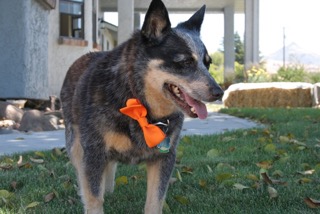


 Learning from Dogs