I opened the first post on Monday with the sub-heading: “Certainty is perfect knowledge secure from error or doubt.” going on to write that, “Whatever your views on the effect of man’s behaviours on our planet’s climate, it’s a long way from the logical idea of ‘2 + 2‘!”
Within that very strict definition, I remain unmoved. The argument that mankind is the cause of the present change in the climate of Planet Earth is not certain!
However, if only life was that simple! The change in our planet’s atmosphere is possibly the most emotionally-laden topic of all time. For some reason that quotation attributed to Hiram Johnson comes to mind, “The first casualty when war comes is truth.” because the supporters and deniers of AGW are engaged in what amounts to a verbal war.
Each side can draw on much information.
For example, a very recent article in The New York Times by their Justin Gillis offered this:
The rise in the surface temperature of earth has been markedly slower over the last 15 years than in the 20 years before that. And that lull in warming has occurred even as greenhouse gases have accumulated in the atmosphere at a record pace.
The slowdown is a bit of a mystery to climate scientists. True, the basic theory that predicts a warming of the planet in response to human emissions does not suggest that warming should be smooth and continuous. To the contrary, in a climate system still dominated by natural variability, there is every reason to think the warming will proceed in fits and starts.
But given how much is riding on the scientific forecast, the practitioners of climate science would like to understand exactly what is going on. They admit that they do not, even though some potential mechanisms of the slowdown have been suggested. The situation highlights important gaps in our knowledge of the climate system, some of which cannot be closed until we get better measurements from high in space and from deep in the ocean.
As you might imagine, those dismissive of climate-change concerns have made much of this warming plateau. They typically argue that “global warming stopped 15 years ago” or some similar statement, and then assert that this disproves the whole notion that greenhouse gases are causing warming.
Rarely do they mention that most of the warmest years in the historical record have occurred recently. Moreover, their claim depends on careful selection of the starting and ending points. The starting point is almost always 1998, a particularly warm year because of a strong El Niño weather pattern.
Dan Gomez, a long-time friend of over 40 years and a regular contributor to items on Learning from Dogs, wrote in a recent email,
I’m not sure what is meant by “believer”, Paul. The Universe unfolds as it should. Because many have been led to “believe” that AGW is inevitable and that all the facts are the ‘Truth”, we’ve created a religious substitute, almost a new “industry” with significant “tithing” obligations, etc. (e.g. Cap and Trade). Presumptions and facts are being manipulated to fulfill the prophecy.
Interesting to note in our daily lives, that weather prediction is very good 24-36 hrs out. This drops precipitously just a few days out. More than 7-10 days is nearly impossible. Even though both Europe and the USA have decreased CO2 levels by multiple percentage points over the last 20 years, the rest of the world does not care and the impact is very problematic. Recently, CO2 gas has increased overall but heat has not. In the past, warming has occurred followed by CO2 levels increasing. Global politics and redistribution of wealth schemes continue to interfere with common sense.
Let’s just deal with the facts as Science reveals its secrets. New information is discovered every day about the interaction of the Earth/Sun/Atmosphere/Lithosphere/Hydrosphere. New information is learned every day about the Universe. These are not closed subjects. Climatology, meteorology, geology and solar system dynamics will continue to shape the Earth’s future for millennia to come whether Man is involved or not.
There is much in what Dan writes that has me nodding my head; stimulates my recollection of what Luther Haave and Derek Alker wrote in 2009:
With the explosion of knowledge, particularly in the past 100 years, each of us has found it a requirement for being successful, and to being able to earn a living, to concentrate our knowledge in an ever increasingly narrow field. Just as we have come to expect others to defer to our expertise in our narrow area, we have come to assume that we need to defer to others who have a deeper comprehension of seemingly complex topics such as the science related to climate change. [Apologies, can’t find the web link for this.]
However, if we broaden the perspective from that tight definition of certainty to an analysis of probabilities, then it all changes for me and I can embrace the views so strongly put forward by Martin Lack.
For example, Martin left a comment on Monday, “ACD is not a matter of opinion or belief; it is a matter of probability. As such, all that matters now is the extremely high probability that the scientific consensus is real, reasonable and reliable.” That comment included a link to a discussion on the website Skeptical Science, Is the science settled? Let me quote from that:
Some aspects of the science of AGW are known with near 100% certainty. The greenhouse effect itself is as established a phenomenon as any: it was discovered in the 1820s and the basic physics was essentially understood by the 1950s. There is no reasonable doubt that the global climate is warming. And there is also a clear trail of evidenceleading to the conclusion that it’s caused by our greenhouse gas emissions. Some aspects are less certain; for example, the net effect of aerosol pollution is known to be negative, but the exact value needs to be better constrained.
What about the remaining uncertainties? Shouldn’t we wait for 100% certainty before taking action? Outside of logic and mathematics, we do not live in a world of certainties. Science comes to tentative conclusions based on the balance of evidence. The more independent lines of evidence are found to support a scientific theory, the closer it is likely to be to the truth. Just because some details are still not well understood should not cast into doubt our understanding of the big picture: humans are causing global warming.
In most aspects of our lives, we think it rational to make decisions based on incomplete information. We will take out insurance when there is even a slight probability that we will need it. Why should our planet’s climate be any different?
That, ultimately, delivers for me what truly counts.
I am not a scientist; just a Brit living in Southern Oregon trying to make sense of the world while I still have a functioning head and body – time is not on my side! 😉 The powerful common-sense in the sentence, “Outside of logic and mathematics, we do not live in a world of certainties.” is beyond argument.
In the year 2012, the total number of passengers carried by US Airlines and other carriers in and out of the USA was a staggering 815 million people. 815,000,000 people!
Remember the sub-heading from the start of this post! “If there’s any doubt, there’s no doubt!” Years ago I heard that from Bob Derham, a long-time friend and a commercial airline Captain since the time God was a boy! It’s that cautious, safety-focused attitude that has made airline transport such an amazing mode of transport for all those millions of passengers.
Should we not travel with the same cautious, safety-focused attitude on the ‘vehicle’ that carries every man, woman and child; every animal, plant and living thing: Planet Earth!
The trouble with today’s post title is that while the analogy with the loss of the Titanic is accurate, indeed too bloody accurate, the phrase has dissolved into the depths of the barrel of smart, clever-dick sayings. The brutal consequence of ‘fiddling while Rome burns‘, to use another ‘smart’ saying, is obscured.
So before you read this guest post from regular contributor, John Hurlburt, let me plead for something?
That is that you don’t treat this as just another anecdote in the affairs of man, but a symptom of the blindness of societies right across the world. As my guest essay tomorrow reveals, waiting for leadership on this planet is a wait that you and I and millions of others just can’t afford. Each and every one of us has to do something, however minute, to make a difference. Even just sharing John’s words.
oooOOOooo
It seems that there’s no escaping politics in daily life.
I recently got together one evening with two friends at our local Elks Club.
They are a couple. Two old friends of about ten years who live across the street and around the corner from me during the summer season. They’ve been together for more than half their lifetimes and spend the fall, winter and early spring in Yuma.
He is a frequent fishing buddy. Sometimes wears a side arm when we fish the beautiful mountain lakes above Payson. Mountain lakes and related campgrounds that are maintained and supervised by the U.S. Forest Service. Rather cheekily, I once asked if the plan was to hook trout or shoot them!
Anyhow, this was our first get together of the season. It was noted that attendance and participation is down in Arizona for such fraternal organizations as the Elks and the Moose. We had a discussion with club management about the nature of the problem.
Fraternal club management tends to be cautious and well paid. However, it seems that placing discomforting restrictions on people is not popular. The case in point was a recent club smoking ban. The logic seemed reasonable enough. Unfortunately, no realistic accommodation was made for the members who chose to smoke. The reaction was emotional.
For many, it was apparently the last straw. There were perhaps four other people at the Payson Elks club at 5:30 p.m. that Friday evening. An evening with a moderately priced dinner buffet on hand that had been advertised online, in a newsletter and by word of mouth.
There was a point when a comment seemed appropriate. I offered the observation that the source of the problem might be political. No one seemed to register the observation.
We talked a bit about aches and pains; the usual organ recital. We spoke about what we’ve been doing. I told them about church and transition town activities. The conversation turned to our illusion of a stable economy. An observation was made that the USA was leveraged over twenty-two times above any material foundation. There was no disagreement.
Despite the clear New York Times warning that morning, climate change never entered the conversation. A remedy was to note that so far Katrina has cost U.S. taxpayers over sixteen Billion dollars and climbing. Sandy is expected to cost American taxpayers as much as sixty Billion dollars.
It was a pleasant evening and we plan to get together again soon.
The full copy of an email received yesterday from 350.org
Support the Cause
Breaking news about a good friend
Dear friends,
Big news has just emerged: Dr. James Hansen, the planet’s premier climate scientist, announced his retirement as head of NASA’s Goddard Institute of Space Studies, where he began his career in 1967.
If 350.org has a patron saint, it’s Jim. It was his 2008 paper that gave us our name, identifying 350 parts per million CO2 as the safe upper limit for carbon in the atmosphere.
But as much as for his science, we respect him for his courage. He’s always been willing to speak the truth bluntly, from the day in 1988 when he told Congress that the time had come “to stop waffling so much and say the planet was warming,” to all he’s done to bring attention to damaging projects like Keystone XL — even to the point of risking arrest to do so. I have no doubt he’ll go on doing science, and speaking plainly — indeed, he told the New York Times that one reason he’s leaving the federal payroll is so he can take on the government more directly.
But this is a big moment, and we need to mark it. Here’s what I hope you’ll do: honor Jim’s lifetime of work by making a public comment to the State Department about Keystone XL and tell them to reject the pipeline. In this case, speaking out is simple — click the link below to go to the page to submit from. There’s a list of ten arguments to choose from – you can mix and match or put it in your own words and just speak from the heart.
Sending a message to the State Department might not seem like much, but I think it’s actually quite fitting tribute.
One reason we’re fighting the pipeline is because Jim Hansen did the math to show that if we combusted the tar sands on top of all else we burn, it would be “game over for the climate.” So far that message hasn’t gotten through: the State Department hired a bunch of compromised oil industry analysts to ‘review’ KXL, and unsurprisingly they decided it would have ‘minimal’ environmental impact. We need to get them to take reality seriously, and change that assessment.
Maybe — just maybe — with a truly overwhelming flood of comments, we can break through. Together with our friends across the movement, we’re aiming for an ambitious target of 1 million comments to the State Department to stop the pipeline.
Beginning this comment push is all the more timely after the disasterous tar sands pipeline spill in Arkansas, where thousands of gallons of toxic oil ran freely through the streets of a suburban community.
Jim Hansen has been to jail twice to try and block KXL. When I saw him in handcuffs, I cringed. I don’t mind going myself, but it seems crazy that we have to send our best climate scientist off in handcuffs; in a sane world he’d never have to leave the lab. And in a sane world we’d just be toasting his retirement from NASA with well-deserved champagne.
But it’s a crazy world, heating fast, and so we need to mark this historic day in a way that really counts. Please do take a couple minutes to submit a comment on the Keystone XL Pipeline.
P.S. please submit your comment re the Keystone XL Pipeline; for all our sakes. This is the acknowledgement you will receive from 350.org.
Hey,
Thanks for submitting your comment. We’ve set the ambitious goal of 1,000,000 comments to the State Department because our best defense against the big money behind this project is overwhelming numbers — in short, people power.
Submitting a comment is just the first step — to hit that big goal, we each need to get our friends, family and maybe a few new people to join us. The next step is to share this with your social networks. You can click below to easily share with Facebook and Twitter:
Learning from Dogs is not a blogsite about climate change!
Why, you may ask, do I start today’s post with that sub-heading? Because, I am conscious that many of my posts do touch on this subject. For example, just two days ago there was Breaking news. Then there was the piece about the climate implications for Phoenix, Arizona. Followed the next day by the changes in the flow of the jet stream across the North Atlantic with all the weather implications for North-West Europe.
Indeed, as the heading to today’s post makes clear, this is also about the changes going on to our planet.
Learning from Dogs is about a different way of living and behaving. A campaign, if one wants to call it that, to show that the way that modern man is living is corrupt. Not with a big ‘C’ but still in the sense of living a dishonest life. Learning from Dogs attempts to show that our wonderful dogs, a source of so much love and pleasure for so many millions, offer us an example of a life in and of this planet.
If there was ever a time in the history of man when we needed being reminded of our frailty and vulnerability, it is now. As the following so starkly illustrates.
A new study of ocean warming has just been published in Geophysical Research Letters by Balmaseda, Trenberth, and Källén (2013). There are several important conclusions which can be drawn from this paper.
Completely contrary to the popular contrarian myth, global warming has accelerated, with more overall global warming in the past 15 years than the prior 15 years. This is because about 90% of overall global warming goes into heating the oceans, and the oceans have been warming dramatically.
But what really jumped off the page was this graph. It is truly scary!
Figure 1: Ocean Heat Content from 0 to 300 meters (grey), 700 m (blue), and total depth (violet) from ORAS4, as represented by its 5 ensemble members. The time series show monthly anomalies smoothed with a 12-month running mean, with respect to the 1958–1965 base period. Hatching extends over the range of the ensemble members and hence the spread gives a measure of the uncertainty as represented by ORAS4 (which does not cover all sources of uncertainty). The vertical colored bars indicate a two year interval following the volcanic eruptions with a 6 month lead (owing to the 12-month running mean), and the 1997–98 El Niño event again with 6 months on either side. On lower right, the linear slope for a set of global heating rates (W/m2) is given.
I’m not going to republish the whole piece, although Peter Sinclair kindly gave permission, because I want to move on. But please do go to that article here and take in the conclusions; for all our sakes. Conclusions such as:
Their results in this respect are very similar to the main conclusion of Nuccitelli et al. (2012), in which we noted that recently, warming of the oceans below 700 meters accounts for about 30% of overall ocean and global warming. Likewise, this new study concludes,
“In the last decade, about 30% of the warming has occurred below 700 m, contributing significantly to an acceleration of the warming trend.”
and such as:
Most importantly, everybody (climate scientists and contrarians included) must learn to stop equating surface and shallow ocean warming with global warming. In fact, as Roger Pielke Sr. has pointed out, “ocean heat content change [is] the most appropriate metric to diagnose global warming.” While he has focused on the shallow oceans, actually we need to measure global warming by accounting for all changes in global heat content, including the deeper oceans. Otherwise we can easily fool ourselves into underestimating the danger of the climate problem we face.
If you’ll forgive me for stating the obvious: Most people don’t understand climate change very well. This includes a large proportion of the nation’s politicians, journalists, and pundits — even the pundits who write about it. (I’m looking at you, Joe Nocera.)
One reason for the widespread misunderstanding is that climate change has been culturally coded as an “environmental problem.” This has been, in all sorts of ways, a disaster. Lots of pundits, especially brain-dead “centrist” pundits, have simply transferred their framing and conception of environmental problems to climate. They approach it as just another air pollution problem.
David writes that firstly carbon dioxide is not like other pollutants, for example like air particulants. Then later goes on to say:
The second difference is that climate change is irreversible.
As Joe Romm notes in a recent post, New York Times columnist Joe Nocera slipped up in his latest column and referred to technology that would “help reverse climate change.” I don’t know whether that reflects Nocera’s ignorance or just a slip of the pen, but I do think it captures the way many people subconsciously think about climate change. If we heat the planet up too much, we’ll just fix it! We’ll turn the temperature back down. We’ll get around to it once the market has delivered economically ideal solutions.
This paper shows that the climate change that takes place due to increases in carbon dioxide concentration is largely irreversible for 1,000 years after emissions stop. Following cessation of emissions, removal of atmospheric carbon dioxide decreases radiative forcing, but is largely compensated by slower loss of heat to the ocean, so that atmospheric temperatures do not drop significantly for at least 1,000 years. [my emphasis]
The article is really best read in full. Because it’s a reminder that the way we presently behave is, in so many ways, a scary legacy for future generations.
So, back to dogs!
When dogs were living as wild dogs, thousands of years ago, a typical pack size was between 40 to 50 animals. The ‘head’ dog was the alpha dog, always a female. Next in status was the beta dog, always a dominant male. The last one in terms of status was the omega dog, or clown dog. Those genetic traits still survive in the domestic dog.
Pharaoh – still being an assertive beta dog; taken 22 days ago!
The alpha dog had two important roles as ‘leader of the pack’. She had first pick of the male dogs, for obvious reasons. (Only much later in life do we human men come to understand that it’s always the woman who chooses!)
The second role was that she was the one who decided that their territory was unsustainable for her pack and signalled the need to find a new territory.
For man, there’s no other territory to move to. So we will just have to clean up the only one we have!
“Why do you get out of bed in the morning, and why should anyone care?”
These words are spoken by Simon Sinek just before the three-minute mark in the video that follows. As Wikipedia explains,
Simon O. Sinek (born October 9, 1973) is an author best known for popularizing a concept of The Golden Circle.
He joined the RAND Corporation in 2010 as an adjunct staff member, where he advises on matters of military innovation and planning. His first TEDx Talk on “How Great Leaders Inspire Action” is the 7th most viewed video on TED.com.
His 2009 book on the same subject, Start With Why: How Great Leaders Inspire Everyone to Take Action (2009) delves into what he says is a naturally occurring pattern, grounded in the biology of human decision-making, that explains why we are inspired by some people, leaders, messages and organizations over others.
He has commented for The New York Times, Wall Street Journal, The Washington Post, Houston Chronicle, FastCompany, CMO Magazine, NPR and BusinessWeek, and is a regular contributor to The Huffington Post, BrandWeek, IncBizNet.
This new year that we are now in is going to require millions of us to think and do differently. As Einstein so famously quoted, “Insanity: doing the same thing over and over again and expecting different results“. More than ever before we need different results and that means thinking and doing differently.
That unwritten law of the power of unintended consequences strikes again.
Before moving on to today’s post, just wanted to say that our recent move to Merlin, Oregon continues to take up huge (and enjoyable) demands on our time so the opportunity to write lengthy posts on Learning from Dogs is still some way off. Having said that with the quality of analysis that is available from others, some readers may prefer it as it currently is!
There is no better example of this than the post that follows. It is from the blog site of Peter Sinclair ‘Climate Crocks‘. As the ‘About‘ page says,
Peter Sinclair is a long time advocate of environmental awareness and energy alternatives. An award winning graphic artist, illustrator, and animator, Mr. Sinclair runs Greenman Studio from his home in Midland, MI.
Mr. Sinclair’s syndicated cartoons have appeared worldwide, and his work has been profiled in numerous publications, including the New York Times. He is the producer of the YouTube series, “Climate Denial Crock of the Week”.
A couple of days ago, Peter published a post called, ““La La La I Can’t Hear You” Comes Home to Haunt GOP, in the Election, and on Climate”. I read it with interest and asked Peter if I might republish it. In a matter of moments, I received a reply giving me such permission; here it is.
oooOOOooo
When Al Jazeera and The American Conservative are in agreement that you have a problem, you probably have a problem.
But the problem wasn’t just that conservative media gave Romney supporters bad information. The people in conservative media also seem to have been fully taken in by the idea that Romney would win and would do so in decisive fashion, and the campaign came to believe its own propaganda, too. As York notes, Romney didn’t have a prepared concession speech. It apparently never occurred to his campaign that he would lose. That’s not so remarkable by itself, but it is just one part of the overall pattern of the Romney campaign and the conservative movement’s reaction to Obama. Romney spent years running against a fantasy record and campaigning on a series of gross distortions and falsehoods, and so it shouldn’t be too surprising that his campaign and his conservative media boosters didn’t have the firmest grip on political reality.
After the election, a number of different people tweeted about a rather obvious connection – how the same people who didn’t believe the polls don’t believe global warming, either. There’s a further correlation here: On the polling side, the supposedly most liberally-biased pollsters actually came closest to hitting the mark, both in the Fordham analysis of national polls and a more sophisticated analysis of state polls by Emory political scientist Drew Linzer at his Votamatic website.
On the global warming side, a new study comparing climate models finds that those predicting the largest climate impacts by 2100 are the most accurate in modelling climate change that’s already occurred – specifically, humidity levels related to cloud formation. In short, the reality being denied in both cases is even worse than it first appears, so attempts to “compromise” or give conservatives “the benefit of the doubt” actually lead us further astray (since I first wrote this, David Roberts of Grist has written an excellent comparison of the twin delusions).
But there is more than just a correlation here. There is a common causal factor involved: Conservatives, trusting their guts, have created their own separate reality, with their own authorities, and their reasoning dominated by ideology, where certain sorts of facts simply cannot intrude. Election day was one of those rare moments in which the bubble they live inside collapsed.
In the face of model projections like Silver’s, Jonah Goldberg said that “the soul … is not so easily number-crunched.” David Brooks warnedthat “experts with fancy computer models are terrible at predicting human behavior.” Joe Scarborough said “anybody that thinks that this race is anything but a tossup right now is such an ideologue.” Peggy Noonan said that “the vibrations are right” for a Romney win. All sorts of conservative pundits were convinced the Romney campaign just felt like a winner.
–
Empiricism won. It didn’t win because it’s a truer faith or a superior ideology. It won because it works. It is the best way humans have figured out to set aside their perceptual limitations and cognitive shortcomings, to get a clear view of what’s happening and what’s to come.
As it happens, there’s another issue in American politics where empiricists are forecasting the future and being ignored. Here’s what the Nate Silvers of climate science are up to:
Looking back at 10 years of atmospheric humidity data from NASA satellites, [John Fasullo and Kevin Trenberth of the National Center for Atmospheric Research] examined two dozen of the world’s most sophisticated climate simulations. They found the simulations that most closely matched actual humidity measurements were also the ones that predicted the most extreme global warming.
In other words, by using real data, the scientists picked simulation winners and losers.
“The models at the higher end of temperature predictions uniformly did a better job,” Fasullo said. The simulations that fared worse — the ones predicting smaller temperature rises — “should be outright discounted,” he added.
That means the world could be in for a devastating increase of about eight degrees Fahrenheit by 2100, resulting in drastically higher seas, disappearing coastlines and more severe droughts, floods and other destructive weather.
Just reread that last paragraph a couple of times – and make a promise to yourself, and those loved ones around you, to make a positive difference starting now. And subscribe to Peter’s blogsite!
The grandeur of the ancient relationship between dog and man.
A couple of weeks ago, I came across a fascinating article that had been published in American Scientist magazine (online version) written by Professor Pat Shipman. The article provided the background and evidence to support the proposition that dogs may have been man’s best friend for thousands of years longer than we realized.
Very quickly I came across Pat Shipman’s website and learnt that this is one clever lady. As her About page explains,
CAREER SUMMARY
Prof. Shipman
I am internationally known as a paleoanthropologist and conducted research for many years in Africa on human evolution and the animal communities in which humans evolved.
I have conducted research on material from sites in France, Spain, the United States, Java, Ethiopia, Kenya, Tanzania, and South Africa. I have written more than 50 scholarly articles, appearing in journals such as Nature, Science, Journal of Archaeological Science, Paleobiology, Journal of Human Evolution, and Current Anthropology.
I have written more than 100 articles in popular science magazines or newspapers, including The Guardian, The New York Times, The Times Literary Supplement, American Scientist, Discover, and Natural History. Two of my books were featured on the cover of The New York Times Book Review: The Neadertals and Taking Wing. Taking Wing won the Phi Beta Kappa prize for science book of the year and was a runner-up for the LA Times Science Book prize.
My book on Homo erectus, Wisdom of the Bones, was co-authored by Alan Walker and won the Rhone-Poulenc Prize in science writing.
My books have been widely praised as compelling, accessible, and highly readable, with a strong narrative thread. Reviewers frequently comment upon the meticulous research that underpins my books, a feature I consider to be my trademark.
My most recent popular science book, The Ape in the Tree, written with Alan Walker, was called by The Vancouver Sun “part adventure story, part cutting-edge science.” In a Science magazine review, the book was praised as “a fine account of new ways to puzzle out the behaviors of fossilized animals from odd scraps of bone.” Another reviewer raved, “Wonderfully engaging and insightful, The Ape in the Tree, is sure to become a classic in the literature on human origins.” MacArthur fellow John Fleagle wrote in the Quarterly Review of Biology, “Science writing doesn’t get any better than this.” In 2009, this book was awarded the W.W. Howells Book Prize by the American Anthropological Association.
In Britain, my new biography of Mata Hari, Femme Fatale, was selected as The Book of the Week by BBC radio. Each day during the week, an actress gave dramatic readings from the book on the air for fifteen minutes.
With The Animal Connection, I return to paleoanthropology and consider the influence of our connection with animals on human evolution and the origin of modern human behavior.
See what I mean!
Anyway, as you can readily understand, as the author of a blog that writes about what we can learn from this ancient relationship between the dog and man, it struck me as wonderful if I might be permitted to republish in full that article. Prof. Shipman promptly gave me such permission.
So today, I am doing just that and tomorrow I want to write more about Pat Shipman’s latest book, The Animal Connection.
oooOOOooo
The Woof at the Door
Dogs may have been man’s best friend for thousands of years longer than we realized
It’s funny how much difference a single letter makes. A “woof” at the door is a very different thing from a wolf at the door. One is familiar, domestic, reassuring; the other is a frightening apparition of imminent danger. The distinction between our fond companions and the ferocious predator of northern climes goes back a long way.
Dogs are descended from wolves, probably the gray wolf. Some scientists argue that, because dogs and wolves can and do interbreed, they shouldn’t be considered to be separate species at all. They believe that domestic dogs are only a subspecies or variant of the gray wolf, Canis lupus, and ought to be called Canis lupus familiaris (the familiar or domestic wolf) instead of Canis familiaris (the familiar or domestic dog). Although the ability to interbreed and produce fertile offspring is a tried-and-true criterion for recognizing that two populations are really variants of a single species, the reality is more nuanced. We cannot know whether dog-wolf hybrids will thrive and survive, or die out, in the long run.
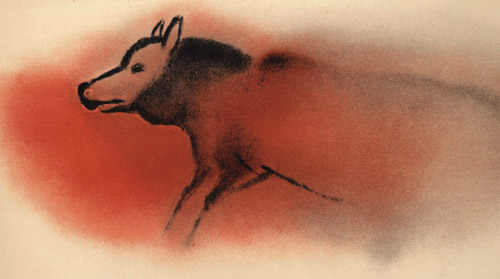
Prehistoric cave paintings rarely depict wolves or other carnivores. This watercolor tracing of a cave painting was made by the archaeologist Abbé Henri Breuil in the early 1900s from the Grotte de Font-de-Gaume in France. The 17,000-year-old cave paintings number about 250 and mostly show bison and mammoths—only one is thought to be a wolf. Canids may have been domesticated by this point; it is possible that portraying wolves and humans was taboo. Paul Bahn
Certainly we expect to be able to distinguish a dog from a wolf if we see one. Of course, domestic dogs are wildly variable in size and shape, thanks to several hundred years of selective breeding. Some have long, fluffy coats; others have tightly curled, nearly waterproof coats and webbed feet. Some are leggy and swift, whereas others are solid, stoutly built guard dogs. Some fit neatly into a pocketbook, but others barely fit into a compact car. As Robert K. Wayne of the University of California at Los Angeles declares, “Dogs show more diversity in appearance than any other mammal.”
What is it that tells us this animal is “dog” and that one is “wolf?”
Modern wolves and dogs can be distinguished reasonably easily by their appearance. The most telling feature of dogs is the snout, which is significantly shorter and wider than wolves’ snouts. Only a few dog breeds with extremely elongated, slender snouts, such as Irish wolfhounds, surpass wolves in “snoutiness.”
But a crucial part of the difference we perceive is in the animals’ manner and attitude towards humans. Domesticated dogs are just that: canids that live in the house or domicile of humans. They are genetically disposed to seek out human attention and approval and to accept human leadership. Wolves are not.
How did this important change come about? Probably in the distant past, humans took in a wolf cub, or even a whole litter of cubs, and provided shelter, food and protection. As the adopted cubs matured, some were aggressive, ferocious and difficult to handle; those probably ended up in the pot or were cast out. The ones that were more accepting of and more agreeable to humans were kept around longer and fed more. In time, humans might have co-opted the natural abilities of canids, using the dogs’ keen noses and swift running skills, for example, to assist in hunting game. If only the most desirable dogs were permitted to breed, the genes encoding for “better” dogs would continue to be concentrated until the new domesticated species (or subspecies) was formed.
Time to Tame
The creation of a domestic, useful, familiar canid by years of selectively breeding wild and terrifying wolves was almost certainly unplanned. The wolf at the beginning of the process of domestication was tamed—made individually docile—but the essential fact is that, over time, the offspring of those initial wolves were genetically inclined to be more tractable.
Domestication was one of the most brilliant accidents in the entire history of humankind. What’s more, we got it right the first time: Dogs were the original trial animal, and successful product, of such an accident—the happy outcome of years of unwitting experiments and dumb luck.
How long does domestication take? Nobody knows. In an experiment, Russian biologists kept a breeding colony of silver foxes and intentionally selected for breeding those with the least fear and the least aggression toward humans. After 10 generations, 18 percent of the foxes sought human contact and showed little fear. After 30 or so generations, a “domesticated fox” had been created.
The catch is that this experiment was deliberate and strictly controlled. The foxes could not breed with wild foxes and dilute the changing gene pool. Human contact was minimized so animals could not be tamed by their handlers. And because of the experiment’s scientific intent, no one could say, “Oh this one is so cute, let’s let it breed even if it is a little aggressive.” So in the case of dogs, without all these controls, the process could have taken much longer.
Another way of estimating the time at which domestic dogs originated is to consider their genetic differences from wolves. One prominent group of researchers, including Robert Wayne, along with Carles Vilà of the Uppsala University in Sweden and their collaborators, initially estimated in 1997 that dogs diverged from gray wolves 100,000 to 135,000 years ago. After more study, they revised their divergence date to between 40,000 and 100,000 years ago. Another group, led by Peter Savolainen of the Royal Institute of Technology in Sweden, favored the Chinese wolf, a subspecies of the gray wolf, as the probable ancestor and estimated in 2002 that it was domesticated between 15,000 and 40,000 years ago.
How do these genetic estimates stack up against the fossil record? Until 2009, the oldest known remains of domestic dogs were two adult skulls dated to between 13,000 and 17,000 years ago, from Eliseevichi, a region in Russia. Both had the relatively broad, short snout typical of dogs, and both were large, heavy animals, nearly the size of great Danes.
Then a team led by Mietje Germonpré of the Royal Belgian Institute of Natural Sciences reported a stunning new finding in the February 2009 issue of Journal of Archaeological Science: a nearly complete fossil dog skull dated to 31,680 + 250 years ago.
Another Look
Germonpré and her colleagues thought that researchers might have overlooked early prehistoric dogs in the fossil record of the Upper Paleolithic, so they analyzed skulls of large canids (wolves or dogs) from various European sites. The Upper Paleolithic time period spanned 40,000 to 10,000 years ago and is divided into sections based on the artifacts from those times. By convention, each span is named for a culture of people who made the artifacts, and the people, in turn, are usually named for the geographical location where the artifacts were found. The Epigravettian culture existed from 14,000 to 10,000 years ago; before that, the Magdalenian culture thrived from 18,000 to 10,000 years ago; and skipping back a few sections, the Aurignacian culture occurred from 32,000 to 26,000 years ago.
In order to identify the fossil skulls accurately, Germonpré’s team first analyzed a large reference sample of 48 wild, modern wolves and 53 dogs belonging to 11 different breeds. They also examined five skulls (including the ones found in Eliseevichi) that were firmly established as prehistoric domesticated dogs.
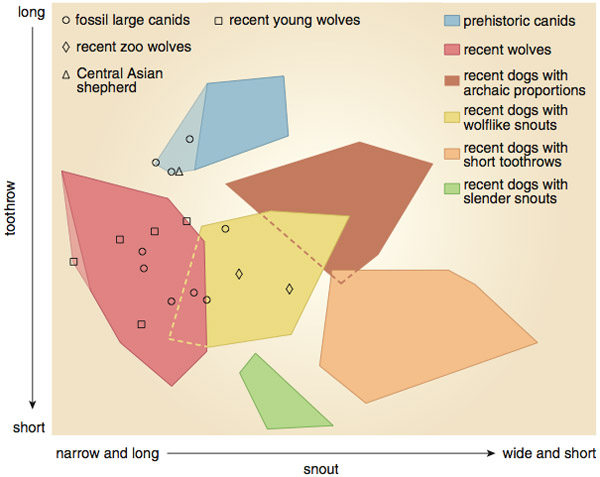
In order to establish the morphological differences between wolves and dogs, a group of researchers led by Mietje Germonpré statistically analyzed skulls from 48 modern, wild wolves and 53 modern dogs from 11 breeds, as well as five skulls that were previously established to be from prehistoric dogs. Recent wolves (pink) and prehistoric dogs (blue) clustered into their own groups, based on the length of their toothrows and the shape of their snouts. Modern dogs clustered into four groups, with some overlap in their areas. Recent dogs with archaic proportions included huskies (brown), recent dogs with wolflike snouts included German shepherds (yellow), recent dogs with short toothrows included great Danes (orange), and recent dogs with slender snouts included doberman pinscers (green). One modern dog, a Central Asian shepherd, clustered with the prehistoric dogs. The group then classified new skulls into the established groupings; examples that fell slightly outside of the ranges but that are statistically likely to be within the group are shown as lighter-shaded areas. Recent young wolves fell into the recent-wolf group, whereas wolves kept in captivity were classifed as recent dogs with wolflike snouts. Fossil canid skulls divided between the recent-wolf group and the prehistoric-dog group, with one falling in the group of recent dogs with wolflike snouts. Stephanie Freese, data courtesy of Mietje Germonpré.
The team used statistical analysis of cranial and dental measurements on the skulls to sort the reference sample into six natural clusters. One cluster contained modern wolves. Another consisted of recent dogs of archaic proportions (such as chow-chows and huskies); a single specimen of a Central Asian shepherd was closer to this group than any other but fell outside it. A third cluster included dogs, such as German shepherds and malinois, which have wolflike proportions. These three groups overlapped each other in their cranial proportions. A fourth group of modern dogs has short toothrows—the length of the jaw that contains teeth—and includes such breeds as great Danes, mastiffs and rottweilers. This group overlapped slightly with the archaic-proportioned dog group but not with the others.
The fifth and sixth clusters were completely separate from all others. One consisted of dogs with extremely long, slender snouts, such as Doberman pinschers. The final group, which had long toothrows and short, broad snouts, was made up of the prehistoric dogs. Statistically, the team’s ability to identify any individual specimen as belonging to the correct group was highly significant and accurate.
Using these clusters as reference categories, Germonpré and colleagues used a statistical technique (called discriminant function analysis ) to assign 17 unknown fossil canid skulls to the established categories. Not all of the “unknowns” were truly unknown, however. Five were immature modern wolves that might have had different proportions because of their age, two were wolves that had been kept in captivity, and one was the Central Asian shepherd that didn’t cluster into any of the groups. Additional unknowns were 11 fossil skulls from sites in Belgium, the Ukraine and Russia, although two of these fossil skulls proved to be too incomplete to classify.
The technique correctly classified all of the immature wolves as wolves, but the two zoo wolves were classified as recent dogs with wolflike snouts. Five of the fossil skulls also fell easily into the modern wolf group; although two of these specimens fell into the region of measurements that overlapped with the group of recent dogs with wolflike snouts, they had a higher statistical probability of being wolves. One fossil skull fit directly into the group of recent dogs with wolflike snouts, even though this specimen was clearly ancient.
The remaining three fossil skulls—one from Goyet Cave in Belgium and one each from Mezin and Mezhirich in the Ukraine—resembled each other closely. All three were classified as prehistoric dogs with probabilities of 99 percent, 73 percent and 57 percent, respectively, as was the (modern) Central Asian shepherd, with a 64 percent probability. In addition, the Mezin skull was odd enough in appearance (for a wolf) that another researcher has suggested it might have been a captive wolf. Germonpré and her team were delighted with these results.
The group also successfully extracted mitochondrial DNA (mtDNA) from seven ancient canid bones from Goyet Cave and Trou des Nutons in Belgium. Rather than damage precious skulls, they sampled only bones in which wolves and dogs differ little, so they presumed all of those they sampled for mtDNA were wolves. From each sample, they sequenced a segment of the mtDNA that is highly variable in living wolves and dogs. Each fossil had a unique mtDNA sequence, or haplotype , in this region, which could not be matched with any known sequences for modern wolves (of which there are about 160) or modern dogs (of which more than 1,000 exist) stored in GenBank, a database of all publicly available nucleotide sequences.
“I was not so surprised at the rich genetic diversity of the fossil wolves,” says Germonpré, because there have been other studies with similar findings. Foxes and wolves underwent a severe bottleneck in population size at the end of the last Ice Age, and many genetic lineages went extinct at this time.
“But we were surprised at the antiquity of the Goyet dog,” Germonpré adds. “We expected it would probably be Magdalenian,” perhaps 18,000 to 10,000 years old. This outcome would fit with their results for the Mezin and Mezhirich skulls, which were found with Epigravettian artifacts roughly 14,000 to 10,000 years old. When the age of this specimen from Goyet was directly dated using accelerated mass spectroscopy radiocarbon-dating techniques, the team found that it was not 18,000 years old, but almost twice as old as the next oldest dog, placing the Goyet dog in the Aurignacian period.
A Time of Change
The Goyet dog fossil shows that the domestication of the first animal was roughly contemporaneous with two fascinating developments in Europe.
Around this time, Europeans began producing objects that are recognizable as art. Some of the earliest known art objects from Europe include the remarkable cave paintings of Chauvet Cave in France, the oldest of which were made 32,900 ± 490 years ago. None of the hundreds of glorious Chauvet paintings show wolves. However, the cave preserves something even more haunting: the footprints of a human child about four-and-a-half feet tall, as well as many footprints of large canids and bears.
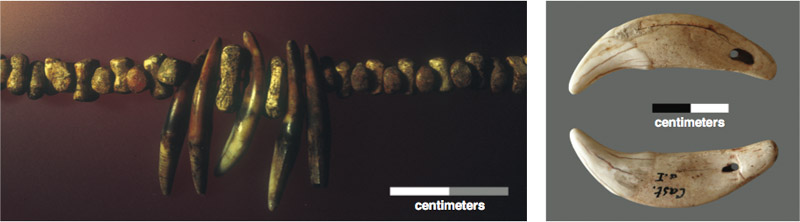
Around 33,000 years ago, humans began perforating teeth for use in decoration. Although canid teeth made up a very small percentage of the total fauna teeth available, they were used in a majority of the ornaments. Fangs from foxes and wolves appear to have been favorites. One example of a perforated wolf tooth (shown in two views at right) is from Abri Castanet in France and has been dated to 33,000 years ago. A strand of beads interspersed with fox teeth came from the Russian site of Sungir and has been dated to 24,000 years ago (left). There is no specific evidence that canid teeth were used in necklaces; the fox-teeth strand may have been a belt. Randall White
Michel-Alain Garcia of the Centre National de la Recherche Scientifique in Nanterre noticed in 1999 that one track of canid prints appears to accompany the child’s prints. These canid prints, unlike the others, have a shortened middle digit on the front paw: a characteristic of dogs. Garcia suggested that the child and dog might have explored the cave together. Charcoal from a torch the child carried is 26,000 years old.
The Upper Paleolithic cultures of Europe are famous for the flowering of all kinds of exquisite art: sculptures, carvings, paintings and engravings. Animals are common and readily recognizable subjects. Prehistoric art expert Paul Bahn notes that depictions of carnivores, including wolves or dogs, and of humans are rare. Bahn conjectures that portraying wolves and humans might have been taboo.
Anne Pike-Tay of Vassar College offers another perspective. She observes that the scarcity of artistic depictions of carnivores parallels their scarcity in the fossil faunas of the Upper Paleolithic. If domesticated dogs were helping humans hunt, she speculates that they might have been placed in a completely different symbolic category from other animals.
“What if dogs were put in the ‘human family’ category as an extension of the hunter, and like humans, warranted no (or very few) painted or engraved depictions?” she wonders.
The second development of the Aurignacian period is the appearance of objects of personal adornment: jewelry. Although beads and perforated objects occurred much earlier in Africa, the earliest such objects in Europe appeared about 40,000 years ago. At 33,000 years ago, early Aurignacian people began perforating animal teeth (and occasionally human teeth) to wear as pendants or other ornaments, such as belts.
Which teeth did they choose? Among their favorite sources are what have been identified as fangs of foxes and wolves. These identifications might better be termed “small or large canids,” because until now no one has considered the possibility that dogs might have been domesticated so long ago. Besides, identifying a single canid tooth specifically as dog or wolf would be difficult, if not impossible.
Randall White of New York University argues that Aurignacian and later people chose to wear objects that displayed their identity or membership in a certain group or clan. Like gang colors or a t-shirt that proclaims its wearer to be a fan of a particular band, ancient people wore things that made their allegiances clear.
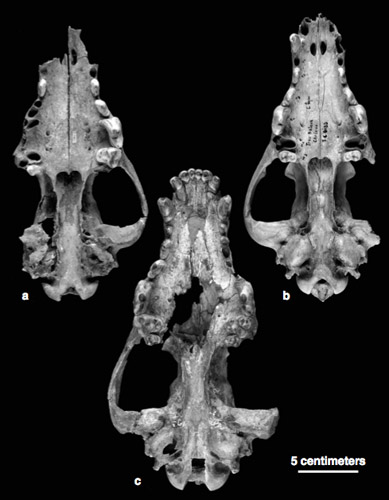
Fossils have helped to establish a far earlier timeframe for dog domestication. A paleolithic canid skull from Goyet in Belgium, about 31,000 years old, has traits characteristic of a dog rather than a wolf (a). When compared to wolves from a similar era, one from Trou Ballu (b) and one from Trou des Nutons (c) in France, the Goyet dog has a relatively wider snout and larger carnassial teeth, and it also has a wider braincase. Elsevier Ltd.
White observes that the teeth Aurignacian people chose to wear were obviously not a random sample of the animals in the fauna. For example, the fauna from the Grotte des Hyènes (Cave of Hyenas) at Brassempouy, France, is dominated by horses, aurochs (a type of cattle) and reindeer—mostly as food remains that often show cutmarks or charring—as well as hyenas, which probably lived in the cave when humans did not. Wolves are rare, making up less than 3 percent of the total fauna. Of approximately 1,600 animal teeth at Brassempouy, only about 2 percent were modified for use as ornaments. However, nearly two-thirds of the ornaments are teeth of wolves or foxes. The rest of the perforated teeth are from other rare species: bear, humans and red deer. None of the teeth of the most common species were used as ornaments at Brassempouy.
Did someone who wore a perforated canid tooth 33,000 years ago proclaim him- or herself to be one of the group that domesticated dogs?
Possibly. Domesticating dogs was a remarkable human achievement that doubtless provided a definite selective advantage to those who accomplished it successfully. They might well have had reason to brag about their accomplishment by wearing canid teeth.
Bibliography
Germonpré, M., et al. 2009. Fossil dogs and wolves from Paleolithic sites in Belgium, the Ukraine and Russia: Osteometry, ancient DNA and stable isotopes. Journal of Archaeological Science 36:473–490.
Morey, D. F. 1994. The early evolution of the domestic dog. American Scientist 82:336–347.
Ostrander, E. A. 2007. Genetics and the shape of dogs. American Scientist 95:406–413.
Savolainen, P., et al. 2002. Genetic evidence for an East Asian origin of domestic dogs. Science 298:1610–1613.
Trut, L. N. 1999. Early canid domestication: The farm-fox experiment. American Scientist 87:160–169.
Vilà, C., et al. 1997. Multiple and ancient origins of the domestic dog. Science 276:1687–1689.
On the 17th March, I wrote another piece inspired by Lester Brown’s book, World on the Edge. That piece was about what Lester Brown calls Plan B and shows that there are positive, real solutions to the dilemma that us humans have got ourselves in.
Anyway, I was delighted to see in my email in-box the following,
PLAN B:MOBILIZING TOSAVECIVILIZATION—THE FILM
Plan B video
For the month of April only, you can watch a streaming edition of the film Plan B on the PBS website. So if you missed the initial release for whatever reason, here is your opportunity to watch it at your leisure.
Based on Lester Brown’s Plan B book series, this 90-minute film, by the award-winning film producers Marilyn and Hal Weiner, follows Lester as he speaks in Beijing, Seoul, Tokyo, New Delhi, Rome, Istanbul, Ankara, and Washington, DC, and visits with world leaders to discuss ways to respond to the challenges of climate change.
The film begins with a dramatic portrayal of a world where there is a mounting tide of public concern about melting glaciers and sea level rise and a growing sense that we need to change course in how we react to emerging economic and social pressures. The film also spotlights a world where ocean resources are becoming scarce, croplands are eroding, and harvests are shrinking.
But what makes Plan B significant and timely is that it provides hopeful solutions—a road map that will help eradicate poverty, stabilize population, and protect and restore our planet’s fisheries, forests, aquifers, soil, grasslands, and biological diversity.
Along with Lester Brown, you will hear from notable scholars and scientists including Nobel Laureate Paul Krugman, Pulitzer Prize winner and New York Times columnist Thomas Friedman, and former Governor and Secretary of the Interior Bruce Babbitt.
Narrated by Matt Damon, well-known for his work raising environmental awareness.
The film is available to view here. Note that it is only free to watch for the month of April.
Ice loss from Antarctica and Greenland has accelerated over the last 20 years, research shows, and will soon become the biggest driver of sea level rise.
From satellite data and climate models, scientists calculate that the two polar ice sheets are losing enough ice to raise sea levels by 1.3mm each year.
Overall, sea levels are rising by about 3mm (0.12 inches) per year.
2. Running on Oil
A recent email in my in-box from John Maudlin was all about Japan and oil. But there were some stark messages about our use of oil across the planet. Try this:
There are multiple sources for many of the metals Japan imports, so that if supplies stop flowing from one place it can get them from other places. The geography of oil is more limited. In order to access the amount of oil Japan needs, the only place to get it is the Persian Gulf. There are other places to get some of what Japan needs, but it cannot do without the Persian Gulf for its oil.
This past week, we saw that this was a potentially vulnerable source. The unrest that swept the western littoral of the Arabian Peninsula and the ongoing tension between the Saudis and Iranians, as well as the tension between Iran and the United States, raised the possibility of disruptions. The geography of the Persian Gulf is extraordinary. It is a narrow body of water opening into a narrow channel through the Strait of Hormuz. Any diminution of the flow from any source in the region, let alone the complete closure of the Strait of Hormuz, would have profound implications for the global economy. [My italics.]
3. Energy rethink
From Rob Dietz of CASSE, Centre for the Advancement of the Steady State Economy.
As if we really required more prompting, the unfolding nuclear accidents in Japan are confirming what we must do. When a disaster strikes, the most urgent response is to help those who are suffering, prevent further calamities, and clean up the messes—it’s a time to get busy. But the next critical step is to figure out what we might do differently—it’s a time to take a step back and contemplate how we got where we are and where we might go from here. With each passing day, it is becoming increasingly clear that we need to rethink where and how we get our energy supplies.
And later in this article:
A New York Timesarticle provides an astonishing description of what happened at the Fukushima nuclear power plant where the backup generators failed to cool the overheating reactor:
The central problem arises from a series of failures that began after the tsunami. It easily overcame the sea walls surrounding the Fukushima plant. It swamped the diesel generators, which were placed in a low-lying area, apparently because of misplaced confidence that the sea walls would protect them.
The key phrase in that description is “misplaced confidence.” Misplaced confidence sums up how we got to this point in history when it comes to selecting sources of energy to power our ever-expanding economy. Regardless of what smooth-talking P.R. professionals say, a nuclear power facility has been the site of a serious accident about every 10 years: witness Three Mile Island in the U.S. in 1979, Chernobyl in Ukraine in 1986, Tokaimura in Japan in 1999, and now Fukushima in 2011. “Safe nuclear power” is an offensive oxymoron.
Misplaced confidence also describes our failure to take big strides on phasing out fossil fuels. We have misplaced confidence that we’ll find a technological solution to climate destabilization, that the market will take care of the problem, and that Mother Nature will continue to warehouse the emissions from our economy with no consequences.
Maybe millions of us should be adopting the same query as Alice; “It would be so nice if something made sense for a change.” Because continuing as we are without understanding the urgent need to make ‘sense’, to take heed, of the living, conscious planet that is our only home is utter nonsense!
Back to Mr Rabbit, “Oh my ears and whiskers, how late it’s getting!”
Income inequality, when it becomes excessive, is very corrosive to a society.
This is clearly a complex subject because one man’s excess is another man’s just reward for building a successful business that employs his fellow citizens.
Nonetheless, I do want to touch on this sensitive area because, to my mind, they are connected with the tragic story that is the point of this article.
This document presents details on the wealth and income distributions in the United States, and explains how we use these two distributions as power indicators.
Some of the information may come as a surprise to many people. In fact, I know it will be a surprise and then some, because of a recent study (Norton & Ariely, 2010) showing that most Americans (high income or low income, female or male, young or old, Republican or Democrat) have no idea just how concentrated the wealth distribution actually is.
Later on, Prof. Domhoff writes:
The Wealth Distribution
In the United States, wealth is highly concentrated in a relatively few hands. As of 2007, the top 1% of households (the upper class) owned 34.6% of all privately held wealth, and the next 19% (the managerial, professional, and small business stratum) had 50.5%, which means that just 20% of the people owned a remarkable 85%, leaving only 15% of the wealth for the bottom 80% (wage and salary workers). In terms of financial wealth (total net worth minus the value of one’s home), the top 1% of households had an even greater share: 42.7%. Table 1 and Figure 1 present further details drawn from the careful work of economist Edward N. Wolff at New York University (2010).
That table and the whole article is powerful and a well-worth reading. Read it here.
Stay with me a little longer. Here’s an extract from an article from Nicholos Kristof of the New York Times written in November last year.
Nicholas Kristof
In my reporting, I regularly travel to banana republics notorious for their inequality. In some of these plutocracies, the richest 1 percent of the population gobbles up 20 percent of the national pie.
But guess what? You no longer need to travel to distant and dangerous countries to observe such rapacious inequality. We now have it right here at home — and in the aftermath of Tuesday’s election, it may get worse.
The richest 1 percent of Americans now take home almost 24 percent of income, up from almost 9 percent in 1976. As Timothy Noah of Slate noted in an excellent series on inequality, the United States now arguably has a more unequal distribution of wealth than traditional banana republics like Nicaragua, Venezuela and Guyana.
C.E.O.’s of the largest American companies earned an average of 42 times as much as the average worker in 1980, but 531 times as much in 2001. Perhaps the most astounding statistic is this: From 1980 to 2005, more than four-fifths of the total increase in American incomes went to the richest 1 percent.
By the way, Kristof has his own blog site and added material from him about this topic and readers’ comments are here.
Now to the core of this article on Learning from Dogs which, I passionately believe, is closely tied in to the background theme already expressed here. It’s from the blogsite Corrente and, once again, I am indebted to Naked Capitalism for having it in a recent set of links.
It concerns Jack, his family and their house.
The House that Jack’s Bank Took
Jack was a friendly man, who always had a pleasant word and a smile and handshake for everyone. The men hung with him at barbeques and discussed sports. He was strong, had a belly, and always wore a baseball cap. He was married to his high school sweetheart, Mary. He was good to his 4 kids and took care of his oldest child when he had a breakdown in his early twenties. He went to all school and family events and encouraged his children in their dreams. He took care of the family needs and finances. He was a small business owner and had invented his product, which a short while ago became outmoded. He always decorated the house with lots of Christmas decorations and candles. They are still up. He lost his house to foreclosure and the family was given 3 days to move out.
He drove into the deep woods and drank poison to make sure he was dead. I knew him. My family knew him; he lived within walking distance of one of us. At his funeral his childhood sweetheart and their children told a lot of Jack stories. The family did their best to resurrect him to our eyes. One of his kids sang and the eldest read a poem he’d written. Mary said she didn’t know what she was going to do and that she would now have to rely on those from town sitting in the packed chapel pews. There are other houses nearby that haven’t been foreclosed on but Jack’s house was nice and had a good view. The bank has now given Mary 3 weeks to move out.
It was written on the 15th February, 2011; you can read it here. Click on the link and read some of the comments expressed – very powerful.
Wish I could think of something apt to say but I can’t. All I can feel is great sadness and a horrible feeling in the pit of my stomach that this ‘Jack’ story is being echoed in many other places.






 Learning from Dogs