It really is an obvious statement!
I am indebted to my son for dropping me an email with a link to a recent BBC Radio programme. It was from the long-running programme series In Our Time, presented by the consummate broadcasting professional Melvyn Bragg.
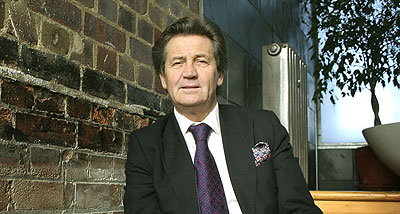
The WikiPedia entry details, The Rt. Honourable The Lord Bragg no less,
Melvyn Bragg, Baron Bragg, FRS, FBA, FRSA, FRSL, FRTS (born 6 October 1939), is an English broadcaster and author, best known for his work with the BBC and for ITV presenting the The South Bank Show (1978–2010). Since 1998 he has presented over 550 weekly episodes of the BBC Radio discussion programme In Our Time.
Bragg was born on 6 October 1939 in Carlisle, the son of Mary Ethel (née Park), a tailor, and Stanley Bragg, a stock keeper turned mechanic.[3]He attended the Nelson Thomlinson School in Wigton and read Modern History at Wadham College, Oxford in the late 1950s and early 1960s.
This particular episode was called Ice Ages; the link will take you to the programme page which includes the ability to listen to the 43 minutes long episode. (Alternatively, you can go straight to the recording via the BBC iPlayer.) The programme page explains:
ICE AGES
Jane Francis, Richard Corfield and Carrie Lear join Melvyn Bragg to discuss ice ages, periods when a reduction in the surface temperature of the Earth has resulted in ice sheets at the Poles. Although the term ‘ice age’ is commonly associated with prehistoric eras when much of northern Europe was covered in ice, we are in fact currently in an ice age which began up to 40 million years ago. Geological evidence indicates that there have been several in the Earth’s history, although their precise cause is not known. Ice ages have had profound effects on the geography and biology of our planet.
With:
Jane Francis
Professor of Paleoclimatology at the University of LeedsRichard Corfield
Visiting Research Fellow in the Department of Earth Sciences at Oxford UniversityCarrie Lear
Senior Lecturer in Palaeoceanography at Cardiff University.Producer: Thomas Morris
LINKS AND FURTHER READING
Professor Jane Francis at the University of Leeds
Dr Caroline Lear at Cardiff University
Climate: Long range Investigation, Mapping, and Prediction – Wikipedia
Now the programme requires careful listening as the conversation ranges rapidly about the number of ice ages, the intervening greenhouse periods and where we are at present. It would be easy to end up thinking that we are in a cooling phase (we are not) or that it’s only a matter of time before we are back in the next ice age (in geological terms, yes).
Go to the programme blog and read this from Melvyn:
Hello
It was a close call. After the programme Jane Francis and Carrie Lear continued to talk about the climbing count of CO2 which was pumping up global warming, in their opinion, which would lead most dramatically to mass flooding. On the programme Richard Corfield did not join in very enthusiastically, pointing out that the CO2 count had been at least twice as high quite recently (geologically speaking) and even higher than that a bit before recently. The situation was beginning to develop into a relevant, contemporary conversation about climate change and the final bell was a merciful release. There was no thought of the ingenuity of men and women combating what would be a gradual increase (if it happens) of rising sea levels – we could have looked at the Dutch in the sixteenth century onwards. But I strayed from my task.
The grim conclusion of Jane Francis was never to buy or rent a house on a flood plain, always to buy or rent a house on a hill, or take a tent, or anything, as long as it’s on a hill and, I think Richard Corfield added, fortify it. Well, well. [my italics]
As I wrote yesterday, either Jane or Carrie, don’t recall whom, said on air just at the end that a CO2 level of nearly 400 ppm (January 2013: 395.55 ppm) is way above the range of levels where the Earth’s atmosphere has traditionally behaved in a stable manner.
In the end it really doesn’t matter geologically.
Our planet is approximately 4,540,000,000 years old. As WikiPedia explains,
There have been five known ice ages in the Earth’s history, with the Earth experiencing the Quaternary Ice Age during the present time. Within ice ages, there exist periods of more severe glacial conditions and more temperate referred to as glacial periods and interglacial periods, respectively. The Earth is currently in an interglacial period of the Quaternary Ice Age, with the last glacial period of the Quaternary having ended approximately 10,000 years ago with the start of the Holocene epoch.
This graph shows the history of ice ages and the fact that we are close to turning upwards towards a hotter geological period.

So we live on a planet that is 4.5 billion years old, towards the end of the current ice age that started 2.58 million years ago.
Contrast that with the age of homo sapiens.
Homo sapiens originated in Africa, where it reached anatomical modernity about 200,000 years ago and began to exhibit full behavioral modernity around 50,000 years ago.
Early man evolved from hunting and gathering into the domestication of plants and animals, in other words farming, about 10,000 years ago. In these short years, from a geological perspective, we have lost total sight of the intimate relationship we had with the planet when our very survival depended on hunting and gathering.
In so little time!
Just reflect on the last 100 years of so-called modern agriculture. It has been characterised by enhanced productivity, the replacement of human labour by synthetic fertilizers and pesticides, selective breeding, and mechanisation. It has been closely tied to political issues such as water pollution, biofuels, genetically modified organisms, tariffs, and farm subsidies. All of which explains the backlash against the external environmental effects of mechanised agriculture, and increasing support for the organic movement and sustainable agriculture.
One might say that we have been farming the planet in the most broadest of senses; as if the planet is nothing more than a bottomless pool of resources.

Chief Jackie Thomas at the recent Forward-On-Climate rally talked about the toll that tar sands are already taking on her neighbors in Alberta, and promised that First Nations communities and their allies in Canada will never allow a pipeline to be built west to the Pacific.
Such peoples still in tune with their ancient heritage understand that humanity is first and foremost in and of the land.
But do you know what?
 Learning from Dogs