As many know, yesterday was the fourteenth anniversary of when those two planes struck the towers of the World Trade Centre. Thus it seemed beautifully appropriate to recognise the life of the last living 9/11 rescue dog by republishing the article just published on Mother Nature News.
ooOOoo
Last living 9/11 rescue dog rewarded with epic day
Bretagne traveled to NYC to be honored for her weeks of service at Ground Zero.
By: Laura Moss, September 11, 2015.
At 16, Bretagne is a senior dog, but that hasn’t slowed her down. She now volunteers at schools. (Photo: BarkPost)
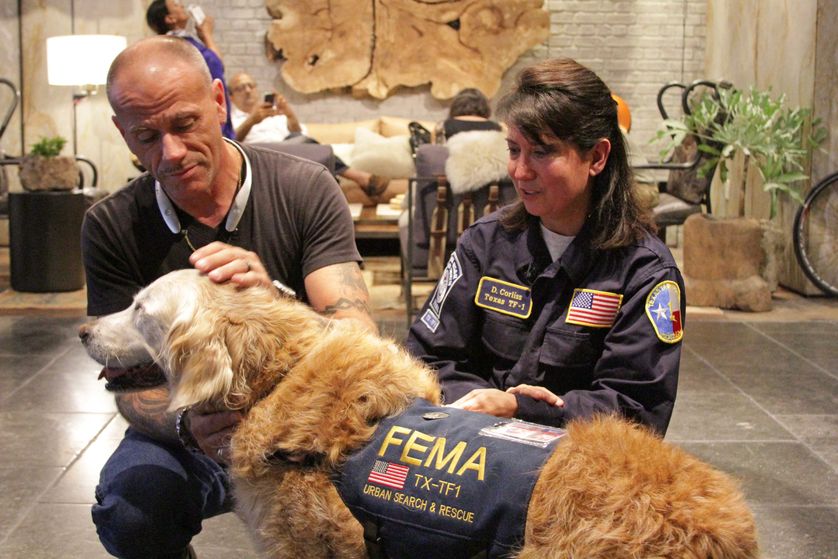
About 100 search-and-rescue dogs scoured the twisted steel beams and crumbled concrete of the World Trade Center in the aftermath of the 9/11 attacks, and today, Bretagne (pronounced “Brittany”) is the last known living 9/11 search-and-rescue dog. And she just had the best day ever.
To honor Bretagne for her service and celebrate her 16th birthday, BarkPost teamed up with the dog-friendly 1 Hotel Central Park to give the golden retriever a “Dog’s Best Day” that included a full day of treats and activities in New York City.
When Bretagne arrived in New York with her owner and handler Denise Corliss, she was greeted by a personalized billboard in Times Square.
Photo: BarkPost
Then she was off to play in the water at Hudson River Park, where she was presented with the doggie version of the Key to the City.
Former search-and-rescue teammates attended Bretagne’s sweet-16 party later that day, where she received a variety of toys and treats — and her very own birthday cake.
Photo: BarkPost
Corliss was also presented with a $1,000 donation for Texas Task Force 1, Bretagne’s search-and-rescue team, which is the most active one in the country.
In addition to her recovery work at Ground Zero, Bretagne and Corliss also worked in New Orleans following Hurricane Katrina, and today, the senior dog serves her community by volunteering at school programs that teach children to read.
Corliss adopted Bretagne as an 8-week-old puppy in 1999, and after undergoing rigorous training, the two joined Texas Task Force 1. Their first deployment was to Ground Zero, where a search for survivors quickly turned into a search for human remains.
Bretagne with a firefighter and her owner and handler, Denise Corliss during her “Dog’s Best Day.” (Photo: BarkPost)
For two weeks, the golden retriever tirelessly worked 12-hour shifts at the former site of the World Trade Center, and one day, Bretagne walked away from Corliss, ignoring commands to come back. The 2-year-old dog made her way to a firefighter sitting on the ground, laid next to him and put her head in his lap.
“When we deploy to some of the disasters, what I didn’t anticipate is the role that they take on as a therapy dog,” Corliss told BarkPost. “It provides an opportunity for people to have support from the dog and comfort from the dog in a real difficult environment.”
Watch Bretagne enjoy her best day in the video below.
ooOOoo
Don’t these wonderful, fabulous animals just make your heart ache!
Jean and I salute Bretagne and all the other Search & Rescue dogs both here in America and all around the world.
A very interesting report that recently appeared on Mother Nature Network (MNN).
We live in Josephine County here in Southern Oregon. Our next door neighbours to the East are Jackson County. Josephine and Jackson Counties share one very noble attribute: each is only one of just nine GMO-free counties in the entire United States of America. Plus, as evidenced at our local Grants Pass Farmers’ Market every Saturday, the growing of organic fruit and vegetables is widespread in our county. We feel very happy to have ended up in this part of America.
All of which makes a logical introduction to a report that appeared on MNN on September, 1st. It is republished below.
ooOOoo
For safer, cheaper pest control, just add ants
Ants offer a surprisingly effective alternative to synthetic pesticides on crops ranging from cashews to sugar cane, according to a new review of more than 70 scientific studies.
By: Russell McLendon, September 1, 2015, 9:30 a.m.
Weaver ants can not only protect tree crops from pests, but may also benefit the quality of produce. (Photo: Rushen/Flickr)
Sometimes ants are pests, marching through our kitchens on an industrious quest for crumbs. But when faced with more serious pests — namely those that destroy crops on which people’s livelihoods depend — we can also use ants to our advantage.
Published in the Journal of Applied Ecology, a new research review suggests ants can control agricultural pests as efficiently as synthetic pesticides, with the bonus of being more cost-effective and generally safer. And since many pesticides pose a danger to helpful wildlife like birds, bees and spiders — not to mention humans — ants might be a key ally in feeding the planet’s booming human population.
The review covers more than 70 scientific studies on dozens of pest species that plague nine crop varieties in Africa, Southeast Asia and Australia. Because ants are organized as “superorganisms” — meaning the colony itself is like an organism, with individual ants acting as “cells” that can move around independently — they are uniquely capable of hunting down pests and then overwhelming them.
“Ants are great hunters and they work cooperatively,” says author Joachim Offenberg, a biologist at Aarhus University in Denmark, in a press release about the research. “When an ant finds its prey, it uses pheromones to summon help from other ants in the nest. By working together, they can subdue even large pests.”
Most studies in the review focused on weaver ants, a tropical genus of tree-dwelling ants that weave ball-shaped nests using leaves and larval silk. Since they live in the canopy of their host trees, near the fruit and flowers that need protection, weaver ants have a natural tendency to control pest populations in orchards.
A colony of weaver ants in India works on converting leaves into a nest. (Photo: Raghu Mohan/Flickr)
In one three-year study, Australian cashew growers recorded yields 49 percent higher in trees guarded by weaver ants versus trees treated with synthetic chemicals. But higher yields were only part of the prize: The farmers also got higher-quality cashews from the trees with ants, resulting in a 71 percent higher net income.
Similar results were reported in mango orchards. While mango trees with ants had roughly the same yields as those with synthetic chemicals, the ants were cheaper — and the trees they inhabited grew higher-quality fruit. That led to a 73 percent higher net income compared with pesticide-treated trees. Not all crops had such dramatic results, but studies on more than 50 pests showed that ants can protect crops including cocoa, citrus and palm oil at least as effectively as pesticides.
“Although these are rare cases where the ants were superior to chemicals, many studies show that ants are just as efficient as chemical controls,” Offenberg says. “And of course ant technology is much cheaper than chemical pest control.”
To recruit weaver ants in their orchards, farmers just collect nests from the wild, hang them in plastic bags from tree branches and feed them a sugar solution while they build new nests. Once the ants establish their colony, farmers can help them expand by connecting target trees with aerial walkways made from string or vines.
The ants are mostly self-sufficient from there, needing only some water during the dry season — provided via plastic bottles in the trees — and pruning of non-target trees that host different ant colonies to prevent fights. Farmers can also help their ants by avoiding broad-spectrum insecticide sprays, researchers say.
Ants protect mango trees about as effectively as pesticides, but at less cost, research suggests. (Photo: Shutterstock)
It’s worth noting that ants can also be detrimental to some plants, such as when they herd sap-feeding insects like aphids and leafhoppers. But if they still fend off fruit-ruining flies and beetles, their net impact may be positive nonetheless. Not only do weaver ants kill pest insects on their trees, but their presence alone is reportedly enough to scare away marauders as large as snakes and fruit bats. And research suggests their urine even contains important plant nutrients.
The use of ants for pest control isn’t new. As early as 300 B.C., Chinese farmers could buy weaver ants in markets to release in their citrus groves, a practice that has faded over time, especially after the advent of chemical pesticides. But it may be coming back, both because ants are cheaper than pesticides and because certified organic produce can fetch higher prices, due to concerns that broad-spectrum pesticides harm more than just pests. Aarhus University is studying the use of weaver ants as pest control in Benin and Tanzania, for example, where the insects could lead to increased export revenue of $120 million and $65 million, respectively.
“To kill the flies with pesticides, you have to make the mango so poisonous that it can kill the maggot,” Aarhus University biologist Mogens Gissel Nielsen told China’s Xinhua news agency in 2010. “But when it is too poisoned for the maggot to eat, it might not be good for us to eat either.”
While the research in Offenberg’s review focused largely on weaver ants, he points out they “share beneficial traits with almost 13,000 other ant species, and are unlikely to be unique in their properties as control agents.” Lots of ants nest in the ground, and while it may be a challenge to relocate them, they too have shown promise in protecting a variety of commercially important crops.
“Weaver ants need a canopy for their nests, so they are limited to plantations and forestry in the tropics,” Offenberg says. “But ground-living ants can be used in crops such as maize and sugar cane. European wood ants are renowned for controlling pests in forestry, and new projects are trying to use wood ants to control winter moths in apple orchards. Ants could even be used to fight plant pathogens because they produce antibiotics to combat diseases in their dense societies.”
ooOOoo
As with many of the other fine articles that appear on Mother Nature Network, this report by Russell McLendon has many links to other information sources, too many for me to set up. So if this report ‘speaks’ to you and you want to look up the background information then please go here and read it over on MNN.
Even before I met Jean back in 2007 and came out from England to be with her in 2008 (with Pharaoh), I had learnt that one of the many joys in having a dog was being able to share so much of one’s life with your loving canine companion.
Thus you will not be surprised in the slightest that walking with your dog is another joyous activity. Plus the benefit of living a few more years, as the following article from Mother Nature News illustrates.
ooOOoo
The secret to adding 7 years to your life
Hint: Get ready to lace up your sneakers.
By: Jenn Savedge, August 31, 2015
Researchers find that just 25 minutes of walking each day can trigger the anti-aging process. (Photo: Nejc Vesel/Shutterstock)
It’s easier than you might think to add another seven years to your life. Researchers have found that adding a simple 25-minute walk to your daily routine could give you several more years of healthy living.
Researchers found that participants in their 50s and 60s who took a brisk daily walk that lasted for at least 25 minutes had half the risk of dying from a heart attack than their couch-potato peers. The study, conducted at Saarland University in Germany, evaluated the health of 69 healthy non-smokers, aged between 30 and 60, who were not regular exercisers before the study began.
Participants were asked to complete various types of daily exercise — from simple aerobics to high-intensity interval training to strength training over a six-month period. Meanwhile, researchers took blood samples that allowed them to measure the increase of telomerase activity and the decrease of senescence markers, two indicators of cellular aging found in the blood. Using these measurements, researchers found that daily aerobic exercise triggers the anti-aging process.
Researchers presented their findings at the European Society of Cardiology conference with the suggestion that people add regular exercise to their daily routine to add years to their lives. They also noted that it’s never too late to start. A 70-year-old woman who has never exercised before can still gain tremendous mental and physical health benefits by adding a brisk daily walk to her routine.
Heart disease is the number one killer of men and women in the U.S. According to the Centers for Disease Control and Prevention, more than 600,000 Americans will lose their lives to the disease this year, but exercise could slash that figure in half, bringing more years to millions of Americans.
Do you have your sneakers laced yet?
ooOOoo
So there you are! Just twenty-five minutes a day with your favourite person and your favourite dog or two and you will all live forever.
Carry on sharing!
Pharaoh in the back of a Piper Super Cub back in 2002. Proving that he loved taxying around the grass airfield but I drew the line at flying – for both our sakes!
P.S. When I showed Jean this post yesterday evening she remarked that I still had, and wore at times, the same green T-shirt and cap that I featured in the photograph above some 13 years ago. I guess I’m not a fashion plate!
We rarely get to know what a rescue dog has been through.
Of the ten dogs that we have here at home, two are pedigree dogs purchased from breeders, that’s Pharaoh and Cleo, two are rescue dogs that came from known sources, Oliver from neighbours who couldn’t cope with him and Pedy from the local Merlin dog pound, and the rest are all ex-rescue dogs that Jean took from the streets of San Carlos, Mexico.
The last rescue dog to be taken in by Jean before we both left Mexico was Hazel who was abandoned outside Jean’s house in San Carlos a few weeks before we left for Arizona. The picture below is of Hazel taken in March 2014.
Hazel is the most loving and adorable of dogs and the love that I feel coming from her towards me is real, tangible and precious. Yet this is a mother dog who very shortly before she was deposited in front of Jean’s house in Mexico had had all her puppies removed from her as Hazel was still in milk. (The poor in San Carlos frequently sell young puppies for a few Pesos.) It’s beyond the comprehension of us humans, especially women, to imagine what it must be like for a mother to so catastrophically lose her young babies.
That’s why a recent article over on Mother Nature Network really reached out to me. We never know what homeless dogs have to contend with before they find loving homes.
ooOOoo
Why our Great Dane is so scared to be alone
Most of us will never know what our rescue dogs have been through. We found out.
By: Ali Berman, August 12, 2015
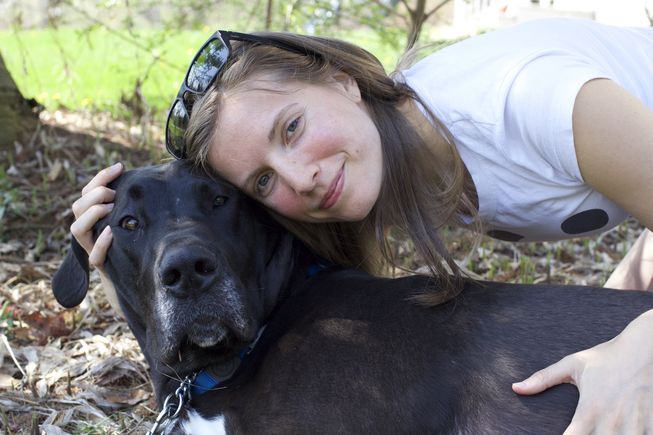
Author Ali Berman discovered she had a new shadow when she met Cooper. (Photo: Ali Berman)
In February 2015, David and Glenda Berman — that’s my mom and dad — drove from New York to Connecticut to meet Cooper, a 13-month-old Great Dane. When they were introduced, 100-pound Cooper rushed over to give them an enthusiastic greeting, burying his head in their legs, leaning on them, and asking to be petted. My mom and dad fell in love, and Cooper took the two-hour drive back to their house, the place that would become his forever home.
During those first few weeks, my parents got to know Cooper. They went for walks in the snow, played together, and snuggled. (He’s a major snuggler.) But, in addition to those normal doggy behaviors, they noticed something else. Cooper was reluctant to leave their sides. If they left the room, he went with them. He took trip after trip to the kitchen, to the bathroom, to the laundry room. When they moved, he moved.
I didn’t believe the extent of it until I got the chance to meet him myself. I traveled back to New York to visit my family in May. For me and Coop, it was love at first sight. We played, we ran, we cuddled, and by the end of the first day, I found myself with a 115-pound shadow. As soon as I showed any sign of movement, his head perked up and he was ready to follow me. In the morning when he opened his eyes, he went directly to my room to wake me up. When I napped in the afternoon, he came with me, opting to sleep right next to the bed. And when I went out to dine with a friend, my parents distracted him so he wouldn’t see that I was leaving.
Now, when a small dog follows you everywhere, it’s not a big deal. But when a Great Dane follows you around, it’s not stealthy. Seeing how much he craved to be near people, I welcomed him wherever I went — even the bathroom. Still, I wondered: Why was he so reluctant to be alone? Did he not believe we’d come back?
If there’s a hug going on, Cooper wants to be a part of it. (Photo: Ali Berman)
Thinking we knew the full story behind his upbringing, we all wrote it off as him being a little insecure. In just over a year he had experienced four different homes. After he left the breeder (his first home), Cooper went to live with a young woman who loved him very much. Unfortunately, they learned that while Cooper enjoys meeting other dogs on his walks, he has trouble living with other dogs. He got into fights with another pooch in the house and with great difficulty, the young woman sent Cooper to live with her uncle. As he also had animals at home, the problem repeated itself.
Cooper needed to live with a one-dog family. The uncle — who could easily have sold purebred Cooper for a handsome sum — instead decided to put him up for adoption to find the best family possible. My parents had been looking for a Great Dane to adopt, so they sent their references, along with pictures with their previous Great Dane who had died two years before, and a heartfelt message. They were chosen to be Cooper’s new and final family.
Because Cooper was loved and well treated in all of his homes, my parents thought the insecurity came from the many moves.
But that wasn’t the full story. Not even close.
In an email from the woman who originally took Cooper in, my mother learned the truth. Cooper had been born with the rest of his litter in the home of an Iowa breeder. One night, when the breeders were out bowling, their home caught on fire. Everything went up in flames. Cooper’s mother and siblings all tragically perished. Baby Cooper was found alone in the debris in the yard. In just one night, he had lost his entire family, suffering more trauma in an instant than most experience in a lifetime.
After the fire, the breeders had to rebuild their lives, so they put Cooper up for adoption. That’s when he started to move from house to house, finally finding his perfect match with my parents. Now, he starts out every day with a multi-mile walk, a nap in the office while my dad works, and then Cooper spends an hour or two playing with his friends in the dog park in the afternoon. If he’s not snoozing or walking, he’s out in the garden with my mom soaking up the sun.
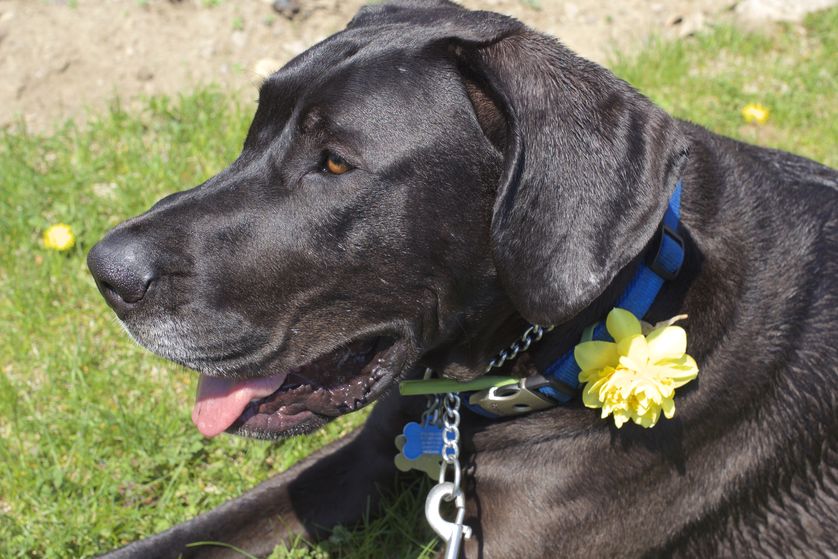
Some serious trauma as a puppy made Cooper never want to be alone. (Photo: Ali Berman)
Just part of the story
When we rescue an animal, most of the time we never get to know their complete history. Why do some cry when their humans leave the house? Or some bark and growl at men who wear hats? Like people, animals remember the various difficulties and tragedies they have suffered. Those scars go through life with them, just like our own scars follow us. The only difference is they can’t tell us their fears, and we can’t explain to them that they are safe. The best we can do is show them they are loved and hope with enough repetition, they’ll get the message.
In an ideal world, every dog would only have good memories. Their first Frisbee catch or trip to the beach, their favorite person who knows how to pet the ears just right, and the safety of a single home where they will live their life right through to ripe old age. That’s not the case for every dog. Some need a little extra help from us as they learn to trust, move on from the past and accept that their new reality is the one they can count on.
With time, Cooper might just learn to keep snoozing while his mom or dad goes to get a cup of tea. Until then, we’ll all keep showing him that he’s loved, and that this home and this family are forever.
ooOOoo
When one thinks of how dogs, Cooper, Hazel and tens of thousands of others, so beautifully offer their unlimited love to us humans it is just a great shame that we humans haven’t emulated our beloved dogs across mankind in such a widespread manner.
Picture taken by our guest Don Reeve of Hazel (and me) Wednesday afternoon.
Gorgeous Hazel. Who would have thought from that smiling face of hers that she had ever suffered the catastrophic loss of her puppies that she had.
(I’m conscious that many recent posts have been more of me republishing stuff than being creative on my own account. Blame it on ‘the book’: my first edit is now complete and the next stage is sending the manuscript out to those who have volunteered to proof-read the book.)
I saw this article on Mother Nature Network and it struck me immediately as being full of common-sense and well worth sharing with you.
ooOOoo
How to build the perfect backyard for dogs
Learn which plants are hardy, which are poisonous, and how to create a beautiful but functional layout.
Designing your garden with your dog in mind will prevent an infinite number of headaches down the road. (Photo: upixa/Shutterstock)
A dog and a healthy, beautiful backyard don’t often go hand in hand. The amount of wear and tear a dog throws at a garden can leave it in tatters. But it doesn’t have to be this way! With a bit of planning and a careful selection of plants able to hold up to whatever dogs spray at them, your backyard can be both a haven for humans and a paradise for your pups.
Here are helpful strategies for planning out a yard and a list of plants to use or to avoid.
7 tips for dog-friendly garden design
Build raised beds for the more sensitive plants or for any fruits and vegetables you may want to grow. Add in some fencing or netting around the boxes to protect them if your dog is still tempted to hop up and snoop around in them.
Build a dog-friendly path around the yard. This will guide your dog through the garden and minimize the detours into the flowerbeds. You may want to start by watching where your dog goes on his own, and creating the path along that route. That way you aren’t trying to train your dog to go somewhere he doesn’t normally want to go, and you aren’t frustrated when your dog goes where he wants to anyway.
Providing pathways for your dogs will show them where they’re allowed to run and will help keep them out of more sensitive areas of the garden. (Photo: Julius Elias/Shutterstock)
Discourage digging through design. If your dog sometimes digs holes, you can help keep your garden beds safe by making them raised beds. However, if your dog is a relentless digger and no part of the yard is safe, then consider building an area where your dog can do anything he’d like within that space, including dig. This could be a fenced area that has a sand box, where the outlet of digging is welcomed.
Create a designated area for bathroom breaks. This will of course require training your dog to use it, but the time and effort spent in training will counter any time and money spent in replacing dead plants.
Provide places to sun. Many dogs love to sunbathe and might pick the sunniest spot in the middle of your favorite bed of flowers. Avoid a dog selecting his own area by providing one for him instead. A small deck, or a few paving stones in a pretty design, or even an area with bark chips will be a welcoming place for your dog to lie down, out of the way of the plants.
Create shaded areas to keep your pet comfortable. Yards are the perfect place to hang out in the sun, but on hot days it can feel pretty miserable without relief with a little shade. Plant trees or tall shrubs where your dog can enjoy a cool break from playing in the sun.
If you have a water feature, make sure the water is drinkable and free of chemicals.
Safe and hardy plants for dogs
After figuring out a few design elements to make your yard a place where both dogs and humans can feel comfortable, it’s time to review your plant selection. There are a fair number of plants that are resistant to dog urine. By placing these plants in the areas your dog frequents, you can reduce how much replanting you need to do as well as keep your yard looking fresh and healthy.
Many herbs are not only safe but also healthy for dogs. But you’ll still want to protect them from your dog by growing them in a raised bed or pots. (Photo: Jamie Hooper/Shutterstock)
Luckily, the herbs you likely want to have in your kitchen garden are also healthy for dogs. If you like cooking with these savory staples, you’ll be happy to know they’re more than welcome in your dog-friendly garden! The five best options include:
Basil — antioxidant, antiviral and antimicrobial properties
Oregano — helps digestive problems including diarrhea and gas
Parsley — a source of flavonoids, antioxidants and vitamins
Peppermint — soothes upset stomachs, reduces gas and nausea, and helps with travel sickness
Rosemary — high in iron, calcium and Vitamin B6
Groundcovers are a great alternative to a grassy lawn. Many varieties can withstand abuse from dogs better than any grasses. Great options include:
Carpet bugle
Elfin thyme
Kinnikinick
Miniature stonecrop
Silver carpet
Snow in summer
Winter creeper
Another staple for a dog-friendly yard are urine-resistant plants. Here are a few suggestions:
Bears breech
Burkwood osmanthus
Doublefile viburnum
Feather reed grass
Holly fern
Japanese spindle tree
Mexican sage
New Zealand flax
Redtwig dogwood
Snowball viburnum
Spider plants
Sword fern
Plants poisonous to dogs
Even if they look pretty, there are quite a few plants you should avoid having in your yard because ingesting them can mean illness or death for your pet. It doesn’t mean you can’t have these plants around; it just means you’ll want to plant them in areas your dog can’t access, such as fenced-off portions of the yard or in hanging baskets out of reach. University of California, Davis put together a list of the 12 plants that cause the most visits to their vet hospital. They include:
Aloe vera
All species of amaryllis
Anemone
Asparagus fern
Chrysanthemums
Cycads (including Sago palm and cardboard palm)
Cyclamen
Daffodil
Jade plants
Lilies
Lily of the valley
Philodendrons
The ASPCA provides a full list of plants toxic to dogs. Reviewing this list before planting will help prevent trips to the vet in the future.
Be sure to double check if the plants you’re adding to your garden are toxic to dogs. While some dogs stay out of the plants, others may munch on anything they feel like, which could lead to a trip to the vet’s office. (Photo: Dora Zett/Shutterstock)
Other things your dog could, but shouldn’t eat
Which mulch you select could be important to your dog’s health. Cocoa mulch, made of cocoa bean shells, is a by-product of chocolate production and can be toxic. Most dogs aren’t going to eat mulch and if they do, they probably wouldn’t eat enough to cause a problem. However, if you have a dog that seems to dine on anything and everything, you may want to consider using something like shredded pine instead.
Much like eating mulch, ingesting large amounts of fertilizer can be unhealthy or even life-threatening for your pet. Be sure to use all-natural fertilizers, follow the directions and make sure that your pet isn’t allowed into the fertilized area within the suggested waiting period after application.
Compost piles are a great addition to any garden but depending on what you’re tossing in them, they can also pose problems for pets. Coffee grinds, moldy food and certain types of fruit and vegetables are toxic to dogs. In addition, fungal toxins can grow within the compost piles that can cause problems for your pet’s health and overall immunity if consumed. It’s a good idea to keep your compost in a bin that is off limits to your dog.
It is also a smart idea to ditch the chemical herbicides and pesticides. Not only are they terrible for the environment but they can also have disastrous effects on pets, including causing cancer.
ooOOoo
This is so brimful of good advice that it deserves to be shared as widely as possible.
A story about a Pit Bull that will touch the soul.
The Pit Bull dog breed gets a very bad press thanks to the despicable way that these dogs were associated with dog fighting many years ago. But take away man’s disgraceful involvement and most times you will find a gorgeous, loving dog.
We have a Pit Bull mix here at home.
Casey, at home; picture taken January, 2014.
He is the most wonderful of dogs.
Now read this article, as seen on Mother Nature Network.
ooOOoo
Rescued pit bull helps autistic teen open his heart
The first time Joey Granados gave his mother a kiss on the cheek was when they adopted Roxy.
The best part about Roxy and Joey’s friendship? No judgments. Just love. (Photo: Amanda Granados/Instagram)
Pit bulls often get a bad rap. So do kids with autism.
Both are misunderstood. But what happens when you put the two of them together? Magic.
Just ask Amanda Granados of Los Angeles. Her son, Joey, has autism. From an early age, Joey turned away from his mom’s hugs and kisses. He would not let his mom hold his hand. He preferred to be alone. According to his mom, Joey had a really difficult time adjusting in social situations.
But Joey has recently met a new friend that has opened up his heart to his mom and others in his world. That friend is Roxy, a goofy, loving pit bull who knows how it feels to have people look at you and think you are something you are not.
Fourteen-year-old Joey had been asking his mom for a dog for some time to help him deal with the loneliness of his life with autism. Just after Thanksgiving, Amanda was perusing the website for the local animal shelter when she came across Roxy’s picture and just knew that this would be a good match.
As Joey tells it, when he and his mom went down to the shelter to look at Roxy, the dog walked right passed Amanda and jumped on Joey’s lap. The two have been best friends ever since. And Roxy has opened up Joey’s world to the love and affection of others.
“I get emotional thinking about it,” Amanda Granados recently told “Today.” “For all those years, he wouldn’t hold my hand, he wouldn’t hug me — it was all part of the autism — but this dog has taught him how to give and show affection. He holds my hand now! He hugs me! The first time I got a kiss on the cheek was when Roxy came home.”
Joey told “Today” that Roxy has made it easier for him to give and receive affection.
“I didn’t have too many friends growing up, but then we got Roxy and I’ve been able to make friends ever since,” Joey said. “At home, I’ve been able to hold my mom’s hand, kiss her, hug her and do a lot of things that I hadn’t been able to do growing up.
“She’s opened up my heart.”
According to Amanda, the best part about the bond between Roxy and Joey is that there are no judgments. Just true friendship. And lots and lots of love.
Want to see this adorable pair in action? Check it out:
I opened the week last Monday by publishing a post under the title of Beyond humans. That post included me writing about Michael Mountain’s talk at the Personhood Beyond the Human conference at Yale University. That talk, that may be listened to in that post, was described in the following abstract:
Abstract: The past 50 years have seen enormous growth in the animal protection movement. But the situation for nonhuman animals in every sphere, with the exception of homeless pets, continues to deteriorate. Any small advances remain incremental. Animal rights and welfare groups find themselves at a loss to explain their inability to influence the general public. But the work of Ernest Becker (The Denial of Death) and of psychologists in the field of Terror Management Theory (TMT) offer essential insight.
In this talk, we discuss how our need, as humans, to proclaim that “I am not an animal!” and to deny personhood to other animals affects our relationship with them at a fundamental level. We argue that to be effective, the animal protection movement needs to understand TMT and take it into account. And we conclude that a new kind of relationship to the world of nature in the 21st Century is not only essential to the mitigation of the catastrophic effects of the Sixth Great Extinction, but that it also holds the key to Becker’s still-unanswered question of how we can begin to relate positively to our own terror of personal mortality — and therefore our own future as a species.
Thus I want to close the week by reinforcing Michael Mountain’s message by using an article published yesterday over at Mother Nature Network.
ooOOoo
Many Americans support equal rights for animals
Animal rights cases and films like ‘Blackfish’ are credited with influencing public opinion.
By: Tanya Lewis, LiveScience
Tue, May 26, 2015 at 11:08 AM
About 33 percent of people said they were ‘very concerned’ about the use of animals in research, and 21 percent were very concerned about zoo animals. (Photo: Pavel L Photo and Video/Shutterstock)
Nearly one-third of Americans believe animals should have the same rights as people, a recent poll finds.
Thirty-two percent of the people surveyed believe animals and humans should have equal rights, up from 25 percent in 2008. Another 62 percent believe animals deserve some protection from harm and exploitation, but it is “still appropriate to use them for the benefit of humans.” Only 3 percent believe animals don’t require protection from harm and exploitation “since they are just animals,” according to the poll.
Gallup interviewed a random sample of more than 1,000 people across the United States on May 6 to 10, 2015. About half of those surveyed were asked about the protection of animals, while the other half were surveyed about the treatment of animals in various settings. The poll’s margin of sampling error was 5 percentage points. [The 5 Smartest Non-Primates on the Planet]
Across all demographic groups, an increasing fraction of people support equal rights for animals, although women were more likely than men to have this view, the poll found. About 42 percent of the women polled supported full animal equality in 2015, compared with 22 percent of men. However, the percentage of men and women who support this view has increased by about the same amount since 2008 — from 35 percent to 42 percent for women, and 14 percent to 22 percent for men.
In addition, Democrats and Democratic-leaning independents were more likely than their Republican counterparts to support complete animal equality. About 39 percent of liberal-leaning people supported that view this year, compared with 23 percent of conservative-leaning people. But the number of both Democrats and Republicans who support animal equality has increased since the last poll, according to Gallup.
The poll found little difference between the views of younger and older Americans.
Gallup also asked Americans how they felt about the treatment of animals in different settings. About 33 percent of people said they were “very concerned” about the use of animals in research, compared with 21 percent who were very concerned about zoo animals. About two-thirds of people said they were “very or somewhat” concerned about animals in the circus; in competitive animal sports or contests; or in research. About 46 percent of people said they were very or somewhat concerned about the treatment of household pets.
The increasing concern for animals can be seen, for example, in the recent court case where animal-rights advocates sought personhood for chimpanzees. The Nonhuman Rights Project has argued for a writ of habeas corpus — a court order to prevent unreasonable detention — to free a pet chimpanzee named Tommy being kept in a cage in upstate New York.
Meanwhile, views on the treatment of marine or farm animals may have been influenced by popular documentaries such as “Blackfish” and “Food, Inc.,” which sought to expose truths about the treatment of whales at SeaWorld and of farm animals raised for consumption, respectively.
Concerns about the treatment of pets may reflect campaigns to stop cruelty toward these animals by organizations such as the American Society for the Prevention of Cruelty to Animals.
Follow Tanya Lewis on Twitter. Follow us @livescience, Facebook & Google+. This story was originally written for LiveScience and was republished with permission here. Copyright 2015 LiveScience, a Purch company. All rights reserved.
ooOOoo
The MMN article above included a number of links; too many on balance for me to insert in this republication.
So I recommend strongly that if this article strikes a chord of interest with you that you go to this place and check out all the many links.
36 golden retrievers rescued from streets of Turkey
Rescuers in Atlanta shower the lucky pups with love, medical attention and playtime.
By: Mary Jo DiLonardo
Tue, May 12, 2015 at 04:00 PM
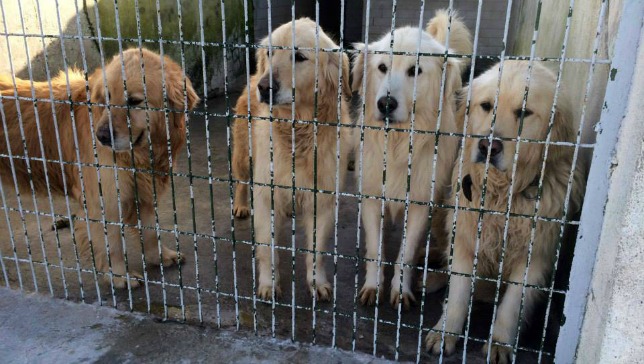
Golden retrievers are packed into an animal shelter in Turkey before being rescued and flown to Atlanta. (Photo: Adopt a Golden Atlanta/Facebook)
Three dozen abandoned golden retrievers made the long trek from the streets of Istanbul, Turkey, to an Atlanta suburb this week thanks to the efforts of an animal rescue group.
The dogs were discovered by an American living in Turkey, who said she saw them living on the streets and taking over shelters. The breed was once considered a status symbol, but as the dogs became more prolific, their popularity waned and the pets were quick to be discarded. On the harsh streets of Istanbul, the gentle dogs didn’t fare well against vicious feral dogs.
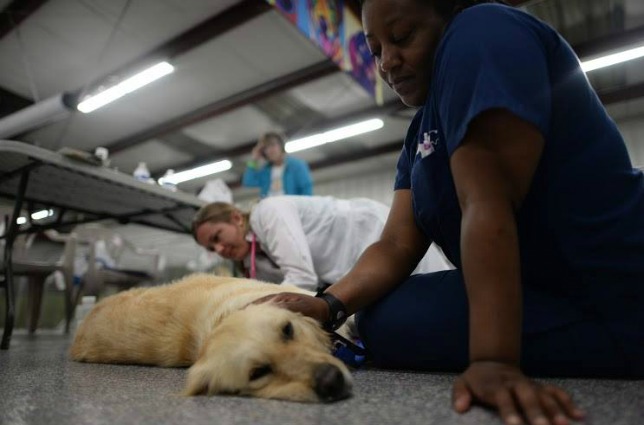
Adopt a Golden Atlanta arranged for 36 of the dogs to be flown to the U.S. where they’re now housed at the Pet Lodge Pet Resort in Alpharetta, an Atlanta suburb. They’ve been given medical attention, baths and lots of playtime. Although they don’t yet understand English commands, volunteers say they seem happy with all the attention — wagging tails all around.
[See footnote]
The goldens made a 12-hour flight and seven-hour layover to get to their new home. They range in age from 6 months to 10 years.
The pups should be available for adoption in a few weeks, and they already have names, says Adopt a Golden founder Lauren Genkinger, who spearheaded the rescue effort.
“They’re the freedom dogs and all of them have been given names, Freedom, Patriot, Liberty, Glory…” Genkinger told WXIA TV in the video above. “It wasn’t easy coming up with 36 patriotic names. The only thing missing from this story … is someone to call America in from the yard … to dinner.”
A golden retriever is examined in Atlanta after arriving from Turkey. (Photo: Adopt a Golden Atlanta)
ooOOoo
Footnote:
There is a two-minute video in the MNN version that I was unable to transport over to here. It may be watched here.
Something a little different for this week. Mother Nature Network put out an email earlier in January that opened, thus:
Dear friend of Mother Nature, We all see the beauty in a sunset or in a gorgeous painting, but can you appreciate the art in bacteria, climate images or preserved animal remains? These beautiful examples show how for centuries, art and science have danced a well-choreographed routine. The result has been some breathtaking creativity.
The pictures were so wonderful that I have offered the first six for today and the balance in a week’s time.
So without further ado, here is the balance of those paintings.
Leonardo da Vinci
As if he wasn’t busy enough, Italian painter, architect, engineer, sculptor and inventor Leonardo da Vinci was also fascinated with anatomy. He was so intrigued by the human body that by the end of his life da Vinci claimed he had dissected more than 30 corpses. He filled pages and pages with incredibly detailed drawings of body parts, accompanied by thousands of explanatory notes. U.K. heart surgeon Frances Wells, author of “The Heart of Leonardo,” recalled seeing da Vinci’s drawings for the first time as a medical student, “I remember thinking that they were far better than anything we had in modern textbooks of anatomy,” he said. “They were beautiful, accurate, absorbing – and there was a liveliness to them that you just don’t find in modern anatomical drawings.”
oooo
Earth as art
The Earth looks pretty darn cool from way, way up in the sky. Technically, NASA’s Landsat series of Earth observation satellites are critical for understanding scientific issues related to land use and natural resources. But really, they take some pretty remarkable images of mountains, valleys, islands and just general patterns in the forests and grasslands. Showing off this natural artistic sensibility, the U.S. Geological Survey created a series of “Earth as Art” images that are absolutely gorgeous. (And if you’re a fan, don’t miss NASA’s global maps, which are mesmerizing.)
oooo
Climate science
Marco Tedesco, associate professor of earth and atmospheric sciences at City College of New York, sees the beauty in climate science. Coastal flooding. Cloud cover. Melting ice. To make climate work more attractive to the less weather-obsessed, he gathered colleagues from his school’s music, graphic design and video game design departments. The project, called Polarseeds, resulted in a multimedia art exhibit featuring photography, music and video, all centered on the beauty in climate science. Data on Greenland’s melting ice was transformed into music and the gallery featured photos of cracking ice.
oooo
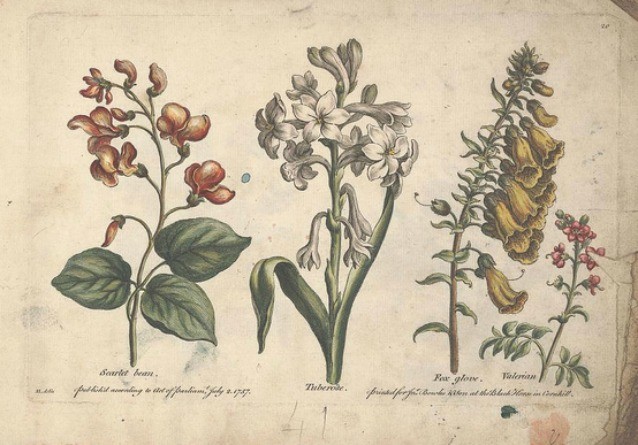
Botanical illustrations
Centuries ago, botanical drawings were key to helping people keep records of plants that had healing properties. The incredibly detailed illustrations of herbs and other plants were designed so that botanists and doctors could recognize the species for medicinal purposes. The oldest surviving example of botanical art, the Codex Vindebonensis, dates back to 512 A.D. The illustrations became more detailed and accurate as the centuries unfolded and now have taken on an artistic rather than medical purpose. There has been a recent resurgence in the art form through groups such as the American Society of Botanical Artists.
oooo
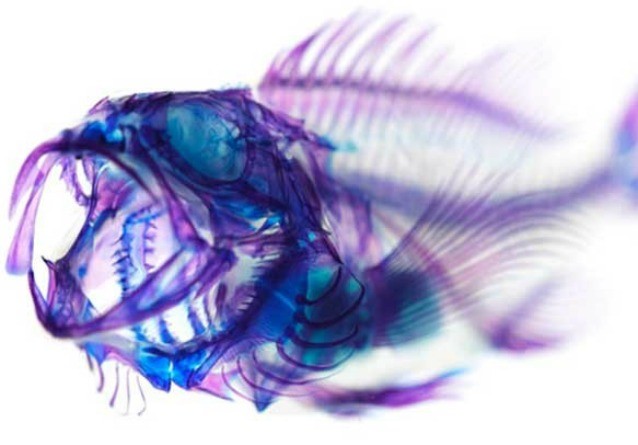
Preserved animal art
Japanese artist Iori Tomita sees beauty in death. He blends chemistry and art as he explores the natural beauty of the skeletal system in sea life. In his series “New World Transparent Specimens,” Tomita chemically bleaches and then dyes preserved animal bodies of fish, turtles, seahorses and other creatures. A chemical mix breaks down the protein and muscle, but leaves the collagen so the bodies keep their forms. Dyes then color the bones and tendons of the specimens, which are preserved in brightly lit glycerin.
oooo
Pharaoh’s serpent
Mercury thiocyanate is an inorganic chemical compound that makes for some pretty dramatic moving art when it’s ignited. In the science world, mercury thiocyanate (typically present as a white powder) has several uses in chemical synthesis, but its real claim to fame is in pyrotechnics. When it’s lit, the compound produces a long spiraling column of ash and smoke that looks like a moving snake. These used to be sold in firework stores, but now you’re only likely to see them in a chemistry class because of claims of toxicity. The modern version is a nontoxic “black snake” that makes a less spectacular — albeit safer — presentation.
Mother Nature Network put out an email earlier in January that opened, thus:
Dear friend of Mother Nature,
We all see the beauty in a sunset or in a gorgeous painting, but can you appreciate the art in bacteria, climate images or preserved animal remains? These beautiful examples show how for centuries, art and science have danced a well-choreographed routine. The result has been some breathtaking creativity.
The pictures were so wonderful that I have offered the first six for today and the balance in a week’s time.
Finding the link Who doesn’t find beauty in nature? But can you find the art in bacteria or global warming or in the interesting forms of dead animal remains? For centuries, art and science have danced a careful routine. As each has informed the other, the result has been some spectacular creativity. (Text: Mary Jo DiLonardo)
oooo
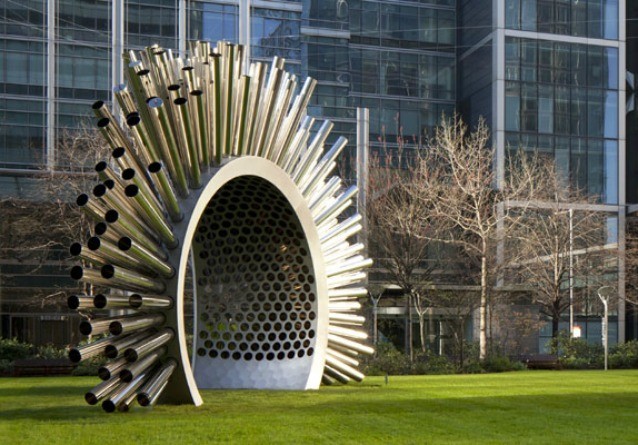
Sonic sculptures Already known for his blown-glass microbes and bacteria, U.K. artist Luke Jerram also makes creations motivated by the science of sound. In Jerram’s sonic sculptures, “invisible sound waves are visualized as silent, three-dimensional experiences,” says science writer Joe Hanson, host of PBS’s “It’s Okay To Be Smart.” One striking example is Aeolus, a giant stringed musical instrument with harp-like cables that vibrate and make music, responding to changes in the wind. The sculpture (also shown at left) was designed “to make audible the silent shifting patterns of the wind and to visually amplify the ever changing sky,” says Jerram.
oooo
Albrecht Dürer Albrecht Dürer was a German painter, printmaker and theorist who many say was the greatest German artist of the Northern Renaissance. Although he was most well-known for his woodcuts and watercolors, Dürer was also revered for his anatomical and cartographic work, says Harvard art historian Susan Dackerman. She says his groundbreaking terrestrial map was “the first perspectival rendering of a terrestrial hemisphere.” His other science-inspired works include a map showing how the brain works and a woodcut of a rhinoceros so detailed that until the 18th century, it was the go-to scientific reference for the animal.
oooo
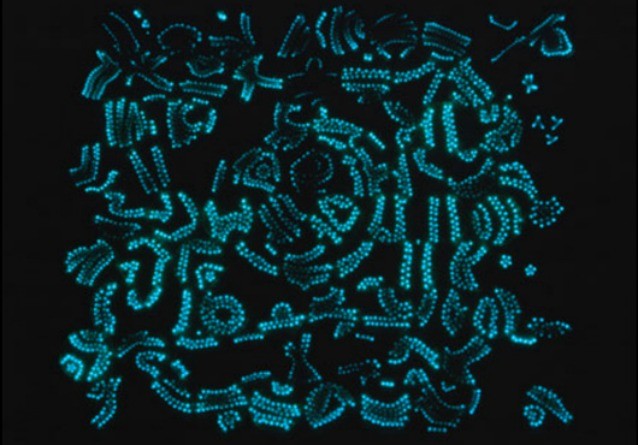
Bioluminescent art Who knew bacteria could be so beautiful? In a mash-up of nature and design, bioluminescent art uses naturally glowing bacteria to create intricate designs that you can see only in the dark. Showing off these creations, BIOGLYPHS is an art and science collaboration by members of the Center for Biofilm Engineering and the Montana State University School of Art. The group “painted” bioluminescent bacterium naturally present in marine environments onto petri dishes to come up with the spectacular glow-in-the-dark creations.
oooo
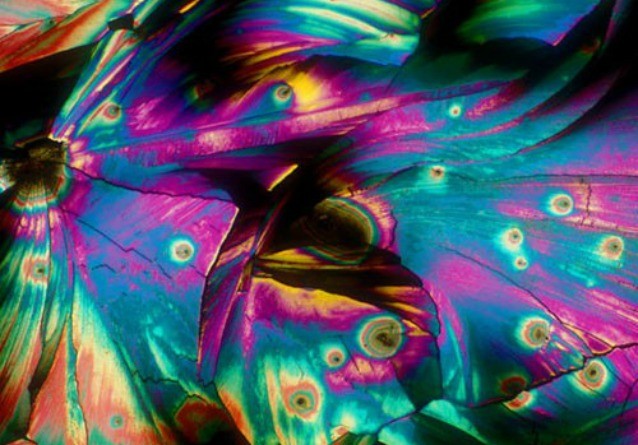
Microscopic art It’s amazing how incredible something can look when you magnify it. Florida State researcher Michael Davidson has a catalog of lovely microscopic images of beer, wine and cocktails. Davidson started his company, BevShots, as a way to raise funds for his lab. Scientific photographer Martin Oeggerli (known as Micronaut) uses scanning electron microscopy to produce images of pollen, microbes, insects and fungi with 500,000 magnification or more. An interesting combination, Oeggerli is a scientific photographer who holds a doctorate in molecular biology. His images often appear in National Geographic where he says, “I also want to broaden people’s awareness that even the smallest living organisms are perfectly ‘designed’ and well worth … our attention.”
oooo
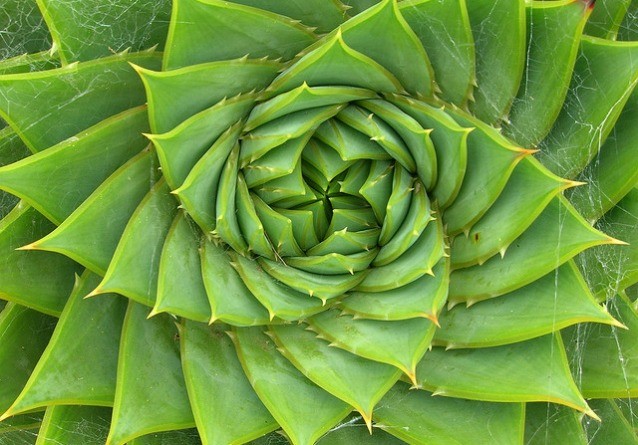
Fibonacci art Math fans know the Fibonacci sequence as an important series of numbers used in all sorts of key mathematical scenarios. The first nine numbers in the Fibonacci sequence are: 0, 1, 1, 2, 3, 5, 8, 13, 21. The sequence — which ironically was explained by Fibonacci himself using the multiplication of rabbits — also appears in nature. MNN’s Shea Gunther writes that the Fibonacci sequence can be found in the formation of sunflowers, galaxies, cellular structure, hurricanes and honeybees. Artists have also been intrigued by the number series. It has inspired everything from sculpture to furniture.













 Learning from Dogs