Tag: Mother Nature Network

Being more aware of dog flu!

This article was recently seen on Mother Nature Network and is shared with you all.

ooOOoo

What you need to know about dog flu

Jenn Savedge

January 29, 2016
Most dogs in the U.S. don't have the immunity to fight off the Asian-based dog flu. (Photo: Lindsay Helms/Shutterstock)
Most dogs in the U.S. don’t have the immunity to fight off the Asian-based dog flu. (Photo: Lindsay Helms/Shutterstock)

As animal experts around the country amplify their warnings about dog flu outbreaks, pet owners are scrambling to understand the illness and learn how they can protect their pets. Here’s what you need to know about this potentially deadly disease.

What is the dog flu?

Dog flu — or canine influenza — is an infection caused by one of two virus strains: H3N2 and H3N8. Of the two, H3N2 is more commonly seen in pets in the U.S. It is thought that the strain came from Asia, possibly originating as an avian flu that was transferred to a dog.

Dog flu symptoms

Like the flu that affects humans, the symptoms of the dog flu hit the respiratory system causing coughing, a runny nose, watery eyes and a sore throat. It’s also usually accompanied by a high fever and loss of appetite. But unlike with humans, your dog won’t be able to tell you how bad she is feeling, and you may not notice the symptoms right away. Animal experts say to watch your dog for changes in behavior. If your normally hyper dog seems lethargic or if your pup who is usually enthusiastic about eating starts skipping meals, it’s time to take a closer look.

Dogs who spend a lot of time around other dogs are more likely to be exposed to the virus. (Photo: Dalibor Sosna/Shutterstock)

How does the dog flu spread?

The dog flu virus spreads just like the human flu virus does — through bodily fluids that are released into the air via a sneeze or cough or by touching objects or surfaces that have been contaminated. The dog flu virus can live in the environment for two days.

Dogs that spend a lot of time around other dogs — in dog parks, kennels, shelters, groomers or veterinary clinics — are the most likely to contract the illness.

What to do if your dog gets the flu

Older dogs, younger dogs and dogs that are already sick are the most vulnerable when it comes to the dog flu, not because of the virus itself, but because these dogs are the most likely to develop complications, like pneumonia, that could be fatal. If you think your dog may have the flu, it’s important to check in with your vet to make sure he isn’t getting any worse.

At home, you can keep track of your dog’s temperature by placing a thermometer under her armpit, or for a more accurate reading, in her backside. According to the American Kennel Club the normal range for a dog’s temperature should be between 101 and 102.5 degrees Fahrenheit (38.3 to 39.2 degrees Celsius.)

Keep the fluids going as much as possible and try to entice your pooch to keep eating. Check with your vet about foods that may prompt him to eat without giving him a stomachache.

More than anything, give your pet plenty of time for R&R. Give her a week or so off from running, walking and other forms of exercise and just let her rest and sleep as much as she needs. Just make sure that she is still drinking, eating a little, and relieving herself.

How you can keep your dog from getting the flu?

The best way to minimize your dog’s risk of getting the flu is to keep her away from other dogs. If you spend time with other dogs, be sure to wash your hands and even change your clothes before interacting with your own dog. While humans can’t contract canine influenza, we can carry the virus on our hands and clothing for up to 24-hours after handling an infected dog.

You could also talk to your vet about a dog flu vaccine, although there is some question about its effectiveness as the vaccine for H3N8 may not offer protection from H3N2 and vice versa.

ooOOoo

If any readers have anything to add to this article, I would love to hear from you.

Let’s please keep all our dogs safe!

I am what I learn!

Reflections on the old and the new.

So here we are on the last day of 2015, the cusp of a new year and who knows what the next twelve months have in store.

All I am going to do is to reflect on the huge potential our modern ‘wired-up’ world offers for learning.

Most will know the saying, “You can’t teach an old dog new tricks.”

But it is wrong!

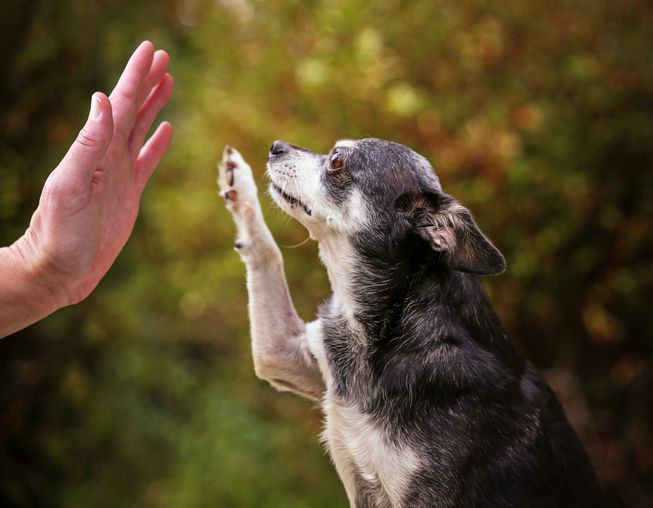
Here at home, where a number of the dogs are in their old age (Pharaoh is the equivalent in age of 100 human years; one dog year being approximately the same as eight human years) Jean and I see no difficulty in these elderly dogs learning new tricks.  Staying with Pharaoh, as an example, his hearing is pretty poor now but he has learnt a whole range of hand signals in recent months and he still communicates very well with us.

There is much in this new world that concerns me and I know I am not alone with this view. But the rewards of reading the thoughts of others right across the world are wonderful beyond measure.

Here’s a tiny dip into some fascinating items and articles that have graced my in-box in just the last twenty-four hours.

  • Eckhart Tolle’s Moment Reminder: “As far as inner transformation is concerned, there is nothing you can do about it. You cannot transform yourself, and you certainly cannot transform your partner or anybody else. All you can do is create a space for transformation to happen, for grace and love to enter.”
  • Val Boyco, “Everything comes to us that belongs to us, if we create the capacity to receive it.” ~ Rabindranath Tagore
  • John Zande in his Sketches on Atheism, “Theism’s most potent, pervasive, irresistibly enchanting gift to frightened but otherwise sane individuals is a belief—a promise—that upon their death they will go home.”
  • Mother Nature Network, “7 ways to meditate while you move – If you don’t have time for sitting meditation, give one of these active meditations a try.”
  • George Monbiot, (on the UK floods), “These floods were not just predictable. They were predicted. There were clear and specific warnings that the management of land upstream of the towns now featuring in the news would lead to disaster.”

and my final selection:

  • Patrice Ayme: (from an essay on Brain & Consciousness) “The best microprocessors you can buy in a store now can do 10 to the power 11 (10^11; one hundred billions) operations per second and use a few hundred watts,” says Wilfred van der Wiel of the University of Twente in the Netherlands, a leader of the gold circuitry effort. “The human brain can do orders of magnitude more and uses only 10 to 20 watts.  That’s a huge gap in efficiency.”

So here’s to a new year of wonderful new learnings.  And let me leave you with this additional message for 2016.

Namely that The Nation weekly journal are celebrating their 150 years of publishing the magazine. They recently published a 150th Anniversary edition and the front editorial is written by Katrina Vanden Heuval. There is a ‘break out’ to one side on Page 2 of that editorial that reads:

Change is inevitable, but the one constant in The Nation‘s history has been a faith in what can happen if you tell people the truth.

Finding out the truth and sharing it so we can all see what can happen is my wish for 2016.

Happy New Year to all of you, and to all of your friends and loved ones.

Our Winter Solstice.

Is the moment of publishing this post.

I thought it would make a nice change to publish tomorrow’s post a little earlier than usual. To be precise to publish it on Dec. 22, at 04:48, Coordinated Universal Time (UTC). Or in our local Pacific Standard Time (PST) UTC-8 hrs or 20:48 Dec. 21., i.e. 20:48 on the evening of the 21st December. (I am seeing the exact time being declared as 04:48 or 04:49 UTC depending on what you read.)

Granted that the Northern Hemisphere tends to deliver the worst of the Winter weather after the shortest day, it still is good to know that for the next six months, the hours of daylight, in the Northern Hemisphere, will be increasing.

My inclination to write a post on the topic was greatly influenced by a most beautiful post over on Val Boyco’s blogsite. It was called And Winter Came.  Here’s the video that Val included in her post.

Isn’t that a most beautiful few minutes!

Impossible to top that!

But I can continue including an informative item that was published over on Mother Nature News, and is republished here within the terms of MNN.

ooOOoo

8 things to know about the winter solstice

From when it happens to why, here’s your crash course on the shortest day of the year.

By: Melissa Breyer, December 18, 2015

Hello, winter. (Photo: psynovec/Shutterstock)

“A day without sunshine is like, you know, night,” quipped Steve Martin – and indeed, even a day with less sunshine can feel a bit dark. Our world depends on the light radiating from that big star we traipse around, and when it’s in short supply, we feel it. But if you count yourself amongst those who don’t love waking up before the sun rises and getting off work after it has set, things are about to lighten up. Hello, winter solstice!

Although winter is really just beginning, we can at least say goodbye to these short little days we’ve been suffering (and don’t let the door hit you on the way out). With that in mind, here’s a collection of curious facts to celebrate the long-awaited return to longer days.

1. There are actually two winter solstices every year


It’s sometimes easy to be hemisphere-o-centric, but the other side of the planet gets a winter solstice too. With the planet’s orbit tilted on its axis, Earth’s hemispheres swap who gets direct sun over the course of a year. Even though the Northern Hemisphere is closer to the sun during the winter, it’s the tilt away from the sun that causes cold temperatures and less light — which is when the Southern Hemisphere is toasty. So while our winter solstice is on Dec. 21 or 22, the Southern Hemisphere celebrates the same on June 21 or 22.

Here’s how that looks from space (kind of):

2. The winter solstice happens in the blink of an eye


Although the solstice is marked by a whole day on the calendar, it’s actually just the brief moment when the sun is exactly over the Tropic of Capricorn that the event occurs.

3. Which is why it happens on different days in the same year

What? Yes! In 2015, the solstice happens on Dec. 22, at 04:49 on the Coordinated Universal Time (UTC) time clock, the time standard that the world regulates its hours by. Which means any location that is at least five hours behind UTC should break out the party hats on Dec. 21. For example, in the United States the winter solstice happens on Dec. 21 at 11:49 p.m. Eastern Standard Time. The rest of the time zones can welcome longer days beginning on the 22nd.

4. It’s the first day of winter … or it’s not, depending on whom you ask

Meteorologists consider the first day of winter to be Dec. 1, but ask an astronomer — or just about anyone else — and they’ll likely answer that the winter solstice marks the start of the season. There are two ways to look at it: meteorological seasons and astronomical seasons. Meteorological seasons are based on the annual temperature cycle, explains NOAA, while astronomical seasons are based on the position of the Earth in relation to the sun.

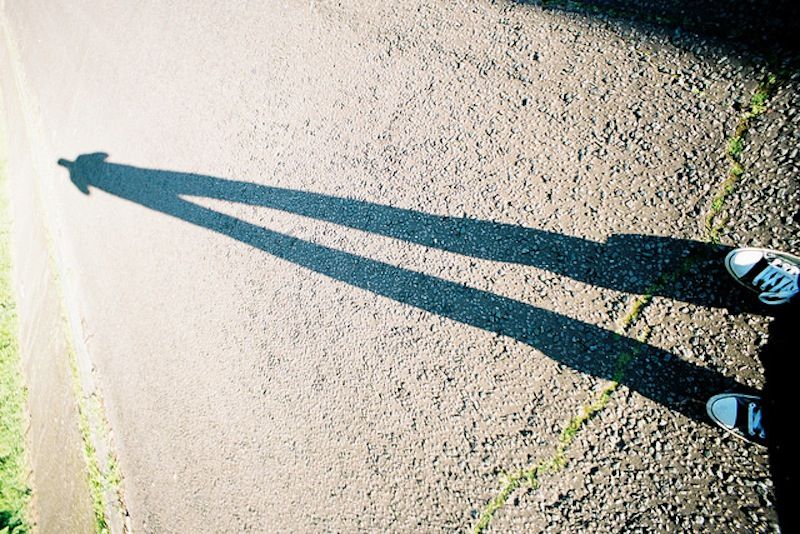
5. It’s a time of gloriously long shadows

Shadows are at their playful best on the solstice. (Photo: Mike Page/flickr)

If you’re inclined to take pleasure in the little things, like shadows that seem cast from a funhouse mirror, then the winter solstice is the time for you. It’s now that the sun is at its lowest arc across the sky and thus, shadows from its light are at their longest. (Imagine a flashlight directly above your head and one hitting you from the side, and picture the respective shadows.) And in fact, your noontime shadow on the solstice is the longest it will be all year. Relish those long legs while you can.

6. Full solstice moons are rarer than blue ones

Since 1793, the full moon has only occurred on the winter solstice 10 times, according to the Farmer’s Almanac. The last one was in 2010, which was also a lunar eclipse! The next full moon on a winter solstice won’t be until 2094.

7. There’s a Christmas connection

Since Christ wasn’t issued a birth certificate, there’s no record of the date when he was supposed to have been born. Meanwhile, humans have been celebrating the winter solstice throughout history — the Romans had their feast of Saturnalia, early German and Nordic pagans had their yuletide celebrations. Even Stonehenge has connections to the solstice. But eventually Christian leaders, endeavoring to attract pagans to their faith, added Christian meaning to these traditional festivals. Many Christmas customs, like the Christmas tree, can be directly traced to solstice celebrations.

8. It’s a reminder to thank Copernicus

Will the real Saint Nick please step forward? (Photo: Wikimedia Commons)

The word “solstice” comes from the Latin solstitium, meaning “point at which the sun stands still.” Since when has the sun ever moved?! Of course, before Renaissance astronomer Nicolaus Copernicus (aka “super smartypants”) came up with the ‘ol heliocentric model, we all figured that everything revolved around the Earth, sun included. Our continued use of the word “solstice” is a beautiful reminder of just how far we’ve come and provides a nice opportunity to give a tip of the hat to great thinkers who challenged the status quo.

And now go have some hot cocoa. Happy winter!

ooOOoo

Only one way to close. That is with this picture of the sun perfectly aligned with the stones at Stonehenge in Wiltshire, UK at the moment of the Winter Solstice.

The December solstice happens at the same instant for all of us, everywhere on Earth. This year the solstice occurs on Tuesday December 22nd at 04:49 GMT (Universal time) with the sun rising over Stonehenge in Wiltshire at 08:04.

Stay safe and warm wherever you are.

The next post from Learning from Dogs will be published at 00:00 PST Wednesday, 23rd December.

Picture parade one hundred and twenty-six

More appropriate images for the time of the year.

The previous set of images are here.

snow9

oooo

snow10

oooo

snow11

oooo

snow12

oooo

snow13

oooo

snow14

oooo

snow15

oooo

You all stay warm and dry!

We want them to live forever!

Here’s an anti-aging project that we all wish for a successful outcome.

Despite the fact that one of the very important items that we learn from dogs is the certainty of death, there is not a single dog carer who doesn’t want them to live much longer lives.

Today’s post is the republication of a recent science report over on Mother Nature Network concerning a drug, rapamycin, that is hoped may give our wonderful dogs several more healthy years of life. As always, republished within the generous terms of MNN.

We wish the scientists much luck in achieving this outcome, without any deleterious side effects.

ooOOoo

Anti-aging project aims to extend dogs’ life spans

Researchers hope a drug called rapamycin can give dogs several more healthy years of life.
By: Russell McLendon, December 4, 2015,

Although some dogs have lived as long as 29 years, canine life spans are typically closer to half that length. (Photo: Shutterstock)

Living with a dog can help humans in lots of ways, from reducing stress and anxiety to lifting our spirits and making us laugh. Yet despite the abundance of benefits dogs offer, they also come with a notable drawback: Their life spans are much shorter than ours, forcing us to deal with the sadness of their deaths every 15 years or so.

Grieving for our dogs is just part of life, and in the big picture, it’s a small price to pay. But according to researchers at the University of Washington (UW), there may be a way to help our best friends stay with us — and stay healthy — a little longer.

Dog aging varies widely by size and breed, with smaller dogs typically maturing more quickly, yet also living a few years longer on average. It’s also common for mutts to outlive purebred dogs, thanks to the perks of higher genetic diversity. But while almost any dog is considered elderly by age 15, some have been known to nearly double their expected life spans — including Bluey, an Australian cattle dog who famously lived to see his 29th birthday last century.

And now researchers at UW’s Dog Aging Project (DAP) are working to bring similar longevity to canines of all kinds. In addition to performing “the first nationwide, large-scale longitudinal study of aging in pet dogs,” this project involves efforts to improve dogs’ “healthy life span” via therapies that already work in lab settings.

“To be clear, our goal is to extend the period of life in which dogs are healthy, not prolong the already difficult older years,” the project’s website explains. “Imagine what you could do with an additional two to five years with your beloved pet in the prime of his or her life. This is within our reach today.”

If it pans out, this may also aid ongoing research into extending the lives of other animals, including humans. But for now, the therapy is focused on dogs.

Researchers think rapamycin might increase a dog's healthy life span by up to 5 years. (Photo: Shutterstock)
Researchers think rapamycin might increase a dog’s healthy life span by up to 5 years. (Photo: Shutterstock)

Namely, they’re testing the FDA-approved drug rapamycin (aka sirolimus) on middle-aged dogs. High doses of rapamycin are already used in humans to fight cancer and prevent organ-transplant rejection, but at low doses, it has also been shown to slow aging and extend life span in several animals with few or no side effects. In mice, for example, the immunosuppressant can lengthen lives by up to 25 percent.

“If rapamycin has a similar effect in dogs — and it’s important to keep in mind we don’t know this yet — then a typical large dog could live 2 to 3 years longer, and a smaller dog might live 4 years longer,” the project’s organizers write. “More important than the extra years, however, is the improvement in overall health during aging that we expect rapamycin to provide.”

Rapamycin trials have already begun on 32 middle-aged golden retrievers, Labrador retrievers and German shepherds. Ranging from 6 to 9 years old, these dogs will spend several months on a low-dose rapamycin regimen in which researchers study age-related metrics like heart function, immune response, physical activity, body weight and cognitive measures. They’ll also follow these 32 dogs throughout the rest of their lives, looking for any significant changes in aging or life span.

And in phase two of the study, a second group of middle-aged dogs will enter a longer-term, low-dose rapamycin regimen “designed to optimize lifespan extension.” Based on mouse studies conducted both at UW and elsewhere, they anticipate the drug “could increase healthy lifespan of middle-aged dogs by 2-5 years or more.”

Rapamycin isn’t a miracle drug, however, and high doses have been linked to side effects like immune suppression and delayed wound healing. But as the DAP website argues, “these are greatly mitigated at the doses used to extend longevity, and both animal and human studies indicate that even mild adverse events are rare.”

Regular exercise and outdoor time are great ways to boost a dog's quality of life. (Photo: Shutterstock)
Regular exercise and outdoor time are great ways to boost a dog’s quality of life. (Photo: Shutterstock)

While the idea of extending dogs’ lives is exciting, it’s important not to let quantity of life overshadow quality of life. We may never have full control over how long our dogs live, but we can make sure they live well while they’re here.

A good reminder of this comes from Pegasus, a Great Dane rescued from unscrupulous breeders in South Africa when she was 4 weeks old. Suffering from a pigment deficiency often associated with blindness and deafness, Pegasus wasn’t expected to live very long. Filmmaker Dave Meinert adopted her anyway, and decided to film her daily as she grew up. In May 2015, he released a time-lapse movie (see below) of her reaching adulthood that quickly went viral. And as he explains in the video, Pegasus’ prognosis only helped the pair live every day like it was their last.

“I still don’t know how long she is going to live,” Meinert admits. “But right now is pretty great.”

ooOOoo

Watching the video offers the most beautiful, and powerful, reminder of the unconditional love that we can share with our dogs! What a gift they give us!

Wouldn’t we all love a few more years of happy and healthy life for our beloved dogs.

Picture parade one hundred and twenty-five.

The following seemed very appropriate for this time of the year!

(As seen on Mother Nature Network)

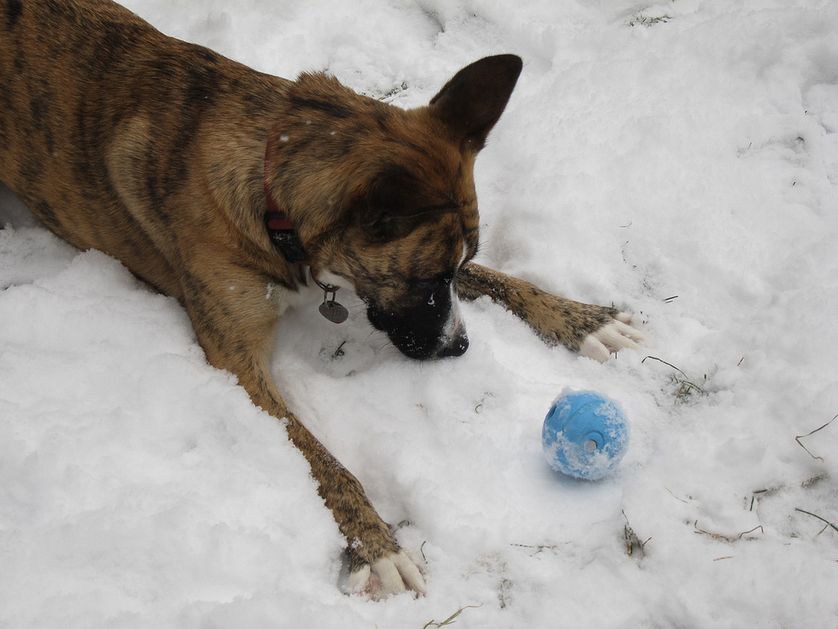
It may be made of snow, but it's just another toy ball to your dog. (Photo: b r/flickr)
It may be made of snow, but it’s just another toy ball to your dog. (Photo: b r/flickr)

oooo

Photo: Graham Milldrum/flickr

oooo

Photo: aaandreasss/flickr

oooo

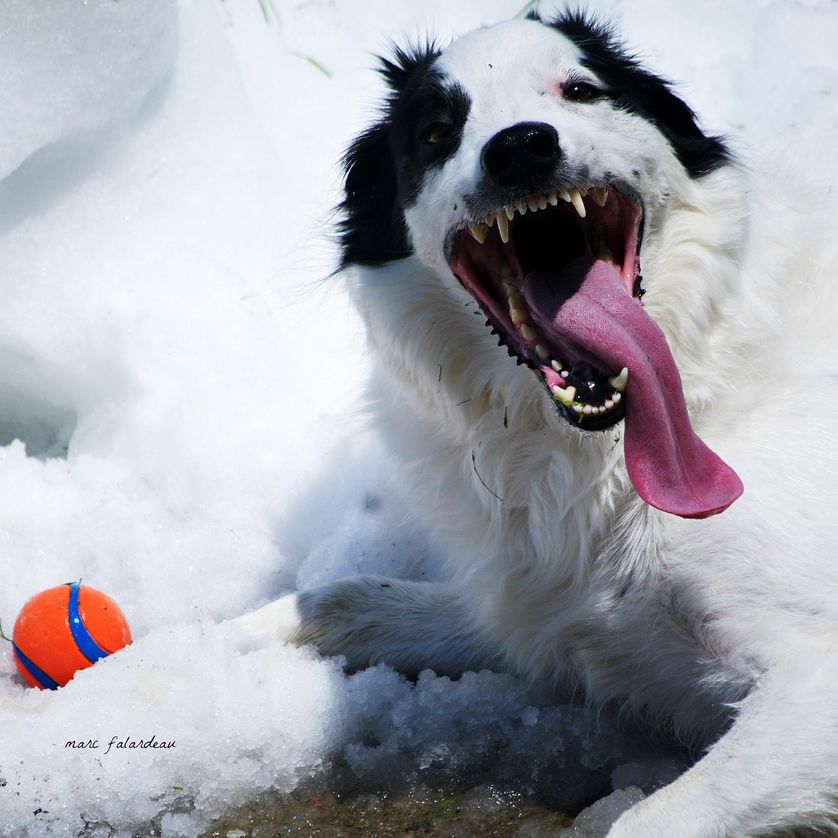
Photo: marc falardeau/flickr

oooo

Photo: bambe1964/flickr

oooo

Photo: Hanna Gustafsson/flickr

oooo

Photo: Andrew E. Russell/flickr

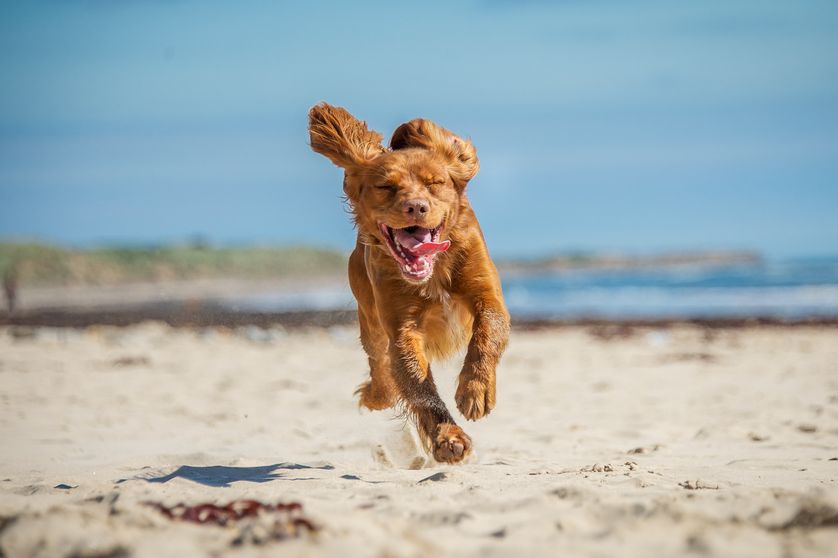
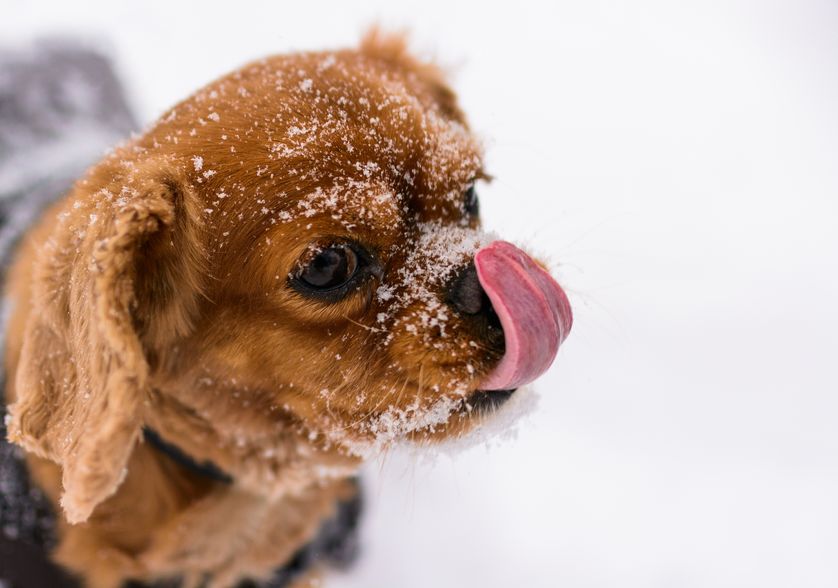
Wherever you are in the world; whatever the weather you and your dogs stay warm and happy!

And more tricks for senior dogs.

The concluding part to yesterday’s post.

ooOOoo

Open a door

Your dog can cue to you open the door by ringing a bell, but how about taking it to the next level and teaching your dog to open the door by himself? In fact, there’s a handy trick built into this that we will introduce later on! This video walks you through all the steps to opening doors and drawers:

Hold an object

If your dog likes to play fetch or tug, it may be a great idea to teach him how to hold and carry an object. It’s a new way for a dog to think about holding a toy, since once the dog has a grip on it, he needs to wait for you to give the cue to release it. This trick is also included in a more complicated trick, which is next on our list. But first, here’s a video that shows you how to master this trick:

Fetch something from the fridge or cupboard

When you have the training down for touch, opening the door, knowing the names of objects, and holding an object, it’s just a matter of putting the steps together to teach your dog to fetch an item from somewhere in the house. A popular version of this trick is of course to fetch a beer from the fridge! But maybe start out with a less fizzy drink option, just in case.

http://www.youtube.com/watch?v=amkZItU9TP0

Back up

An interesting trick to teach your senior dog is how to walk backwards. It’s a great one to help with getting him to think about using his body a little differently. Most dogs aren’t really aware of where their hind end is — it’s just the part that follows their front end. By teaching your dog to walk backward, you’re teaching him to be aware of where his back legs are going. It’s great for both mental and physical agility.

Find it

Keep life interesting for your dog by creating a game around using his nose to find a reward. This is a great trick especially for dogs whose hearing or sight has diminished with age. The trick teaches them to use their noses even more purposefully, using scent work to find the hidden treat or toy. Once you teach your dog how to find it, you can have the “it” be something different every time you play to keep your dog at the top of his game. This video shows an older Labrador learning the steps to the “find it” game and having fun playing:

Tuck himself in bed

It’s surprising how much fun you can have with a trick that only requires your dog to grab a blanket and roll over. This adorable trick is great for dogs of any age, and is an easy (and cozy) trick for your senior dog to learn. You simply teach your dog to lie down on a blanket, grab and hold the corner of it, and roll over so he tucks himself into bed. For senior dogs who like to snooze in extra warm blankets, this is a dream trick. Here’s how it works:

ooOOoo

So there you are. Plenty to keep you and your senior dogs engaged for a long time. Once again, if you missed part one then that was published yesterday.

Tricks for us seniors

Eleven tricks you can teach a senior dog.

The household here in Oregon has a number of seniors, both dogs and humans. And while I’m pretty sure that this senior human is practically past the point of learning new tricks, apparently it doesn’t apply to our old dogs.

So enjoy this recent article that appeared on Mother Nature News.

oooooh

Teaching an old dog new tricks is not only possible, but a lot of fun!

By: Jaymi Heimbuch, November 30, 2015

Old dogs can learn new tricks with ease! (Photo: Annette Shaff/Shutterstock)

The old saying goes that you can’t teach an old dog new tricks, but we know a lot of old sayings are wrong — this one included. Of course we can teach old dogs new tricks! In fact, it’s a great way to keep your dog mentally stimulated and having fun throughout his life.

One important thing to keep in mind about teaching senior dogs new tricks and behaviors is the dog’s level of physical ability. Many senior dogs are perfectly able, but if your dog is getting achy in the joints or has other limitations that come with age, keep these in mind. Older dogs may have joint pain or arthritis and have a harder time jumping or even sitting for long periods. They may also have dental issues which may limit the tricks they can do using their mouths. And they may also have hearing or vision problems which alter not only what kinds of tricks you want to teach them but also the way in which you teach them. So it’s important to know what your dog’s physical limitations are when you’re thinking up new tricks, and not push him to the point of possible injury.

While your dog may be past the days of learning to jump through hoops or leap over walls, there is a huge range of tricks that keep mobility issues in mind, and which senior dogs will have a lot of fun learning. Some of the tricks listed here build on each other and gain complexity, so you can keep things interesting for your dog for weeks at a time while training.

Touch

This is such a great trick to use as a foundation for other tricks, from flipping light switches on or off to coming back to your side. And it’s incredibly easy for your dog to learn and do. This is great for older dogs because you can make it really simple at first and build complexity into it after your dog has it down. To start out, you train your dog to do hand targeting. Here’s a video that shows not only how to train your dog to touch your hand, but many of the uses of the behavior:

http://www.youtube.com/watch?v=RWSJVwZybwo

Yawn

Teaching your dog to yawn is all about “capturing behavior” with clicker training. It’s much like training your dog “touch” but this time, you have to wait for your dog to offer the behavior and capture it when it happens. Click — or say a key word like “Yes” — whenever you catch your dog yawning, and then reward him with treats or a game with a toy. After awhile, your dog begins to associate the yawn as being a trick that earns a reward. Here’s a video that demonstrates capturing different behaviors that you can turn into cute tricks, including yawning on command:

http://www.youtube.com/watch?v=ybL0mkN0ZYA

Put toys away

Even when you’re a grown-up, you have to pick up your toys when you’re done playing. Teaching your dog this tidy behavior will keep him or her a little more active in a low-key way, and thus help loosen up those stiff joints and muscles without putting a strain on their body. Plus, it’s a fun game that you can play over and over, not just on clean-up duty.

http://www.youtube.com/watch?v=LjfjzhErIF4

Names of objects

Stretch your dog’s mental abilities by teaching him the name of different objects or toys. This is a great way to teach your dog to fetch certain items from the toy box or even various objects from around house. You can start off with a few items from the toy box or simply get rolling with items you may want him to fetch for you, including hats, keys, shoes, blankets and so on.

Though it may take a while for your dog to truly grasp the name for each item at first, soon he will catch on to what the name game is all about and will likely grasp names faster when introduced to new objects.

Here’s a video that shows how to begin teaching a dog the name of an item, and how to add more items into the mix:

http://www.youtube.com/watch?v=9cDzgEa4Ado

Ring a bell to go out

Your senior dog may be house-trained, but is he also trained to tell you precisely when he wants or needs to go out? You can give your older dog a great tool to tell you what he needs by teaching him to ring a bell as a cue to go outside. This video shows the progression of teaching a dog to touch the bell, and then eventually transition to learning that ringing the bell means their human opens the door for them.

http://www.youtube.com/watch?v=cjve4nuw7So

oooooh

The balance of this fascinating article comes out tomorrow.

Stillness!

One of the classic lessons we can learn from our dearest dogs.

In yesterday’s post, towards the end of the essay by Russell McLendon was the following paragraph:

All this may seem like an esoteric quest for neuroscientists, but it’s about more than just academic curiosity. By knowing which parts of the human brain generate our sensation of happiness, we might develop more accurate ways to test methods of becoming happier, like travel, exercise or meditation.

I have written before on the subject of stillness and how important it is for us humans. That was a post back in August where I shared an interesting talk by Pico Iyer The Art of Stillness.

Anyway, back to yesterday’s post and the essay that was linked to from the word “meditation”. An essay that I am going to republish in full, within the terms of Mother Nature Network.

ooOOoo

Russell Simmons says meditation is the key to greater happiness

Business magnate shares the benefits and practice of daily meditation in his new book ‘Success Through Stillness.’

By: Michael d’Estries, March 6, 2014

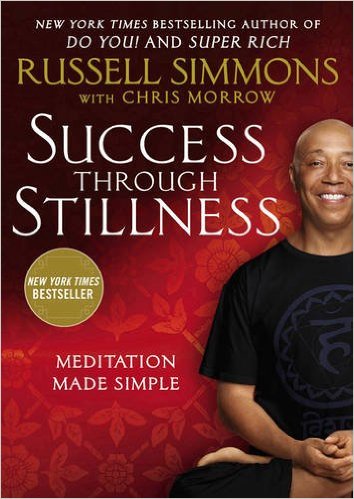
Book cover of "Success Through Stillness"
Book cover of “Success Through Stillness”

For those wondering if the daily practice of meditation really works, Russell Simmons has both a succinct response and a more in-depth answer totaling more than 220 pages.

“Today my new book ‘Success Through Stillness: Meditation Made Simple’ comes out,” he recently wrote in a blog post. “As the title suggests, it is a very straight-forward, easy-to-digest guide on how to get past whatever misconceptions or apprehensions you might have about meditation and learn how to use this simple yet incredibly effective tool.
“As I move around talking about the book, one question I seem to get asked over and over again is, ‘Does meditaion really work?’ And my answer is always an unequivocal ‘YES!'”

The 56-year-old vegan and healthy living guru, who has built a net worth estimated at more than $340 million, says he was skeptical at first that 40 minutes of daily meditation could do anything to stem the anxiety he was feeling.

“The idea of being still and operating from a calm place is one that I never would’ve thought would’ve suited my lifestyle or my goals or the way that I pursue life, ’cause I pursue everything with a vigor,” he told Yahoo! News.

Simmons explains that he practices mantra-based meditation, in which one repeats a word or sound for a period of 20 minutes. Simmons repeats the word “Rum” over and over, a process he says has led him to greater happiness.

“I come out of meditation, and sometimes I just start giggling, I feel so happy, right in the mornings,” he shares.

According to a study released earlier this year, while feelings of happiness may not necessarily occur for all practitioners of meditation, reductions in anxiety, depression and possibly pain are possible.

“Meditation helps young people and adults to get control of the noise,” says Simmons. “The noise is the cause of almost all sickness and sadness. If we can calm the noise, our relationship with the world benefits tremendously.”

ooOOoo

51Ui6mnp6pL._SX352_BO1,204,203,200_

If you would like to buy a copy of Simmons’ book, in Kindle, Hardback or Paperback formats, then do click on the link below.

Success Through Stillness: Meditation Made Simple

Finally, to underline how dogs are such wonderful examples of being still, do enjoy the following photograph that was taken earlier yesterday morning.

P1150822
From left-to-right: Cleo; Oliver; Sweeny; Hazel; Jeannie; Pedy.

I truly envy a dog’s ability to be still so easily!
These extraordinary minds of ours.

Serendipity at work.

Chapter 8 of my book is entitled: Behaviours and Relationships. It opens thus:

“It is all to do with relationships.”

I heard this many years before the idea of writing this book came to me. Heard it from J, who was referred to in the previous chapter. J was speaking of what makes for happy people in all walks of life. It’s one of those remarks that initially comes over as such an obvious statement, akin to water being wet or the night being dark, that it is easy to miss the incredible depth of meaning behind those seven words.

Humans are fascinating. Every aspect of who we are can be seen in our relationships. How we relate to people around us, whether it be a thirty-second exchange with a stranger or a long natter with friends whom we have known for decades, including our partners and family relations. The core relationship, of course, the relationship that drives so many of our behaviours is the relationship that we have with ourself. That being rooted in our relationship experiences with the adults around us when we were young people.

When one looks at the performance of successful companies one often sees, nay one always sees, people being valued. The directors and managers of those companies understand that if people are valued then a myriad of benefits flow from that approach to relationships. Moving out of the workplace, the relationships that people have are always stronger and happier if those individual persons know they are valued. Moving beyond people, our dogs, and many other animals, are always stronger and happier if they feel valued. It’s the difference between empathy and sympathy.

Recently over on Mother Nature Network there was an essay presented by Russell McLendon who is science editor for MNN. It is about happiness.

ooOOoo

Happiness is all in your head

Scientists say they’ve found where happiness happens in the brain. What does that mean?

By: Russell McLendon, November 24, 2015

Understanding how our brains generate happiness could help make it less elusive, researchers say. (Photo: Andrew Vargas/Flickr)

Everyone wants to be happy. Yet despite all our efforts in pursuit of this prized emotion, it can be a surprisingly nebulous goal. What is “happiness,” exactly?

That question has puzzled philosophers for thousands of years, and it’s still tricky for anyone to tackle. But recent advances in neuroscience have finally begun to shed light on it, and now a new study claims to have found an answer. Being told happiness is “all in your head” may seem both obvious and dismissive, but in this case the specifics are also empowering. The more we know about how (and where) happiness happens, the less helpless we’ll be to summon it when we need it.

By comparing magnetic resonance imaging (MRI) with questionnaires about emotional states, researchers from Kyoto University in Japan say they’ve traced the experience of happiness to a specific part of the human brain. Overall happiness, they conclude, occurs when positive emotions combine with a sense of life satisfaction in the precuneus, a region of the medial parietal lobe that’s linked to important brain tasks like episodic memory, self-reflection and consciousness.

Psychologists already distinguish between broad life satisfaction and “subjective well-being,” since happiness often seems to fade during bad moods without necessarily plunging us into deeper existential despair. But by revealing the neural mechanics of how these feelings combine to create overall happiness, the authors of the new study hope to make it easier to objectively quantify this mysterious and elusive emotion.

“Over history, many eminent scholars like Aristotle have contemplated what happiness is,” lead author Wataru Sato says in a press release. “I’m very happy that we now know more about what it means to be happy.”

Scientists used MRI brain scans to identify happiness in a brain region known as the precuneus. (Photo: Kyoto University)

To pinpoint the location of happiness, Sato and his colleagues first used MRI to scan the brains of their study subjects. Those participants then took a survey, which asked about their general sense of happiness, the intensity of their emotions and the degree of their overall life satisfaction.

After analyzing the data, the researchers discovered that those who scored higher on the happiness survey also had more gray matter mass in the precuneus. That means this brain region is larger in people who feel happiness more intensely, feel sadness less intensely and who are better able to find meaning in life.

“To our knowledge, our study is the first to show that the precuneus is associated with subjective happiness,” the researchers write in the journal Scientific Reports.

Complex phenomena like happiness rarely boil down to a single brain region, but other recent research also points to an outsized role for the precuneus. A study published this month links impaired connectivity in the precuneus to depression, for example, and a 2014 study suggests the region is a “distinct hub” in the brain’s default-mode network, which is active during self-reflection and daydreaming.

All this may seem like an esoteric quest for neuroscientists, but it’s about more than just academic curiosity. By knowing which parts of the human brain generate our sensation of happiness, we might develop more accurate ways to test methods of becoming happier, like travel, exercise or meditation.

“Several studies have shown that meditation increases grey matter mass in the precuneus,” Sato says. “This new insight on where happiness happens in the brain will be useful for developing happiness programs based on scientific research.”

ooOOoo

It’s an unscientific opinion from me but I truly believe that humans have a bias towards happiness. And if there’s one animal that we can learn happiness from, it’s the dog!

Photo: Kiuko/flickr.