Tag: Mississippi State University

An article on decluttering

And it isn’t all that one might expect!

Jeannie and I are at opposite ends of the scale, so to speak. The older I get the more I want everything in the same place, primarily because I cannot remember where I previously put something.

Jeannie loves putting stuff anywhere because she can recall where it is!

So an article in The Conversation was fascinating.

ooOOoo

Decluttering can be stressful − a clinical psychologist explains how personal values can make it easier
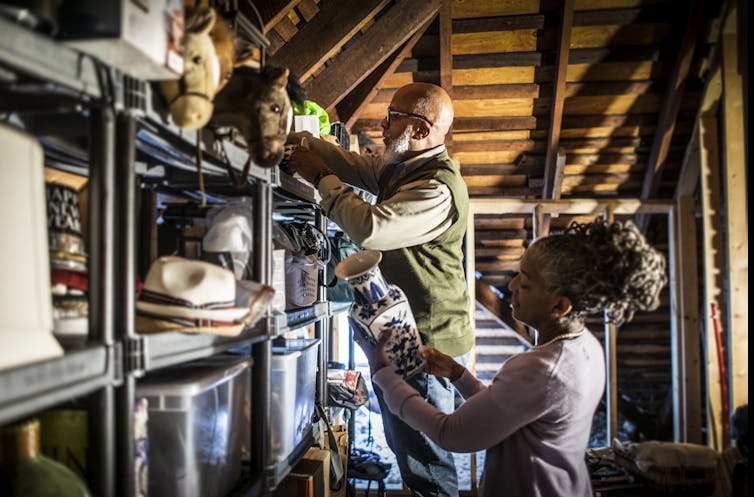
Asking how discarding an item fits with a person’s goals can help them decide whether to keep it. MoMo Productions via Getty Images

Mary E. Dozier, Mississippi State University

I recently helped my mom sort through boxes she inherited when my grandparents passed away. One box was labeled – either ironically or genuinely – “toothpick holders and other treasures.” Inside were many keepsakes from moments now lost to history – although we found no toothpick holders.

My favorite of the items we sorted through was a solitary puzzle piece, an artifact reflecting my late grandmother’s penchant for hiding the final piece to a jigsaw puzzle just to swoop in at the last moment and finish it.

After several hours of reminiscing, my mom and I threw away 90% of what we had sorted.

“Why did I keep this?” is a question I hear frequently, both from my family and friends and from patients. I am a licensed clinical psychologist whose research focuses on the characterization, assessment and treatment of hoarding disorder, particularly for adults 60 years of age or older. As such, I spend a great deal of my time thinking about this question.

What drives the need to keep stuff?

Hoarding disorder is a psychiatric condition defined by urges to save items and difficulty discarding current possessions. For adults with “clinically severe” hoarding disorder, this leads to a level of household clutter that impairs daily functioning and can even create a fire hazard. In my professional experience, however, many adults struggle with clutter even if they do not meet the clinical criteria for hoarding disorder.

Holding on to things that have sentimental value or could be useful in the future is a natural part of growing older. For some people, though, this tendency to hold on to objects grows over time, to the point that they eventually do meet criteria for hoarding disorder. Age-related changes in executive function may help explain the increase in prevalence of hoarding disorder as we get older; increasing difficulty with decision-making in general also affects decisions around household clutter.

The traditional model behind hoarding disorder suggests that difficulty with discarding comes from distress during decision-making. However, my research shows that this may be less true of older adults.

When I was a graduate student, I conducted a study in which we asked adults with hoarding disorder to spend 15 minutes making decisions about whether to keep or discard various items brought from their home. Participants could sort whatever items they wanted. Most chose to sort paper items such as old mail, cards or notes.

We found that age was associated with lower levels of distress during the task, such that participants who were older tended to feel less stressed when making the decision about what to keep and what to discard. We also found that many participants, particularly those who were older, actually reported positive emotions while sorting their items.

In new research publishing soon, my current team replicated this finding using a home-based version of the task. This suggests that fear of making the wrong decision isn’t a universal driver of our urge to save items.

In fact, a study my team published in August 2024 with adults over 50 with hoarding disorder suggests that altruism, a personality trait of wanting to help others, may explain why some people keep items that others might discard. My colleagues and I compared our participants’ personality profiles with that of adults in the general population of the same gender and age group. Compared with the general population, participants with hoarding disorder scored almost universally high on altruism.

Altruism also comes up frequently in my clinical work with older adults who struggle with clutter. People in our studies often tell me that they have held onto something out of a sense of responsibility, either for the item itself or to the environment.

“I need it to go to a good home” and “my grandmother gave this to me” are sentiments we commonly hear. Thus, people may keep things not out of fear of losing them but because saving them is consistent with their values. https://www.youtube.com/embed/JNVjPM1cIbg?wmode=transparent&start=0 Your values can help guide which possessions should stay in your life and which ones should go.

Leaning into values

In a 2024 study, my team demonstrated that taking a values-based approach to decluttering helps older adults to decrease household clutter and increases their positive affect, a state of mind characterized by feelings such as joy and contentment. Clinicians visited the homes of older adults with hoarding disorder for one hour per week for six weeks. At each visit, the clinicians used a technique called motivational interviewing to help participants talk through their decisions while they sorted household clutter.

We found that having participants start with identifying their values allowed them to maintain focus on their long-term goals. Too often, people focus on the immediate ability of an object to “spark joy” and forget to consider whether an object has greater meaning and purpose. Values are the abstract beliefs that we humans use to create our goals. Values are whatever drives us and can include family, faith or frivolity.

Because values are subjective, what people identify as important to keep is also subjective. For example, the dress I wore to my sister’s wedding reminded me of a wonderful day. However, when it no longer fit I gave it away because doing so was more consistent with my values of utility and helpfulness: I wanted the dress to go to someone who needed it and would use it. Someone who more strongly valued family and beauty might have prioritized keeping the dress because of the aesthetics and its link to a family event.

Additionally, we found that instead of challenging the reasons a person might have for keeping an item, it is helpful to instead focus on eliciting their reasons for discarding it and the goals they have for their home and their life.

Tips for sweeping away the old

My research on using motivational interviewing for decluttering and my observations from a current clinical trial on the approach point to some practical steps people can take to declutter their home. Although my work has been primarily with older adults, these tips should be helpful for people of all ages.

Start with writing out your values. Every object in your home should feel value-consistent for you. For example, if tradition and faith are important values for you, you might be more inclined to hold onto a cookbook that was made by the elders at your church and more able to let go of a cookbook you picked up on a whim at a bookstore.

If, instead, health and creativity are your core values, it might be more important to hold onto a cookbook of novel ways to sneak more vegetables into your diet.

Defining value-consistent goals for using your space can help to maintain motivation as you declutter. Are you clearing off your desk so you can work more efficiently? Making space on kitchen counters to bake cookies with your grandchildren?

Remember that sometimes your values will conflict. At those moments, it may help to reflect on whether keeping or discarding an object will bring you closer to your goals for the space.

Similarly, remember that values are subjective. If you are helping a loved one declutter, maintain a curious, nonjudgmental attitude. Where you might see a box filled with junk, your grandmother might see something filled with “toothpick holders and other treasures.”

For additional resources and information on hoarding disorder, visit the International OCD Foundation website.

Mary E. Dozier, Assistant Professor of Psychology, Mississippi State University

This article is republished from The Conversation under a Creative Commons license. Read the original article.

ooOOoo

Prof. Mary Dozier makes some powerful, and cogent, statements in this article. Especially that one’s values are subjective. Nevertheless, I think I should write out my values and see what they tell me.
Keeping healthy in old age.

One has to work at it!

For most of us these days old age is part of the scene (and I am classifying old age as being over 70 years). Here are a few facts from the website of the World Health Organization.

Key facts

  • Worldwide obesity has nearly tripled since 1975.
  • In 2016, more than 1.9 billion adults, 18 years and older, were overweight. Of these over 650 million were obese.
  • 39% of adults aged 18 years and over were overweight in 2016, and 13% were obese.
  • Most of the world’s population live in countries where overweight and obesity kills more people than underweight.
  • 39 million children under the age of 5 were overweight or obese in 2020.
  • Over 340 million children and adolescents aged 5-19 were overweight or obese in 2016.
  • Obesity is preventable.

What are obesity and overweight Overweight and obesity are defined as abnormal or excessive fat accumulation that may impair health.

Body mass index (BMI) is a simple index of weight-for-height that is commonly used to classify overweight and obesity in adults. It is defined as a person’s weight in kilograms divided by the square of his height in meters (kg/m2).

Adults

For adults, WHO defines overweight and obesity as follows:

  • overweight is a BMI greater than or equal to 25; and
  • obesity is a BMI greater than or equal to 30.

BMI provides the most useful population-level measure of overweight and obesity as it is the same for both sexes and for all ages of adults. However, it should be considered a rough guide because it may not correspond to the same degree of fatness in different individuals.

World Health Organisation

This is the link for anyone who wants to use the BMI Calculator.

Now this is not a post about obesity or being overweight. It is a post taken from The Conversation about staying as healthy as one can in one’s older years.

ooOOoo

Steep physical decline with age is not inevitable – here’s how strength training can change the trajectory

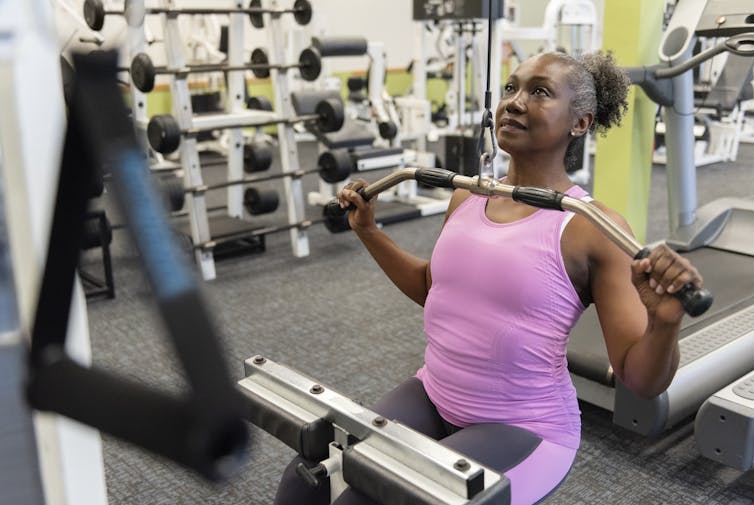
Resistance training can take many forms and can be individualized to suit a person’s needs as they age. Jamie Grill/Tetra Images via Getty Images

Zachary Gillen, Mississippi State University

Raise your hand if you regularly find yourself walking up a flight of stairs. What about carrying heavy bags of groceries? How about picking up your child or grandchild? Most of us would raise our hands to doing at least one of those weekly, or even daily.

As people age, it can become more and more difficult to perform some physical tasks, even those that are normal activities of daily living. However, prioritizing physical fitness and health as you get older can help you go through your normal day-to-day routine without feeling physically exhausted at the end of the day.

It can also help you continue to have special memories with your family and loved ones that you might not have been able to have if you weren’t physically active. For example, I ran two half-marathons with my dad when he was in his 60s!

I am an exercise physiologist who studies how people can use resistance training to improve human performance, whether it be in sports and other recreational settings, in everyday life, or both. I am also a certified strength and conditioning specialist. My career has given me the opportunity to design exercise programs for kids, college athletes and elderly adults.

Staying physically active as you get older doesn’t need to include running a half-marathon or trying to be a bodybuilder; it could be as simple as trying to get through the day without feeling winded after you go up a flight of stairs. Although our muscles naturally get weaker as we age, there are ways we can combat that to help improve quality of life as we get older.

Man in his 60s, a middle-aged woman and a middle-aged man, all wearing race medals and running gear.
From left are the author’s father, who was age 61 at the time, the author’s wife and the author after completing the Lincoln Half Marathon. Zachary Gillen, CC BY-NC-ND

Muscle loss and chronic disease

One of the most important parts of exercise programming, no matter who I am working with, is proper resistance training to build muscle strength. Some amount of age-related loss of muscle function is normal and inevitable. But by incorporating resistance training that is appropriate and safe at any ability level, you can slow down the rate of decline and even prevent some loss of muscle function.

The medical term for a condition that involves age-related loss of muscle function and mass is sarcopenia. Sarcopenia can begin as early as age 40, but it tends to be more common in adults age 60 and older. Sarcopenia is associated with a number of health issues such as increased risk of falling, cardiovascular disease and metabolic disease, among others.

In one of our team’s previous studies, we saw that otherwise healthy individuals with sarcopenia had issues delivering vital nutrients to muscle. This could lead to greater likelihood of various diseases, such as Type 2 diabetes, and slow down recovery from exercise.

Recent estimates suggest that sarcopenia affects 10% to 16% of the elderly population worldwide. But even if a person doesn’t have clinically diagnosed sarcopenia, they may still have some of the underlying symptoms that, if not dealt with, could lead to sarcopenia.

Strength training is key

So the question is, what can be done to reverse this decline?

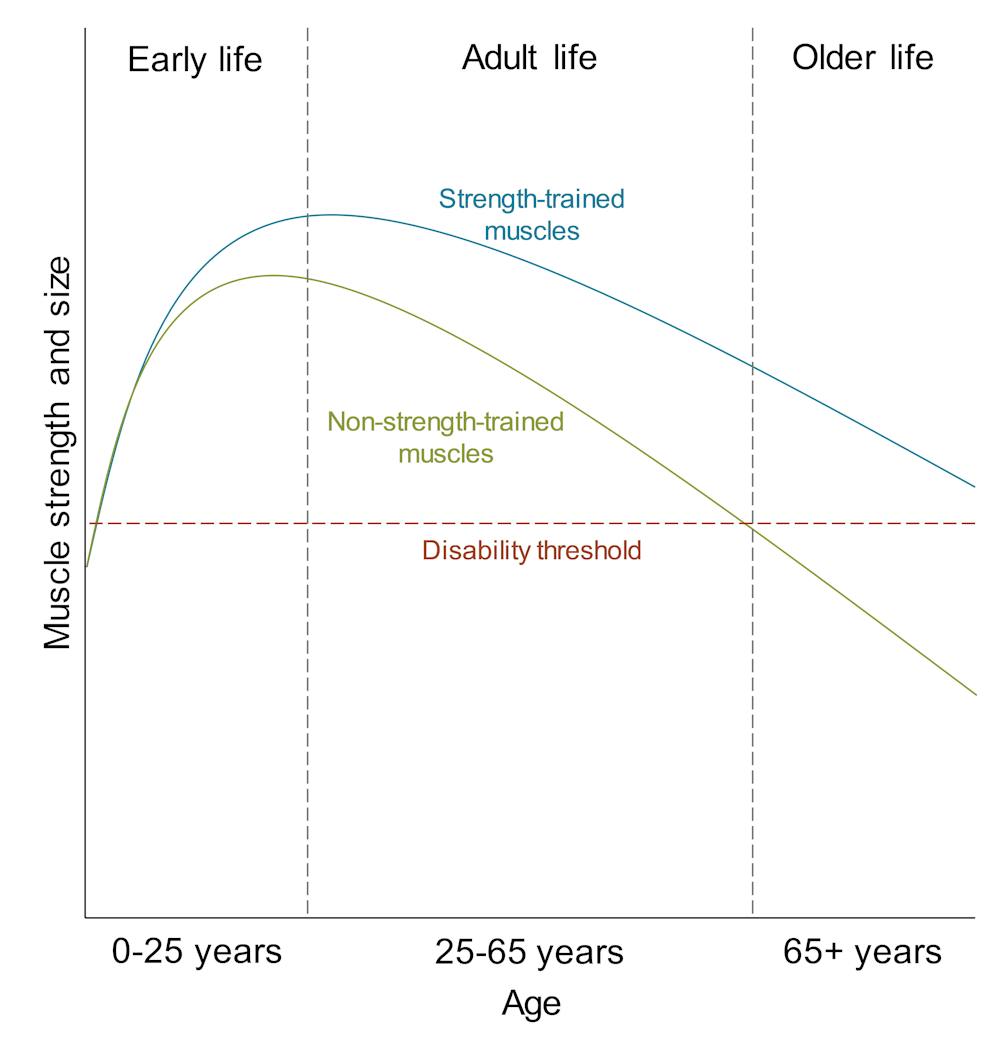
Recent evidence suggests that one of the key factors leading to sarcopenia is low muscle strength. In other words, combating or reversing sarcopenia, or both, may be best done with a proper resistance-training program that prioritizes improving strength. In fact, the decline in muscle strength seems to occur at a much faster rate than the decline in muscle size, underscoring the importance of proper strength training as people age.

Chart showing the general pattern for changes in muscle strength and size across stage of life.
Typical age-related changes in muscle strength and size with and without strength training. Zachary Gillen

Continuing to regularly strength train with moderate to heavy weights has been shown to be not only effective at combating the symptoms of sarcopenia but also very safe when done properly. The best way to make sure you are strength training properly is to seek out guidance from a qualified individual such as a personal trainer or strength and conditioning specialist.

Despite the clear benefits of strength training, it’s been shown that only about 13% of Americans age 50 and older do some form of strength training at least twice a week.

Finding what works for you

So how does a person properly strength train as they age?

The National Strength and Conditioning Association, a leading organization in advancing strength and conditioning around the world, states that for older adults, two to three days per week of strength training can be incredibly helpful for maintaining healthy muscle and bone and combating a number of chronic conditions.

The organization recommends that these workouts involve one to two exercises involving multiple joints per major muscle group, with six to 12 repetitions per set. These are done at an intensity of 50% to 85% of what’s known as one-repetition maximum – the most weight you could handle for a single repetition – with the exception of body weight exercises that use one’s own body weight as the resistance, such as pushups.

I would also recommend resting for about two to three minutes between sets, or even up to five minutes if the set was challenging. For older adults, particularly those age 60 and older, the National Strength and Conditioning Association guidelines suggest that a program like this be performed two to three days per week, with 24 to 48 hours between sessions.

An example of a strength training routine for older adults based on the National Strength and Conditioning Association guidelines

There are a great variety of exercises that could be done interchangeably in a strength training program like this.

ExerciseNumber of setsRepetitions per setIntensity
Barbell squat3670-85%
Barbell bench press3670-85%
Dumbbell lunges38 per leg50-70%
Dumbbell bent over row31050-70%
Double-leg hops212Body weight
Pushups212Body weight

Table: The Conversation Source: Zachary Gillen Get the data Created with Datawrapper

Making life’s tasks lighter

The guidelines above are only one example out of many options, but they provide a framework that you can use to build your own program. However, I would highly recommend seeking out a professional in the field to give specific exercise programming advice that can be tailored to your own needs and goals as you age.

Following such a program would give your muscles an excellent stimulus to enhance strength, while also allowing enough recovery, a very important consideration as people age. You might think it looks like a huge time commitment, but an exercise routine like this can be done in less than an hour. This means that in less than three hours of strength training per week you can help improve your muscle health and reduce the risk of getting sarcopenia and associated health issues.

It’s also important to note that there is no one right way to do resistance training, and it needn’t involve traditional weight equipment. Group classes like Pilates and yoga or those that involve circuit training and work with resistance bands can all produce similar results. The key is to get out and exercise regularly, whatever that entails.

Zachary Gillen, Assistant Professor of Exercise Physiology, Mississippi State University

This article is republished from The Conversation under a Creative Commons license. Read the original article.

ooOOoo

My wife, Jean, was diagnosed with Parkinson’s Disease (PD) in December, 2015. Many of you know that.

Fortunately at our local Club Northwest there was a group of PD sufferers who twice a week held a ‘Rock Steady Class’ under the instruction of a professional coach; Jean joined the group. It was a brilliant move for Jean and she gets a huge amount of care from being with them.

Luckily for me having to drive Jean into Club Northwest it made sense for me to sign up to a fitness class at the same time so I am put through a regular fitness routine under the coaching of Bruce. Plus I try and go bike riding three times a week.

In other words, we both try and stay as fit as we can.

So go on, how old is your dog?

An explanation of how old is that pet of yours.

One of the most frequent questions dog and cat owners get asked is how old is he or she. The pet that is!

And one of the most frequent concerns we have for our pets is how long will they live, as in what is their natural life span. Certainly, most of us realise that the larger dogs live slightly shorter lives but is that borne out in practice.

Well a recent professional article on The Conversation blogsite answered those questions.

ooOOoo

How old is my pet in dog years or cat years? A veterinarian explains

By

Clinical Instructor of Veterinary Medicine, Mississippi State University

July 23rd, 2019

“Just how old do you think my dog is in dog years?” is a question I hear on a regular basis. People love to anthropomorphize pets, attributing human characteristics to them. And most of us want to extend our animal friends’ healthy lives for as long as possible.

It may seem like sort of a silly thing to ponder, born out of owners’ love for their pets and the human-animal bond between them. But determining a pet’s “real” age is actually important because it helps veterinarians like me recommend life-stage specific healthcare for our animal patients.

There’s an old myth that one regular year is like seven years for dogs and cats. There’s a bit of logic behind it. People observed that with optimal healthcare, an average-sized, medium dog would on average live one-seventh as long as its human owner – and so the seven “dog years” for every “human year” equation was born.

Not every dog is “average-sized” though so this seven-year rule was an oversimplification from the start. Dogs and cats age differently not just from people but also from each other, based partly on breed characteristics and size. Bigger animals tend to have shorter life spans than smaller ones do. While cats vary little in size, the size and life expectancy of dogs can vary greatly – think a Chihuahua versus a Great Dane.

Human life expectancy has changed over the years. And vets are now able to provide far superior medical care to pets than we could even a decade ago. So now we use a better methodology to define just how old rule of thumb that counted every calendar year as seven “animal years.”

Based on the American Animal Hospital Association Canine Life Stages Guidelines, today’s vets divide dogs into six categories: puppy, junior, adult, mature, senior and geriatric. Life stages are a more practical way to think about age than assigning a single number; even human health recommendations are based on developmental stage rather than exactly how old you are in years.

Canine life stages

Veterinarians divide a dog’s expected life span into six life stages based on developmental milestones. These age ranges are for a medium-sized dog; smaller dogs tend to live longer, while larger dogs tend to have shorter life expectancies.

STAGE
AGE (YEARS)
CHARACTERISTICS
Puppy 0 – 0.5 Birth to sexual maturity
Junior 0.5 – 0.75 Reproductively mature, still growing
Adult 0.75 – 6.5 Finished growing, sexually and structurally mature
Mature 6.5 – 9.75 From middle to last 25% of expected lifespan
Senior 9.75 -13 Last 25% of life expectancy
Geriatric over 13 Beyond life span expectation