Some reflections from Herbert Marshall McLuhan
In a sense this piece today connects with the conclusions from my review of David Kauders’ new book The Greatest Crash; that we are transitioning into a new era.
That’s why I was fascinated to come across a long essay about Herbert Marshall McLuhan written by Michael Valpy and published in the The Globe and Mail last July.
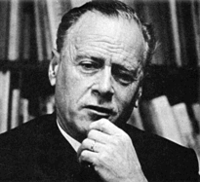
WikiPedia has a comprehensive description of Mr. McLuhan.
Let me quote some extracts from that article to illustrate why I made the connection with my book review.
The University of Toronto professor of English credited with foreseeing the Internet 30 years before it was invented and broadcasting scores of ideas about how electronic communications media was changing the way humans think has been redeemed from labels of McLuhanacy and psuedo-scientific charlatanism.
His work no longer is described, as it was in one erudite journal of the 1970s, as “a hoax so gigantic that it shows every sign of becoming an international intellectual scandal.”
Later on in the article,
Deciding recently to pay a visit to the McLuhan coach house, she wrote: “To be perfectly honest, I had never heard of McLuhan until I moved into residence at SMC, and accidentally stumbled into the book and media studies program. But as I quickly learned, Marshall McLuhan is kind of a big deal. You know that phrase that you hear everywhere: ‘The medium is the message?’ Yeah, that was McLuhan.”
And McLuhan’s problem – one of his problems – is that his message couldn’t escape his medium. As Douglas Coupland points out in a 2009 McLuhan biography, the wonderful, whimsical, boundlessly optimistic and imaginative sixties society that embraced him and lapped up his ideas morphed into the gloom of a change-fatigued seventies society that tired of hearing from him. Yet the brand remained strong. “You know that phrase that you hear everywhere: ‘The medium is the message?’” Ms. Kellogg asks us. “Yeah, that was McLuhan.”
Think of his intellectual history as a journey between two mountain peaks passing through a shadowed valley.
When one thinks of the power of the many new tools we lump under the title ‘social media’ then it’s easy to think that the way that humans are now communicating will have profound implications. Even this humble Blog was read by over 31,000 in the month of October. Back to the article,
McLuhan believed that each new technology created a new human environment and thus a new way of thinking. The medium-is-the-message meant that the content of electronic media is insignificant; it is the medium itself that has the greater impact on the environment. In other words, it wasn’t what we were seeing on TV that was important; it was the fact that we were watching TV (and not doing other things) that altered our brains.
And because, as Prof. Francis points out, McLuhan saw humans as essentially communicative animals, he believed it was the technologies of communication that were primary in shaping who we were, what we thought, and how we acted, with effects that often were subliminal and therefore not recognized.
Finally, the article concludes thus,
To truly understand McLuhan and his ideas, says Prof. Scheffel-Dunand, students have to read him.
Most students of McLuhan today, she says, read scholars who write about McLuhan rather than read McLuhan himself. Which is a mistake, she says, because McLuhan wrote as a poet: he wrote metaphorically, aphoristically, he wrote in what he called “mosaics.”
Biographer Philip Marchand agrees. “My suggestion for students is to begin with the articles written by McLuhan – ‘Acoustic Space’ and ‘The Effect of the Printed Book on the language of the 16th century’ and a couple others that appear in the anthology entitled Explorations in Communication. These articles are lucid, comprehensible introductions to McLuhan’s thought.”
To rejoin UpbeaT blogger Emily Kellogg on her coach house tour: “I don’t want to bore you, dear readers, but I just can’t help gushing. I dig this stuff. These kind of conversations, are the things that make an undergraduate degree worth pursuing. They’re the ones that give you an adrenalin rush because you’re thinking so quickly – and your brain kind of feels like a trapeze artist jumping from idea to idea.
There’s also something innately cool about having an intellectual conversation that ranges from iPhones to Heidegger in five seconds flat in the place that housed Marshall McLuhan as he wrote the books that revolutionized the field of media research.”
Ms. Kellogg: 2011 medium of McLuhan’s message.
Michael Valpy is a freelance writer based in Toronto.
 Learning from Dogs