Tag: Khaled Hosseini

Writing 101

A bit of a change for the next twenty days or so.

As I’m sure you know Learning from Dogs is written under WordPress. Right from the start, I took the decision to offer a daily post and am so glad I did. (This post is number 2,435!)

However, many bloggers do not subscribe to a daily publication of a post and WordPress, in an effort to encourage more bloggers to so do, have launched Writing 101.  Here’s what they sent out to those bloggers that signed up to Writing 101, as indeed did I.

ooOOoo

Day One: Unlock the Mind

You write because you have an idea in your mind that feels so genuine, so important, so true. And yet, by the time this idea passes through the different filters of your mind, and into your hand, and onto the page or computer screen — it becomes distorted, and it’s been diminished. The writing you end up with is an approximation, if you’re lucky, of whatever it was you really wanted to say.

– Author Khaled Hosseini, “How to Write,” the Atlantic

On The Daily Post, we try to instill a daily blogging habit in each of our readers. We’ve gotten to know many of you — your avatars, your blogs — and are reminded each day that our community is full of many different stories and voices.

Some of you want to take your craft of writing to the next level — you might be a seasoned daily prompter ready for something more, or want to experiment with different aspects of storytelling, from considering your setting and point of view, to developing your characters and dialogue.

So welcome to Writing 101: Building a Blogging Habit. In these twenty days, we’ll dive into the elements of storytelling, help you cut through writer’s block and — as Natalie Goldberg teaches — access the pure thoughts and ideas of your wild mind.

To get started, let’s loosen up. Let’s unlock the mind. Today, take twenty minutes to free write. And don’t think about what you’ll write. Just write.

Keep typing (or scribbling, if you prefer to handwrite for this exercise) until your twenty minutes are up. It doesn’t matter if what you write is incomplete, or nonsense, or not worthy of the “Publish” button.

And for your first twist? Publish this stream-of-consciousness post on your blog.

Need a helping hand? Head to The Commons. Happy writing!

ooOOoo

So apart from Sundays I shall be posting in accordance with the daily theme for the next twenty days.  On Sundays I shall revert to my usual Picture Parade.

So that’s enough of a preamble (or delaying tactic!) to today’s theme – here we go.

ooOOoo

Just twenty minutes of free writing.

 (Time: 15:10 PDT)

Writing without thinking!

On the face of it that is an absurd notion … and yet? And yet, there is something fascinating in being totally free to let the words spill out without regard to the potential reader – I guess how one might approach writing a daily diary or journal.

Or try exploring the concept of consciousness!

It strikes me that it’s a little like those odd times when one is sitting in a passenger seat on a commercial airliner flight and one starts to ponder about what makes you and all your fellow passengers remain aloft! There is a difference however in that physics does understand the nature of lift that occurs when air flows across the upper and lower surfaces of a wing.

But consciousness!

I’m pretty sure in my guess that while the human brain is well-understood the precise process, for want of a better term, that explains consciousness is not perfectly understood. If I am wrong on that count then so be it. I hope I am not, for there is something incredibly wonderful, even ephemeral, about a conscious human wondering what it is that makes him or her that conscious human wondering just what it is that causes him or her to be that conscious person! (I sense the closeness of a circular argument appearing out of the mists of my own consciousness!)

The way the brain works in terms of thoughts and inner thoughts and even deeper subconscious thoughts is wonderful. Anyone who has had cause to use the services of a counsellor or therapist to delve into the inner workings of the mind could not fail to be in awe of the power of our brains, the way our brains are so deeply ‘wired-up’ during our formative childhood years, and the way that they conduct our behaviours during our years of adult life.

Which leads me nicely to a closing thought (my wrist-watch is telling me that my twenty minutes are up in six minutes time).

Here it is.

Writing is such a wonderful gift. Put no better than in the words of Khaled Hosseini as quoted in that opening of the Writing 101 item above. It strikes me that it is impossible to write on a regular basis without revealing a great deal about one’s own thoughts, inner thoughts and deeper subconscious thoughts.

That is why blogging is such an incredible way of making connections. Connections across countries, cultures, genders and creeds. In my years of writing this blog I feel an incredible family of friends out there.  Those that follow my humble scribblings and, in turn, those that attract my own following.

It would be wonderful to think that this new world of digital writing and the consequential sharing of the thoughts and ideas that drive our writing may one day make this world a very much better place.

And with those words, I stop.

(Time: 15:30 PDT)
Afghanistan and truth!

“But better to be hurt by the truth than comforted with a lie.”

The quote is from the film, The Kite Runner, which was based on the book  of the same name written by Khaled Hosseini.

This Post is not about taking a position, at any level, about the West’s involvement in the war in Afghanistan – far too dangerous territory!  But it is a reflection on what truth means.

At first that proposition might appear bizarre, of course we know what truth means. My Thesaurus offers three meanings: Correspondence with fact or truth; Freedom from deceit or falseness; The quality of being actual or factual.  Clear?  H’mmm not really in this instance.

OK, to the motivation behind this article.

Last Sunday two outwardly disconnected actions came together, as often seems to happen, to cause me to ponder on how my opinions are formed.  The actions concerned Afghanistan.

The first was that a friend from the congregation gave me his copy of TIME Magazine for January 17th.  In it was an article about a Black Hawk Medevac unit in Afghanistan.  From the TIME website:

The Birds Of Hope: With A Black Hawk Medevac Unit In Afghanistan

By James Nachtwey Monday, Jan. 17, 2011

General William Tecumseh Sherman got it right. War is hell. But even within the cruelty of war, there exists mercy.

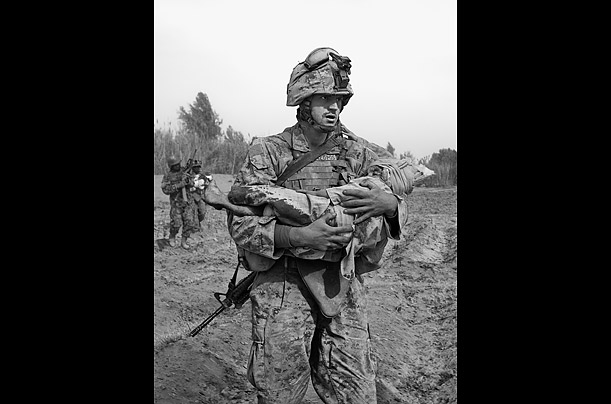
Across a dusty field, two U.S. Marines walk toward a helicopter, each carrying a bloodied and bandaged child. They hold the children as if they were their own. Although at this moment they appear as saviors, a few minutes earlier, they had called in air support in response to enemy fire. The shooter was among children, however (a fact that I have to believe was not known to the Marines), and two were seriously wounded by fragments from machine-gun rounds.

Innocent people are caught in the cross fire in all wars. That’s reality. The two Marines never signed up to hurt kids, and in the shock and confusion, their default reaction was to be protective of the children they indirectly had a hand in wounding. The kids were not left to die, as they might have been in another time and another place by other armies. Instead, a U.S. Army air-ambulance medevac crew was dispatched to fly them to the same medical facility that treats American casualties. If the shooter had survived, he too would have been helped.

Read more: http://www.time.com/time/magazine/article/0,9171,2041191,00.html#ixzz1Byu1S0xj

The article in TIME Magazine contained some emotionally powerful pictures, such as the one below.


A Marine carries an Afghan child.

The full description of the photograph, taken by James Nachtwey for TIME , is Helping Hand
A Marine carries an Afghan child, one of two wounded by coalition aircraft during an air support mission.

My reaction on reading the gruelling story was confused and difficult to articulate clearly but certainly not complimentary! Something along the lines of big and powerful nations, such as the USA, Russia and the United Kingdom, playing out their global strategies with no real insight into the pain and suffering caused by their big ‘war games’.

The second action was that Jean had returned a rental film to the local Blockbuster store and returned with another one that had caught her eye for us to watch on Sunday evening.  That film was The Kite Runner based on the book of the same name by Khaled Hosseini.

There’s a good summary of the plot of the film at WikiPedia.  Here’s a flavour.

In Kabul, prior to the Soviet invasion of Afghanistan, well-to-do young boy Amir and his loyal young Hazara servant Hassan are best of friends. Amir enjoys writing and literature, reading stories to the eager but illiterate Hassan. Amir’s Baba (father), is contemptuous of Amir’s writing and privately regards him as a weakling for letting Hassan protect him from bullies. Baba’s friend Rahim Khan demonstrates interest and encouragement to Amir. Assef, a bully with rancor towards Hazaras, and two accomplices confront Hassan and Amir, but Hassan prevents the attack with a slingshot, a birthday gift from Amir. Assef swears revenge, ridiculing their relationship as mere master and servant. .

Soon the Soviets invade Afghanistan; forcing Baba, a known anti-communist, to flee the country leaving Rahim Khan as property caretaker. En route to Pakistan, Baba bravely risks his life defending a female refugee from a Soviet soldier who demands to rape her in return for safe passage for all. Baba and Amir eventually reach the United States as humble refugees in Fremont, California. Baba tends a gas station while Amir attends community college and vends at a weekly flea market. There, Amir meets Soraya Taheri; Soraya is interested in Amir’s writing although her father, the ex-General Taheri, a proud traditional Pashtun, is contemptuous. Baba is stricken mortally ill but manages to obtain General Taheri’s permission for Amir to marry Soraya. Although Soraya feels bound to confess her previous relationships, they are happily married despite an inability to conceive children. As foreshadowed in the movie’s first scene, Amir’s debut novel is published, dedicated to Rahim Khan who encouraged his writing.

It was a fabulous film, one of the more thought-provoking films seen in many years.  If you haven’t seen it, do so.

So to the point of this article.

The film demonstrated to me that my rather black-and-white opinion of the West’s involvement in Afghanistan was based much more on my instincts that ‘war is bad’ and that the USA tends to throw its military weight around, than having a clue as to the enormous complexities, both at the level of a family and of the nation, that these conflicts entail.

The film showed a much more compassionate aspect to the activities of the USA, specifically in getting involved in Afghanistan and, more generally, in a policy of offering a new home and new hope to those from afar.

And for me, the realisation that while it may be said, ‘There is only one truth’, knowing what that truth is is something very much more challenging!

The first casualty when war comes is truth“. (Hiram W Johnson, senator for California, 1917)