Tag: June

There’s an old saying …

I’m thinking of this one.

There are those that do,

There are those that don’t,

There are those who wondered what happened!

So what prompted me bringing out that old saw?

Simply the ever-increasing rate of the loss of our Arctic sea ice.

Patrice Ayme commented recently on my post, The connection between man and climate.  This is part of what he wrote,

Arctic ice depletion can be tracked at: http://nsidc.org/arcticseaicenews/  It is now lower than the preceding lowest on July 5…

 Over on the Carbon Brief blog, we find a recent post (June 29th) that opens up thus,

The Guardian jumps the gun on record June sea ice melt

29 Jun 2012, 11:15 – Verity Payne

The Guardian this week reports that recent rapid melting of Arctic sea ice has seen levels reach a “record low for June”. But it’s premature to be heralding June 2012 as having record low Arctic sea ice extent before the month is even over, particularly as sea ice extent is not currently tracking at record low levels.

The Guardian article says Arctic sea ice “has melted faster this year than ever recorded before”, under the online headline “Arctic sea-ice levels at record low for June”.

This headline could be read in two ways. The first interpretation is that Arctic sea ice extent for the month of June is at a record low. But can we know that before the month is out? The second is that at some point in June Arctic sea ice was at a record low. But does highlighting a few days of sea ice behaviour best illustrate what’s happening to the sea ice?

The piece also appeared in the print version of the Guardian yesterday with the headline “Arctic sea ice has melted faster than ever, say scientists”.

Melt season

The Arctic sea ice is in long-term decline due to man made climate change, but it’s not a uniform decline – sea ice cover changes with the seasons, and the weather in the region affects how far the sea ice extends, particularly as it melts towards the ice minimum in late September.

During melt season, Arctic sea ice seems to get a lot of media attention, often with rather confusing results. This Guardian article was prompted by analysis from the US National Snow and Ice Data Center (NSIDC), who provide daily updates and regular analysis of Arctic sea ice conditions.

The mention of that Guardian Newspaper article is worth clicking through to, if only to enjoy the fabulous photograph, as below:

Scientists say Arctic sea ice has plummeted to its lowest levels ever this year. Photgraph: Steven J Kazlowski/Alamy

Back to that embedded link in the Carbon Brief posting to the US National Snow and Ice Data Center.  It reveals a wealth of important information.  Try this …

Rapid sea ice retreat in June

Arctic sea ice extent declined quickly in June, setting record daily lows for a brief period in the middle of the month. Strong ice loss in the Kara, Bering, and Beaufort seas, and Hudson and Baffin bays, led the overall retreat. Northern Hemisphere snow extent was unusually low in May and June, continuing a pattern of rapid spring snow melt seen in the past six years.

Overview of conditions

Arctic sea ice extent for June 2012 averaged 10.97 million square kilometers (4.24 million square miles). This was 1.18 million square kilometers (456,000 square miles) below the 1979 to 2000 average extent. The last three Junes (2010-2012) are the three lowest in the satellite record. June 2012 ice extent was 140,000 square kilometers (54,000 square miles) above the 2010 record low. Ice losses were notable in the Kara Sea, and in the Beaufort Sea, where a large polynya has formed. Retreat of ice in the Hudson and Baffin bays also contributed to the low June 2012 extent. The only area of the Arctic where sea ice extent is currently above average is along the eastern Greenland coast.

 Get your mind around this image that comes from the latest NSIDC report.

Arctic sea ice extent for June 2012 was 10.97 million square kilometers (4.24 million square miles). The magenta line shows the 1979 to 2000 median extent for that month. The black cross indicates the geographic North Pole. Sea Ice Index data. About the data

That old saying that I opened with, the one about There are those that do, etc.

No question in my mind that firmly in the camp of those that do is Mother Nature!  Anyone prepared?
The connection between man and climate.

The voice of science

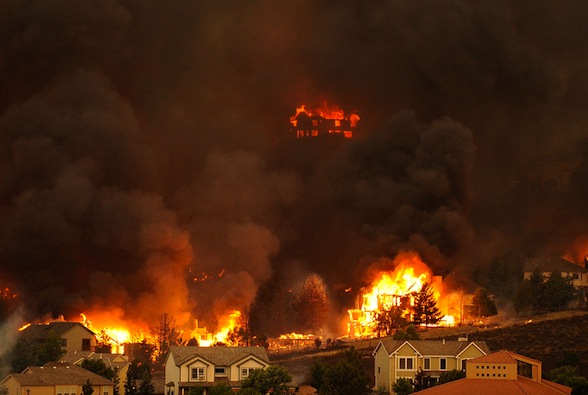
This summer has seen nature visiting on man a series of catastrophes.  To name just a few, we have the record-breaking rainfall in Britain in June, the Colorado wildfires and the 1,400,000 storm-struck households in the eastern US.

Colorado burning

Inevitably, many wonder if this is connected to climate change as a result of mankind’s behaviours.  Many now believe so.

But we have to stand on the rock of science.

So it was great to come across a recent article on Grist that led me to this organisation, Climate Communication.  As they say on the About Us page,

Climate Communication is a non-profit science and outreach project funded by the Rockefeller Brothers Fund and the ClimateWorks Foundation. Climate Communication operates as a project of the Aspen Global Change Institute, a non-profit organization dedicated to furthering the scientific understanding of Earth systems and global environmental change.

The article on Grist that had caught my eye was this one, Did climate change ’cause’ the Colorado wildfires? and within that article there was the link to Climate Communication, viz: That much we know with a high degree of confidence, as this excellent review of the latest science by Climate Communication makes clear.

That review on Climate Communication includes the following video,

Not convinced?

Then try this evidence from an interview with Kevin Trenberth of the National Center for Atmospheric Research shown on PBS Newshour,

Want more?  Go for it!

The PBS video came from the British Guardian newspaper (link thanks to Naked Capitalism).  The Guardian reported,

Is it now possible to blame extreme weather on global warming?

Wildfires, heatwaves and storms witnessed in the US are ‘what global warming looks like’, say climate scientists

Posted by Leo Hickman
Tuesday 3 July 2012

Whenever an episode of extreme weather – heatwave, flood, drought, etc – hits the headlines, someone somewhere is sure to point the finger of blame at human-induced climate change.

Such claims are normally slapped down with the much-aired mantra: “You cannot blame a single episode of bad weather on global warming.” But with the on-going record high temperatures affecting large parts of the US, there seems to be a noticeable reduction in such caveats and notes of caution.

This week, scientists have been queuing up, it seems, to explain how the wildfires in Colorado, the heatwave across the eastern seaboard, and the “super derecho” are all indicative of “what global warming looks like“. Most pulled back, though, from directly blaming global warming for such weather events.

“In the future you would expect larger, longer more intense heat waves and we’ve seen that in the last few summers,” Derek Arndt of NOAA Climate Monitoring told the Associated Press.” The same report added: “At least 15 climate scientists told the Associated Press that this long hot US summer is consistent with what is to be expected in global warming.”

So, can we now say, or not, that specific extreme weather events are caused, or at least exacerbated, by global warming? Has anything changed in climate scientists’ understanding of the attribution – or “anthropogenic fingerprint” – of such events? Are they now more confident about making such links?

I put this question to a number of climate scientists ….

Leo Hickman then reports the assessments of eight leading scientists.  Go and read their words here.  If you can do it now!

The science is solid!

So as you watch these scientists talking about the meaning of climate extremes think what you can do today to reduce your own impact on this planet.  Just as importantly, think how you can influence those around you and those that represent you that now is the time to wake up to the fact that nature is telling us to slow down!

As I said in a comment to a post on Tuesday,

The growth in awareness of what we are doing to the planet is astounding. There is hope, we have to promote hope and we have to acknowledge that hope is a powerful agent of change.