“Before we change the world, we need to change the way we think.”
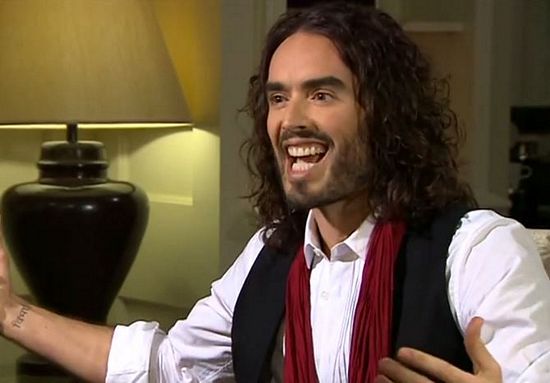
That quote comes from the sub-heading of an article in the magazine The New Statesman, Britain’s current affairs magazine. In fact, written by Russell Brand from the week that he is guest editor for the magazine. Hence it following on from yesterday.

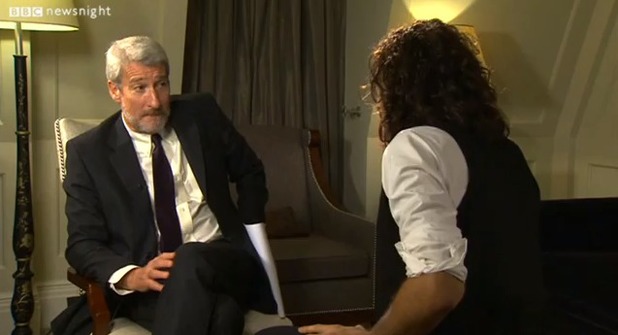
To remind readers, my post yesterday A powerful brand of truth centred around the interview on BBC Newsnight of Russell Brand by Jeremy Paxman.
Thus for today I wanted to offer some further thoughts from Russell Brand together with the film made by Dr Nafeez Ahmed. You will possibly recall that Dr. Ahmed was the author of the Guardian article that I quoted from yesterday.
Russell Brand’s New Statesman article spoke powerfully and eloquently of the issues that he covered in his BBC Newsnight interview. With The New Statesman’s permission let me offer a few extracts:
First from where Brand is speaking about “young people, poor people, not-rich people”.
They see no difference between Cameron, Clegg, Boris, either of the Milibands or anyone else. To them these names are as obsolete as Lord Palmerston or Denis Healey. The London riots in 2011, which were condemned as nihilistic and materialistic by Boris and Cameron (when they eventually returned from their holidays), were by that very definition political. These young people have been accidentally marketed to their whole lives without the economic means to participate in the carnival. After some draconian sentences were issued, measures that the white-collar criminals who capsized our economy with their greed a few years earlier avoided, and not one hoodie was hugged, the compliance resumed. Apathy reigned.
There’s little point bemoaning this apathy. Apathy is a rational reaction to a system that no longer represents, hears or addresses the vast majority of people. A system that is apathetic, in fact, to the needs of the people it was designed to serve.
Russell Brand is also no slouch when it comes to offering solutions, as in:
These problems that threaten to bring on global destruction are the result of legitimate human instincts gone awry, exploited by a dead ideology derived from dead desert myths. Fear and desire are the twin engines of human survival but with most of our basic needs met these instincts are being engaged to imprison us in an obsolete fragment of our consciousness. Our materialistic consumer culture relentlessly stimulates our desire. Our media ceaselessly engages our fear, our government triangulates and administrates, ensuring there are no obstacles to the agendas of these slow-thighed beasts, slouching towards Bethlehem.
For me the solution has to be primarily spiritual and secondarily political. This, too, is difficult terrain when the natural tribal leaders of the left are atheists, when Marxism is inveterately Godless. When the lumbering monotheistic faiths have given us millennia of grief for a handful of prayers and some sparkly rituals.
By spiritual I mean the acknowledgement that our connection to one another and the planet must be prioritised. Buckminster Fuller outlines what ought be our collective objectives succinctly: “to make the world work for 100 per cent of humanity in the shortest possible time through spontaneous co-operation without ecological offence or the disadvantage of anyone”. This maxim is the very essence of “easier said than done” as it implies the dismantling of our entire socio-economic machinery. By teatime.
Towards the end of the article, or manifesto as Brand calls it, he speaks about the change that is required:
We are still led by blithering chimps, in razor-sharp suits, with razor-sharp lines, pimped and crimped by spin doctors and speech-writers. Well-groomed ape-men, superficially altered by post-Clintonian trends.
We are mammals on a planet, who now face a struggle for survival if our species is to avoid expiry. We can’t be led by people who have never struggled, who are a dusty oak-brown echo of a system dreamed up by Whigs and old Dutch racists.
We now must live in reality, inner and outer. Consciousness itself must change. My optimism comes entirely from the knowledge that this total social shift is actually the shared responsibility of six billion individuals who ultimately have the same interests. Self-preservation and the survival of the planet. This is a better idea than the sustenance of an elite. The Indian teacher Yogananda said: “It doesn’t matter if a cave has been in darkness for 10,000 years or half an hour, once you light a match it is illuminated.”
Then shortly thereafter:
The only systems we can afford to employ are those that rationally serve the planet first, then all humanity. Not out of some woolly, bullshit tree-hugging piffle but because we live on it, currently without alternatives. This is why I believe we need a unifying and in – clusive spiritual ideology: atheism and materialism atomise us and anchor us to one frequency of consciousness and inhibit necessary co-operation.
With the article/manifesto concluding:
But we are far from apathetic, we are far from impotent. I take great courage from the groaning effort required to keep us down, the institutions that have to be fastidiously kept in place to maintain this duplicitous order. Propaganda, police, media, lies. Now is the time to continue the great legacy of the left, in harmony with its implicit spiritual principles. Time may only be a human concept and therefore ultimately unreal, but what is irrefutably real is that this is the time for us to wake up.
The revolution of consciousness is a decision, decisions take a moment. In my mind the revolution has already begun.
It’s a powerful and very personal response to the issues facing all of humanity now and I can’t recommend too strongly reading the article in full.
So on to another powerful and personal analysis of the issues facing humanity. This time in a film made by Dr Nafeez Ahmed. The film is called The Crisis of Civilization and shows, oh so clearly, the interconnectedness of the many issues we are facing these days. It’s nearly an hour-and-a-half long but eminently watchable.
Author and international security analyst Dr Nafeez Mosaddeq Ahmed on The Crisis of Civilization. Dr Ahmed is author of A User’s Guide to the Crisis of Civilization: And How to Save It, and co-producer of The Crisis of Civilization.
It often seems that different crises are competing to devastate civilization. The Crisis of Civilization argues that financial meltdown, environmental degradation, dwindling oil reserves, terrorism and food shortages need to be considered as part of the same ailing system.
Most accounts of our contemporary global crises focus on one area, or another, to the exclusion of others. The Crisis of Civilization suggests that the unwillingness of experts to look outside their own fields explains why there is so much disagreement and misunderstanding about the nature of the global threats we face. The Crisis of Civilization attempts to investigate all of these problem areas, not as isolated events, but as trends and processes that belong to a single global system. We are therefore not dealing with a ‘clash of civilizations’ as Samuel Huntington argued. Nor have we witnessed ‘the end of history’ that Francis Fukuyama prematurely declared. Rather, we are dealing with the end of the industrial age, a fundamental crisis of civilization itself.
oooOOOooo
OK, that’s the end of the serious stuff for this week. Things are going to be very different here on Learning from Dogs for the month of November.
Tune in tomorrow and I’ll explain!
 Learning from Dogs