Tag: Jennifer Broudy de Hernandez

Governments: Listen to your people!

Because you clearly are not listening to Nature!

Sunday: 10:30 PDT. Won’t rabbit on too long as we are due out with our guests in the next thirty minutes. Just dipped into the online BBC News headlines and, frankly, was more than disappointed to see that the Climate March in New York, and many other cities all around the world, was the third headline after Afghanistan and Yemen.

Oh well!

What I read earlier in the morning was the most fabulous essay over on the Transition Times blogsite written by Jennifer Browdy.  It is republished in full with her kind permission.

This should be read in full!

ooOOoo

The People’s Climate March: Taking the Evolutionary Leap of Radical Democracy

The People’s Climate March in New York City is just one manifestation of a huge sea-change sweeping through our culture. Or perhaps “seeping” would be a better verb—this shift in awareness is not happening with the tsunami force of a revolution, but more with the steady, determined drip-drip-drip of water undermining rock.

Humans are paradoxical. On the one hand, we love everything that’s new and innovative, we all want to be out ahead of the curve when it comes to technological breakthroughs and new ideas. On the other hand, we hold tight to the received wisdom of our forebears, living by enshrined writings thousands of years old (the Bible, the Koran, the Mahabharata, Confucius, etc.) or hundreds of years old (the Declaration of Independence, the Constitution, the Bill of Rights).

We have established elaborate educational, political and legal systems designed to hold us to a particular form of society, permitting free, innovative thinking only along narrow channels carefully defined by the interests of business and commerce.

The arts and humanities, traditionally the realm of creative, imaginative exploration, have been steadily starved in this brave new world, which can only imagine creativity in the service of profit.

What happens to a society that can only envision creative energy in an instrumental, utilitarian light?

We become a society of robots. We lose our connection to the soul of the world, the anima mundi that sustains us humans along with all other living beings on the planet.

TT1

The People’s Climate March, which is happening not only in New York City but worldwide, with 2,808 marches and events in 166 countries, bears welcome witness to the fact that the sparks of creative, independent thinking have not totally gone out.

There are many, many people worldwide who are aware, and aghast, at the failure of our political and business leaders to act in the best interests of the people and all the beautiful, innocent creatures who are slipping away into the night of extinction day by day due to the relentless human assault on our shared planet.

We are here, we are aware, and we are engaged. We are not going to stand by silently and let corporate greed and shortsightedness overwhelm us.

It is true that business and government have a stranglehold on official channels of communication, education and social change.

They control the curricula taught in our schools, what appears on our major media channels, and what projects and areas of creative exploration are funded. They keep us in line with the debt bondage of school loans, mortgages, car payments and the fear of not having enough money in the bank for a comfortable old age. We’re so busy running on the treadmills they’ve set up we have no time or energy to think about changing the system.

Or do we?

We saw it happen in the Arab Spring, where people used cell phones and texts to organize themselves to resist oppression.

We saw those people get beaten back, the promise of their revolution squashed by the entrenched power of men with guns and tear gas.

The rise of the Islamic State, like the rise of Al Quaeda and the Taliban, is all about conservative forces resisting change.

I am just as afraid of men with guns and tear gas as the next woman. I am happier making revolution on my laptop than in the streets. But at some point we have to come out from behind our screens, get off the treadmills of debt bondage, look around us at the beauty of the world, and say: this is what I want to live for, and this is what I’m willing to die for.

So far, the one social area that has not been overtaken by corporate/governmental control is the World Wide Web. It’s still a Wild West space, a place where you can find everything and everyone, from dangerous sadists to beneficent spiritual leaders. There’s room for every kind of idea out there to percolate through our collective consciousness. And make no mistake: the energy we’re seeing in the People’s Climate March is fueled in large part by the distribution power of the Web, the ability to get the word out and get people fired up to come together to take a stand.

Photo: Cheryl Himmelstein

Environmental activist and writer Terry Tempest Williams, in her book The Open Space of Democracy, says that the time has come to “move beyond what is comfortable” (81) in pursuit of what she calls a “spiritual democracy.”

“We have made the mistake of confusing democracy with capitalism and have mistaken political engagement with a political machinery we all understand to be corrupt,” she says.

“It is time to resist the simplistic, utilitarian view that what is good for business is good for humanity in all its complex web of relationships. A spiritual democracy is inspired by our own sense of what we can accomplish together, honoring an integrated society where the social, intellectual, physical and economic well-being of all is considered, not just the wealth and health of the corporate few” (87).

Williams calls for a radical recognition of the interdependence of all life on Earth. “The time has come to demand an end to the wholesale dismissal of the sacredness of life in all its variety and forms,” she says. “At what point do we finally lay our bodies down to say this blatant disregard for biology and wild lives is no longer acceptable?” (86)

If we humans could step into our destiny as the stewards of our planet, the loving gardeners and caretakers of all other living beings, we would harness our incredible intelligence and creativity to re-stabilize our climate and do what needs to be done to ensure the well-being of all.

Williams calls this “the next evolutionary leap” for humanity: “to recognize the restoration of democracy as the restoration of liberty and justice for all species, not just our own” (89).

If we are able to take this leap, we will not only avert climate-related disaster on a Biblical scale, we will also overcome many of the social problems that we currently struggle with. “To be in the service of something beyond ourselves—to be in the presence of something other than ourselves, together—this is where we can begin to craft a meaningful life where personal isolation and despair disappear through the shared engagement of a vibrant citizenry,” says Williams (89).

TT2

Williams’ small gem of a book grew out of a speech she gave at her alma mater, the University of Utah, in the spring of 2003, as America was rushing into its ill-conceived War on Terror in Iraq. She describes her heart pounding as she got up to make a speech advocating a different form of democracy than that embraced and espoused by all the conservative friends and family sitting in the audience before her.

Challenging one’s own friends and family, betraying one’s own tribe, is the hardest aspect of being a social revolutionary. You have to question the very people you love most, who have given you so much and made your whole life possible.

But if we become aware that the social systems that gave birth to us are the very social systems that are undermining the possibility of a livable future on this planet, can we continue to just go with the flow, to avoid asking the difficult questions?

Or will we become change agents who work slowly and steadily, drip by drip, to awaken those around us, those we love most, to the necessity of undertaking “the next evolutionary leap” in the human saga on the planet?

TT3

ooOOoo

From that BBC News website:

On Tuesday, the UN will host a climate summit at its headquarters in New York with 125 heads of state and government – the first such gathering since the unsuccessful climate conference in Copenhagen in 2009.

So world leaders, are you going to reflect the wishes of millions of your peoples across the world and step up to the mark?  We will see.
The power of hope.

Funny how things happen.

Yesterday evening we had close friend Don Reeve staying with us.  To put this into context, it was Don and his wife, Suzann, who in 2007 invited me to spend Christmas with them at their Winter home down in San Carlos, Mexico. That, in turn, led me to meeting Jean, Suzann’s best friend, and look where that got me! 🙂

(Can’t resist adding that Jean and I were born in London, some 23 miles from each other!)

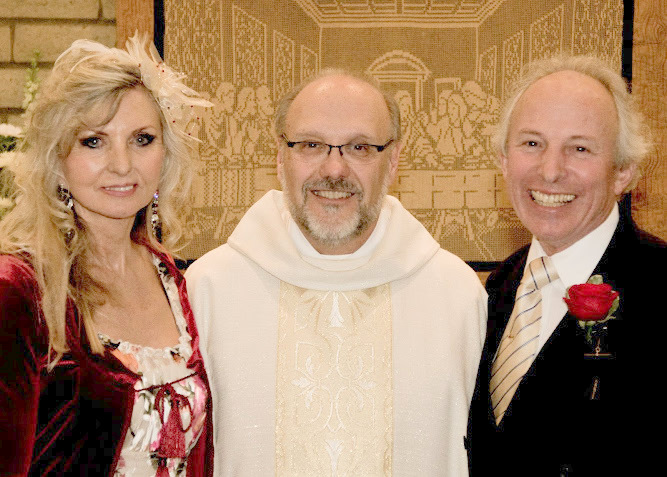
Fr. Dan Tantimonaco with the newly weds!
Fr. Dan Tantimonaco with the newly weds! Payson, AZ. November 20th., 2010.

Thus you can understand the pleasure it was for Jean and me again to see Don; albeit for a brief overnight stay.

What was an extra, unanticipated pleasure was meeting a young, rescue dog that Don had adopted in recent weeks.  Her name is Margarita and she was found and rescued by Suzann from the streets in San Carlos.  What was so glorious was to see the love and hope for a better future that flowed between Don and the sweet, young Margarita.  It resonated so perfectly well with Suzan’s post published here on Monday: Rescued dogs are life-savers.

By the time I sat down at my desk yesterday, I was conscious of a) not having a clue as to what to write, and b) inspired by the sense of hope that dogs offer us humans.  Serendipitously, the theme of hope led me to a post written by Jennifer Broudy de Hernandez over on her Transition Times blog.  It was called Warriors for the Planet and was the most beautiful essay.

I’m delighted to reblog that here with Jennifer’s approval.

ooOOoo

Warriors for the Planet

Another summer, another war. I wonder how many summers there have been in the last 5,000 years when human beings were not occupied with killing each other?

Correction: not “human beings,” “men.”

Let’s be frank: even though there may be women in the armed forces of many countries now, war still remains a masculine activity and preoccupation. The women who serve as soldiers must adhere to the masculine warrior code and become honorary “bros,” for whom the worst insult is still be called a “girl” or a “pussy.”

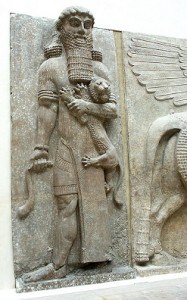
annebaring_a_lgI have been reading Anne Baring’s magisterial book The Dream of the Cosmos, in which she gives a detailed account of the shift, around the time of Gilgamesh, from the ancient, goddess- and nature-worshipping “lunar cultures” to the contemporary era of solar, monotheistic, warrior-worshipping cultures.

In her elaboration of this shift, I read the tragedy of our time, enacted over and over again all over the planet, and not just by humans against humans, but also by humans against the other living beings with whom we share our world. I quote at length from Baring’s remarkable book:

gilgamesh-187x300“The archetype of the solar hero as warrior still exerts immense unconscious influence on the modern male psyche, in the battlefield of politics as well as that of corporate business and even the world of science and academia: the primary aim of the male is to achieve, to win and, if necessary, to defeat other males. The ideal of the warrior has become an unconscious part of every man’s identity from the time he is a small child.

“With the mythic theme of the cosmic battle between good and evil and the indoctrination of the warrior went the focus on war and territorial conquest. War has been endemic throughout the 4000 years of the solar era. The glorification of war and conquest and the exaltation of the warrior is a major theme of the solar era—still with us today in George W. Bush’s words in 2005: ‘We will accept no outcome except victory.’ This call to victory echoes down the centuries, ensuring that hecatombs of young warriors were sacrificed to the god of war, countless millions led into captivity and slavery, countless women raped and widows left destitute. It has sanctioned an ethos that strives for victory at no matter what cost in human lives and even today glorifies war and admires the warrior leader. This archaic model of tribal dominance and conquest has inflicted untold suffering on humanity and now threatens our very survival as a species.

2014-06-15-mission
“The cosmic battle between light and darkness was increasingly projected into the world and a fascination with territorial conquest gripped the imagination and led to the creation of vast empires. It is as if the heroic human ego, identified with the solar hero, had to seek out new territories to conquer, had to embody the myth in a literal sense and as it did so, channel the primitive territorial drives of the psyche into a Dionysian orgy of unbridled conquest, slaughter and destruction. We hear very little about the suffering generated by these conquests: the weeping widows, the mothers who lost sons, the orphaned children and the crops and patterns of sowing and harvesting devastated and disrupted by the foraging armies passing over them, the exquisite works of art pillaged and looted….The long chronicle of conquest and human sacrifice, of exultation in power and the subjugation of enemies might truly be named the dark shadow of the solar age” (118;124).

Like Baring, I see our time as a critical era in the long history of homo sapiens on the planet. There is still hope that enough of us will be able to detach ourselves from the pressures and busyness of our lives—will become conscious of what is happening to the planet and human civilization writ large—will understand that there are other ways to relate to each other and to the Earth, ways that will seem increasingly possible and obvious once we focus on them and begin to put our energies into manifesting our visions of a creative, collaborative, respectful mode of being.

Baring ends her disturbing chapter on the ascendancy of the solar warrior culture with a hopeful quote from The Passion of the Western Mind by Richard Tarnas, from which she springs into her own positive vision of the potential of our time.

“’We stand at the threshold of a revelation of the nature of reality that could shatter our most established beliefs about ourselves and the world. The very constriction we are experiencing is part of the dynamic of our imminent release. For the deepest passion of the Western mind has been to reunite with the ground of its being. The driving impulse of the West’s masculine consciousness has been its quest not only to realize itself, to forge its own autonomy, but also, finally, to recover its connection with the whole, to come to terms with the great feminine principle in life; to differentiate itself from but then rediscover and reunite with the feminine, with the mystery of life, of nature, of soul. And that reunion can now occur on a new and profoundly different level from that of the primordial unconscious unity, for the long evolution of human consciousness has prepared it to be capable at last of embracing the ground and matrix of its own being freely and consciously.’

“As this deep soul-impulse gathers momentum, the ‘marriage’ of the re-emerging lunar consciousness with the dominant solar one is beginning to change our perception of reality. This gives us hope for the future. If we can recover the values intrinsic to the ancient participatory way of knowing without losing the priceless evolutionary attainment of a strong and focused ego, together with all the discoveries we have made and the skills we have developed, we could heal both the fissure in our soul and our raped and vandalized planet” (130-131).

My heart aches for the suffering of the innocent civilians trapped in the crossfire in Gaza this summer, and for the grieving families of the passenger plane heinously shot down by warriors who were either poorly trained or just plain evil.

I am heartsick when I think about the holocaust that is overtaking living beings on every quadrant of our planet as humans continue to ravage the forests and seas, to melt the poles with our greenhouse gases, and to poison the aquifers and soil with our chemicals.

The last Polar Bear

This is where the solar cultures, with their “great” warrior kings, have led us. And yet, as Baring says, they have also presided over the most amazing advances in science and technology that humans have ever known in our long history on the planet.

We don’t need or want to go back to the simple innocence of ancient lunar societies. We don’t have to bomb ourselves back into the Stone Age.

What we need is to go forward, wisely and joyously, into a new phase of consciousness, in which the masculine warrior spirit is used for protection and stewardship rather than destruction, and the Earth is honored as the Mother of all that she is.

Never let anyone tell you it can’t be done. It is already happening.

ooOOoo

May I tempt you to go back and re-read that penultimate paragraph.  A sentence that I cannot resist emphasising:

What we need is to go forward, wisely and joyously, into a new phase of consciousness, in which the masculine warrior spirit is used for protection and stewardship rather than destruction, and the Earth is honored as the Mother of all that she is.

 The power of hope!