Just wanted to share some good news with you. Well, regarding Oregon’s wolves!
My so-called book has rather ground to a halt. Sturdy followers of this blog will recall that in November last year, I sat down and wrote the first draft of a book, under the umbrella of NaNoWriMo = write a minimum of a 50,000-word novel in the month of November. That I did write in excess of 50,000 words (53,704) in under thirty days felt a wonderful achievement.
But then reality set in!
I subscribed to a NaNoWriMo webinar on editing hosted by David Henry Sterry and Arielle Eckstut of The Book Doctors. To my horror, half-way through the webinar came the realisation that what I had written wasn’t even a fictional novel: It was a personal story on the theme of what dogs have taught me over a life of approaching 70 years.
So those 53,000 words had to be rewritten as non-fiction book!
The next boulder to cause me to fall was the issue of tense. The book had been written in the 3rd-person, as you can see from the draft of Chapter Twenty-Three. But the more that I thought about the story the more that it felt that it should be in the 1st-person; namely this first person! Reinforced by feedback from Jeannie and from reading Melinda Roth’s latest book Mestengo clearly written in the first-person.
Mestengo book cover.
Chapter One
I first smelled the smoke as I stood in the driveway of the farmhouse on the top of a hill in McHenry County in Northern Illinois that was, according to the man who leased it to me one month before, the highest point in all of Northern Illinois.
Damn, damn, damn! Now the rewrite not only has to go from fiction to non-fiction, it also has to change the tense from ‘Philip’ to ‘Paul’; from him to me! The words from The Book Doctors seminar rang louder and louder, “You write the first draft for yourself; you edit it for your readers!” (Smart arses!)
Then along came hope in the form of Kami Garcia, the author. It was a NaNoWriMo pep talk.
So you made it through NaNoWriMo, and you have 50,000 words… Now what? It’s the same question a lot of writers face when they finish a first draft. The good news is you finished the hard part: you have a draft.
I can hear some of you cursing me now: “But Kami, my first draft is totally crappy and worthless. It’s terrible. I wasted an entire month of my life, and all I have 50,000 terrible words to show for it.”
My answer: It doesn’t matter if you wrote the crappiest first draft in the history of all first drafts. You have something to work with, which means you can fix it, mold it, and bang it into whatever shape you want. Here are a few tips to get started:
Read Your First Draft (and Possibly Cry a Little)
After you put away the pint of ice cream and the tissues, take an objective look at your draft. What are the strongest points? The parts that kept you reading? Whether you print out your draft to make notes or use software (I love Scrivener), mark the best bits—circle, highlight, whatever works for you. These are the parts you’ll re-read whenever you start to lose hope (which will be often).
All of which is a long-winded way of me saying that I shouldn’t be spending time writing blog posts but have my head down in the big edit.
But, hey, already come this far so going to leave you with this wonderful news.
ooOOoo
Hello Paul,
Good news: For the first time since 2009, the Oregon Department of Fish & Wildlife has confirmed wolves south of the Eagle Cap Wilderness!
Based on recent evidence, it’s clear that at least five wolves are frequenting an area in Northern Baker County. It may not be a story as epic as Journey’s, but it’s another good sign wolves are continuing to retake their rightful place on the Oregon landscape.
Those of you who have been tracking wolf issues for a long time, may remember the iconic photo of a scraggly Oregon wolf in sagebrush. The young wolf and his partner frequented an area near the Keating Valley in Baker County.
Sadly, the “Keating Wolves”, as they came to be known, were killed in 2009. Despite some tantalizing reports, since that time, only one Oregon wolf is known south of the Wallowas.
Later today, we’ll revisit the story of the Keating Wolves on the Oregon Wild Blog and post it on the Oregon Wolves Facebook page. Wolf recovery still has a long ways to go. But today’s news is significant.
Since 2009 – with your help – we’ve stopped round after round of wolf kill bills in Salem. We’ve stood up for wolves in court. We’ve worked with responsible ranchers. We’ve educated the public, highlighted the positive impacts of having wolves back on the landscape, and shared news – good and bad – of wolf recovery.
Things are far from perfect. Old prejudices die hard and wolves continue to be at the center of a campaign of misinformation and fear. The Obama administration is stubbornly pushing a scheme to strip wolves of important protections, and the state can still kill wolves on behalf of the livestock industry.
But today’s news is a sign that we’re headed in the right direction here in Oregon. And there should be more on the horizon. Wolves are mating, pups should be on their way, and Oregon will announce an updated wolf population estimate soon. That’s more news we look forward to sharing.
For wolves and wildlife, Rob Klavins Wildlife Advocate, Oregon Wild
You will recall that yesterday I very briefly mentioned our trip to visit Strawberry Mountain Mustangs, our meeting with Darla and the outcome. Namely, that subject to an adoption agreement being signed and approved we hope to be able to adopt Ranger.
Here is Ranger’s story.
Ranger
Ranger is believed to be a quarter-horse (a quarter thoroughbred, as I now have learnt) that earlier on in his life was a roping and barrel-racing horse. Ranger is a little over 15 hands.
He has been abused in the past. Evidenced by the scars of previous ill-fitting saddles and from being wary of having his ears touched.
Originally Ranger came to Strawberry Mountain because he was found abandoned and starving in an Oregon forest. After he became a settled horse at Strawberry, he was adopted out to a family. But after some months of being ridden he threw his riders by spinning so quickly they came off.
He came back to Darla and eventually was adopted out to a different home. But after some months with his next owners, the habit of spinning riders off his back resurfaced.
Back he came to Darla but his age, he is about 15 years-old, and not being a secure riding horse were against him. Darla was unhopeful that he would ever be found a home.
Hallo, my name’s Jean. Will you come and live with us, Ranger?
But in our case, I don’t know how to ride and Jean is not interested in riding Ranger. His age is a bonus because it reduces the odds of Ranger outliving Jean and me. So Ranger seemed like a perfect match.
Jean and Ranger getting to know each other.
So that’s where we are just now. As we progress in getting our fencing done and our adoption approved (fingers crossed) then there will be more to report. We have come a long way from wild mustangs but this truly feels like the most sensible way to help given that our experience and facilities are not sufficient for us to handle a rescued Mustang.
P.S. the comments and the ‘Likes’ to yesterday’s post were wonderful. Both Jean and I are touched beyond measure.
Yesterday, Sunday, Jean and I went North in Oregon to visit Strawberry Mountain Mustangs to explore the pros and cons of adopting a horse previously rescued by Darla, of Strawberry Mountain. It was a long day and by the time I sat down in front of the PC it was already past 5pm.
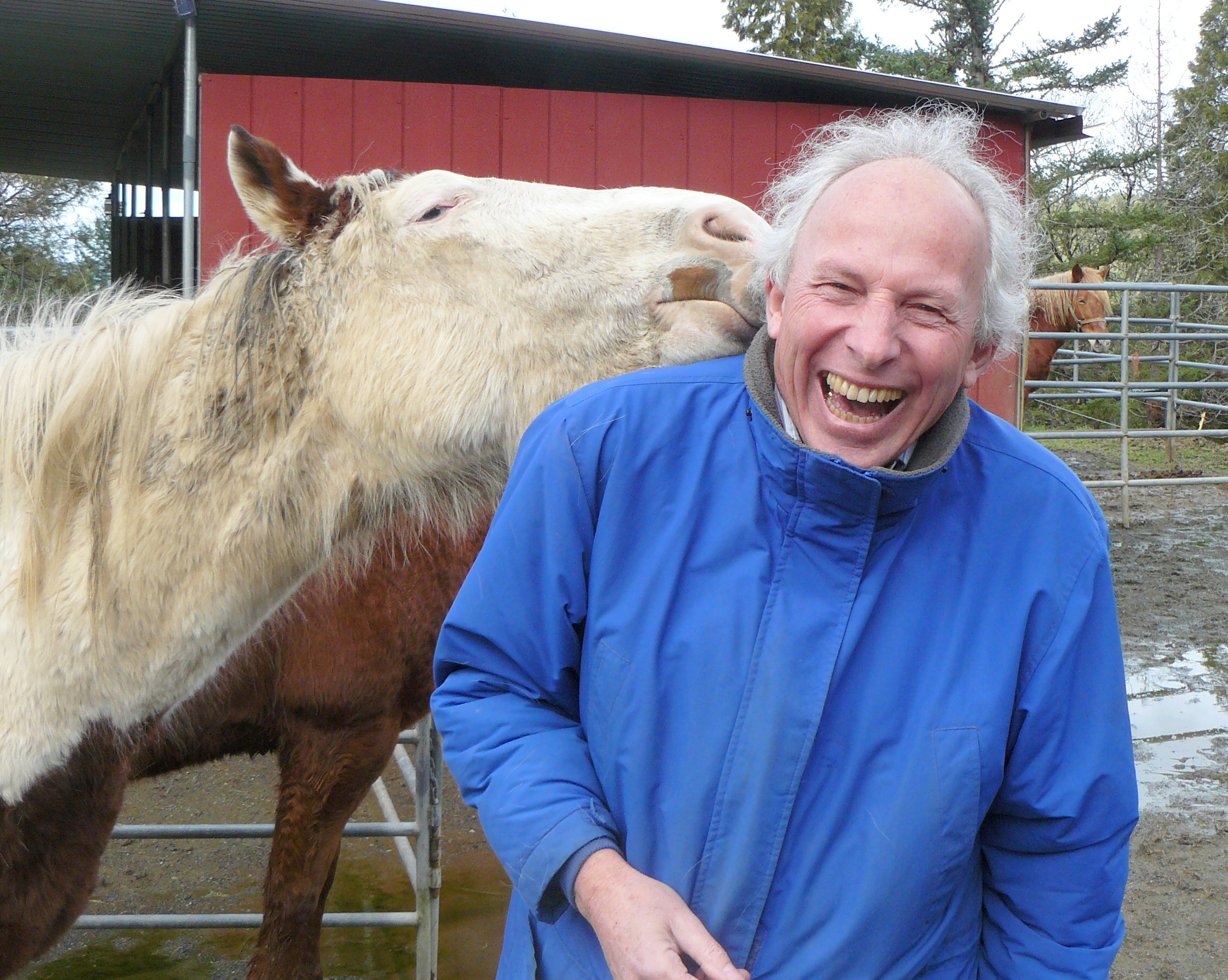
So for today going to offer you two pictures from our inspiring time with Darla and all her magnificent horses, most of whom have backgrounds that would make one weep.
Tomorrow, I will write more fully about what we are discovering when it comes to adopting a horse.
Trust me, a horse with its tongue in your ear is very ticklish!
Friend and follower, Amanda Smith from Australia, recently emailed me a set of twenty-five fabulous pictures. I propose to offer eight of them today, and eight more next Sunday and, possibly, the final nine in two weeks time; that is if the response from you, dear reader, suggests you would like that.
oooo
oooo
oooo
oooo
oooo
oooo
oooo
oooo
Thanks Amanda, and if anyone knows any of the names of the photographers who took these delightful photographs, do please say so in a comment. Would be nice to acknowledge them.
The second set next Sunday – you all have a peaceful and untroubled week.
According to the online version of the Merriam Webster dictionary, one of the two definitions of synchronicity is:
: the coincidental occurrence of events and especially psychic events (as similar thoughts in widely separated persons or a mental image of an unexpected event before it happens) that seem related but are not explained by conventional mechanisms of causality —used especially in the psychology of C. G. Jung
That seems sufficiently apt to warrant the choice of title for today’s post.
Here’s why!
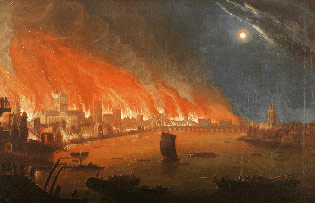
Yesterday, Chris Snuggs left a comment to my post Unconditional love. Essentially, Chris made the argument that much of what we see as wrong with the world is not new; not new at all [my insertion of the image of and link to the Great Fire of London].
Great Fire of London. September 2nd-5th, 1666.
What I mean is, the danger of thinking that today’s events are somehow special and different in kind than throughout history, a feeling generated by the fact that WE are living NOW. However, is it not true that ALL ages of Mankind have seen disasters, wars, dangers, catastrophes, including natural ones? How must those have felt who lived through the 30 Years War, the plague, the Great Fire of London, Stalin’s purges and of course the holocaust?
Even in these present times, Chris doubted that mankind had not been here before [my emphasis]:
WHAT then is special about OUR era? Well, Patrice is and rightly very concerned about the kleptocracy. The staggering statistic that emerged the other day about 85 individuals having as much wealth as 3,5 BILLION people was yet another wake-up call, especially as history seems to tell us that A) there have ALWAYS been kleptocracies and B) they ALWAYS end in revolution, dictatorship or social collapse. But the point is, this is nothing NEW. On the contrary, it has in many societies been the normal progression of things for millenia.
So what about Global Warming, as in man-caused? Chris wrote:
No, all my uncertainties lie in the area of GW. It’s pretty clear that there Is global warming, but A) Is it our fault? B) What should we DO about it? and C) Is it too late anyway?
The notion that it is too late to prevent widespread, major consequences from the heating of our planet is widely shared; I sing the siren’s song myself.
So when an item came along yesterday from Transition Network’s blog courtesy of Rob Hopkins pointing out that Chris, me and many others may be wrong to sing the ‘doom and gloom’ song, it naturally caught my eye. A quick call to the Transition Network team in Totnes, Devon gave me permission to republish on Learning from Dogs, so here it is. Thanks TN team. (My thoughts follow the TN piece.)
ooOOoo
Lipkis on Holmgren: “Our job is to make viable the alternative and have it ready”
You know how sometimes someone will just put something you were thinking far more eloquently and clearly than you would have been able to? On Thursday we’ll be posting an interview with Andy Lipkis of TreePeople in Los Angeles. When I talked to Andy last week, it was 80°F, and a state of drought emergency had just been declared (in LA, not Totnes, it was raining here, as usual). At the end of the interview, I asked for his thoughts on the recent debate sparked by David Holmgren’s Crash on Demand article. I asked him “Can we achieve the action on climate change that we need within the existing paradigm, or do we need to deliberately bring the economy down, to deliberately crash it?”. Here’s what he told me.
Andy Lipkis
“This system is so armoured to defend itself from a deliberate crash that much of our resources and intelligence networks are focused on exactly stopping that. On the flip side, the crash is already happening. We don’t have to engineer it: it’s already been engineered into the system. Check it out: Infrastructure systems are in breakdown in major cities around the world, with severe climate exceeding the designed capacity for storms, floods, water shortages, heat events resulting in increasing numbers of people being dislocated, injured or killed. In the US, taxpayers are unwilling or unable to pay for the rapidly inflating costs for upgrading and climate-proofing the outmoded infrastructure systems, all the while, climate change denial campaigns prevent communities from preparing for and protecting themselves from the impacts.
I think our job is to make viable the alternative and have it ready. If we’ve really done our homework, we could scale this thing in a flash in California right now because this crash is upon us. And I hope we’re going to be able, perhaps within months…I invented a cistern that could replace the backyard fence or wall, that could hold 5,000 – 20,000 gallons and could be manufactured locally. The City’s going “hey, maybe we should do that now”. Now. Because it’s going to rain again, even if this drought lasts some years, we could deploy them quickly, just as they did in Australia’s 12 year drought.
I think we’ve been trained to spend time on these battles, on the negativity, and we lose people. We’ve lost precious decades. The crash is on its way. We don’t have to do anything. We need the time to convert people and move people. We need to use examples of Australia and what’s happening now in California to tell those stories, because I agree, denial, defending the system is keeping it pumping. But as you saw from Snowden and all the evidence, for those of us who went through the ‘60s and ‘70s in protest, I don’t think that’s going to succeed. If we focus on that our best leaders are going to end up in jail for too long.
When you look at how fast people change when you add inspiration, when you add attraction, people change on a dime! When we were growing up, there were – I don’t know if you had The Munsters? One of the only people who we all knew who was doing yoga and eating yoghurt was Uncle Fester. But when we started seeing beautiful, sexy male and female bodies doing that, it started selling, moving people by the millions and then billions to choose these lifestyles.
I’m not saying the marketplace is the only answer, I’m just saying that if we choose attraction and inclusion we can create those markets, as you’re starting to do. Your stories over and over again on what’s happening with local currency – it’s time to tell the stories better and use those market forces, because people will choose those because they’re less painful and more attractive. And to be smart, to say wow, yeah.
The Bush administration was ready for all Americans to be protesting to try to stop the Iraq war. They expected that, they built that into their design. I was so amazed that they could say they didn’t care what the people said, that I had to think through why they did not care about that. How did they make it resilient? Because all they cared about was as long as people kept consuming, especially petroleum, their objective was being met. They were counting on no-one changing lifestyles.
The most radical thing sometimes that you can do is actually vote with your feet and vote with your dollars. I was going – “wow, yeah, they’re counting on people complaining”. Protesting and not changing. I started thinking that even the Obama administration is still using the same metrics as the Bush administration was, saying people won’t change on energy. “It’s going to take 35 years to reduce our energy use by 30%”. Well that’s bullshit, because we can choose to do that in a week.
So, I decided that I was going to show that that’s possible even in my own lifestyle. I drive a Prius which is especially fuel efficient, but I’m going to stop driving that car two or three days a week. I told my secretary to book meetings downtown where I could get the bus to. I got out of the car, took the bus, and it actually became a really cool thing. I started investing my dollars in the local bus system. I did it for over two years. I blogged about it. A lot of other people stopped full time car use, and right at the right time as gasoline prices were spiking, a proposal came out to build a new transit system. It’s always been rejected in LA, but the voters at that moment chose to fund 40 billion dollars to build a new subway system in Los Angeles so we could get out of our cars. It’s a radical move, but it’s starting to happen.
So maybe that’s a long complicated answer, but we’ve built the right foundation. Our happiness, our health is the answer. It’s infectious. Our job is to be that much more infectious and inclusive. And don’t put up barriers of titles. Don’t put up barriers of shame and blame. Be open to learning fast and welcoming people in. We’re hacking the system and making it so much better. If we invite that kind of creativity, the generation that’s inheriting this right now is really ready to take this home.
ooOOoo
Don’t know about you but I find that compelling. It’s far too easy to wait for others to fix the problems. Too easy to see the issues as insurmountable. Each of us has the ability and the common-sense to make a change in our lives. Whether it is a small, medium or large change in your behaviour, you will make a difference.
So if you have been inspired by this, as Jeannie and I have been, commit to making a difference.
On New Year’s Day I published the first part of a film called Awakening the Dreamer: Changing the Dream. Then yesterday came the second part. I found it a remarkable film. Because, while the first part reminded the viewer of the list, the long list, of things that are wrong with these present times, the second part highlighted the many currents of positive changes that are taking place here and now.
Without hope there is nothing.
The film is available to watch on Top Documentary Films and here is the introduction offered in that place.
Of all the innumerable beliefs and hypotheses that make up our contemporary industrial perspective on life there is one that is dominant and very frequent. That’s the assumption that we are disconnected, from everyone and everything. This belief configures basically all our ideas and actions. There’s a crucial fallacy that we are separate. But, if there is only one, then whatever I do to you I’m actually doing it to myself, my family, and my children.
Spiritual attitude has long instructed that partition is actually an illusion. However, in the past, the narrative that’s been exchanged in the modern world, whether consciously or unconsciously, has been that the world functions like a huge machine made of separate parts like a big clock. For the past four centuries, the scientific established practice has been trying to take the clock apart, and figure out how it functions, so we can use it for our own ambitions.
This rigid aspect meant that instead of realizing the relation between things, we were analyzing and taking apart those very same things. So, what developed was kind of disintegrated view of the natural world. And we became entranced with the ability that came out of this technology, and we lost our relations to each other; we lost our connection to the enigma of the cosmos.
Although the modern worldview is superior on Earth, it’s valuable to identify that it’s not the only worldview. Traditional, native cultures are not so concentrated on “advancement”, rather they’re focused on their health and persistence of the community, and they see the interdependence of all things. They try to recognize that we’re related to everything… to the animals, fish, plants, trees, birds, and even to the microorganisms. Indigenous people of the world have a particularly important role to play at this moment in history. We need them to come forward and explain how they see things.
The film was produced by the Pachama Alliance, an organisation I hadn’t come across before. Their website is here and on the About page one learns:
Purpose
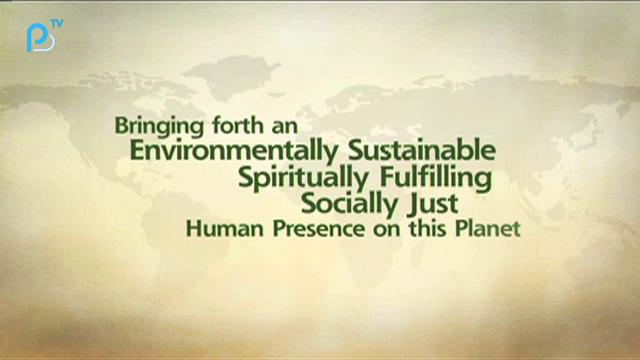
The Pachamama Alliance, empowered by our partnership with indigenous people, is dedicated to bringing forth an environmentally sustainable, spiritually fulfilling, socially just human presence on this planet. Our unique contribution is to generate, and engage people everywhere in, transformational conversations and experiences consistent with this purpose. We weave together indigenous and modern worldviews such that human beings are in touch with their dignity and are ennobled by the magnificence, mystery and opportunity of what is possible for humanity at this time. We are here to inspire and galvanize the human family to generate a critical mass of conscious commitment to a thriving, just and sustainable way of life on Earth. This is a commitment to transforming human systems and structures that separate us, and to transforming our relationships with ourselves, with one another, and with the natural world.
If you have read this post so far, then you will enjoy this video. More than enjoy it; you will find it inspiring and liberating.
Another organisation mentioned in the film was Bioneers, also not previously known to me. Their website is here. The organisation describes itself, in part:
Collective Heritage Institute – Bioneers is a non-profit New Mexico corporation founded in 1990 by Kenny Ausubel and Nina Simons. The overarching mission of Bioneers is the advancement of holistic education pertaining to global social, cultural and environmental issues. Bioneers identifies progressive yet nature-honoring solutions to rising challenges of instability, inequality, and unsustainable growth and disseminates this knowledge via independent media, events, and community action networks.
There is much on these two websites to offer hope.
Those of you who watched Part One of Awakening the Dreamer that was published yesterday could be excused for thinking that it was a very gloomy window on our world at the start of 2014.
Park those feelings and watch Part Two.
The Hope
[vimeo http://vimeo.com/52496263]
ooOOoo
Tomorrow, Friday, I will complete this run of four days by dropping in on a few of the organisations named in these films plus a few other items.
A moving, insightful postscript to the life of the late Ernest Callenbach.
This is a continuation of the republication of a recent TomDispatch Tomgram. As I explained in Part One published yesterday I have been a follower of Tom Dispatch for some time and frequently find the essays most interesting. However, reading the words of Ernest Callenbach touched me in many ways, some of which are still evolving. Callenbach was clearly a man who many years ago not only foresaw how our world was heading but via his writings was able to articulate the solutions. Today, as the video at the end of the Post so clearly exemplifies, those solutions are spot on.
The other point that strikes me is that in leaving this ‘message’ on his computer asking for it to be released after his death, Callenbach isn’t trying to prove anything. We are reading the words of a person who feels so strongly about the fate of mankind that he wants those words to be his epitaph for ever more. Trust me. When you read the words below you will be as touched as I was, indeed still continue to be. It is a rare privilege to republish them.
Ernest ‘Chick’ Callenbach Epistle to the Ecotopians
By Ernest Callenbach[This document was found on the computer of Ecotopia author Ernest Callenbach (1929-2012) after his death.]
To all brothers and sisters who hold the dream in their hearts of a future world in which humans and all other beings live in harmony and mutual support — a world of sustainability, stability, and confidence. A world something like the one I described, so long ago, in Ecotopia and Ecotopia Emerging.
As I survey my life, which is coming near its end, I want to set down a few thoughts that might be useful to those coming after. It will soon be time for me to give back to Gaia the nutrients that I have used during a long, busy, and happy life. I am not bitter or resentful at the approaching end; I have been one of the extraordinarily lucky ones. So it behooves me here to gather together some thoughts and attitudes that may prove useful in the dark times we are facing: a century or more of exceedingly difficult times.
How will those who survive manage it? What can we teach our friends, our children, our communities? Although we may not be capable of changing history, how can we equip ourselves to survive it?I contemplate these questions in the full consciousness of my own mortality. Being offered an actual number of likely months to live, even though the estimate is uncertain, mightily focuses the mind. On personal things, of course, on loved ones and even loved things, but also on the Big Picture.
But let us begin with last things first, for a change. The analysis will come later, for those who wish it.
Hope. Children exude hope, even under the most terrible conditions, and that must inspire us as our conditions get worse. Hopeful patients recover better. Hopeful test candidates score better. Hopeful builders construct better buildings. Hopeful parents produce secure and resilient children. In groups, an atmosphere of hope is essential to shared successful effort: “Yes, we can!” is not an empty slogan, but a mantra for people who intend to do something together — whether it is rescuing victims of hurricanes, rebuilding flood-damaged buildings on higher ground, helping wounded people through first aid, or inventing new social structures (perhaps one in which only people are “persons,” not corporations). We cannot know what threats we will face. But ingenuity against adversity is one of our species’ built-in resources. We cope, and faith in our coping capacity is perhaps our biggest resource of all.
Mutual support. The people who do best at basic survival tasks (we know this experimentally, as well as intuitively) are cooperative, good at teamwork, often altruistic, mindful of the common good. In drastic emergencies like hurricanes or earthquakes, people surprise us by their sacrifices — of food, of shelter, even sometimes of life itself. Those who survive social or economic collapse, or wars, or pandemics, or starvation, will be those who manage scarce resources fairly; hoarders and dominators win only in the short run, and end up dead, exiled, or friendless. So, in every way we can we need to help each other, and our children, learn to be cooperative rather than competitive; to be helpful rather than hurtful; to look out for the communities of which we are a part, and on which we ultimately depend.
Practical skills. With the movement into cities of the U.S. population, and much of the rest of the world’s people, we have had a massive de-skilling in how to do practical tasks. When I was a boy in the country, all of us knew how to build a tree house, or construct a small hut, or raise chickens, or grow beans, or screw pipes together to deliver water. It was a sexist world, of course, so when some of my chums in eighth grade said we wanted to learn girls’ “home ec” skills like making bread or boiling eggs, the teachers were shocked, but we got to do it. There was widespread competence in fixing things — impossible with most modern contrivances, of course, but still reasonable for the basic tools of survival: pots and pans, bicycles, quilts, tents, storage boxes.
We all need to learn, or relearn, how we would keep the rudiments of life going if there were no paid specialists around, or means to pay them. Every child should learn elementary carpentry, from layout and sawing to driving nails. Everybody should know how to chop wood safely, and build a fire. Everybody should know what to do if dangers appear from fire, flood, electric wires down, and the like. Taking care of each other is one practical step at a time, most of them requiring help from at least one other person; survival is a team sport.
Organize. Much of the American ideology, our shared and usually unspoken assumptions, is hyper-individualistic. We like to imagine that heroes are solitary, have super powers, and glory in violence, and that if our work lives and business lives seem tamer, underneath they are still struggles red in blood and claw. We have sought solitude on the prairies, as cowboys on the range, in our dependence on media (rather than real people), and even in our cars, armored cabins of solitude. We have an uneasy and doubting attitude about government, as if we all reserve the right to be outlaws. But of course human society, like ecological webs, is a complex dance of mutual support and restraint, and if we are lucky it operates by laws openly arrived at and approved by the populace.
If the teetering structure of corporate domination, with its monetary control of Congress and our other institutions, should collapse of its own greed, and the government be unable to rescue it, we will have to reorganize a government that suits the people. We will have to know how to organize groups, how to compromise with other groups, how to argue in public for our positions. It turns out that “brainstorming,” a totally noncritical process in which people just throw out ideas wildly, doesn’t produce workable ideas. In particular, it doesn’t work as well as groups in which ideas are proposed, critiqued, improved, debated. But like any group process, this must be protected from domination by powerful people and also over-talkative people. When the group recognizes its group power, it can limit these distortions. Thinking together is enormously creative; it has huge survival value.
Learn to live with contradictions. These are dark times, these are bright times. We are implacably making the planet less habitable. Every time a new oil field is discovered, the press cheers: “Hooray, there is more fuel for the self-destroying machines!” We are turning more land into deserts and parking lots. We are wiping out innumerable species that are not only wondrous and beautiful, but might be useful to us. We are multiplying to the point where our needs and our wastes outweigh the capacities of the biosphere to produce and absorb them. And yet, despite the bloody headlines and the rocketing military budgets, we are also, unbelievably, killing fewer of each other proportionately than in earlier centuries. We have mobilized enormous global intelligence and mutual curiosity, through the Internet and outside it. We have even evolved, spottily, a global understanding that democracy is better than tyranny, that love and tolerance are better than hate, that hope is better than rage and despair, that we are prone, especially in catastrophes, to be astonishingly helpful and cooperative.
We may even have begun to share an understanding that while the dark times may continue for generations, in time new growth and regeneration will begin. In the biological process called “succession,” a desolate, disturbed area is gradually, by a predictable sequence of returning plants, restored to ecological continuity and durability. When old institutions and habits break down or consume themselves, new experimental shoots begin to appear, and people explore and test and share new and better ways to survive together.
It is never easy or simple. But already we see, under the crumbling surface of the conventional world, promising developments: new ways of organizing economic activity (cooperatives, worker-owned companies, nonprofits, trusts), new ways of using low-impact technology to capture solar energy, to sequester carbon dioxide, new ways of building compact, congenial cities that are low (or even self-sufficient) in energy use, low in waste production, high in recycling of almost everything. A vision of sustainability that sometimes shockingly resembles Ecotopia is tremulously coming into existence at the hands of people who never heard of the book.
___________________
Now in principle, the Big Picture seems simple enough, though devilishly complex in the details. We live in the declining years of what is still the biggest economy in the world, where a looter elite has fastened itself upon the decaying carcass of the empire. It is intent on speedily and relentlessly extracting the maximum wealth from that carcass, impoverishing our former working middle class. But this maggot class does not invest its profits here. By law and by stock-market pressures, corporations must seek their highest possible profits, no matter the social or national consequences — which means moving capital and resources abroad, wherever profit potential is larger. As Karl Marx darkly remarked, “Capital has no country,” and in the conditions of globalization his meaning has come clear.
The looter elite systematically exports jobs, skills, knowledge, technology, retaining at home chiefly financial manipulation expertise: highly profitable, but not of actual productive value. Through “productivity gains” and speedups, it extracts maximum profit from domestic employees; then, firing the surplus, it claims surprise that the great mass of people lack purchasing power to buy up what the economy can still produce (or import).
Here again Marx had a telling phrase: “Crisis of under-consumption.” When you maximize unemployment and depress wages, people have to cut back. When they cut back, businesses they formerly supported have to shrink or fail, adding their own employees to the ranks of the jobless, and depressing wages still further. End result: something like Mexico, where a small, filthy rich plutocracy rules over an impoverished mass of desperate, uneducated, and hopeless people.
Barring unprecedented revolutionary pressures, this is the actual future we face in the United States, too. As we know from history, such societies can stand a long time, supported by police and military control, manipulation of media, surveillance and dirty tricks of all kinds. It seems likely that a few parts of the world (Germany, with its worker-council variant of capitalism, New Zealand with its relative equality, Japan with its social solidarity, and some others) will remain fairly democratic.
The U.S., which has a long history of violent plutocratic rule unknown to the textbook-fed, will stand out as the best-armed Third World country, its population ill-fed, ill-housed, ill-educated, ill-cared for in health, and increasingly poverty-stricken: even Social Security may be whittled down, impoverishing tens of millions of the elderly.
As empires decline, their leaders become increasingly incompetent — petulant, ignorant, gifted only with PR skills of posturing and spinning, and prone to the appointment of loyal idiots to important government positions. Comedy thrives; indeed writers are hardly needed to invent outrageous events.
We live, then, in a dark time here on our tiny precious planet. Ecological devastation, political and economic collapse, irreconcilable ideological and religious conflict, poverty, famine: the end of the overshoot of cheap-oil-based consumer capitalist expansionism.
If you don’t know where you’ve been, you have small chance of understanding where you might be headed. So let me offer a capsule history for those who, like most of us, got little help from textbook history.
At 82, my life has included a surprisingly substantial slice of American history. In the century or so up until my boyhood in Appalachian central Pennsylvania, the vast majority of Americans subsisted as farmers on the land. Most, like people elsewhere in the world, were poor, barely literate, ill-informed, short-lived. Millions had been slaves. Meanwhile in the cities, vast immigrant armies were mobilized by ruthless and often violent “robber baron” capitalists to build vast industries that made things: steel, railroads, ships, cars, skyscrapers.
Then, when I was in grade school, came World War II. America built the greatest armaments industry the world had ever seen, and when the war ended with most other industrial countries in ruins, we had a run of unprecedented productivity and prosperity. Thanks to strong unions and a sympathetic government, this prosperity was widely shared: a huge working middle class evolved — tens of millions of people could afford (on one wage) a modest house, a car, perhaps sending a child to college. This era peaked around 1973, when wages stagnated, the Vietnam War took a terrible toll in blood and money, and the country began sliding rightward.
In the next epoch, which we are still in and which may be our last as a great nation, capitalists who grew rich and powerful by making things gave way to a new breed: financiers who grasped that you could make even more money by manipulating money. (And by persuading Congress to subsidize them — the system should have been called Subsidism, not Capitalism.) They had no concern for the productivity of the nation or the welfare of its people; with religious fervor, they believed in maximizing profit as the absolute economic goal. They recognized that, by capturing the government through the election finance system and removing government regulation, they could turn the financial system into a giant casino.
Little by little, they hollowed the country out, until it was helplessly dependent on other nations for almost all its necessities. We had to import significant steel components from China or Japan. We came to pay for our oil imports by exporting food (i.e., our soil). Our media and our educational system withered. Our wars became chronic and endless and stupefyingly expensive. Our diets became suicidal, and our medical system faltered; life expectancies began to fall.
And so we have returned, in a sort of terrible circle, to something like my boyhood years, when President Roosevelt spoke in anger of “one third of a nation ill-housed, ill-fed, ill-clothed.” A large and militant contingent of white, mostly elderly, Anglo-Saxon, Protestant right wingers, mortally threatened by their impending minority status and pretending to be liberty-lovers, desperately seek to return us still further back.
Americans like to think of ours as an exceptional country, immune through geographical isolation and some kind of special virtue to the tides of history. Through the distorted lens of our corporate media, we possess only a distorted view of what the country is really like now. In the next decades, we shall see whether we indeed possess the intelligence, the strength, and the mutual courage to break through to another positive era.
No futurist can foresee the possibilities. As empires decay, their civilian leaderships become increasingly crazed, corrupt, and incompetent, and often the military (which is after all a parasite of the whole nation, and has no independent financial base like the looter class) takes over. Another possible scenario is that if the theocratic red center of the country prevails in Washington, the relatively progressive and prosperous coastal areas will secede in self-defense.
Ecotopia is a novel, and secession was its dominant metaphor: how would a relatively rational part of the country save itself ecologically if it was on its own? AsEcotopia Emerging puts it, Ecotopia aspired to be a beacon for the rest of the world. And so it may prove, in the very, very long run, because the general outlines of Ecotopia are those of any possible future sustainable society.
The “ecology in one country” argument was an echo of an actual early Soviet argument, as to whether “socialism in one country” was possible. In both cases, it now seems to me, the answer must be no. We are now fatally interconnected, in climate change, ocean impoverishment, agricultural soil loss, etc., etc., etc. International consumer capitalism is a self-destroying machine, and as long as it remains the dominant social form, we are headed for catastrophe; indeed, like rafters first entering the “tongue” of a great rapid, we are already embarked on it.
When disasters strike and institutions falter, as at the end of empires, it does not mean that the buildings all fall down and everybody dies. Life goes on, and in particular, the remaining people fashion new institutions that they hope will better ensure their survival.
So I look to a long-term process of “succession,” as the biological concept has it, where “disturbances” kill off an ecosystem, but little by little new plants colonize the devastated area, prepare the soil for larger and more complex plants (and the other beings who depend on them), and finally the process achieves a flourishing, resilient, complex state — not necessarily what was there before, but durable and richly productive. In a similar way, experiments under way now, all over the world, are exploring how sustainability can in fact be achieved locally. Technically, socially, economically — since it is quite true, as ecologists know, that everything is connected to everything else, and you can never just do one thing by itself.
Since I wrote Ecotopia, I have become less confident of humans’ political ability to act on commonsense, shared values. Our era has become one of spectacular polarization, with folly multiplying on every hand. That is the way empires crumble: they are taken over by looter elites, who sooner or later cause collapse. But then new games become possible, and with luck Ecotopia might be among them.
Humans tend to try to manage things: land, structures, even rivers. We spend enormous amounts of time, energy, and treasure in imposing our will on nature, on preexisting or inherited structures, dreaming of permanent solutions, monuments to our ambitions and dreams. But in periods of slack, decline, or collapse, our abilities no longer suffice for all this management. We have to let things go.
All things “go” somewhere: they evolve, with or without us, into new forms. So as the decades pass, we should try not always to futilely fight these transformations. As the Japanese know, there is much unnoticed beauty in wabi-sabi — the old, the worn, the tumble-down, those things beginning their transformation into something else. We can embrace this process of devolution: embellish it when strength avails, learn to love it.
There is beauty in weathered and unpainted wood, in orchards overgrown, even in abandoned cars being incorporated into the earth. Let us learn, like the Forest Service sometimes does, to put unwise or unneeded roads “to bed,” help a little in the healing of the natural contours, the re-vegetation by native plants. Let us embrace decay, for it is the source of all new life and growth.
Ernest Callenbach, author of the classic environmental novel Ecotopiaamong other works, founded and edited the internationally known journal Film Quarterly. He died at 83 on April 16th, leaving behind this document on his computer.
Copyright Ernest Callenbach 2012
The above video is 56 minutes long. It consists of Ernest Callenbach and Harvey Wasserman chatting together in front of a camera. But please don’t let that put you off watching it. The video is deeply fascinating. In it Ernest Callenbach (ECOTOPIA, 1975) and Harvey Wasserman (SOLARTOPIA, 2007) discuss the role of the visionary novelist in opening public discourse to ‘outside the box’ possibilities. They look at the many elements of Callenbach’s Ecotopian vision that have actually come into being (and some that haven’t yet) and explore the catalytic power of realistic hope to shape the present and the future. They agree the time has come to democratically enlarge our vision of sustainable society from local, national and regional spheres to the planetary context.
Finally, I was delighted to come across a review recently written in The New York Times that is recommended to you. Here’s how NYT author Mark Bittman closed that review:
Callenbach, who grew up in central Pennsylvania and lived to be 83, led a life as “American” — whatever that means — as any of us. The messages I take from him are these: hope is necessary, organizing is imperative, and a government by and for the vast majority of the people must not be considered impossible.
Jean and I watched this film the other evening. I have seen it a number of times but Jean just once before when it first was released in 1968! Yes, over 40 years ago!
What struck me watching it today was how beautifully slow the film was. I mean in the sense of camera and scene changes. I had forgotten just how beautiful the film was from a technical perspective. It held the eye and brain in a way that seemed so foreign to the way that films have been made in the last so many years.
And there are more summaries on the INDB website, here’s an example:
“2001” is a story of evolution. Sometime in the distant past, someone or something nudged evolution by placing a monolith on Earth (presumably elsewhere throughout the universe as well). Evolution then enabled humankind to reach the moon’s surface, where yet another monolith is found, one that signals the monolith placers that humankind has evolved that far. Now a race begins between computers (HAL) and human (Bowman) to reach the monolith placers. The winner will achieve the next step in evolution, whatever that may be.
The sign!
What is just as interesting is remembering the feelings that I had when I first saw the film, probably in 1968 or 1969, when I was living out in Australia, aged mid-twenties!
I was incredibly fascinated by the US expeditions out to the moon with the actual landing in July 1969. Indeed, I rented a TV and took a complete week’s holiday from work just to watch every minute of this historical event.
So the film, 2001: A Space Odyssey, seemed to capture, for me anyway, the feelings and mood of a brave new world reaching out beyond Planet Earth. The year 2001 felt like aeons away. It was obvious that when we eventually got to the 21st century, mankind would be unbelievably advanced in many exciting and positive ways.
Ah, the dreams of the naive young!
Now here we are heading towards the year 2011 and the world, I mean mankind, seems to be going where? Here’s Jon Lavin’s rather sombre view:
Have been musing about the part failure of the Russian grain harvest and the resultant speculation, that has forced the grain price up astronomically, the impact on bread/food/beer etc., evidence of the same mentality that kicked the banks/investments recession off.
Also, the fact that Lloyds TSB are 43% owned by the British people and are charging interest on non-approved loans of 165% and have a bonus fund of half billion pounds that certainly they have not asked my permission about.
This continuing lack of integrity, in the face of food shortages, untold hardship for millions of people, just goes to show that until an absolute calamity strikes to stop the whole of mankind in our tracks, it’s business as usual for the financially-led people and get-rich-on-the-back-of-anything-and-anybody crowd.
Are we still at consciousness level 204 or have we crossed back below the threshold, back below integrity 200, where falsehood rules?
The answer is to retain faith in the future, faith in the power of love and compassion, and faith in the fact that being the best that we can be today, now, in the present, just as dogs are so wonderful at doing, will bring us the better tomorrows we all dreamed about in 1968. Here’s a reminder:
By Paul Handover
P.S. Serendipity at work. Saw this from the BBC less than 5 minutes after completing this Post!
On July 15th, 2009 a post called Parenting lessons from Dogs started what has now become a bit of a ‘habit’. But more reflections tomorrow.
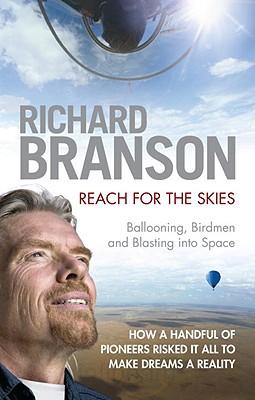
Reach for the Skies
Today I want to voice something that has been running around my mind for some time. It is whether we give in to the mounting doom and gloom at so many levels in our societies (and it can be a very compelling draw) or whether we see this as a painful but necessary period where slowly but surely the desires of ordinary people; for a fairer, more truthful, more integrous world are gaining power.
And I’m going to use Richard Branson to voice it for me!
(Now this is an unusually long Post so I’ve inserted the Read More divider to prevent the Post visually swamping your browser.)

.jpg) Those of you who have been tracking wolf issues for a long time, may remember the iconic photo of a scraggly Oregon wolf in sagebrush. The young wolf and his partner frequented an area near the Keating Valley in Baker County.
Those of you who have been tracking wolf issues for a long time, may remember the iconic photo of a scraggly Oregon wolf in sagebrush. The young wolf and his partner frequented an area near the Keating Valley in Baker County. Since 2009 – with your help – we’ve stopped round after round of wolf kill bills in Salem. We’ve stood up for wolves in court. We’ve worked with responsible ranchers. We’ve educated the public, highlighted the positive impacts of having wolves back on the landscape, and shared news – good and bad – of wolf recovery.
 For wolves and wildlife,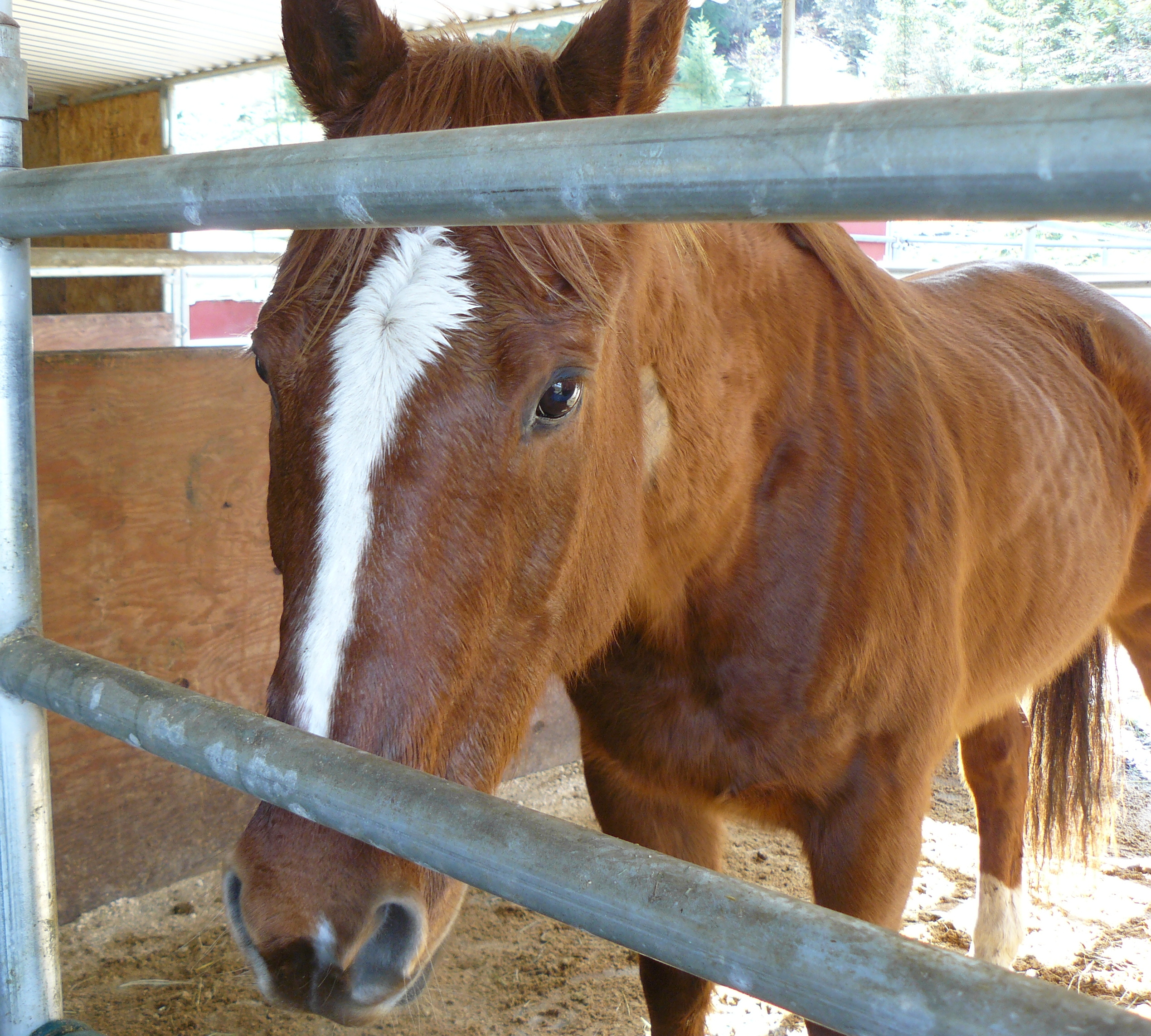






 Learning from Dogs