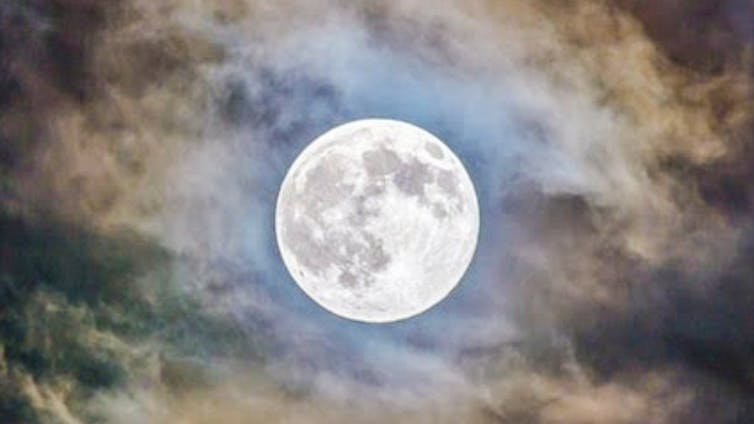
There was something really special about the last full moon. We watched as the moon rose on the very early nights of February, 2026 and I wished I had taken some photos. But no problem as YouTube had captured the images of the moon taken by others.
The Snow Moon in 2026 was the full moon that lit up the night sky on February 1, 2026, reaching its peak illumination around 5:09 p.m. EST (around 22:09 UTC) that evening. Because the moon appears full for a couple of nights around that moment, it was visible as a bright, full lunar disk on the nights of February 1 and 2. It’s traditionally called the “Snow Moon” because February is usually one of the snowiest months in the Northern Hemisphere. Here are some gorgeous images from our talented community of photographers. Enjoy them!
As has been mentioned previously, my dear wife and her Parkinson’s means that we go to bed early and get up early the following morning. Thus a recent item on The Conversation fascinated me and it is shared with you now.
ooOOoo
Does the full moon make us sleepless? A neurologist explains the science behind sleep, mood and lunar myths
Have you ever tossed and turned under a full moon and wondered if its glow was keeping you awake? For generations, people have believed that the Moon has the power to stir up sleepless nights and strange behavior – even madness itself. The word “lunacy” comes directly from luna, Latin for Moon.
The answer is, of course, more nuanced than folklore suggests. Research shows a full moon can modestly affect sleep, but its influence on mental health is much less certain.
I’m a neurologist specializing in sleep medicine who studies how sleep affects brain health. I find it captivating that an ancient myth about moonlight and madness might trace back to something far more ordinary: our restless, moonlit sleep.
What the full moon really does to sleep
Several studies show that people really do sleep differently in the days leading up to the full moon, when moonlight shines brightest in the evening sky. During this period, people sleep about 20 minutes less, take longer to fall asleep and spend less time in deep, restorative sleep. Large population studies confirm the pattern, finding that people across different cultures tend to go to bed later and sleep for shorter periods in the nights before a full moon.
The changes are modest. Most people lose only 15 to 30 minutes of sleep, but the effect is measurable. It is strongest in places without artificial light, such as rural areas or while camping. Some research also suggests that men and women may be affected differently. For instance, men seem to lose more sleep during the waxing phase, while women experience slightly less deep and restful sleep around the full moon.
Modern science adds an important twist. Research is clear that sleep loss itself is a powerful driver of mental health problems. Even one rough night can heighten anxiety and drag down mood. Ongoing sleep disruption raises the risk of depression, suicidal thoughts and flare-ups of conditions like bipolar disorder and schizophrenia.
But here’s the catch: When researchers step back and look at large groups of people, the evidence that lunar phases trigger psychiatric crises is weak. No reliable pattern has been found between the Moon and hospital admissions, discharges or lengths of stay.
But a few other studies suggest there may be small effects. In India, psychiatric hospitals recorded more use of restraints during full moons, based on data collected between 2016 and 2017. In China, researchers noted a slight rise in schizophrenia admissions around the full moon, using hospital records from 2012 to 2017. Still, these findings are not consistent worldwide and may reflect cultural factors or local hospital practices as much as biology.
In the end, the Moon may shave a little time off our sleep, and sleep loss can certainly influence mental health, especially for people who are more vulnerable. That includes those with conditions like depression, bipolar disorder, schizophrenia or epilepsy, and teenagers who are especially sensitive to sleep disruption. But the idea that the full moon directly drives waves of psychiatric illness remains more myth than reality.
The sleep/wake cycle is synchronized with lunar phases.
The gravitational forces that move oceans are far too weak to affect human physiology, and studies of geomagnetic and atmospheric changes during lunar phases have yielded inconsistent or negligible results. This makes sleep disruption from nighttime light exposure the most plausible link between the Moon and human behavior.
Why the myth lingers
If the science is so inconclusive, why do so many people believe in the “full moon effect”? Psychologists point to a concept called illusory correlation. We notice and remember the unusual nights that coincide with a full moon but forget the many nights when nothing happened.
The Moon is also highly visible. Unlike hidden sleep disruptors such as stress, caffeine or scrolling on a phone, the Moon is right there in the sky, easy to blame.
Screen-time habits are far more likely to have detrimental effects on sleep than a full moon. FanPro/Moment via Getty Images
Lessons from the Moon for modern sleep
Even if the Moon does not drive us “mad,” its small influence on sleep highlights something important: Light at night matters.
Our bodies are designed to follow the natural cycle of light and dark. Extra light in the evening, whether from moonlight, streetlights or phone screens, can delay circadian rhythms, reduce melatonin and lead to lighter, more fragmented sleep.
In our modern world, artificial light has a much bigger impact on sleep than the Moon ever will. That is why many sleep experts argue for permanent standard time, which better matches our biological rhythms.
So if you find yourself restless on a full moon night, you may not be imagining things – the Moon can tug at your sleep. But if sleeplessness happens often, look closer to home. It is likely a culprit of the light in your hand rather than the one in the sky.
Ever since I have been an adult I have wondered what the purpose was of daylight time and standard time. The University of Colorado have the history of the time change and, as I suspect, it was brought about by the war; World War I.
Here’s part of that article:
It was first introduced in Germany in 1916 during World War I as an energy saving measure, according to CU Boulder sleep researcher Kenneth Wright. The U.S. followed suit, adopting DST in 1918. Initially implemented as a wartime measure, it was repealed a year later.
Daylight saving time was reinstituted in 1942 during World War II. The next couple decades were a free-for-all, when states and localities switched between DST and standard time (ST) at will. To put an end to the clock chaos, Congress finally passed the Uniform Time Act in 1966, which standardized daylight saving time and its start and end dates across the country — with the exception of Hawaii and Arizona, which opted to keep standard time year-round.
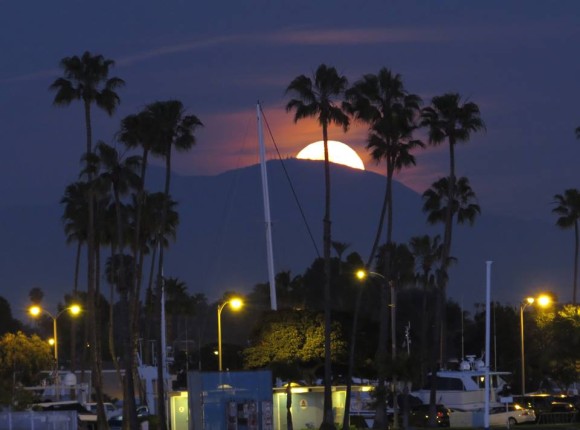
Photo above: Bruce Tennant captured the March 2014 full moon rising over Santiago Peak, Alamitos Bay, Long Beach, California.
The March 20-21, 2019, full moon ushers in the first full moon of spring for the Northern Hemisphere, and the first full moon of autumn for the Southern Hemisphere. This full moon is also a supermoon, particularly close to Earth. It comes less than four hours after the arrival of the March 20 equinox.
This is the closest coincidence of a full moon with the March equinox since March 2000 – 19 years ago. The full moon and March equinox won’t happen less than one day apart again for another 11 years, or until March 2030.
March 2000 full Moon: March 20 at 4:44 UTC
March 2000 equinox: March 20 at 7:35 UTC
March 2030 full moon: March 19 at 17:56 UTC
March 2030 equinox: March 20 at 13:51 UTC
This month’s full moon also presents the third and final supermoon of 2019. Will it appear bigger in your sky? No, not unless you happen to catch the moon just after it has risen in the east, around sunset. Then its larger-than-usual size has less to do with the supermoon, but more from a psychological effect known as the moon illusion.
Supermoons don’t look bigger to the eye to most people, but they do look significantly brighter. If you’re in the suburbs or a rural area, notice the bright moonlight cast on the landscape at this full moon.
Also, supermoons have a stronger-than-usual effect on Earth’s oceans. Watch for higher-than-usual tides to follow the supermoon by a day or so, especially if a coastal storm is happening in your part of the world.
At the equinox, the sun is at zenith (straight overhead) at the Earth’s equator. Because the Earth’s atmosphere refracts (bends) sunlight, a tiny bit more than half of the globe is covered over in daylight.Generally, the first full moon of a Northern Hemisphere spring heralds the imminent coming of the Christian celebration of Easter. Since Easter Sunday – by proclamation – occurs on the first Sunday after the first full moon in spring, some of us might expect the upcoming Sunday on March 24 to be Easter Sunday. However, by ecclesiastical rules, the equinox is fixed on March 21, so that places this year’s Easter Sunday (for Western Christendom) on April 21, 2019.
By the Gregorian calendar, the last time that an ecclesiastical Easter and an astronomical Easter didn’t occur on the same date was 38 years ago, in 1981. The next time won’t be until 19 years from now, in 2038.
(Easter Sunday for Eastern or Orthodox Christendom actually falls on April 28, 2019. That’s because the Eastern Church bases Easter on the old style Julian calendar, instead of the revised Gregorian calendar used by Western Christianity and most of the world.)
For our friends in the Southern Hemisphere, this March full moon counts as your Harvest Moon. The Harvest Moon is the full moon occurring closest to the autumnal equinox. On the average, the moon rises about 50 minutes later with each passing day. But for several days around the time of the Harvest Moon, the lag time between successive moonrises is reduced to a yearly minimum. For instance, at 40 degrees south latitude, the moon now rises some 30 to 35 minutes later (instead of the average 50 minutes later) each day for the next several days.
Like Earth, Saturn has equinoxes too! The ringed planet last had an equinox in 2009, and will have its next equinox in 2025. From Earth, Saturn’s rings disappear from view at a Saturn equinox, because these rings are then edge-on from our vantage point. But this near-equinox view of Saturn’s rings is readily visible from the Cassini spacecraft, because it’s 20 degrees above the ring plane. Image via NASA.
Here in the Northern Hemisphere, where it’s the closest full moon to the spring equinox, the lag time between successive moonrises is at a yearly maximum. At 40 degrees north latitude, the moon now rises around 70 to 75 minutes later daily. In the Northern Hemisphere, we ‘ll have to wait for the September full moon to bring forth our procession of early evening moonrises.
Last but hardly least, this March 2019 full moon gives us the first of four full moons in one season (between the March equinox and June solstice). Most of the time, a season – the time period between an equinox and a solstice, or vice versa – only harbors three full moons. But since this March full moon comes very early in the season, that allows for a fourth full moon to take place before the season’s end.
March 2019 equinox: March 20 at 21:58 UTC
March 2019 full moon: March 21 at 1:43 UTC
April 2019 full moon: April 19 at 11:12 UTC
May 2019 full moon: May 18 at 21:11 UTC
June 2019 full moon: June 17 at 8:31 UTC
June 2019 solstice: June 21 at 15:54 UTC
Some people call the third of four full moons in one season a Blue Moon. So our next Blue Moon (by the seasonal definition of the term) will fall on May 18, 2019.
The next Blue Moon by the monthly definition – second of two full moons in one calendar month – will come on October 31, 2020.
Bottom line: Enjoy the equinox full moon on March 20-21, 2019. It’s the third and final full supermoon of 2019, and the first of four full moons in the upcoming season (spring for the Northern Hemisphere, autumn for the Southern Hemisphere).
Bruce McClure has served as lead writer for EarthSky’s popular Tonight pages since 2004. He’s a sundial aficionado, whose love for the heavens has taken him to Lake Titicaca in Bolivia and sailing in the North Atlantic, where he earned his celestial navigation certificate through the School of Ocean Sailing and Navigation. He also writes and hosts public astronomy programs and planetarium programs in and around his home in upstate New York.
ooOOoo
It’s not about dogs. But then again maybe it is. For I’m thinking of dogs howling at the moon.
She died a short while ago, at 21:22 GMT/UTC on Monday, November 14th.
That is 9:22 pm British time on the same day as the moon’s closest distance to our Mother Planet since 1948.
Or to find some poetry in the timing of the end of my mother’s life, she died 10 hours to the minute after that closest moment of the moon’s passing, that was at 11:22 British time this morning.
This photograph of the moon was taken last night from here at home in Oregon at a few minutes after 10pm.
My mother was born Elizabeth Foreman and after the death of our father, Frederick Handover, in 1956, she subsequently married Richard Mills.
My sister, Elizabeth, and I were born in 1944 and 1949 respectively. My mother and Richard were parents to our half-sister Eleanor, who was born in 1959.
Our mother was an incredible woman and her death is truly the end of an era for the family.
For the rest of my years, I will look up at the full moon and remember my mother’s amazing life.
Dan, my Best Man, at the wedding of Jean and me, November 20th 2010. My mother is between Dan and me.
Dear people, you will understand why I will be taking a few days away from blogging.
On Sunday evening Jean and I were invited around to Jim and Janet’s place as their regular summer movie nights swung back into the calendar.
Around 10pm local time the night sky just shone with stars and planets and my old friend The Plough, or Big Dipper (Ursa Major), was up there pointing the way to the North Star.
Then as we all prepared to return to our homes, around 11pm, there was the wonderful, fabulous full Moon.
So it’s a special day today as for the first time in almost fifty years both the full moon and the Summer Solstice fall on the same day. Or better put over on Time and Date:
First June Solstice Full Moon in Decades
In 2016, a full Moon, also commonly known as Strawberry Moon, will coincide with the June Solstice. The 2 events haven’t occurred on the same day since 1967 and will not coincide again until 2062.
Now technically the exact moment of the Solstice was yesterday evening at 22:34 UTC. Or to put it as it was mentioned over on EarthSky:
On June 20, 2016, the moon turns full at 11:02 UTC. The solstice arrives some 11.5 hours later, at 22:34 UTC.
I will close with the gorgeous photograph of that full moon, again courtesy of that EarthSky article.
Rising nearly full moon – near San Francisco, California – on June 19, 2016 via EarthSky Facebook friend Amy Van Artsdalen.
I must admit that there’s a strange feeling inside me knowing that this was the last time that I will see such a coincidence of full moon and summer solstice.
There are a number of news stories about this extra-special full moon but I’ve chosen to republish some of what appeared on the Mother Nature Network website.
In terms of the timing of this full moon, rather than give you times for various places around the world, as this website does, I will simply offer the UTC/GMT time:
Sunday 6th May 2012 at 03:35:06 am
If you want to covert that to your local time wherever you are on this beautiful planet The World Time Server is as good a website as any.
BIGGER THAN YOUR AVERAGE MOON: Skywatcher Tim McCord of Entiat, Washington caught this amazing view of the March 19, 2011 supermoon. (Photo: Tim McCord)
Skywatchers take note: The biggest full moon of the year is due to arrive this weekend. And because this month’s full moon coincides with the moon’s perigee — its closest approach to Earth — it will also be the year’s biggest.
The moon will swing in 221,802 miles (356,955 kilometers) from our planet, offering skywatchers a spectacular view of an extra-big, extra-bright moon, nicknamed a supermoon.
And not only does the moon’s perigee coincide with full moon this month, but this perigee will be the nearest to Earth of any this year, as the distance of the moon’s close approach varies by about 3 percent, according to meteorologist Joe Rao, SPACE.com’s skywatching columnist. This happens because the moon’s orbit is not perfectly circular.
The full Moon will be up to 14% larger and 30% brighter than others during the year. The reason for this phenomenon is that the Moon becomes full on its closest approach to Earth on May 5, 2012, also known as the perigee full Moon.
So enjoy this most beautiful sight if you are somewhere on this planet where the moon will be visible at night. And double-check the time and the day so you don’t miss it! Finally, let me close by ‘spoiling’ my many readers in Arizona, and to serve as a good reminder for yours truly by saying that anyone on US Mountain Standard Time will see this moon at:
Saturday, 5th May 2012 at 20:35:06
“Aim for the moon. If you miss, you may hit a star.” W. Clement Stone.




 Learning from Dogs