I saw this on Freyja’s Facebook account and thought it would be appropriate for a Saturday reflection along with Random Notes 2. I’m sure many have seen it already but it was new to me!
There was a blind girl who hated herself because she was blind. She hated everyone except her loving boyfriend. He was always there for her. She told her boyfriend, ” If I could see the world, I’d marry you”.
One day someone donated eyes to her. When the bandages came off, she was able to see everything, including her boyfriend. He asked her, “Now that you can see the world, will you marry me?”
The girl looked at her boyfriend and saw that he was blind. The sight of his closed eyelids shocked her. She hadn’t expected that. The thought of looking at him for the rest of her life led her to refuse his offer of marriage. Her boyfriend left her in tears and days later wrote a note to her saying; “Take good care of your eyes, my dear, for before they were yours, they were mine.”
Having just cut and pasted that from the Facebook page, I thought that I would do a web search on ‘There was a blind girl who hated herself‘ and the first link on the results page was Stories from the Heart from the A View on Buddhism website. So that was a lovely find and a web site that deserves more browsing.
At the top of the ‘Home Page’ was the following quote:
“Don’t try to use what you learn from Buddhism to be a Buddhist;
use it to be a better whatever-you-already-are.” His Holiness the 14th Dalai Lama
Just a short note to say how very grateful I am for the number of readers who have signed up as subscribers over the last couple of weeks.
Many of you are already bloggers and very soon I’m going to find a way of linking Learning from Dogs to your blog. The obvious way would be to use the Blog Roll feature but methinks the list would be too long. I shall put my thinking cap on this aged head and see what would be an effective way of linking back to all those subscribers who also Blog. Feel free to add a comment if you have ideas.
A reminder that other people in other places may not be so fortunate as you.
In that sub-heading is an assumption that everyone who calls by Learning from Dogs enjoys a life where they are, relatively speaking, free to make their own life decisions. My apologies if that is a false assumption.
Amnesty International have a December campaign Write for Rights. It is so worth supporting. Here are some details from that website,
YOUR WORDS CAN CHANGE LIVES.
Your words can be a SPOTLIGHT that exposes the dark corners of the torture chamber. They can bring POWER to a human rights defender whose life is in jeopardy. They can IGNITE hope in a forgotten prisoner.
Your words can SAVE LIVES.
Join hundreds of thousands of people around the world in marking International Human Rights Day this December by taking part in Amnesty International’s Write for Rights Global Write-a-thon – the world’s largest human rights event. Through letters, cards and more, we take action to demand that the human rights of individuals are respected, protected and fulfilled. We show solidarity with those suffering human rights abuses, and work to bring about positive change in people’s lives.
Will you write a letter to save a life?
Sign up now to Write for Rights!
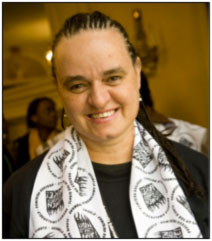
Jenni Williams
“I am alive today, after 34 arrests, because members of Amnesty International spoke out for me.”
– Jenni Williams, human rights defender in Zimbabwe
It really doesn’t make any difference which Amnesty case you support – just pick one and do it before the end of the month.
Amnesty also offer a full suite of resources, obtainable from here, to assist you with producing your letter.
Jean and I have decided to write in support of Jabbar Savalan, as described here and below,
AZERBAIJAN – Jabbar Savalan / Youth activist detained after using facebook
Jabbar Savalan
Hours after he posted a note on Facebook calling for protests against the government, Jabbar Savalan told his family that he was being followed. The next evening, February 5, 2011, police arrested him without explanation and took him to the Sumgayit police station, where they “discovered” marijuana in his outer coat pocket. Police questioned him without a lawyer for two days, reportedly hitting and intimidating him to make him sign a confession.
Authorities in Azerbaijan have a history of using trumped-up drug charges to jail perceived critics. Jabbar maintains that he does not use drugs and that the marijuana was planted on him. In May 2011, he was was convicted of possessing illegal drugs and sentenced to two-and-a-half years in prison. Amnesty International believes that authorities fabricated the drug charges against Jabbar to silence him. Amnesty considers him to be a prisoner of conscience.
A history student in college, Jabbar was an active member of an opposition political party. In January 2011, he posted on Facebook a newspaper article that described Azerbaijan’s President Ilham Aliyev as corrupt.
On February 4, Jabbar was inspired by the protests in the Middle East and North Africa to use Facebook to call for a “Day of Rage” to protest the government in Azerbaijan. The next day, police arrested him. He was 19 years old at the time.
It started when someone we know in Payson, Peter N, posted an item on Facebook about dogs being able to smell out cancer. The Facebook item referred to an article in Natural News. That item here went as follows:
(NaturalNews) The mainstream media is suddenly reporting on the idea that dogs can sniff out cancer in human beings. This concept is no surprise to NaturalNews readers, of course, as we’ve talked about this before, but until now the idea that cancer patients could be detected by smelling them was considered pure quackery by conventional doctors.
Of course, conventional doctors are once again wrong:Cancer patients do have a particular smelldue to the metabolic off-gassing of cancer cell tumors. But here’s the real story the mainstream media isn’t telling you: It’s not just dogs that can smell cancer — manyhealth practitionerscan also smell cancer patients.
I’ve personally spoken to numerous natural health practitioners who say they can smell cancer in patients. It’s not really a difficult thing to do, it turns out. With a bit of training, I believe most doctors could even be trained to do it, much like this dog in Japan which correctly identified cancer from stool samples 37 out of 38 times.
It doesn’t mean doctors have to sniff patients’ poo, either: You can also smell cancer on someone’s breath, so just talking to a patient can give a doctor an opportunity to do that. (Historically, by the way, physicians use to taste patients’ urine, from which they could diagnose a number of diseases, especially diabetes.)
This particular research on dogs’ ability to sniff out cancer was conducted by researchers at the Kyushu University in Japan. Dr Hideto Sonoda, who conducted the research, told the BBC, “The specific cancer scent indeed exists, but the chemical compounds are not clear. Only the dog knows the true answer.”
An important point in all this is thatthe cancer-sniffing dogs were able to detect early-stage bowel cancer— something that is extremely difficult for modern medical technology to detect. And it only takes a dog a few seconds — at virtually zero cost — to make the assessment.
Now, of course, medical scientists are busy trying to build an electronic device to replace the dog, because conventional medicine can’t stand the fact that something built by nature (the dog’s nose) might be better than some million-dollar electronic gizmo they come up with that can be billed out at $500 a test. So rather than just using dogs who can already detect cancer right now, they’re going to wait around a few years and try to create some high-tech equipment that will probably be a poor replacement for the dog.
That’s how modern medicine works: It steals good ideas from nature and replicates them, but the results are almost always a poor imitation of what Mother Nature has provided for free. Here’s how the end results would likely stack up:
CANCER-SNIFFING DOG
Accuracy: 98%
Cost: One dog biscuit and a pat on the head
CANCER-SNIFFING HIGH-TECH MACHINE
Accuracy: 60%
Cost: $500 billed to Medicare [the US medical system for those unfamiliar with the term. Ed.]
Gee, which one do you think conventional medicine will end up using?
In fact, a quick web search finds much information on the topic including these YouTube videos.
Now how to get our dogs to tell us ……… we’re OK; assuming we are!
The British Medical Journal published a ground-breaking research reporting how dogs have been trained to detect bladder cancer by its smell in urine, bringing together dogs’ exceptional sense of smell, with the theory that cancer produces chemicals with distinctive odours. (on September 24th, 2004 )
Six dogs, none of which had any prior experience in scent discrimination, were trained over seven months to distinguish between urine samples from bladder cancer patients and those from healthy people and individuals with non-cancerous diseases. For the final tests, each dog was offered a set of seven urine samples, and their task was to determine which of them was from a patient with bladder cancer. All of the samples used in the tests were completely new and unfamiliar to the dogs.
The dogs, comprising three spaniels, one papillon, one Labrador and one mongrel, correctly selected the bladder cancer urine on 22 out of 54 occasions – an average success rate of 41% compared to the 14% which would have been expected if the dogs had randomly selected a sample each time. This was statistically significant.
The research was undertaken by a unique partnership of medical scientists, including a statistician, and dog trainers. An orthopaedic surgeon from Buckinghamshire, Mr John Church, brought together colleagues from the Department of Dermatology, Buckinghamshire Hospitals NHS Trust (funded by the Erasmus Wilson Dermatological Research Fund) to develop and supervise the scientific protocol for the research, and Hearing Dogs for Deaf People (based near Princes Risborough) for the purpose of training the dogs for the trial.
“We were flattered to be asked to assist in this study on the basis of our reputation in the field of training dogs,” Claire Guest, Operations Director at Hearing Dogs said, “although we have been very careful not to let this project affect our normal work which involves training dogs for deaf people. The four of us who trained these cancer detection dogs did so using our own pet dogs, in our own homes, in our own spare time.”
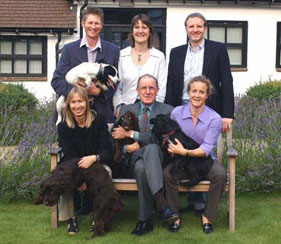
Back row: And Cook, Claire Guest, Martin Church. Front row: Carolyn Willis, John Church, Susannah Church
I rather loved the quote from John Church, “I am a passionate believer that animals have a huge amount to teach us, and I have heard many stories of people who have been alerted to the presence of cancer in their bodies by their pet dogs. I was delighted to find that the two charities were open-minded enough to participate in this study, so that we could really examine this phenomenon scientifically.”
As I keep going on about – we really can learn from dogs!
This Post for Learning from Dogs was inspired by a simple email. An email sent out automatically by Facebook inviting me to join a group committed to holding the Nobel prize in Economics accountably for the crisis.
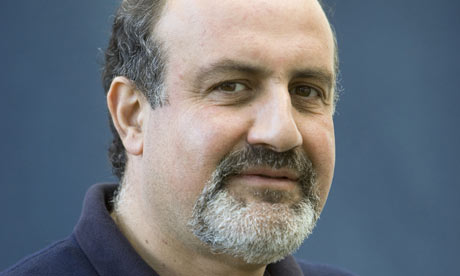
Nassim Nicholas Taleb
That intrigued me. Like thousands of others I had previously read The Black Swan, a book The Times newspaper describes as ” as one of the 12 most influential books since World War II”.
Wikipedia has a thorough description of Taleb much recommended if you have 10 minutes to read it.
Bryan Appleyard of The Times wrote an excellent piece on Taleb on the 1st June, 2008 which may be read here. Here’s an extract from near the front of that piece in The Times:
He spilt the tea – bear with me; this is important – while grabbing at his BlackBerry. He was agitated, reading every incoming e-mail, because the Indian consulate in New York had held on to his passport and he needed it to fly to Bermuda. People were being mobilised in New York and, for some reason, France, to get the passport.
The important thing is this: the lost passport and the spilt tea were black swans, bad birds that are always lurking, just out of sight, to catch you unawares and wreck your plans. Sometimes, however, they are good birds. The recorders cost $20 less than the marked price owing to a labelling screw-up at Circuit City. Stuff happens. The world is random, intrinsically unknowable. “You will never,” he says, “be able to control randomness.”
To explain: black swans were discovered in Australia. Before that, any reasonable person could assume the all-swans-are-white theory was unassailable. But the sight of just one black swan detonated that theory. Every theory we have about the human world and about the future is vulnerable to the black swan, the unexpected event. We sail in fragile vessels across a raging sea of uncertainty. “The world we live in is vastly different from the world we think we live in.”
Despite the article being over two years old, it is still an important piece for anyone trying to understand the causes of the financial mess we are all still in.
Finally, Taleb’s own website is a rich resource of much that will allow us all to better understand where we got to, where we are and what has to change if we are to have real hope for a better future.
Here’s a YouTube video of a TV interview taken in May, 2010.
Here’s an earlier video of Taleb explaining what his theory of black swans is about.
There’s a new power on the streets and it may make politicians feel very uncomfortable!
The Rt Hon Gordon Brown
Like me, you probably haven’t heard of Greg Craven. I hadn’t until about 24 hours before starting to write this Post (that would be Friday afternoon, Mountain Time, on the 11th December).
I was doing some research for an earlier Post about Copenhagen and came across a YouTube video created by Greg. More details and links later after making a more fundamental point.
This video of Greg’s has had 2,704,000 viewings! The information on that YouTube ‘page’ has had over 7,500,000 viewings. Greg has now written a book and so on, and so on.
In other words, the personal message that Greg is conveying has reached an unbelievable number of people. That would have been impossible without the power and reach of modern social media software systems: YouTube, Facebook, Linked-In, Twitter, MySpace, Digg, at al.
In the past, information has flowed outwards in a much more ‘top down’ way. Hierarchical, as it is called. That has suited those that wish, in some way, to control the message. While individuals would always chatter and gossip with their peers, there was a finite limit to that before “Send reinforcements, we are going to advance” morphed into “Send three and fourpence, we are going to a dance”!
The example of Greg Craven shows only too well how information can now flow. Out of anyone’s control, spreading virally.
Having made my point, I want to return to the subject matter that Greg is championing – but will include that in a separate Post.
Politicians! Be very careful what you say. We are all listening now, in one way or another, and ready to pounce if we don’t trust your words!














 Learning from Dogs