Tag: Earth

Postscript.

Planet Earth; just a grain of sand

In my last essay on love that was published on Friday, I quoted Carl Sagan, “For small creatures such as we the vastness is bearable only through love.Carl Sagan” My conclusion about love was:

… that if we don’t love our planet with all the ardour and passion of a teenager’s first romance, all those other loves in our lives will ultimately become irrelevant.

In researching for that essay, I visited Carl Sagan’s website, a rich source of information and materials for anyone interested in the far Cosmos right down to our future on this planet.

Just a little over three months ago, I wrote a post with the title of Carl Sagan with the objective of promoting his beautiful and awe-inspiring film called Pale Blue Dot.

Back to the present. On YouTube I came across this short video that seems so relevant to our need to love the only planet we have.

Carl Sagan explains the immensity of space and time in this clip is from Carl Sagan’s Cosmos episode 8, “Journeys in Space and Time.

“Those worlds in space are as countless as all the grains of sand on all the beaches of the Earth. Each of those worlds is as real as ours. In every one of them, there’s a succession of incidence, events, occurrences which influence its future. Countless worlds, numberless moments, an immensity of space and time.

And our small planet, at this moment, here we face a critical branch-point in the history. What we do with our world, right now, will propagate down through the centuries and powerfully affect the destiny of our descendants. It is well within our power to destroy our civilization, and perhaps our species as well. If we capitulate to superstition, or greed, or stupidity we can plunge our world into a darkness deeper than time between the collapse of classical civilization and the Italian Renaissance.

But we are also capable of using our compassion and our intelligence, our technology and our wealth, to make an abundant and meaningful life for every inhabitant of this planet. To enhance enormously our understanding of the Universe, and to carry us to the stars.”

Today, in the USA it is Memorial Day. The day of remembering the men and women who died while serving in the United States Armed Forces.  It doesn’t seem out of order to reflect that all those courageous men and women died with a belief in the future.  That belief in the future surely must embrace “… using our compassion and our intelligence, our technology and our wealth, to make an abundant and meaningful life for every inhabitant of this planet.

It really is a very simple message!

Repeat after me: We are of this planet!  It’s really very simple!

There are times when I look back at my writings on Learning from Dogs, now well over 1,500 posts (1,633 as of today, to be anal about it!) and ponder if the fundamental message behind the name of the blog often gets overlooked.  The Welcome page states:

As man’s companion, protector and helper, history suggests that dogs were critically important in man achieving success as a hunter-gatherer. Dogs ‘teaching’ man to be so successful a hunter enabled evolution, some 20,000 years later, to farming, thence the long journey to modern man. But in the last, say 100 years, that farming spirit has become corrupted to the point where we see the planet’s plant and mineral resources as infinite. Mankind is close to the edge of extinction, literally and spiritually.

Dogs know better, much better! Time again for man to learn from dogs!

Elsewhere on the blog, I underpin that proposition by listing the attributes of dogs:

Dogs:

  • are integrous ( a score of 210) according to Dr David Hawkins
  • don’t cheat or lie
  • don’t have hidden agendas
  • are loyal and faithful
  • forgive
  • love unconditionally
  • value and cherish the ‘present’ in a way that humans can only dream of achieving
  • are, by eons of time, a more successful species than man.

Now this is all fine and dandy but of what relevance is this to the mess that homo sapiens now finds itself in? Two parts to that answer come to mind.

The first part is that watching a dog out in the open countryside quickly brings home the fact that these animals are part of nature and, if push comes to shove, can live in the wild and fend for themselves.  Not saying that a domestic dog would enjoy the experience but that their wild dog and grey wolf roots still rest somewhere in a dog’s consciousness.

The second part of the answer is that all animals instinctively live in harmony, in balance, with their surroundings; with their environment.

For the incredibly obvious reason that dogs, as with all other animal species, are an evolutionary consequence of the natural history of Planet Earth.  That evolutionary journey from the Grey Wolf (Canis lupus) part of the Canidae family, a family including wolves, coyotes and foxes, thought to have evolved 60 million years ago.  That journey all the way to the domestic dog (Canis lupus familiaris).

That ancient journey where the African wild dog (Lycaon pictuspainted dog) came together with early man. No one knows when but the African wild dog was certainly around when man developed speech and set out from Africa, about 50,000 years ago!

Two vastly different natural species, dog and man, evolving compatibly with each other for so many thousands of years.

Back to the attributes of dogs, in particular a dog’s ability to cherish the present.  Earlier this week I was chatting with Kevin Dick, friend from Payson, AZ days, about the ‘interesting’ times we are living in.  Kevin thought there was a significant difference between the generations born in the 1940’s and 1950’s and those born in later times.  Most people over the age of, say 55, were brought up to save for ‘a rainy day’ and, possibly, be able to leave a legacy to their offspring.  Kevin then went on to reflect that more recent generations exhibit a ‘buy today, don’t delay’ mentality.

A by-product of this materialistic instant gratification approach is that the whole damn consumer machine has created a total disconnect with the fact that we humans are of this planet.

The earth is the mother of all people..

(Chief Joseph 1840 – 1904, leader of the Wallowa band, a Native American tribe

indigenous to the Wallowa Valley in northeastern Oregon)

Humans today fail to comprehend this fundamental fact: Our ability to harm the planet and think that it won’t affect our species is complete madness!  If only we could learn how to cherish the present in the way that our dogs do!

I’m now going to offer an essay from John Hurlburt.  I knew John had written this essay but didn’t get round to reading it properly until I had finished the introduction above.  I’m blown away by the resonance between the two but, as always, John’s words are so much more eloquent.

Inside Out

Climate change, religion, economics, government, politics and social issues are topics which create strong personal opinions and cultural divisions. We have difficulty accepting ideas which may conflict with our personal understandings. As usual, it’s an ego thing. The arrogance of our species is inclusive. We all suffer the consequences.

To counter our ego, we know that everything fits together. We exist in a unified cosmos with fluctuations and diversities that emerge around and through us.

Our present transformative state is as a biological form of energy and matter which possesses a conscious awareness of the natural order. We choose to ignore or deny the essential nature of our being at our own peril. Do we live only for the moment or do we live to insure our species future? That’s our fundamental choice.

Seek the truth and identify the common good.” Zoroaster [also known as Zarathustra, Ed.]

We are a consciously aware component of a living world in an isolated corner of a remote galaxy. Everything within and on the earth has an extraterrestrial origin. We live on an incubator we call the earth. We rarely truly communicate with or fully understand the energy of nature in our lives. Our critical thinking ability has become enveloped by an electronic cloud.

We generally agree that the actions of many religions and most politics are based upon short term human interests rather than upon the long term well being of our planet and its disappearing life forms. The fact is that we only began to emerge as a species about 100,000 years ago. Hubble telescope observations have dated our universal origin to roughly 13,002,000,000 years ago.

Could it be that we only imagine ourselves as independent beings? Could it be that beyond the mind games we play there is a vast reality greater that we can understand with our limited sensory apparatus and our finite minds?

Life is a transformative experience. All species, tribes, races and genders are united by the nature of life. We pass through a period of being selfish and ambitious during our journey. Many of us choose to move into these familiar ruts and furnish them. We do not always walk the way we talk.

Nature favors species which adapt to constant change in an emerging universe.

If we agree that our intelligence is judged by choices we make, there is some question about intelligent human life on earth. A recent Harvard University study of species in relation to change estimates that the life span of the human species is approximately 100,000 years. Sound familiar?

The wisdom of our brief human history tells us that we are on a careless and needless path to self destruction. All that’s necessary to verify this assertion is to turn on the news of the day. The systemic paradigm that has been imprinted on our psyches is in constant flux. As we live and learn, we realize that our purpose is to leave life better than we found it.

A delicate balance is necessary to maintain an even strain of faith in the natural process rather than dwelling upon our self centered fears of losing something we imagine we own or not attaining something we believe we want. The earth heals itself from the inside out. We can do the same as a species. Today is the tomorrow we dreamed of yesterday. What have we done to fulfill the true purpose of our lives?

an old lamplighter

So, yes, we have much to learn from dogs.

I will close as I started. We are of this planet!  It’s really very simple!
To see is to understand.

Something each and every one of us has to absorb – but without going in to space!

No problem can be solved from the same level of consciousness that created it.

So said Albert Einstein.  As with so many wise men from all times, what gets uttered strikes as such obvious common-sense.  But it took a wise person to utter it!

We need a change of consciousness.  About the world we live on.  This single, fragile, vulnerable rock in space that was featured in last Sunday’s post, Just a small white dot, and in yesterday’s post about Carl Sagan.

Climate Crocks, a ‘must follow’ blogsite for those that are concerned about the state of our planet, recently published a post that revealed how astronauts upon viewing the Planet Earth from Space had a profound Consciousness Change.  Take this example;

“I  think you start out with this idea of what it’s going to be like…and then when you do finally look at the Earth for the first time…you’re overwhelmed by how much more beautiful it really is, when you see it for real.

It’s just like it’s this dynamic, alive place, ..that you see glowing all the time..”

-Nicole Stott, Shuttle, ISS Astronaut

Or this from Ron Garan;

“When we look down on the Earth from space, we see this amazing, indescribably beautiful planet, ..it looks like a living, breathing organism..”

– Ron Garan, Suttle, ISS Astronaut

Wonderfully, that Climate Crocks piece quickly led to a new organisation called Planetary Collective.

Planetary Collective is a group of filmmakers, visual media creatives and thinkers who work with cosmologists, ecologists, and philosophers to explore some of the big questions facing our planet at this time.

Embracing a multidisciplinary, multi-media approach, we brings scientists, philosophers, and researchers together with designers, coders, and creatives to bring new perspectives to audiences around the world in fresh and innovative ways.

It was this group that last December released the short, but incredibly powerful film, Overview.  Here it is:

Released 7th December 2012

At the end of 2011, we filmed a short documentary called OVERVIEW about astronauts’ experiences in space, due for release in the last quarter of 2012. The film is both a stand-alone short film and a prelude to CONTINUUM, introducing many of the key ideas expanded upon in the feature documentary.

SYNOPSIS

Astronauts who have seen the Earth from space have often described the ‘overview effect’ as an experience that has transformed their perspective of the planet and mankind’s place upon it, and enabled them to perceive it as our shared home, without boundaries between nations or species.

OVERVIEW is a short film that will explore this perspective through interviews with astronauts who have experienced the overview effect. The film also features insights from commentators and thinkers on the wider implications and importance of this understanding for humanity as a whole, and especially its relevance to how we meet the tremendous challenges facing our planet at this time.

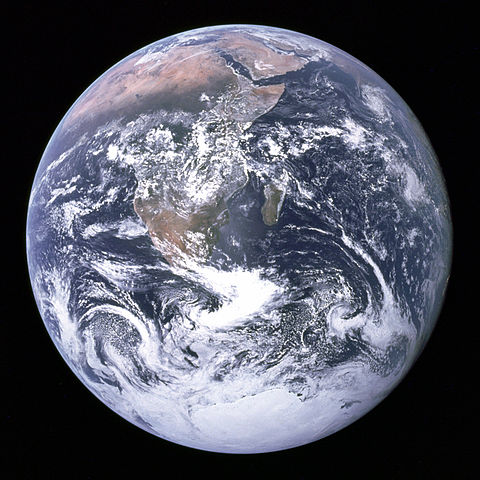
That film release date of the 7th December, 2012 was the 40th anniversary of the most famous photograph of Planet Earth taken on the 7th December, 1972: The Blue Marble.

The Earth seen from Apollo 17.

Original caption: “View of the Earth as seen by the Apollo 17 crew traveling toward the moon. This translunar coast photograph extends from the Mediterranean Sea area to the Antarctica south polar ice cap.

This is the first time the Apollo trajectory made it possible to photograph the south polar ice cap. Note the heavy cloud cover in the Southern Hemisphere. Almost the entire coastline of Africa is clearly visible. The Arabian Peninsula can be seen at the northeastern edge of Africa. The large island off the coast of Africa is Madagascar. The Asian mainland is on the horizon toward the northeast.”

From WikiPedia,

The Blue Marble is a famous photograph of the Earth, taken on December 7, 1972, by the crew of the Apollo 17 spacecraft, at a distance of about 45,000 kilometres (28,000 mi).

The snapshot — taken by astronauts on December 7, 1972, at 5:39 a.m. EST (10:39 UTC) — is one of the most widely distributed photographic images in existence.

The image is one of the few to show a fully illuminated Earth, as the astronauts had the Sun behind them when they took the image. To the astronauts, Earth had the appearance and size of a glass marble, hence the name.

Back to that Overview film.  Slightly confusing is the fact that the Planetary Collective website, where that Overview film is highlighted, is a different one to the associated Overview Institute website, from where one can read this Declaration:

A Critical Time

We live at a critical moment in human history. The challenges of climate change, food, water and energy shortages as well as the increasing disparity between the developed and developing nations are testing our will to unite, while differences in religions, cultures, and politics continue to keep us apart.

The creation of a “global village” through satellite TV and the Internet is still struggling to connect the world into one community. At this critical moment, our greatest need is for a global vision of planetary unity and purpose for humanity as a whole.

And to my mind the greatest need, the ONLY need, for that global vision is to move rapidly beyond our industrial and materialistic way of life to one where we live in harmony with our planet.

To pick up on what Ron Garan was quoted as saying, Planet Earth is a living, breathing organism.  If the species man and thousands of other non-human species are to stand a chance of remaining on this living, breathing organism then You, Me and every other person out there, has to have a change of consciousness about the one and only place we live on.

So don’t flick over from those last words to the next thing in your life.  Go back and look at the picture of our home, taken from Apollo 17.  Make sure that you ask as many as you can to watch the Overview film above.

Finally, you be a person who makes a change in your consciousness.  The rest is easy.

Back to dear old Albert E.

No problem can be solved from the same level of consciousness that created it.

Carl Sagan

How very precious, vulnerable and fragile is this precious place we call home.

Today’s consciousness perambulation is the fault of Mr. P., as I like to call him. I refer to Pendantry as he is on his blog, Wibble.

You see on Sunday he added a comment to my post Just a small, white dot! that included the beautiful and awe-inspiring film made by the late Carl Sagan called Pale Blue Dot.

carl-sagan

Like millions of others, I came to admire Carl Sagan through watching the fabulous, the truly fabulous, television series Cosmos: A Personal Voyage. (NB. All the episodes are on YouTube, Episode One is at the end of this Post, Ed.)  Here’s how WikiPedia opens their reference to Carl.

Carl Edward Sagan (November 9, 1934 – December 20, 1996) was an American astronomer, astrophysicist, cosmologist, author, science popularizer and science communicator in astronomy and natural sciences. He spent most of his career as a professor of astronomy at Cornell University where he directed the Laboratory for Planetary Studies.

He published more than 600 scientific papers and articles and was author, co-author or editor of more than 20 books. He advocated scientifically skeptical inquiry and the scientific method, pioneered exobiology and promoted the Search for Extra-Terrestrial Intelligence (SETI).

Sagan is known for his popular science books and for the award-winning 1980 television series Cosmos: A Personal Voyage, which he narrated and co-wrote.  The book Cosmos was published to accompany the series. Sagan wrote the novel Contact, the basis for a 1997 film of the same name.

He died far too young and was a tragic loss to humanity.  The Carl Sagan web portal is here.

That 3:30 minute video Pale Blue Dot has, likewise, been seen by millions.  If you or someone you know hasn’t seen it, then you must pause now …

It’s practically impossible to watch that video and not embrace the central message from Mr. Sagan.  Here’s the transcript:

Our home from 6 billion kilometres. A very tiny dot against the vastness of space.

From this distant vantage point, the Earth might not seem of any particular interest. But for us, it’s different.

Consider again that dot. That’s here. That’s home. That’s us.

On it everyone you love, everyone you know, everyone you ever heard of, every human being who ever was, lived out their lives.

The aggregate of our joy and suffering, thousands of confident religions, ideologies, and economic doctrines, every hunter and forager, every hero and coward, every creator and destroyer of civilization, every king and peasant, every young couple in love, every mother and father, hopeful child, inventor and explorer, every teacher of morals, every corrupt politician, every “superstar,” every “supreme leader,” every saint and sinner in the history of our species lived there – on a mote of dust suspended in a sunbeam.

The Earth is a very small stage in a vast cosmic arena.

Think of the rivers of blood spilled by all those generals and emperors so that in glory and triumph they could become the momentary masters of a fraction of a dot.

Think of the endless cruelties visited by the inhabitants of one corner of this pixel on the scarcely distinguishable inhabitants of some other corner. How frequent their misunderstandings, how eager they are to kill one another, how fervent their hatreds.

Our posturings, our imagined self-importance, the delusion that we have some privileged position in the universe, are challenged by this point of pale light. Our planet is a lonely speck in the great enveloping cosmic dark. In our obscurity – in all this vastness – there is no hint that help will come from elsewhere to save us from ourselves.

The Earth is the only world known, so far, to harbor life. There is nowhere else, at least in the near future, to which our species could migrate. Visit, yes. Settle, not yet. Like it or not, for the moment, the Earth is where we make our stand.

It has been said that astronomy is a humbling and character-building experience. There is perhaps no better demonstration of the folly of human conceits than this distant image of our tiny world. To me, it underscores our responsibility to deal more kindly with one another and to preserve and cherish the pale blue dot, the only home we’ve ever known.

Tomorrow, I will stay with the theme of our beautiful planet. Hope you can join me.

Now spoil yourself and watch Episode One of Cosmos.

DA14

Not such a bizarre post title as you might think!

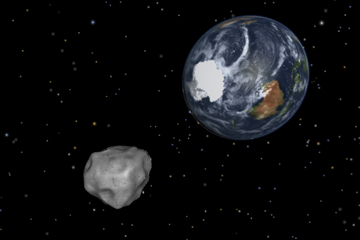
asteroid-2012-da14-art

DA14, or to give it’s full name, Asteroid 2012 DA14, is calling by Planet Earth rather soon.  To quote the item on the Planetary Society’s website,

Asteroid 2012 DA14 Discovery Enabled by Planetary Society Grant

On Friday, February 15, 2013, Asteroid 2012 DA14 will travel just 17,000 miles above the Earth – closer to our planet than the orbit of the communications satellite that broadcast the Super Bowl around the world. About half the size of a football field and with more than 100 times the energy impact of the nuclear bomb that fell on Hiroshima, DA14 will miss Earth this time around, but if it had impacted, this asteroid could have taken out any major metropolitan city on our planet.

The discovery of Asteroid DA14 was made by a small team of observers at La Sagra Observatory in Southern Spain, on February 22, 2012, enabled with a grant provided by The Planetary Society. One of the observatory’s telescopes had recently been upgraded with funds donated by The Planetary Society’s NEO Shoemaker Grant program. Its new camera enabled detection of fast moving objects like 2012 DA14 – requiring very fast imaging for discovery and determination of their paths. The upgraded instrument has far outperformed the Observatory’s other telescopes.

Now, we get to point the world’s telescopes at this 2013 close flyby and learn more about this asteroid and its orbit because of the support of our Planetary Society Members all over the world.

This asteroid won’t hit Earth, at least for many, many decades.  But it is a reminder we live in a cosmic shooting gallery.  We need to find, track, and characterize these objects and develop the technical and political capability to deflect an asteroid.  It is not a matter of whether there will be a dangerous impact, it is a matter of when.

The Planetary Society and its members are working to do our part through programs like ourShoemaker NEO Grants, like the one that made the discovery of 2012 DA14 possible, and projects like Laser Bees, exploring new ways to potentially deflect a dangerous asteroid.

NASA have recently released a video, see below, but a search on YouTube will find more, some of which are more engaging than the rather dry style of the NASA release.


Have questions?  Bet you do!  Here are some of the answers to the obvious ones.  Including these:

What is the time of closest approach

Feb. 15, 2013, 19:25 UTC (11:25 PST)

What is the closest approach altitude?

Approximate altitude above the surface of the Earth will be 27,330 km, 17,000 mi (34,100 km, 21,200 mi from center of Earth).  That is closer than the altitude of geosynchronous satellites, e.g., satellite TV satellites, at 35,786 km (22,236 mi) altitude.

Will it be visible with the naked eye, how bright will it be?

It will not be a naked eye object.  At closest approach, its brightness will be about a magnitude of 7.  It will be bright enough that it could be seen with steady binoculars or a small telescope if you are on the side of Earth it will be passing.

What parts of Earth will have a chance to observe it telescopically?

Near closest approach when it is brightest, most of Europe, Asia, and Africa.  It will pass from the southern hemisphere to northern hemisphere.  Though it will be much dimmer, it is observable by larger telescopes for days to weeks before and after closest approach.

Finally, well done those gents that first spotted DA14.

Miguel Hurtado, Jaime Nomen, and Jaume AndreuWinners of a Planetary Society Shoemaker NEO Grant in 2010
Miguel Hurtado, Jaime Nomen, and Jaume Andreu
Winners of a Planetary Society Shoemaker NEO Grant in 2010

Now where did I put my tin helmet?

The dirt beneath our feet.

A film about dirt that opens eyes!

dirt-splsh

I have mentioned the website of the Permaculture Research Institute of Australia before.  It’s a fabulous resource for many aspects of moving towards a more sustainable lifestyle, and not just for Australians.

A few days ago, their regular posting included a link to this:

Dirt: The Movie

DIRT! The Movie — directed and produced by Bill Benenson and Gene Rosow — takes you inside the wonders of the soil. It tells the story of Earth’s most valuable and underappreciated source of fertility — from its miraculous beginning to its crippling degradation. The opening scenes of the film dive into the wonderment of the soil. Made from the same elements as the stars, plants and animals, and us, “dirt is very much alive.” Though, in modern industrial pursuits and clamor for both profit and natural resources, our human connection to and respect for soil has been disrupted. “Drought, climate change, even war are all directly related to the way we are treating dirt.”

DIRT! the Movie — narrated by Jaime Lee Curtis — brings to life the environmental, economic, social and political impact that the soil has. It shares the stories of experts from all over the world who study and are able to harness the beauty and power of a respectful and mutually beneficial relationship with soil.

DIRT! the Movie is simply a movie about dirt. The real change lies in our notion of what dirt is. The movie teaches us: “When humans arrived 2 million years ago, everything changed for dirt. And from that moment on, the fate of dirt and humans has been intimately linked.” But more than the film and the lessons that it teaches, DIRT the Movie is a call to action.

Here’s the trailer to the film.

And here’s the movie’s website.

The link to the film on the PRI Australia’s website is here: Dirt: The Movie.

So plan on sitting down somewhere and enjoying a full-length film about dirt.  It will hold you spellbound.

To nurture a garden is to feed not just on the body, but the soul.  Alfred Austin

In the sky with diamonds!

A fascinating item recently published by Yale University.

Apologies, time pressure allows me little more than to repeat this in full.  But still no less interesting.

oooOOOooo

Nearby super-Earth likely a diamond planet

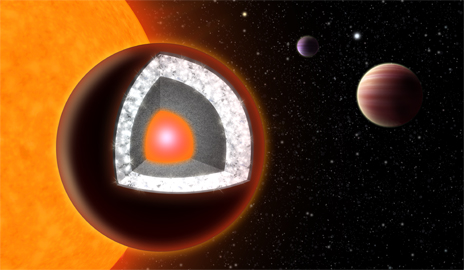
Illustration of the interior of 55 Cancri e — an extremely hot planet with a surface of mostly graphite surrounding a thick layer of diamond, below which is a layer of silicon-based minerals and a molten iron core at the center. (Image by Haven Giguere)

October 11, 2012

New research led by Yale University scientists suggests that a rocky planet twice Earth’s size orbiting a nearby star is a diamond planet.

“This is our first glimpse of a rocky world with a fundamentally different chemistry from Earth,” said lead researcher Nikku Madhusudhan, a Yale postdoctoral researcher in physics and astronomy. “The surface of this planet is likely covered in graphite and diamond rather than water and granite.”

The paper reporting the findings has been accepted for publication in the journal Astrophysical Journal Letters.

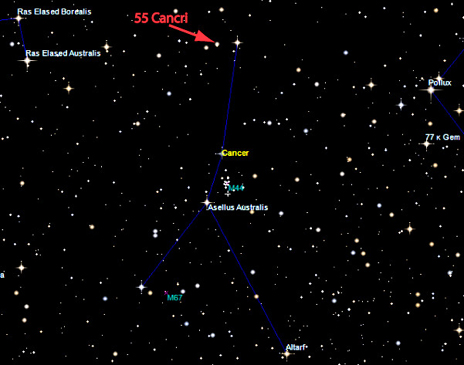
The planet — called 55 Cancri e — has a radius twice Earth’s, and a mass eight times greater, making it a “super-Earth.” It is one of five planets orbiting a sun-like star, 55 Cancri, that is located 40 light years from Earth yet visible to the naked eye in the constellation of Cancer.

The planet orbits at hyper speed — its year lasts just 18 hours, in contrast to Earth’s 365 days. It is also blazingly hot, with a temperature of about 3,900 degrees Fahrenheit, researchers said, a far cry from a habitable world.

The planet was first observed transiting its star last year, allowing astronomers to measure its radius for the first time. This new information, combined with the most recent estimate of its mass, allowed Madhusudhan and colleagues to infer its chemical composition using models of its interior and by computing all possible combinations of elements and compounds that would yield those specific characteristics.

Star map showing the planet-hosting star 55 Cancri in the constellation of Cancer. The star is visible to the naked eye, though better through binoculars. (Image by Nikku Madhusudhan; created using Sky Map Online

Astronomers had previously reported that the host star has more carbon than oxygen, and Madhusudhan and colleagues confirmed that substantial amounts of carbon and silicon carbide, and a negligible amount of water ice, were available during the planet’s formation.

Astronomers also thought 55 Cancri e contained a substantial amount of super-heated water, based on the assumption that its chemical makeup was similar to Earth’s, Madhusudhan said. But the new research suggests the planet has no water at all, and appears to be composed primarily of carbon (as graphite and diamond), iron, silicon carbide, and, possibly, some silicates. The study estimates that at least a third of the planet’s mass — the equivalent of about three Earth masses — could be diamond.

“By contrast, Earth’s interior is rich in oxygen, but extremely poor in carbon — less than a part in thousand by mass,” says co-author and Yale geophysicist Kanani Lee.

The identification of a carbon-rich super-Earth means that distant rocky planets can no longer be assumed to have chemical constituents, interiors, atmospheres, or biologies similar to those of Earth, Madhusudhan said. The discovery also opens new avenues for the study of geochemistry and geophysical processes in Earth-sized alien planets. A carbon-rich composition could influence the planet’s thermal evolution and plate tectonics, for example, with implications for volcanism, seismic activity, and mountain formation.

“Stars are simple — given a star’s mass and age, you know its basic structure and history,” said David Spergel, professor of astronomy and chair of astrophysical sciences at Princeton University, who is not a co-author of the study. “Planets are much more complex. This ‘diamond-rich super-Earth’ is likely just one example of the rich sets of discoveries that await us as we begin to explore planets around nearby stars.”

In 2011, Madhusudhan led the first discovery of a carbon-rich atmosphere in a distant gas giant planet, opening the possibility of long-theorized carbon-rich rocky planets (or “diamond planets”). The new research represents the first time that astronomers have identified a likely diamond planet around a sun-like star and specified its chemical make-up. Follow-up observations of the planet’s atmosphere and additional estimates of the stellar composition would strengthen the findings about the planet’s chemical composition.

The authors of the paper are Madhusudhan, Lee, and Olivier Mousis, a planetary scientist at the Institut de Recherche en Astrophysique et Planetologie in Toulose, France.

The paper is titled “A Possible Carbon-rich Interior in Super-Earth 55 Cancri e.”

The research was supported by the Yale Center for Astronomy and Astrophysics (YCAA) in the Yale Department of Physics through Madhusudhan’s YCAA postdoctoral prize fellowship.

oooOOOooo

Dead easy to know how to finish this post off!

A study of man’s behaviours.

A reflection on why living in harmony with Planet Earth seems so challenging.

John Hurlburt is the ‘mover and shaker’ behind a series of talks and discussions under the overall title of Everything Fits Together, part of the adult education umbrella of St Paul’s Episcopal Church here in Payson, AZ.  John generously asked if I would lead the discussion tonight (19th) along the theme of Nature and Faith.  I plan to close the session with these words and the compelling video that was on Learning from Dogs last Friday A planet worth protecting.

oooOOOooo

Man – a study in behaviours.

The relationship between Planet Earth and man goes back a very long way. But what of today?

There is little doubt that many people, even with the minimum of awareness about the world in which we live, are deeply worried. On so many fronts there are forbidding and scary views. It feels as though all the certainty of past times has gone; as if all the trusted models of society are now broken. Whether we are talking politics, economics, employment or the environment, nothing seems to be working.

Why might this be?

It would be easy to condemn man’s drive for progress and an insatiable self-centredness as the obvious causes of our society failing in widespread ways. But in my view that’s too simple an explanation. It’s much more complex.

I propose that the challenges we all face today have their roots in the dawning of our evolution. Let’s remind ourselves how far back that goes.

The earliest documented members of the genus Homo are Homo habilis which evolved around 2.3 million years ago. Homo habilis was the first species for which we have positive evidence of the use of stone tools.

A theory known as Recent African Ancestry theory, postulates that modern humans evolved in Africa possibly from Homo heidelbergensis and migrated out of the continent some 50,000 to 100,000 years ago, replacing local populations of Homo erectus and Homo neanderthalensis.

Thus for tens of thousands of years, the behaviours of humans have served our species well, by definition. Ergo, mankind has evolved as the result of mankind’s behaviours. Behaviours that may have changed little over those countless years.

So one might speculate that these behaviours have been potentially damaging to the ultimate survival of our species, perhaps hugely damaging, for a very long time. But because man’s population footprint has been so small for 99% of eternity the consequences have not impinged on the planet until now. Let’s reflect on those population figures.

Until the development of agriculture, around the 11th millennium BC, the world population was stable at around one million persons, as man lived out a subsistence hunter-gatherer existence. By about 2000 years ago the global population of man had climbed to around 300 million. It took another 1,200 years for that global population to reach the first billion, as it did in 1804.

However, just 123 years later, in 1927, the two-billionth baby was born. The three-billionth baby was born in 1960, just 33 years later! Only a further 14 years slip by for the four-billionth baby to be born in 1974. Another blink of the geological eyelid and 13 years later, in 1987, along comes the five-billionth bundle of joy. Around October 1999, the sixth-billionth baby is born! It is likely that we are in a world where there are now seven billion people! Indeed, the world population clock estimates that on September 12th, a week ago, the world population was 7,039,725,283 persons.

About a billion every decade. The equivalent of a growth of 100 million each and every year, or around 270,000 every single day! Or if you prefer 11,250 an hour (Remember that’s the net growth, births minus deaths, of the population of humans on this planet!)

Combine man’s behaviours with this growth of population and we have the present situation. A totally unsustainable situation on a planet that is our only home.

The only viable solution is to amend our behaviours. To tap into the powers of integrity, self-awareness and mindfulness and change our game.

All of us, no exceptions, have to work with the fundamental, primary relationships we have with each other and with the planet upon which we all depend. We need the birth of a new level of consciousness; of our self, of each other and of the living, breathing planet. A new consciousness that will empower change. We need spiritual enlightenment. We need a spiritual bond with this beautiful planet.

Over eons of time, Planet Earth has favoured our evolution. Now, today, not tomorrow, it is time to favour our beautiful planet with our love and with our faith. It is the ultimate decision for our species.


oooOOOooo

If you need a reminder of how beautiful our planet is (and I’m sure the majority of LfD readers don’t require that reminder) then go back and watch David Attenborough’s video and voice-over to the song What a Wonderful World.

I will close by inserting into this post, the video that Martin Lack included in a recent comment to my post The wind doth blow!

A planet worth protecting

This is our beautiful planet.

There have been a couple of hard-hitting posts this week, first about the implications of climate, with respect to the massive drought across the USA this year, and the efforts of Polly Higgins of the Eradicating Ecocide movement to make ecocide a crime against humanity.

This short but very compelling video shows why the planet is so worth protecting. Enjoy!

Loving our planet!

While Learning from Dogs trawls around a wide variety of topics, the theme behind the writings is, as the banner says on the home page: Dogs are integrous animals. We have much to learn from them.

Integrity, defined more or less universally as the ‘adherence to moral and ethical principles; soundness of moral character; honesty.

Please trust me that this position is taken not from the perspective of the writer, I’m struggle with ‘right’ and ‘wrong’ as much as the next guy.  No, this position is the result of one very simple and stark vision: If we don’t understand pretty damn soon what we, as in mankind, are doing to our planet, both directly and indirectly, then we are living through the era of the end of civilised man; these are the last times.

The relationship between man and the dog is ancient beyond contemplation.  It is widely believed by scientists who study the history of man that, at the very least, dogs assisted man in evolving from hunter-gatherers to farmers.  But some scientists believe that without the support of dogs, man never would had made the transition to farming.  Either way the relationship goes back more than 10,000 years.

So what on earth does that have to do with integrity?  Simply that alongside millions of us, dogs offer us the examples of loyalty, faith, meditation, patience, truth in love; an example of an adherence to moral and ethical principles; soundness of moral character; honesty.‘  In a single word: integrity!

OK, now that I have got that off my chest, to the topic of today’s post.  For some months now I have subscribed to the blog run by The Permaculture Research Institute of Australia.  It has much that will be useful for Jean and me when we move to Oregon in November.  But also, not infrequently, the Institute highlights deeper, more fundamental, issues.

Thus it was that a few days ago, my attention was drawn to an item with the title of  We Need Your Help to End the Era of Ecocide.  It was about the work of English woman, Polly Higgins.  I’m ashamed to say that I had not heard of her before!  A very quick search came across the website Eradicating Ecocide, from which one quickly learns that Polly,

In March 2010 international barrister and award winning author Polly Higgins proposed to the United Nations that Ecocide be made the fifth Crime Against Peace. There are currently four Crimes Against Peace: genocide, war crimes, crimes of aggression and crimes against humanity. Ecocide is the missing fifth crime – it is a crime against humanity, against current and future generations, and against all life on Earth.

Wow, that makes sense.  So what is ecocide? Again, Eradicating Ecocide offers the answer,

Back to the specific topic.  This is a copy of what is the latest news item on the Eradicating Ecocide website and it is reproduced in full.  I’ve included the Editor’s introduction from the Permaculture News website, as I couldn’t say it any better.

oooOOOooo

We need your help to end this era of Ecocide

Editor’s Note: We’ve covered a little of Polly Higgin’s important work before (see here and here). If you’re not already familiar with Polly’s work, I would strongly encourage you to check out the web pages and videos linked to below, as well as our aforementioned pieces. Permaculturists dream of whole earth restoration, but our efforts, whilst essential, are, if I may, largely piecemeal. The reason for this is that for every positive step someone makes, an industry or government does, or allows, something significantly more destructive to take place that more than overshadows it. We will never break out of this destructive cycle unless we make environmental destruction illegal, and hold the people responsible accountable. As you are able, please support Polly’s work. If you cannot donate, please at least do what you can to share and circulate this page.

Polly Higgins

I have something I would like to share with you. Today myself and my team have reached zero. The pot is now bare and our funding resources are in urgent need of replenishing. In the past year your donations of over £200,000 funded my and my team’s work; we planted some incredible seeds in the run up to the Rio Earth Summit. Out of that we have had some wonderful successes; in the past year alone we have held a mock Ecocide Trial in the UK Supreme Court, the University of London launched their Ecocide Project, I have travelled to countries and spoken on many platforms, I launched my second book Earth is our Business, I have been awarded Overall Champion by the PEA awards, I have started a training programme for others to learn how to become a Voice for the Earth and I have submitted a concept paper, Closing the door to dangerous industrial activity to all government’s around the world. All this has been done with the help of your money and without it none of this would have been at all possible.

Yesterday we held an emergency meeting; despite the enormous efforts of our fundraiser over the past few months we have been unable to raise more than a few thousand pounds. We are looking squarely at the future and we see enormous opportunity to take forward all that I have already achieved; just think how close we are to making this law a reality.

Everything we do is governed by permaculture ethics; people care, earth care and fair share. Ecocides occur when we take far more than our fair share, which affects both our people and our Earth. To ensure we live within our planetary limits, a law of Ecocide creates a legal framework that can ensure we all live in peaceful enjoyment.

Please help me to continue to build upon all of this good work; now more than ever people care, earth care and fair share matters. Together we can end the era of Ecocide.

With love for the Earth,

Polly

oooOOOooo

If you read this and want to share this Post, feel free to so do.  If you want to do that and more, then:

How you can help

  • Set up a direct debit.
  • Give a one-off donation.
  • Do a direct bank transfer.
  • Send a cheque to us at 6 Highbury Corner, Highbury Crescent, London N5 1RD. Please write your cheque out to our charity, The Earth Community Trust.
  • In the US you can donate via the Iris Arts and Education Group 1856 San Antonio Ave, Berkeley, California 94707. Please write your cheque out to our charity, The Earth Community Trust.
  • Please become one of our funding volunteers. We are seeking a team of people to help us fundraise. This can be done in a number of ways. If you think you can help, please email our intern Nina: nina (at) eradicatingecocide.com
  • We are seeking a volunteer for 2 weeks full time to come into our London office: please email Louise with your CV: louise (at) eradicatingecocide.com

And don’t forget to go to the Eradicating Ecocide website to become more aware and then take action!  Speaking of becoming more aware, do watch this video.