Tag: DNA

The view from the window.

Perhaps ancient man is still alive and well in all of us.

Two delightful events have provided the fuel for today’s post which, I warn you, is much more the personal mental ramble than the usual daily post on Learning from Dogs.  So, health warning, continue reading at your own risk, or be safe and switch off now!

Before getting in to my perambulations, just a word of thanks to you for your support.  Last month, there were 31,291 viewers of Learning from Dogs and 71 of you have chosen to subscribe.  I am humbled by your interest.  Don’t ever hesitate to give me feedback or, if you prefer, comment to a specific post.

OK, to the theme of today.

On Wednesday I had an enjoyable lunch with a friend from here in Payson, Dennis L.  Sitting in the Crosswinds restaurant at Payson airport is one of the most beautiful eating spots in terms of the view from the window.  So it’s a very conducive place to relax and try put the world to rights!  Conversation ranged across a variety of topics but frequently touched on the lunacy of so many things to do with man, especially when it comes to the government of peoples.

Dennis and I also acknowledged that entering politics with a set of passionate ideals, as we were sure many persons did, would quickly run up against the skein of vested interests that must permeate governments from top to bottom.

Yes Minister was a satirical comedy written by Antony Jay and Jonathan Lynn that ran for many years.  It was extraordinarily funny, here’s a 3-minute clip,

That programme underlined, far better than anything else, how governments most probably work in reality.

Dennis and I were clear, as so many millions of other global citizens must be, that the complexity of commerce, politics, national interests, global finance, and more, had created ‘systems’ of decision making that were utterly disconnected with the needs of mankind having a long and stable future on the only finite home around, Planet Earth.

Then today (Thursday), Jean and I attended our regular weekly gardening course at the local college in Payson.  Today’s subject was Arizona’s Climate and the tutor, Mike C., was a professional climatologist and meteorologist.  It was fascinating, indeed, totally absorbing.  Mike’s graphs and slides about the climate, some showing data for the last 1,000 years, underlined the incredible complexity and interconnectedness of the processes that made up the global climate system.

Once again that use of the word ‘complexity’.  He confirmed that there was no scientific doubt that the world was warming as a result of changes to the Earth’s atmosphere, science certain most of it is caused by increasing concentrations of greenhouse gases produced by human activities such as deforestation and burning fossil fuels.

Mike closed the session with an interesting reflection.  He reminded the audience that mankind is still essentially wired, in evolutionary terms, to know how to react to an attacking tiger or similar wild beast, as in the fight or flee response, than know how to deal with such complex, despite intellectually obvious, threats as global climate change, rising sea levels and many other totally unsustainable practices.  Mike held the view that only when man had the threat in his face equivalent to that of the attacking tiger would there be a wholesale change.

On the home page of this blog, I write,

As man’s companion, protector and helper, history suggests that dogs were critically important in man achieving success as a hunter-gatherer.  Dogs ‘teaching’ man to be so successful a hunter enabled evolution, some 20,000 years later, to farming,  thence the long journey to modern man.  But in the last, say 100 years, that farming spirit has become corrupted to the point where we see the planet’s plant and mineral resources as infinite.  Mankind is close to the edge of extinction, literally and spiritually.

In the context of homo sapiens, Latin for “wise man” or “knowing man”, then we know that modern man, anatomically, originated in Africa about 200,000 years ago.  Modern man only evolved from hunter/gatherer to farmer around 10,000 years ago, a tiny proportion of H. sapiens existence and, in evolutionary terms, no time at all.

The DNA of the domesticated dog separated from that of the wolf around 100,000 years ago.  No one knows for sure when man and dog came together but there is archaeological evidence of dogs being buried in mens’ graves around 30,000 years ago.  That’s an association over a huge time period.

Dennis and Mike, between them, triggered in my mind something fundamental.  Perhaps modern society, with all it’s bizarre behaviours and so many totally illogical practises (especially, in terms of a long-term relationship with our planet), could be understood.  Understood from the perspective of our social behaviours, built so much on technology, having raced far on to the point where they are now practically out of sight of our instinctive evolutionary behaviours.  We really don’t know how to change those core behaviours.

In contrast, dogs have remained much more stable with regard to their evolutionary progress and their external world.  Consider that the last big change for the domesticated dog was the association with man and that is at least three times as long ago as man becoming farming man.  No wonder when we curl up with our dog it has echoes of a time thousands of years before we could even spell the word, ‘politician’.  Echoes of a stability that seems now so way beyond reach.

And the view from the window of the Crosswinds ……

Mogollon Rim, North of Payson, AZ., in Winter

What is the dog?

Time to attempt an answer to this fundamental, well for this Blog, question!


Like wolves, the Dingo is smarter than pet dogs.

(The above photograph comes from an article on ImpactLab – see foot of Post for more details.)

When putting together the Blog ahead of the publication of the very first Post on July 15th, 2009, some 820 Posts ago, I prepared some additional material that set out to justify the Raison d’être for the venture.  Included was a piece regarding Dogs and integrity.  There I wrote:

Dogs are part of the Canidae, a family including wolves, coyotes and foxes, thought to have evolved 60 million years ago.  There is no hard evidence about when dogs and man came together but dogs were certainly around when man developed speech and set out from Africa, about 50,000 years ago.  See an interesting article by Dr. George Johnson.

Anyway, I revisited the article written by Dr Johnson and thought it worthy of being published in full, as a separate article in Learning from Dogs.  I requested permission to reproduce the article in full and Dr. George Johnson was very gracious in quickly coming back to me giving his agreement.  Thank you.  The original article can be read here, the ONSCIENCE home page is here and Dr. Johnson’s details are here.

Evolution of the family dog

I first suspected that Boswell would have a short life when he bit my wife on our nuptial bed.

Boswell was my dog, a feisty Toto-like terrier who shared my bachelor bed and resented the intrusion of a woman where he felt a dog — Boswell — ought to be. As it turns out, my suspicion was correct, and he did not live out the year, which was 1982. Staying with others while I and my bride were overseas, Boswell resented being denied chicken bones, ate them anyway, and died of the consequences. To this day I miss him.

This week I found myself wondering about Boswell’s origins. From what creature did the domestic dog arise? Darwin suggested that wolves, coyotes, and jackals — all of which can interbreed and produce fertile offspring– may all have played a role, producing a complex dog ancestry that would be impossible to unravel. In the 1950s, Nobel Prize-winning behaviorist Konrad Lorenz suggested some dog breeds derive from jackals, others from wolves.

Based on anatomy, most biologists have put their money on the wolf, but until recently there was little hard evidence, and, as you might expect if you know scientists, lots of opinions.

The issue was finally settled in 1997 by an international team of scientists led by Robert Wayne of the University of California, Los Angeles. To sort out the evolutionary origin of the family dog, Wayne and his colleagues used the techniques of molecular biology to compare the genes of dogs with those of wolves, coyotes and jackals.

Wayne’s team collected blood, tissue, or hair from 140 dogs of sixty-seven breeds, and 162 wolves from North America, Europe, Asia, and Arabia. From each sample they extracted DNA from the tiny organelles within cells called mitochondria.

While the chromosome DNA of an animal cell derives from both parents, the mitochondrial DNA comes entirely from the mother. Biologists love to study mitochondrial DNA because of this simple line of descent, female-to-female-to-female. As changes called mutations occur due to copying mistakes or DNA damage, the mitochondrial DNA of two diverging lines becomes more and more different. Ancestors can be clearly identified when you are studying mitochondrial DNA, because clusters of mutations are not shuffled into new combinations like the genes on chromosomes are. They remain together as a particular sequence, a signature of that line of descent.

When Wayne looked at his canine mitochondrial DNA samples, he found that wolves and coyotes differ by about 6% in their mitochondrial DNA, while wolves and dogs differ by only 1%. Already it smelled like the wolf was the ancestor.

Wayne’s team then focused their attention on one small portion of the mitochondrial DNA called the control region, because it was known to vary a lot among mammals. Among the sixty seven breeds of dogs, Wayne’s team found a total of 26 different sequences in the control region, each differing from the others at one or a few sites. No one breed had a characteristic sequence — rather, the breeds of dogs share a common pool of genetic diversity.Wolves had 27 different sequences in the control region, none of them exactly the same as any dog sequence, but all very similar to the dog sequences, differing from them at most at 12 sites along the DNA, and usually fewer.

Coyote and jackal were a lot more different from dogs than wolves were. Every coyote and jackal sequence differed from any dog sequence by at least 20 sites, and many by far more.

That settled it. Dogs are domesticated wolves.

Using statistical methods to compare the relative similarity of the sequences, Wayne found that all the dog sequences fell into four distinct groups. The largest, containing 19 of the 26 sequences and representing 3/4 of modern dogs, resulted from a single female wolf lineage. The three smaller groups seem to represent later events when other wolves mated with the now-domesticated dogs. Domestication, it seems, didn’t happen very often, and perhaps only once.

The large number of different dog sequences, and the fact that no wolf sequences are found among them, suggests that dogs must have been separated from wolves for a long time. The oldest clear fossil evidence for dogs is 12,000 – 14,000 years ago, about when farming arose. But that’s not enough time to accumulate such a large amount of mitochondrial DNA difference. Perhaps dogs before then just didn’t look much different from wolves, and so didn’t leave dog-like fossils. Our species first developed speech and left Africa about 50,000 years ago. I bet that’s when dogs came aboard, when our hunter-gatherer ancestors first encountered them. They would have been great hunting companions.

I think Boswell would be happy to know his ancestor was a wolf. I doubt, however, I will ever be able to get my wife to overlook the biting as “wolf genetic baggage” inherited from nobel ancestors. In my house, science only stretches so far. © Txtwriter Inc

As so often happens, for reasons quite beyond me, when I am pursuing an article idea something else crops up that is highly relevant to my musings.  This was no exception.

A recent article in the Christian Science Monitor describes finding a fragment of dog bone in North America dating back some 9,400 years.  Here’s a flavour of that article.

By Associated Press / January 19, 2011

PORTLAND, MaineNearly 10,000 years ago, man’s best friend provided protection and companionship — and an occasional meal.

That’s what researchers are saying after finding a bone fragment from what they are calling the earliest confirmed domesticated dog in the Americas.

University of Maine graduate student Samuel Belknap III came across the fragment while analyzing a dried-out sample of human waste unearthed in southwest Texas in the 1970s. A carbon-dating test put the age of the bone at 9,400 years, and a DNA analysis confirmed it came from a dog — not a wolf, coyote or fox, Belknap said.

Because it was found deep inside a pile of human excrement and was the characteristic orange-brown color that bone turns when it has passed through the digestive tract, the fragment provides the earliest direct evidence that dogs — besides being used for company, security and hunting — were eaten by humans and may even have been bred as a food source, he said.

Belknap wasn’t researching dogs when he found the bone. Rather, he was looking into the diet and nutrition of the people who lived in the Lower Pecos region of Texas between 1,000 and 10,000 years ago.

The article then, a little later, goes on to say:

Dogs have played an important role in human culture for thousands of years.

There are archaeological records of dogs going back 31,000 years from a site in Belgium, 26,000 years in the Czech Republic and 15,000 years in Siberia, said Robert Wayne, a professor of evolutionary biology at UCLA and a dog evolution expert. But canine records in the New World aren’t as detailed or go back nearly as far.

Darcy Morey, a faculty member at Radford University who has studied dog evolution for decades, said a study from the 1980s dated a dog found at Danger Cave, Utah, at between 9,000 and 10,000 years old. Those dates were based not on carbon-dating or DNA tests, but on an analysis of the surrounding rock layers.

“So 9,400 years old may be the oldest, but maybe not,” Morey said in an e-mail.

Morey, whose 2010 book, “Dogs: Domestication and the Development of a Social Bond,” traces the evolution of dogs, said he is skeptical about DNA testing on a single bone fragment because dogs and wolves are so similar genetically.

My last extract is as follows:

Darcy Morey, a faculty member at Radford University who has studied dog evolution for decades, said a study from the 1980s dated a dog found at Danger Cave, Utah, at between 9,000 and 10,000 years old. Those dates were based not on carbon-dating or DNA tests, but on an analysis of the surrounding rock layers.

“So 9,400 years old may be the oldest, but maybe not,” Morey said in an e-mail.

Morey, whose 2010 book, “Dogs: Domestication and the Development of a Social Bond,” traces the evolution of dogs, said he is skeptical about DNA testing on a single bone fragment because dogs and wolves are so similar genetically.

Fascinating.

Finally, going back to the photograph at the top of the page, this came from an article here in ImpactLab.  It’s well worth a read.

Dr Bruce Lipton continued

The concluding videos from his lecture The Biology of Perception.

No point in going any further if you haven’t seen Parts 1 to 4 which are here.

Here are Parts 5 to 7.

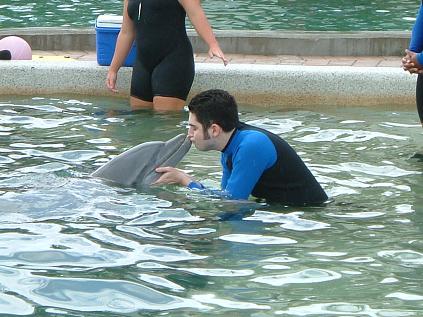
Man is very, very close to Dolphin

Dolphin DNA very close to Human DNA

I had real trouble in writing yesterday’s Post about the appalling slaughter of the dolphins in Japan. Perhaps there was something out there in the ether that recognised the pain that I was sharing with so many thousands of other dolphin lovers.

Because while I was writing the article, into my in-box came something from Save Japan Dolphins about how close dolphins are to mankind, in DNA terms.

The article opened thus:

Seema Kumar, of Discovery Channel Online, writes that scientists have discovered that the genetic make-up of dolphins is amazingly similar to humans. They’re closer to us than cows, horses, or pigs, despite the fact that they live in the water.

David Busbee of Texas A&M University is then quoted as saying:

Busbee says, “If we can show that humans are similar to dolphins, and anything that endangers dolphins is an equal concern for humans, it may be easier to persuade governments to keep oceans clean.

And make it easier for all honest and loving people to join the fight to stop that most dastardly murdering of dolphins in Taiji, Japan.

If you do nothing else, at least sign up to receiving the latest news from Save Japan Dolphins – which is how this Post was conceived.


Kissing not killing, please.


By Paul Handover