Tag: David Roberts

Happy lives!

Happiness.

I guess that it would be difficult to find a greater change in topic than going from America’s relationship with war to the secret of happiness!  But that’s what’s on offer today!

All as a result of reading a recent article on the Grist blogsite written by one of the Grist staff writers, David Roberts.

ooOOoo

The secret to a happy life: revealed!

By David Roberts
10 Sep 2014

I don’t want to brag, but while I was on sabbatical I discovered the secret to happiness.

The crazy thing is, it was lying right there in the open. It’s been revealed dozens, hundreds of times over the course of human history. It’s revealed every day in ordinary human affairs, if you’re paying attention.

What is it? Let’s ask George Vaillant.

Vaillant is a Harvard psychologist who has been working for over 40 years on the Grant Study, one of the longest-running longitudinal studies in scientific history. It began tracking a set of 268 (white, physically and mentally healthy) men when they were sophomores at Harvard in 1939 and has been tracking them ever since, for 75 years, with exhaustive regular physical and psychological tests. It has followed them as they’ve grown, gone to war, married, divorced, worked, been fired, gotten sick, found God, and so on. (The ups and downs of the study’s history are recounted in this classic Atlantic piece, one of my favorite magazine stories ever.)

Vaillant has spent most of his adult life analyzing the data from the study, attempting to determine which factors most reliably correlate with well-being. He’s probably studied happiness longer, and in greater depth, than any other single human being. So what is it, George Vaillant? What’s the secret to a happy life?

“That the only thing that really matters in life are your relationships to other people.”

Wow. That’s pretty straightforward. But can you boil it down just a little more?

“Happiness is love. Full stop.”

All right then! There you have it. The secret to happiness, revealed. It’s love.

If you want to break it down a little more, there’s plenty of social science research on it. We live longer, healthier, happier lives when we are at the center of overlapping social networks, when we have a devoted life partner, close family and friends (and pets), extensive “weak ties” with acquaintances and colleagues, peer and professional networks that value our skills, and a sense of autonomy balanced with a sense of involvement in something larger than ourselves. We are happiest when we have a place in the world, when we love and are loved, when we make the most of our gifts.

This is all obvious, of course, and has been said a million times. But that’s the point. People want there to be a what of happiness, a secret, an epiphany that once you learn it changes you forever. But the what of happiness is banal. It’s been confirmed by research. It’s in a kajillion self-help books. It’s cliché.

The what of happiness is not the hard part. The how is the hard part. As a million deathbed testimonials have taught us, when we look back on our lives, we won’t wish we’d worked harder, maintained Inbox Zero, finished those reports on deadline, gotten more promotions, owned a nicer car. We’ll wish we’d spent more time appreciating the ones we love and who love us, that we’d done more meaningful work, that we’d traveled more and had more memorable experiences.

We all know this. But it is no easy matter to translate that knowledge into action. Why? Vaillant is insightful about that, too, as The Atlantic explains:

Vaillant [says] positive emotions make us more vulnerable than negative ones. One reason is that they’re future-oriented. Fear and sadness have immediate payoffs—protecting us from attack or attracting resources at times of distress. Gratitude and joy, over time, will yield better health and deeper connections—but in the short term actually put us at risk. That’s because, while negative emotions tend to be insulating, positive emotions expose us to the common elements of rejection and heartbreak.

Gratitude and joy are emotions we can muster when we don’t feel threatened, when our lizard brain calms and our prefrontal cortex takes over. But it’s very difficult when our egos feel under siege. Relationships are more meaningful the more we open and extend ourselves (and are reciprocated), but our degree of openness is also our degree of vulnerability. Often we close off, deciding, consciously or not, that it’s not worth the risk of getting hurt; our lizard-brain fear overpowers us.

We cannot control this dynamic entirely. As the Atlantic piece explains, researchers believe that about 50 percent of our happiness is determined by our internal “set point,” which is shaped by genetics and early childhood and mostly fixed in place. About 10 percent is determined by circumstances. But that other 40 percent comes from how we react to circumstances, and over that we do have some control.

We can learn to detach from fear and anger, to let them go, to take deep breaths, return our focus to the present, and choose positive emotions. That, as I wrote yesterday, is what mindfulness is all about. It’s what the entire discipline of positive psychology (which counts Vaillant as a founding father) is about: strengthening the prefrontal cortex so that it’s more able to override instinctual fear and anger. The more inclement the circumstances we face, the more we need it. That’s why mindfulness training is catching on in low-income communities, the military, and elderly care.

So when people ask, as they have many times in the last week, “What did you learn over your break?” … the honest answer is, nothing. I already knew the what of happiness, just as you already know it. The break was about more consciously practicing the how, and on that score I’m afraid I have no grand epiphanies, only a few baby steps down a road I’ll be walking all my life.

ooOOoo

The original Grist article was headed with a picture of a group of happy dogs and it seemed almost an automatic response from me to close today’s post with a picture of happy dogs here in Oregon. But rather obvious, don’t you think!

Instead, I’m going to use a photograph of me being ‘loved’ by Ben so soon after he came to us in April; Ben being one of the two horses (Ben and Ranger) to come here that were rescued by Darla Clark, as explained here.

P1140593

Now going to offer my own reflection on happiness.

Animals that are comfortable being around us readily display unconditional affection to humans.  All that these dogs, cats, horses, and others, require is trust in us.  The knowledge that we are there to care for them, to comfort them, to cuddle them, to love them for the majority of the interactions between the person and the creature.  That doesn’t rule out chastisement, far from it, just that it comes from a heartfelt desire to care for the animal.

I now have a life surrounded by loving animals.  It has been that way since I started living with Jean back in 2008. Yes, I had had Pharaoh in my life since 2003.  Still have him; the precious animal. But the one-on-one bond that existed between Pharaoh and me hadn’t previously opened my heart in the way that all 14 dogs and 5 cats did that were living with Jean when I joined her.

The unconditional love shown by those animals in my life for the last six years has profoundly affected me.  We are now ‘down’ to 9 dogs and 4 cats plus we have the 4 horses (2 rescue quarter-horses and 2 miniature horses). Still there are very few moments in the whole of my day, either day or night, where I am not in the company of, or in contact with, an animal that offers me unconditional love.

Recall earlier in the David Roberts article: “We are happiest when we have a place in the world, when we love and are loved, when we make the most of our gifts.

Of course, I have ‘off’ days!

But down to my core, I know that being loved by Jean and all the animals and returning that love provides me with a deep happiness unimaginable prior to 2008.

It is better to have a heart that makes love than a mind that makes sense.” Robert Keck
This year of separation.

Ultimately, a message of hope.

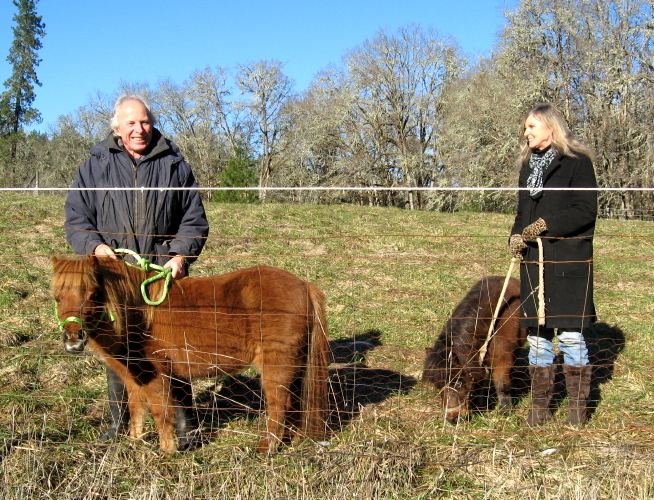
Today’s title came from a recent chat ‘across the garden fence’ with our neighbours, Dordie and Bill.  At their request we had walked our two horses over to the fence-line between our two properties so Dordie and Bill could meet and fondle them.  The warm afternoon sunshine was beautiful and while the horses munched the newly-found grass, we grown-ups talked about this and that and generally tried to put the world to rights!

Paul with Dancer; Jean with Grace.

We talked about the strangeness of present times.  Not just in the USA but across the world. Bill thought 2013 would be the year of separation.  I queried what he meant by that.

Bill replied, “I sense that by the end of the year, the vast majority of people will have decided if climate change is or is not a significant issue.”  There would be few who remained neither unconcerned nor undecided.

That resonated with me and neatly put the framework to today’s post.  Stay with me while I journey to the destination that this year will be the year of hope.

I am one of many who subscribe to the online magazine Grist.  They describe themselves, thus:

Laugh now — or the planet gets it.

You know how some people make lemonade out of lemons? At Grist, we’re making lemonade out of looming climate apocalypse.

It’s more fun than it sounds, trust us!

Grist has been dishing out environmental news and commentary with a wry twist since 1999 — which, to be frank, was way before most people cared about such things. Now that green is in every headline and on every store shelf (bamboo hair gel, anyone?), Grist is the one site you can count on to help you make sense of it all.

The weekly Grist digest that arrived in my in-box that same day as when we were chatting with Dordie and Bill included a number of key stories.

Here’s one that smacked me in the eye.

The 32 most alarming charts from the government’s climate change report

By Philip Bump

Just reading about the government’s massive new report outlining what climate change has in store for the U.S. is sobering. In brief: temperature spikes, drought, flooding, less snow, less permafrost. But if you really want to freak out, you should check out the graphs, charts, and maps.

Now I’m not going to republish all 32 charts but will include just these two, because the message is clear.

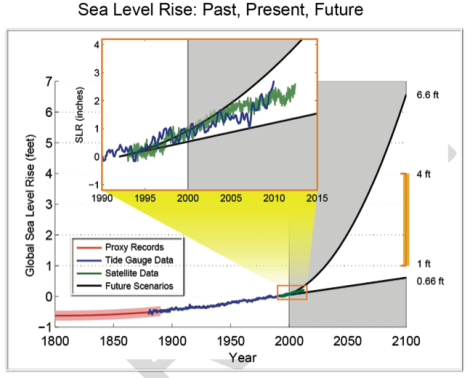
It’s possible that sea levels could only rise eight inches. It is also possible that they could rise over six-and-a-half feet.

sea-level-range

—-

7-sea-rises

Sea-level rise will affect different areas to different degrees — but note the map at lower right. On the Georgia coast, “hundred year” floods could happen annually.

OK, that first chart takes a while to absorb the full implications. The second one doesn’t!

The full range of charts is chilling.  While they refer to the USA, the messages apply to the whole world.

Then in that same Grist weekly summary was this story.

If you aren’t alarmed about climate, you aren’t paying attention

By David Roberts

There was recently another one of those (numbingly familiar) internet tizzies wherein someone trolls environmentalists for being “alarmist” and environmentalists get mad and the troll says “why are you being so defensive?” and everybody clicks, clicks, clicks.

I have no desire to dance that dismal do-si-do again. But it is worth noting that I find the notion of “alarmism” in regard to climate change almost surreal. I barely know what to make of it. So in the name of getting our bearings, let’s review a few things we know.

We know we’ve raised global average temperatures around 0.8 degrees C so far. We know that 2 degrees C is where most scientists predict catastrophic and irreversible impacts. And we know that we are currently on a trajectory that will push temperatures up 4 degrees or more by the end of the century.

David then works his way through those ‘things we know’ in a powerful manner.  Do read the full article, please!  This is his conclusion:

All this will add up to “large-scale displacement of populations and have adverse consequences for human security and economic and trade systems.” Given the uncertainties and long-tail risks involved, “there is no certainty that adaptation to a 4°C world is possible.” There’s a small but non-trivial chance of advanced civilization breaking down entirely.

Now ponder the fact that some scenarios show us going up to 6degrees by the end of the century, a level of devastation we have not studied and barely know how to conceive. Ponder the fact that somewhere along the line, though we don’t know exactly where, enough self-reinforcing feedback loops will be running to make climate change unstoppable and irreversible for centuries to come. That would mean handing our grandchildren and their grandchildren not only a burned, chaotic, denuded world, but a world that is inexorably more inhospitable with every passing decade.

Take all that in, sit with it for a while, and then tell me what it could mean to be an “alarmist” in this context. What level of alarm is adequate?

So am I stark staring mad for having hope in my mind?  Stay with me for just a little longer.  Then form your own judgment.

Recall the post that I published on Tuesday hitting out at the British newspaper The Daily Mail.  Towards the end of that post, in discussing the recently released American National Climate Assessment, I wrote this:

That’s why this report is to be encouraged, nay embraced.  Of all the nations in the world, the one that should be setting the lead is the United States of America.  As the banner on that globalchange.gov website proclaims: Thirteen Agencies, One Vision: Empower the Nation with Global Change Science

So go and read the report.  For your sake and all our sakes.

Because the more informed you and I are, the better the chances of real political leadership taking place in this fine nation.

Now with that in mind let’s go to the final Grist article.

A new grand strategy for the U.S., built around sustainability

By David Roberts

Let’s just accept it: America’s current political and economic systems are incapable of responding adequately to climate change. As things stand, reducing carbon emissions — or more broadly, shifting to sustainability — is a kind of add-on, a second-tier consideration, bolted onto systems and institutions that were built for other purposes.

A little later, David writes:

So what would a new U.S. grand strategy built around sustainability look like? That’s the question tackled by “A New U.S. Grand Strategy,” a piece in Foreign Policy by Patrick Doherty, director of the Smart Strategy Initiative at the New America Foundation.

It’s a hugely ambitious and wide-ranging piece, far too much to even summarize adequately here. Bookmark it. Instapaper it. Pinterest it to your iCloud, or whatever kids do these days. But let’s take a quick look.

Doherty identifies four central challenges facing the U.S.:

  • Economic inclusion: People are swarming out of poverty around the world (especially in China). Over the next 20 years, the global middle class will welcome around 3 billion new members. That’s going to put intense stress on natural, economic, and political systems that are already showing signs of strain.
  • Ecosystem depletion: Pretty sure Grist readers are familiar with this one.
  • Contained depression: Rather than a recession, the U.S. faces a “constrained depression,” with the full effects of low aggregate demand and high debt being masked by policy. No amount of fiscal or economic stimulus will revive a system that has exhausted itself.
  • Resilience deficit: Our industrial supply lines and value chains are efficient, but lack redundancy; they are brittle. Our infrastructure is old and crumbling, $2.2 trillion in the hole, and that’s just for the aging Cold War stuff, never mind building water, power, and transportation systems suited to an era of climate disruption.

“These four challenges,” Doherty says, “are the four horsemen of the coming decades.” And they are inter-dependent. They must be solved together. It’s a rough situation.

With these in mind, Doherty proposes a new grand strategic concept: “The United States must lead the global transition to sustainability.

What a vision for the United States of America.  That this Nation will be the most wonderful example of how man can learn, adapt and change.  David Roberts concludes:

Here are Doherty’s main suggestions for how to realign the U.S. economic engine:

  • Walkable communities: More and more Americans want to live in dense, walkable areas; get rid of regulations that hamper them and start building them.
  • Regenerative agriculture: Farmers can produce “up to three times the profits per acre and 30 percent higher yields during drought” with agricultural techniques that also clean water and restore soils. America must “adopt modern methods that will bring more land into cultivation, keep families on the land, and build regional food systems that keep more money circulating in local economies.”
  • Resource productivity: “Energy and resource intensity per person will have to drop dramatically.” That imperative can drive “innovation in material sciences, engineering, advanced manufacturing, and energy production, distribution, and consumption.”
  • Excess liquidity: Channel all the corporate cash that’s sitting around in funds into long-term investments in America by taxing waste and creating regional growth strategies.
  • Stranded hydrocarbon assets: Figure out how to devalue the immense amount of carbon that’s still sitting underneath the ground without unduly traumatizing the economy.

Obviously the devil is in the details on this stuff, but at a broad level, this is about as eloquent and forward-thinking as it gets. I love the idea of using sustainability in a muscular way, to revive regional economies and nurture the middle class. I recommend reading the whole thing.

I, too, recommend reading “A New U.S. Grand Strategy – Why walkable communities, sustainable economics, and multilateral diplomacy are the future of American power.” (NB: You will have to register with Foreign Policy before access to the report is possible, but it’s free.)

So, the wall-to-wall stream of information that is shouting out how quickly the planet is changing is the fuel that is going to feed the fires of hope.

Let me leave you with the most beautiful words of an ancient philosopher – Aristotle.

Hope is a waking dream.

Avoiding the catastrophe of indifference.

Doing nothing is not an option.

Introduction

So back to non-doggy stuff although I hope the themes of truth and integrity continue to rein supreme though this blog!

In the last couple of weeks, I have devoted a number of posts to the subject of change, as in how do we humans change.  The first post was Changing the person: Me where I started examining the process of change; by process I mean the models of change commonly understood in, say, management change.

The next post was You have to feel it! which drew heavily on research from Ezra M. Markowitz & Azim F. Shariff regarding the psychological aspects posed by climate change to the human moral judgement system.

The final post was From feeling to doing.  In this post, David Roberts of Grist showed that one could put aside all the ‘head stuff’ about change and in just 15 minutes cover all that one would ever want to know about the biggest issue of all facing this planet.

So rather a long introduction to two guest posts that today and tomorrow set out the case for what we all have to consider; doing nothing is just not a viable option.  The first is from Martin Lack of the popular and hard-hitting blog Lack of Environment.

oooOOOooo

Avoiding the catastrophe of indifference.

by Martin Lack.

Paul has very kindly invited me to follow-up his recent post regarding David Roberts’ item on the Grist blog entitled ‘Why climate change doesn’t spark moral outrage, and how it could’ followed by a second post in which was embedded David Roberts’ excellent video ‘Climate change is simple – we do something or we’re screwed’.

So my guest post is an expansion of a comment I submitted in response to the first of those two posts, You have to feel it.  However it would be wrong not to first add my voice to all those that have applauded David Roberts for all his excellent work.

Clive Charles Hamilton

In 2010, the Australian social anthropologist Clive Hamilton published Requiem for a Species: Why we Resist the Truth About Climate Change – one of the scariest but most important books I think I have ever read.

Reading Hamilton’s book was one of the reasons I decided, as part of my MA in Environmental Politics, to base my dissertation on climate change scepticism in the UK.

In the process, I read much but Hamilton’s book was one of very few that I actually read from cover to cover – I simply did not have time to read fully all the books for my research. However, because I have a background in geology and hydrogeology, my greatest challenge was learning to think like a social scientist.

I was all for taking these climate change sceptics head on and demolishing their pseudo-scientific arguments or taking them to task for the ideological prejudices that drive them to reject what scientists tell us. Thus, it fell to my dissertation supervisor to mention politely but firmly that I needed to disengage with the issues and analyse patterns of behaviour and frequency of arguments favoured by different groups of people.  In short, I needed to stop trying to prove the scientific consensus correct and start understanding the views held by those that dispute that consensus.

Having said how I read Professor Hamilton’s book in full, I must admit to learning about a load of other equally-scary sounding books since subscribing to Learning from Dogs;  Lester Brown’s World on the Edge: How to Prevent Environmental and Economic Collapse being just one that comes to mind!

David Roberts

Then of course there is what David Roberts himself says, which is just as scary. I think we have good reason to be scared. However, as Hamilton points out, we must move beyond being scared, which is simply debilitating, and channel our frustration into positive action.

Because if we do not, there is a great deal of circumstantial evidence to suggest that civilisation may well fail. If that means engaging in acts of civil disobedience, as it has done for James Hansen and many others, well, so be it. I suspect that nothing worthwhile has ever been achieved without someone breaking the law in order to draw attention to injustice – the abolition of slavery and child labour, the extension for all of the right to vote including women, come to mind.

That is the conclusion of Hamilton’s book; that civil disobedience is almost inevitable (p.225). Just as turkeys won’t vote for Christmas, our politicians are not going to vote for climate change mitigation unless we demand that they do so.

So it was the steer from my dissertation supervisor that lead me to read David Aaronovitch’s Voodoo Histories: How Conspiracy Theory Has Shaped Modern History, and much more about psychology. All of which guided the Introductory section of my dissertation, which summarised the philosophical roots of scepticism, the political misuse of scepticism, and the psychology of denial; see a recent post on my blog Lack of Environment.   In terms of what I want to say here, it is an elaboration of the last of those topics, the psychology of denial.  Indeed, it formed the preamble to the findings of my research.

To help me research this unfamiliar subject, my dissertation supervisor sent me a PDF copy of a paper written by Janis L. Dickinson in 2009 and published in Ecology and Society.  It was called ‘The People Paradox: Self-Esteem Striving, Immortality Ideologies, and Human Response to Climate Change’ and dealt with a challenging, almost taboo subject, namely our own mortality.

Despite my initial reluctance to learn about psychology, the more I read the more I realised just how central psychology was to explaining why we humans have failed to address the problem of climate change.

I ended up summarising the work of Dickinson, together with other sources of material, in the following manner.

In considering reasons for the collective human failure to act to prevent anthropogenic global warming (AGW), a number of authors appear to have been influenced by Ernest Becker’s The Denial of Death (1973). For example, Aaronovitch proposed that we try to avoid the “catastrophe of indifference” that a world devoid of meaning or purpose represents (p. 340).  Hamilton suggested that climate disruption “has the smell of death about it” (p. 215).

Janis Dickinson elaborates a little more, exploring what she describes as “…one of the key psychological links between the reality of global climate change and the difficulty of mobilizing individuals and groups to confront the problem in a rational and timely manner”, then referring to what psychologists call terror management theory (TMT) – Dickinson also categorises denial of climate change; denial of human responsibility and immediacy of the problem as proximal responses (Dickinson 2009).

Furthermore, as referenced here, both Dickinson and Hamilton suggest that other distal TMT responses, such as focussing on maintaining self-esteem or enhancing self-gratification, can be counter-intuitive and counter-productive. Dickinson summarises the recent work of Tim Dyson by saying “[b]ehavioral response to the threat of global climate change simply does not match its unique potential for cumulative, adverse, and potentially chaotic outcomes” (ibid).

Based on the evidence of the most frequently used arguments for dismissing the scientific consensus regarding climate change, I collated the findings of my research and which might be summarised as follows:

Having analysed the output of such UK-based Conservative think-tanks (CTTs), along with that of scientists, economists, journalists, politicians and others, it would appear that the majority of CTTs dispute the existence of a legitimate consensus, whereas the majority of sceptical journalists focus on conspiracy theories; the majority of scientists and economists equate environmentalism with a new religion; and politicians and others analysed appear equally likely to cite denialist or economic arguments for inaction.

As I find myself saying quite frequently, the most persistent arguments against taking action to mitigate climate change are the economic ones.

However, as all the authors mentioned have suggested, or at least inferred, I think it is undoubtedly true that the most potent obstacle to people facing up to the truth of climate change is our psychological reluctance to accept responsibility for something that is obviously deteriorating – namely our environment!

Nevertheless, all is not yet lost.  We do not all need to go back to living in the Dark Ages to prevent societal and environmental collapse but we do need to accept a couple of fundamental realities:

  1. Burning fossilised carbon is trashing the planet. Therefore, fossil fuel use must be substituted in every possible process as rapidly as possible. Unfortunately, it is not substitutable in the most damaging process of all; aviation.  That merely increases the urgency of substituting where we can (i.e. power, lighting and temperature control).
  2. Poor people in developing countries have a legitimate right to aspire to having a more comfortable life but the planet definitely cannot cope with 7 to 10 billion people living like we do in the “developed” countries.

Once we accept these realities, we will learn to use less fossil fuels and, if we can become self-sufficient using renewable energy sources, we can have a flat-screen TV in every room and leave them on standby and the A/C on full power 24/7 and still have a clear conscience. However, we must get off fossil fuels ASAP.

oooOOOooo

I am indebted to Martin for writing such an insightful analysis of how we all have to change.  Tomorrow, another guest post further exploring the options that face us all as we work towards a sustainable future.  As I opened this post, doing nothing is not an option!

From feeling to doing!

Each of us must understand there is no choice – we have to change. So let’s do it!

This timely video from The Evergreen State College conference, another contribution from David Roberts, was brought to my attention by a recent post on Christine’s excellent blog, 350 or bust.

It so perfectly carries on from yesterday’s Learning from Dogs post, You have to feel it.

So please, promise yourself to watch this video now!  It’s just 15 minutes of very plain speaking by David.  Watch it not just for yourself but for the children and the children’s children across this beautiful world.

David Roberts is staff writer at Grist.org. In “Climate Change is Simple” he describes the causes and effects of climate change in blunt, plain terms.

On April 16, 2012, speakers and attendees gathered at TEDxTheEvergreenStateCollege: Hello Climate Change to reflect on the ability — and responsibility — of formal and informal education to inspire and empower action in this era of climate change.

Watch, be inspired and be empowered as a person that is taking personal responsibility for doing!

As dear old Albert said, (as in Albert Einstein) “You cannot solve a problem from the same consciousness that created it. You must learn to see the world anew.”

You have to feel it!

Fascinating insight into our complex relationship with complex ideas!

There’s a powerful saying in the world of writing: If you can’t feel it you can’t write it!

But our feelings are so, so much a part of what it is to be human.  That’s why I spent some time exploring how our resistance to change is so wrapped up in the emotions that change brings about in an article back on the 2nd August: Changing the person: Me.

So a post on the grist online magazine not so long ago really caught my eye.  It was called Why climate change doesn’t spark moral outrage, and how it could, and was written by David Roberts.  I would dearly love to have sought David’s permission to republish it in full; it’s so relevant to understanding how we humans have to approach turning back from our present course of making the Earth’s biosphere uninhabitable for we humans.

But in a couple of days time, I have a Post coming out that is republished with David’s written permission called Cutting CO2 emissions – who leads the world! It felt greedy to ask David for another full republication.  So I’m going to dip into this one, hopefully to the point where you will go across to grist and read it for yourself.

David opens up as follows:

Perhaps the single biggest barrier to action on climate change is the fact that it doesn’t hit us in the gut. We can identify it as a great moral wrong, through a chain of evidence and reasoning, but we do not instinctively feel it as one. It does not trigger our primal moral intuitions or generate spontaneous outrage, anger, and passion. It’s got no emotional heat. (Ironic!)

David’s article then goes on to refer to a recent paper published on the Nature.com website called Climate change and moral judgement by Ezra M. Markowitz & Azim F. Shariff.  The abstract sets out that:

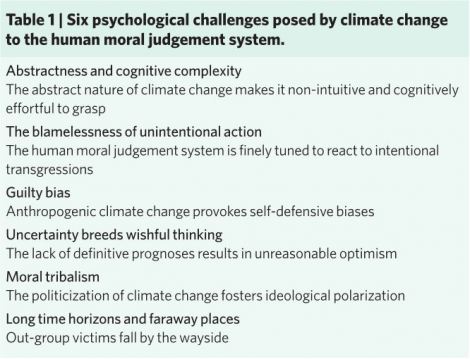
Converging evidence from the behavioural and brain sciences suggests that the human moral judgement system is not well equipped to identify climate change — a complex, large-scale and unintentionally caused phenomenon — as an important moral imperative. As climate change fails to generate strong moral intuitions, it does not motivate an urgent need for action in the way that other moral imperatives do. We review six reasons why climate change poses significant challenges to our moral judgement system and describe six strategies that communicators might use to confront these challenges. Enhancing moral intuitions about climate change may motivate greater support for ameliorative actions and policies.

M’mmm – not sure how that leaves me.  (Which is my way of saying that I don’t really understand that!)  Luckily David goes on to say that the authors “go on to identify six reasons why, “unlike financial fraud or terrorist attacks, climate change does not register, emotionally, as a wrong that demands to be righted.” and refers to an interesting table in the research paper.

Now go to the article on grist to better understand how those challenges are explained.

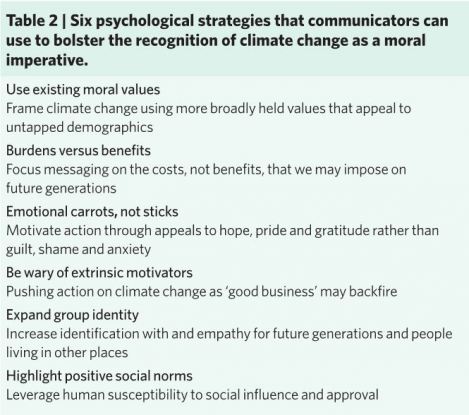
Then later on in the research paper, there is a second table, as below:

Again, these strategies are expanded upon in David’s article.  What I will do is to copy his final few paragraphs:

6. Highlight positive social norms: This is, to me, the Big Kahuna. As I was reading about all the psychological barriers to climate action, I kept thinking, “one thing can overcome all these: peer pressure!” If people see others that they view as peers or leaders doing something, they will tend to do it too, and retrofit reasons for it after the fact. This is the essence of humans as social creatures.

The recommendation is twofold, though: not just to “highlight pro-environmental, prosocial injunctive norms such as prohibitions against being wasteful,” but also to “be careful not to inadvertently highlight negative, but existent, descriptive norms, which can actually encourage individuals to follow suit in the wrong direction.”

In other words, you want to emphasize that climate hawkery is good, socially desirable, admirable, and that all the cool kids are doing it. You don’t want to give people the impression that “everyone’s doing it” if it is bad. Even if you state clearly that it’s bad, the fact that others are doing it is, in and of itself, a powerful incentive to do it too. It’s the herd instinct. This is good reason not to whine on and on about how everyone drives too much or everyone wastes electricity. The subtext is, “it’s the social norm.”

—-

Aaaanyway, this is a lot of food for thought. But it’s the kind of stuff — not about science but about people — that far too many climate hawks ignore or disregard. Climate change is not only the economic and ecological crisis of our time, it’s also a moral crisis. What we are doing to our descendants is a moral crime. Finding ways to help people get that, feel it in their guts the way they would if someone threatened their own families, is a precondition for serious, sustained action.

Let me repeat David’s closing words, “Climate change is not only the economic and ecological crisis of our time, it’s also a moral crisis. What we are doing to our descendants is a moral crime.

OK, so how strongly do you feel that?  Great, so you do feel it – even feel it deep inside you.

Now that you do, let’s all get stuck into making a difference.  It is all about doing.  As someone of huge stature, and a wonderful person of action no less, said;

I have been impressed with the urgency of doing. Knowing is not enough; we must apply. Being willing is not enough, we must do. Leonardo da Vinci (1452-1519)

We must do!  Start your own ‘doing’, don’t wait upon others, actively look for ideas (there are a few here) and together we can make a positive difference.

Well done, David – great article.

It’s really quite simple.

David Roberts of Grist offers a very clear message.

But before going to the piece, just let me say why there’s been a preponderance of climate change articles on Learning from Dogs.  Two reasons come to mind.  The first one is that this blog’s primary theme is integrity.  The idea of writing about what we can learn from the closest species to man, the domesticated dog, came out of the understanding that dogs are integrous creatures.  As I concluded in the Purpose of this blog,

Or, possibly, it’s more accurate to say that our civilisation is under threat and the time left to change our ways, to embrace those qualities of integrity, truth and consciousness for the very planet we all live on, is running out.

So what has this to do with dogs? Simply that man’s best friend, a relationship that goes back tens of thousands of years, is still a wonderful example of the many qualities that we need now for the very survival of the human species.

The second reason is that as many will be aware it is the G20 gathering this week and the more that millions around the world add their demand for common-sense and reason the better that will be.  Again, honesty and integrity, values not usually associated with the world’s political leaders, must come to the fore.

So now to the recent piece from Grist.

Climate change is simple: We do something or we’re screwed

By David Roberts

Back in April, The Evergreen State College invited me to speak at a TEDx event called “Hello Climate Change: Rethinking the Unthinkable.” Videos from the event are now online.

My talk was called “Climate change is simple.” I’m proud to say that I used only 17 of my allotted 15 minutes.

I’ve put an annotated version of my slideshow beneath the video, linking to sources and adding thoughts. The only thing I’ll say about the video itself is that I’ve always thought these things would be better with a soundtrack. If anybody out there on the web wants to make a mashup with it, add some good beats, be my guest.

This is the video of David’s talk.

And in case you think this is all green paranoia, then spend a couple of minutes watching this,

A group of scientists from around the world who are part of The Berkeley Initiative in Global Change Biology (BiGCB) is warning that an ever-growing population and widespread destruction of natural ecosystems may be driving Earth toward a planet-wide tipping point, an irreversible change in the biosphere with unpredictable consequences. Anthony Barnosky, professor of integrative biology at the University of California, Berkeley, is the lead author of a review paper about this issue in the journal Nature.
For full story: NewsCenter.berkeley.edu
Video by Roxanne Makasdjian, UC Berkeley Media Relations

NB. I found the sound levels on these videos to be rather low – hope you can hear them clearly.