Note:We have a flooring contractor in the house all week and it’s making it a little tricky to spend the couple of hours a day that is my usual pattern for writing posts for LfD. So apologies if this week’s posts are more dependent on the thoughts of others than is usual.
Alain de Botton
Alain de Botton is a familiar face on British television. WikiPedia’s entry describes him, thus:
Alain de Botton, FRSL (born 20 December 1969) is a Swiss/British writer, philosopher, television presenter and entrepreneur, resident in the United Kingdom. His books and television programmes discuss various contemporary subjects and themes, emphasizing philosophy’s relevance to everyday life.
He has been the presenter of a BBC Six-part series called Philosophy: A Guide To Happiness. And who wouldn’t be turned on by that!
Luckily, all six episodes are available on YouTube, at this overall link.
But I wanted to share the first episode because despite the title being Socrates on Self-Confidence it really speaks to our lives in this year of 2013.
Moving on.
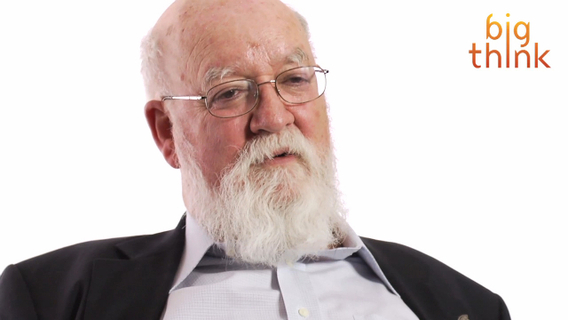
A recent item on Big Think, again about philosophy, jumped off the page at me. It specifically looked at making our life, as in mental health, easier in these demanding times. It was by Daniel Dennett and was called The Philosopher’s Self-Help Book.
Daniel Dennett
oooo
The Philosopher’s Self-Help Book (with Daniel Dennett)
While Silicon Valley and Silicon Alley busy themselves making every aspect of our lives more efficient (except, perhaps, for the process of discovering these new technologies, learning them, and integrating them into our lives), Daniel Dennett sits up at Tufts University in Massachusetts, philosophizing. His latest book, Intuition Pumps and Other Tools for Thinking is an attempt to make transparent some of the tricks of the philosopher’s trade. In an accelerating age, it’s a self-help book designed to slow the reader down and improve our ability to think things through.
The kinds of things Mr. Dennett likes to think about include the nature of consciousness, evolution, and religious belief. But the mind-training his new book offers is applicable to any problem you want to consider thoroughly. In an age of quick fixes and corner-cutting, we’re in constant danger of bad decision making – of overreliance on what cognitive psychologist Daniel Kahneman calls “system 1”, and what most of us call intuition. This rapid decision making channel of the brain is helpful when we are in mortal danger, or pressed for a quick decision within our areas of expertise. But for most decisions, the slower, more deliberate channel (system 2) is much more reliable. What Dennett offers, then, in Intuition Pumps, is a workout for system 2 – a series of thought experiments you can apply to puzzles real and imagined to bulk up the slower, wiser parts of your consciousness.
Some of the tools Dennett offers in the book are more familiar than others. Reductio ad absurdum arguments, for example, in which we test the validity of a claim by taking it to its most outrageous illogical extreme (a: “all living things have a right to liberty.” b: “so let me get this straight – a blade of grass has a right to liberty? What does that even mean?”). But the true delights of the book are the far-out exercises Dennett and his colleagues have dreamed up in the course of their work, such as “Swampman Meets A Cow-Shark”, from Donald Davidson, which begins:
Suppose lightning strikes a dead tree in a swamp; I am standing nearby. My body is reduced to its elements, while entirely by coincidence (and out of different molecules) the tree is turned into my physical replica. My replica, The Swampman, moves exactly as I did; according to its nature it departs the swamp, encounters and seems to recognize my friends, and appears to return their greetings in English.
Walking us through Davidson’s considerations about whether and to what extent the Swampman is anything like Davidson, and related ones about a cow that gives birth to something that looks exactly like a shark (yet has cow DNA in all of its cells), Dennett teaches us a surprising lesson about the utility of wild philosophical speculation.
Cloaked in the breezy, familiar trappings of a self-help book, Intuition Pumps is in actuality a dark mirror of that genre – a field of rabbit holes designed to leave the reader with more questions than answers, and wiser for the long and indirect journey.
Watch for Daniel Dennett’s Tools For Better Thinking – a Big Think Mentor workshop coming soon.
oooOOOooo
I’m tempted to put the book on my own reading list. If you want to drop into the appropriate Amazon page there is an audio link plus the option to read an extract. Amazon describe the book, as follows:
One of the world’s leading philosophers offers aspiring thinkers his personal trove of mind-stretching thought experiments.
Over a storied career, Daniel C. Dennett has engaged questions about science and the workings of the mind. His answers have combined rigorous argument with strong empirical grounding. And a lot of fun.
Intuition Pumps and Other Tools for Thinking offers seventy-seven of Dennett’s most successful “imagination-extenders and focus-holders” meant to guide you through some of life’s most treacherous subject matter: evolution, meaning, mind, and free will. With patience and wit, Dennett deftly deploys his thinking tools to gain traction on these thorny issues while offering readers insight into how and why each tool was built.
Alongside well-known favorites like Occam’s Razor and reductio ad absurdum lie thrilling descriptions of Dennett’s own creations: Trapped in the Robot Control Room, Beware of the Prime Mammal, and The Wandering Two-Bitser. Ranging across disciplines as diverse as psychology, biology, computer science, and physics, Dennett’s tools embrace in equal measure light-heartedness and accessibility as they welcome uninitiated and seasoned readers alike. As always, his goal remains to teach you how to “think reliably and even gracefully about really hard questions.”
A sweeping work of intellectual seriousness that’s also studded with impish delights, Intuition Pumps offers intrepid thinkers—in all walks of life—delicious opportunities to explore their pet ideas with new powers.
Speaking of ‘pet ideas with new powers’ prompts one to reflect on the amount of time that dogs spend thinking! As the following picture confirms!
Philosopher Daniel Dennett offers a kind of self-help book for deep thinkers.
Those of you that are regular followers of Learning from Dogs know that I tend to offer posts for the week-end that are light-hearted. Certainly that’s easier for me, if you pardon me from saying, and hopefully a change for you, dear reader.
Well today’s offering is not exactly heavy but it is, nonetheless, not a typical Saturday topic.
However, trust you find it engaging.
Of the many blogs and websites that I follow, I enjoy the regular mental stimulation that flows from the blog Big Think. Recently there was a piece from Daniel Dennett that tickled my interest and I wanted to share it here.
While Silicon Valley and Silicon Alley busy themselves making every aspect of our lives more efficient (except, perhaps, for the process of discovering these new technologies, learning them, and integrating them into our lives), Daniel Dennett sits up at Tufts University in Massachusetts, philosophizing. His latest book, Intuition Pumps and Other Tools for Thinking is an attempt to make transparent some of the tricks of the philosopher’s trade. In an accelerating age, it’s a self-help book designed to slow the reader down and improve our ability to think things through.
The kinds of things Mr. Dennett likes to think about include the nature of consciousness, evolution, and religious belief. But the mind-training his new book offers is applicable to any problem you want to consider thoroughly. In an age of quick fixes and corner-cutting, we’re in constant danger of bad decision making – of overreliance on what cognitive psychologist Daniel Kahneman calls “system 1”, and what most of us call intuition. This rapid decision making channel of the brain is helpful when we are in mortal danger, or pressed for a quick decision within our areas of expertise. But for most decisions, the slower, more deliberate channel (system 2) is much more reliable. What Dennett offers, then, in Intuition Pumps, is a workout for system 2 – a series of thought experiments you can apply to puzzles real and imagined to bulk up the slower, wiser parts of your consciousness.
Some of the tools Dennett offers in the book are more familiar than others. Reductio ad absurdum arguments, for example, in which we test the validity of a claim by taking it to its most outrageous illogical extreme (a: “all living things have a right to liberty.” b: “so let me get this straight – a blade of grass has a right to liberty? What does that even mean?”). But the true delights of the book are the far-out exercises Dennett and his colleagues have dreamed up in the course of their work, such as “Swampman Meets A Cow-Shark”, from Donald Davidson, which begins:
Suppose lightning strikes a dead tree in a swamp; I am standing nearby. My body is reduced to its elements, while entirely by coincidence (and out of different molecules) the tree is turned into my physical replica. My replica, The Swampman, moves exactly as I did; according to its nature it departs the swamp, encounters and seems to recognize my friends, and appears to return their greetings in English.
Walking us through Davidson’s considerations about whether and to what extent the Swampman is anything like Davidson, and related ones about a cow that gives birth to something that looks exactly like a shark (yet has cow DNA in all of its cells), Dennett teaches us a surprising lesson about the utility of wild philosophical speculation.
Cloaked in the breezy, familiar trappings of a self-help book, Intuition Pumps is in actuality a dark mirror of that genre – a field of rabbit holes designed to leave the reader with more questions than answers, and wiser for the long and indirect journey.
Watch for Daniel Dennett’s Tools For Better Thinking – a Big Think Mentor workshop coming soon.
oooOOOooo
Don’t know about you but Daniel Dennett’s book looks like one that deserves reading. If you feel the same way the book is called Intuition Pumps And Other Tools for Thinking and here’s the link to Amazon.
I am indebted to James Kwak, the author of this article on Baseline Scenario, for giving me permission to reproduce in full what was published on the 12th March, 2011.
By James Kwak
A friend passed on this article in The Motley Fool by Morgan Housel. It begins this way:
“Enough.
“That’s the title of Vanguard founder John Bogle’s fantastic book about measuring what counts in life.
“The title, as Bogle explains, comes from a conversation between Kurt Vonnegut and novelist Joseph Heller, who are enjoying a party hosted by a billionaire hedge fund manager. Vonnegut points out that their wealthy host had made more money in one day than Heller ever made from his novelCatch-22. Heller responds: ‘Yes, but I have something he will never have: enough.’”
The rest of the article discusses the cases of Rajat Gupta and Bernie Madoff, the former accused (but not criminally) and the latter convicted of illegal activity done after they had already been enormously successful, professionally and financially.
Housel asks, why do people push on — legally or illegally — when they have more of everything than anyone could possibly need? He summarizes the happiness research as follows:
“Money isn’t the key to happiness. What really gives people meaning and happiness is a combination of four things: Control over what they’re doing, progress in what they’re pursuing, being connected with others, and being part of something they enjoy that’s bigger than themselves.”
Of course, even if that’s true (and I think it is, except for the first sentence, on which more below), that doesn’t mean that people realize it. And if people don’t understand the relationship between their actions and their personal outcomes, we have no reason to believe that they will behave in a utility-maximizing way.
That said, renowned economist Justin Wolfers was recently on Planet Money saying that money does, indeed, buy happiness. He was discussing a paper he did with Betsey Stevenson looking at datasets covering many countries over many years. They find a positive relationship between income and subjective well-being, whether in the form of life satisfaction or happiness (although the relationship appears somewhat weaker for happiness).* In particular, they find that there is no satiation point, at least when making cross-country comparison (that is, the positive relationship persists even when you look only at countries that are at least moderately wealth).
At one point in the Planet Money interview, I believe Wolfers did say that when it comes to happiness, someone (Kahneman, I think) had estimated that there is a satiation point at around $75,000 per year. But, he went on, the issue is that we may want subjective states other than simple happiness. So, for example, we may want the subjective feeling of power, whether or not it actually makes us happy in the moment. And those other subjective states may not have satiation points, or they may have little to do with income.
But ultimately I agree with Heller. It is a great thing to have “enough,” and to know you have enough. And that is a feeling that for some people, apparently, no amount of money can buy.
* The difference, put simply, is between whether you feel happy at this moment and whether you feel satisfied with your life as a whole. For more, see this fantastic TED Talk by Daniel Kahneman (which I have recommended before).


 Learning from Dogs