As in how a primate chooses to communicate with humans.
In recent times there have been a couple of posts in this place about the science of communication between dogs and humans.
What about other animals?
What about a gorilla?
If you drop across to the YouTube site and search for Koko the Talking Gorilla you will be astounded by how many videos are to be seen.
Try this one:
A very moving account from Robin Williams.
If we then want more background information on this remarkable animal, Wikipedia is there to oblige (in part):
Hanabiko “Koko” (born July 4, 1971) is a female western lowland gorilla who is known for having learned a large number of hand signs from a modified version of American Sign Language (ASL).
Her instructor and caregiver, animal psychologist Francine “Penny” Patterson, reports that Koko is able to understand more than 1,000 signs of what Patterson calls “Gorilla Sign Language” (GSL).[2] In contrast to other experiments attempting to teach sign language to non-human primates, Patterson simultaneously exposed Koko to spoken English from an early age. Reports state that Koko understands approximately 2,000 words of spoken English, in addition to the signs.[3] Koko’s life and learning process has been described by Patterson and some of her collaborators in a number of books, peer reviewed articles, and on a website.
Koko got her birthday wish this July 4th — not only did one kitten come to visit, but a whole litter. Koko fell in love with one, and the other fell in love with her. Koko has adopted these two kittens into her family, and it has energized her world.
Not only have Koko’s maternal and play instincts kicked in, but she is signing more to her caregivers and generating new content everyday that can be used by The Gorilla Foundation to create empathy for great apes. This can have significant benefits to both endangered free-living great apes and those in captive environments, by encouraging the development of 2-way communication with their caregivers (which Koko has had since she was a baby).
The Gorilla Foundation is now working on a multimedia sequel to the classic book, “Koko’s Kitten,” which has already reached millions of children worldwide, and has the power to motivate millions more to learn how to make the world a better place for all of its conscious inhabitants.
You can support The Gorilla Foundation mission of Conservation through Communication by visiting http://www.koko.org
Thank you!
Will close with this photograph seen ‘on the web’.
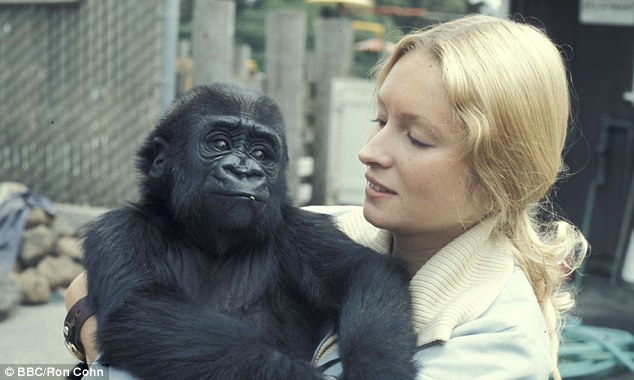
Graduate student Penny Paterson with a young Koko on her back not long after they met in 1971 in San Francisco. (The Daily Mail newspaper 2nd June, 2016.)
We can never turn aside from cruelty, in all its forms.
The rather rosy mood engendered by my post about the relationship between a Brazilian fisherman and a penguin published on the 31st May and the saving of a dog from a culvert by a serving police officer in Rhode Island was bound not to last. But I didn’t anticipate that it would turn so bleak by the following petition that was highlighted to me and everyone by a recent comment to a post by John Zande.
TARGET: Cidade de Presidente Figueiredo Mayor Neilson da Cruz, Brazil
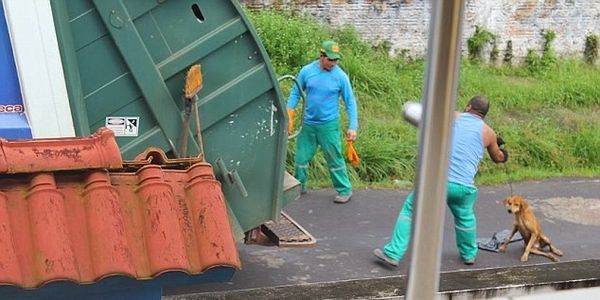
A garbage man can be seen in pictures, attached, as he deliberately went on to the sidewalk to hit a dog and then stopped the truck to put a chain around his neck and drag and throw him into the truck’s compactor to be crushed to death.
Although the article claims that the man was fired, we hereby implore the Mayor Neilson da Cruz to prosecute Jadson James Franca to the fullest extent of the law with jail time and fines. We also want the garbage company ViaLimpa to fire the 2 co-workers in the photos laughing and allowing this madman to crush the dog.
Mr. Mayor: If you do not prosecute this man with jail time, you are sending a message to the youth of Brazil that this is acceptable conduct to innocent animals that have done nothing wrong other than to walk on the sidewalk. This Jadson James Franca is clearly a sociopath who enjoys the torture and murder of animals. He is a danger to the people of Brazil, while he is still walking free. It is a known fact that sociopaths begin to torture and murder animals and then move on to people. ALL serial killers started out with torturing and murdering animals and Jadson Franca is no different. What will you do if he kills his wife, child, neighbor or an innocent person on the street and you could have done something to stop it by prosecuting him now?
I ask all to sign this petition to stop this murdering rampage that is happening on the streets of Brazil and send a message that this blatant murder of an innocent dog will not be tolerated by the citizens of the world.
ooOOoo
I can do no better in terms of my own feelings than to highlight what June wrote, “This Jadson James Franca is clearly a sociopath who enjoys the torture and murder of animals. He is a danger to the people of Brazil, while he is still walking free.”
Well over 30,000 people signed that petition including John and myself. In doing further research, however, it became clear that this group anger and disgust worked, assuming the British Daily Mail newspaper is reporting the story accurately.
For in their online edition of May 31st, their online reporter, Matt Roper published this:
A binman has been sacked after he was caught dragging an injured dog across a road before throwing the terrified animal in the back of his rubbish truck to be crushed alive.
Jadson James Franca, 35, mounted the pavement of the street in Presidente Figueiredo, northern Brazil and hit the stray dog, according to shocked residents.
The council binman then stopped the garbage truck and tied a chain around the neck of the whimpering animal, which had had both of its legs broken.
As his colleagues looked on, Franca then dragged the frightened dog along the pavement before tossing it into the compacting mechanism of the collection vehicle.
Later on in that same article Matt Roper reported:
Brazilian TV presenter Xuxa, who once dated football legend Pele, also posted the shocking photos to her 4.4million Facebook followers.
She wrote: ‘This little dog, who wasn’t bothering anyone, had its legs broken, and in agony was tied up and dragged by the neck, before being brutally murdered by this individual, being thrown and crushed alive in the back of the garbage truck.’
This monster can still appeal against a fine and will still be walking the streets in freedom! Are we going to let that happen?? Let’s do something?? Together we can.’
Yesterday Presidente Figueiredo’s mayor, Neilson da Cruz, told Brazil’s A Critica newspaper that the binman had been sacked and the refuse collection company, ViaLimpa, would face an unspecified fine.
That Daily Mail article also has more photographs but without permission to republish them here all I can do is give you the links included in my ‘copy and paste’ of those two extracts above.
I’m voting with my feet and cancelling my Facebook account; here’s why.
Like tens of thousands of other people, I use social media: Facebook, Linked-In and Twitter. In my own case primarily for promoting my blog writings.
It was another blogger who drew my attention to something so terrible, so despicable, that it pains me to even think about it, let alone write about it.
For six months I have been experimenting with a Facebook account in order to stay in contact with the creative industry in my town of Colchester. This experiment came to an end today when I closed my Facebook account due to Facebook allowing content associated with the torture of animals.
The word torture, highlighted by me, included a link to an article in the UK Daily Mail newspaper. The link to that Daily Mail article is here. BUT PLEASE do not click on that link if you are not prepared to be hurt, shocked and made to feel VERY ANGRY! To reinforce my warning, the headline of that article reads thus:
Facebook refuses to remove video of kitten being doused in petrol and set on fire ‘because it doesn’t breach any rules’
I can’t even bring myself to include the two photographs of the poor, tortured kitten who was killed by the bastards concerned. However, I will reproduce one image carried by the Daily Mail:
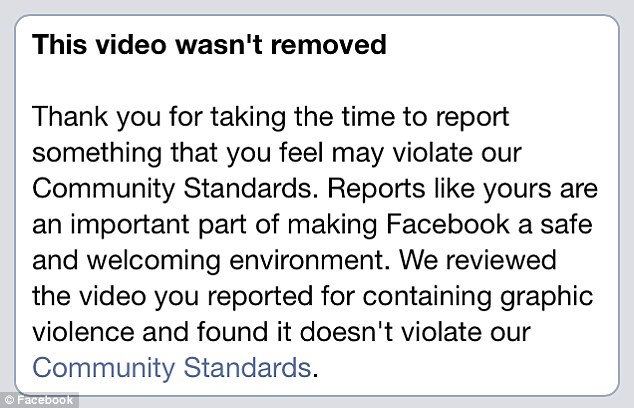
Response: After reporting the video, which was not thought to have uploaded by either of the men in the video, and carries a warning message, Mr Dunwel was told the video would not be removed.
But frankly any standards that regard the burning to death of a kitten as not being ‘graphic violence’ are incorrect standards.
So this coming Friday, I shall be cancelling my Facebook account. Why not immediately? Because my blog posts are themselves promoted on Facebook and I hope other Facebook subscribers who read today’s post are motivated to do the same over the intervening three days.
If you are still uncertain of the merits of my action, and you have a very tough stomach, then the link to the video in question is here.
I have not watched the video for the simple reason that the details of the video were more than enough for me. These are those details:
Published on Sep 9, 2014 Cruel man douses kitten in full
Facebook has refused to take down a video of a kitten being covered in petrol and set on fire.
The web giant reportedly said the shocking footage does not breach any of its rules.
The footage shows two men pushing the animal into a bucket and pouring liquid on it.
The kitten is then set alight.
It can then be seen escaping from the bucket and running away still on fire.
The kitten rolls around in obvious distress but one of the men pours on more fuel as it burns.
When the flames are extinguished a plastic bag can be seen being placed over the animal.
The clip has caused disgust online, with thousands of Facebook commenting on it – but the social networking site has refused to take it down.
PLEASE, PLEASE if you are a Facebook user consider cancelling your account.
Our animals deserve our support.
I will close by asking Facebook to reconsider: Facebook you truly can do better than this.
The human eye needs the stimulation of sunlight and the outdoors to develop properly. The BBC [Ed: Massive rise in Asian eye damage] reports that a recent study of students in South Asian cities found 90% of the samples were short-sighted, a condition called myopia that needs glasses. Modern South Asian students spend a large part of their lives indoors studying or involved with electronic technology such as the internet. Young children in the UK are rapidly getting myopia as young as three because of being indoors and on computers for long periods of time according to the Daily Mail.
That got me thinking about both the ‘old’ and ‘new’ styles of social bonding. In defence of our digital world, there is no question that social media programs (apps?) such as Facebook, Linked-In and Twitter are incredible means of communicating with people that one doesn’t know directly. Even the funny old world of blogging delivers that. I would have stopped writing for Learning from Dogs years ago if it weren’t for the many ‘friends’ that have been made across the ‘blogosphere’!
But (and you knew there was a ‘but’ coming, didn’t you!), social intimacy, as in being able to rub shoulders with people, is the vital core to how we ‘wear’ the world around us.
That was brought home to me by a recent article on the Smithsonian website, an article that I am taking the liberty of republishing in this place. The article is about the contagious nature of yawning; not just for us humans but for wolves.
Note: there were many links to other content in the article making it almost impossible to replicate. So please go to the original to follow up those links.
ooOOoo
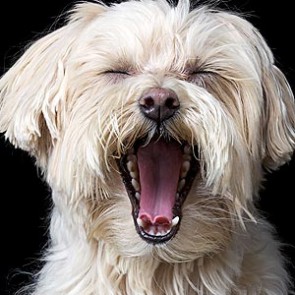
Yawning Spreads Like a Plague in Wolves
Evidence of contagious yawning in chimps, dogs and now wolves suggests that the behavior is linked to a mammalian sense of empathy
Chimps do it, birds do it, even you and I do it. Once you see someone yawn, you are compelled to do the same. Now it seems that wolves can be added to the list of animals known to spread yawns like a contagion.
Among humans, even thinking about yawning can trigger the reflex, leading some to suspect that catching a yawn is linked to our ability to empathize with other humans. For instance, contagious yawning activates the same parts of the brain that govern empathy and social know-how. And some studies have shown that humans with more fine-tuned social skills are more likely to catch a yawn.
Similarly, chimpanzees, baboons and bonobos often yawn when they see other members of their species yawning. Chimps (Pan troglodytes) can catch yawns from humans, even virtual ones, as seen in the video below. At least in primates, contagious yawning seems to require an emotional connection and may function as a demonstration of empathy. Beyond primates, though, the trends are less clear-cut. One study found evidence of contagious yawning in birds but didn’t connect it to empathy. A 2008 study showed that dogs (Canis lupus familiaris) could catch yawns from humans, and another showed that dogs were more likely to catch the yawn of a familiar human rather than a stranger. But efforts to see if dogs catch yawns from each other and to replicate the results with humans have so far had no luck.
Now a study published today in PLOS ONE reports the first evidence of contagious yawning in wolves (Canis lupus lupus). “We showed that the wolves were able to yawn contagiously, and this is affected by the emotional bond between individuals, which suggests that familiarity and social bonds matter in these animals the same way as it does in humans,” says study co-author Teresa Romero, who studies animal behavior at the University of Tokyo.
The prevalence of contagious yawning in primates and other mammals could give us some clues to the evolution of empathy—that’s in part what makes the phenomenon so interesting and so controversial. If dogs can catch yawns from humans, did they pick up the behavior because of domestication, or does the trait run deeper into evolutionary history?
The Tokyo team took a stab at those questions by looking at contagious yawning in dog’s closest relatives, wolves. For 254 hours over five months, they observed twelve wolves (six males and six females) at the Tama Zoological Park in Tokyo. They kept tabs on the who, what, when, where, how many and how long of every yawn, then separated out data for yawns in relaxed settings, to minimize the influence of external stimuli.
Next, they statistically analyzed the data and looked for trends. They found that wolves were much more likely to yawn in response to another’s yawn rather than not, which suggests that contagious yawning is at play.
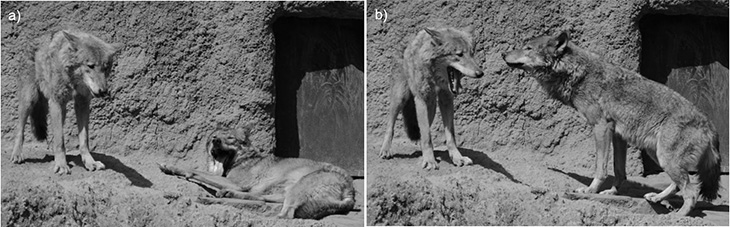
In image A, an individual (right) yawned during a resting period, and a few seconds later, image B shows the subject (on the left) yawned contagiously. (Teresa Romero)
Wolves were more likely to catch the yawn if they were friends with the yawner. Females were also quicker on the yawn uptake when watching the yawns of those around them—possibly because they’re more attuned to social cues, but with such a small group it’s hard to say for sure.
The results seem to add to the case for empathy as the primary function of contagious yawning. “We have the strongest responses to our family, then our friends, then acquaintances, and so on and so forth,” says Matt Campbell, a psychologist at California State University, Channel Islands. “That contagious yawning works along the same social dimension supports the idea that the mechanism that allows us to copy the smiles, frowns and fear of others also allows us to copy their yawns.”
Empathy likely originated as an ancestral trait in mammals, and that’s why it emerges in such disparate species as wolves and humans. “More and more research is supporting this idea that basic forms of empathy are very ancient, and they are present in a wide number of species, at least in mammals,” says Romero. Elephants, for example, comfort their upset friends. Even rats exhibit a basic helping behavior toward other friendly rodents.
Why does contagious yawning between members of the same species show up in wolves and not dogs? The difference probably comes down to study design, not biology. “Most likely, dogs also catch yawns from [other dogs], as now shown for wolves,” says Elaine Madsen, a cognitive zoologist at Lund University in Sweden. Further studies might reveal the extent to which human interaction has affected present-day dogs’ susceptibility to catching another species’ yawns, she says.
It’s impossible to say what true function contagious yawning serves in wolves, but the researchers argue that such behavior could cultivate social bonds. “If an individual is not in sync with its group, it risks being left behind. That is not good,” says Campbell. Just watching wolves yawn can’t definitively prove that empathy drove the behavior, but it’s certainly compelling evidence that wolves might feel for their fellow lupines.
ooOOoo
Fascinating. As too is an article also on the Smithsonian website about dogs yawning. Going to republish that in a few days.
However, this post was prompted by the reminder that there is no substitute for social bonding with others who we meet physically. That is why the Smithsonian essay seemed such an important reminder. As was written (my emphasis):
Among humans, even thinking about yawning can trigger the reflex, leading some to suspect that catching a yawn is linked to our ability to empathize with other humans. For instance, contagious yawning activates the same parts of the brain that govern empathy and social know-how. And some studies have shown that humans with more fine-tuned social skills are more likely to catch a yawn.
Yesterday’s post spelled out in letters bold, so to speak, the madness of our present relationship with food. As in the blindness of the vast majority of consumers when it comes to our consumption of food. Such as the blindness of Americans, for example! Presuming that few are aware that feeding all of us Americans accounts for about 15% of US energy use, [1] and the average food item travels more than 5,000 miles from farm to fork. [2]
So it’s encouraging to see that there are signs of hope.
For example, in the UK, Martin Crawford has a wealth of information about forest gardening on his website The Forest Garden.
Welcome to the Forest Garden.
Inspired by the effortless abundance in nature we believe that forest gardens are the best way to produce local wholesome organic food, timber products and a myriad of other natural non-wood items. Forest gardens, with careful design and management, also improve degraded soils and create wildlife havens, employment and beauty. We love this way of gardening and farming with nature, we hope you do too.
We’ve just started to create the largest Forest Garden site in UK so please check back regularly to see how we’re getting on.
And Martin’s thirteen-minute video on the topic is pure inspiration.
Then in the USA, we see the increasing power of the voice of such organisations as the Post Carbon Institute whose mission statement reads:
Post Carbon Institute provides individuals, communities, businesses, and governments with the resources needed to understand and respond to the interrelated economic, energy, environmental, and equity crises that define the 21st century. We envision a world of resilient communities and re-localized economies that thrive within ecological bounds.
Still in the USA but much closer to home, indeed just a four-minute drive away, is Sweet Water Farm.
A picture from Sweet Water Farm.
Sweet Water Farm is a small family owned and operated farm located in beautiful Hugo, Oregon near the base of Mt. Sexton. Sam and Denise work the fields with their son Ari and daughter Ivory overseeing the operation. Our mission is to provide healthy food to our community while take care of the place we call home.
Secondly, by reading the article in the UK’s Daily Mail newspaper back in February, 2009. From which I quote:
More than 96 per cent of all the food grown in Britain is reliant on synthetic fertiliser. Without it we’d be in serious trouble.
But without artificial fertiliser there’s not enough nutrients for the crops to grow, and without ploughing there is nothing to aerate the soil. So how can we manage without them?
The answers are in nature. As Charles Darwin pointed out, earthworms have been ploughing and aerating the soil for millions of years. And as for fertilisers, just look at how a forest flourishes: by using the natural fertility created by billions of living microbes, fungi, plants and animals.
I wrote down the title of today’s post a few days back. Jean and I had just watched the BBC Panorama Special regarding Amazon UK. It had been screened on the 25th November and was described:
It’s the online retailer that has transformed the way we shop, but how does Amazon treat the workers who retrieve our orders? Working conditions in the company’s giant warehouses have been condemned by unions as among the worst in Britain. Panorama goes undercover to find out what happens after we fill our online shopping basket.
Or more fully reported in a BBC News item, as this extract reveals:
A BBC investigation into a UK-based Amazon warehouse has found conditions that a stress expert said could cause “mental and physical illness”.
Prof Michael Marmot was shown secret filming of night shifts involving up to 11 miles of walking – where an undercover worker was expected to collect orders every 33 seconds.
It comes as the company employs 15,000 extra staff to cater for Christmas.
Amazon said in a statement worker safety was its “number one priority”.
Undercover reporter Adam Littler, 23, got an agency job at Amazon’s Swansea warehouse. He took a hidden camera inside for BBC Panorama to record what happened on his shifts.
He was employed as a “picker”, collecting orders from 800,000 sq ft of storage.
A handset told him what to collect and put on his trolley. It allotted him a set number of seconds to find each product and counted down. If he made a mistake the scanner beeped.
Adam Littler went undercover as a “picker” at Amazon’s Swansea warehouse
“We are machines, we are robots, we plug our scanner in, we’re holding it, but we might as well be plugging it into ourselves”, he said.
The 30-minute Panorama programme is on YouTube and is included in this post just below.
As I started to explain, the reaction to watching the Panorama programme was to feel sickened by the way these workers were being treated.
Not helped when yesterday, the UK Daily Mail newspaper added their own story of another undercover reporting operation at Amazon. Here’s an extract from the last third of the piece, reported by Carole Cadwalladr:
It is taxes, of course, that pay for the roads on which Amazon’s delivery trucks drive, and the schools in which its employees are educated.
Taxes that all its workers pay, and that, it emerged in 2012, Amazon tends not to pay.
On UK sales of £4.2 billion in 2012, it paid £3.2 million in corporation tax. In 2006, it transferred its UK business to Luxembourg and reclassified its UK operation as simply an ‘order fulfilment’ business.
The Luxembourg office employs 380 people. The UK operation employs 21,000. You do the sums.
Brad Stone tells me that tax avoidance is built into the company’s DNA. From the very beginning it has been ‘constitutionally oriented to securing every possible advantage for its customers, setting the lowest possible prices, taking advantage of every known tax loophole or creating new ones’.
In Swansea I chat to someone called Martin for a while. It’s Saturday, the sun is shining and the warehouse has gone quiet. The orders have been turned off like a tap.
‘It’s the weather,’ he says. ‘When it rains, it can suddenly go mental.’ We clear away boxes and the tax issue comes up.
‘There was a lot of anger here,’ he says. ‘People were very bitter about it. But I’d always say to them: “If someone told you that you could pay less tax, do you honestly think you would volunteer to pay more?”’
He’s right. And the people who were angry were also right. It’s an unignorable fact of modern life that, as Stuart Roper of Manchester Business School tells me, ‘some of these big brands are more powerful than governments. They’re wealthier. If they were countries, they would be pretty large economies.
‘They’re multinational and the global financial situation allows them to ship money all over the world. And the Government is so desperate for jobs that it has given away large elements of control.’
MPs like to attack Amazon and Starbucks and Google for not paying their taxes, but they’ve yet to actually create legislation compelling them to do so.
Then if that wasn’t sufficient to make me want to live on a desert island, along comes George Monbiot pointing out that even the BBC, to me the most respected and trusted news organisation on the planet, has been economical with the truth.
The BBC’s disgraceful failure to reveal who its contributors are speaking for.
By George Monbiot, published on the Guardian’s website 29th November 2013
Do the BBC’s editorial guidelines count for anything? I ask because it disregards them every day, by failing to reveal the commercial interests of its contributors.
Let me give you an example. Yesterday the Today programme covered the plain packaging of cigarettes. It interviewed Mark Littlewood, director-general of the Institute of Economic Affairs, an organisation which calls itself a thinktank.
Mishal Husain introduced Mark Littlewood as “the director of the Institute of Economic Affairs, and a smoker himself”.
It’s bad enough when the BBC interviews people about issues of great importance to corporations when it has no idea whether or not they are funded by those companies, and makes no effort to find out.
It’s even worse when those interests have already been exposed, yet the BBC still fails to mention them.
Then along came three items that pulled my back from the brink of despair and disgust.
The first came from the blog of the UK’s Transition Network, Transition Times. Rob Hopkins wrote an article on December 5th called The day I closed my Amazon account. Please read it if you feel unsettled by the Amazon situation. The last two paragraphs are:
Me, I resolve to buy less, but better. Less, but longer-lasting. Less, but local. The thought of where we will end up in 5 years time, 10 years time, 20 years time, if companies like Amazon continue as they are, really frightens me. It’s not good, it’s not right. It’s not about our needs, it’s about the needs of huge investors. I want a different world for my boys.
I can’t, on my own, do that much about it. I can’t insist that the UK government legislate so that, as in Holland, the Recommended Retail Price (RRP) is the legal minimum at which any book can be sold, although I think that is grounds for a really timely campaign. Because of that, Amazon don’t really operate in Holland. Bring back the RRP for books here, and let’s have a level playing field. As I say, I can’t do much, but I can withdraw my support. I just have withdrawn my support. It feels surprisingly unsettling, as one does after ending a relationship, but it was the right thing to do. It may be a drop in the ocean, but if enough people do it….
The second was coming across something called The Restart Project in London. I had never heard of them before. But it gets better because these London folk are part of a global movement. Which in the words of The Restart Project can be explained thus:
A spontaneous, global, grassroots repair movement
Sitting in London, we at The Restart Project have been inspired by Holland, the US, Australia, and now we realize that there are many more community repair and fixit groups than we ever knew of before… Milan, Barcelona, Finland, the list just grows.
Some groups have regular events in their own spaces and some are pop-up groups.
The most remarkable thing is that we are not just all doing similar things, we are doing them in the same way and with similar motivations
1) learning, skillsharing and community are a premium. No judgment. Openness and inclusivity, all are made to feel welcome.
2) the idea is NOT a freebie fix. The idea is that people get involved in the repair, taking responsibility for their stuff and taking back control. It’s about behaviour change, not just about waste prevention
and
3) importantly – fun!
Please help us map repair groups, to connect people to their local repair gurus and fixit friends – and who knows, inspire the creation of more.
“Just repair, don’t despair!”
Just repair, don’t despair! That shouted out at me. The more that the world we live in is consumed by the power-brokers and greed-mongers. The more that our traditional view of politics is seen to be out-dated and incorrect, then the more we have do within our own lives, within our own communities and with our friends, loved ones and families to show we can repair our world a darn site quicker than the ‘dark forces’ can break it.
My third example of hope is tomorrow in a post called The power of self.

 Learning from Dogs