Tag: climate change

Modelling the future.

Can we trust the predictive output of computer modelling?

I would be the first to admit that this is not an area where I have anything more than general knowledge.  However, what prompted me to think about this topic was a chance conversation with someone here in Payson.  We were chatting over the phone and this person admitted to being less than fully convinced of the ’cause and effect’ of man’s influence on the global biosphere.

When I queried that, what was raised was the idea that all modelling algorithms used in climate change predictions must incorporate mathematical constants.  I continued to listen as it was explained that, by definition, all constants were, to some degree, approximations.  Take, for example, the obvious one of the constant π, that Wikipedia describes as: a mathematical constant that is the ratio of a circle’s circumference to its diameter. Pi, of course, would have to be rounded if it was to be used in any equation.  Even taking it to thirty decimal places, as in 3.14159 26535 89793 23846 26433 83279, would mean rounding it to 3.14159 26535 89793 23846 26433 83280 (50288 being the 30th to 35th decimal places).

OK, so I must admit that I was leaning to the viewpoint that this person had a valid perspective.  I then asked Martin Lack, he of Lack of Environment and a scientifically trained person, for his thoughts.  The rest of this post is based on the information that Martin promptly sent me.

One of the links that Martin sent was to this post on the Skeptical Science blogsite.  That post sets out the common skeptics view, namely:

Models are unreliable
“[Models] are full of fudge factors that are fitted to the existing climate, so the models more or less agree with the observed data. But there is no reason to believe that the same fudge factors would give the right behaviour in a world with different chemistry, for example in a world with increased CO2 in the atmosphere.”  (Freeman Dyson)

The author of the Skeptical Science posting responds,

Climate models are mathematical representations of the interactions between the atmosphere, oceans, land surface, ice – and the sun. This is clearly a very complex task, so models are built to estimate trends rather than events. For example, a climate model can tell you it will be cold in winter, but it can’t tell you what the temperature will be on a specific day – that’s weather forecasting. Climate trends are weather, averaged out over time – usually 30 years. Trends are important because they eliminate – or “smooth out” – single events that may be extreme, but quite rare.

Climate models have to be tested to find out if they work. We can’t wait for 30 years to see if a model is any good or not; models are tested against the past, against what we know happened. If a model can correctly predict trends from a starting point somewhere in the past, we could expect it to predict with reasonable certainty what might happen in the future.

So all models are first tested in a process called Hindcasting. The models used to predict future global warming can accurately map past climate changes. If they get the past right, there is no reason to think their predictions would be wrong. Testing models against the existing instrumental record suggested CO2 must cause global warming, because the models could not simulate what had already happened unless the extra CO2 was added to the model. All other known forcings are adequate in explaining temperature variations prior to the rise in temperature over the last thirty years, while none of them are capable of explaining the rise in the past thirty years.  CO2 does explain that rise, and explains it completely without any need for additional, as yet unknown forcings.

I strongly recommend you read the full article here.  But I will republish this graph that, for me at least, is a ‘slam dunk’ in favour for modelling accuracy.

Sea level change. Tide gauge data are indicated in red and satellite data in blue. The grey band shows the projections of the IPCC Third Assessment report (Copenhagen Diagnosis 2009).

Not only does this show that the data is within the range of projections of the modelled output, more seriously the data is right at the top end of the model’s predictions.  The article closes with this statement:

Climate models have already predicted many of the phenomena for which we now have empirical evidence. Climate models form a reliable guide to potential climate change.

There is a more detailed version of the above article available here.  Do read that if you want to dig further down into this important topic.  All I will do is to republish this,

There are two major questions in climate modeling – can they accurately reproduce the past (hindcasting) and can they successfully predict the future? To answer the first question, here is a summary of the IPCC model results of surface temperature from the 1800’s – both with and without man-made forcings. All the models are unable to predict recent warming without taking rising CO2 levels into account. Noone has created a general circulation model that can explain climate’s behaviour over the past century without CO2 warming. [my emphasis, Ed.]

Finally, back to Lack of Environment.  On the 6th February, 2012, Martin wrote an essay Climate science in a nut fragment.  Here’s how that essay closed:

Footnote:
If I were to attempt to go even further and summarise, in one single paragraph, why everyone on Earth should be concerned about ongoing anthropogenic climate disruption, it would read something like this:

Concern over anthropogenic climate disruption (ACD) is not based on computer modelling; it is based on the study of palaeoclimatology. Computer modelling is based on physics we have understood for over 100 years and is used to predict what will happen to the atmosphere for a range of projections for CO2 reductions. As such, the range of predictions is due to uncertainty in those projections; and not uncertainties in climate science. Furthermore, when one goes back 20 years and chooses to look at the projection scenario that most-closely reflects what has since happened to emissions, one finds that the modelled prediction matches reality very closely indeed.

In his email, Martin included these bullet points.

  • Concern over anthropogenic climate disruption (ACD) is not based on computer modelling.
  • It is based on our understanding of atmospheric physics (and how the Earth regulates its temperature).
  • Computer modelling is based on this physics (which we have understood for over 100 years).
  • Models have been used to predict temperature and sea level rise for a range of projections for CO2 emissions. 
  • The wide range of predictions was due to uncertainty in those emissions projections not uncertainties in climate science. 
  • This can be demonstrated by looking at predictions made over 20 years ago in light of what actually happened to emissions.
  • The model predictions for both temperature and sea level rise are very accurate (if not slightly under-estimating what has happened).

Sort of makes the point in spades!  The sooner all human beings understand the truth of what’s happening to our planet, the sooner we can amend our behaviours.  I’m going to pick up the theme of behaviours in tomorrow’s post on Learning from Dogs.

Finally, take a look at this graph and reflect!  This will be the topic that I write about on Thursday.

Avoiding the catastrophe of indifference.

Doing nothing is not an option.

Introduction

So back to non-doggy stuff although I hope the themes of truth and integrity continue to rein supreme though this blog!

In the last couple of weeks, I have devoted a number of posts to the subject of change, as in how do we humans change.  The first post was Changing the person: Me where I started examining the process of change; by process I mean the models of change commonly understood in, say, management change.

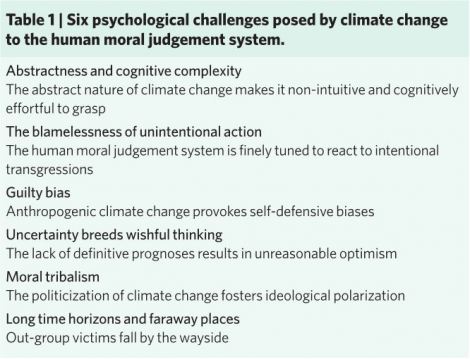
The next post was You have to feel it! which drew heavily on research from Ezra M. Markowitz & Azim F. Shariff regarding the psychological aspects posed by climate change to the human moral judgement system.

The final post was From feeling to doing.  In this post, David Roberts of Grist showed that one could put aside all the ‘head stuff’ about change and in just 15 minutes cover all that one would ever want to know about the biggest issue of all facing this planet.

So rather a long introduction to two guest posts that today and tomorrow set out the case for what we all have to consider; doing nothing is just not a viable option.  The first is from Martin Lack of the popular and hard-hitting blog Lack of Environment.

oooOOOooo

Avoiding the catastrophe of indifference.

by Martin Lack.

Paul has very kindly invited me to follow-up his recent post regarding David Roberts’ item on the Grist blog entitled ‘Why climate change doesn’t spark moral outrage, and how it could’ followed by a second post in which was embedded David Roberts’ excellent video ‘Climate change is simple – we do something or we’re screwed’.

So my guest post is an expansion of a comment I submitted in response to the first of those two posts, You have to feel it.  However it would be wrong not to first add my voice to all those that have applauded David Roberts for all his excellent work.

Clive Charles Hamilton

In 2010, the Australian social anthropologist Clive Hamilton published Requiem for a Species: Why we Resist the Truth About Climate Change – one of the scariest but most important books I think I have ever read.

Reading Hamilton’s book was one of the reasons I decided, as part of my MA in Environmental Politics, to base my dissertation on climate change scepticism in the UK.

In the process, I read much but Hamilton’s book was one of very few that I actually read from cover to cover – I simply did not have time to read fully all the books for my research. However, because I have a background in geology and hydrogeology, my greatest challenge was learning to think like a social scientist.

I was all for taking these climate change sceptics head on and demolishing their pseudo-scientific arguments or taking them to task for the ideological prejudices that drive them to reject what scientists tell us. Thus, it fell to my dissertation supervisor to mention politely but firmly that I needed to disengage with the issues and analyse patterns of behaviour and frequency of arguments favoured by different groups of people.  In short, I needed to stop trying to prove the scientific consensus correct and start understanding the views held by those that dispute that consensus.

Having said how I read Professor Hamilton’s book in full, I must admit to learning about a load of other equally-scary sounding books since subscribing to Learning from Dogs;  Lester Brown’s World on the Edge: How to Prevent Environmental and Economic Collapse being just one that comes to mind!

David Roberts

Then of course there is what David Roberts himself says, which is just as scary. I think we have good reason to be scared. However, as Hamilton points out, we must move beyond being scared, which is simply debilitating, and channel our frustration into positive action.

Because if we do not, there is a great deal of circumstantial evidence to suggest that civilisation may well fail. If that means engaging in acts of civil disobedience, as it has done for James Hansen and many others, well, so be it. I suspect that nothing worthwhile has ever been achieved without someone breaking the law in order to draw attention to injustice – the abolition of slavery and child labour, the extension for all of the right to vote including women, come to mind.

That is the conclusion of Hamilton’s book; that civil disobedience is almost inevitable (p.225). Just as turkeys won’t vote for Christmas, our politicians are not going to vote for climate change mitigation unless we demand that they do so.

So it was the steer from my dissertation supervisor that lead me to read David Aaronovitch’s Voodoo Histories: How Conspiracy Theory Has Shaped Modern History, and much more about psychology. All of which guided the Introductory section of my dissertation, which summarised the philosophical roots of scepticism, the political misuse of scepticism, and the psychology of denial; see a recent post on my blog Lack of Environment.   In terms of what I want to say here, it is an elaboration of the last of those topics, the psychology of denial.  Indeed, it formed the preamble to the findings of my research.

To help me research this unfamiliar subject, my dissertation supervisor sent me a PDF copy of a paper written by Janis L. Dickinson in 2009 and published in Ecology and Society.  It was called ‘The People Paradox: Self-Esteem Striving, Immortality Ideologies, and Human Response to Climate Change’ and dealt with a challenging, almost taboo subject, namely our own mortality.

Despite my initial reluctance to learn about psychology, the more I read the more I realised just how central psychology was to explaining why we humans have failed to address the problem of climate change.

I ended up summarising the work of Dickinson, together with other sources of material, in the following manner.

In considering reasons for the collective human failure to act to prevent anthropogenic global warming (AGW), a number of authors appear to have been influenced by Ernest Becker’s The Denial of Death (1973). For example, Aaronovitch proposed that we try to avoid the “catastrophe of indifference” that a world devoid of meaning or purpose represents (p. 340).  Hamilton suggested that climate disruption “has the smell of death about it” (p. 215).

Janis Dickinson elaborates a little more, exploring what she describes as “…one of the key psychological links between the reality of global climate change and the difficulty of mobilizing individuals and groups to confront the problem in a rational and timely manner”, then referring to what psychologists call terror management theory (TMT) – Dickinson also categorises denial of climate change; denial of human responsibility and immediacy of the problem as proximal responses (Dickinson 2009).

Furthermore, as referenced here, both Dickinson and Hamilton suggest that other distal TMT responses, such as focussing on maintaining self-esteem or enhancing self-gratification, can be counter-intuitive and counter-productive. Dickinson summarises the recent work of Tim Dyson by saying “[b]ehavioral response to the threat of global climate change simply does not match its unique potential for cumulative, adverse, and potentially chaotic outcomes” (ibid).

Based on the evidence of the most frequently used arguments for dismissing the scientific consensus regarding climate change, I collated the findings of my research and which might be summarised as follows:

Having analysed the output of such UK-based Conservative think-tanks (CTTs), along with that of scientists, economists, journalists, politicians and others, it would appear that the majority of CTTs dispute the existence of a legitimate consensus, whereas the majority of sceptical journalists focus on conspiracy theories; the majority of scientists and economists equate environmentalism with a new religion; and politicians and others analysed appear equally likely to cite denialist or economic arguments for inaction.

As I find myself saying quite frequently, the most persistent arguments against taking action to mitigate climate change are the economic ones.

However, as all the authors mentioned have suggested, or at least inferred, I think it is undoubtedly true that the most potent obstacle to people facing up to the truth of climate change is our psychological reluctance to accept responsibility for something that is obviously deteriorating – namely our environment!

Nevertheless, all is not yet lost.  We do not all need to go back to living in the Dark Ages to prevent societal and environmental collapse but we do need to accept a couple of fundamental realities:

  1. Burning fossilised carbon is trashing the planet. Therefore, fossil fuel use must be substituted in every possible process as rapidly as possible. Unfortunately, it is not substitutable in the most damaging process of all; aviation.  That merely increases the urgency of substituting where we can (i.e. power, lighting and temperature control).
  2. Poor people in developing countries have a legitimate right to aspire to having a more comfortable life but the planet definitely cannot cope with 7 to 10 billion people living like we do in the “developed” countries.

Once we accept these realities, we will learn to use less fossil fuels and, if we can become self-sufficient using renewable energy sources, we can have a flat-screen TV in every room and leave them on standby and the A/C on full power 24/7 and still have a clear conscience. However, we must get off fossil fuels ASAP.

oooOOOooo

I am indebted to Martin for writing such an insightful analysis of how we all have to change.  Tomorrow, another guest post further exploring the options that face us all as we work towards a sustainable future.  As I opened this post, doing nothing is not an option!

You have to feel it!

Fascinating insight into our complex relationship with complex ideas!

There’s a powerful saying in the world of writing: If you can’t feel it you can’t write it!

But our feelings are so, so much a part of what it is to be human.  That’s why I spent some time exploring how our resistance to change is so wrapped up in the emotions that change brings about in an article back on the 2nd August: Changing the person: Me.

So a post on the grist online magazine not so long ago really caught my eye.  It was called Why climate change doesn’t spark moral outrage, and how it could, and was written by David Roberts.  I would dearly love to have sought David’s permission to republish it in full; it’s so relevant to understanding how we humans have to approach turning back from our present course of making the Earth’s biosphere uninhabitable for we humans.

But in a couple of days time, I have a Post coming out that is republished with David’s written permission called Cutting CO2 emissions – who leads the world! It felt greedy to ask David for another full republication.  So I’m going to dip into this one, hopefully to the point where you will go across to grist and read it for yourself.

David opens up as follows:

Perhaps the single biggest barrier to action on climate change is the fact that it doesn’t hit us in the gut. We can identify it as a great moral wrong, through a chain of evidence and reasoning, but we do not instinctively feel it as one. It does not trigger our primal moral intuitions or generate spontaneous outrage, anger, and passion. It’s got no emotional heat. (Ironic!)

David’s article then goes on to refer to a recent paper published on the Nature.com website called Climate change and moral judgement by Ezra M. Markowitz & Azim F. Shariff.  The abstract sets out that:

Converging evidence from the behavioural and brain sciences suggests that the human moral judgement system is not well equipped to identify climate change — a complex, large-scale and unintentionally caused phenomenon — as an important moral imperative. As climate change fails to generate strong moral intuitions, it does not motivate an urgent need for action in the way that other moral imperatives do. We review six reasons why climate change poses significant challenges to our moral judgement system and describe six strategies that communicators might use to confront these challenges. Enhancing moral intuitions about climate change may motivate greater support for ameliorative actions and policies.

M’mmm – not sure how that leaves me.  (Which is my way of saying that I don’t really understand that!)  Luckily David goes on to say that the authors “go on to identify six reasons why, “unlike financial fraud or terrorist attacks, climate change does not register, emotionally, as a wrong that demands to be righted.” and refers to an interesting table in the research paper.

Now go to the article on grist to better understand how those challenges are explained.

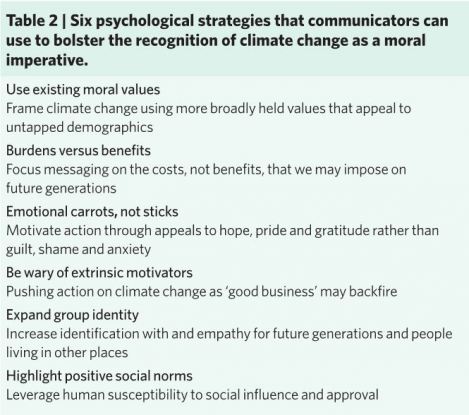
Then later on in the research paper, there is a second table, as below:

Again, these strategies are expanded upon in David’s article.  What I will do is to copy his final few paragraphs:

6. Highlight positive social norms: This is, to me, the Big Kahuna. As I was reading about all the psychological barriers to climate action, I kept thinking, “one thing can overcome all these: peer pressure!” If people see others that they view as peers or leaders doing something, they will tend to do it too, and retrofit reasons for it after the fact. This is the essence of humans as social creatures.

The recommendation is twofold, though: not just to “highlight pro-environmental, prosocial injunctive norms such as prohibitions against being wasteful,” but also to “be careful not to inadvertently highlight negative, but existent, descriptive norms, which can actually encourage individuals to follow suit in the wrong direction.”

In other words, you want to emphasize that climate hawkery is good, socially desirable, admirable, and that all the cool kids are doing it. You don’t want to give people the impression that “everyone’s doing it” if it is bad. Even if you state clearly that it’s bad, the fact that others are doing it is, in and of itself, a powerful incentive to do it too. It’s the herd instinct. This is good reason not to whine on and on about how everyone drives too much or everyone wastes electricity. The subtext is, “it’s the social norm.”

—-

Aaaanyway, this is a lot of food for thought. But it’s the kind of stuff — not about science but about people — that far too many climate hawks ignore or disregard. Climate change is not only the economic and ecological crisis of our time, it’s also a moral crisis. What we are doing to our descendants is a moral crime. Finding ways to help people get that, feel it in their guts the way they would if someone threatened their own families, is a precondition for serious, sustained action.

Let me repeat David’s closing words, “Climate change is not only the economic and ecological crisis of our time, it’s also a moral crisis. What we are doing to our descendants is a moral crime.

OK, so how strongly do you feel that?  Great, so you do feel it – even feel it deep inside you.

Now that you do, let’s all get stuck into making a difference.  It is all about doing.  As someone of huge stature, and a wonderful person of action no less, said;

I have been impressed with the urgency of doing. Knowing is not enough; we must apply. Being willing is not enough, we must do. Leonardo da Vinci (1452-1519)

We must do!  Start your own ‘doing’, don’t wait upon others, actively look for ideas (there are a few here) and together we can make a positive difference.

Well done, David – great article.

And now to do something.

The cumulative effect of millions of decisions brings about change!

Yesterday’s Post was about personal change.  It came on the back of a short series that was triggered by the Bill McKibben essay in Rolling Stone magazine that I republished on 31st July.  If you haven’t read it, do yourself a favour and read it soon.

The essay highlighted the challenge of how we change our ways, that is at a personal level, which is why I decided to devote a complete Post to the subject of change.  There was no doubt that the McKibben essay opened our eyes to the need for change, if they weren’t open already.  So being clear about the need for change and how, initially, it can make us feel less sure of ourselves, where do we go from here?  As John Fisher explains, within the change process, there is the stage where things start to happen.  This is what he writes about that stage,

Moving forward

In this stage we are starting to exert more control, make more things happen in a positive sense and are getting our sense of self back. We know who we are again and are starting to feel comfortable that we are acting in line with our convictions, beliefs, etc. and making the right choices. In this phase we are, again, experimenting within our environment more actively and effectively.

Keep this stage in mind as you journey along your individual path towards reducing your impact on the planet.  It really does act as a beacon for you, as a candle in the darkness.

OK, there’s an old saying in business ‘if you can’t measure it you can’t manage it!‘  So let’s start off by calculating the CO2 we are presently responsible for.

There are a number of CO2 calculators available on the Web but this one from The Resurgence Trust website seems as good as any.  Easy to use and it provides a starting point from which to plan your attack!  Make a promise to calculate your present CO2 output, soon!

Then to the plan of action!  A web search on reducing CO2 produces a huge number of results and I recommend that you undertake your own trawl to find the information that ‘rocks your boat’.  But on the Brave New Climate website there’s a summary that caught my eye, especially how it was introduced:

Top 10 ways to reduce your CO2 emissions footprint

Posted on 29 August 2008 by Barry Brook

Solving climate change is a huge international challenge. Only a concerted global effort, involving the governments of all nations, will be enough to avert dangerous consequences. But that said, the individual actions of everyday people are still crucial. Large and complex issues, like climate change, are usually best tackled by breaking down the problem into manageable bits.

For carbon emissions, this means reducing the COcontribution of each and every one of the six and a half billion people on the planet. But what can you, as an individual person or family, do that will most make a difference to the big picture? Here are my top ten action items, which are both simple to achieve and have a real effect. They are ranked by how much impact they make to ‘kicking the COhabit’.

Then follows ten solid recommendations:

  1. Make climate-conscious political decisions.
  2. Eat less red meat.
  3. Purchase “green electricity“.
  4. Make your home and household energy efficient.
  5. Buy energy and water efficient appliances.
  6. Walk, cycle or take public transport.
  7. Recycle, re-use and avoid useless purchases.
  8. Telecommute and teleconference.
  9. Buy local produce.
  10. Offset what you can’t save.

Each of these recommendations is supported by great web links and plenty of advice.  So don’t just skip through those 10 options, go here and commit to doing something!

And when you are ready to involve others beyond your family, 350.org has a great selection of resources for potential organizers.

We can make a difference!

Changing the person: Me!

It is better to light a candle than curse the darkness. – Chinese Proverb

Yesterday, in a post that picked up on the deep implications of Bill McKibben’s chilling essay on where the world is heading if we don’t change, I set out my understanding of what holds us back from that change.  I wrote, “ … the process of change cannot start until we  truly want to change; a total emotional commitment.  And the formation of those emotions, that realisation, requires a new understanding of the world around us, who we are and who we want to be.”

Previously on Learning from Dogs I have quoted Jon Lavin, “The best way to save the world is to work on our selves.”  I remember decades ago when working as a humble office-products salesman for IBM UK the well-worn saying, “Selling is 90% me and 10% the customer.”  Sort of reminds me of Woody Allen’s: “Eighty percent of success in life is showing up.”

OK, enough of these mental perambulations.  Let’s get on with the task of looking at change.  Because make no bones about it, if we rely on ‘them’, on others, to turn mankind back from where we are heading then it’s all over!  It comes down to each and every one of us deciding to change.

Think this is all melodramatic nonsense?  Go and read the first paragraph of Bill McKibben’s article where he states, “June broke or tied 3,215 high-temperature records across the United States. That followed the warmest May on record for the Northern Hemisphere – the 327th consecutive month in which the temperature of the entire globe exceeded the 20th-century average..

Want more reason to change?  Try this from a recent article on The Daily Impact:

From American Drought to “Global Catastrophe”

Some poet  invented the name “Arab Spring” as a label for the tsunami of public desperation that last year took down the governments of Tunisia, Egypt and Libya. Poets and Pollyannas saw the events as an upwelling of love for democracy. Realists related them to the spike in world food prices that threatened the survival of whole populations and made them desperate for change — any change.  Now, thanks in large part to events unfolding in the American heartland, get ready for another, worse, spike.

We are running out of superlatives with which to describe the Mid- and Southwestern drought and its effect on this year’s corn and soybean crops. According to this week’s USDA crop update the situation during the previous seven days went from “critical” to, um, worse than that. The drought is the worst in half a century. Of the largest US acreage ever planted in corn (industrial agriculture was crowing about that just a couple of months ago), only one-quarter is still in good condition. (Modest rainfall in drought-stricken areas early this week provided mostly emotional relief; the drought is forecast to continue unabated through October.)

Change really does seem like a ‘no-brainer’!

Here’s a lovely cartoon that summarises the steps of change, the process of transition, for you and me.

That diagram is from John Fisher’s model of personal change, full details of which are here.  It includes a link to the process of transition diagram, show above, here.

The most important thing to note, and this is why so many ‘change’ ambitions fail, is that change is deeply unsettling at first.  When change happens for the majority of us, often ‘forced’ on us as a result of unplanned life events, we are left deeply unsettled; a strong feeling of being lost, of being in unfamiliar surroundings.  Think divorce or, worse, the death of a partner or child, reflect on how many sign up for bereavement counselling in such circumstances.  Big-time change is big-time tough (apologies for the grammar!).

Stay with me for a short while while I reinforce this from my own experiences.

My previous ex-wife announced in December, 2006 that she was leaving me for a younger model!  It came as a complete surprise.  Subsequently, I was invited to spend Christmas 2007 out in San Carlos, Mexico with Suzann and her husband, Don.  Suzann is the sister of my dear, close friend of many years, Dan Gomez, hence the connection.  There I met Jean, a long-term friend of Suzann living in San Carlos and, coincidentally as I am, another Londoner by birth.  Jean and I fell deeply in love with each other and a year later I moved out from SW England with Pharaoh to Mexico.

Throughout 2008 I suffered from what was eventually diagnosed as vestibular migraine.  It involved partial loss of vision, vertigo, headaches and significant short-term memory disturbances; let me tell you it was pretty frightening!

Eventually, in 2012 well after we moved from San Carlos up to Payson, Arizona, I got so worried that I went to see a neurologist, convinced that I was heading down the road of dementia.  Dr. Goodell examined me thoroughly and said that there were no signs of dementia or early-onset Alzheimer’s disease.  His conclusion: I was showing the normal signs of forgetfulness that any person of my age (now 67) would show having been through similar life changes.  Dr. Goodell went on to explain that back in England 98% of my life was constant and familiar and therefore adjusting to a 2% change was unremarkable.  However, on moving my life out to Mexico and then on to Arizona, it was all reversed: 2% of my life was constant and 98% was change and that was a huge psychological hill to climb with all the associated mental stresses that I had been experiencing.

Interestingly, that diagnosis rapidly set me on the path of feeling so much better!

So, apologies for that personal diversion but I hope it underlined that life-change is a big deal!

In my trawl across the Web looking for change references, I came across a software engineer by the name of Dave Cheong.  Dave writes a blog.  In Dave’s blog was a piece about change.  Change as a result of a merger of his employer.  This is what Dave wrote:

As a result of the merger, lots of change is happening. Some folks are questioning where things are headed, what management have planned, how their lives will change, etc. Most certainly, there will be job losses as the two companies consolidate things, in particular administrative positions.

With the chaos that’s been unfolding, I’ve thought a bit about “change” in general. What is it? Why do people resist it? Is it always a good thing? What should I do?

And later he writes after referring to the Satir Change Process model, named after Virginia Satir, an American author and psychotherapist:

The diagram depicts several stages of accepting change. The first stage is known as Status Quo (Gray Zone), a state where everyone is generally comfortable with the way things are. The second stage is a point in time a Foreign Element, trigger or change agent is introduced. What follows is a period of Resistance and Chaos (Red Zone), personified as a result of people being scared of the uncertainties the change has brought about and how their lives will be impacted.

The level of performance generally drops off and fluctuates more greatly between the Gray and Red Zones. There are various reasons for this – people may reject the change to protect the status quo; are confused with the change and are unsure of what to do; or simply become less competent with the new tools and processes introduced.

This describes why people by nature resist change. They don’t want to become less useful than they already are.

Just reflect on that.  Dave calls it being ‘less useful’ but that downplays the emotional significance of partially losing one’s self-image, one’s self-identity, the undermining of who we think we are.  As I wrote earlier, life-change is a big deal!

Here’s my final example of how dealing with change is all about the self.  It’s from the Best Self Help website, and opens,

Self help, personal development and self-improvement are topics of considerable interest to pretty much everyone on the planet.

In 1975 my life was a total mess. I was depressed, unemployed and my 5 year marriage was ending.

I’m not going to quote it all but it really is worth a read.  However, I do want to quote the conclusion,

Finally, I Got It!!!

In the Western world, we are educated to look outside ourselves for validation. We want more money to acquire “things” with the mistaken belief this is the source of happiness.

The true source of love, health, happiness and financial success cannot be found outside of ourselves – each of these is already within us. The key is learning how to access and activate that which we already possess.

 “True wisdom comes to each of us when we realize how little we understand about life, ourselves, and the world around us.” ~Socrates~

So that’s enough for today. If you haven’t got the message about change coming from within, then not sure what else I can offer!  However, if you do want to explore changing the way you impact this beautiful planet (and it applies equally to me) then drop in tomorrow.

More on the ‘Act’ stuff!

The business of acting to make a difference.

The future depends on what we do in the present. – Mahatma Gandhi

Yesterday, I republished a long essay from Bill McKibben under my title of Stop, read, reflect and Act!    Bill’s essay was called Global Warming’s Terrifying New Math and terrifying the numbers are!

If you didn’t read it yesterday, I encourage you to do so as soon as you can.  Why?  Because the process of change cannot start until we truly want to change; a total emotional commitment.  And the formation of those emotions, that realisation, requires a new understanding of the world around us, who we are and who we want to be.  An outcome that is all part of being better informed, which is why the McKibben essay is so profoundly important.

Tomorrow, I want to explore that process of personal change.

But before then, let me go back and repeat some words in Bill’s essay that really jumped off the page and hit me between the eyes.

Writing of Germany, Bill said, “… on one sunny Saturday in late May, that northern-latitude nation generated nearly half its power from solar panels within its borders. That’s a small miracle – and it demonstrates that we have the technology to solve our problems. But we lack the will.

We lack the will!!

Then in the next paragraph, Bill went on to write,

This record of failure means we know a lot about what strategies don’t work. Green groups, for instance, have spent a lot of time trying to change individual lifestyles: the iconic twisty light bulb has been installed by the millions, but so have a new generation of energy-sucking flatscreen TVs. Most of us are fundamentally ambivalent about going green: We like cheap flights to warm places, and we’re certainly not going to give them up if everyone else is still taking them. Since all of us are in some way the beneficiaries of cheap fossil fuel, tackling climate change has been like trying to build a movement against yourself – it’s as if the gay-rights movement had to be constructed entirely from evangelical preachers, or the abolition movement from slaveholders.

This is what hit me between the eyes, “the iconic twisty light bulb has been installed by the millions, but so have a new generation of energy-sucking flatscreen TVs.”  That describes me to perfection.  OK, we have installed solar panels as well but I admit to a significant degree of ambivalence! ” tackling climate change has been like trying to build a movement against yourself

Let me remind you of Bill’s next paragraph,

People perceive – correctly – that their individual actions will not make a decisive difference in the atmospheric concentration of CO2; by 2010, a poll found that “while recycling is widespread in America and 73 percent of those polled are paying bills online in order to save paper,” only four percent had reduced their utility use and only three percent had purchased hybrid cars. Given a hundred years, you could conceivably change lifestyles enough to matter – but time is precisely what we lack.

So it comes down to change; change in a timely manner, to boot!

Let’s hold that until tomorrow and I will leave you with this: Put your future in good hands – your own.

Are you negligent, incompetent or complicit?

A guest post from Martin Lack points to the crux of the issue of denying man-caused climate change.

Introduction

I saw this post on Martin’s Blog Lack of Environment the day after I wrote a piece called In praise of fairness.  In my piece I mentioned the sad case of Mr. Bob Diamond and Martin continued with the theme in such a manner that I wanted to republish his article in full.  Here it is.

oooOOOooo

Are you negligent, incompetent or complicit?

This was a question posed to former Barclays CEO Bob Diamond this week, when he appeared before a Parliamentary Select Committee of MPs on Wednesday. It is a question that I would like to ask Dr Richard Lindzen… In fact, I have asked the question and – just as Bob Diamond did – he has refused to answer it… Here is the evidence on which you should decide for yourself:

Many readers will recall that, following my visit to London to hear Lindzen speak to a room full of fake sceptics in the Palace of Westminster on 22 February this year, I attempted to get some answers to questions. Unfortunately, I failed. I have been particularly frustrated by one thing; possibly the most misleading aspect of Lindzen’s entire presentation – a combination of graphs of recent atmospheric CO2 and temperature data that was mysteriously omitted from the PDF of the presentation that was initially posted on the Internet.  Although Lindzen never answered any of my questions, he did insert this slide into the PDF of his presentation despite my pointing out to him – MIT and the AGU – that it was essentially meaningless (as the y-axes could be stretched to show either correlation or no correlation as preferred by the speaker).

Here is a screenshot of the misleading graph from the video of the presentation:

Misrepresentation of data?
Steeply inclined Keeling curve versus apparently non-correlating temperature – if you stretched the temperature axis enough it would appear to correlate quite well. Therefore slide neither proves not disproves anything.

This bears more than a passing resemblance to the World Climate Widget – a very similar-looking combination of graphs (i.e. manipulated to suggest that there is no correlation between recent atmospheric CO2 and temperature data) – that can be downloaded as a widget from Anthony Watts’ Watts Up With That? (WUWT) misinformation blog.

If you go to the WUWT widget page, you will find the two graphs in both of these images (above and right) are there presented separately. However, to prove my point – that anyone using these graphs to try and prove there is no correlation between long-term CO2 and temperature changes – just look at what happens when you take the graph of University of Alabama at Huntsville (UAH) global lower atmosphere data as used by WUWT (i.e. cooler than surface temperature data) and stretch it:

Clearing the fog of data misrepresentation created by Lindzen et al. - Note the clear upward trend in the temperature graph on the left (it was there all the time).
Clearing the fog of data misrepresentation created by Lindzen et al. – Note the clear upward trend in the temperature graph on the left (it was there all the time).

Therefore, for anyone – including Lindzen – to try and use the original combination of graphs to suggest there is no correlation between CO2 and temperature, this suggests that they are either negligent, incompetent, or deliberately trying to mislead people. For many people who are not scientists to be fooled by this is understandable but, for a prominent scientist like Lindzen to make this mistake – and not apologise for doing so – is unforgivable. Furthermore, it would seem that, no matter how many times he is criticised, he just keeps repeating the same old mistakes: Skeptical Science: Lindzen and Choi 2011 – Party Like It’s 2009

It would appear that, despite the best efforts of the majority of prominent climate scientists, Lindzen’s London Illusions are still fooling a lot of people. If you follow that last link, it will take you to the website of what I prefer to call The Global Wonky Policy Foundation, where it is reported that only 43% of the British adult population felt able to agree with the following statement: “Global warming is a fact and is mostly caused by emissions from vehicles and industrial facilities”.

It has been suggested to me that this question is carefully phrased to deter people from saying “yes” (i.e. they might agree that warming is occurring and/or that humans are the primary cause; but they might not agree that vehicles and factories are the primary source of emissions). However, this is ‘clutching at straws’ in my opinion; and leaves me wondering what percentage of the population would feel able to agree with this statement:

“The sunrise is a fact and is mostly caused by the Earth not being flat and spinning once a day whilst orbiting the Sun”…?

oooOOOooo

I’m very grateful to Martin for allowing me to republish this.

The connection between man and climate.

The voice of science

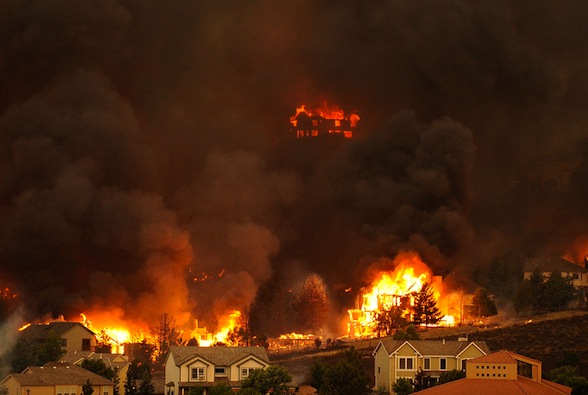
This summer has seen nature visiting on man a series of catastrophes.  To name just a few, we have the record-breaking rainfall in Britain in June, the Colorado wildfires and the 1,400,000 storm-struck households in the eastern US.

Colorado burning

Inevitably, many wonder if this is connected to climate change as a result of mankind’s behaviours.  Many now believe so.

But we have to stand on the rock of science.

So it was great to come across a recent article on Grist that led me to this organisation, Climate Communication.  As they say on the About Us page,

Climate Communication is a non-profit science and outreach project funded by the Rockefeller Brothers Fund and the ClimateWorks Foundation. Climate Communication operates as a project of the Aspen Global Change Institute, a non-profit organization dedicated to furthering the scientific understanding of Earth systems and global environmental change.

The article on Grist that had caught my eye was this one, Did climate change ’cause’ the Colorado wildfires? and within that article there was the link to Climate Communication, viz: That much we know with a high degree of confidence, as this excellent review of the latest science by Climate Communication makes clear.

That review on Climate Communication includes the following video,

Not convinced?

Then try this evidence from an interview with Kevin Trenberth of the National Center for Atmospheric Research shown on PBS Newshour,

Want more?  Go for it!

The PBS video came from the British Guardian newspaper (link thanks to Naked Capitalism).  The Guardian reported,

Is it now possible to blame extreme weather on global warming?

Wildfires, heatwaves and storms witnessed in the US are ‘what global warming looks like’, say climate scientists

Posted by Leo Hickman
Tuesday 3 July 2012

Whenever an episode of extreme weather – heatwave, flood, drought, etc – hits the headlines, someone somewhere is sure to point the finger of blame at human-induced climate change.

Such claims are normally slapped down with the much-aired mantra: “You cannot blame a single episode of bad weather on global warming.” But with the on-going record high temperatures affecting large parts of the US, there seems to be a noticeable reduction in such caveats and notes of caution.

This week, scientists have been queuing up, it seems, to explain how the wildfires in Colorado, the heatwave across the eastern seaboard, and the “super derecho” are all indicative of “what global warming looks like“. Most pulled back, though, from directly blaming global warming for such weather events.

“In the future you would expect larger, longer more intense heat waves and we’ve seen that in the last few summers,” Derek Arndt of NOAA Climate Monitoring told the Associated Press.” The same report added: “At least 15 climate scientists told the Associated Press that this long hot US summer is consistent with what is to be expected in global warming.”

So, can we now say, or not, that specific extreme weather events are caused, or at least exacerbated, by global warming? Has anything changed in climate scientists’ understanding of the attribution – or “anthropogenic fingerprint” – of such events? Are they now more confident about making such links?

I put this question to a number of climate scientists ….

Leo Hickman then reports the assessments of eight leading scientists.  Go and read their words here.  If you can do it now!

The science is solid!

So as you watch these scientists talking about the meaning of climate extremes think what you can do today to reduce your own impact on this planet.  Just as importantly, think how you can influence those around you and those that represent you that now is the time to wake up to the fact that nature is telling us to slow down!

As I said in a comment to a post on Tuesday,

The growth in awareness of what we are doing to the planet is astounding. There is hope, we have to promote hope and we have to acknowledge that hope is a powerful agent of change.

Unintended consequences

That law of unintended consequences strikes again.

With thanks to Rich S. for including me on his circulation of this,

ALERT!!!

Look what happens when we cut down too many trees.

Global warming is one thing, but look at what might happen if we continue to clear our forests!

We have to stop cutting down trees! This is getting serious!

It’s really quite simple.

David Roberts of Grist offers a very clear message.

But before going to the piece, just let me say why there’s been a preponderance of climate change articles on Learning from Dogs.  Two reasons come to mind.  The first one is that this blog’s primary theme is integrity.  The idea of writing about what we can learn from the closest species to man, the domesticated dog, came out of the understanding that dogs are integrous creatures.  As I concluded in the Purpose of this blog,

Or, possibly, it’s more accurate to say that our civilisation is under threat and the time left to change our ways, to embrace those qualities of integrity, truth and consciousness for the very planet we all live on, is running out.

So what has this to do with dogs? Simply that man’s best friend, a relationship that goes back tens of thousands of years, is still a wonderful example of the many qualities that we need now for the very survival of the human species.

The second reason is that as many will be aware it is the G20 gathering this week and the more that millions around the world add their demand for common-sense and reason the better that will be.  Again, honesty and integrity, values not usually associated with the world’s political leaders, must come to the fore.

So now to the recent piece from Grist.

Climate change is simple: We do something or we’re screwed

By David Roberts

Back in April, The Evergreen State College invited me to speak at a TEDx event called “Hello Climate Change: Rethinking the Unthinkable.” Videos from the event are now online.

My talk was called “Climate change is simple.” I’m proud to say that I used only 17 of my allotted 15 minutes.

I’ve put an annotated version of my slideshow beneath the video, linking to sources and adding thoughts. The only thing I’ll say about the video itself is that I’ve always thought these things would be better with a soundtrack. If anybody out there on the web wants to make a mashup with it, add some good beats, be my guest.

This is the video of David’s talk.

And in case you think this is all green paranoia, then spend a couple of minutes watching this,

A group of scientists from around the world who are part of The Berkeley Initiative in Global Change Biology (BiGCB) is warning that an ever-growing population and widespread destruction of natural ecosystems may be driving Earth toward a planet-wide tipping point, an irreversible change in the biosphere with unpredictable consequences. Anthony Barnosky, professor of integrative biology at the University of California, Berkeley, is the lead author of a review paper about this issue in the journal Nature.
For full story: NewsCenter.berkeley.edu
Video by Roxanne Makasdjian, UC Berkeley Media Relations

NB. I found the sound levels on these videos to be rather low – hope you can hear them clearly.