Tag: Carl Sagan

Walking Away from Empire; a book review

“Once you eliminate the impossible, whatever remains, no matter how improbable, must be the truth.” Arthur Conan Doyle.

Ten days ago, I finished reading the book Walking Away from Empire: A Personal Journey. It had been sent to me by the author.

Let me explain how this came about.

A few weeks ago, I published an item under the title of Doggedly seeking the truth.  I included the video “The Twin Sides of the Fossil-Fuel Coin: Developing Durable Living Arrangements in Light of Climate Change and Energy Decline.“  That video was a presentation by Prof. Guy McPherson.

Subsequently, during an exchange of emails with Prof. McPherson there was an offer to receive a free copy of his book, Walking Away from Empire: A Personal Journey.  Naturally, I accepted.

Having finished reading the book it seemed only fair to write a review.

So far, so good!

I tried to marshal my thoughts for well over a week.   Couldn’t get started.  Strange, because when immersed in the book the messages were crystal clear.

Why the struggle to embrace Guy McPherson’s messages?  Then in a moment of insight I realised that I was struggling to understand why I was struggling!
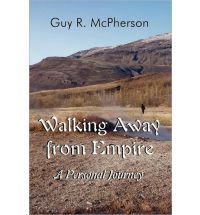
walkingaway
Published by PublishAmerica, LLLP

Because the blunt truth of the matter is that this book spells out the bleedin’ obvious.  Humanity is between a rock and a hard place!

Look no further than the very first paragraph of the first chapter, Reason,:

At this late juncture in the era of industry, it seems safe to assume we face one of two futures. If we continue to burn fossil fuels, we face imminent environmental collapse. If we cease burning fossil fuels, the industrial economy will collapse. Industrial humans express these futures as a choice between your money or your life, and tell you that, without money, life isn’t worth living. As should be clear by now, industrial humans — or at least our “leaders” — have chosen not door number one (environmental collapse) and not door number two (economic collapse), but both of the above.

Sandy Krolick of Transition Voice wrote a review of Guy McPherson’s book in September, 2011.  His last sentence was, “This is a book you will not put down; and having read it, you’ll no longer be able to ignore its conclusions.

Again, what Sandy Krolick writes is perfectly correct. No argument.  Yet …. something about that sentence from Sandy doesn’t speak to me.  That struggle again.

Then I got it!

Let me go straight to page 177 of Prof. McPherson’s book and quote this:

It’s no longer just the living planet we should be concerned about. It’s us. The moral question, then: What are you going to do about it?

Then one paragraph later, come this:

There is simply no feeding the hollow spot in my gut and my psyche, as there was when I replaced my invisible, omnipotent friend in the sky with reason. Instead of abandoning the mirage of eternal life, I’m abandoning the mirage of globalization. Instead of giving up an everloving god, I’m giving up a comfortable life spent with my best friend. I’m taking yet another step in the path from make-believe to reality. And, as we all know, reality is a harsh, dispassionate mistress who doesn’t give a damn about the emptiness in my fragile little psyche. Fortunately, I still have the amusing memories of the absurdity of my former life, in which I believed I was saving the world by conducting and publishing mundane research and teaching irrelevant concepts to a largely disinterested audience.

I found the first step to be the most difficult. Simply recognizing the industrial economy as an omnicidal imperial beast forced me to cross a threshold most people find far too formidable to attempt.

Just reflect on those key words, “a threshold most people find far too formidable to attempt.”

Keep those words in mind as I quote the next paragraph from the book.

We’ve never been here as a species, much less as individuals. And every cultural message tells us we’re wrong, that the industrial age will last forever, that justice and goodness will prevail over every enemy (i.e., terrorist), that progress is a one-way street to industrial nirvana, that the harbinger of hope will keep the oil coming and the cars running and the planes flying so we can all soak up the sun on a sandy beach any time we need a break from our tumultuous lives in the cube farms of empire.

This, then, was the result of reading the book.  The realisation of the reality of our existence.  The immensity of the truth of where mankind is.  The here and NOW!

Sorry, let me amend those last sentences.  My realisation of the reality of my existence.  The immensity of the truth of where I am.  My here and NOW!

No wonder I struggled.

So not much of a book review, more a review of yours truly!  That is the power of this book.  Sandy Krolick was right; “This is a book you will not put down; and having read it, you’ll no longer be able to ignore its conclusions.

Be warned.  When you read this book brace yourself for what you see staring out of the mirror back at you. There will be no room left for delusion.

As Carl Sagan said, “It is far  better to grasp the universe as it really is than to persist in delusion, however satisfying and reassuring.

Carl Sagan

How very precious, vulnerable and fragile is this precious place we call home.

Today’s consciousness perambulation is the fault of Mr. P., as I like to call him. I refer to Pendantry as he is on his blog, Wibble.

You see on Sunday he added a comment to my post Just a small, white dot! that included the beautiful and awe-inspiring film made by the late Carl Sagan called Pale Blue Dot.

carl-sagan

Like millions of others, I came to admire Carl Sagan through watching the fabulous, the truly fabulous, television series Cosmos: A Personal Voyage. (NB. All the episodes are on YouTube, Episode One is at the end of this Post, Ed.)  Here’s how WikiPedia opens their reference to Carl.

Carl Edward Sagan (November 9, 1934 – December 20, 1996) was an American astronomer, astrophysicist, cosmologist, author, science popularizer and science communicator in astronomy and natural sciences. He spent most of his career as a professor of astronomy at Cornell University where he directed the Laboratory for Planetary Studies.

He published more than 600 scientific papers and articles and was author, co-author or editor of more than 20 books. He advocated scientifically skeptical inquiry and the scientific method, pioneered exobiology and promoted the Search for Extra-Terrestrial Intelligence (SETI).

Sagan is known for his popular science books and for the award-winning 1980 television series Cosmos: A Personal Voyage, which he narrated and co-wrote.  The book Cosmos was published to accompany the series. Sagan wrote the novel Contact, the basis for a 1997 film of the same name.

He died far too young and was a tragic loss to humanity.  The Carl Sagan web portal is here.

That 3:30 minute video Pale Blue Dot has, likewise, been seen by millions.  If you or someone you know hasn’t seen it, then you must pause now …

It’s practically impossible to watch that video and not embrace the central message from Mr. Sagan.  Here’s the transcript:

Our home from 6 billion kilometres. A very tiny dot against the vastness of space.

From this distant vantage point, the Earth might not seem of any particular interest. But for us, it’s different.

Consider again that dot. That’s here. That’s home. That’s us.

On it everyone you love, everyone you know, everyone you ever heard of, every human being who ever was, lived out their lives.

The aggregate of our joy and suffering, thousands of confident religions, ideologies, and economic doctrines, every hunter and forager, every hero and coward, every creator and destroyer of civilization, every king and peasant, every young couple in love, every mother and father, hopeful child, inventor and explorer, every teacher of morals, every corrupt politician, every “superstar,” every “supreme leader,” every saint and sinner in the history of our species lived there – on a mote of dust suspended in a sunbeam.

The Earth is a very small stage in a vast cosmic arena.

Think of the rivers of blood spilled by all those generals and emperors so that in glory and triumph they could become the momentary masters of a fraction of a dot.

Think of the endless cruelties visited by the inhabitants of one corner of this pixel on the scarcely distinguishable inhabitants of some other corner. How frequent their misunderstandings, how eager they are to kill one another, how fervent their hatreds.

Our posturings, our imagined self-importance, the delusion that we have some privileged position in the universe, are challenged by this point of pale light. Our planet is a lonely speck in the great enveloping cosmic dark. In our obscurity – in all this vastness – there is no hint that help will come from elsewhere to save us from ourselves.

The Earth is the only world known, so far, to harbor life. There is nowhere else, at least in the near future, to which our species could migrate. Visit, yes. Settle, not yet. Like it or not, for the moment, the Earth is where we make our stand.

It has been said that astronomy is a humbling and character-building experience. There is perhaps no better demonstration of the folly of human conceits than this distant image of our tiny world. To me, it underscores our responsibility to deal more kindly with one another and to preserve and cherish the pale blue dot, the only home we’ve ever known.

Tomorrow, I will stay with the theme of our beautiful planet. Hope you can join me.

Now spoil yourself and watch Episode One of Cosmos.

and it’s so insignificant!

Yesterday’s post It’s all we have showing the famous Earthrise picture taken from Apollo 8 generated a lovely follow-up.

One of the comments was from Mike Turner who wrote,

It’s all we have and it’s so insignificant!

The Pale Blue Dot

Mike included a link to an entry on WikiPedia about the tiny, small dot of light in the universe that is Earth, shown in a photograph taken by spaceship Voyager 1 from the edge of the Solar System on February 14th, 1990.  Here’s that photograph,

Planet Earth from 3,762,136,324 miles

Can you see our planet home?  Earth appears as a tiny dot (the blueish-white speck approximately halfway down the brown band to the right) within the darkness of deep space. In a 2001 article by Space.comSTScI‘s Ray Villard and JPL‘s Jurrie Van der Woude selected this photograph as one of the top ten space science images of all time.

Carl Sagan later wrote about his deep feelings about this photograph.  That was almost 20 years ago and, as I reflected just a few days ago, human insanity still seems alive and well; it’s about time that the majority of us recognised the fragility and vulnerability of where we live.

Sagan’s words are reproduced here and should be read by every inhabitant of this planet.

From this distant vantage point, the Earth might not seem of particular interest. But for us, it’s different. Look again at that dot. That’s here, that’s home, that’s us. On it everyone you love, everyone you know, everyone you ever heard of, every human being who ever was, lived out their lives. The aggregate of our joy and suffering, thousands of confident religions, ideologies, and economic doctrines, every hunter and forager, every hero and coward, every creator and destroyer of civilization, every king and peasant, every young couple in love, every mother and father, hopeful child, inventor and explorer, every teacher of morals, every corrupt politician, every “superstar,” every “supreme leader,” every saint and sinner in the history of our species lived there – on a mote of dust suspended in a sunbeam.The Earth is a very small stage in a vast cosmic arena. Think of the rivers of blood spilled by all those generals and emperors so that, in glory and triumph, they could become the momentary masters of a fraction of a dot. Think of the endless cruelties visited by the inhabitants of one corner of this pixel on the scarcely distinguishable inhabitants of some other corner, how frequent their misunderstandings, how eager they are to kill one another, how fervent their hatreds.

Our posturings, our imagined self-importance, the delusion that we have some privileged position in the Universe, are challenged by this point of pale light. Our planet is a lonely speck in the great enveloping cosmic dark. In our obscurity, in all this vastness, there is no hint that help will come from elsewhere to save us from ourselves. [my italics, Ed]

The Earth is the only world known so far to harbor life. There is nowhere else, at least in the near future, to which our species could migrate. Visit, yes. Settle, not yet. Like it or not, for the moment the Earth is where we make our stand.

It has been said that astronomy is a humbling and character-building experience. There is perhaps no better demonstration of the folly of human conceits than this distant image of our tiny world. To me, it underscores our responsibility to deal more kindly with one another, and to preserve and cherish the pale blue dot, the only home we’ve ever known.

You may also wish to watch this video.

Thanks Mike for prompting this piece.