We live on a finite Earth. But really understanding what that means is difficult. I guess because most of us think that in our own little way we can’t really be doing any harm to the planet – I mean what’s another few grams of CO2?
Al Bartlet, University of Colorado
Well here’s Dr Albert Bartlett of the Department of Physics at the University of Colorado chatting about arithmetic! And if you go to his website, you will come across this quote on the home page:
“Can you think of any problem in any area of human endeavor on any scale, from microscopic to global, whose long-term solution is in any demonstrable way aided, assisted, or advanced by further increases in population, locally, nationally, or globally?”
Want to sit in on his famous lecture, “Arithmetic, Population and Energy: Sustainability 101”? Well you can.
The lecture is broken down into 8 10-minute videos, each of them on YouTube. The first two instalments are in this post with each of the following three days having the next two.
Does anyone else see how perverted this story is? A company which is 60% owned by the U.S. Treasury, in other words, 60% owned by taxpayers — not voluntary shareholders, but TAXPAYERS, has hired a private investment banking company to take the company public.
That is, to be sold to public stockholders. For a profit. Which is going to be distributed to whom? The government. Who took the company over by edict, essentially by force, ignoring lawfully binding financial contracts in the process. Oh, yes, technically G.M. went through a “banktuptcy,” but when one of the two involved parties is the federal government — the one who makes up the rules of the game — then it isn’t a game anymore. It’s “do it, or else!”
GM Headquarters
Absolutely unbelievable. This IPO should not be happening. The bailout should not have happened. None of this should have happened. If the company cannot generate a profit in the marketplace, then it should go bankrupt and its resources freed up to be used where they are most valued by the marketplace.
Derivative securities are not inherently evil, though the media would have you think otherwise. It seems that any
Are they evil?
type of investment that does not directly involve commodities is an easy target these days.
But derivatives are just another type of investment, those whose value is derived from some underlying security or asset or event. Insurance is a type of derivative investment, as a matter of fact. If the bad event happens (a car accident, flood, or fire, for example), then a claim is made against the policy. If not, the policy expires. The value of the policy is derived from the insured asset or event.
If derivatives are bad, then so too is insurance. If derivatives are bad, then so too are leases with the option to own. If derivatives are bad, then so too is the equity in any type of company, small or large, private or public, including those that produce real products and commodities, for stock is nothing more than an option to buy the underlying assets of the company for the price of the face value of its debt. If derivatives are bad, then so too are convertible securities and most every other type of financial innovation we’ve witnessed in the last 30 years, and for decades to come.
Several times a week, I drop into Karl Denninger’s blog The Market Ticker. While frequently the articles are too technical for me, it’s still, nonetheless, possible to get the drift of Karl’s messages.
As his overall theme is strongly coincident with my own views on my pension investments, and which have served me proud over the last 10 years, especially the last 2 years, it’s natural that I like what Karl does.
But the point of this Post is to underline just how much time and effort Karl puts in to his work, all of which is free to the world at the click of a mouse.
Are there others who devote equal amounts of time to their Blogs and websites? Yes, many! And many of them are also heroes (and heroines!)
Of course, I have no doubt that The Market Ticker is part of Karl’s business strategy but, again, he could choose other ways to make his income without sharing, for free, so many valuable ideas.
Here are a couple of examples to underline my deep respect for this man. (Taken from Market Ticker on the 13th May.)
Transocean Deepwater Horizon Explosion-A Discussion of What Actually Happened?
The trouble with the way that the news is presented and consumed is that major events are delivered in ‘headline’ style and even something as terrible as the oil spill in the Gulf of Mexico is starting to compete with other, more current, news stories.
The other issue with news channels is that it is uncommon to be presented with a real insight into the human scale of massive catastrophes. Thank goodness for the web!
Drilling Ahead is a website that describes itself as A Social Network of Oil & Gas Professionals. Another website find courtesy of Naked Capitalism.
An Ill-fated Discovery
According to news accounts, at about 10 p.m. CDT last Tuesday, Deepwater Horizon was stable, holding an exact position in calm, dark seas about 45 miles south of the Louisiana coastline. Water depth in the area is 5,000 feet. The vessel manifest listed 126 souls on board.
Deepwater Horizon was finishing work on an exploration well named Macondo, in an area called Mississippi Canyon Block 252. After weeks of drilling, the rig had pushed a bit down over 18,000 feet, into an oil-bearing zone. The Transocean and BP personnel were installing casing in the well. BP was going to seal things up, and then go off and figure out how to produce the oil — another step entirely in the oil biz.
The Macondo Block 252 reservoir may hold as much as 100 million barrels. That’s not as large as other recent oil strikes in the Gulf, but BP management was still pleased. Success is success —
certainly in the risky, deep-water oil environment. The front office of BP Exploration was preparing a press release to announce a “commercial” oil discovery.
This kind of exploration success was par for the course for Deepwater Horizon. A year ago, the vessel set a record at another site in the Gulf, drilling a well just over 35,000 feet and discovering the 3 billion barrel Tiber deposit for BP. SoDeepwater Horizon was a great rig, with a great crew and a superb record. You might even say that is was lucky.
But perhaps some things tempt the Gods. Some actions may invite ill fate. Because suddenly, the wild and wasteful ocean struck with a bolt from the deep.
The Lights Went out;
and Then...
Witnesses state that the lights flickered on the Deepwater Horizon. Then a massive thud shook the vessel, followed by another strong vibration. Transocean employee Jim Ingram, a seasoned
offshore worker, told the U.K. Times that he was preparing for bed after working a 12-hour shift. “On the second [thud],” said Mr. Ingram, “we knew something was wrong.” Indeed, something was very wrong.
Within a moment, a gigantic blast of gas, oil and drilling mud roared up through three miles of down-hole pipe and subsea risers. The fluids burst through the rig floor and ripped up into the gigantic draw-works. Something sparked. The hydrocarbons ignited. In a fraction of a second, the drilling deck of the Deepwater Horizon exploded into a fireball. The scene was an utter conflagration.
Came across a relatively new Blog with the title The Fourteenth Banker. Caught my eye because of the similarity to the book written by Simon Johnson and James Kwak of Baseline Scenario fame. Here’s an extract from the ‘About’ piece of this new Blog.
In response to the comments of folks in the Congress and oversight regimes, I have created this blog as a home for bankers who need to speak out and do not have a central clearinghouse or a safe place to do so. Big banks now treat their employees like property, bought and owned. Typically employees must subject themselves to all sorts of potential sanctions, forfeitures of compensation, clawbacks and even lawsuits if they speak in ways we often have thought were protected speech. I am not talking about revealing confidential customer or proprietary information, I am talking about simply commenting on a company, management philosophy, making general observations or raising concerns. It makes one appreciate unions even if not historically supportive of unions. At least management and labor can have a debate. Not so in today’s large banks. Gag orders are written in the most intimidating way, included in Codes of Ethics, attached to incentive plans, posted on the company home pages. We should ask ourselves, what is the big secret?
Do support the Blog by calling by. Here’s a taste of what they are writing about:
This can only be called what it is. Delusion. Delusion about self, society, morality, values and anything else you can name. These are symptoms of a grave illness which is too common among those in power. In fact, the illness may be the requisite to power.
Uncontrolled borders and Washington’s lack of self-control
[This article appeared in the online version of the Wall Street Journal on May 1st. Copyright exists with the WSJ and it is reproduced below without permission. However, it seems to me to be such an insightful commentary on present conditions that the decision was taken to publish it on Learning from Dogs. Ed.]
By Peggy Noonan
Peggy Noonan
We are at a remarkable moment. We have an open, 2,000-mile border to our south, and the entity with the power to enforce the law and impose safety and order will not do it. Wall Street collapsed, taking Main Street’s money with it, and the government can’t really figure out what to do about it because the government itself was deeply implicated in the crash, and both political parties are full of people whose political careers have been made possible by Wall Street contributions. Meanwhile we pass huge laws, bills so comprehensive, omnibus and transformative that no one knows what’s in them and no one—literally, no one—knows how exactly they will be executed or interpreted. Citizens search for new laws online, pore over them at night, and come away knowing no more than they did before they typed “dot-gov.”
It is not that no one’s in control. Washington is full of people who insist they’re in control and who go to great lengths to display their power. It’s that no one takes responsibility and authority. Washington daily delivers to the people two stark and utterly conflicting messages: “We control everything” and “You’re on your own.”
All this contributes to a deep and growing alienation between the people of America and the government of America in Washington.
This is not the old, conservative and long-lampooned “I don’t trust gummint” attitude of the 1950s, ’60s and ’70s. It’s something new, or rather something so much more broadly and fully evolved that it constitutes something new. The right never trusted the government, but now the middle doesn’t. I asked a campaigner for Hillary Clinton recently where her sturdy, pantsuited supporters had gone. They didn’t seem part of the Obama brigades. “Some of them are at the tea party,” she said.
None of this happened overnight. It is, most recently, the result of two wars that were supposed to be cakewalks, Katrina, the crash, and the phenomenon of a federal government that seemed less and less competent attempting to do more and more by passing bigger and bigger laws.
Add to this states on the verge of bankruptcy, the looming debt crisis of the federal government, the likelihood of ever-rising taxes. Shake it all together, and you have the makings of the big alienation. Alienation is often followed by full-blown antagonism, and antagonism by breakage.
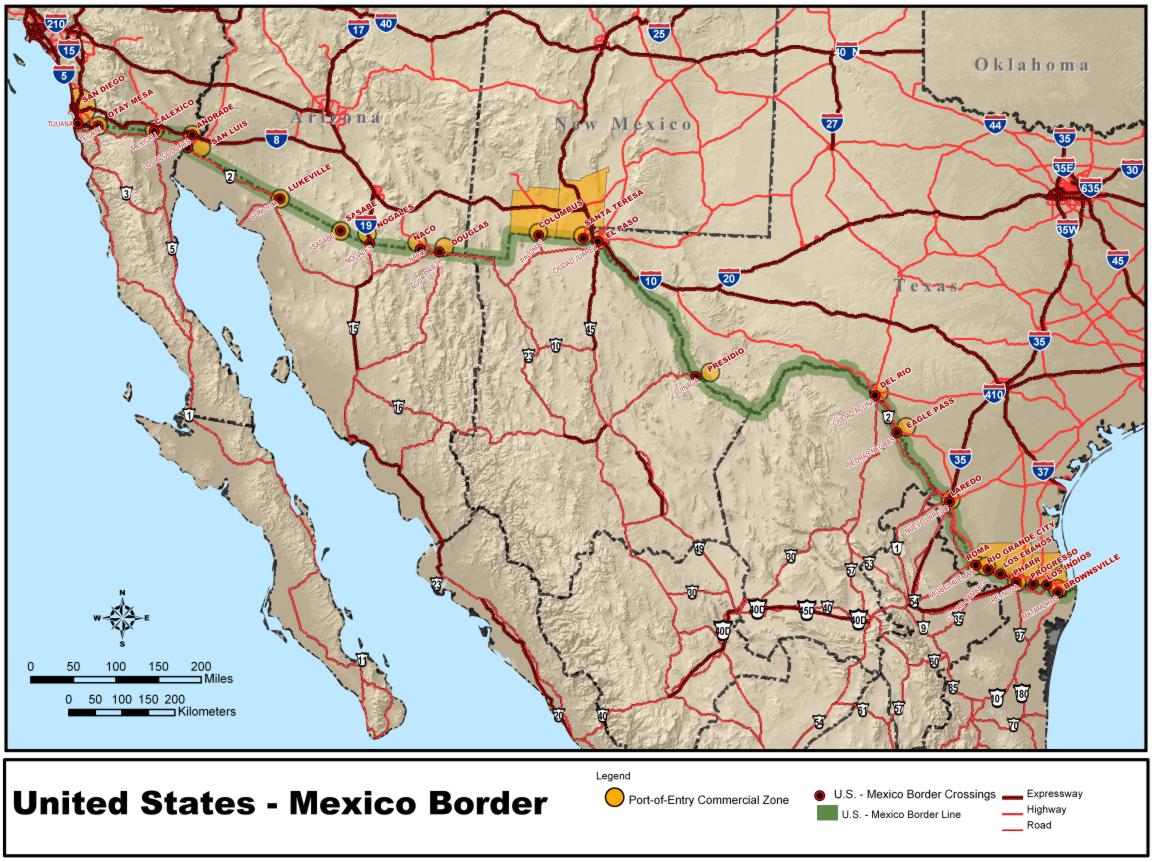
Which brings us to Arizona and its much-criticized attempt to institute a law aimed at controlling its own border with Mexico. It is doing this because the federal
The US-Mexico border
government won’t, and because Arizonans have a crisis on their hands, areas on the border where criminal behavior flourishes, where there have been kidnappings, murders and gang violence. If the law is abusive, it will be determined quickly enough, in the courts. In keeping with recent tradition, they were reading parts of the law aloud on cable the other night, with bright and sincere people completely disagreeing on the meaning of the words they were reading. No one knows how the law will be executed or interpreted.
Every state and region has its own facts and experience. In New York, legal and illegal immigrants keep the city running: They work hard jobs with brutal hours, rip off no one on Wall Street, and do not crash the economy. They are generally considered among the good guys. I’m not sure New Yorkers can fairly judge the situation in Arizona, nor Arizonans the situation in New York.
But the larger point is that Arizona is moving forward because the government in Washington has completely abdicated its responsibility. For 10 years—at least—through two administrations, Washington deliberately did nothing to ease the crisis on the borders because politicians calculated that an air of mounting crisis would spur mounting support for what Washington thought was appropriate reform—i.e., reform that would help the Democratic and Republican parties.
Both parties resemble Gordon Brown, who is about to lose the prime ministership of Britain. On the campaign trail this week, he was famously questioned by a party voter about his stand on immigration. He gave her the verbal runaround, all boilerplate and shrugs, and later complained to an aide, on an open mic, that he’d been forced into conversation with that “bigoted woman.”
He really thought she was a bigot. Because she asked about immigration. Which is, to him, a sign of at least latent racism.
The establishments of the American political parties, and the media, are full of people who think concern about illegal immigration is a mark of racism. If you were Freud you might say, “How odd that’s where their minds so quickly go, how strange they’re so eager to point an accusing finger. Could they be projecting onto others their own, heavily defended-against inner emotions?” But let’s not do Freud, he’s too interesting. Maybe they’re just smug and sanctimonious.
The American president has the power to control America’s borders if he wants to, but George W. Bush and Barack Obama did not and do not want to, and for the same reason, and we all know what it is. The fastest-growing demographic in America is the Hispanic vote, and if either party cracks down on illegal immigration, it risks losing that vote for generations.
But while the Democrats worry about the prospects of the Democrats and the Republicans about the well-being of the Republicans, who worries about America?
No one. Which the American people have noticed, and which adds to the dangerous alienation—actually it’s at the heart of the alienation—of the age.
In the past four years, I have argued in this space that nothing can or should be done, no new federal law passed, until the border itself is secure. That is the predicate, the commonsense first step. Once existing laws are enforced and the border made peaceful, everyone in the country will be able to breathe easier and consider, without an air of clamor and crisis, what should be done next. What might that be? How about relax, see where we are, and absorb. Pass a small, clear law—say, one granting citizenship to all who serve two years in the armed forces—and then go have a Coke. Not everything has to be settled right away. Only controlling the border has to be settled right away.
Instead, our national establishments deliberately allow the crisis to grow and fester, ignoring public unrest and amusing themselves by damning anyone’s attempt to deal with the problem they fear to address.
Why does the federal government do this? Because so many within it are stupid and unimaginative and don’t trust the American people. Which of course the American people have noticed.
If the federal government and our political parties were imaginative, they would understand that it is actually in their interests to restore peace and order to the border. It would be a way of demonstrating that our government is still capable of functioning, that it is still to some degree connected to the people’s will, that it has the broader interests of the country in mind.
The American people fear they are losing their place and authority in the daily, unwinding drama of American history. They feel increasingly alienated from their government. And alienation, again, is often followed by deep animosity, and animosity by the breaking up of things. If our leaders were farsighted not only for themselves but for the country, they would fix the border.
Peggy Noonan is a columnist for The Wall Street Journal whose work appears weekly in the Journal’s Weekend Edition and on OpinionJournal.com.
She is the author of eight books on American politics and culture. The most recent, “Patriotic Grace,” was published in October 2008. Her first book, the bestseller “What I Saw at the Revolution: A Political Life in the Reagan Era,” was published in 1990.
She was a special assistant to the president in the White House of Ronald Reagan. Before that she was a producer at CBS News in New York. In 1978 and 1979 she was an adjunct professor of journalism at New York University.
One of the fascinating aspects of my new American life is seeing how loud the volume of dissent is from the American
Bill Moyers
people about the shenanigans on Wall Street and the Too Big To Fail banks. There is an intensity and passion that I can’t see happening on the other side of the Pond. Maybe this is the cultural legacy of a people that just a short time ago, relatively speaking, were opening up this giant country seeking a better way of life than the ‘old countries’.
This intensity and passion is why, in the end, I believe that the solution to the huge crisis that still awaits us will start from this side of the Atlantic. But it will get a whole lot worse before it gets better, such is the complexity and depth of the fraud that is being visited on decent, ordinary folks in this and many other fine countries.
Bill Moyers of the Bill Moyers Journal on PBS is retiring. He’s approaching 76 and that’s a grand age to be dealing with the workload and stress of a weekly television presentation. His last Journal was broadcast on the 23rd April, a week ago today airing two really important topics. My only regret is that I haven’t been here sufficiently long to view many more of his Journals.
William K Black
In that last broadcast on the 23rd, Bill had two key interviews. In this Post, I want to bring to your attention his first report, which was an interview with William K Black, now an academic but, just as importantly, a former bank regulator. William Black really understands what is going on in banking.
The interview is both fascinating and captivating because, well to me anyway, it explains in terms that us laymen can understand, exactly what is going on and why it is so terribly important that legislation and regulations are brought into force to stop this fraud ever happening again.
This interview has not yet made it’s way onto YouTube so I can only post the link to the Bill Moyers website.
But, please, if you care about what is happening to us in whatever country you live in, click on this link and watch the interview.
And if you want to watch the earlier interview that Bill Moyers had with William Black then here it is.
…. is how Gavin Hewitt recently headed up a post on his BBC Europe blog. The headline caught my eye and then when I read the full article it seemed as yet another piece of western civilisation was sliding into chaos. Maybe it’s my age!
Gavin Hewitt
Gavin Hewitt is the BBC’s Europe Editor and as you can see from his bio, Gavin is a very experienced reporter. Here’s how this Eurozone article starts:
Friday [April 23rd, Ed] will be remembered as the day the euro needed rescuing. Sure it is Greece that has asked to be bailed out but it was still a day that the architects of the single currency had never envisaged. For when it came to it, there were no plans to save a euro member in trouble.
You see what I mean about grabbing one’s attention!
In fact the article is so powerful that I am going to run the risk of incurring the wrath of the BBC’s legal department by republishing it in full.
A suit was filed last week in the US against Goldman Sachs by the US government’s financial watchdog, the Securities and Exchange Commission.
GS is an example of all that is morally and practically wrong with capitalism. This is an obscenely-rich company whose ludicrously-rewarded executives do not actually do anything that I would describe as “work”. Their activities do not in
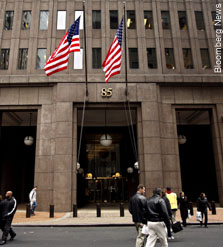
Goldman Sachs HQ
my estimation benefit the world in any meaningful way. They are parasites which feed off the backs of real workers (nurses, police, teachers, firemen, bridge-builders, electricians and so on) and – as in the recent shambles – end up practically killing the host.
There is a good case for forcibly putting them out of business and completely reorganising financial services, with the accent on SERVICES. A functioning society needs investment and jobs. Banks should be there to look after money and provide investment to companies, not shuffle around paper to make themselves obscenely-rich.
GS and others apparently have some sort of electronic system that operates automatically and instantaneously to market movements, allowing them to make vast sums by doing no work. NO WONDER bright graduates seek to join such leech-like firms instead of becoming teachers, researchers or otherwise seeking to do something useful for society apart from themselves.
If they are guilty, I hope we see the company broken up and put out of business. The criminal deception is no different from that at Enron, where people pretending (with already vast salaries) to serve the public were conniving to do criminal damage to put up the cost of their product. They were given a severe penalty, and it should be the same for any white-collar worker if found guilty. I don’t have much hope for the eventual down-to-earth-sizing of GS (they are well-connected and can afford good lawyers …), but I am not the only person angry about all this greed. Get past the cosy confines of Wall Street bars into the real America and there are plenty more who feel the same way.







 Learning from Dogs