Tag: Business

Remarkable people: Warren Buffett

What does Bill Gates admire about Warren Buffet?


On this blog about integrity, and in these difficult economic times, it is particularly poignant to note that Bill Gates cites Warren Buffett’s integrity. This was during a recent event at Columbia Business School in New York City, see below.

While many of the questions from MBA students and the answers from Gates and Buffett are not new, Buffett’s brief witty and topical comments provide considerable insight into his thinking.

It is particularly interesting to get a sense of how the world is viewed by people with their perspective. When asked about the outlook for America, both Gates and Buffett answered that it is very good. Warren Buffett even offered any of the MBA students $100,000 in return for 10% of their future earnings. Later, he increased the offer to $150,000, if they received training in personal communication skills!

Watch them together on CNBC at Columbia Business School, New York City on November 12, 2009.

Maybe you are interested in further information about Warren Buffett, if so you are not alone. The BBC, among others, have taken a strong interest in him recently.

You might like to read and view some recent stories on the “Oracle of Omaha” including:

Despite a setback in 2008, Warren Buffett’s long term investment success is without question.

By John Lewis

Government Spending and jobs! Uh? What jobs?

Government spending isn’t what it is made out to be.

The headlines are full of claims about the number of jobs created or saved by the stimulus package, the impact of the Cash for Clunkers program on U.S. output and, the latest, the reduction in the deficit from the proposed U.S. health care reform legislation.

What total rubbish!

Government spending is just that — SPENDING.  It does not, can not, never has, and never will CREATE any output, economic wealth, or job.  The only way — and I mean the ONLY way — that profits or wealth or a new job is created is through a business.  Businesses are the only entity that can hire labor and capital and combine them in such a way as to create a product or a service that society may decide is worth more than it costs.

And that spread between the cost of production and what society is willing to pay is economic value; it is the generation of profits that then enables the taxes that the government collects to spend on the goods and services it thinks America ought to consume.

Private industry is the job creator.  Not the government.   And this is not wishful thinking, or a political point of view, or a theoretical model.  It is an unmitigated, irrefutable fact.

By Sherry Jarrell

The ageing of the USA, Part Three

Back to the future – a new way of seeing forward

The concluding part of a three-part paper previously published by Professor Sherry Jarrell, Part One is here and Part Two is here.

What kinds of business establishments will thrive in the U.S. city of the future?  To answer this question, we examined the count of the number of establishments per business category listed on yellowpagecity.com, adjusted proportionately to represent a population of 500,000, and found the following results.

Death services. Although the strain on the healthcare system has received much attention in relation to ageing in the United States, the next logical step—death—is rarely mentioned, although it certainly represents many business and professional opportunities.  Our data suggest that the number of funeral facilities and cremations per 500,000 residents might double or even triple by 2025. The same applies to the number of cemeteries and companies listing monuments.

Healthcare. Along with roughly 30% more doctors, our data suggest that a range of medical services and products will be in greater demand by 2025. Nearly all of them relate to age. Consistent with the expectation that mental and self-care disabilities increase with age, listings also jump considerably for alcohol information and treatment, and counseling services. This trend doesn’t occur, however, for mental health services.

Real estate and living arrangements. Real estate listings significantly increase across the six MSAs, along with a substantial growth in listed land surveyors. The number of listings for nursing and convalescent homes moves from an average of 30 for the current MSAs to 50 for the 2020 and 2025 cities. There’s an even larger average rise in the number of retirement communities and homes.

Perhaps the most surprising pattern, at least initially, is the dramatic increase in the number of listings for mobile home dealers and mobile home parks and communities. Insurance studies have shown, however, that the percent of manufactured (mobile) home owners who are age 65 and older has risen from 26% in 1990 to 30% in 2002. Similar percentages are cited for owners who are retired. In addition, over the same period, the amount of owners age 80 and older has changed from 3% to 7%. Therefore, the future might be replete with mobile homes. The data might reflect the strategy of retirees selling larger homes to extract the equity, which is used to help fund retirement and buy a less-expensive manufactured home.

Activities. The data show a marked increase in the number of associations, clubs, churches, and fraternal organizations, which supports the description of mature adults as “joiners.” Bingo games are more popular in the 2020 and 2025 cities. Perhaps most noticeably, more golf is played in the 2020 and 2025 MSAs, requiring many more golf courses and golf-related products and services—not just in Florida, but also in Youngstown, Utica, and Scranton. Residents in the 2020 and 2025 cities also spend more time at the library, at recreation centers and parks, and reading newspapers.

Finance. Services that will be in higher demand as retirees seek assistance in managing their retirement assets include credit and debt counseling services, insurance, loans, mutual funds, and stock and bond brokers.

Products. The number of listings for new and used automobile dealers increases between the 2005 and 2025 cities, as do listings for new and used furniture dealers, health and diet foods, hardware, lawn and garden equipment and supplies, service stations, TV and radio equipment sales and service, and vitamins. But the data also reveal many other rising trends that are likely age-related, such as for antique dealers, arts and crafts, ceramic equipment and supplies, embroidery, gift shops, giftwares, jewelers, and security-related products. The substantial increase in florists is probably related to the number of hospitals, funeral facilities, and crematories in the cities.

Services. The Yellow Pages listings indicate many more business, employment, and investment opportunities in the future. Several categories relate to home improvement, such as contractors for remodeling, landscaping, and swimming pools. Home maintenance also is in greater demand in cities with older populations. Similarly, listings related to servicing and repairing automobiles, furniture, and jewelry rise across the three pairs of cities—along with beauty salons and massage. Pets apparently deserve no less, as pet washing and grooming services are in greater demand in cities with older populations.

Research Implications

This innovative methodology for studying various aspects of the future reveals that many of the detailed trends across the three pairs of cities have significant implications with respect to new product development and marketing. For example, marketers need to begin partnering with development and land use officials to anticipate future growth in demand for golfing facilities, churches, parks, libraries, cemeteries, and mobile home parks. And medical services providers must be prepared to meet the demands for home health services and many other healthcare preferences of older adults in an increasingly competitive environment.

Although it’s true that many factors other than age will shape future spending patterns, such as changing tastes among mature buyers, new technology, and various economic factors, many of these trends are almost entirely age-related. Therefore, it’s unlikely the future will look that different from Lakeland today, where the share of the population age 65 and older is identical to that projected for the nation in 2025.

The United States will not be a nation of Floridas in 2025; it will be a nation of Lakelands.

By Sherry Jarrell

The ageing of the USA, Part Two

Back to the future – a new way of seeing forward

Part Two of a three-part paper previously published by Professor Sherry Jarrell, Part One is here.

In this post, we examine the current income and spending patterns from metropolitan statistical areas (MSAs) with age demographics similar to those projected for the U.S. economy in 2020 and 2025.  Two MSAs are selected for each year to verify that differences in buying patterns across cities are because of differing age distributions, not peculiarities in the cities.

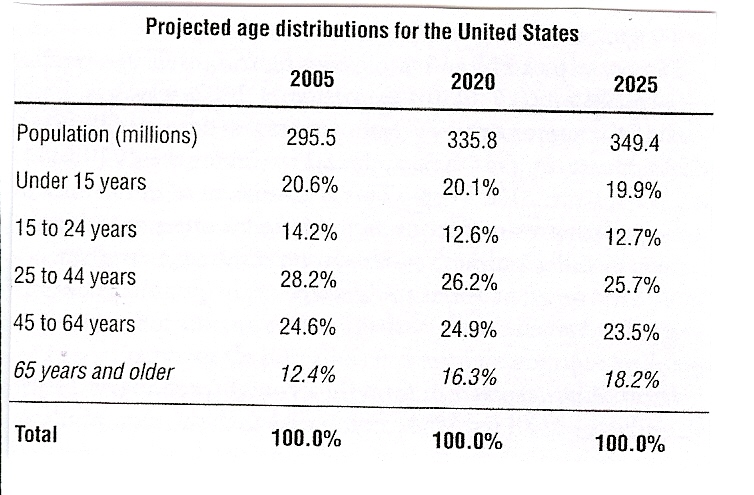
We began with U.S. Bureau of Census data on the percent of total U.S. population expected within five age groups through 2025. The share of U.S. population attributed to people age 65 and older is expected to increase from 12.4% today to 16.3% in 2020 and 18.2% in 2025. By 2025, nearly one out of every four drivers will be age 65 or older, compared with 15.6% today.

Income and Spending Patterns

We find that, although many mature adults are highly mobile, most stay put; this results in the Northeast and Midwest remaining key mature markets.  Three of our four 2020 and 2025 MSAs are in Ohio, New York, and Pennsylvania. We also find that older consumers:

  • spend more of their income: The spending per income ratio rises from .67 today, to .76 for the 2020 MSAs and .77 for the 2025 MSAs.
  • continue to depend on their cars and prefer them to public transportation.
  • spend increasingly larger shares of their income on healthcare.
  • make TV a key element of their lifestyles.
  • remain in their homes and avoid nursing homes.
  • are politically conservative.
  • are civically active and wield growing influence.
  • are joiners.
  • spend heavily on housekeeping supplies, household furnishings and equipment, new vehicles, entertainment, computers, healthcare products, vitamins, healthier foods, and reading materials.
  • spend less on apparel, cosmetics, and fast food.

Retail spending data

We find that the percent of retail spending on necessities such as products at food and beverage stores and the subcategory of grocery stores is generally higher in all six of our MSAs, compared with the nation. The same is true for the general merchandise store category, which includes discount stores.  We also observe generally lower spending shares relative to the nation in the more discretionary categories of clothing and accessories stores, furniture and home furnishings stores, electronics and appliance stores, building materials stores, and garden equipment stores.

The more important observations relate to spending patterns across the three pairs of MSAs. Looking at food and beverage stores, spending as a share of total retail sales declines across the three pairs of MSAs with increasingly older populations. Beginning with an average of 17.2% in the 2005 MSAs, spending at food and beverage stores drops to 14.1% in the 2025 MSAs.

Similarly, the subcategory of grocery stores falls from 15.1% today to 12.2% in the 2025 MSAs. Note that the approximately 3 percentage point declines in these categories are in spending relative to total retail sales, and that within the categories, the decreases in spending are nearly 20%. For example, for every $1,000 in retail spending in the 2005 cities, approximately $151 is spent at grocery stores. That compares with $122 in the 2025 cities. Thus, although spending shares at food and beverage stores are higher than the national average in all six MSAs, the spending shares fall across the three pairs of MSAs as their populations become increasingly older.

The trend also is downward over time for food service and drinking places, from an average of 9.7% in the 2005 MSAs to 7.5% in the 2025 MSAs—with the trend again representing a roughly 20% absolute dollar spending decline per capita within the category. These results support the expectation that older consumers eat healthier and in less quantities (especially in the case of fast food), and also spend fewer dollars at drinking places.

Per capita spending at clothing and accessories stores decreases from an average of 4% of retail sales in the two 2005 cities to 3.2% in the 2025 cities. As before, although the 1% drop appears small, it represents an approximately 20% reduction in per capita spending.

What types of stores benefit from older populations?

Our results indicate increased spending on furniture, automobiles, and homes. Looking at the per capita shares of total retail spending for furniture, home furnishings, and electronics and appliances, spending shares rise from an average of 2% in the 2005 MSAs to 3.9% in the 2020 MSAs and 4.2% in the 2025 MSAs. This suggests a doubling of per capita spending at furniture and related stores. There are similar patterns for the subcategories of furniture and home furnishings stores, and electronics and appliance stores. Spending also generally rises at building materials and garden equipment stores. Upward trends across the six cities additionally are shown for motor vehicles and parts, and healthcare and personal care.

In the third and final installment of this research, we will discuss the specific types of business establishments that will thrive in the U.S. city of the future.

By Sherry Jarrell

The ageing of the USA, Part One

Back to the future – a new way of seeing forward

Part One of a three-part paper previously published by Professor Sherry Jarrell

Market research on the ageing of the U.S. baby boomer generation has focused on the spending habits of these older consumers. A new approach enables marketing researchers to observe the future now: Examine income and spending patterns from metropolitan statistical areas (MSAs) with age demographics similar to those projected for the U.S. economy in 2020 and 2025. With knowledge of these trends, they can begin preparing to meet the demands for particular products and services.

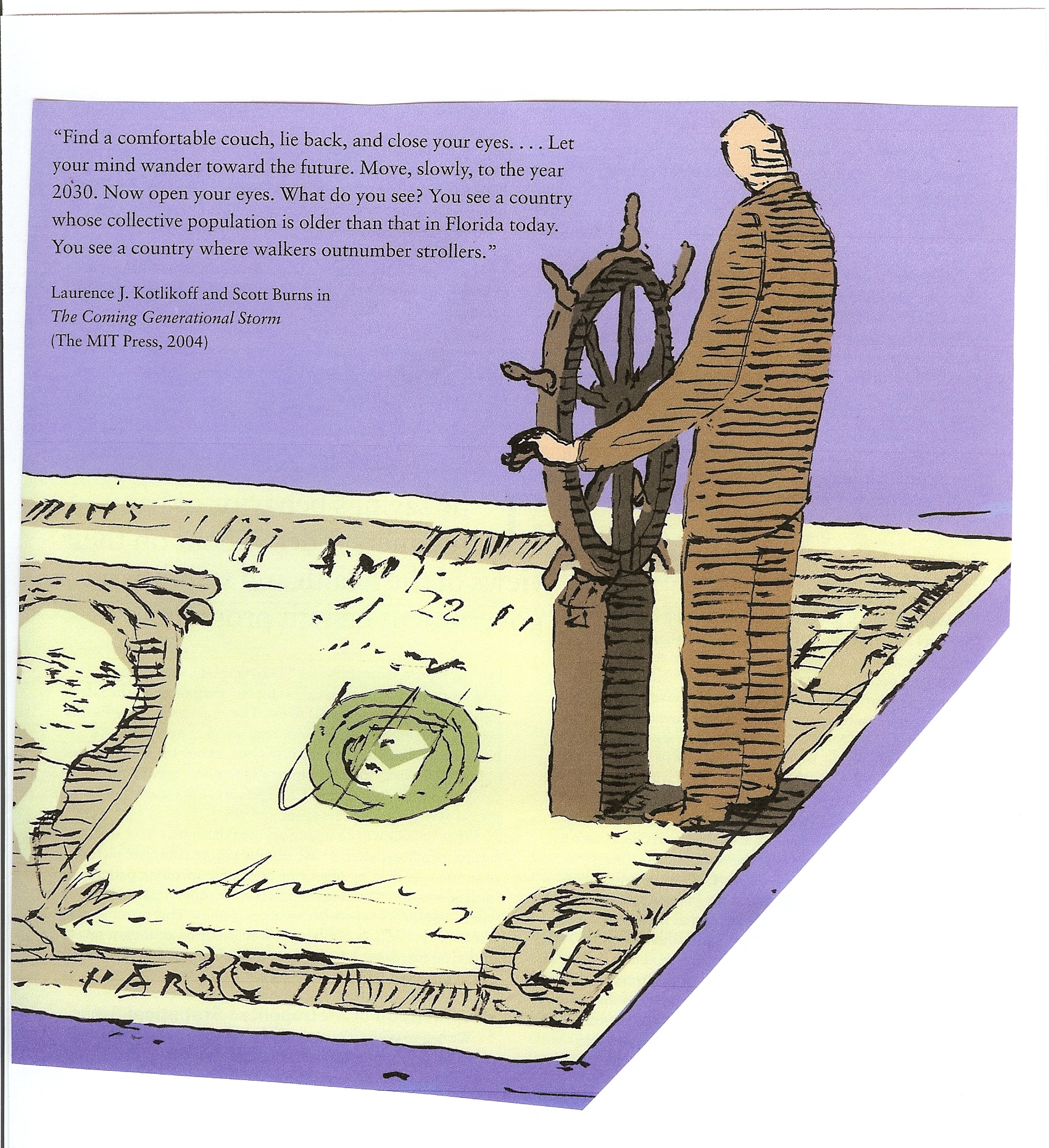
“Find a comfortable couch, lie back, and close your eyes. … Let your mind wander toward the future. Move, slowly, to the year 2030. Now open your eyes. What do you see? You see a country whose collective population is older than that in Florida today. You see a country where walkers outnumber strollers.” Laurence J. Kotlikoff and Scott Burns in The Coming Generational Storm (The MIT Press, 2004).

Projected Age Distribution, U.S. Bureau of Census data

There has been much speculation regarding the effects of the aging population on the U.S. economy. By the year 2025, more than 18% of the U.S. population is projected to be age 65 or older, greater than the percentage in Florida today. This has led some to describe the future of the United States as “a nation of Floridas.” Furthermore, the aging of the United States is not expected to pass with the demographic bulge produced by baby boomers (those born between 1946 and 1964). The U.S. population also is aging because of increased life expectancy and decreased numbers of offspring. As a result, current research projects that the U.S. age profile soon will transform from the current pyramid shape, with older groups at the top, to more of a barrel shape, with roughly 40% of the population divided fairly evenly between the youngest (under age 15) and oldest (over age 65) groups. This new profile will persist for decades.

Although much has been said about aging baby boomers leading to potential crises in Social Security and Medicare, we are more interested in the economic prospects of their retirement as they relate to consumer spending: in particular, whether they have saved enough to maintain their standards of living in retirement. In this regard, the Congressional Budget Office (CBO) reviewed studies from the past decade on the retirement prospects of aging Americans, and found evidence that varied with the standard used to define “enough.” Some studies defined it as the level that maintained the retiree’s working-age standard of living, whereas others defined it as levels that made the retiree as well off as his or her parents at the same age.

The picture that emerges from the CBO study is that baby boomers, relative to their parents at the same age, have higher real incomes, are preparing for retirement at the same pace, and have accumulated more private wealth. Furthermore, the savings behavior of baby boomers and other future retirees is dependent on their views of the health and stability of government benefit programs. If they believe that they will receive all of the government benefits they have earned, then they will tend to work and save less. If they believe that these programs are in trouble, then they might increase savings and postpone retirement.

What impact will changing age demographics have on future spending patterns? We obtain a more complete picture of future spending by observing aggregate spending patterns in local economies that resemble the future now: those cities where “walkers outnumber strollers” today. This novel research approach is based on actual observed data, rather than on speculation and long-term statistical forecasts, both of which are notorious for inaccuracy.

In the next post, we discuss our sometimes surprising findings on the spending patterns in the U.S. city of the future.

By Sherry Jarrell

Remarkable people: Benjamin Zander

Music is his base

Very few people demonstrate and explain the benefits of responding positively to the world around us as effectively as Benjamin Zander.  The Boston Philharmonic Orchestra is “semi-professional”, which means that it is a volunteer orchestra who play to professional standards. He has conducted the orchestra for 30 years; and his standing as a professional cellist and conductor is without question.

Leadership is his forte

But his contribution as a musician is exceeded by his contribution as a speaker on leadership.

He combines speeches on leadership with his musical performances and has given keynote speeches at the World Economic Forum on at least four occasions.

In the book ,”The Art of Possibility”, which he co-authored with his partner Rosamund Stone Zander, they relate the following moving story.

A New Children’s Story

A little girl in second grade underwent chemotherapy for leukaemia.  When she returned to school, she wore a scarf to hide the fact that she lost all her hair. But some of the children pulled it off, and in their nervousness laughed and made fun of her.  The little girl was mortified and that afternoon begged her mother not to make her go back to school. Her mother tried to encourage her, saying. “The other children will get used to it, and anyway your hair will grow in again soon.”

The next morning, when their teacher walked in to class, all the children were sitting in their seats, some still tittering about the girl who had no hair, while she shrank into her chair.  “Good morning, children, “ the teacher said, smiling warmly in her familiar way of greeting them. She took off her coat and scarf. Her head was completely shaved.

After that, a rash of children begged their parents to let them cut their hair. And when a child came to class with short hair, newly bobbed, all the children laughed merrily – not out of fear – but out of the joy of the game. And everybody’s hair grew back at the same time.

Isn’t that wonderful?

Contrast that with the narrow thinking behind a recent incident at at school in the Australia when a child shaved her head to raise money for a charity in support of her father’s illness. She was barred from the school. The story is described here.

How daft is that? As others have asked, what would they have done if a pupil had lost her hair as a result of chemotherapy?

Sometimes you might wonder whether we live on the same planet!

Take time to watch …

If you are not familiar with Benjamin Zander’s presentation, then this is an uplifting experience. For example, this presentation (of more than an hour) was given at the World Economic Forum 2009 (and never mind the image quality, it is good enough!):

More on remarkable people …

By John Lewis

Feeling safe is good!

Safe, as in psychologically as well as physically, has its rewards.

Jon 05'I had a very interesting session recently. I did some coaching work with a client company who managed a small team. The day was split into two – the morning with the client and the afternoon with the whole team.

What struck me about the day was the power of good leadership and the importance of leaders who are aware of how they come across and are capable of forming a relationship with their teams. My client was struggling with her team because she was unaware how she was communicating, not only with her team but with other people in the organisation.

Unfortunately, becoming aware of how we are in a relationship with others brings us face to face with ourselves and requires a willingness to accept ourselves, warts and all, before trying to change anything.

After we all had lunch together and broke the ice a bit we focused on what was working (not what was not working), what was missing, what inspired and what was possible. By examining these areas and so creating a safe environment, everybody was able to reveal more of themselves and what they needed to have a satisfactory, safe working relationship with each other.

By Jon Lavin

Integrity in the making of films.

Creativity, Integrity and commercialism – are there conflicts?

This is guest post from Magnus Dennison.  Magnus is a Cinematographer who, together with his wife, Katja Roberts, runs a film production company in Newcastle-upon-Tyne in the North-East of England. Their company is called Meerkat Films.  Magnus writes about integrity in film making.

I am going to write about film producers who have made creative choices to ensure their films are commercial successes. My question is whether these films lose their integrity when the motivation for making them becomes financial.

A little about my background. I am an independent film producer working in the UK and don’t profess to be an expert on these matters; the views expressed here are simply my opinion.

I will start by presenting one of my favourite films: ‘The Lives of Others’ (2006) directed by Florian Henckel von Das_Leben_der_anderenDonnersmarck. The team has, in my opinion, made one of the most powerful films of the decade. But more interestingly, they have made many choices that have preserved the integrity of the story at the risk of reducing commercial viability.
It is obvious why they have done this; they are passionate about the artistry and the integrity of the film, more than the financial gain. The film is very slow paced and the tension builds so gradually you’re almost unaware of it until you are completely engrossed.

Read more of this guest post

Understanding your Market, Part Three

Market research for sales people

Yesterday, in part two of this three-part Post, we looked at two real-life examples of how listening to your market works.  In this concluding part we examine some practical methods for sales people.  (By sales people I also include those who run their own business because there is no better sales person than the person who runs their own enterprise!)

  1. Empty your mind of all your pre-conceived ideas as to why your customers buy your product or service.
  2. Start off by listening to the reasons why a recent customer bought from you.  Ideally in person but if not, then by telephone.  Never by email!  I’ll leave it to you to think how you might do that – easy in practice.  Comment if you want to explore this aspect.
  3. Listen to sufficient number of customers so that you feel you have a representative view.  I guess what you are looking for is the Pareto relationship – what are the 20% of reasons/motives that generate 80% of your sales.  You should be able to end up knowing what are the differences that make the difference (between you and your competitors.)
  4. Just like Guy Watson of Riverford, knowing why a customer buys MUST also include knowing what use that customer is making of your product/service.
  5. Negotiate with as many customers as possible the opportunity to stay in touch – at whatever frequency makes sense to both sides. Again, think about how you stay in touch – personal visits may be unwieldy but phone usually is acceptable.  Not via email!
  6. Once you know why people become customers then you need to know what their experience is when they are accustomed to using your product or service.  This is key!  Think what you felt like when you bought your last car.  Full of the thrill of a new experience and the anticipation of enjoying your ‘smart’ decision.  Now think how you regard your car today after the reality of the cost of ownership, a few unplanned service issues and when it now feels much more like the utility vehicle that it really is.  If the original sales person doesn’t know how you feel today then there is no way that the sales person’s next sales proposition can be modified to keep you as a client.
  7. Staying in touch allows you to anticipate future needs of your customers – the key to all business success.
  8. Understanding your customers means that you can build loyalty – and loyal customers is the key to business LoyaltyEffectRevCoverprofitability.  If at all possible get hold of a copy of Prof. Fred Reichheld’s The Loyalty Effect.
  9. Use the relationships you build with your customers to seek their ideas as to what their future needs may be, how they would like to see your products and services evolve and who, and why,  they regard as your potential competitors.
  10. Finally, as in the first point, keep an open mind and never assume.  Remember the old ditty – if you assume you make an ‘ass’ out of ‘u’ and ‘me’.

By Paul Handover

Understanding your Market, Part Two

Market research for sales people.

Yesterday, I started a Post on undertaking market research, from a practical point of view. It continues.

To me, there are very significant advantages in being a small business and one of the most important benefits is that it is so much easier to really know what your customers want.  Here’s a fascinating extract (p.139-140) from Malcolm Gladwell’s book Outliers.

In 1889, Louis and Regina Borgenicht boarded an ocean liner in Hamburg bound for America.  Louis was from Galacia, in what was then Poland.  Regina was from a small town in Hungary.  They had been married only a few years and had one small child and a second on the way ……

….. They had enough money to last a few weeks, at best.

…..Louis and Regina found a tiny apartment on Eldridge Street, on Manhattan’s Lower East Side, for $8 a month.  Louis took to the streets, looking for work.  He saw peddlers and fruit sellers and sidewalks crammed with pushcarts.  The noise and activity and energy dwarfed what he had known in the Old World.  He was first overwhelmed, then invigorated.  He went to his sister’s fish store on Ludlow Street and persuaded her to give him a consignment of herring on credit.  He set up shop on the sidewalk with two barrels of fish ….

….. By the end of the week, he had cleared &8.  By the second week, $13.  Those were considerable sums.  But Louise and Regina could not see how selling herring on the street would lead to a constructive business…..

….The answer came to him after five long days of walking up and down the streets of Lower East Side, just a he was about to give up hope.  He was sitting on an overturned box, eating a late lunch of the sandwiches Regina had made for him.  It was clothes. Everywhere around hi, stores were opening – suits, dresses, overalls, shirts, skirts, blouses, trousers, all made and ready to be worn.  Coming from a world where clothing was sewn at home by hand or made to order by tailors, this was a revelation.

Borgenicht took out a small notebook.  Everywhere he went, he wrote down what people were wearing and what was for sale – menswear, women’s wear, children’s wear.  He wanted to find a ‘novel’ item, something that people would wear that was not being sold in the stores.  For four more days he walked the streets.  On the evening of the final day as he walked toward home, he saw a half dozen girls playing hopscotch.  One of the girls was wearing a tiny embroidered apron over her dress, cut low in the front with a tie in the back, and it struck him, suddenly, that in his previous days of relentlessly inventorying the clothing shops of the Lower East Side, he had never seen one of those aprons for sale.

This is such a wonderful example of what understanding your market is all about. Louise was sufficiently smart to know that selling herrings, while lucrative in the short term, was not the long-term answer. He was sufficiently patient to watch and not jump to conclusions until the answer was clear. He was sufficiently tough to keep at it until he had his answer.

Now let’s jump back to Riverford Organics. Here are the words of Guy Watson.

a cooking odyssey Monday 26th October 2009

As you may have guessed, I am a vegetable bore. Twenty five years ago when I sowed my first leek I was fairly well adjusted but now my wife reckons I can turn any conversation to growing, cooking or eating veg within seconds. The box scheme was founded on the invigorating but dangerous assumption that my obsession was, at least partially, shared by customers.

This year I set out on a cooking odyssey to understand how others use or don’t use our vegetables. I cooked in village halls, in my bus, on the beach, in tents in Wales, on stage at WOMAD [World of Music, Arts and Dance, Ed] but most of all in customers’ homes. The experience has been fascinating (for a veg bore), frustrating (you are all so different) and humbling (there is life after vegetables).

My abiding impression is that most of you do share an enthusiasm for our veg, but that we need to make it easier for you to incorporate them into often busy lives. According to our customer survey last year only 5% of you find it really easy to use your box and 32% struggle. However fresh and tasty, local and minimally packaged, fairly traded and sustainably grown those carrots and beans are, if you are struggling to use them we will lose you in the end. (My underlining)

Our mission for the coming months is to make life with a box easier. There will be a few minor changes like less clods of mud but mostly we want to do this by cooking with you; both virtually and in person. We plan to team up with around 100 like-minded professional cooks who are inspired by our veg and on a par with our chef, Jane Baxter, when it comes to cooking them. They will work part-time with us and our customers, inspiring, teaching, demonstrating, creating recipes. We plan to run initiatives including affordable cookery classes and demos in homes, workplaces and community venues; lunch clubs, supper clubs and cooking clubs and a recipe exchange for customers. We have already run some pilot events and now we really want to get going.

get involved

Would you like to improve your cooking, help others improve theirs or do you know a cook who might want to work with us? If you’d like to get involved, email riverfordcooks@riverford.co.uk with your name, contact details, postcode and what you are interested in and we’ll let you know what is going on in your area.

The underlined sentence is the key. Without this insight, Guy would have had no way of knowing what was influencing his sales figures. And if sales were continuing to grow then this potential loss of business would have remained deeply hidden from sight. Only getting out there and mixing it with your customers revealed this problem, potentially a serious problem.

Tomorrow the concluding part of this three-part Post in which we examine some very practical ways of listening to the market.

By Paul Handover