Tag: Biology

Feeding our furry friends.

An insight into the eating behaviours of cats and dogs.

As it happens, Jean and I are vegetarians; Jean going way back in years to when she first turned away from meat. Thus the only meat that we purchase is from Cartwrights’, a local butcher in Grants Pass, where we buy hearts and liver for the dogs. The cats are fed on dried cat biscuits and canned cat food.

All owners of cats and dogs know that they have very different eating habits, and behaviours.

So to put some flesh on the bone, so to speak, about the eating behaviours of cats and dogs I am going to republish a recent essay that appeared over on The Conversation. As always, it is republished within the terms of The Conversation.

ooOOoo

Why cats are fussy eaters but dogs will consume almost anything

by Hannah Rowland, Lecturer in Ecology and Evolution & Research Fellow at Zoological Society of London, University of Cambridge

November 13, 2015

Anyone who’s watched a cat throwing up after munching on grass knows that our feline friends aren’t natural plant eaters. So you might be surprised to discover that these carnivorous animals share some important genes that are more typically associated with herbivores. And this might help explain why cats aren’t always easy to please when it comes to food.

New research suggests that cats possess the genes that protect vegetarian animals from ingesting poisonous plants by giving them the ability to taste bitter. Animals use their sense of taste to detect whether a potential food is nutritious or harmful. A sweet taste signals the presence of sugars, an important source of energy. A bitter taste, on the other hand, evolved as a defence mechanism against harmful toxins commonly found in plants and unripe fruits.

Evolution has repeatedly tweaked animals’ taste buds to suit various dietary needs. Changes in an animal’s diet can eliminate the need to sense certain chemicals in food, and so receptor genes mutate, destroying their ability to make a working protein.

I can haz chlorophyll. Lisa Sympson/Wikimedia Commons, CC BY-SA

One example of this comes from strictly meat-eating cats, who can no longer taste sweetness. But if bitter detection evolved to warn of plant toxins, then it stands to reason that cats, which (usually) eschew plants, shouldn’t be able to taste bitter either. Humans and other vegetable-munching animals can taste bitter because we possess bitter taste receptor genes. If cats have lost the ability to taste bitterness, we should find that their receptor genes are riddled with mutations.

Geneticists at the Monell Chemical Senses Center in Philadelphia scoured the genome of cats and other carnivorous mammals like dogs, ferrets, and polar bears to see if our carnivorous cousins have bitter genes. They were surprised to find that cats have 12 different genes for bitter taste. Dogs, ferrets, and polar bears are equally well endowed. So, if meat eating animals are unlikely to encounter any bitter morsels, why do they boast genes for tasting bitterness?

Taste test

To find out, Peihua Jiang, a molecular biologist at Monell, put cat taste buds to the test. He inserted the cat taste receptor gene into human tissue cells in the lab. When combined, the cell and the gene act as a taste receptor that responds to chemicals dropped onto it.

Jiang discovered that the cat’s taste receptors responded to bitter chemicals found in toxic plants and to compounds that also activate human bitter receptors. The cat bitter taste receptor, known as Tas2r2, responded to the chemical denatonium benzoate, a bitter substance commonly smeared on the fingernails of nail-biting children.

So why have cats retained the ability to detect bitter tastes? Domestic cats owners know how unpredictable cats’ dietary choices can be. Some of the “presents” cats bring to their owners include frogs, toads, and other animals that can contain bitter and toxic compounds in their skin and bodies. Jiang’s results show that bitter receptors empower cats to detect these potential toxins, giving them the ability to reject noxious foods and avoid poisoning.

Hair of the dog. Michal Hrabovec/Flickr, CC BY-NC-SA

But how often do meat-loving cats actually get exposed to bitter and toxic compounds in their diet, compared with the plethora of plant toxins that their vegetarian counterparts have to contend with? Jiang suggests this is not enough to explain why cats have retained such an arsenal of receptors.

Instead, cat taste receptors may have evolved for reasons other than taste. In humans, bitter taste receptors are found not only in the mouth, but also in the heart and in the lungs, where they are thought to detect infections. It remains to be seen if feline bitter receptor genes also double-up as disease detectors.

The discovery of feline bitter receptors might explain why cats have got a reputation as picky eaters. But their unfussy canine counterparts have a similar number of bitter taste receptors – so why are cats so finicky? One answer might lie in how the cat receptors detect bitter-tasting compounds. Research published earlier this year by another team of researchers showed that some of the cat taste receptors are especially sensitive to bitter compounds, and even more sensitive to denatonium than the same receptor in humans.

Perhaps cats are also more sensitive to bitter chemicals than dogs, or they may detect a greater number of bitter compounds in their everyday diet. Food that tastes bland to us or to a dog could be an unpleasant gastronomic experience for cats. So rather than branding cats as picky, perhaps we should think of them as discerning feline foodies.

ooOOoo

Once again, I find it wonderful and incredible that there is so much knowledge and experience “out there” and how quickly a few clicks of a computer mouse can make it available to all of you wonderful readers!

And with that, it’s time to go off and feed the dogs. (Only showing off – Jean is the one who feeds both our dogs and our cats!)

Speaking of Jean – it’s her birthday today!

happy_birthday_alaskan_malamute_puppy_dog_card_postcard-r95e60e6e059748c58d5441d384bc8382_vgbaq_8byvr_512

The book! Chapter Six.

Where Philip truly embraces the history, the very long history of man and dog.

I left Chapter Five with the lead character, Philip, having been given a detailed introduction into the social order of dogs, especially the roles and attributes of the three teaching dogs: Mentor, Minder and Nannie and realising that his German Shepherd dog, Pharaoh, was a Minder teaching dog (as he is in real life!).

One of our friends from our Payson days, dear MaryA, has been reading the chapters as they have been published in this place.  Her comment in a subsequent telephone conversation was that she found it a bit too intricate, a bit too drawn-out.  That accorded with Jeannie’s view.

It’s clear that much of the so-called fictional writing is highly auto-biographical.  I have no idea whether or not the ‘novel’ gets rejected because of that, or even if rejection is even part of what follows when the 50,000 words are achieved.

But anyone who knows my real life story will not have too much trouble reading between the lines of the fictional account of Philip’s life.

The consequence of this is that, at times, the words flow very easily because it’s very real in my own mind.  Thus too much detail, too much minutia, is a valid criticism.  Then again, the pressure of writing an average of 1,667 words a day, day in and day out, makes ‘dumping’ lots of detail feel rewarding because one is keeping up.  Just as an aside, at the time of writing this post, 3:30pm yesterday, Pacific Time, the NaNoWriMo counter shows that 21,720 words have been written against a requirement by the end of today, Day 13, for 21,677!  I have written for about three hours today. I’m 43 words ahead!

OK, enough of that. Here’s Chapter Six.

oooOOOooo

Learning from Dogs

Chapter Six

Yet again his return to Harberton had him describing to Maggie outcomes so very different to what he had been expecting when he had left the house. It was starting to be an expectation.  That, try as hard as he could to predict what he and Pharaoh were off to do, within a few hours of leaving home he would be returning with a report of events totally unanticipated.

However, these serendipitous and surprising events shared one common journey.  That journey of Philip better understanding the reality of his relationship with dogs in general, and with Pharaoh in particular. The visit to Angela earlier in the morning being outstanding in this regard; he would forever look at Pharaoh with different eyes.

He spent the afternoon pottering about the house and after supper settled down in front of the fire and picked up the article that Angela had given him as he and Pharaoh left her place.

Twenty minutes later, having read the article, he looked across to Maggie, who had settled down in an easy chair just opposite him, the fire creating a mood of comfort and contentment all around, and said, “Wow, Maggie, I had absolutely no idea that the relationship of humans with dogs went so far back in time.  This article is mind-blowing. It’s by a Dr. George Johnson who, according to his bio, is Professor Emeritus of Biology at Washington University in St. Louis.”

Philip went on to say, a smile across his face, in a more-or-less throwaway manner, “You know some day I must really understand what an emeritus professor means. Ah well!”

“Why don’t you read the article to me,” came Maggie’s reply.

“Alright, that would be nice.  Let me skip the opening paragraph and go straight to the heart of what Johnson writes.”

He ran his eye down the page.

“Apparently, the author had a dog called Boswell who died from choking on a chicken bone, which sort of raises some questions, but anyway then  Johnson writes in his second paragraph.

This week I found myself wondering about Boswell’s origins. From what creature did the domestic dog arise? Darwin suggested that wolves, coyotes, and jackals — all of which can interbreed and produce fertile offspring — may all have played a role, producing a complex dog ancestry that would be impossible to unravel. In the 1950s, Nobel Prize-winning behaviourist Konrad Lorenz suggested some dog breeds derive from jackals, others from wolves.

Based on anatomy, most biologists have put their money on the wolf, but until recently there was little hard evidence, and, as you might expect if you know scientists, lots of opinions.”

Philip looked up. “Is this OK for you? Am I reading clearly?”

“Yes, of course,” Maggie replied.

Philip again looked down at the paper, continuing, “The issue was finally settled in 1997 by an international team of scientists led by Robert Wayne of the University of California, Los Angeles. To sort out the evolutionary origin of the family dog, Wayne and his colleagues used the techniques of molecular biology to compare the genes of dogs with those of wolves, coyotes and jackals.

Wayne’s team collected blood, tissue, or hair from 140 dogs of sixty-seven breeds, and 162 wolves from North America, Europe, Asia, and Arabia. From each sample they extracted DNA from the tiny organelles within cells called mitochondria.”

Philip paused, took a couple of breaths, and carried on.

“While the chromosome DNA of an animal cell derives from both parents, the mitochondrial DNA comes entirely from the mother. Biologists love to study mitochondrial DNA because of this simple line of descent, female-to-female-to-female. As changes called mutations occur due to copying mistakes or DNA damage, the mitochondrial DNA of two diverging lines becomes more and more different. Ancestors can be clearly identified when you are studying mitochondrial DNA, because clusters of mutations are not shuffled into new combinations like the genes on chromosomes are. They remain together as a particular sequence, a signature of that line of descent.”

Philip again paused, looked up at Maggie. “Have to say I’m not completely clear just what the author is explaining here but, as you will hear, the crux of the findings is unmistakable.”

Turning back to the article, he continued, “When Wayne looked at his canine mitochondrial DNA samples, he found that wolves and coyotes differ by about 6% in their mitochondrial DNA, while wolves and dogs differ by only 1%. Already it smelled like the wolf was the ancestor.

Wayne’s team then focused their attention on one small portion of the mitochondrial DNA called the control region, because it was known to vary a lot among mammals. Among the sixty seven breeds of dogs, Wayne’s team found a total of 26 different sequences in the control region, each differing from the others at one or a few sites. No one breed had a characteristic sequence — rather, the breeds of dogs share a common pool of genetic diversity.”

Philip again looked up at Maggie.

“This is where it gets fascinating,” and looking back down, went on to read, “Wolves had 27 different sequences in the control region, none of them exactly the same as any dog sequence, but all very similar to the dog sequences, differing from them at most at 12 sites along the DNA, and usually fewer.

Coyote and jackal were a lot more different from dogs than wolves were. Every coyote and jackal sequence differed from any dog sequence by at least 20 sites, and many by far more.

That settled it. Dogs are domesticated wolves.”

The dog’s origin is the wolf. Philip paused, wanting the significance of this to settle over the two of them.  Or, perhaps, better said, settle over the three of them, for Pharaoh was laying prone on his tummy with his head resting between both outstretched front paws.  He was far from sleeping.  One could almost imagine that he was as engrossed in the findings of Dr. George Johnson as Maggie appeared to be.

Philip continued, “Using statistical methods to compare the relative similarity of the sequences, Wayne found that all the dog sequences fell into four distinct groups. The largest, containing 19 of the 26 sequences and representing 3/4 of modern dogs, resulted from a single female wolf lineage. The three smaller groups seem to represent later events when other wolves mated with the now-domesticated dogs. Domestication, it seems, didn’t happen very often, and perhaps only once.”

Again, Philip looked up, “Maggie, just listen to this last paragraph.

The large number of different dog sequences, and the fact that no wolf sequences are found among them, suggests that dogs must have been separated from wolves for a long time. The oldest clear fossil evidence for dogs is 12,000 – 14,000 years ago, about when farming arose. But that’s not enough time to accumulate such a large amount of mitochondrial DNA difference. Perhaps dogs before then just didn’t look much different from wolves, and so didn’t leave dog-like fossils. Our species first developed speech and left Africa about 50,000 years ago. I bet that’s when dogs came aboard, when our hunter-gatherer ancestors first encountered them. They would have been great hunting companions.”

Philip put the article down on the low wooden table in front of the settee. Pharaoh rolled over on to his side and closed his eyes.

“Just think, Maggie, humans have had a relationship with dogs for fifty thousand years. It really does feel that we humans were only able to evolve from the life-style of hunter-gatherer to that of farmer because of dogs.  By that I mean that dogs helped us to be such successful hunters; that we became so well nourished that we weren’t living hand-to-mouth, as it were.  Plus that dogs could protect us as we cleared the lands and became farmers of nature’s bounty.”

There was a silence in the living room.  A silence that flowed from both Maggie and Philip letting the enormity of these findings work their way into their consciousnesses. Fifty thousand years. It was almost beyond grasp.  Surely no other animal has been so bound to the fortunes of humans as the dog.  Philip had no intellectual or educational background, no objective means, to embrace this finding in anything other than a deeply subjective, emotional way.  He couldn’t articulate what it surely had to mean for the animal species, dog, to have been living, and dying, in such close association to the human species, man, for fifty thousand years.  “Phew!” was the only sound to escape his lips.

“Just going to step outside, Maggie.”

“OK,” she replied.  “Oh, looks as though Pharaoh’s coming out with you.”

Philip and Pharaoh stood on that gravelly front level just down from the front door.  It was a crystal clear night.  In the cul-de-sac where they lived, the glow of room-lights from many other homes was shining out through drawn curtains in numerous windows.

Overhead, the scale of the night sky spoke to him.  Those twinkling stars seemed to offer the same feelings of time and distance as those years of the relationship between man and dog.  That distant starlight that had been journeying for inconceivable amounts of time arriving here, at this very moment, this very instance, shining down on man and dog that, likewise, had been on an incredible journey; shining down on Philip and Pharaoh.

1,580 words. Copyright © 2013 Paul Handover

Fight for the trees.

An update to yesterday’s post.

In the recent post Sing for the trees, Pedantry of the blog Wibble left this comment:

 don’t consider myself an envious type, but I have to admit to being jealous of your location there, Paul. Deer in the back garden! Amazing. I guess I’m lucky to see the odd squirrel. But (as usual) I digress…

Trees… yes. Were I King of the Earth my first edict would be to make it illegal to chop down any more trees anywhere for any reason, and to reward true reforestation efforts (while banning old-forest lumbering dressed up as ‘reforestation’).

As I’m not, the extent of my singing for the trees is limited to pledges on such worthy projects as Who Bombed Judi Bari? (less than subtle hint: just 39 hours to go, as I write).

Your first image above is wonderful, and is a terrific, healing counterpoint to the images I see elsewhere, such as in the clip below, of what we’re doing to our home, out of sight of most people. Thank you.

That comment also included this video:

I thought readers would be interested in learning more by visiting the Kickstarter Campaign page and just possibly offering whatever pledge you can afford.

The importance of this campaign was underlined by the fact that just last Wednesday my daughter Maija, son-in-law Marius, and grandson Morten visited the Redwood Forest as part of their holiday with us in Oregon.  Here are three of their pictures taken just two days ago.

Life-giving Redwoods.

oooo

That need lots of loving.

oooo

From young and old alike.

oooo

So do whatever you can, please!  There are just 26 hours to go at the time of posting this: 9:10 am PDT.

Thanks to Pedantry for bringing this to the attention of LfD readers and followers.

I blamed it on the dog

All will be made clear if you go here.

000OOO000

I blamed it on the dog

He lay there, on the hard concrete, motionless, his eyes linked to mine. Linking our two very different species in a bond that defied rational description. A bond across not only two radically different creatures but across the tens of thousands of years since species dog embraced species homo sapiens, that is the hunter-gatherer version.

Such history of intimate co-operation shining out from those quiet, wise, brown eyes. Impossible not to sense the linking of souls as each gazed into the eyes of the other. The arm of the man reached behind, found the camera, and captured forever this magic.

(106 words)

Nature’s butterflies

 The life-cycle of a monarch butterfly.

I have to thank Michelle of Dogkisses’s Blog for alerting me to this short, but beautiful video from the National Geographic series on Great Migrations that Michelle recent featured.  And the critical point that she mentioned,

It’s almost time to start thinking about what you might plant in your garden. I encourage you to plant a few larval food plants so that you may get to watch a butterfly happen in your own backyard.

So do watch the video below and be enthralled as so many others have.

Now go to the Monarch Butterfly USA website and check out what you can do to ensure this great migration goes on for evermore.

Just a beautiful photograph

Pray for our planet this year!

This was emailed to me a couple of weeks ago.  Have no background information as to where the photograph was taken and, indeed, what type of bird it is!  But, nonetheless, just a beautiful reminder of the wonderfully, precious planet that we all, and I mean all, live on.

Nature in all her glory.

Love comes in many forms

A chance email from Dan G. opens up a whole treasure trove.

Here’s what Dan sent to me,

True Friends 

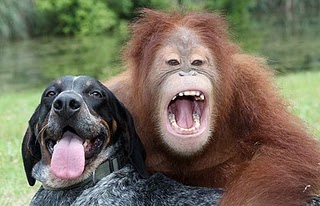
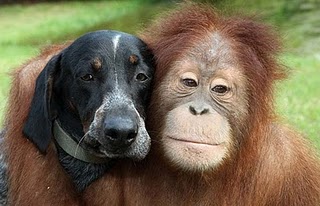
After losing his parents, this 3 year old orangutan was so depressed he wouldn’t eat and didn’t respond to any medical treatments. The veterinarians thought he would surely die from sadness. The zoo keepers found an old sick dog on the grounds in the park at the zoo where the orangutan lived and took the dog to the animal treatment center. The dog arrived at the same time the orangutan was there being treated. The 2 lost souls met and have been inseparable ever since.

The orangutan found a new reason to live and each always tries his best to be a good companion to his new found friend. They are together 24 hours a day in all their activities.

Roscoe and Surya

They live in Northern California where swimming is their favorite past time, although Roscoe (the orangutan) is a little afraid of the water and needs his friend’s help to swim.

Roscoe and Surya
Roscoe and Surya

Together they have discovered the joy and laughter in life and the value of friendship.

Roscoe and Surya
Roscoe and Surya

They have found more than a friendly shoulder to lean on.

Roscoe and Surya
Love across the species boundary

Long Live Friendship!!!!!!!

I don’t know……some say life is too short, others say it is too long, but I know that nothing that we do makes sense if we don’t touch the hearts of others…….while it lasts!

So after I had seen the pictures above, it was pretty easy to find this YouTube video.


Then if that wasn’t amazing and wonderful, try this,

Well that’s enough for today.  But tomorrow, I will continue with Part Two which recounts the amazing year that Joe Hutto spent in the Florida wildlands with ….. (you’ll have to wait for tomorrow!)