Yesterday, I posted about the prediction that in four billion years the Milky Way galaxy would collide with the Andromeda galaxy. I called the post Not of immediate concern.
Today, I am writing about something that is of immediate concern. That is if you regard the next couple of decades as ‘immediate’.
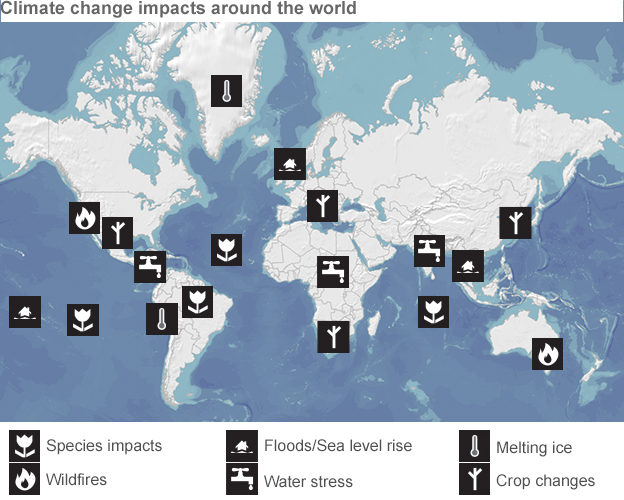
The post is prompted by an item that was published on the BBC News website two days ago. It carried the title Climate inaction catastrophic – US
Climate inaction catastrophic – US
By Matt McGrath
Environment correspondent, BBC News, Yokohama, Japan
The costs of inaction on climate change will be “catastrophic”, according to US Secretary of State John Kerry.
Mr Kerry was responding to a major report by the UN which described the impacts of global warming as “severe, pervasive and irreversible”.
He said dramatic and swift action was required to tackle the threats posed by a rapidly changing climate.
Our health, homes, food and safety are all likely to be threatened by rising temperatures, the report says.
Scientists and officials meeting in Japan say the document is the most comprehensive assessment to date of the impacts of climate change on the world.
In a statement, Mr Kerry said: “Unless we act dramatically and quickly, science tells us our climate and our way of life are literally in jeopardy. Denial of the science is malpractice. There are those who say we can’t afford to act. But waiting is truly unaffordable. The costs of inaction are catastrophic.”
Putting to one side the mild irony of a representative of the US Government wringing his hands about what mankind is doing to our climate, the report is valuable and potentially significant.
The report was from the Intergovernmental Panel on Climate Change (IPCC) which is, as their website explains:
The Intergovernmental Panel on Climate Change (IPCC) was established by the United Nations Environmental Programme (UNEP) and the World Meteorological Organization (WMO) in 1988 to assess the scientific, technical and socio-economic information relevant for the understanding of human induced climate change, its potential impacts and options for mitigation and adaptation.
Watch this 5-minute video of Stanford professor Dr. Chris Field, co-chair of that IPCC working group, addressing some of the key questions raised by this latest report. In particular, focus on Dr. Field discussing the potential of the loss of the Greenland ice cap around 3 min 30 seconds.
Back to the BBC report (which you should read in full!). Back to Dr. Chris Field being quoted as saying:
I think the really big breakthrough in this report is the new idea of thinking about managing climate change as a problem in managing risks. Climate change is really important but we have a lot of the tools for dealing effectively with it – we just need to be smart about it.
It would be easy to get into the mindset that humanity is not going to change its ways in time.
But, then again, the pace of growing awareness about what the changes are that we all need to make, and make relatively soon, is dramatic.
Maybe, just maybe, this will turn out alright!
For all the young people in the world, I do so hope!
Millions of dog owners know how well their animals can read us humans; it’s been mentioned on Learning from Dogs many times before.
Try elephants.
There was a fascinating article on the BBC news website a few weeks ago that went on to explain:
10 October 2013
Elephants ‘understand human gesture’
By Victoria GillScience reporter, BBC News
African elephants have demonstrated what appears to be an instinctive understanding of human gestures, according to UK scientists. In a series of tests, researcher Ann Smet, of the University of St Andrews, offered the animals a choice between two identical buckets, then pointed at the one containing a hidden treat.
From the first trial, the elephants chose the correct bucket.
The item included a short video that I am delighted to say is on YouTube. Here it is:
Published on Oct 10, 2013
African elephants have demonstrated what appears to be an instinctive understanding of human gestures, according to UK scientists.
In a series of tests, researcher Ann Smet, of the University of St Andrews, offered the animals a choice between two identical buckets, then pointed at the one containing a hidden treat.
From the first trial, the elephants chose the correct bucket.
The results are published in the journal Current Biology.
The scientists worked with captive elephants at a lodge in Zimbabwe.
Prof Richard Byrne, a co-author on the research, said the elephants had been rescued from culling operations and trained for riding.
“They specifically train the elephants to respond to vocal cues. They don’t use any gestures at all,” said Prof Byrne.
“The idea is that the handler can walk behind the elephant and just tell it what to do with words.”
Despite this, the animals seemed to grasp the meaning of pointing from the outset.
Ms Smet added that she had been impressed by the animals’ apparently innate understanding of the gesture.
“Of course we had hoped that the elephants would be able to learn to follow human pointing, or we wouldn’t have done the experiment in the first place,” she said.
“But it was really surprising that they didn’t seem to have to learn anything.
“It seems that understanding pointing is an ability elephants just possess naturally and they are cognitively much more like us than has been realised.”
Prof Byrne said studying elephants helped build a map of part of the evolutionary tree that is very distant from humans.
“They’re so unrelated to us,” he told BBC News. “So if we find human-like abilities in an animal like an elephant, that hasn’t shared a common ancestor with people for more than 100 million years , we can be pretty sure that it’s evolved completely separately, by what’s called convergent evolution.”
The researchers said their findings might explain how elephants have successfully been tamed and have “historically had a close bond with humans, in spite of being potentially dangerous and unmanageable due to their great size”.
But the scientists added the results could be a hint that the animals gesture to one another in the wild with their “highly controllable trunks”.
Ms Smet told BBC News: “The next step [in our research] is to test whether when an elephant extends its trunk upwards and outwards – as they regularly do, such as when detecting a predator, this functions as a point.”
Prof Byrne said studying elephants helped build a map of part of the evolutionary tree that is very distant from humans.
“They’re so unrelated to us,” he told BBC News. “So if we find human-like abilities in an animal like an elephant, that hasn’t shared a common ancestor with people for more than 100 million years , we can be pretty sure that it’s evolved completely separately, by what’s called convergent evolution.”
The researchers said their findings might explain how elephants have successfully been tamed and have “historically had a close bond with humans, in spite of being potentially dangerous and unmanageable due to their great size”.
But the scientists added the results could be a hint that the animals gesture to one another in the wild with their “highly controllable trunks”.
Ms Smet told BBC News: “The next step [in our research] is to test whether when an elephant extends its trunk upwards and outwards – as they regularly do, such as when detecting a predator, this functions as a point.”
On the 21st., I published a post Be in peace this day! It was noting this year’s International Peace Day. One of the comments left by Patrice Ayme, in response to an earlier comment from Alex Jones, was this:
Alex: I read your message, and I approve it. Very well put. As Lord Keynes said: ”In the end, we are all dead.” Death seems pretty violent to me. Yet, one can live with it, and embrace it, because, as there is no choice, we may as well.
War is not anymore a problem than peace is. What matters most is the harmony of the society with the environment, not strife within. Plutocrats have unbalanced the environment, so they should be reduced, and that means war, because peace certainly will not reduce them.
Force is the truth of man. Everything else is delusion, even the vegetarian style.
To which I replied:
Patrice, as much as I deeply respect your intellect, I fundamentally am at odds with the sentiments you express. But rather than hide behind a short reply that few will read and even fewer take notice of, I’m going to write a post exploring my reactions in detail. As always, your comments are welcomed.
This, then, is that post.
But where oh where to start? Perhaps by me setting out this general premise.
Wherever one looks, it seems there are examples of madness bordering on the criminally insane.
In so many ways and at so many levels we are running the very real risk that by 2050 the end of this present era of human civilisation by the end of the century will be unavoidable. Ergo: Born after 1980? Then brace yourself for the end times.
The only solution is to adopt the core values of humanity. Very soon!
So on to a few examples of the present madness (and I would be the first to admit that I am, perhaps prejudicially, inclined to see the darkness of our present times).
First: Climate Change
The recent IPCC report made it clear that climate change is most likely a result of man’s activities on this planet. As the summary for policy makers says (selected extracts):
Warming of the climate system is unequivocal, and since the 1950s, many of the observed changes are unprecedented over decades to millennia. The atmosphere and ocean have warmed, the amounts of snow and ice have diminished, sea level has risen, and the concentrations of greenhouse gases have increased.
and
Human influence on the climate system is clear. This is evident from the increasing greenhouse gas concentrations in the atmosphere, positive radiative forcing, observed warming, and understanding of the climate system.
and [my emboldening]
Human influence has been detected in warming of the atmosphere and the ocean, in changes in the global water cycle, in reductions in snow and ice, in global mean sea level rise, and in changes in some climate extremes (Figure SPM.6 and Table SPM.1). This evidence for human influence has grown since AR4. It is extremely likely that human influence has been the dominant cause of the observed warming since the mid-20th century.
But denial is only part of the problem. More significant is the behaviour of powerful people who claim to accept the evidence. This week the former Irish president Mary Robinson added her voice to a call that some of us have been making for years: the only effective means of preventing climate breakdown is to leave fossil fuels in the ground. Press any minister on this matter in private and, in one way or another, they will concede the point. Yet no government will act on it.
As if to mark the publication of the new report, the Department for Business, Innovation and Skills has now plastered a giant poster across its ground-floor windows: “UK oil and gas: Energising Britain. £13.5bn is being invested in recovering UK oil and gas this year, more than any other industrial sector.”
The message couldn’t have been clearer if it had said “up yours”. It is an example of the way in which all governments collaborate in the disaster they publicly bemoan. They sagely agree with the need to do something to avert the catastrophe the panel foresees, while promoting the industries that cause it.
It doesn’t matter how many windmills or solar panels or nuclear plants you build if you are not simultaneously retiring fossil fuel production. We need a global programme whose purpose is to leave most coal and oil and gas reserves in the ground, while developing new sources of power and reducing the amazing amount of energy we waste.
But, far from doing so, governments everywhere are still seeking to squeeze every drop out of their own reserves, while trying to secure access to other people’s. As more accessible reservoirs are emptied, energy companies exploit the remotest parts of the planet, bribing and bullying governments to allow them to break open unexploited places: from the deep ocean to the melting Arctic.
And the governments who let them do it weep sticky black tears over the state of the planet.
Kevin Anderson, professor of energy and climate change at the University of Manchester
What has changed significantly since the last report is that we have pumped an additional 200 billion tonnes of CO2 into the atmosphere. Annual emissions are now 60% higher than at the time of the first report in 1990 and atmospheric CO2 levels are the highest they have been for over two million years.
So what are we doing in the UK to help reverse this reckless growth in emissions? Record levels of investment in North Sea oil, tax breaks for shale gas, investment in oil from tar sands and companies preparing to drill beneath the Arctic.
Against this backdrop, the UK Treasury is pushing for over 30 new gas power stations, whilst the government supports further airport expansion and has dropped its 2030 decarbonisation target – all this alongside beleaguered plans for a few wind farms and weak energy efficiency measures. Governments, businesses and high-emitting individuals around the world now face a stark choice: to reduce emissions in line with the clear message of the IPCC report, or continue with their carbon-profligate behaviour at the expense of both climate-vulnerable communities and future generations.
OK, let’s move to another example of our collective madness.
Second: The way we treat the natural wildlife.
Last Thursday, the New York Times published an item about a recent report confirming the terrible cost to our wildlife of fragmenting their habitat. Here are the opening paragraphs, including the leading photograph in that NYT piece.
In Fragmented Forests, Rapid Mammal Extinctions
An isolated forest in the Chiew Larn reservoir. A Thai government project to supply hydroelectric power to the area transformed 150 forested hilltops into islands. ANTONY LYNAM
By CARL ZIMMER
September 26, 2013
In 1987, the government of Thailand launched a huge, unplanned experiment. They built a dam across the Khlong Saeng river, creating a 60-square-mile reservoir. As the Chiew Larn reservoir rose, it drowned the river valley, transforming 150 forested hilltops into islands, each with its own isolated menagerie of wildlife.
Conservation biologists have long known that fragmenting wilderness can put species at risk of extinction. But it’s been hard to gauge how long it takes for those species to disappear. Chiew Larn has given biologists the opportunity to measure the speed of mammal extinctions. “It’s a rare thing to come by in ecological studies,” said Luke Gibson, a biologist at the National University of Singapore.
Over two decades, Dr. Gibson and his colleagues have tracked the diversity of mammals on the islands. In Friday’s issue of the journal Science, they report that the extinctions have turned out to be distressingly fast.
“Our results should be a warning,” said Dr. Gibson. “This is the trend that the world is going in.”
On a similar theme, many will recall my post back on the 19th, Pity the bees; pity us when I drew attention to the drastic reduction in the numbers of wild bees, including the quote “the vanishing honeybee could be the herald of a permanently diminished planet.“
Guard their future – and ours!
Third: Money and power.
Again from The New York Times but this time an essay by Paul Krugman.
Robert Benmosche, the chief executive of the American International Group, said something stupid the other day. And we should be glad, because his comments help highlight an important but rarely discussed cost of extreme income inequality — namely, the rise of a small but powerful group of what can only be called sociopaths.
For those who don’t recall, A.I.G. is a giant insurance company that played a crucial role in creating the global economic crisis, exploiting loopholes in financial regulation to sell vast numbers of debt guarantees that it had no way to honor. Five years ago, U.S. authorities, fearing that A.I.G.’s collapse might destabilize the whole financial system, stepped in with a huge bailout. But even the policy makers felt ill used — for example, Ben Bernanke, the chairman of the Federal Reserve, later testified that no other episode in the crisis made him so angry.
And it got worse. For a time, A.I.G. was essentially a ward of the federal government, which owned the bulk of its stock, yet it continued paying large executive bonuses. There was, understandably, much public furor.
So here’s what Mr. Benmosche did in an interview with The Wall Street Journal: He compared the uproar over bonuses to lynchings in the Deep South — the real kind, involving murder — and declared that the bonus backlash was “just as bad and just as wrong.”
OK, that’s enough ‘copying’ from me so please go and read more about the plight of those poor billionaires. But if the NYT and Paul Krugman will forgive me, here’s the paragraph towards the end of the Krugman essay that makes me sick [my emboldening]:
The thing is, by and large, the wealthy have gotten their wish. Wall Street was bailed out, while workers and homeowners weren’t. Our so-called recovery has done nothing much for ordinary workers, but incomes at the top have soared, with almost all the gains from 2009 to 2012 going to the top 1 percent, and almost a third going to the top 0.01 percent — that is, people with incomes over $10 million.
Staying with the struggles of our billionaires for a moment longer, try the recent report on Bloomberg about the recent Monaco Yacht Show that included this:
As the yacht size has stretched — this year saw the launch of a record-holding 590-footer called the Azzam — so has the list of distractions onboard. Soaking in a jacuzzi, shooting hoops on a floating court or playing a baby grand Steinway piano no longer cut it.
“There is a change in attitude of super-yacht owners,” said Bert Houtman, founder and chairman of the Netherlands-based U-Boat Worx, surveying two of his submarine models on display quai-side in Monaco. “They’re fed up with drinking white wine and riding jet skis so they’re looking for another thrill.”
later including:
“A lot of guys who are billionaires have profound financial accomplishments and are now concerned about their legacy,” said Deppe. (Marc Deppe, Triton Subs vice-president of sales and marketing.)
It’s enough to make one weep!
Fourth: Politicians and governments not serving their peoples.
Making this my last example. Simply because a recent item published on Naked Capitalism had so much detail on what is wrong with our leaders; in this particular case regarding the American Affordable Care Act (ACA). This is how the article opens:
Many people, and especially Obama supporters, characterize the ACA (ObamaCare) as “just starting” or a “work in progress” and then go on to urge that the program will have “glitches,” needs to be “tweaked,” isn’t yet “fully implemented,” and so forth. We think it’s a mistake to see the ACA as just starting. We also think it’s a mistake not to weigh the costs of ObamaCare’s stately three-year progress toward partial coverage for the the American people, and just as important to weigh the opportunity costs.
The ACA was passed in March 2010, incorporating many features designed to meet Republican objections to the Bill. Yet, in the end, Democrats never put Medicare for All on the table, abandoned the public option and many other features, and did not get a single Republican vote in either chamber.
The Democrats even saw to it that the bill was fiscally neutral over a 10 year projection at a time when the tanked economy needed more deficit spending and the jobs that would have brought. And to do that, they postponed implementation of most of the bill for more than three years, until now, allowing people to go without care, to die, to divorce, and to lose their homes or go bankrupt due to medical bills, just so they could argue that the bill was fiscally neutral. In gauging the record of the bill, these 3 to 3.5 years of waiting for its implementation and their real costs to the people of the United States must be taken into account.
It also must be taken into account that in the year before the ACA was passed there were some 45 million Americans uninsured, and they were dying at the rate of 1,000 more for every million than in the general population. That is, lack of insurance was causing more than 45,000 fatalities per year. (The cost of those deaths in money terms: $1.38 trillion).
That’s what we’ve lost by not trying to pass HR 676 and by trying instead to take a bipartisan insurance company conciliation approach to passing the ACA. This post, gives the total for the anticipated opportunity cost by comparing Romney’s 2012 alternative to the ACA, the baseline of no reform at all, the ACA, and Medicare for All over the period 2010 – 2022. Bottom line: the ACA is projected to cost 286,500 lives through 2022, assuming no change. That’s a lot better than the baseline and a lot better than Romney’s 2012 alternative. But it’s still terrible compared to what we might have had if we had a President who really represented people rather than Wall Street.
What if an effort to pass HR 676 had failed in 2009 because too many Democrats in the Senate defected to pass it? Well, I think this would have been very unlikely with the very large Democratic majority and the popularity of the president at its height, but even if it would have failed, then the Democrats could still have compromised with members of their party to pass enhanced Medicare for All for everyone under 26 and over 45, or under 26 and over 50, or whatever compromise would have moved those wayward Democrats up to the 50 vote mark. Such a compromise bill would still have lowered the fatalities substantially by providing insurance for those who needed it most and by enhancing the Medicare program for seniors (full coverage and no co-pays). It would also have been something Democrats could have run on and built upon in each successive election year, rather than having to defend the sorry ACA with its package of inadequate goodies, silly mandate, IRS enforcement, high cost for lousy coverage, and Rube Goldberg eligibility determination. Again there would have been no Tea Party, because Tea Partiers like Medicare, and there would have been no Republican nationwide sweep in 2010, no gerrymandering, no voter suppression, no anti-woman bills, and none of all the rest of the nonsense we’ve seen because the Democrats did what they did.
Earlier in the post I offered a general premise that included, “Wherever one seems to look there are examples of madness bordering on the criminally insane.”
To my mind, these examples support that premise. Trust me, there are countless more examples.
So what to do? Because I am fundamentally at odds with the sentiment expressed by Patrice Ayme; “Force is the truth of man. Everything else is delusion, even the vegetarian style.”
The answer takes us to tomorrow’s post, A return to integrity.
And, yes, it does mention dogs! Rather a lot as it happens!
Last Monday, the post on Learning from Dogs was called Growing old!!
The essence of that post was to report on the following:
That’s why a recent item on the BBC News website jumped off the page at me. It was an article called: Health kick ‘reverses cell ageing’ written by Michelle Roberts, Health editor, BBC News online. Here is how the article opened:
Going on a health kick reverses ageing at the cellular level, researchers say.
The University of California team says it has found the first evidence a strict regime of exercise, diet and meditation can have such an effect.
But experts say although the study in Lancet Oncology is intriguing, it is too early to draw any firm conclusions.
The study looked at just 35 men with prostate cancer. Those who changed their lifestyle had demonstrably younger cells in genetic terms.
The full article should be read, by the way, because it covers much more than this opening paragraph.
Anyway, one of the comments to that post was left by Sue, of Sue Dreamwalker, Here is what she wrote:
Great information and learning to Meditate even for a few minutes helps heal and relax.. Dogs have it right…. No stress!
I wrote a complete exercise I used a lot both for myself and within my circle I used to run… Hope you enjoy as you take your roots down into the earth after bringing in the Light….
you can find it here http://wp.me/p16xW7-37
Namaste!
I then asked Sue if I could republish her guidance on meditation as a guest post. Sue kindly agreed. Here it is.
oooOOOooo
A Meditation For My Friends
by Sue Dreamwalker
Meditation.
Some Friends have been asking about Meditation and relaxation techniques, so I have put you a very simple little meditation here for starters.
You can buy books on meditation and read different techniques until your eyes pop out of your head, and you can find plenty about meditation on web sites too. I always say there is no right or wrong way to Meditate. To meditate means finding that quiet place within your own mind, finding that peace and space to be at one with yourself.
When people say empty your mind, this is near enough impossible, as you will always have a train of thought that will pop in at times. So this is why we use the Breath.
The breath is used to bring your concentration back, so focusing on your breath may be one way in which you can stop the hum-drum of your thoughts that chatter away inside your head.
First you need to ensure you’re not going to be disturbed, so switch of the phone, find a comfortable chair, in a quiet room, and relax. If you lie down you may find that you drift asleep, that’s ok also for that shows you have relaxed. But preferably sit upright with your feet slightly apart and have them touching the ground. Take deep breaths breathing in and out through the nose, and close your eyes.
This is one of the meditations I do regularly. It may seem long to read, but once you have it in your mind it will only take you 10 minutes to do. Read it through a couple of times until you have it clear in your mind, and then have a go.
Relax and take some nice deep breaths breathing deeply and evenly, try to breath in to the count of five, hold for a few seconds and then breath out long and slow, Feel your breath rise from your solar plexus your stomach and feel your diaphragm rise and fall.
Do this for a few minutes until you feel comfortable with breathing this way. (Many of us do not breathe deep enough, so this may at first feel uncomfortable, but try not to force it, just try to get your breath into a natural rhythm).
One your breath is comfortable I want you to imagine a beautiful White light coming down in a column from up above your head. Almost like a search light in a darkened room.
As you breath in, I want you to breathe in this light. Imagine that it is flowing down inside your head through your crown, and it passes behind your eyes, relaxing your eyes. It then passes down over your throat, relaxing your throat.
You feel this Light which has healing properties cascading across your shoulders, relaxing your shoulders, taking all the burdens of the day with it. You now see and feel this warm Light travel down your arms into your forearms relaxing your muscles as it goes, now it’s travelling into your finger tips, and your arms now feel heavy and relaxed.
You see the Light now travel through from your throat, down into your heart centre, feel the beat of your heart, and see the light now filling your heart and as it beats see the light dispersing throughout your veins into your whole being,
See the light travelling into your stomach relaxing your stomach muscles, down your thighs relaxing your thighs into your calves, relaxing your calves, and see the light now going into your feet relaxing your toes and feet.
And all the while you are breathing deeply and evenly, relaxing more and more.
Now you are relaxed and are full of healing light, I want you to now see that light coming out of the soles of your feet, as if they were roots from a tree. See these roots going down from your feet into Mother Earth, going down through the rocks, twisting and turning as they go deeper and deeper, and as they travel deeper so too you are feeling more and more relaxed.
You now see an underground cavern, with an underground pool, your roots of light emerge in the ceiling of this cavern, and illuminate it like the lights of a chandelier.
And as the light illuminates the Cavern you now see you are stood in a beautiful Crystal Cavern, The Light reflects the many luminous rainbow colours from the hundreds of giant crystals.. See the rainbow of pastel colours dance around the cavern reflection on the underground pool.
Now you can choose any colour you see, for whatever colour you choose this colour will intuitively be the right healing colour for your needs at this moment in time.
So once you see the colour you are attracted to, allow your roots to wrap themselves around that crystal, and as you breathe deeply in, see now that your roots have now turned into hollow straws, for you will now be able to breathe up that colour through your roots and as you do so, retract your roots back up through Mother Earth, breathe that colour into your feet, feel the warmth of the healing.
Now draw it back up through your calves, up through your thighs, into your solar plexus. Breathing deeply and evenly. Feel the warmth of healing relax and heal all your worries and anxieties, breath it up into your lungs, into your heart, down your arms and into your fingers, see how relaxed and refreshed you now feel, see this colour cleansing your entire being taking with it all the debris that you have collected, all the negative thoughts, flushing you clean.
See this colour now rise and come up through your throat, see it helping you release all the words you have spoken in haste, and all the words you hold back, see them all now flow up past your eyes, helping you see that you are a Being of Light and whole and free, see that colour now rise out through the top of your head, see it cascading out into the Universe Like a fountain, and as it does so see it explode into a thousand stars, taking all your problems and negative debris with it, and know that God and the Universe will disperse this energy as it sees fit,
Give thanks to Mother Earth for her healing energy, and see the top of your head close and seal in your new vibration, and feel yourself glowing from within,
Slowly bring your awareness back to yourself sat in the chair, and open your eyes.
Sit for a moment or two and take a sip of water.
Know that you can go to your crystal cavern at any time for healing.
Hope you relax and Enjoy.
x Dreamwalker x
oooOOOooo
And if you want any encouragement to find that deep, peaceful place, then just breath in this picture of young Cleo letting the world go by!
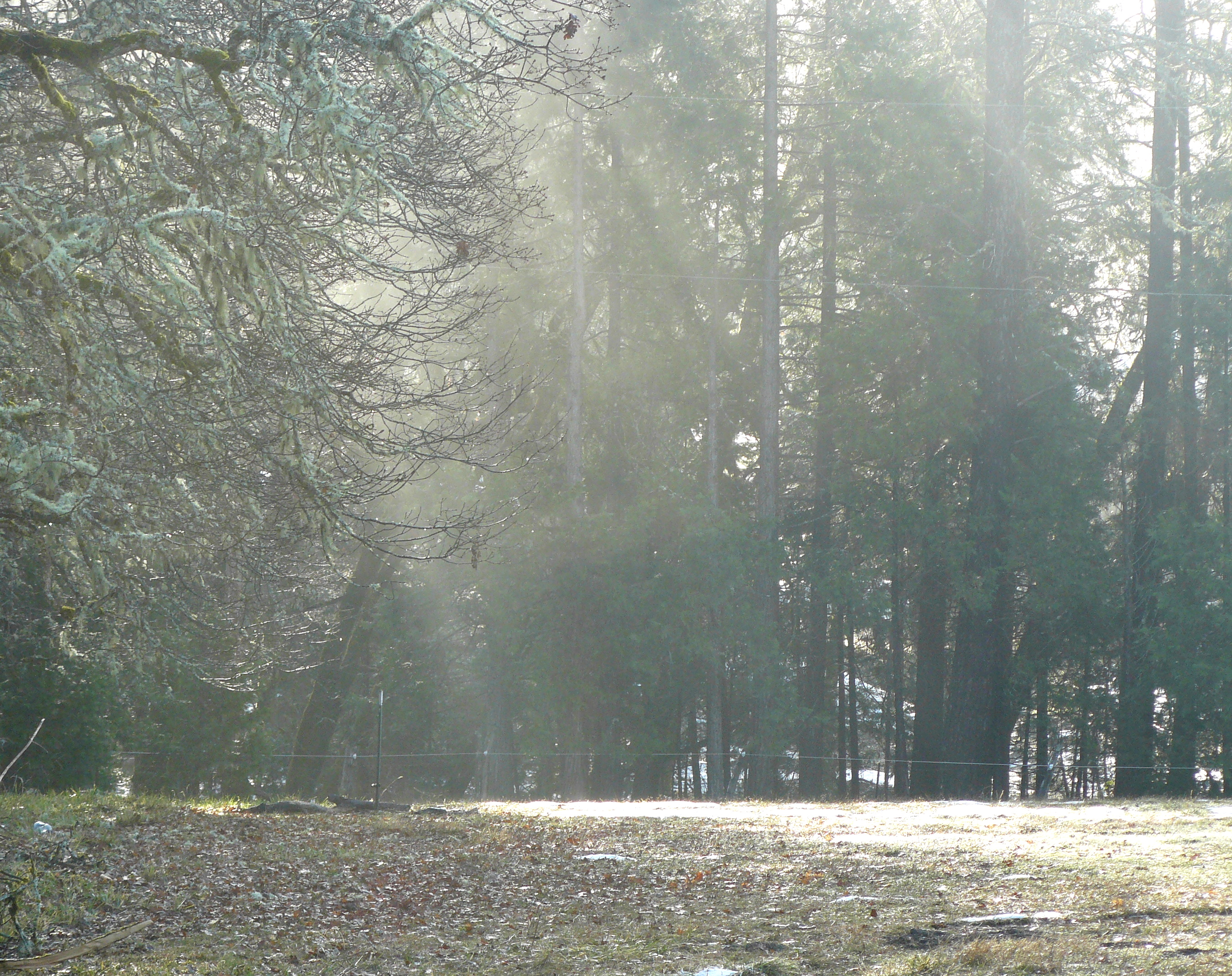
Winter sunlight filtering through the trees. Oregon, January 2013.
We don’t subscribe to television services here at home. The only way I stay partially informed is via the BBC News website. Thus it was a few days ago I saw the headline, “European forests near ‘carbon saturation point’” This was a report by Mark Kinver, Environment reporter, BBC News. It made me sit up and take notice. For Mark Kinver wrote:
European forests are showing signs of reaching a saturation point as carbon sinks, a study has suggested.
Since 2005, the amount of atmospheric CO2 absorbed by the continent’s trees has been slowing, researchers reported.
Carbon sinks play a key role in the global carbon cycle and are promoted as a way to offset rising emissions.
Many of Europe’s forests are reaching an age where growth, and carbon uptake, slows down.
Writing in their paper, the scientists said the continent’s forests had been recovering in recent times after centuries of stock decline and deforestation.
The growth had also provided a “persistent carbon sink”, which was projected to continue for decades.
However, the team’s study observed three warnings that the carbon sink provided by Europe’s tree stands was nearing a saturation point.
It would be wrong to republish the full report but do go and read it here. It contains much information, some of it counter-intuitive. Such as Dr. Gert-Jan Nabuurs from Wageningen University and Research Centre, Netherlands saying of Europe’s forest;
“These forests have now reached 70-80 years old and are starting a phase in the life of a tree where the growth rate starts to come down,” he explained.
“So you have large areas of old forest and even if you add these relatively small areas of new forest, this does not compensate for the loss of growth rate in the old forests.”
The report includes the glaringly obvious, “However, mature woodlands have been recognised as a key habitat for supporting and conserving biodiversity.”!
The issue of knowing what is best for the wildlife, of all types and sizes, of balancing doing nothing to the forest or undertaking beneficial husbandry is one that is going to be in our minds here at home this coming Winter.
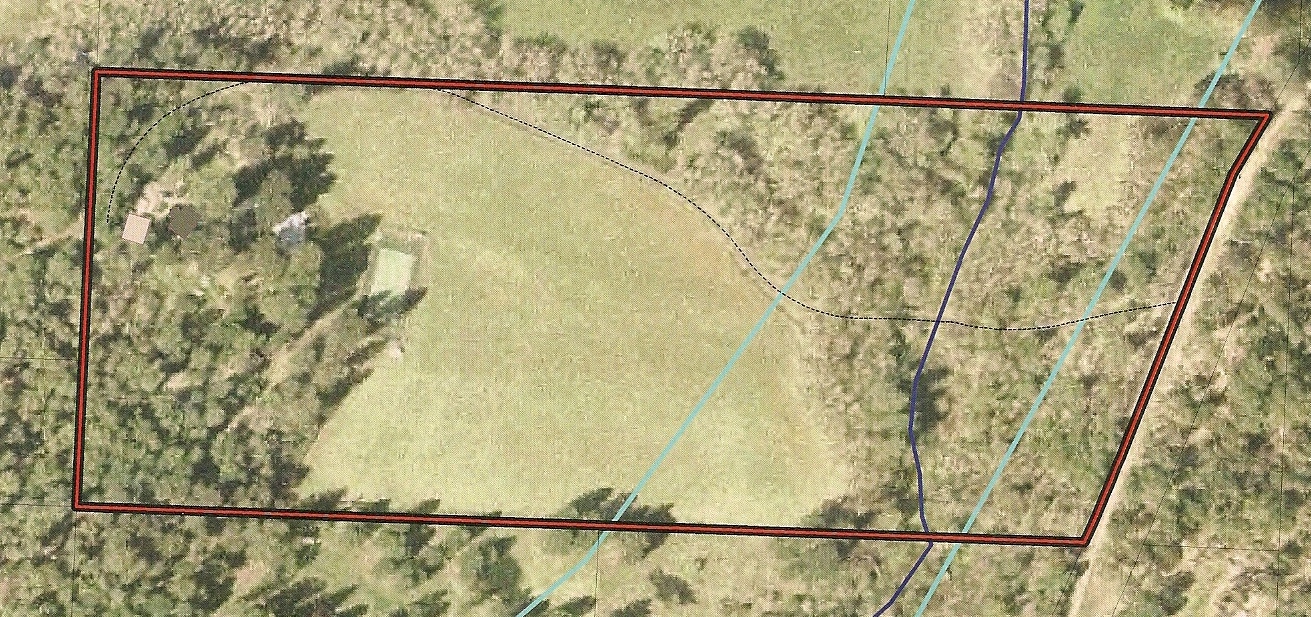
For much of our 13 acres is forest, as the following property map shows.
Assessor’s Map 4000 Hugo Road.
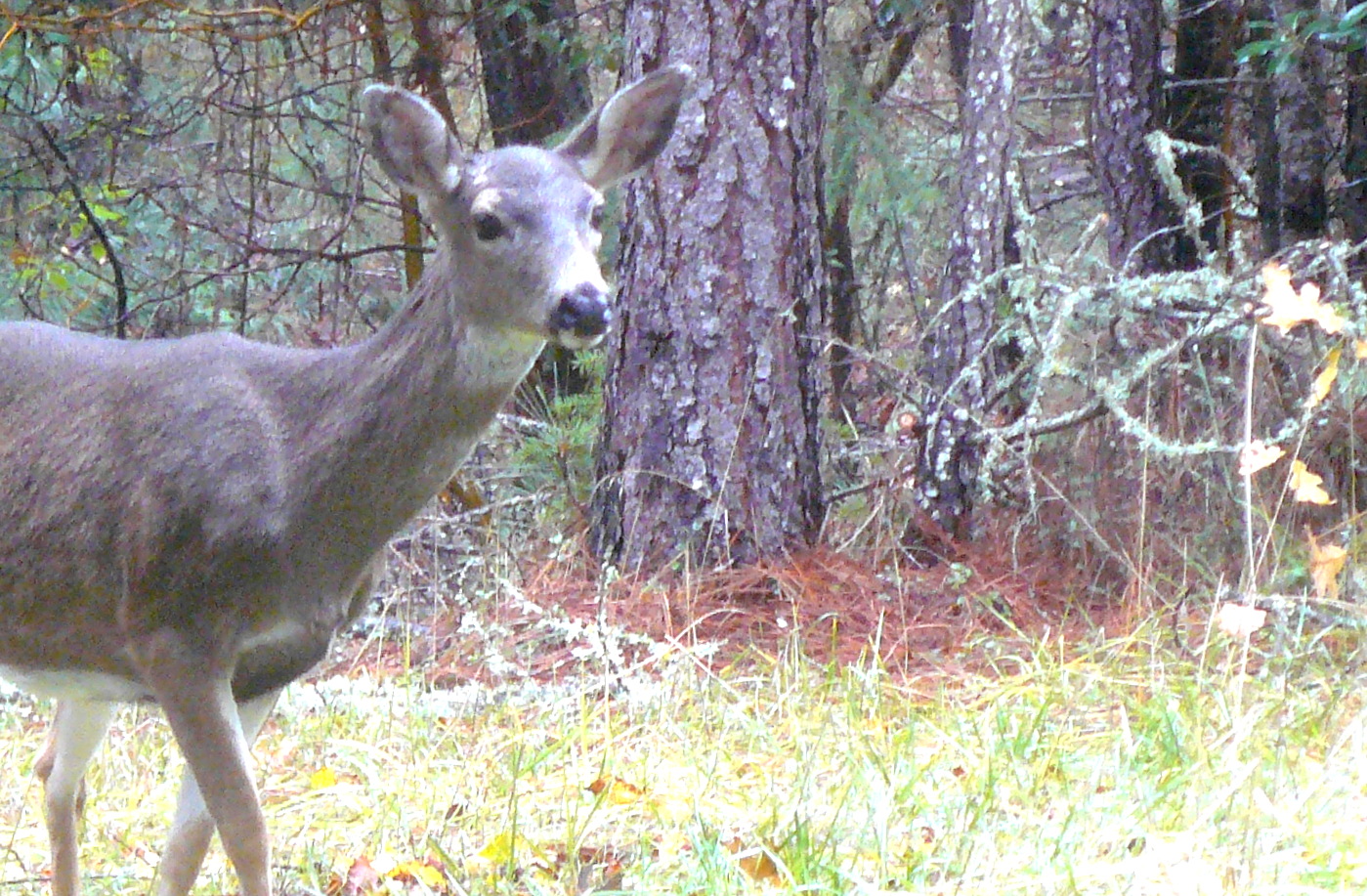
When we first moved in to the house last October, the most common wild large creatures around were the deer. The only way one could get close enough to take a photograph was when there wasn’t a dog in sight. Even then, the slightest sudden sound or movement had a deer dashing into the forest.
Deer very cautiously meets new humans on the block! (Early November 2012)
Yet over the following weeks, the healthy grass made an irresistible Winter meal and the deer settled down to being regular visitors. But always within a few leaps and bounds of the edge of the trees.
Nevertheless, the deer remained very cautious of feeding during the daytime as they soon became aware that without warning dogs could come rushing out from the house; as happened numerous times! It seemed clear that having the forest close by enabled them to scatter as soon as the first bark was heard.
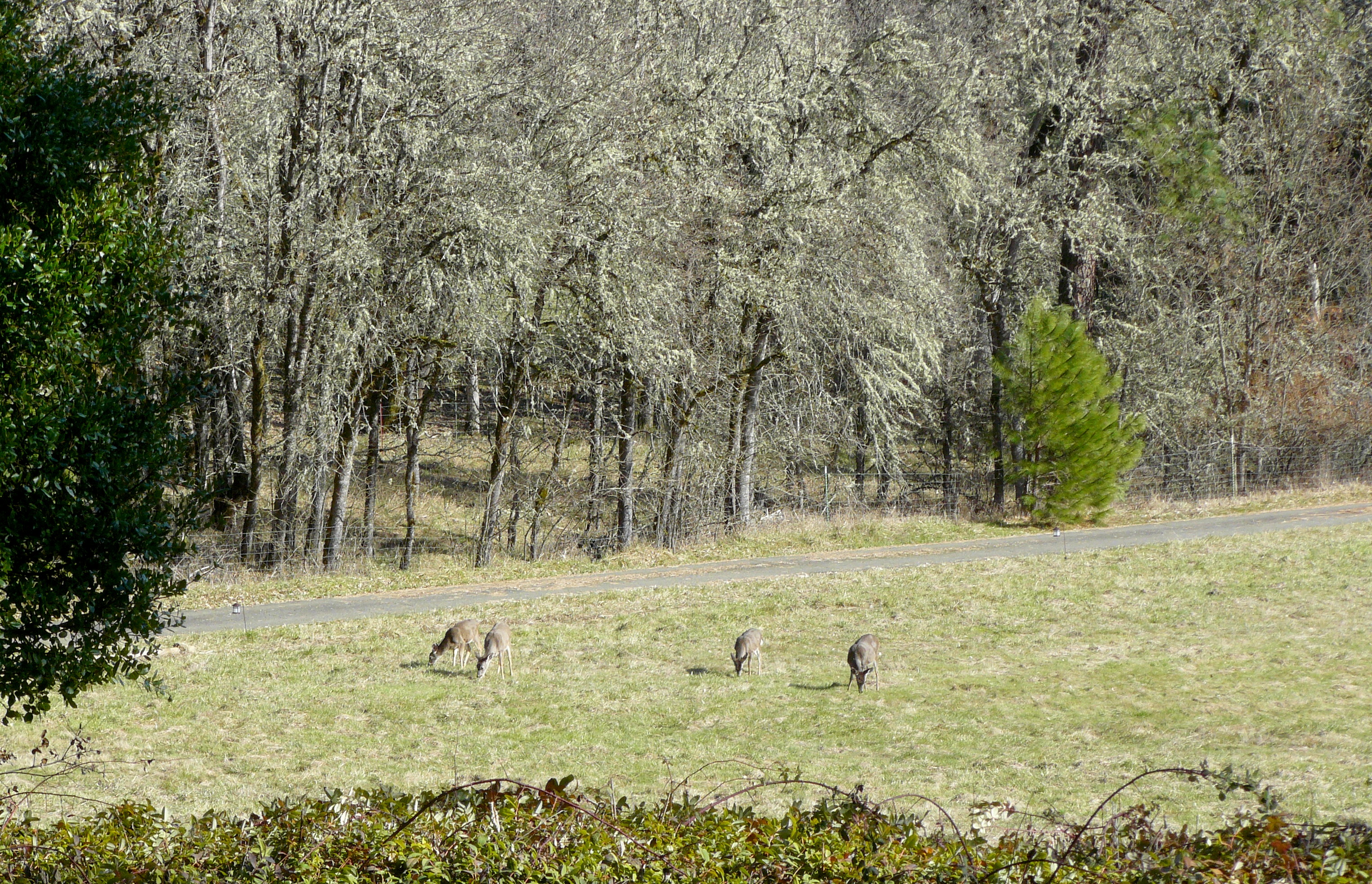
Months later, shown by this photograph taken early afternoon just a couple of weeks ago, these four wild deer still grazed close to the forest.
Wild deer feeding on the grass.
So this Autumn/Fall we shall be coming up with a plan to ensure that the forests on our property are reinvigorated to the best of our abilities.
A plea to sign a global call not to delay action on global warming
How many of you in Europe watched the final episode of Sir Peter Attenborough’s Frozen Planet series, entitled On Thin Ice?
Did you watch the short video in last week’s post, The power of truth? If not, it’s below.
Here’s a piece from a BBC news item from yesterday,
A hungry polar bear
It is an image that is sure to shock many people.
An adult polar bear is seen dragging the body of a cub that it has just killed across the Arctic sea ice.
Polar bears normally hunt seals but if these are not available, the big predators will seek out other sources of food – even their own kind.
The picture was taken by environmental photojournalist Jenny Ross in Olgastretet, a stretch of water in the Svalbard archipelago.
“This type of intraspecific predation has always occurred to some extent,” she told BBC News.
“However, there are increasing numbers of observations of it occurring, particularly on land where polar bears are trapped ashore, completely food-deprived for extended periods of time due to the loss of sea ice as a result of climate change.”
Re-read that last segment of that last sentence, “completely food-deprived for extended periods of time due to the loss of sea ice as a result of climate change.”
So with all that in mind, please read on.
Friends,
What if someone told you we should abandon all hope for global climate action until 2020? Well, that’s exactly the proposal that the United States is pushing at the UN Climate Talks taking place this week in Durban, South Africa. The 2020 delay might well be the worst idea ever.
Waiting nine years for climate action isn’t just a delay, it’s a death sentence for communities on the front lines of the climate crisis — and it could slam the door on ever getting carbon pollution levels below the safe upper limit of 350 parts per million.
It’s not too late to stop this delay from going through. Over the next three days, our team of 350.org activists in Durban will be working with our partners at Avaaz and allies from around the world to isolate the United States — and build support for the African nations that are fighting for real climate action. But it will take a massive grassroots outcry to demonstrate that people everywhere are taking a stand to prevent the United States negotiators from signing away our future.
If we raise an international alarm before the talks end on Friday, we can convince the US to get out of way of progress and help unlock the global process that can lead to bold climate action all around the world.
The climate talks in South Africa end in just 48 hours, and it’s vital that we ramp up the pressure now. To make sure the US gets the message, our team on the ground here in Durban will deliver your messages directly to the US negotiating team at a high-impact event we’re helping to pull together on Friday. We can’t say much more about it now, but suffice to say our message will be unavoidable.
This year, the 350 network has shown that people power can truly move the planet in the right direction. We mobilized hundreds of thousands of people to push for climate action in nearly every country on earth. We beat back the Keystone XL pipeline when no one said it was possible. We took over the radio waves to spread a message of hope and action on the climate crisis. And through our actions, we helped keep the hope of saving our planet — and reaching 350 ppm — alive.
The UN Climate Talks here in Durban aren’t going to get us back to 350 by themselves, but they can keep the option open by making progress on a legally binding, international framework to help nations make serious cuts in carbon emissions. In 2012, we’re going to need to do all we can to challenge the fossil fuel companies that are the real obstacles to progress. Breaking their stranglehold on our governments is the only way to really unlock these negotiations.
But right now, the most important thing we can do is keep the possibility of a strong international climate deal alive by pushing back on the United States negotiating team. In recent months, President Obama has shown that he’ll stand up for the climate, but only if he’s got a movement to back him up. On the Keystone pipeline, he’s been doing the right thing by blocking Republican efforts to push it through — now we need him to do the right thing on the international stage.
There’s no guarantee that we’ll be successful, but we owe it to our allies across the planet — many of whom are already feeling the impacts of climate change — to resist the chorus of cynics and keep hope alive. As Nelson Mandela said, “It always seems impossible until it’s done.” The 350 network has pulled off the impossible before — now’s the time to step up the pressure again.
P.S. We have just 48 hours to build a huge groundswell of pressure. Please help make it go viral with a few clicks on Twitterand Facebook — tag your popular friends, and post it again and again.
A fascinating point of view of the relationship between humans and animals.
Jean and I were at our regular gardening college class yesterday. It was all about the growing of vegetables. OK, I can hear you thinking, what on earth does that have to do with today’s topic? Simply because the tutor, Cayci V., mused at the start of her lesson how gardeners were great animal lovers and then proceeded to list all the animals she and her husband kept at their home in Globe, about an hour from Payson, Arizona. Cayci admitted to having 5 dogs, 15 cats, 2 emus, 2 llamas, numerous chickens. She also had 2 bison that recently died having been poisoned by Oleander cuttings. Anyway, to the article.
A recent article on the BBC News Magazine was about the need for humans to have contact with animals. It was presented by John Gray who is a political philosopher and author of the book False Dawn: The Delusions of Global Capitalism which argues that free market globalization is unstable and is in the process of collapsing! H’mmm. John is also the author of the book Straw Dogs: Thoughts on Humans and Other Animals, a book that was described by the British Observer newspaper thus,
There is unlikely to be a more provocative or more compelling book published this year than Straw Dogs. A long-time scourge of the delusions of global capitalism, John Gray is one of the most consistently interesting and unpredictable thinkers in Britain. He is unpredictable because, unlike most political commentators, he never ceases to question the underlying assumptions of his own beliefs and prejudices.
Anyway, I’m at risk of digressing, as many of you will regularly notice! The article by John Gray on the BBC News website was published over a couple of weeks ago and, therefore, I feel it not too great a copyright sin to reproduce it in full on Learning from Dogs. It’s a fascinating article.
Why does the human animal need contact with something other than itself, asks John Gray.
Many years ago an eminent philosopher told me he’d persuaded his cat to become a vegan. To begin with I thought he was joking. Knowing a bit about cats, I couldn’t take seriously the idea that they’d give up their predatory ways.
“You must have provided the cat with some pretty powerful arguments,” I said jokingly. “It wasn’t as difficult as you may think,” he replied rather sternly.
He never explained exactly how the transformation was achieved. Was his cat presented with other cats that had converted to veganism – feline role models, so to speak? Had he prepared special delicacies for his cat – snacks that looked like mice but were made of soya, perhaps?
Beginning to suspect that the philosopher might after all be serious, I asked if the cat went out. He told me it did. That answered a part of my puzzlement. Evidently the cat was supplementing its vegan diet by hunting, natural behaviour for cats after all.
I was still a little perplexed though. Cats tend to bring their hunting trophies back home and I wondered how the philosopher had missed seeing them. Had the cat hidden them out of sight? Or were the cat’s trophies prominently displayed but disregarded by the philosopher, marks of atavistic feline behaviour that would eventually disappear as the cat progressed towards a new kind of meat-free life?
The conversation tapered off and I never did get to the bottom of the mystery. The dialogue did set me thinking. Evidently the philosopher thought of the cat as a less evolved version of himself that, with a lot of help, could eventually share his values. But the idea that animals are inferior versions of humans is fundamentally misguided.
Each of the millions of species that evolution has thrown up is different and particular, and the animals with which we share the planet aren’t stages on the way to something else – ourselves. There’s no evolutionary hierarchy with humans perched at the top. The value of animals – or as I’d prefer to say other animals – comes from being what they are. And it’s the fact that they are so different from humans that makes contact with them so valuable to us.
Human qualities
Some philosophers – not many it must be admitted – have in the past understood this. The 16th Century French essayist, Michel de Montaigne, loved cats because he knew he would never be able to enter their minds. “When I play with my cat,” he asked, “how do I know she is not amusing herself with me rather than I with her?”
Montaigne didn’t want his animal companions to be mirrors of himself, he wanted them to be a window from which he could look out from himself and from the human world.
Never more than partly domesticated, cats are never fundamentally humanised. Montaigne found them lovable for precisely this reason, it wasn’t that he was suggesting we should emulate cats. Wiser than the philosopher who believed he’d converted his cat to veganism, he understood that the good life means different things for animals with different natures. What he questioned was the idea that one kind of life, the kind humans alone can live, is always best.
It’s true that cats don’t have some of the capacities we associate with morality. They seem to lack empathy, the capacity of identifying with the emotions of others. This may explain what has often been described as cruelty in their behaviour, toying with captured mice for example. Attributing cruelty to cats seems a clear case of anthropomorphism – the error of projecting distinctively human qualities onto other species.
Cats are not known to display compassion, but neither do they inflict pain and death on each other in order to gratify some impulse or ideal of their own. There are no feline inquisitors or suicide bombers. Pedants will say that this is because cats lack the intellectual equipment that is required to formulate an idea of truth or justice. I prefer to think that they simply decline to be enrolled in fanaticism, another peculiarly human trait.
Dogs seem to be capable of showing human-like emotions of shame, but though they are more domesticated they still remain different from us. And I think it’s their differences from us, as much as their similarities, that makes them such good companions.
Whatever you feel about cats and dogs, it seems clear that the human animal needs contact with something other than itself. For religious people this need may be satisfied by God, even if the God with whom they commune seems too often all-too-human. For many landscape gives a sense of release from the human world, even if the land has been groomed and combed by humans for generations, as it has in England.
The contemplation of field, wood and water intermingling with wind and sky still has the power to liberate the spirit from an unhealthy obsession with human affairs. Poets such as Edward Thomas and Ted Hughes have turned to the natural world in an attempt to escape a purely human view of things. Since they remained human and used human language in the attempt, it’s obvious that they couldn’t altogether succeed. It’s also obvious that searching for a way of looking at the world that’s not simply human expresses a powerful human impulse.
The most intense example of this search I know is that recorded by John Baker in his book The Peregrine. First published in 1967 and recently reissued, the book is seemingly a piece of nature writing which slowly reveals itself as the testament of someone struggling to shed the point of view of a human observer.
Renewed humanity
Baker records his pursuit of two pairs of peregrines, which had arrived to hunt in the part of East Anglia where he lived. Alone he followed the birds for over 10 years. Concentrating the decade-long quest into a single year in order to recount it in the book, he writes of the peregrine: “Wherever he goes, this winter, I will follow him. I will share the fear, and the exaltation, and the boredom of the hunting life.”
He tells us that he came late to the love of birds. “For years I saw them only as a tremor on the edge of vision. They know suffering and joy in simple states not possible for us. Their lives quicken and warm to a pulse our hearts can never reach. They race to oblivion.”
In time the human observer seemed to be transmuted into the inhuman hawk. “In a lair of shadow,” Baker writes, “the peregrine was crouching, watching me… We live, in these days in the open, the same ecstatic fearful life. We shun men.”
Note how Baker switches suddenly from describing the hawk watching him to describing how “we” flee from humans. Baker found a sensation of freedom in the feeling that he and the hawk were fused into one. Sharing in the “exaltation and serenity” of the birds’ life he could imagine that he’d shed his human identity, at least for a time, and could view the world through hawks’ eyes.
Of course he didn’t take this to be literal truth. He knew he couldn’t in the end be anything other than human. Yet he still found the pursuit of the peregrine deeply rewarding, for it opened up a temporary exit from the introspective human world.
John Baker’s devotion to the peregrine hadn’t enabled him to see things as birds see them. What it had done was to enable him to see the world through his own eyes, but in a different way. His descriptions of the landscape of East Anglia are exact and faithful to fact. But they reveal that long-familiar countryside in a light in which it looks as strange and exotically beautiful as anything in Africa or the Himalayas. The pursuit of a bird had revitalised his human perceptions.
What birds and animals offer us is not confirmation of our sense of having an exalted place in some sort of cosmic hierarchy, it’s admission into a larger scheme of things, where our minds are no longer turned in on themselves. Unless it has contact with something other than itself, the human animal soon becomes stale and mad. By giving us the freedom to see the world afresh, birds and animals renew our humanity.
A fascinating, beautiful and incredibly thought-provoking essay.
Just maybe, economic activity and financial capital could align itself with the planetary demands!
A collection of items crossed my screen in the last few days that reinforced the interconnectedness of all life on Planet Earth.
First I saw an item on the BBC News website that demonstrated that climate change, global warming, or however one wants to describe man’s relationship with the planet, is not some crazy, fuzzy idea of a few liberal environmentalists. This was a report of the significant drop in global wheat yields.
The report was entitled, Climate shifts ‘hit global wheat yields’ and was written by Mark Kinver, Science and environment reporter, BBC News. Here’s a taste of what was written.
Shifts in the climate over the past three decades have been linked to a 5.5% decline in global wheat production, a study has suggested.
A team of US scientists assessed the impact of changes to rainfall and temperature on four major food crops: wheat, rice, corn and soybeans.
Climate trends in some countries were big enough to wipe out gains from other factors, such as technology, they said.
Professor David Lobell from Stanford University went on to say,
“In particular, you have to assume how non-linear the response will be and how different the crops of tomorrow will be from the crops of today,” he said.
He added that the study focused on historical data in order to strengthen confidence in the existing projections.
“I think it is very clear that climate is not the predominant driver of change over long periods of time in crop production.
“Across the board, you see crop yields going up over the past 30 years, but the question is how much is climate modified (and) what would have happened if the climate was not changing.
“In some countries, we see that climate has only affected things by a few percent. In other countries, we see that yields would have been rising twice as fast.
“On a global average, we see that wheat production would be about 5% higher if we had not seen the warming since 1980. We see about the same for maize or corn.
“Yet for rice and soybean, we actually find that production is about the same as if climate had not been trending.”
Sort of moving on, most people, when they stop and think about it, must realise that 6.9 billion people living (i.e. depending) on Planet Earth have to be causing changes. The Inside Science News Service published a reminder from last December of a calculation that,
By Mary Caperton Morton, ISNS Contributor
Inside Science News Service
STRASBURG, Pa. — Next month, representatives from more than 190 nations will gather in Japan at the Nagoya Biodiversity Summit to develop a global strategy for staunching habitat and biodiversity loss around the world.
The statistics are sobering: Every 20 minutes a species goes extinct. At that rate — estimated to be a thousand times faster than pre-human impact background levels – in 300 years, half of all living species of mammals, birds, fish, reptiles and plants will be gone. [My italics]
This alarming decline has not gone unnoticed. In 1992, the United Nations Convention on Biological Diversity — or CBD — one of the most widely ratified treaties in the world, established lofty conservation goals to be met by 2010. But since then the decline in biodiversity has not slowed. Nearly 16,000 species are still listed as threatened, with more than 200 of them described as “possibly extinct.”
What we need, some might ask, is for big business to get behind and push! Perhaps not so far fetched.
Last October, the British Guardian newspaper, published a very telling reminder that nothing ever in life stays the same.
A controlled burn of oil from the Deepwater Horizon well in the Gulf of Mexico. The report cites the Gulf of Mexico oil spill as an extreme example of the potential impact of inadequate environmental controls. Photograph: Ann Heisenfelt/EPA
The financial risks posed by the loss of species and ecosystems have risen sharply and are becoming a greater concern for businesses than international terrorism, according to a United Nations report released today.
From over-depletion of fish stocks and soil degradation caused by agricultural chemicals to water shortages and mining pollution, the paper – commissioned by the UN Environment Programme and partners – said the likelihood has climbed sharply that declines in biodiversity would have a “severe” $10bn (£6bn) to $50bn impact on business.
With the European Union and other regions increasingly holding companies liable for impacts on ecosystem services, it suggests banks, investors and insurance companies are starting to calculate the losses that could arise from diminishing supplies, tightened conservationcontrols and the reputational damage caused by involvement in an unsound project.
Achim Steiner, UN under-secretary general and Unep executive director, said: “The kinds of emerging concerns and rising perception of risks underlines a fundamental sea change in the way some financial institutions, alongside natural resource-dependent companies, are now starting to glimpse and to factor in the economic importance of biodiversity and ecosystems”.
The briefing paper cites the 55% crash of BP’s share price and the decline of its credit rating in the wake of the Gulf of Mexico oil spill as an extreme example of the potential impact of inadequate environmental controls.
The United Nations Environment Programme report may be found here. The cover page says this,
“ As the global financial sector recovers and moves into the post financial crisis era,
there is one notion that crystallises before our eyes more acutely than ever: we need
to understand systemic risk in a much more holistic way. This CEO Briefing underscores
the critical natural capital that underpins our economic activity and financial capital.” Richard Burrett, Partner in Earth Capital Partners Co-Chair, UNEP Finance Initiative
Well put!
As I wrote at the very start, just maybe, economic activity and financial capital could align itself with the planetary demands!






 Learning from Dogs