This vidoe was posted on Roger Davis’ Facebook page in the last day.
By way of background, Roger and I were running companies from the same office base in Colchester, Essex, England back in the 1980s and it was Roger who introduced me to gliding, or sail-planing in American speak.. Here’s a short extract from a previous LfD post in 2014.
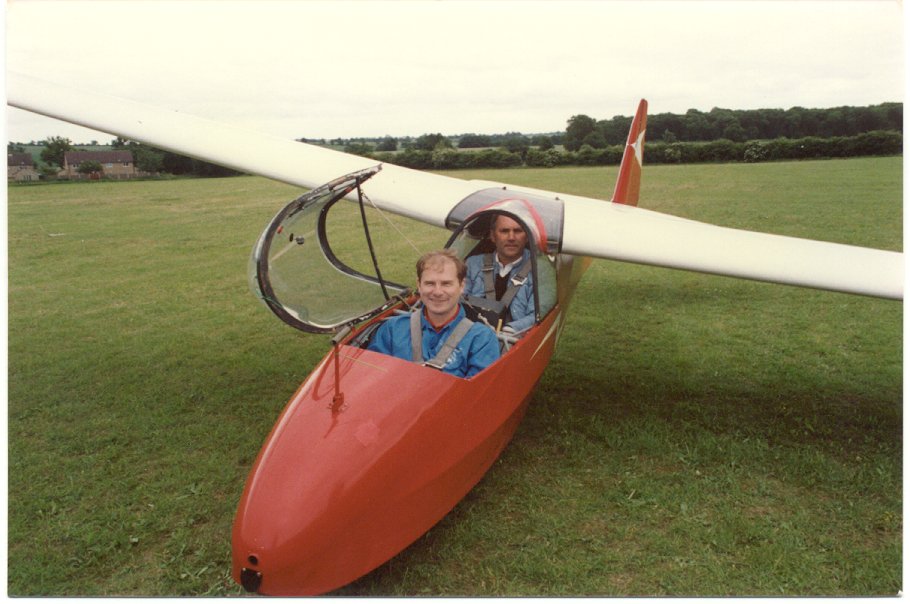
My first exposure to private flying was on the 7th June, 1981 when, at Rattlesden Gliding Club in Suffolk, I was taken up for two air-experience circuits in a two-seater glider known as a ‘K7’. I was immediately hooked! Those experience flights leading to a 4-minute flight (flight number 46) on the 6th September, 1981 that has the remark in my pilot’s log book: Solo! Now fast forward to October, 1984 and my log book shows me attending a gliding instructor’s course at Lasham, resulting in me being issued with a British Gliding Association (BGA) Assistant Instructor Rating on the 14th October. (105/84).
A K-7 two-seat glider.
Anyway, here’s the item that just had to be shared:
Yesterday was heading to be a very hot day in Merlin, Oregon with top temperatures forecasted to be around the mid-90’s, or 34-36 deg. C in ‘new money’. The light westerly wind must have been generating some up currents, aided and abetted by the rising hot air, for there were a number of black ravens soaring in a thermal. Watching the birds circle and climb in the thermal current without needing to flap their wings took me back too many years.
It took me back to a June day in 1981 where I experienced my first glider flight (sailplane in American speak) at the Rattlesden Gliding Club in Suffolk, East Anglia. I’m delighted to see that the Club is still an active one, as their website confirms. Although I subsequently went on to gain my private pilot’s licence (PPL) there are still times when I miss the magic, the pure magic, of gaining altitude in a glider in a beautiful thermal.
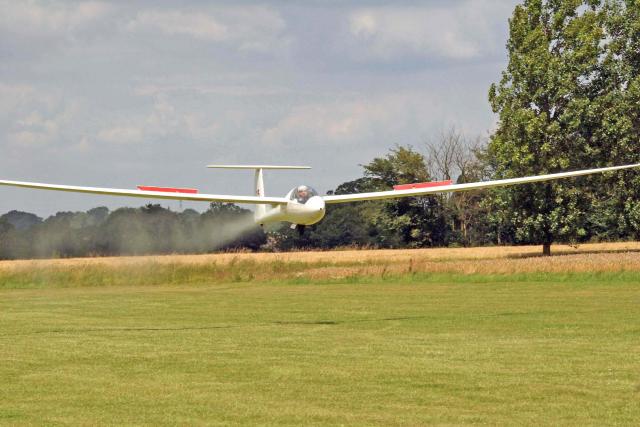
Modern fibreglass glider coming into land at Rattlesden G.C.
So what prompted this flood of flying nostalgia!! An item that was published on the BBC website earlier in the year.
ooOOoo
Fly like a bird: The V formation finally explained
By Victoria Gill, Science reporter, BBC News
The mystery of why so many birds fly in a V formation may have been solved.
Scientists from the Royal Veterinary College fitted data loggers to a flock of rare birds that were being trained to migrate by following a microlight. This revealed that the birds flew in the optimal position – gaining lift from the bird in front by remaining close to its wingtip.
A previous experiment in pelicans was the first real clue to the energy-saving purpose of V formations. It revealed that birds’ heart rates went down when they were flying together in V.
But this latest study tracked and monitored the flight of every bird in the flock – recording its position, speed and heading as well as every wing flap.
This was possible thanks to a unique conservation project by the Waldarappteam in Austria, which has raised flocks of northern bald ibises and trained them to migrate behind a microlight.
The aim of this unusual project is to bring the northern bald ibis back to Europe; the birds were wiped out by hunting, so the team is retraining the birds to navigate a migration route that has now been lost.
Fitting tiny data loggers to these critically endangered ibises showed that the birds often changed position and altered the timing of their wing beats to give them an aerodynamic advantage.
Lead researcher Dr Steven Portugal explained: “They’re seemingly very aware of where the other birds are in the flock and they put themselves in the best possible position.”
This makes the most of upward-moving air generated by the bird in front. This so-called “upwash” is created as a bird flies forward; whether it is gliding or flapping, it pushes air downward beneath its wings.
“Downwash is bad,” explained Dr Portugal. “Birds don’t want to be in another bird’s downwash as it’s pushing them down.” But as the air squeezes around the outside of the wings, it creates upwash at the wingtips.
“This can give a bit of a free ride for the bird that’s following,” said Dr Portugal. “So the other bird wants to put its own wingtip in the upwash from the bird in front.”
The other really surprising result, the researchers said, was that the birds also “timed their wing beats perfectly to match the good air off the bird in front”.
“Each bird [kept] its wingtip in the upwash throughout the flap cycle,” Dr Portugal explained.
oooo
In a sidebar to that BBC article there is this explanation about Flapping and Flying:
As a bird’s wings move through the air, they are held at a slight angle, which deflects the air downward. This deflection means the air flows faster over the wing than underneath, causing air pressure to build up beneath the wings, while the pressure above the wings is reduced. It is this difference in pressure that produces lift.
Flapping creates an additional forward and upward force known as thrust, which counteracts the weight and the “drag” of air resistance. The downstroke of the flap is also called the “power stroke”, as it provides the majority of the thrust. During this, the wing is angled downwards even more steeply.
You can imagine this stroke as a very brief downward dive through the air – it momentarily uses the animal’s own weight in order to move forward. But because the wings continue to generate lift, the creature remains airborne. In each upstroke, the wing is slightly folded inwards to reduce resistance.
ooOOoo
The BBC piece also included this wonderful short video:
This piece has nothing to do with dogs unless one extends the mindset to the magic of the complete natural world.
UPDATE
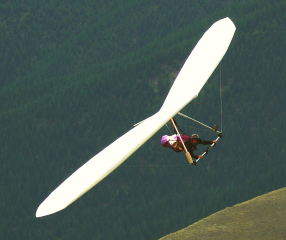
This is a photograph of George Ball hang-gliding – see his reply below.
A Biological Basis for the Unconscious? Surely not?
Ten days ago or thereabouts, I saw a piece on Big Think about the unconscious. The title of the piece was as the sub-heading: A Biological Basis for the Unconscious? I was intrigued, to say the least, and wanted to write about that on Learning from Dogs.
Today, the question of how people make decisions is an animated and essential one, capturing the attention of everyone from neuroscientists to lawyers to artists. In 1956, there was one person in all of New York known for his work on the brain: Harry Grundfest. An aspiring psychiatrist who was born in Austria in the 1930’s, Eric Kandel took an elective in brain science during medical school and found himself studying alongside Grudfest at Columbia University.
“What is it you want to study?” Grundfest asked Kandel. “I want to know where the id, the ego, and the super-ego are located in the brain,” Kandel replied. Grundfest looked at him as if he was crazy. “I haven’t got the foggiest notion whether these constructs exist,” he said. “But the way to approach the brain is to study it one cell at a time. Why don’t you study how the cells work?”
Now it would be improper to republish the whole article, not having permission to so do, and I thoroughly recommend you going to the article here and reading it completely from the Big Think website.
But there are a number of interesting videos on YouTube and the one I have selected is a great example of Kandel’s power of mind. As the short description of the video reveals, “A Conversation With Nobel Laureate Eric Kandel, Who Continues to Look Forward at 80.”

 Learning from Dogs