Tag: Atlantic Ocean

Hollywood movie to reality?

Where is the global climate going?

The challenge with writing posts, albeit not so often, about the global environment, especially when I am a non-scientist, is that one relies entirely on the words of others. In the case of a recent article, published by The Conversation, the authors are claimed to be specialists, and I do not doubt their credentials.

The three authors are René van Westen who is a Postdoctoral Researcher in Climate Physics, at Utrecht University, Henk A. Dijkstra who is a Professor of Physics, also at Utrecht University, and Michael Kliphuis, a Climate Model Specialist, again at Utrecht University.

So, here is their article:

ooOOoo

Atlantic Ocean is headed for a tipping point − once melting glaciers shut down the Gulf Stream, we would see extreme climate change within decades, study shows

Too much fresh water from Greenland’s ice sheet can slow the Atlantic Ocean’s circulation. Paul Souders/Stone via Getty Images

René van Westen, Utrecht University; Henk A. Dijkstra, Utrecht University, and Michael Kliphuis, Utrecht University

Superstorms, abrupt climate shifts and New York City frozen in ice. That’s how the blockbuster Hollywood movie “The Day After Tomorrow” depicted an abrupt shutdown of the Atlantic Ocean’s circulation and the catastrophic consequences.

While Hollywood’s vision was over the top, the 2004 movie raised a serious question: If global warming shuts down the Atlantic Meridional Overturning Circulation, which is crucial for carrying heat from the tropics to the northern latitudes, how abrupt and severe would the climate changes be?

Twenty years after the movie’s release, we know a lot more about the Atlantic Ocean’s circulation. Instruments deployed in the ocean starting in 2004 show that the Atlantic Ocean circulation has observably slowed over the past two decades, possibly to its weakest state in almost a millennium. Studies also suggest that the circulation has reached a dangerous tipping point in the past that sent it into a precipitous, unstoppable decline, and that it could hit that tipping point again as the planet warms and glaciers and ice sheets melt.

In a new study using the latest generation of Earth’s climate models, we simulated the flow of fresh water until the ocean circulation reached that tipping point.

The results showed that the circulation could fully shut down within a century of hitting the tipping point, and that it’s headed in that direction. If that happened, average temperatures would drop by several degrees in North America, parts of Asia and Europe, and people would see severe and cascading consequences around the world.

We also discovered a physics-based early warning signal that can alert the world when the Atlantic Ocean circulation is nearing its tipping point.

The ocean’s conveyor belt

Ocean currents are driven by winds, tides and water density differences.

In the Atlantic Ocean circulation, the relatively warm and salty surface water near the equator flows toward Greenland. During its journey it crosses the Caribbean Sea, loops up into the Gulf of Mexico, and then flows along the U.S. East Coast before crossing the Atlantic.
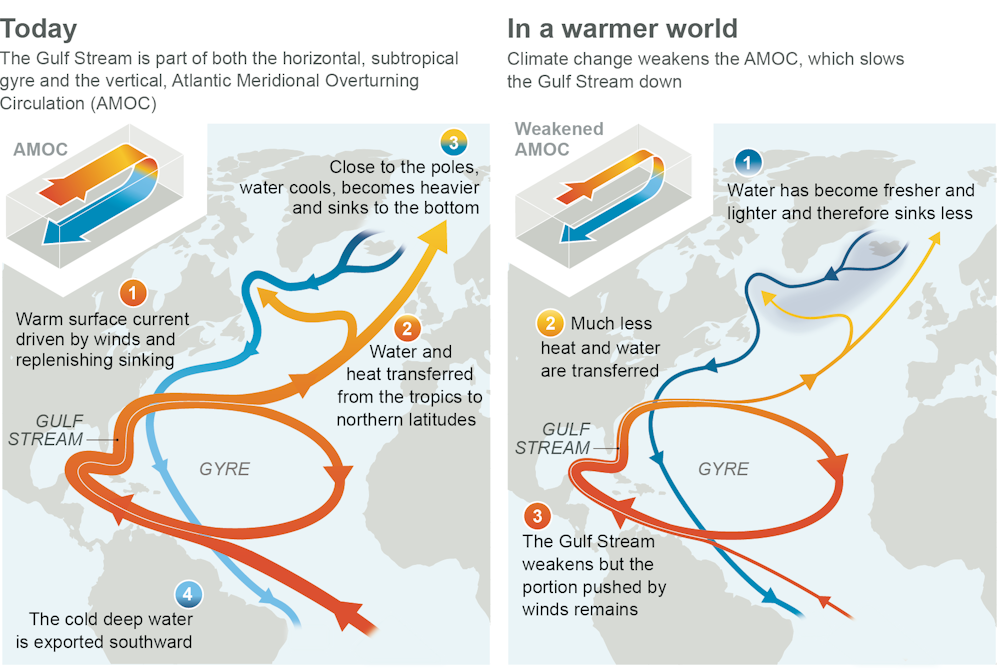
Two illustrations show how the AMOC looks today and its weaker state in the future
How the Atlantic Ocean circulation changes as it slows. IPCC 6th Assessment Report

This current, also known as the Gulf Stream, brings heat to Europe. As it flows northward and cools, the water mass becomes heavier. By the time it reaches Greenland, it starts to sink and flow southward. The sinking of water near Greenland pulls water from elsewhere in the Atlantic Ocean and the cycle repeats, like a conveyor belt.

Too much fresh water from melting glaciers and the Greenland ice sheet can dilute the saltiness of the water, preventing it from sinking, and weaken this ocean conveyor belt. A weaker conveyor belt transports less heat northward and also enables less heavy water to reach Greenland, which further weakens the conveyor belt’s strength. Once it reaches the tipping point, it shuts down quickly.

What happens to the climate at the tipping point?

The existence of a tipping point was first noticed in an overly simplified model of the Atlantic Ocean circulation in the early 1960s. Today’s more detailed climate models indicate a continued slowing of the conveyor belt’s strength under climate change. However, an abrupt shutdown of the Atlantic Ocean circulation appeared to be absent in these climate models. https://www.youtube.com/embed/p4pWafuvdrY?wmode=transparent&start=0 How the ocean conveyor belt works.

This is where our study comes in. We performed an experiment with a detailed climate model to find the tipping point for an abrupt shutdown by slowly increasing the input of fresh water.

We found that once it reaches the tipping point, the conveyor belt shuts down within 100 years. The heat transport toward the north is strongly reduced, leading to abrupt climate shifts.

The result: Dangerous cold in the North

Regions that are influenced by the Gulf Stream receive substantially less heat when the circulation stops. This cools the North American and European continents by a few degrees.

The European climate is much more influenced by the Gulf Stream than other regions. In our experiment, that meant parts of the continent changed at more than 5 degrees Fahrenheit (3 degrees Celsius) per decade – far faster than today’s global warming of about 0.36 F (0.2 C) per decade. We found that parts of Norway would experience temperature drops of more than 36 F (20 C). On the other hand, regions in the Southern Hemisphere would warm by a few degrees.

Two maps show US and Europe both cooling by several degrees if the AMOC stops.
The annual mean temperature changes after the conveyor belt stops reflect an extreme temperature drop in northern Europe in particular. René M. van Westen

These temperature changes develop over about 100 years. That might seem like a long time, but on typical climate time scales, it is abrupt.

The conveyor belt shutting down would also affect sea level and precipitation patterns, which can push other ecosystems closer to their tipping points. For example, the Amazon rainforest is vulnerable to declining precipitation. If its forest ecosystem turned to grassland, the transition would release carbon to the atmosphere and result in the loss of a valuable carbon sink, further accelerating climate change.

The Atlantic circulation has slowed significantly in the distant past. During glacial periods when ice sheets that covered large parts of the planet were melting, the influx of fresh water slowed the Atlantic circulation, triggering huge climate fluctuations.

So, when will we see this tipping point?

The big question – when will the Atlantic circulation reach a tipping point – remains unanswered. Observations don’t go back far enough to provide a clear result. While a recent study suggested that the conveyor belt is rapidly approaching its tipping point, possibly within a few years, these statistical analyses made several assumptions that give rise to uncertainty.

Instead, we were able to develop a physics-based and observable early warning signal involving the salinity transport at the southern boundary of the Atlantic Ocean. Once a threshold is reached, the tipping point is likely to follow in one to four decades.
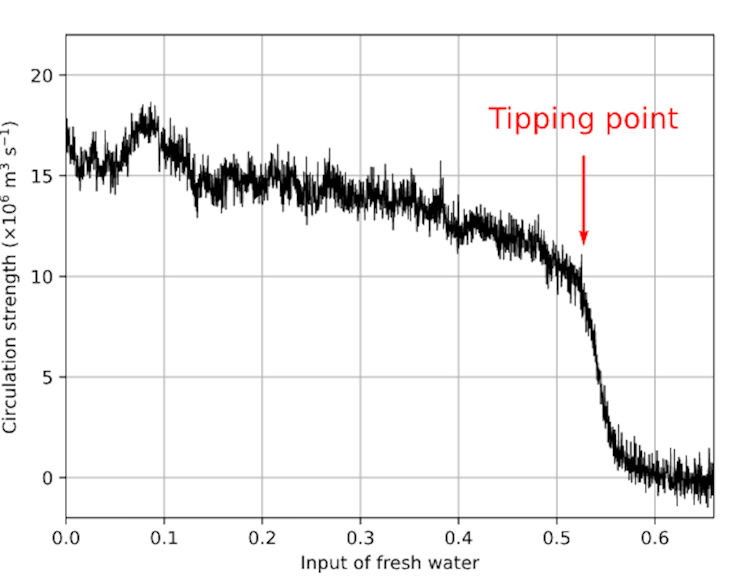
A line chart of circulation strength shows a quick drop-off after the amount of freshwater in the ocean hits a tipping point.
A climate model experiment shows how quickly the AMOC slows once it reaches a tipping point with a threshold of fresh water entering the ocean. How soon that will happen remains an open question. René M. van Westen

The climate impacts from our study underline the severity of such an abrupt conveyor belt collapse. The temperature, sea level and precipitation changes will severely affect society, and the climate shifts are unstoppable on human time scales.

It might seem counterintuitive to worry about extreme cold as the planet warms, but if the main Atlantic Ocean circulation shuts down from too much meltwater pouring in, that’s the risk ahead.

This article was updated to Feb. 11, 2024, to fix a typo: The experiment found temperatures in parts of Europe changed by more than 5 F per decade.

René van Westen, Postdoctoral Researcher in Climate Physics, Utrecht University; Henk A. Dijkstra, Professor of Physics, Utrecht University, and Michael Kliphuis, Climate Model Specialist, Utrecht University

This article is republished from The Conversation under a Creative Commons license. Read the original article.

ooOOoo

I am 79! I like to think that whatever is coming down the wires, so to speak, will be after my death. But that is a cop out for a) I have a son and a daughter who are in their early fifties, b) I have a grandson, my daughter and son-in-law’s young man, who is a teenager, with his birthday next month, and c) I could possibly live for another twenty years.

The challenge is how to bring this imminent catastrophic global change in temperature to the fore. We need a global solution now enforced by a globally respected group of scientists and leaders, and, frankly, I do not see that happening.

All one can do is to hope. Hope that the global community will eschew the present-day extremes of warring behaviour and see the need for change. That is NOW!

So that the Hollywood movie, The Day After Tomorrow, remains a fictional story. And for those that have forgotten the film or who have never seen it, here is a small slice of a Wikipedia report:

The Day After Tomorrow is a 2004 American science fiction disaster film conceived, co-writtendirected, co-produced by Roland Emmerich, based on the 1999 book The Coming Global Superstorm by Art Bell and Whitley Strieber, and starring Dennis QuaidJake GyllenhaalSela WardEmmy Rossum, and Ian Holm. The film depicts catastrophic climatic effects following the disruption of the North Atlantic Ocean circulation, in which a series of extreme weather events usher in climate change and lead to a new ice age.

Wikipedia

And here is a YouTube video:

There we go, folks!

RMS Titanic – in memory.

Spare a moment’s thought today.

On April 14th, 1912, at 23.40 ships time, the Titanic struck an iceberg and the rest is history.  I’m not going to add to the wealth of information available on this sad centenary except to say that 1,514 people lost their lives and they and their descendants should be held in our prayers.  And to recognise that one of those who lost his life was young ‘Jack’ Phillips, Senior Wireless Operator, who persisted in sending out distress messages by Morse Code to the very last, thus enabling the RMS Carpathia to rescue 710 souls.

Rest In Peace

Below are some local times to assist you in offering up a quiet thought as one hundred years ago to the moment the sound of a liner hitting an iceberg reverberated around the world.

RMS Titanic Ships Time April 14th 2340 – 11.40 PM

GMT/UTC April 15th 0240 – 2.40 AM

British Summer Time April 15th 0340 – 3.40 AM

Arizona/California April 14th 1940 – 7.40 PM

New York April 14th 2240 – 10.40 PM

London April 15th 0340 – 3.40 AM

Paris April 15th 0440 – 4.40 AM

Moscow April 15th 0640 – 6.40 AM

Singapore April 15th 1040 – 10.40 AM

Sydney, Australia April 15th 1240 – 2.40 PM

More world times may be calculated from this website.

A Home with a View!

A light distraction to the serious article yesterday!

My son mentioned the other day that a rather unusual property is for sale in North Devon, SW England.  What’s unusual about it?  Well the picture below answers that question!

Hartland Point Lighthouse

Not a bad view, is it!  The lighthouse, or rather ex-lighthouse, depending in which direction one is looking, has the start of the Bristol Channel off to the right, or the Atlantic Ocean directly ahead with the Island of Newfoundland being the next stop Westwards.

The island seen on the horizon in the picture is Lundy Island, a granite outcrop, three and a half miles long and half a mile wide.  As an aside, I can recall a fly-in to Lundy many years ago.  Went there in the Piper Super Cub and the landing and take-off were ‘interesting’.

Back to Hartland Point Lighthouse.  Thanks to WikiPedia, we learn that,

Hartland Point Lighthouse is a Grade II listed building at Hartland Point Devon, England.  The point marks the western limit (on the English side) of the Bristol Channel Atlantic Ocean continuing to the west.

Built in 1874 by Mr. Yerward of Wales under the direction of Sir James Douglass, the tower is 18 metres (59 ft) tall with the lamp being 37 metres (121 ft) above mean sea level. The light can be seen up to 25 miles (40 km) away from the coast. It is protected by a 30 metres (98 ft) long sea wall which was built in 1925 to prevent erosion of the rocks on which it stands.

It was blessed by Frederick Temple, Bishop of Exeter, who later became Archbishop of Canterbury, and the light was lit for the first time by Lady Stuckley of Hartland Abbey during the opening ceremony on July 1, 1874.

The tower was automated in 1984 and is now controlled from Trinity House Operations Centre at Harwich in Essex. Prior to automation the lighthouse was built with accommodation for four keepers and their families. The keepers’ dwellings have since been demolished to make room for a helipad to be constructed. This was necessary due to the precarious nature of the access road which is liable to frequent rock falls and landslips. Vehicular access is now very difficult and the gates tend to remain locked. The large concrete structures immediately to the south of the lighthouse were to provide the keepers with fresh water.

In the 2010 Aids to Navigation Review, by Trinity House, they proposed to discontinue the Hartland Point Lighthouse Station on grounds that the rocks that it sits on is eroding away.

So if you are looking for that really special room with a view, this could be it!  The agency selling the Lighthouse are Smithsgore and the details, including a guide price of £500,000, may be found here.

Practice makes perfect

A personal musing about the value of training.

A good friend here in Payson, himself a former ‘lamplighter’ forwarded me an email with a link to a video taken using the Head-Up-Display (HUD) camera which  also has a voice recorder.

F-16 fighter/attack aircraft

This is the email,

Here’s the F-16 dead stick into Elizabeth City, NC: A fairly short  RWY for jets, (about 6000 ft long), but qualifies for an  “Emergency landing field” in the grand scheme of US  aviation.

You’ll probably have to watch the video several times to appreciate  how intense the situation and how busy the pilot was all the way to  stopping on the runway.  Very apparently, the pilot was one-of-four  F-16s in a flight returning to their base, (most probably from  the Navy Dare bombing range south of Manteo), and the F-16  in question had already reported a “Ruff-Running Engine” to his flight  leader before the start of the video.
A few comments not readily apparent are:

  • The whole episode, from start-to-finish only takes about 3 1/2  minutes!
  • The video begins as the flight is being followed on radar.
The flight leader asks for the Elizabeth City tower UHF freq which  is repeated as 355.6 and the entire flight switches to that freq: Just  one-more-task for the pilot to execute in the cockpit as he reports that  his engine has QUIT.  He has to activate the Emergency Unit to  maintain electric and hydraulic power.  This unit is powered by  Hydrazine:  (the caustic fuel that Germany created in WW II to  power their V-2 Rockets and their ME-163 rocket fighters among  others.) Thus, the last call about requesting fire support after the  jet is safe on deck, and pilot breathing easy.

Meanwhile, back in the cockpit, the pilot is busily attempting to  “Re-light” his engine: (Unsuccessfully, of course) while tending to  everything else.  The video is taken using the Head-Up-Display (HUD) camera which  also has a voice recorder.

The HUD is a very busy instrument, but among things to notice  are the ‘circle’ in the middle which represents the nose of the aircraft  and where it is ‘pointed’: “The velocity Vector”.

The flight leader reports they are 7-miles out from the airport and  at 9000 ft altitude.  Since the weather is clear and the airport is  in sight, this allows for adequate “Gliding distance” to reach a  runway with the engine OFF.  Rest assured, jet fighters glide sorta like a rock.  They don’t enjoy the higher lift design of an airliner like that which allowed Sullenburger to land in the  NY river.

Coming down 9000 ft in only 7-miles requires a helluva rate of  descent, so the pilot’s nose remains well below the “Horizon” until just  prior to touching down on the runway.  The HUD horizon is a solid,  lateral bar, and below the horizon, the horizontal lines appear as dashes.  You’ll see a “10” on the second dashed line below the horizon which =  10-degrees nose low.

Radio chatter includes the flight leader calling the  tower and the tower stating runway 10 with wind 070 @ 5 mph with the altimeter setting of 30.13, yet  another step for the pilot to consider.
The flight leader calls for the pilot to jettison his external fuel  tanks and askes another pilot in the flight to “Mark” where they  dropped.  The tower later tells the pilot to land on any runway he  chooses.
Pilot reports “Three in the green” indicating all three gear  indicate down and locked which the flight leader acknowledges.
You will hear the computer voice of “Bitchin’-Betty” calling out  “Warnings”.  More confusing chatter when none is welcome or even  necessary.  (That’s “Hi-Tech” for ya.)

The pilot has only ONE CHANCE to get this right and must also slow  to an acceptable landing speed in order to stop on the short runway.   You’ll see Black rubber on the rwy where “The rubber meets the road” in  the touchdown area.  Note that during rollout, he gets all the way to the far end which you can see by all the black skid marks where planes have landed heading in the opposite direction.

OK: That’s more than ya probably wanted to know, but you have to  appreciate the fine job this guy did in calmly managing this emergency  situation.  He is a “USAF Reserve” pilot and those guys generally have plenty of experience.  That really pays off.

Please scroll down for the link  + Enjoy.

The pilot just saved  about $20+m at his own  risk…….Great job!  Note  the breathing rate on the hot mic and also the sink rate  (airspeed  tape on the left side of the heads up  display.)

Pretty  cool guy!!!

See  if you can keep all of the radio transmissions  straight.

Probably  the coolest sounding voice in the whole mix is the pilot of the  engine out aircraft.

Just  a reminder an F-16 has only one engine.  When  it goes, you are coming down. It  is just a matter of figuring out where the airplane will come to  rest on terra firma.

(Cut N Paste if a click doesn’t open this link )

http://www.patricksaviation.com/videos/SUPERGT/3384/

Note: For  those not familiar, the EPU (Electrical Power Unit) provides  hydraulic and electrical power in event of failure of the engine,  electrical or hydraulics.  The  EPU is powered by Hydrazine which decomposes into hot gasses as it  passes across a catalyst bed or engine bleed air (if  available).  The  hot air passes through a turbine which drives the emergency  hydraulic pump and generator through a gear  box.

The video is also on YouTube, as below,

Most people are aware of the value of training and experience that saved, in this case, the US taxpayer a large pile of money.

Now onto a much more tragic case, the loss of Air France Flight AF 447 that went down on 1 June 2009 after running into an intense high-altitude thunderstorm, four hours into a flight from Rio de Janeiro in Brazil to Paris.  AF 447 was an Airbus A330-203 aircraft registered F-GZCP.

Many will recall that earlier on in May the second of the ‘black boxes’ or flight recorders was found.  Here’s how Bloomberg reported that,

Air crash investigators retrieved the second of two black boxes from the Air France jet that plunged into the Atlantic in 2009, which may help them unlock the mysteries of the crash after two years.

“They appear to be in a good state,” said Jean-Paul Troadec, head of the BEA, the French air crash investigator that has been probing the accident that killed all 228 people aboard a flight from Rio de Janeiro to Paris. “The first thing is to dry them, prepare them, which needs about a day.” Once the boxes arrive in BEA’s offices, in about 10 days, “the reading of information would be pretty fast,” he said.

Full article is here.

Those who wish to read the report issued by the French Authorities may find it here.  The summary from the report concludes,

NEW FINDINGS

At this stage of the investigation, as an addition to the BEA interim reports of 2 July and 17 December 2009, the following new facts have been established:

  • ˆ The composition of the crew was in accordance with the operator’s procedures.
  • ˆ At the time of the event, the weight and balance of the airplane were within the operational limits.
  • ˆ At the time of the event, the two co-pilots were seated in the cockpit and the Captain was resting. The latter returned to the cockpit about 1 min 30 after the disengagement of the autopilot.
  • ˆ There was an inconsistency between the speeds displayed on the left side and the integrated standby instrument system (ISIS). This lasted for less than one minute.
  • ˆ After the autopilot disengagement:
    • „ the airplane climbed to 38,000 ft,
    • „ the stall warning was triggered and the airplane stalled,
    • „ the inputs made by the PF were mainly nose-up,
    • „ the descent lasted 3 min 30, during which the airplane remained stalled. The angle of
    • attack increased and remained above 35 degrees,
    • „ the engines were operating and always responded to crew commands.
  • ˆ The last recorded values were a pitch attitude of 16.2 degrees nose-up, a roll angle of 5.3 degrees left and a vertical speed of -10,912 ft/min.

If my maths is correct a descent speed of 10,912 feet per minute is the equivalent of 124 miles per hour!

Anyway, I am advised by someone who is a very experienced Airbus captain that the odds of a stall in the cruise for a commercial airliner are extremely low, sufficiently so that it is not something that is regular covered during crew recurrent training sessions.

Here’s a short news video from ABC News.