Life is a one-way track.
Those of you who follow this place on a regular basis know that last Friday I published a post under the title of Friday Fondness. You will also know that later that same day I left this comment to that post:
Thus, as heralded, I am going to write some more.
You would not be surprised to hear that the last few days have been an emotional roller-coaster, for both Jean and me. Including on Monday Jean hearing from our local doctor here in Grants Pass, OR, that a recent urine test has shown that Jean has levels of lead in her bones some three times greater than the recommended maximum. While our doctor is remaining open-minded it remains to be seen whether Jean is exhibiting symptoms of lead poisoning, whether the lead is a possible cause of the Parkinson’s disease (PD), see this paper, or whether it is a separate issue to be dealt with.
However, I want to offer some more from the consultation that Jean had with the neurologist Dr. Eric Lee last Friday. Shared with the full support of Jean who has read the whole of today’s post yesterday evening; as she does with every post published in this place.
But before so doing, please understand that while I was present throughout the complete examination of Jean, what you are about to read carries no more weight than that of any casual onlooker. If you are at all affected by any of the following make an appointment to see your own doctor!
Jean’s examination lasted for about an hour. It consisted of a great number of checks and tests on how her body responded to many different tests and stimulations. At the end of the examination Dr. Lee said that while he wasn’t 100% certain the balance of probability was that Jean was demonstrating the very early signs of PD. For example, showing such signs as walking and not swinging both arms in a normal, balanced manner. Or having a very slow blink rate. Then she was exhibiting some difficulty with rapid finger-to-thumb taps.
However, Dr. Lee did say that Jean was at the very early stages of PD and that we would have to wait another six months to see if the PD indicators were firming up. He also said that he had PD patients who had had the disease for twenty, even thirty years. Some of the general indicators that PD is progressing include a stooped gait, decreasing size of handwriting, and a quieter speaking tone. The NINDS website has more information on this. Here’s a little of what they explain about PD:
What is Parkinson’s Disease?
Parkinson’s disease (PD) belongs to a group of conditions called motor system disorders, which are the result of the loss of dopamine-producing brain cells. The four primary symptoms of PD are tremor, or trembling in hands, arms, legs, jaw, and face; rigidity, or stiffness of the limbs and trunk; bradykinesia, or slowness of movement; and postural instability, or impaired balance and coordination. As these symptoms become more pronounced, patients may have difficulty walking, talking, or completing other simple tasks. PD usually affects people over the age of 60. Early symptoms of PD are subtle and occur gradually. In some people the disease progresses more quickly than in others. As the disease progresses, the shaking, or tremor, which affects the majority of people with PD may begin to interfere with daily activities. Other symptoms may include depression and other emotional changes; difficulty in swallowing, chewing, and speaking; urinary problems or constipation; skin problems; and sleep disruptions. There are currently no blood or laboratory tests that have been proven to help in diagnosing sporadic PD. Therefore the diagnosis is based on medical history and a neurological examination. The disease can be difficult to diagnose accurately. Doctors may sometimes request brain scans or laboratory tests in order to rule out other diseases.
But here’s the good news regarding my darling wife – there are three things that Dr. Lee strongly recommends:
- Hang on to a positive mental attitude for the body actively produces dopamine when in a positive mental state.
- At least 30-minutes of good aerobic exercise three times a week,
- And physiotherapy.
In addition, Dr. Lee said to always THINK BIG! Big in voice, big in attitude, big in stature.
Finally, let me share with you what was posted on the Visible Procrastinations blog back in 2009. Reposted with the author’s permission.
ooOOoo
My Change Journey
Some notes from My Change Journey: This workshop is designed to help you understand your emotional and psychological needs during times of change and strategies you can use to take control of your own change journey. It also focuses on creating opportunities and seeing possibilities in the new world of work.
change – an event that occurs when something passes from one state or phase to another;
transition – the act of passing from one state or place to the next
The Big Picture
You are not always seeing the bigger picture;
Experiencing Transitions
When change is implemented at any level in an organisation, people typically respond by moving through a series of phases. People will spend different times in each phase.

William Bridges (1995) Bridges’ three-phase transition framework: The first phase, the Ending phase, is about letting go of an old identity, an old reality or an old strategy. The Neutral Zone is akin to crossing the wilderness between the old way and the new. The final phase is making a new beginning and functioning effectively in a new way.
The Process of Transition
John Fisher’s model of personal change – The Transition Curve – is an excellent analysis of how individuals deal with personal change.

John Fisher’s transition curve – the stages of personal transition – and introduction to personal construct psychology. http://www.businessballs.com
http://www.businessballs.com/personalchangeprocess.htm
Influencing and exploring options
“You should only worry about things that are within your sphere of influence.”

From The Seven Habits of Highly Effective People – you should only worry about things in your “sphere of influence.” If you have no control over certain aspects of your life, why bother worrying about them?

Mental Models: our way of seeing the world
Mental models are usually tacit, existing below the level of awareness – they should be tested, examined and evaluated.
Joel Barker pioneered the concept of paradigm shifts to explain profound change and the importance of vision to drive change within organizations. View The Power of Paradigms [SWF].
Take 1000
add 40 to it
Now add another 1000
Now add 30
Add another 1000
Now add 20
Now add another 1000
Now add 10
What is the total?
Did you get 5000 ? The correct answer is actually 4100 .
The Fifth Discipline Fieldbook by Peter M. Senge
References
Amado, G., & Ambrose A. (Eds.) (2001) The Transitional Approach to Change. London: Karnac
Amado, G., & Vansina, L. (Eds.) (2004) The Transitional Approach in Action. London: Karnac
Bridges, W. (1998) Managing Transitions: Making the Most of Change London: Nicholas Brealey.
Bridges, W. & Associates (online resources to articles and assessment tools for ‘Managing Transitions’) www.wmbridges.com
Bunker, K. (2008) Responses to Change: Helping People Make Transitions San Francisco: Jossey-Bass
Covey, S.R. (1990) The Seven Habits of Highly Successful People Melbourne: The Business Library
Duck, J. (1993) Managing Change: the art of balancing Harvard Business Review, 71 (Nov/Dec): pp.109-118
Ethical work and life learning (Free online education for ethical work, business, career and life learning; training materials for entrepreneurs, organizations, seflf-development, business management, sales, marketing, project management, communications, leadership, time management, team building and motivation) www.businessballs.com
Fischer, P. (2008) The New Boss: How to Survive the First 100 Days. London: Kogan Page.
Johnson, S. (1999) Who Moved My Cheese? An amazing way to deal with change in your work and in your life London: Vermillion
O’Hara, S. & Sayers, E. Organizational change through individual learning. Career Development International, 1 (4): pp. 38-41
Rogers, C.R. & Roethlisberger, F.J (1991) Barriers and gateways to communication. Harvard Business Review (Nov-Dec): pp.105-111
Stuart, R (1995) Experiencing organizational change: triggers, processes and outcomes of change journeys Personnel Review, 24 (2): pp.3-88
Vansina, L. & Vansina-Cobbaert, J-M (2008) Psychodynamics for Consultants and Managers: From Understanding to Leading Meaningful Change. Chichester: John Wiley & Sons
Williams, D (1999, 2008 update) Transitions: Managing Personal and Organisational Change.
ooOOoo

Let me close today’s post with the opening and closing paragraphs from Chapter 25 of my book: A Way into Our Own Soul.
“Happiness resides not in possessions, and not in gold, happiness dwells in the soul.”
So wrote the philosopher Democritus who was born in 460 BCE (although some claim his year of birth was 490 BCE). He acquired fame with his knowledge of the natural phenomena that existed in those times and history writes that he preferred a contemplative life to an active life, spending much of his life in solitude. The fact that he lived to beyond 100 suggests his philosophy didn’t do him any harm.
………..
In humans, that part of the brain in which self-awareness is thought to arise is called the ventromedial prefrontal cortex. Apparently, that just happens to be located behind the eyes. Ergo, we learn[1] to associate the identity of others with our eyes. Then as we mature, our eyes take on more importance because we develop awareness and a better understanding of the social cues that other people convey with their eyes.
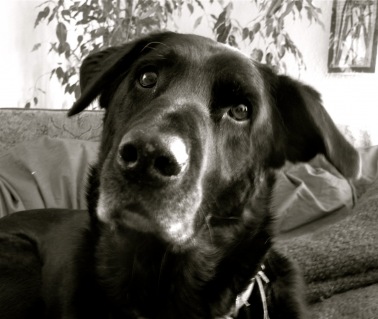
Therefore, is it any surprise that dogs, being the intuitive creatures that they are, soon learn to read us humans and the feelings and emotions that we transmit from our eyes? There’s a knowing in my mind, albeit an unscientific knowing, that dogs, too, give out emotions and feelings from their own eyes.
That loving a dog and being loved back by that dog truly does offer us a way into our own souls. No better put than in the exquisite words of Anatole France,
“Until one has loved an animal, a part of one’s soul remains unawakened.“

[1] Refer to Christina Starmans and Paul Bloom of the Mind and Development Lab at Yale University.
ooOOoo
Oh, and a postscript. Having a loving contact with another person or your dog also releases dopamine within the body – so go and hug your partner or your dog! Now! 🙂




 Learning from Dogs
Sue, and everyone else, we returned from seeing Dr. Lee, the neurologist, a little under two hours ago. Dr. Lee’s prognosis is that Jean is showing the very early signs of Parkinson’s disease, and Jean is comfortable with me mentioning this.
Everyone’s love and affection has meant more than you can imagine. I will write more about this next week once we have given the situation a few ‘coatings of thought’.
Jean sends her love to you all!