Sent to me in the last hour by long-time friend Bob Derham.
Dogs are animals of integrity. We have much to learn from them.
Sent to me in the last hour by long-time friend Bob Derham.
Republished for the wider promotion of this alert.
Dear Fellow Dog Lover,
Because you signed up on our website and asked to be notified, I’m sending you this special recall alert.
On July 7, 2015, Carnivore Meat Company of Green Bay, Wisconsin, announced it is voluntarily recalling two batches of its Vital Essentials raw frozen dog food due to possible contamination with Listeria bacteria.
Listeria is not only dangerous to dogs, it can be deadly to small children, the elderly and those with autoimmune disorders.
The affected products were distributed in 12 U.S. states.
To learn which products are affected, please visit the following link: Vital Essentials Raw Dog Food Recall
Please be sure to share the news of this alert with other pet owners.
Mike Sagman, Editor
The Dog Food Advisor
P.S. Not already on our dog food recall notification list yet? Sign up to get critical dog food recall alerts sent to you by email. There’s no cost for this service.
Fire dogs; another aspect of Man’s Best Friend.
A colleague back in England was speaking to me recently about a series on BBC Television about forensics. The series is called Catching History’s Criminals: The Forensics Story.
Apparently, the third in the series Instruments of Murder (For UK readers the link is here.) included fire being used as a criminal act. That episode featured a dog named Gunner who was a fire forensics dog. To the surprise of both Jean and me, while we were very aware of the sniffer dogs used by the police in many countries, neither of us had previously been aware that dogs were used, at times, in the determination of the cause of fire.
Now listen to Nikki Harvey of Hertfordshire Fire and Rescue Service in this YouTube video:
Published on Jul 23, 2013
Trained from a puppy by his partner in crime and handler, Nikki Harvey, Reqs (pronounced Rex) qualified as Hertfordshire Fire and Rescue Service’s new fire investigation dog in April this year. At a special event on Monday (22 July) Reqs launched his Twitter account and demonstrated his skills at Longfield Training Centre, Stevenage.
The 22-month-old black Labrador is taking over responsibility for helping to investigate the cause of fires in Hertfordshire and surrounding counties. His predecessor, seven year old CC, will work alongside Reqs until he retires.
Richard Thake, Cabinet Member for Community Safety and Planning said: “The work that Reqs does is critical in assisting the Hertfordshire Fire and Rescue Service team and it plays an integral part in community fire safety. Reqs is exceptionally valuable and receives the same high degree of training that we afford all frontline fire personnel.”
From six months old Reqs was trained to sniff out traces of ignitable liquids such as petrol, white spirit and lighter fluid which can remain present even after the most severe fire. Fire investigation officers use Reqs to assist them in determining the cause and origin of fires – whether deliberate or accidental. At the event he proudly gave a demonstration of sniffing out accelerants in a house and a car, as well as riding on an Arial Ladder Platform (ALP) that reaches up to seven floors, can be used as a water tower to extinguish large fires, and forms a safe platform for working at height.
Hertfordshire’s Chief Fire Officer Roy Wilsher said: “Reqs helps out on serious and non-serious cases and knowing what starts a fire helps us enormously in getting important fire safety messages out to the public. We want to prevent fires and keep people safe and now that Reqs is on Twitter his followers will learn a lot of useful tips to prevent accidental fires.
“I use Twitter myself (@HertsFireChief) and social networking is a great way to spread our safety messages across Hertfordshire.”
Fire investigation dogs are used for their speed and accuracy and are proving very successful in their work. Reqs and CC have assisted in many high profile incidents including suicides, fatal fires, arson attacks and murder investigations.
Reqs’ handler, Nikki Harvey said: “We’ve been training together for nearly two years now, which has given us the opportunity to get to know each other and build up trust which is essential. Ongoing training is now part of Reqs’ daily routine and it’s important that he always enjoys the ‘game’. I’m really looking forward to putting Reqs’ new skills to use.”
Reqs is the third fire investigation dog for Hertfordshire Fire and Rescue Service and is sponsored by Hatfield based company Computacenter UK Ltd, who also sponsor CC and his predecessor Browza. Clare Rafferty, Head of Corporate Events, Computacenter (UK) Ltd said: “The Fire investigation dog is a valuable asset to the Fire and Rescue Service and we are yet again delighted to extend that sponsorship to Reqs who is very worthy of stepping into CC’s shoes.”
And to demonstrate that these wonderful dogs undertake these roles both sides of the “pond”, here is a video from Denver, Colorado:
Published on Feb 23, 2015
Victoria travels to Denver, Colorado to check in on experienced arson investigator Jerry Means and his third arson dog, Riley. Jerry shows Victoria how he continues to train Riley, visits his office at the Colorado Bureau of Investigation, and takes her to a burn building to demonstrate live fire and extended training for Riley. Part 1 of 2
All of which seems like a great nudge for me to republish a post from Learning from Dogs from September, 2012 that explained a little more about the incredible power of the dog’s nose! See you tomorrow.
Meet Lizzy The Dancing Dog and her Human Sandra Roth.
Last Saturday, I posted Let’s dance today!
It showed a dog dancing to music, or quite possibly, a dog scratching its back against a wall that someone had cleverly set to music. The video had been sent to me by Chris Gomez.
Then Dan, a brother to Chris, and a close personal friend of mine for 35+ years, sent me the following. This is in a different league to Saturday’s little video. This raises questions as to how the dog was trained to perform like this? How long did it take? What’s the story behind the display?
All I could discover, from the blog Sun Gazing was, “This dog dance was performed at The Open European Championships and totally blew the crowd away.”
Trust me, this is going to have you spellbound!
Enjoy!
If anyone can provide the answers to my earlier questions then Dan and I would love to hear from you.
The penultimate set of Hiding in Plain Sight pictures.

oooo

oooo

oooo

oooo

oooo

oooo

oooo

oooo
That’s it for this week. All the very best to you all.
What better way to celebrate July 4th!
(The following was sent to me by Chris Gomez!)
This fabulous world of blogging.
When I first started writing Learning from Dogs, some six years ago this coming July 15th, I didn’t have a clue. Not a clue about how addictive it would become, how eventually it would motivate me to write a book of the same name as the blog (not yet published), and, above all, what a wonderful family feeling would develop. Not only between me and my followers but also, and just as importantly, from the many wonderful blogs that I follow in turn.
One of those mutual friendships is with Val Boyco and her blog Find Your Middle Ground. Two days ago, Val published a beautiful post entitled Love is the Bridge for Understanding.
In a world that offers so many examples of everything that we don’t love, it’s a great pleasure to republish Val’s post, done so with her very kind permission. Thank you, Val.
ooOOoo
Posted on July 1, 2015 by Val Boyko

Diana over at Talk to Diana wrote a moving post today that has stayed with me. “He Deserves Better Than This” is about her father who has been in chronic back pain for years and has not received treatment to alleviate it. Diana decided that enough was enough and made several calls until she spoke to an administrator in the health service.
Diana’s intention was clear. “They know his medical history, but I wanted to tell them about the man who is my dad, who worked hard all his life, who deserves better than this; who deserves to live his last years with some enjoyment and quality of life.”
Wow.
Sometimes we let ourselves think that others have our best interests in mind… And we suffer in silence. It is up to us to ensure that they understand what our needs are and support us in getting them met. (Having a caring daughter as an advocate also helps!)
So, how do we make ourselves be seen, heard and understood?
Having a good argument doesn’t cut it. Bringing all the facts to the discussion won’t either. Getting angry could also backfire.
I believe that in Diana’s case, her passion and love for her father touched the goodness inside a fellow human being. The administrator wanted to help and she did. He gets treatment on Friday. Yeah!
Love is the bridge for understanding. It moves us from being “one of them” in the eyes of another to become “us” in our common humanity and caring.

Here’s an other story that touched me deeply. Daniel Gottlieb is a family therapist, psychologist and award winning radio host. Thiry years ago he survived a traumatic car accident. He is paralyzed from the neck down and gets around in a special wheelchair.
In his book The Wisdom We’re Born With he shares a personal story. While staying at a hotel on business, the manager approached him and said “I hope you are enjoying your stay”. As it turned out there had been several hurdles that he had had to overcome in order to find a room that was easily accessible and comfortable. He asked to meet with the manager the next day to go on a guided tour with him. The manager seemed sincerely interested.
Gottlieb then asked the manager “Who do you love most in the world?” The manager quickly responded “My daughter.” Gottlieb then said “Okay, could you do this before we meet tomorrow morning? Imagine your daughter is visiting your hotel…. and she is in a wheelchair.”
They did meet the next morning but there really was no need, the manager had already seen the obstacles and hurdles. He was eager for more input from Gottlieb so that he could make it right.
When we reach out with love, we touch the innate love and compassion in others. We come together in our common humanity and caring. We hear each other and understand. We are all connected by love.
And then we know what is to be done.
ooOOoo
Revealing my age, what comes immediately to mind after having read Val’s post is this song:
This hotel welcomes dogs!
For reasons that I’m not entirely clear about I haven’t yet settled back into my planning routine for daily posts since our Internet service was restored.
No matter!
Have no doubt this will raise a smile or two!

Welcome to July!

Sidney Bloch, who is Emeritus Professor in Psychiatry at the University of Melbourne, recently published an essay over on the blogsite The Conversation. (Greatly recommended, by the way.)
His essay was about happiness versus contentment and certainly touched a few spots in this old Englishman’s psyche, contented as I am in this rural part of Oregon. However, until now I had never stopped to think about the difference between being happy and being contented.
So, I think you are going to enjoy Professor Bloch’s views, that now follow. His essay is republished, with permission, just as it was presented on The Conversation.
ooOOoo
June 29, 2015 4.07pm EDT

I want to share a personal view of what it is to be happy and how it differs from feeling content. Let me begin with a clinical story.
They met at a party; it was love at first sight just like one reads about in romantic novels. They married following an exhilarating courtship, and since they shared an eagerness to raise a family, Jennifer soon announced the joyful news of her pregnancy. They called their baby Annie after Adam’s late mother.
They felt blessed; every moment since their first encounter had been nothing but pleasurable. Everyone who knew them concurred that their lives as a couple had been replete with happiness.
Tragically, it was not to endure. Their first setback occurred only days after Annie’s birth. She was sleeping fitfully and her colic stubbornly persisted. Jennifer felt utterly demoralised as a new mother. Her mounting sense of guilt and melancholy led to her admission to a psychiatric ward (her first ever encounter with psychiatry); the fear of her harming Annie or herself spread through the family and circle of friends.
And then, quite shockingly, despite the most diligent medical and nursing care, Jennifer met her death after jumping off a second floor balcony. Her family and friends plunged into deep grief; the medical professionals who had looked after her were similarly bereft.
An elusive goal
Having worked as a psychiatrist for over four decades and got to know dozens of men, women, and children of diverse backgrounds and with unique life stories, I have witnessed many a sad narrative, although suicide has mercifully been a rare event.
These experiences, in tandem with a lifelong fascination with what makes people tick, have led me most reluctantly to the judgement that while we may savour happiness episodically, it will invariably be disrupted by unwelcome negative feelings. Still, most of humankind will continue to harbour the expectation of living happily and remain oblivious that this wishful fantasy is an unconscious way of warding off the threat of psychic pain.
Rather than confront and demoralise those who have sought my help, I have gently but honestly responded to their plaintive yearning (“all I want is just to be happy”), by highlighting an inherent human sentiment. Namely that clinging to the fiction of being able to avoid suffering and enjoying a continuing state of pleasure is tantamount to self-deception.
I have offered them the hope – but not a guarantee – that they have the potential to lead a more fulfilling life than hitherto by participating in a challenging, and at times even distressing process of self-exploration whose purpose is to enhance self understanding and acceptance of the reality-bound emotional state I call contentment.
You may retort: “But you treat people who are miserable, pessimistic and self-deprecating, surely you must be hopelessly biased.” I would readily understand your reaction but suggest that all of us, not just those in treatment, crave happiness and are repeatedly frustrated by its elusiveness.

As the father of psychoanalysis Sigmund Freud emphasised in his 1930 essay, Civilization and Its Discontents, we are much more vulnerable to unhappiness than its opposite. That’s because we are constantly threatened by three forces: the fragility of our physical self, “doomed” by ageing and disease; the external world, with its potential to destroy us (through floods, fires, storms and earthquakes, for example); and our unpredictably complicated relationships with other people (regarded by Freud as the most painful source of unhappiness).
So, am I simply a misanthrope? I hope not but I am inclined to agree with Elbert Hubbard, the American artist and philosopher, who said, “Life is just one damn thing after another“.
We only have to think about the 50 million people who are currently displaced and unlikely to find a secure haven anytime soon, or the 2.2 billion people – including millions of children – who live on less than US$2 a day to appreciate the validity of that remark.
A better option
Given the formidable obstacles to chasing after happiness or promoting its sustainability if we are lucky enough to come by it, what options do human beings have? I have not come across any meaningful approach to this question, even from the unswervingly confident proponents of the contemporary school of positive psychology.
So, I espouse the following: given that we have the means to distinguish between happiness and contentment, we can examine how they differ and, in so doing, identify an alternative to the futile pursuit of happiness.
Happiness, derived from the Norse word hap, means luck or chance; the phrase happy-go-lucky illustrates the association. Many Indo-European languages similarly conflate the feeling of happiness and luck. Glück in German, for instance, can be translated as either happiness or chance, while eftihia, the Greek word for happiness, is derived from ef, meaning good, and tixi, luck or chance.
Thus, a mother may have the good fortune to feel ecstatic when responding to her infant’s playfulness, only to see it evaporate a couple of years later and be replaced by the initial features of autism. In the story we started this article with, Jennifer may have persevered had her baby slept peacefully and not been assailed by colicky pain in her first few weeks of life.
Contentment is derived from the Latin contentus and usually translated as satisfied. No multiple meanings here to confuse us. In my view, feeling content refers to a deep-seated, abiding acceptance of one’s self and one’s worth together with a sense of self-fulfilment, meaning and purpose.
And, most critically, these assets are valued and nurtured whatever the circumstances, or even especially when they are distressing or depressing.I have had the privilege of knowing men and women who suffered grievously as children in the ghettoes and concentration camps of Nazi Europe but emerged from their nightmare to face the challenge of seeking strengths, emotional and spiritual, within themselves. With the passage of time, many succeeded in achieving a sense of deep-seated contentment.
What these survivors have clearly demonstrated is that accepting and respecting oneself, coupled with determining what is personally meaningful, stand a greater chance of accomplishment, even if never completed, than a relentless and ultimately futile pursuit of happiness. What’s more, contentment has the potential to serve as a robust foundation upon which episodes of joy and pleasure can be experienced and cherished.
ooOOoo
I read the essay on The Conversation out aloud to Jeannie yesterday morning and we both found it a very wise and insightful reflection.
Seems to me that there’s another aspect of life that we could learn from our wonderful dogs!
The effect of familiarity on dog–human interactions.
Introduction
You will remember that a couple of weeks ago, Professor Marc Bekoff generously gave me permission to publish his essay Butts and Noses: Secrets and Lessons from Dog Parks. The essence of the essay being that dog parks are gold mines of information about the behavior of dogs and humans. (Post published by Marc Bekoff Ph.D. on May 16, 2015 in Animal Emotions.)
The good Professor then went on to say that I was free to republish any of his essays so long as the usual accreditations and links were provided. So yesterday, I started going through the many html links in his essay, that essay may be read here, looking for posts that would interest readers of Learning from Dogs.
Very quickly, I came across this:
Dogs and their human companions: The effect of familiarity on dog–human interactions
Andrea Kerepesi (a), Antal Dóka (a), Ádám Miklósi (b)
(a) Department of Ethology, Eötvös Loránd University, Hungary
(b) MTA-ELTE Comparative Ethology Research Group, Budapest, Hungary
It’s a very interesting piece of research. I’m going to include the Abstract in today’s post and recommend if anyone wants to read the full article that they do so here.
So here is the Abstract.
ABSTRACT
There are few quantitative examinations of the extent to which dogs discriminate between familiar and unfamiliar persons. In our study we have investigated whether dogs show differential behaviour towards humans of different degrees of familiarity (owner, familiar person, unfamiliar person). Dogs and humans were observed in eight test situations: (1) Three-way strange situation test, (2) Calling in from food, (3) Obedience test, (4) Walking away, (5) Threatening approach, (6) Playful interaction, (7) Food inhibition test and (8) Manipulation of the dog’s body.
Dogs distinguished between the owner and the two other test partners in those tests which involved separation from the owner (Test 1, 4), were aversive for the dog (Test 5) or involved playing interac- tion (Test 6). Our results revealed that the owner cannot be replaced by a familiar person in situations provoking elevated anxiety and fear.
In contrasts, dogs did not discriminate between the owner and the familiar person in those tests that were based on obedient behaviour or behaviour towards an assertive person (Tests 2, 3, 7 and 8). Dogs’ former training experience reduced the difference between their behaviour towards the owner and the familiar person in situations requiring obedience but it did not mask it totally. The dogs’ behaviour towards each of the humans participating in the tests was consistent all over the test series.
In summary, dogs discriminated between their owner and the unfamiliar person and always preferred the owner to the unfamiliar person. However, the discrimination between the owner and the familiar person is context-specific.
This article is part of a Special Issue entitled: Canine Behavior.
© 2014 Elsevier B.V. All rights reserved.
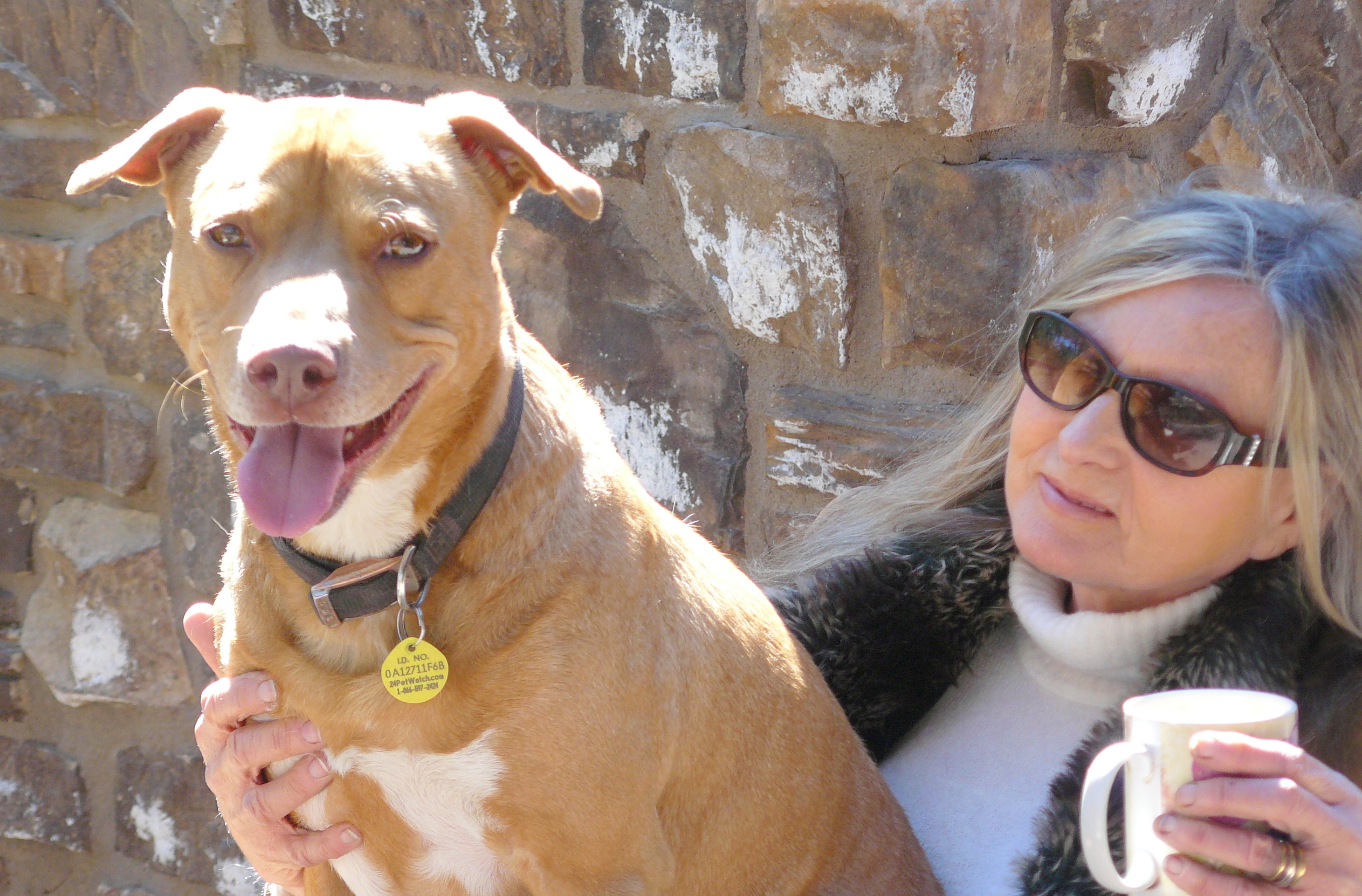
Speaking of dog-human interactions, let me close today’s post with this photograph of Jeannie and Casey.
 Learning from Dogs