Category: Writing

Beating depression without pills!

The value of a loving dog is not to be over estimated!

Returning to the theme of how dogs can help us humans fight off depression.

A delightful guest post from Taylor who recently asked if she could share a post from her own blog. I was delighted to have been asked.

oooooh

Dogs Can Help Decrease Symptoms of Anxiety and Depression.

by Taylor G. February 23rd. 2018.

I have always been a huge animal person. But mostly, a dog person/mom. I have two pups, and I am a dog walker in my neighboring towns. But I also suffer from depression and anxiety. Doctors always rush to prescribe medicine, but I have found that dogs can help as well. This post will be describing how dogs can help people suffering with depression and anxiety.

  1. Exercise- For all you dog owners out there, you know how much exercise your furry friends require. Since becoming a dog walker, I am forced to exercise and walk everyday. While it hasn’t cured my mental illnesses, it has decreased some of my symptoms. I am forced to get out of bed and do something. In recent studies, they have found that dog owners are a lot more likely to meet daily exercise requirements then none dog owners!
  2. Sense of Purpose- When you know that there is another living being that relies solely on you,
    Koda and I on a walk.

    you get a sense of worthiness. I know I struggle with feeling needed, but as soon as I schedule a dog walk, I know that that dog needs me. That the dog is waiting for me to walk it. It makes me feel needed in this world. It has increased my self worth and makes me feel like I have a purpose.

  3. Structure/Daily Routine- Many people who suffer with depression and anxiety know the struggle of having a routine. All we want is structure in our lives in a world where everything is hectic and last minute. Having a dog/being a dog walker, gives you a routine. Most dogs get up to do their business at the same time every morning and they know when its walk/feeding time. Trust me 🙂 It has given me a set schedule and has helped me feel more structured and less crazy!
  4. Forever Companion- Dogs will steal your heart, but you will also steal theirs. They are one of the most loving and caring animals out there. They sense your emotions and will be there for you through your good and bad days. I know that when I have a bad day, I always have my happy little furry babies to come home to. They are my friends when my depression tells me I have none.
  5. Petting Reduces Stress- It is proven, that the ‘motion’ and the ’emotion’ the goes into petting,
    Chloe with my Guinea Pig Daisy

    actually releases oxytocin (hormone related to anxiety relief), which can help reduce blood pressure!

  6. Mindfullness- For people who are trying to practice mindfulness (anxiety/depression technique that keeps you in the current moment), having a dog will help you do that! They keep you distracted from the bad things that are going on, and make you concentrate on their cute shenanigans.
  7. Koda with a cup on his head.

    Help with Isolation- For those days when your depression gets the best of you, they help you feel less lonely and less isolated. They will be there for you when no one else is, and knowing that always makes me feel better.

  8. They allow me to smile- Last year, when my depression and anxiety were at its peak, I forgot how to smile. The only time I smiled was when I was in the presence of my dogs. They taught me how to smile again, and I am so grateful to them.

My dogs have helped give me my life back. While I am still fighting my

Koda smiling.

depression and anxiety, I am definitely proof that dogs can help in this fight against mental illness. While they also may be a huge responsibility, they are also a huge help in the war with mental illness.

ooOOoo

I will close by stating the obvious.

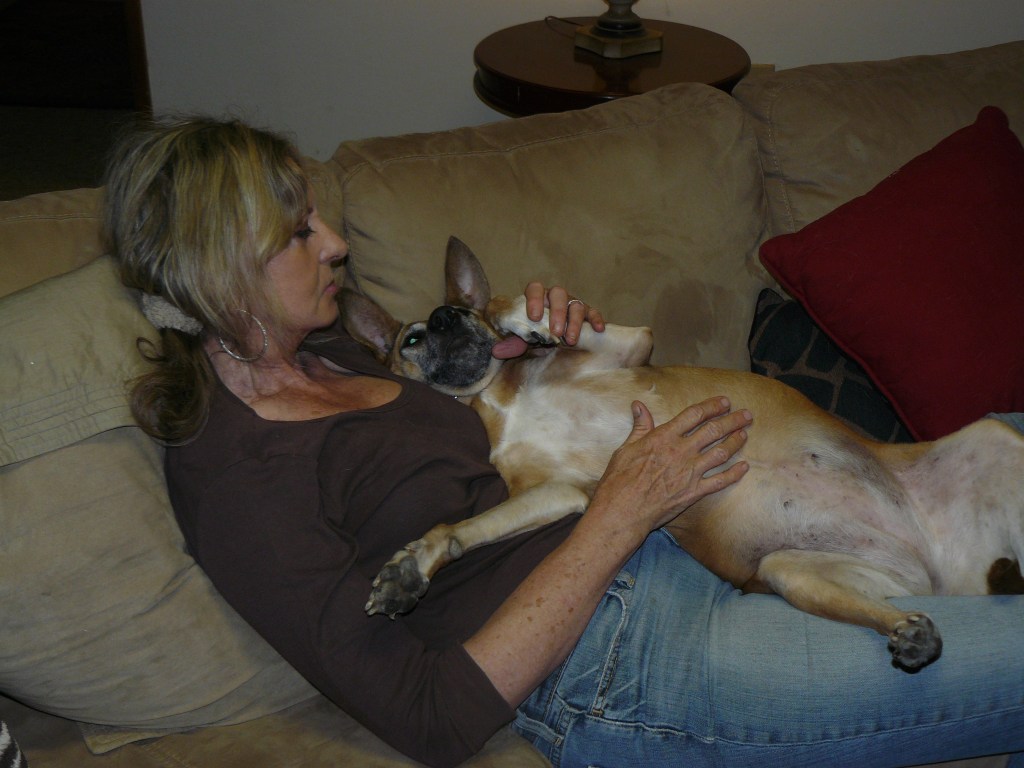
That is that everyone who has a dog or two in their life and has times of feeling depressed knows without question what it means to hug a dog.

Those who do not have a dog in their life and have experienced depression should find their own dog to hug – pronto!

The mists of the mind

Those inner voices inside our heads!

The photograph below is the yacht that I lived on for 5 years, from 1987 though to 1992. My base was Larnaca Marina in the Greek ‘sector’ of the Island of Cyprus although I cruised over much of the Mediterranean during the warm summer months. (Long-term readers, you poor souls, will realise that this isn’t the first time I have spoken of sailing and Tradewinds…)

Songbird of Kent
Tradewind 33 – Songbird of Kent

As I explain over on my ‘author’s’ blog:

During this period Paul became much more aware of the importance of marketing strategy, becoming a Chartered Member of the British Institute of Marketing, and the raft of competencies that deliver entrepreneurial success. In 1986, Paul accepted an offer to sell the Dataview group of companies. (Regrettably, this period also saw the failure of Paul’s marriage to Britta and their subsequent divorce.)

Again, chance intervened in that an Autumn vacation in 1986 to Larnaca in Cyprus resulted in Paul meeting a couple who wanted to sell their yacht, a Tradewind 33, and return to England. Thus very early in 1987, Paul left Essex and became a full-time ‘yachtie’ living on that Tradewind Songbird of Kent in Larnaca marina. Paul was then exposed to the life of an ocean-going sailor returning to Plymouth, Devon via The Azores onboard Songbird of Kent in 1992.

I purchased this Tradewind 33, designed by Englishman John Rock by the way, because somewhere in my soul was a dream to do some solo ocean sailing. Probably inspired by reading too many books written by famous British solo yacht-persons. Such as Robin Knox-Johnston, Chay Blyth, Naomi James, Ellen MacArthur, Pete Goss and the king of them all: Sir Francis Chichester who was the first person ever to sail around the world single-handed.

But it remained a dream for almost all those 5 years. Reason? Because at the start of the summer cruising period each year I slipped out of Larnaca and sailed along the southern coast of Cyprus, up the Western coast and then the open sea crossing to a nearby Turkish harbour, such as Anamur or Alanya. At the end of the summer I would repeat the solo trip in reverse. But I still haven’t said what the core reason was for not being braver and planning a solo ocean voyage.

Because that sailing voyage twice a year, that took me about four days to accomplish, and was undertaken alone, really scared me. I mean scared with a capital ‘S’! For it was impossible to accomplish without many hours of solo sailing at night!

Fast forward a number of years and one day, when I was living on Songbird at Larnaca Marina into the vacant berth next to me came a new visitor to Cyprus. His name was Les Powells and he very quickly explained that he was on his way back to England on his third solo circumnavigation of the world!

imagesInevitably Les and I got chatting over a couple of beers during our evenings together and Les asked me about my sailing ambitions noting that I lived on a yacht that most people purchased for ocean sailing purposes.

I explained my miserable experiences each year going to and fro between Cyprus and Turkey.

Les heard me out and then threw his head back and roared with laughter.

“Paul, what you are experiencing is the adjustment from a land-based life, as in living here in Larnaca, to a water-based life.

I suffer just the same adjustment stress as you have detailed.”

My face conveyed both my amazement and my yearning to learn more.

“Yes, Paul, every time I go to sea solo the first three or four days are hell! I hate them! I only stick with it because there is always a point, (Les really emphasised the word always) usually under a glorious night sky, when I truly become attuned to the life of a solo yachtsman far out from the nearest land and wouldn’t swap it for anything”

“You have to trust this and set out on a solo voyage of more than, preferably much more than, four days sailing.”

Thus in time that’s what happened.

In the Autumn of 1972 I returned to Plymouth in England, via the Azores, sailing solo on Songbird of Kent. Indeed, I was going to republish an article about lighthouses in Oregon but I’m changing tack in mid-stream; so to speak!

I am going to close today’s post by republishing an experience of being alone on the Atlantic Ocean that first graced these blog pages in October 2015. Lighthouses will have to wait.

ooOOoo

There is a place in my mind to which I can so easily travel; a memory of a dark night out in the Atlantic. But first let me set the scene from almost fifty years ago.

The call of the open ocean

Those first few hours were utterly absorbing as I went through the whole business of clearing the yacht harbour at Gibraltar and heading out to the South-West hugging this unfamiliar coastline of Southern Spain. It was tempting to move out to deeper waters but the almost constant flow of large ships through the Straights of Gibraltar soon quashed that idea. Thankfully, the coastal winds were favourable for me and my single-masted sailing yacht.

After such a long time sailing in the relatively confined waters of the Mediterranean, it was difficult for me to imagine that in a few hours time the southern-most point of Spain would pass me by and the vastness of the Atlantic ocean would be my home for the next few weeks.

Soon the city of Tarifa was past my starboard beam and the Spanish coastline was rapidly disappearing away to the North-West. The horizon ahead of me was already approaching 180 degrees of raw, open ocean.  There was just a flicker of a thought that whispered across my mind: “Oh Paul, what have you gone and done” as slowly but persistently the coastlines of Spain to the North and of Africa to the South became more and more distant and fuzzy.  It was at 15:30 that I made an entry in my yacht’s log: “No land in sight in any direction!

Now was the time to make sure that my bunk was made up, flashlights to hand, and my alarm clock ready and set. Alarm clock? Set to go off every twenty minutes during the night! For this was the only way to protect me and my yacht from being hit by one of those gigantic container ships that seemed to be everywhere. It took at least twenty minutes from the moment a ship’s steaming lights appeared above the horizon to crossing one’s path!

It was in the early hours of my first morning alone at sea, when once again the alarm clock had woken me and I was looking around an ocean without a single ship’s light to be seen that more of Les’ words came to me. I remembered asking Les: “What’s the ­appeal of sailing?” Les replied without a moment’s hesitation: “It’s the solitude. When you’re out at sea on your own, there’s no government or bankers to worry about. You’re not ­responsible to anyone but yourself.

Yes, I could sense the solitude that was all around me but it was an intellectual sense not an emotional one. That would come later. Inside, I was still afraid of what I had let myself in for.

Remarkably quickly however, the pattern of solo life aboard a thirty-three-foot yacht became my world. Frankly, it staggered me as to how busy were my days. Feeding myself, navigating, trying to forecast the winds, staying in touch with other yachties via the short-wave radio, keeping the boat tidy and a zillion other tasks meant the first few days and nights just slipped by.

But it was a sight on my fourth night at sea that created the memory that would turn out to remain with me for all my life. The memory that I can go to anytime in my mind.

That fourth night I was already well into the routine of waking to the alarm clock, clipping on my harness as I climbed up the three steps that took me from my cabin into the cockpit, scanning the horizon with my eyes, checking that the self-steering had the boat at the correct angle to the wind and then, if no ships’ lights had been seen, slipping back down into my bunk and sleeping for another twenty minutes. Remarkably, I was not suffering from any long-term tiredness during the day.

It was a little after 3am that fourth night when the alarm clock had me back up in the cockpit once again. Then it struck me.

Songbird was sailing beautifully. There was a steady wind of around ten knots from the south-east, almost a swell-free ocean, and everything set perfectly.  Not a sign of any ship in any direction.

Then I lifted my eyes upwards. There was not a cloud in the night sky, not a single wisp of mist to dim a single one of the million or more stars that were above my head. For on this dark, moonless night, so far removed from any shore-based light pollution, the vastness, yet closeness of the heavens above was simply breath-taking. I was transfixed. Utterly unable to make any rational sense of this night splendour that glittered in every direction in which I gazed. This dome that represented a vastness beyond any meaning other than a reminder of the magic of the universe.

This magic of the heavens above me that came down to touch the horizon in all directions. Such a rare sight to see the twinkling of stars almost touching the starkness of the ocean’s horizon at night. A total marriage of this one planet with the vastness of outer space.

I heard the alarm clock go off again and again next to my bunk down below. But I remained transfixed until there was a very soft lightening of the skyline to the east that announced that another dawn was on its way.

I would never again look up at the stars in a night sky without being transported back to that wonderful night and the memory of a lonely sea and sky.

ooOOoo

Dear, dear Les is still alive and still living on his yacht Solitaire in an English marina. A very close mutual friend, Bob Derham, arranges to visit Les on a very regular basis and take him out for shopping trips and a leisurely pub lunch.

Bob follows this blog and I hope will have the chance to read out today’s post to Les. For my closing sentence is directed to Les, and Les alone: “Dear Les, thank you from the bottom of my heart for the gift you gave me. For it is a rare night when here in rural Oregon when I go outside at the end of the evening and above my head is a clear, black night sky, full of stars, that I am not transported back to that night alone in the Atlantic ocean. I am still rendered speechless in awe of such night skies.”

The deep, dark, wonderful mists of the mind!

Lateral thinking

In debt to Edward de Bono.

One of the great differences between us humans and our beloved dogs is that frequently we think too much! But it’s worse than that. We think too much and get caught up in some spiral from which we can’t think ourselves back out. Perhaps that can be likened to a dog worrying away at something that the dog thinks is being overlooked by it’s human friend, or over-licking a wound or such.

A very quick web search will bring up the background information on Dr. de Bono who was responsible for overturning the way we think. It was de Bono who attended an IBM Office Products management course that I was attending, far too many moons ago, when I was promoted from being a salesman to the first rung of the management ladder; the position of Marketing Manager. It was during de Bono’s talk that I first learned of lateral thinking and what de Bono called the “PO” moment.

Just watch the first minute of this talk to get an appreciation of what the PO moment is. Seriously, the video starts with Simon Middleton defining a PO moment. It’s relevant to the rest of this post.

As you all know Jean has Parkinson’s Disease (PD). We have come to understand that PD affects different people in different ways, albeit there are some aspects that many PD sufferers share.

Take this symptom as described on the APDA website:

Many individuals report difficulties in multitasking and organizing daily activities.

In recent weeks I noticed I was becoming frustrated because although I was suggesting to Jeannie a number of what I thought were pleasant things to do in and around our property they weren’t being done.

As much as I tried to say to myself to chill out, this is all down to Jean’s PD, I couldn’t push out of sight the growing frustration that my help was being rejected, and I know I have a problem dealing with rejection! I really didn’t want my frustration to build up to anger.

Eventually, one morning last week after I came back to the bedroom from having fed the horses and the deer I blurted out, rather clumsily I admit, this frustration that was close to becoming a real annoyance.

At first Jean was upset by what I said, understandably so, but then we settled down to examining each suggestion of mine and where I was coming from. Then the conversation became very productive and in a moment of creative thinking I suggested what turned out to be a ‘PO’ moment. In other words, we had both agreed that while we acknowledged the fact that Jean was not motivated to do the things I was suggesting nonetheless it was important that we choose another day and time to discuss how I should remind Jean of these ‘overlooked’ suggestions and, more importantly, how it could be done in a loving and constructive manner.

It was a fascinating outcome and I immediately jumped out of bed, went to my office room next to the bedroom, grabbed a new, unused notebook and came back to the bedroom.

“Jean, let’s write this down in the book as a reminder of something we need to return to and resolve in a creative way! Let’s call these reminders Pharaoh moments!”

Jean very happily agreed!

I then explained to Jean that this felt very much like one of de Bono’s PO moments and calling it a Pharaoh moment was a beautiful way of remembering our wonderful dog.

It was beyond doubt an example of Jean and me thinking laterally.

So thank you, dear Edward, your legacy still endures.

I will close today’s post by inviting you to watch either or both of these talks by de Bono.

The first is a little over 4 minutes long.

Or a longer video that is still highly recommended:

Published on 22 Oct 2015

Edward de Bono is the originator of the concept of Lateral Thinking, which is now a firm entry in the Oxford English Dictionary. Dr de Bono was born in Malta. As a well-established academic, de Bono was a Rhodes Scholar at Oxford and holds an MA in psychology and physiology from Oxford. He is a Professor at many leading institutions around the world. He is an author of many best-selling books, and is known as the world’s leading authority on thinking.
I write this post as a very happy man who has lived the value and benefits of not bottling up one’s feelings!

One paw in front of the other

A just delightful guest post!

Came from an online exchange.

ooOOoo

So today was the day for me. And I done it with the help of my wonderful dog.

I had been dreaming all night of running and depression and failing miserably.
I was woken at 6:30am by the sound of my dad coming back in after he had been for his normal morning walk around the village with our dog Riley. I was also disturbed by my boyfriend coughing and spluttering up god knows what, and I laid and tossed and turned as I thought oh my god today I’m going to go for a run, followed by don’t be so stupid of course your not you can’t even run down the stairs.

As the early morning light started to come in through the sides of my blinds, I pulled out my eye patches and fell back to a disturbed sleep until…. midday. I couldn’t believe it.

You lazy shit I thought, so much for your run, what a joke you are. Jumping out of bed at the thought of what my mother might say, I went downstairs and put the kettle on, I turned to my dog who had followed me down and said: “I’m going to take you out don’t worry.”

I couldn’t have put it off for any longer if I tried! I hoovered, steam cleaned, made tea, ate beans on toast, tidied my bedroom, anything but get ready to go for a run. Truth is I was terrified!

After not physically being able to tidy much more, I got ready, and put on my new Nike running shoes I had bought in the New Years sales. Riley stretched his tail wagging as he sensed that it was time.

The next twenty or so minutes were the most emotional, and longest, twenty minutes of my life I have ever experienced. I put my new running band on with my phone and beats headphones, and a Spotify playlist that played the most god awful dubstep but I didn’t care. I downloaded the couch to 5k app as I have not really ran in years and pressed start and off me and Riley headed around the village.

The walking was fine, then the lady popped up in her American accent start to run, and so I did.  I started to develop a stitch in my stomach, pain in my chest and the most overwhelming urge to cry. I battled constant thoughts in my head that I could do it … blah! blah! blah!, but Riley was with me. We done it together.

Slow down and start to walk” the voice spoke. I was glad someone knew what I was doing as I didn’t have a clue. I suddenly became awfully aware of the cars going past and thoughts of people looking at me and what they might think: she doesn’t look great; she looks like she is struggling; she must be mad. So with my fave down unable to break a smile or lift my frown I carried on with lead in hand and my faithful dog by my side. I spoke to him, praised him at how well he was doing but I can’t bring to praise myself not yet.

The dubstep tracks blasting in my ears the lyrics started on this train with no destination. And I thought this is how depression and anxiety have made me feel, I have been on a slow and steady train down to rock bottom and I can’t seem to get back up, but I feel today was a start. A little positive I suppose that I can add to my negative.

As it started to snow I thought wow I really am mad, I can’t even run these twenty mins , let a lone a 5k, 10k or yet alone this bloody great north run.

Freezing cold and following my dog in front I made it home and put the kettle straight on and slumped down waiting to make my cup of tea.
For the first time in a long time, I think I see a little light, a little tiny speck of light at the end of my long dark tunnel!

ooOOoo

I asked Catherine for permission to republish this because I was very moved when I read it over at her place. It seemed to say to me that this very honest and open account of what Catherine was experiencing might resonate somewhere out there with you dear readers.

Thank you, Catherine!

More importantly, thank you, Riley. Dogs do so much for us. Even saving our souls!

Our very noisy world

Especially for our dogs at times.

First of all, I owe a number of people who have sent me guest posts a big apology. I have been very lax in publishing them in this place. Frankly, I don’t know where the time goes and on top of that I seem to get so easily distracted by stuff!

Then I go and publish a wonderful guest post that has come in after some of the other great posts that have been sent to me.

As is the case with this very interesting guest essay sent to me by Jenny Nolan.

Trust you will forgive me!

ooOOoo

How to Introduce Your Dog to Noisy and Crowded Environments

by Jenny Nolan.

Over the course of their lifetime, dogs whether they ultimately like it or not will have to experience busy and potentially noisy environments they may not always feel comfortable in.

Just like us, our pets sometimes have to brave situations or scenarios they would prefer to avoid but when it comes to introducing your dog to busy and noisy surroundings you can do so in such a way that can help even the most anxious of pets.

Although in day to day life it is straightforward enough to keep your dog in environments they feel settled within, sometimes this isn’t always the case and you need to take your dog with you when visiting public places that can be crowded and sometimes overbearing. Some common examples include visits to your groomers and even the vets. These environments also have the added disadvantage of potentially unnerving your dog’s in other ways particularly if they are uncomfortable being handled by strangers.

Introducing your dog to crowded and loud environments covers two key aspects of teaching your dog about the world around them.

These two areas of your dog’s development are known as socialization, which is concerned with how they learn to interact with other animals and humans they come into contact with and habituation, how they learn about new environments and ultimately how they behave in certain situations.

Lack of development in these two main areas can lead to behavioral difficulties stemming from a number of issues, perhaps because your pet is threatened by other dogs or feels anxious around large crowds. Fear of loud noises can also lead to your dog developing phobias, which is why proper training needs to be carried out particularly when introducing your pet to new places and new people.

As a dog owner, you want to do all you can to prevent your pet from worrying too much and hopefully aiming to raise a friendly and sociable pooch should be the goal for all of us. Luckily there are a number of ways to ensure your pet is comfortable in new surroundings and ideally, you should begin training while your dog is still a puppy.

The reason for this is because from the age of 6 – 12 weeks your puppy will be extremely receptive to socialization and habituation, meaning you can put a lot of the groundwork in at this time and reap the rewards later. However even if your pet is older than this you don’t have to worry, you can still train them in the same way.

To do this you should make the process as natural as possible to ensure you raise a well-rounded pet. One way to do this is to look to introduce your dog to as many different situations as possible, by doing so you will help them to feel comfortable whatever their surroundings may be.

Although this may all sound straightforward there are a number of points to bear in mind to ensure you introduce your pet to new environments in the correct way. Below we have broken down three main tips you can follow, using our experience of coming in contact with literally hundreds of dogs a week, some nervous, some boisterous, who when confronted with new surroundings, loud noises, and left without their owners all react in very different ways.

We hope these tips cover two main areas of raising a dog: training, and grooming. Both of these can seem daunting to new pet owners but it is important to take both aspects of dog parenting one step at a time. To help with this there are a number of great dog training books out there while sometimes it is important to remember not only what we can teach them but also what we can learn from our dogs.

So without further ado here are three key tips when familiarizing your dog with new and potentially busy surroundings:

Don’t rush or apply pressure – this should be the basis for all dog training so is worth repeating here. It is important you don’t rush your pet into any experience they aren’t comfortable with.

As pet groomers, this also applies to a situation we see most often. Although it isn’t anyone’s fault we often encounter owners bringing their pet in to be groomed who just aren’t used to new environments and are visibly nervous.

The last thing this dog wants is to be left with a complete stranger which is why we often suggest for dogs we are grooming for the first time to be brought in quickly before they are scheduled in to be groomed to meet us and get used to the saloon. On this trip they are not left alone, instead stay with their owner for five minutes or so in a new environment and then head home again. By not rushing you can be sure your pet is completely comfortable in new surroundings.

Repetition – Now although in some ways this point may contradict what we have explained above we still think it is vitally important. By reintroducing your pet to experiences and environments they are not overly keen on you avoid phobias and deep-rooted fears by showing your pet they have nothing to be afraid of.

Take our example from earlier with the nervous dog left with us at the saloon to be groomed for the first time. Now upon arrival to pick their pet up the owner may become unnerved themselves at just how anxious their pet has become while they weren’t there. An overprotective owner may jump to the conclusion that their dog just doesn’t like being groomed by others or visit places they aren’t familiar with.

This could lead them to begin home grooming their dog and only letting them interact with other humans and dogs at home. This would actually be a step back in the dog’s development and it is advisable to continue to expose your pet to situations they aren’t so comfortable with slowly, in the case of crowds this can be from afar at first and then edging closer as your pet relaxes.

Encourage others to interact with your pet – Once you have eased your dog into becoming comfortable in crowds with distractions and unfamiliar sounds at every turn it is also important to encourage others to interact with your dog if they’re happy to do so. This continues the socialization phase of your dog’s development and can further help ease any fears they may have of the unknown and strangers in particular.

This can be even more beneficial if you have a nervous or anxious dog. When this is the case, others may be hesitant to pet or say hello to your furry friend. As already mentioned, if people avoid your dog, for this reason, this may perpetuate the problem in your dog’s mind, leading to deep-rooted fears and phobias.

This is a fairly easy step to follow and you can start slowly by introducing your dog to one stranger every time you take them for a walk. By doing so your pet will come into contact with tens and eventually hundreds of unfamiliar faces and begin to ease the worries they may once have had. Obviously, some passers-by may not be pet lovers like you and I but if they are also walking their own dog it is fairly common they will be happy to chat and say hello.

As the above step outlined if you repeat this process so your dog meets many new people one by one they will be far more comfortable in crowded environments that may have once unnerved them.

So there you have a real quick roundup of what we hope are three super easy tips to follow in order to ease your dog into unfamiliar social situations. The three tips complement each other well so can be combined to be even more effective than if they are used exclusively on their own.

We hope by following them your dog will become a far more sociable and calm animal and in no time you won’t have to encourage others to interact with your pet as they will be making the first move to say hello themselves.

ooOOoo

Wasn’t that valuable advice!

I will try and focus over the coming days of presenting more guest posts from other authors.

Back to clean air!

Or more specifically the cleansing power of indoor plants.

Back in 2012, I published a post called Clean, clean air. I am going to republish it tomorrow because Kelli sent me an email setting out that over on her blog site she has a much more comprehensive list of plants that purify the air.

Her blog site is Groom & Style and the long list of air-purifying plants that Kelli wrote about may be  see here: 12 Air Purifying Plants That Will Clean Your Air. Here is how Kelli’s post opens:

12 Air Purifying Plants That Will Clean Your Air

We need fresh air to live a healthy and full life, but it’s fast becoming a luxury. Residents of many major cities around the world are plagued with smog and poisonous gases from motor vehicles, fossil fuel based power plants, and factories.

The good news is there is a simple solution you can use at home to make your air much cleaner. While air purifiers might help, air purifying plants are a great and natural way to clean your home’s air supply. In this article, you’ll learn more about air pollution, its dangers, and how to choose the best air purifying plants for your home.

Anyway, if you wish to read more then go here and, as I mentioned above, my post of August, 2012 will be republished tomorrow.

Food for Thought! A Fascinating Documentary!

Looking again into diet and nutrition.

While this post doesn’t specifically look at what we feed our dogs, there’s no question in my mind that good nutrition is just as important for our dogs as it is for ourselves.

Moving on!

You will know that quite a few of my recent posts have been on the back of me being made aware of how a strict diet plus taking many vitamins and supplements had had the effect of putting Colin Potter’s Parkinson’s Disease (PD) into remission.  All of which was summarised in an post last week called Food Truly Does Matter.

But then a good friend who lives locally, and has a solid medical background, spoke to me and said what you are writing can’t possibly be correct because if diet and supplements really did put PD patients into remission then “everyone would be doing it“. It was difficult to argue that.

So I thought the best people to call would be the American Parkinson Disease Association. I was put through to the director of the North-West Chapter of the APDA, located in Seattle, WA., and she agreed that there was no magic bullet in terms of diet and PD remission.

But the director went on to say that diet and lifestyle were nonetheless incredibly important and that there was no question that the correct decisions in terms of lifestyle were vital for anyone with PD; whatever the stage of the disease .

Dr. Laurie Mischley

The director also went on to say that without a doubt we should make contact with Seattle Integrative Medicine also, as the title suggests, in Seattle.

In particular, make contact with Dr. Laurie Mischley for the director said that Dr. Mischley’s clinical speciality is Parkinson’s Disease.

Plus we were advised to watch a talk that Dr. Mischley gave in British Columbia towards the end of 2016.

The talk is 49 minutes long and should be watched by everyone!

Reason?

Because in the talk there is much evidence, as in factual evidence, that shows the link between our lifestyle choices and what helps or hinders those with PD.

But even more critical to my way of thinking is that the evidence presented in the talk offers solid reasons why all of us as we approach middle-age and beyond should be careful about what we eat.

Food for Thought: Diet & Nutrition in PD – Dr. Laurie Mischley, ND, PhD, MPH from Parkinson Society BC on Vimeo.

This is a recorded presentation from Parkinson Society British Columbia’s Victoria Regional Conference featuring Laurie Mischley. Dr. Mischley studied naturopathic medicine (ND) at Bastyr University and epidemiology (MPH) and nutritional sciences (PhD) at the University of Washington. Her work is focused on identifying the nutritional requirements unique to individuals with neurodegenerative diseases. She has published articles on coenzyme Q10, lithium and glutathione deficiency in Parkinson’s disease (PD). Dr. Mischley maintains a small clinical practice at Seattle Integrative Medicine focused on nutrition and neurological health.

So, my dear reader, here is a little plea from Paul.

Whether or not you have PD, watch the talk and have all the people you love and care for watch it as well.

Oh, and give your dog a cuddle from Jean and me!


Please understand that I do not offer advice and nothing on any website, including the blog site Learning from Dogs, email or any other communication is intended to treat, diagnose, prevent or cure any disease. It is not a substitute for consulting your doctor. You should consult a doctor for diagnosis of conditions, before beginning any diet, exercise or supplementation or if you suspect you have any healh issue. You should not stop medication without consulting your doctor.

Nutrition for dogs

Good food matters just as much for our dogs!

In yesterday’s post I mentioned that Justina had sent me a couple of links in response to me wondering if there was good nutritional advice for dogs as well as there clearly was for us!

Here are those two articles that Justina sent me links to.

Namely, the first being an article that is on Dr. Patrick Mahaney’s website.

Specifically:  Feeding Your Pet from the Perspective of Chinese Medicine

That article opens thus:

This article originally appeared as Using Warming, Cooling, or Neutral Food Energy to Promote Your Pet’s Health and Nutrition on PetFoodDirect.com

Since the onset of my veterinary career, I’ve had a strong interest in how the foods our pets consume contribute to an overall state of wellness or illness. Learning how to apply this interest to my patients took many years of post-veterinary school practice, continuing education, and an ongoing belief in the inherent nutritional benefits of whole foods.

During veterinary school, students’ brains are heavily saturated with a variety of academic information. As graduation date nears, a general sense of insecurity develops about making the appropriate professional choices to best serve our patients. As a result, common sense notions about the value of looking more discerningly at the ingredients formulating a pet’s diet are often overlooked.

You may read the full article here.

The second one is on the DogVills site.

Again, specifically about the role of Chinese Medicine as part of dog food therapy.

Chinese Medicine Meets Dog Food Therapy: What You Need to Know

You may have heard of Chinese medicine for people, but did you know that it can also be used for dogs? In fact, Chinese medicine has an entire approach to dog food therapy that is quite intriguing. Let’s talk a bit about it so you can decide if it’s right for your dog.

Chinese medicine is often referenced when anyone talks about holistic approaches to healthcare. It seems that it has a treatment for almost everything, and often those treatments work. Something I learned recently is that traditional Chinese medicine extends to dogs, and many people use hot, cold, and neutral foods to help their dogs feel better.

I am going to explore getting permission to republish both articles in full.

Food truly does matter!

The power of connections!

(Post alert! This is a longish post so if you are interested in diet, nutrition and health and are short on time just now then bookmark it for a better time for you. For I am of the opinion that this post will be of great value to you and many others!)

Regular readers of this place (you poor people!!) will be aware that via a series of lucky chances, or the fickle finger of fate as I like to call it, not being a religious person, I made contact with Justina, a London-based nutritionist, following contacting Colin Potter.

I wrote about that connection in more detail in my post The Power of Good Food that was published on the 16th January. Here’s a snippet from that post:

Richard lives with his good lady, Julie, in Minety, a village in North Wiltshire. He and I go back many, many years and we have been close friends from the day that we first met. Richard was diagnosed with early-stage Parkinson’s Disease (PD) the same year and month as my Jeannie: December, 2015.

Last New Year’s Eve Richard and Julie were at a local party and the subject of PD came up. Richard subsequently told me that he was speaking to a fellow party guest who said that he was, in turn, an acquaintance of a Colin Potter. He went to add that Colin had also been diagnosed with PD but had decided not to ‘give in’ to the diagnosis but undertake comprehensive research into the causes and whether it was possible to go into remission. He later launched a website Fight Parkinsons.

We then reached out to Colin and very quickly subscribed to his Fight-Parkinson’s site. Colin’s message was that it was all about diet! Here’s that message in a short video from Colin.

That, in turn, resulted in both Jean and me adding to our already reasonably healthy diet a significant number of additional vitamins and supplements; the reasons for which will be spelt out later on. Plus more fruit, eggs, cheese but most definitely coming off all grains, sugar, carbohydrate and processed foods. Or in Colin’s words:

The right diet
This is the high fat/ low carb diet which is covered in the Fight-Parkinsons Recovery Eating Plan on my website.

I follow a diet that excludes all grains, sugar, carbohydrate and processed foods, and is rich in fats and cholesterol-laden foods. So, in addition to organic vegetables, I eat plenty of eggs, butter, dairy (full fat), fish and a little meat.

This raises the question of cholesterol and the so-called link to heart disease. THIS ARTICLE should lay this misguided information to rest and inform you of the fraud that has been practised upon us over the past 60 years (the same period during which chronic disease, in all its forms, has rocketed).

I consume foods rich in antioxidants and avoid inflammatory foods.

 Supplementation
It is vital that we get the required minerals, vitamins and amino acids on a daily basis, and THIS VIDEO of an interview with Dr Joel Wallach explains why.
I have taken numerous supplements over the past few years, often leading to me taking a small mountain of capsules each day.

So, to underline that “small mountain” phrase here is a photograph of what Jeannie and yours truly are now taking by way of vitamins and supplements.

Plus, all the other organic fruit and vegetables and nutrients.

Returning to Justina.

She has been very helpful in bringing us up to speed on the efficacy of the the required minerals, vitamins and amino acids we need on a daily basis. Or to put it more specifically on the efficacy of the products that one can purchase from Youngevity. She said that the Wellness 90 Pak was effective albeit one had to commit to taking it for a period of at least 90 days (hence the name) as the body required that time to ‘adjust’ if that’s the correct term.  Here’s a description of the purpose of that ‘Wellness Pak’ from their website.

The Wellness 90 Pak™ delivers the nutritional support needed for individuals following the Wellness 90 Program. This program focuses on a diet rich in fruits, vegetables, whole grains, legumes, nuts, olive oil, and other healthy options, that helps improve your overall nutrition. This Pak™ includes: (1) TMR Total Meal Replacement-Vanilla canister, (1) Slender FX™ Sweet EZE™, (1) TrueDetox Tea™ box (30 packets), and (1) Slender FX™ Rev™ bottle. See individual products for details.

Justina then mentioned about the online food resource site known as Food Matters TV (FMTV). Not a site we had come across before but, again, once we signed up to the site, a subscription site, we were blown away by what was available.  Especially a documentary called Food Matters. Here’s the trailer to that documentary (that has been viewed nearly 1.8 million times!).

As Justina pointed out the documentary expresses the same critically important message as Dr. Joel Wallach is promoting: We Are What We Eat! But there is no connection between the two.

The bottom line is that Jean and I are going to add the Wellness 90 Pak to our diets for the next 90 days and you can be sure that how it goes will be reported here.

What about our dear, dear dogs?

I asked Justina the question knowing that I would be writing and publishing this post and this is what she said:

I don’t have dogs, but my friend has two golden retrievers and one of them didn’t or couldn’t lift his tail.

She went to see conventional vet and they said he needed a surgery that costs thousands and there’s still possibility of him being paralyzed. So she found holistic vet and wanted to get their opinion.

She was really impressed as they made a special food plan for him and after 3 month he lifts his tale half way! In  Chinese medicine he was called a ‘hot dog’ and needed certain nutrients daily for his condition and that was natural just majority raw food that humans eat too!

More on good food for dogs coming along tomorrow.

Hope this was interesting to you!

Finally, please understand that I do not offer advice and nothing on any website, including the blog site Learning from Dogs, email or any other communication is intended to treat, diagnose, prevent or cure any disease. It is not a substitute for consulting your doctor. You should consult a doctor for diagnosis of conditions, before beginning any diet, exercise or supplementation or if you suspect you have any health issue. You should not stop medication without consulting your doctor.

The Role of Pets in Depression and Bullying in Kids

Another great guest post from Emily Ridgewell!

Both Emily’s previous guest posts were received very well by you. There was Four-legged Gardening, published here last October 24th, and Return To The Movies that came out on the 4th of that same month.

Now Emily writes about something that is never far away from us these days, irrespective of age: depression. And the strongly positive role of pets. Great guest post but first let me re-introduce you to Emily.

Emily Ridgewell is an arts professional and a pet enthusiast from sunny LA. Emily has a creative energy and an aesthetic sense of living, where everything beautiful is worth sharing. She loves her yorkie Olivia and writes original and fun articles on ways to learn and improve your pet-best friend’s life. She finds exciting new things to explore and experience! Don’t forget to connect with her on Twitter: @ridgewell_j

ooOOoo

The Role of Pets in Depression and Bullying in Kids

Kids today are faced with more stress and worry than ever, and childhood depression is on the rise because of it. Recent studies have shown almost 10% of children and adolescents experience depression. One of the main sources of depression among children is being the victim of bullying. Unfortunately, bullying doesn’t discriminate and can happen to boys and girls of any ethnic, racial, religious, or socio-economic background. Lasting effects of being bullied include having low self-esteem and negative self-image, unhappiness at school and difficulty focusing, and trouble establishing healthy relationships with peers.

Interestingly enough, these side effects are found in the bullies as well as their victims. Both are more likely to experience depressive symptoms than those who have never been involved in bullying. They also are more likely to have coexisting mental health issues, such as Oppositional Defiance Disorder, Attention Deficit Disorder, and Clinical Depression and Anxiety. If left unaddressed, these feeling of depression and low self-worth can lead to chronic levels of mental health issues, isolation, and even suicidal ideation.

The first line of defense for parents is arming themselves with strategies to help their children cope with feelings of depression and address them when they first appear. First and foremost, they need to recognize the signs of depression. Then they need to put their heads together and come up with a plan to help their child combat it. Use resources such as your pediatrician, teachers, and school counselors to help develop a long term plan. In the meantime, one of the most effective and immediate ways to help them at home is by getting a pet.

Pets have several benefits that help combat depression and help your child feel happier, more whole, and well connected. First of all, they offer uncomplicated, unconditional love. They don’t say hurtful things, get angry over petty misunderstandings, or hold grudges. They simply love and express joy every time they see their owners. They also offer constant companionship. Having a pet means never having to feel alone or isolated. Additionally, the act of petting a dog or cat (or any other pet, for that matter) offers physical touch and provides comfort, creating a soothing effect and releasing feel-good endorphins in the brain. In turn, this reduces stress and anxiety and helps your child feel calmer and more emotionally balanced.

Further, having a pet means your child will have an added responsibility. Contrary to what you may originally think, a new responsibility provides a distraction and offers a positive focus instead of what’s bothering him.. Plus, he’ll feel good about himself for taking care of something that needs him. He will feel capable, and this bolsters self-esteem and causes a ripple effect in all aspects of her life. It’s a win-win situation.

If you opt for a dog, part of the responsibilities will be walking it. This earns another point in the fight against depression for a couple of reasons. It will make your child be physically active, a well-known tool for negating depressive symptoms. It also is an excellent way to increase social interaction. People are always wanting to touch a puppy, and this leads to a natural conversation when they ask permission. Even if your child is anxious about talking to new people, dogs and pets are automatic ice breakers. Talking about their pet can easily guide the conversation with very little pressure on your child to generate small talk. If they are engaging in conversation, they are less likely to feel isolated and will benefit mentally from the interaction.

Of course, pet ownership isn’t something you should jump into lightly. Be sure to choose the right pet for your child and teach him the right way to handle and care for it. With care and supervision, your child and her pet will become fast friends in no time. While there is no quick fix for depression, owning a pet has multiple benefits which will show their impact quickly. Having an unconditional friend to love can work wonders for building confidence and self-esteem and combatting the negative effects of bullying and depression.

ooOOoo

Emily is spot on. Pets, especially dogs, are the epitome of loving us humans unconditionally and that connection is precious beyond words. Being able to hug or cuddle a dog, frequently as an ad-hoc impulse, is about as comforting a place that us humans, well certainly this human, can get.

Sitting in front of the television of an evening and having a cat snuggle up next to one and start purring is a very close second-best!

Great post from Emily!