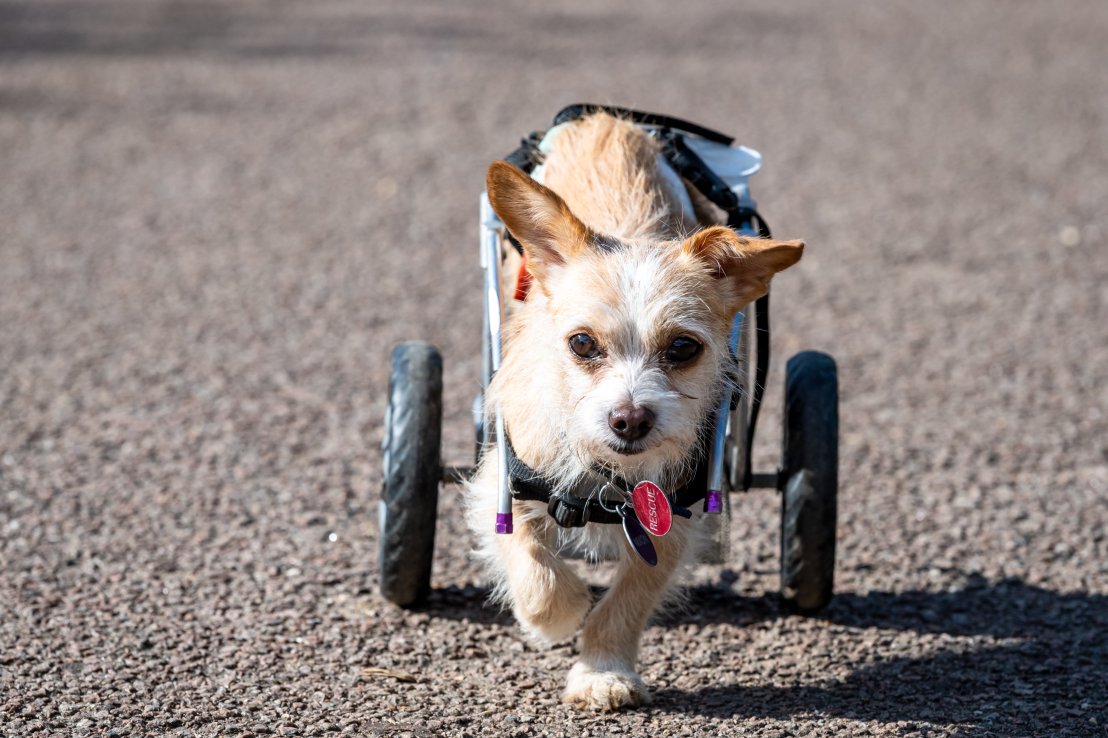
Science has maybe found a clue to the ancestor of the dog and the wolf.
For an animal that means so much to us humans, the origins of the dog are still uncertain. Indeed, as this interesting article shows, the origins of the wolf are uncertain.
ooOOoo
Was This 18,000-Year-Old Puppy Frozen in Siberian Permafrost the Ancestor of Wolves, Dogs or Both?
DNA tests on the well-preserved remains can’t determine whether the little canine was wild or domestic
(Sergey Fedorov/NEFU)
By Jason Daley, smithsonianmag.com
Dec. 3, 2019, 10 a.m.”>December 3, 2019
Meet Dogor, an 18,000-year-old pup unearthed in Siberian permafrost whose name means “friend” in the Yakut language. The remains of the prehistoric pup are puzzling researchers because genetic testing shows it’s not a wolf or a dog, meaning it could be an elusive ancestor of both.
Locals found the remains in the summer of 2018 in a frozen lump of ground near the Indigirka River, according to the North-Eastern Federal University in Yakutsk. Parts of the animal are incredibly well-preserved, including its head, nose, whiskers, eyelashes and mouth, revealing that it still had its milk teeth when it died. Researchers suggest the animal was just two months old when it passed, though they do not know the cause of death.
The pup is so well-preserved that researchers at the Centre for Palaeogenetics in Sweden were able to sequence the animal’s DNA using a piece of rib bone. The results found that Dogor was male, but even after two rounds of analysis the team could not determine whether he was a dog or a wolf.
“It’s normally relatively easy to tell the difference between the two,” David Stanton, a Centre for Palaeogenetics research fellow, tells Amy Woodyatt at CNN. “We have a lot of data from it already, and with that amount of data, you’d expect to tell if it was one or the other. The fact that we can’t might suggest that it’s from a population that was ancestral to both—to dogs and wolves.”
The find is exciting, regardless of whether Dogor turns out to be a common canine ancestor, an early dog, or an early wolf. Hannah Knowles at The Washington Post reports that Dogor comes from an interesting time in canine evolution, when wolf species were dying out and early dogs were beginning to emerge.
“As you go back in time, as you get closer to the point that dogs and wolves converge, [it becomes] harder to tell between the two,” Stanton tells Knowles.
(Sergey Fedorov/NEFU)
The history of just how and when dogs split from wolves is unresolved. There’s a general agreement among scientists that modern gray wolves and dogs split from a common ancestor 15,000 to 40,000 years ago, explains Brian Handwerk previously for Smithsonian.com. How dogs became dogs, however, is contested. Some research suggests that dogs were domesticated by humans once, while other studies have found dogs were domesticated multiple times. Exactly where in the world wild canines became man’s best friend is also disputed. The origin of the human-animal bond has been traced to Mongolia, China and Europe.
Scientists disagree about how dogs ended up paired with people, too. Some suspect humans captured wolf pups and actively domesticated them. Others suggest that a strain of “friendly,” less aggressive wolves more or less domesticated themselves by hanging out near humans, gaining access to their leftover food.
Dorgor’s DNA could help unravel these mysteries. The team plans to do a third round of DNA testing that may help definitively place Dogor in the canine family tree, report Daria Litvinova and Roman Kutuko at the Associated Press.
ooOOoo
This is incredibly interesting, don’t you think?
Hopefully I will hear of that third round of DNA testing and, if so, will most definitely share it with you.
Posted by Deborah Byrd in Astronomy Essentials | Earth|December 15, 2019
December solstice 2019 arrives on December 22 at 4:19 UTC.
That’s December 21 for much of North America. High summer for the Southern Hemisphere. For the Northern Hemisphere, the return of more sunlight!
Ian Hennes in Medicine Hat, Alberta, Canada, created this solargraph between a June solstice and a December solstice. It shows the path of the sun during that time period.
Late dawn. Early sunset. Short day. Long night. For us in the Northern Hemisphere, the December solstice marks the longest night and shortest day of the year. Meanwhile, on the day of the December solstice, the Southern Hemisphere has its longest day and shortest night. The 2019 December solstice takes place on Sunday, December 22, at 04:19 UTC (That’s December 21 at 10:19 p.m. CST; translate UTC to your time).
No matter where you live on Earth’s globe, a solstice is your signal to celebrate.
When is the solstice? The solstice happens at the same instant for all of us, everywhere on Earth. In 2019, the December solstice comes on December 21 at 10:19 p.m. CST. That’s on December 22 at 04:19 Universal Time (UTC). It’s when the sun on our sky’s dome reaches its farthest southward point for the year. At this solstice, the Northern Hemisphere has its shortest day and longest night of the year.
Just remember: you’re translating from 04:19 UT on December 22. For example, if you live in Perth, Australia, you need to add 8 hours to Universal Time to find out that the solstice happens on Sunday, December 22, at 12:19 p.m. AWST (Australian Western Standard Time).
Day and night sides of Earth at the instant of the December 2019 solstice (December 22, 2019, at 04:19 UTC). Image via EarthView.
What is a solstice? The earliest people on Earth knew that the sun’s path across the sky, the length of daylight, and the location of the sunrise and sunset all shifted in a regular way throughout the year. They built monuments such as Stonehenge in England – or, for example, at Machu Picchu in Peru – to follow the sun’s yearly progress.
But we today see the solstice differently. We can picture it from the vantage point of space. Today, we know that the solstice is an astronomical event, caused by Earth’s tilt on its axis and its motion in orbit around the sun.
Because Earth doesn’t orbit upright, but is instead tilted on its axis by 23 1/2 degrees, Earth’s Northern and Southern Hemispheres trade places in receiving the sun’s light and warmth most directly. The tilt of the Earth – not our distance from the sun – is what causes winter and summer. At the December solstice, the Northern Hemisphere is leaning most away from the sun for the year.
At the December solstice, Earth is positioned in its orbit so that the sun stays below the North Pole horizon. As seen from 23 1/2 degrees south of the equator, at the imaginary line encircling the globe known as the Tropic of Capricorn, the sun shines directly overhead at noon. This is as far south as the sun ever gets. All locations south of the equator have day lengths greater than 12 hours at the December solstice. Meanwhile, all locations north of the equator have day lengths less than 12 hours.
For us on the northern part of Earth, the shortest day comes at the solstice. After the winter solstice, the days get longer, and the nights shorter. It’s a seasonal shift that nearly everyone notices.
Earth has seasons because our world is tilted on its axis with respect to our orbit around the sun. Image via NASA.
Where should I look to see signs of the solstice in nature? Everywhere.
For all of Earth’s creatures, nothing is so fundamental as the length of daylight. After all, the sun is the ultimate source of all light and warmth on Earth.
If you live in the Northern Hemisphere, you can notice the late dawns and early sunsets, and the low arc of the sun across the sky each day. You might notice how low the sun appears in the sky at local noon. And be sure to look at your noontime shadow. Around the time of the December solstice, it’s your longest noontime shadow of the year.
In the Southern Hemisphere, it’s opposite. Dawn comes early, and dusk comes late. The sun is high. It’s your shortest noontime shadow of the year.
Around the time of the winter solstice, watch for late dawns, early sunsets, and the low arc of the sun across the sky each day. Notice your noontime shadow, the longest of the year. Photo via Serge Arsenie on Flickr.Meanwhile, at the summer solstice, noontime shadows are short. Photo via the Slam Summer Beach Volleyball festival in Australia.
Why doesn’t the earliest sunset come on the shortest day? The December solstice marks the shortest day of the year in the Northern Hemisphere and longest day in the Southern Hemisphere. But the earliest sunset – or earliest sunrise if you’re south of the equator – happens before the December solstice. Many people notice this, and ask about it.
The key to understanding the earliest sunset is not to focus on the time of sunset or sunrise. The key is to focus on what is called true solar noon – the time of day that the sun reaches its highest point in its journey across your sky.
In early December, true solar noon comes nearly 10 minutes earlier by the clock than it does at the solstice around December 22. With true noon coming later on the solstice, so will the sunrise and sunset times.
It’s this discrepancy between clock time and sun time that causes the Northern Hemisphere’s earliest sunset and the Southern Hemisphere’s earliest sunrise to precede the December solstice.
The discrepancy occurs primarily because of the tilt of the Earth’s axis. A secondary but another contributing factor to this discrepancy between clock noon and sun noon comes from the Earth’s elliptical – oblong – orbit around the sun. The Earth’s orbit is not a perfect circle, and when we’re closest to the sun, our world moves fastest in orbit. Our closest point to the sun – or perihelion – comes in early January. So we are moving fastest in orbit around now, slightly faster than our average speed of about 18.5 miles per second (30 kilometers per second). The discrepancy between sun time and clock time is greater around the December solstice than the June solstice because we’re nearer the sun at this time of year.
Solstice sunsets, showing the sun’s position on the local horizon at December 2015 (left) and June 2016 (right) solstices from Mutare, Zimbabwe, via Peter Lowenstein.
The precise date of the earliest sunset depends on your latitude. At mid-northern latitudes, it comes in early December each year. At northern temperate latitudes farther north – such as in Canada and Alaska – the year’s earliest sunset comes around mid-December. Close to the Arctic Circle, the earliest sunset and the December solstice occur on or near the same day.
By the way, the latest sunrise doesn’t come on the solstice either. From mid-northern latitudes, the latest sunrise comes in early January.
The exact dates vary, but the sequence is always the same: earliest sunset in early December, shortest day on the solstice around December 22, latest sunrise in early January.
And so the cycle continues.
Solstice Pyrotechnics II by groovehouse on Flickr.
Bottom line: The 2019 December solstice takes place on Sunday, December 22, at 04:19 UTC (that’s December 21 at 10:19 p.m. CST; translate UTC to your time). It marks the Northern Hemisphere’s shortest day (first day of winter) and Southern Hemisphere’s longest day (first day of summer). Happy solstice, everyone!
ooOOoo
Well for many in the Northern Hemisphere the worst of the winter weather is yet to come.
A fascinating article on vegetarian diets for our dogs.
We are non-meat eaters here at home. Have been for a while. Our diet is essentially vegan most of the time with some fish thrown in as well. It seems to be doing us well!
But what does us good is not what does dogs good. Not at all!
You know that dogs need meat but there was a recent article on Mother Nature Network which went into details:
Experts say plant-based diets don’t always give dogs the nutrition they need. (Photo: Stickler/Shutterstock)
More people are forgoing meat in their diets for a whole spectrum of reasons — from environmental to philosophical — and now vegetarians are taking a second look at their dogs’ meat-based diets too. As a result, more owners are putting their dogs on a vegetarian or even vegan diet to bypass the health and ethical dilemmas that come with a side of beef, pork or chicken in their pet’s kibble.
“I’ve been vegan for more than two years now, and I don’t wish to contribute to the slaughterhouse or factory farm industry for my own food nor for my dogs’,” explains Debra Benfer, who together with her husband owns three vegan dogs. “If people really read what ingredients are put in dog food, I believe more people would understand why a vegetarian diet is the way to go.”
Some of those ingredients include meat from animals deemed unfit for human consumption, known in the pet food industry as the 4 Ds — dead, dying, diseased or disabled animals. In addition, many commercial pet foods contain “meat meal” or “byproducts,” which can include various animal parts and slaughterhouse waste that don’t exactly match the idyllic pictures of juicy meat chunks often seen on a bag or can of dog food. Much like commercial meat for humans, meat used in pet food can contain hormones, pesticides and antibiotics, a concern that has led many dog owners to seek alternative diets.
“If someone is saying it’s OK to give my dog these things, I would add a 5th ‘D’ to that equation and say ‘don’t,’” says Jill Howard Church, president of the Vegetarian Society of Georgia. “As a vegetarian, I know what’s in human meat and since the meat that falls below the human standard is what goes into pet food, it gives me cause for concern.”
Church’s two dogs were on a vegetarian diet for their entire lives and lived to be a healthy 15 and 19 years old. Church currently has a 3-year-old black Labrador retriever that’s also thriving on a vegetarian diet.
Church and Benfer’s positive experience with vegetarian dog diets is mirrored in hundreds of testimonials found on the internet from owners who have successfully switched their dogs to a vegetarian diet. Some owners have bypassed the dog food industry altogether by cooking their own wholesome vegetarian dog meals.
“People are taking control of their animals’ diet back into their own hands instead of relying on the pet food industry so much,” says Greg Martinez, author of “Dog Dish Diet: Sensible Nutrition for Your Dog’s Health“. “We’ve all been held hostage by industry a little bit.”
In addition to decreasing a dog’s carbon pawprint (meat production is a major contributor to greenhouse gas emissions), owners say that putting their dogs on a vegetarian diet has resulted in everything from longer life spans and shinier coats to decreased aggression.
‘It is truly unnatural for them’
It would be smart to consult with a veterinary nutritionist before switching to a vegetarian diet for your dog. (Photo: Rasulov/Shutterstock)
However, there are those who worry that vegetarian dogs may not be able to get adequate nutrition from a plant-based diet. Dogs, like humans, are omnivores, meaning they can survive on a diet of either plant or animal origin, but owners must be careful to ensure that their dogs are getting the proper nutrients from plant-based ingredients. (Cats, on the other hand, are strictly carnivores.)
According to the Association of American Feed Control Officials (AAFCO), a non-regulatory industry group that establishes pet food standards, dog food for an average adult dog should contain about 18% protein, an amount deemed necessary for good health and proper growth and development. But since every protein source contains different levels of amino acids, which are protein’s building blocks, all protein is not created equal. Some proteins are better for pets than others. For example, egg and cottage cheese are considered quality sources of protein for dogs.
“Vegetarian proteins tend not to have all the amino acids, so you have to do multiple combinations of varying types of sources of protein to get the right amino acids, which can get a little tricky to manage,” says Dr. Jessica Waldman, a veterinarian who operates a full-time pet rehabilitation clinic in Santa Monica, California. Waldman says she steers her clients away from vegetarian diets because she believes they are unnatural.
“Although I think it would be possible to put a dog on a vegetarian diet, it is truly unnatural for them,” says Waldman. “There are still dogs in the wild and they eat a vast majority of animal protein, so I think that keeping your pet’s diet as close to natural is best for limiting disease and promoting health.”
Other vets disagree, arguing that dogs can successfully be vegetarians as long as their diet is balanced and they are able to get proteins from varying sources.
Dr. Jennifer Larsen, a veterinary nutritionist at the University of California-Davis, says that both commercial and home-cooked vegetarian diets “can be used safely and can provide adequate nutrition if carefully and appropriately formulated” and as long as owners pay special attention to providing their dogs with the proper protein and amino acids.
Commercial vegetarian diets and home-cooked options are prescribed by veterinarians for dogs with specific diseases, but there currently isn’t much extensive research to prove or disprove their healthfulness. One survey conducted by PETA found that 82% of dogs that had been vegan for five years or more were in good to excellent health and that the longer a dog remained on a vegetarian or vegan diet, the greater the likelihood that the dog would have overall good to excellent health.
The study, however, also found that vegetarian dogs may be more prone to urinary tract infections as well as a form of heart disease known as dilated cardiomyopathy, which can be caused by a deficiency of the amino acids L-carnitine or taurine. But as the researchers pointed out, DCM isn’t just a problem for vegetarian dogs since L-carnitine and taurine also can be washed away in the processing of meat in commercial dog food.
To help bypass this problem, some commercial dog food companies like V-dog, a high protein vegan dog food, have added taurine and L-carnitine to their formulas to insure quality health that “exceeds the nutrient profiles established by the AAFCO,” says V-dog President David Middlesworth.
Though putting dogs on a vegetarian diet may remain controversial until further studies are conducted, veterinarians and vegetarian dog owners can agree that people considering putting their dog on a vegetarian diet should first do their own research to determine what’s best for their individual dog’s needs and/or consult their veterinarian.
Jennifer Adolphe, an animal nutritionist at the University of Saskatchewan, told The Washington Post that pet owners should do research. She advises pet owners to do “some homework to find out who is behind the company, if it employs a full-time qualified nutritionist, what kind of quality control measures do they use.”
“It just takes research and the willingness to stick by your reasons for having your dogs on a vegetarian diet,” says Benfer, who often makes homemade dog food for her three vegan dogs. “I get strange looks when I let people know my dogs are vegan, but it’s only because they aren’t educated about dogs being vegetarian and don’t realize how easy and possible it really is to do.”
Editor’s note: This story has been updated with new information since it was published in August 2010.
ooOOoo
Well not much to add from me. This article is completely clear to my mind.
This was seen on the photographic forum Ugly Hedgehog and I just loved it.
It is fully republished with permission.
ooOOoo
I took our little dog for a woods walk after the snow.
We went for a walk in the woods behind our house this afternoon. We got about 3 inches of snow that stuck to the trees. Norah loves to run in the new snow!
oooo
oooo
oooo
oooo
oooo
oooo
oooo
By the stream. She doesn’t like to get her dainty paws wet.
oooo
ooOOoo
I think these are wonderful.
The dog’s name is Norah as you may have gathered and she is a tailless dog. As was said on the forum: ” Her name is Norah. She’s the best (only) tailless dog we’ve every had! Our best guess is that she may be part Jack Russell but we don’t know. She’s a rescue dog.”
For next Sunday I’m going to repeat a few of these but using my Luminar photo-editing software. I have a feeling that a few of these wonderful photographs can produce some great edits.
There’s something almost beyond the world of words, pictures and blogging. That’s when a dog goes missing and then is found. Especially if the lover of the dog is a young boy who fears the worst.
Dogs bring out so much that is good in us. Dogs cross gender, age, country and ethnic boundaries.
This is what struck me with some force I will admit when I read this article on the Daily Dodo yesterday. It is republished for your own delight!
The holidays aren’t about what’s under the tree; it’s who you’re with that matters. And no one understands that better than Carter Licata and his dog, Piper.
The 2-year-old pug loves everyone in her family, but her bond with her brother is special. “It was love at first sight for the two of them,” April Licata, Carter’s mom, told The Dodo.
But the family’s holiday season was nearly destroyed when the unthinkable happened — Piper went missing.
Photo Credit: April Licata
Last month, Licata let Piper and her other dog outside to use the bathroom. But when she opened the door to let them back in, Piper was nowhere to be seen.
The family searched everywhere, posted on social media, and reached out to neighbors and community groups. They prayed for Piper’s safe return, but as days turned to weeks, they feared that they would never see their pug again.
“We were all sick,” Licata said. “The older kids wanted nothing to do with decorating the Christmas tree and it was a very somber Thanksgiving for them.”
Then, Licata received a Facebook message from the Genesee County Animal Shelter. A dog matching Piper’s description had been dropped off at the shelter by a person who wanted to remain anonymous. “My husband and I were going out to dinner and honestly, there was an outcry of joy in the truck,” Licata said. “We were shocked and elated!”
Carter was out of town when they learned about Piper, so they decided to keep it a secret and surprise him with a special reunion when he returned. Piper, meanwhile, wandered around the house looking for her brother, until finally, their reunion day arrived.
Photo Credit: Facebook/April Licata
When Carter saw Piper in the front seat of the truck, decked out in bows, he immediately broke down in tears.
Piper’s tail went crazy at the sight of her brother and as soon as he stepped in the truck, she jumped in his arms, showering him with kisses.
The family couldn’t be happier to have Piper back again — and just in time for Christmas.
“My son loves his dog so much, was sick while she was gone, and tonight she’s sleeping next to him again,” Licata wrote on Facebook. “What a Christmas miracle for our family.”
You can see the heart-warming video below.
ooOOoo
I know that for the main part I just republish the work that others do. But that doesn’t mean that I’m not affected by the articles. This one in particular had me in tears.
Woman Manages To Get Her 17 Pets To Pose For Incredible Family Paw-Trait
By Jess Hardiman, 3rd December, 2019
A woman has achieved the ultimate feat for any pet owner, having managed to get not just one of her animals to pose nicely for a photo, but all 17 of them.
Kathy Smith, 30, is the proud owner of eight dogs and nine cats, who she somehow wrangled into an incredible family paw-trait.
Mind you, the accomplishment didn’t easy, as Kathy spent two weeks trying to get the perfect shot. That’s right, a FORTNIGHT – I guess they do always tell you never to work with animals; now I can see why.
It turns out the dogs were up for the challenge and sat quietly for the camera, but it was getting the cats involved that proved to be more difficult. Like trying to herd… well, cats.
PIC FROM Kennedy News and Media (PICTURED: KATHY SMITH, 30, WITH CAT SMOKEY ON HER SHOULDER) A pet owner managed to get her SEVENTEEN cats and dogs to pose perfectly still for the ultimate ‘family pawtrait’ – after spending days trying to get the perfect shot. The amazing photo shows eight solemn-faced pooches and nine felines lined up on and around the sofa, all gazing stoically into the camera. Dedicated Kathy Smith managed to set up and capture the heart-warming snap in five minutes two weeks ago after bribing them with a stash of treats. SEE KENNEDY NEWS COPY – 0161 697 4266
Numerous warm-up photos show the eight well-behaved pooches in place, with Kathy bribing Ruby, Ben, Max, Sheba, Teddy, Rio, Storm and Misha to ‘sit’ with a handful of treats.
Then came the moggies, a process that saw shop assistant Kathy dashing back and forth with her camera on standby, hauling the cats back into place several times.
Kathy eventually got them all into position and captured a split-second snap of the 17-strong pack before they scattered to return to their pressing everyday lives.
PIC FROM Kennedy News and Media (PICTURED [from back left – front right]: KATHY’S PETS DINKY, JAKIE, OPAL, PADDY, SOCKS, SAFI, CINDERS, DUSTY, MAX, SHEBA, SMOKEY, STORM, RUBY, BEN, TEDDY, RIO, MISHKA) A pet owner managed to get her SEVENTEEN cats and dogs to pose perfectly still for the ultimate ‘family pawtrait’ – after spending days trying to get the perfect shot. The amazing photo shows eight solemn-faced pooches and nine felines lined up on and around the sofa, all gazing stoically into the camera. Dedicated Kathy Smith managed to set up and capture the heart-warming snap in five minutes two weeks ago after bribing them with a stash of treats. SEE KENNEDY NEWS COPY – 0161 697 4266
Kathy, from Corwen, Wales, said: “I was so thrilled when I I’d captured this shot – it’s like a little family photo.
“I love all of my pets so much so I was really happy when I managed to get them all posing together – despite it not being easy to do.
“I kept trying to get photos of the cats and dogs all together but some of them were always out of frame.
“The dogs will all sit for treats so that was easy enough, but the cats were another matter.
PIC FROM Kennedy News and Media (PICTURED: KATHY SMITH’S PREVIOUS ATTEMPTS AT PICTURES WHEN CATS REFUSED TO POSE) A pet owner managed to get her SEVENTEEN cats and dogs to pose perfectly still for the ultimate ‘family pawtrait’ – after spending days trying to get the perfect shot. The amazing photo shows eight solemn-faced pooches and nine felines lined up on and around the sofa, all gazing stoically into the camera. Dedicated Kathy Smith managed to set up and capture the heart-warming snap in five minutes two weeks ago after bribing them with a stash of treats. SEE KENNEDY NEWS COPY – 0161 697 4266
“I now know the real meaning behind herding cats – I had to just keep picking them up and putting them back until they stayed.
“It took about three attempts but in the I managed to keep them there for a couple of seconds and get the photo before they were off again.
“We live in quite a chaotic but you get used to it.”
Kathy, who rescues and cares for pets and other wildlife in need, said people are often surprised to see her giant four-legged family when they come to visit her in her three-bedroom semi-detached home.
She has three German Shepherds (Mishka, Storm and Max), three border collies (Sheba, Ben and Rio), a mongrel called Ruby and a Yorkshire Terrier Maltese cross named Teddy.
PIC FROM Kennedy News and Media (PICTURED: KATHY SMITH, 30, FROM COLWYN BAY, WALES, WITH FRIEND’S DOG LOLA) A pet owner managed to get her SEVENTEEN cats and dogs to pose perfectly still for the ultimate ‘family pawtrait’ – after spending days trying to get the perfect shot. The amazing photo shows eight solemn-faced pooches and nine felines lined up on and around the sofa, all gazing stoically into the camera. Dedicated Kathy Smith managed to set up and capture the heart-warming snap in five minutes two weeks ago after bribing them with a stash of treats. SEE KENNEDY NEWS COPY – 0161 697 4266
Along with the nine cats, she also has four budgies, several fish and even a baby hedgehog in her care.
Kathy “People are usually shocked when they come over and realise how many pets we have, the house is but we’re used to it.
“They all run and you don’t there’s a lot of them until they’re in one room.” Featured Image Credit: Kennedy News
ooOOoo
One can easily get Jess’s background for it is on the same page:
Jess is a journalist at LADbible who graduated from Manchester University with a degree in Film Studies, English Language and Linguistics – indecisiveness at its finest, right there. She also works for FOODbible and its sister page Seitanists, which are both a safe haven for her to channel a love for homemade pasta, fennel and everything else in between. You can contact Jess at editorial@ladbible.com.
Brilliant! To be honest I don’t really know how Jess pulled it off!
Buddy and Merlyn behaved like a “tag team”, Pita Oates said
A runner who broke her leg on remote moorland was rescued after her dogs raised the alarm.
Pita Oates, 48, was left unable to stand after she fell on a three-mile run in Lancashire with her blue collies Buddy and Merlyn.
One of the dogs stayed with her as she inched down the hill, while the other ran around barking for help.
This attracted the attention of another dog walker who contacted emergency services.
Ms Oates, from Leyland, said: “They were like a tag team, Buddy never left me while Merlyn went for help.
“I would have died without a doubt, I wouldn’t have lasted the night.”
When help arrived Ms Oates, who had left her mobile phone in her camper van, was drifting in and out of consciousness and starting to suffer the effects of hypothermia.
She said: “It was the tail-end of Storm Gareth, it was freezing and I was soaking wet. The winds were horrendous.”
Ms Oates said she could have died on the moors without her dogs’ help
Ms Oates broke the femur behind her left knee and tore her anterior and cruciate ligaments on the run on Great Hill near Chorley on 12 March.
“I couldn’t stand up, I was having to bum-shuffle all the way down,” she said.
“Every time my leg touched the ground I was in pain so I rigged up a sling using the dog’s lead to keep my leg up.”
It took her 90 minutes to get down the hill by which time it had gone dark.
“Buddy never left me and Merlyn kept barking back at him – when this man came with his dog he knew something wasn’t right,” she said.
Paramedics and members of the Bowland Mountain Rescue Team, as well as two from Bolton Mountain Rescue, arrived to help rescue Ms Oates.
She spent eight days in hospital and had a titanium plate fitted but still needs another operation.
Pita Oates was on a three-mile run when she was injured
ooOOoo
Part of me is not surprised at the behaviour of Ms Oates’ dogs. Dogs show their care and attention in so many ways. But then again I was surprised because these two dogs knew exactly what to do. One to stay and one to seek help. Which is what they did.
It was a close-run thing (pardon the pun) as Pita was starting to fade away when help arrived.
There’s a science background to being healthy and happy.
Especially as one gets older.
It’s Jean’s birthday today and we are grateful for our lot. I’m 75 now and Jean is a few years younger. But more importantly we are so grateful to have met and, subsequently, fallen in love.
As well as Jean’s love in return we have our gorgeous dogs as well (not to count in addition the two horses, the two parakeets and the cat) and they reinforce the feelings of happiness that surround us.
All of which is an introduction to an article on The Conversation that caught my eye yesterday.
I’m afraid it doesn’t mention dogs but then again we dog owners know for sure how they benefit us humans.
ooOOoo
Are you as grateful as you deserve to be?
November 26, 2019
By Richard Gunderman
Chancellor’s Professor of Medicine, Liberal Arts, and Philanthropy, Indiana University
Gratitude is not only a great feeling but a healthy one. Aaron Amat/Shutterstock.com
As a physician, I have helped to care for many patients and families whose lives have been turned upside down by serious illnesses and injuries. In the throes of such catastrophes, it can be difficult to find cause for anything but lament. Yet Thanksgiving presents us with an opportunity to develop one of the healthiest, most life-affirming and convivial of all habits – that of counting and rejoicing in our blessings.
Gratitude’s benefits
Research shows that grateful people tend to be healthy and happy. They exhibit lower levels of stress and depression, cope better with adversity and sleep better. They tend to be happier and more satisfied with life. Even their partners tend to be more content with their relationships.
Perhaps when we are more focused on the good things we enjoy in life, we have more to live for and tend to take better care of ourselves and each other.
When researchers asked people to reflect on the past week and write about things that either irritated them or about which they felt grateful, those tasked with recalling good things were more optimistic, felt better about their lives and actually visited their physicians less.
It is no surprise that receiving thanks makes people happier, but so does expressing gratitude. An experiment that asked participants to write and deliver thank-you notes found large increases in reported levels of happiness, a benefit that lasted for an entire month.
Philosophical roots
Giving thanks is important for our psyches and our souls. Love You Stock/Shutterstock.com
One of the greatest minds in Western history, the Greek philosopher Aristotle, argued that we become what we habitually do. By changing our habits, we can become more thankful human beings.
If we spend our days ruminating on all that has gone poorly and how dark the prospects for the future appear, we can think ourselves into misery and resentment.
But we can also mold ourselves into the kind of people who seek out, recognize and celebrate all that we have to be grateful for.
This is not to say that anyone should become a Pollyanna, ceaselessly reciting the mantra from Voltaire’s “Candide,” “All is for the best in this, the best of all possible worlds.” There are injustices to be righted and wounds to be healed, and ignoring them would represent a lapse of moral responsibility.
But reasons to make the world a better place should never blind us to the many good things it already affords. How can we be compassionate and generous if we are fixated on deficiency? This explains why the great Roman statesman Cicero called gratitude not only the greatest of virtues but the “parent” of them all.
Religious roots
Gratitude is deeply embedded in many religious traditions. In Judaism, the first words of the morning prayer could be translated, “I thank you.” Another saying addresses the question, “Who is rich?” with this answer: “Those who rejoice in what they have.”
From a Christian perspective, too, gratitude and thanksgiving are vital. Before Jesus shares his last meal with his disciples, he gives thanks. So vital a part of Christian life is gratitude that author and critic G.K. Chesterton calls it “the highest form of thought.”
Gratitude also plays an essential role in Islam. The 55th chapter of the Quran enumerates all the things human beings have to be grateful for – the Sun, Moon, clouds, rain, air, grass, animals, plants, rivers and oceans – and then asks, “How can a sensible person be anything but thankful to God?”
In his 1994 book, “A Whole New Life,” the Duke University English professor Reynolds Price describes how his battle with a spinal cord tumor that left him partially paralyzed also taught him a great deal about what it means to really live.
After surgery, Price describes “a kind of stunned beatitude.” With time, though diminished in many ways by his tumor and its treatment, he learns to pay closer attention to the world around him and those who populate it.
Reflecting on the change in his writing, Price notes that his books differ in many ways from those he penned as a younger man. Even his handwriting, he says, “looks very little like that of the man he was at the time of his diagnosis.”
“Cranky as it is, it’s taller, more legible, and with more air and stride. And it comes down the arm of a grateful man.”
A brush with death can open our eyes. Some of us emerge with a deepened appreciation for the preciousness of each day, a clearer sense of our real priorities and a renewed commitment to celebrating life. In short, we can become more grateful, and more alive, than ever.
Practicing gratitude
Good conversation, good friends and connections – not material possessions – bring great joy. Jacob Lund/Shutterstock.com
When it comes to practicing gratitude, one trap to avoid is locating happiness in things that make us feel better off – or simply better – than others. In my view, such thinking can foster envy and jealousy.
There are marvelous respects in which we are equally blessed – the same Sun shines down upon each of us, we all begin each day with the same 24 hours, and each of us enjoys the free use of one of the most complex and powerful resources in the universe, the human brain.
Much in our culture seems aimed to cultivate an attitude of deficiency – for example, most ads aim to make us think that to find happiness we must buy something. Yet most of the best things in life – the beauty of nature, conversation and love – are free.
There are many ways to cultivate a disposition of thankfulness. One is to make a habit of giving thanks regularly – at the beginning of the day, at meals and the like, and at day’s end.
Likewise, holidays, weeks, seasons and years can be punctuated with thanks – grateful prayer or meditation, writing thank-you notes, keeping a gratitude journal and consciously seeking out the blessings in situations as they arise.
Gratitude can become a way of life, and by developing the simple habit of counting our blessings, we can enhance the degree to which we are truly blessed.
That reference to Reynolds Price and his challenges make one think. I have been fortunate that nothing really dreadful has happened to me; apart from my father’s death when I had just turned 12. I’m getting a little hazy in terms of certain memories but that’s an old age thing rather than an illness. But to go through what he did; I just don’t know the person that I am, in terms of how I wold react to that.
But to the general tone of the article, I would hope that I can get better and better.
For it’s splendid to cultivate that disposition.
One is to make a habit of giving thanks regularly – at the beginning of the day, at meals and the like, and at day’s end.
I’m Tony I have been interested in eating healthy for more than 35 years. Unfortunately, my actions haven’t always matched my aims. As Mae West said, “I used to be Snow White, but I drifted.”
I drifted too, for a long time, but after writing posts for this blog for nearly 10 years, I have gotten good at it. I used the Lose It! App for a while (iPhone, iPad, Touch) a calorie counter that also breaks down nutrients and gives you a daily weight chart to demonstrate your progress. It’s not the only tool like this around, but it’s a good one. I think you are better off using a tool than not using one, especially if you are just embarking on a weight loss program.
Using that tool and practicing some self discipline I now have complete confidence in my ability to maintain a healthy body weight. I still need to work on the lean muscle mass thing, though. I love riding my bicycle and have no problem logging lots of miles and putting calories into the bank to free up my eating. I average around 100 miles a week. That covers a multitude of sins at the table. Biking is a wonderful cardio workout. Few people realize, however, it is also very stimulating for the brain. It’s a lot more fun than working with weights, but ya gotta do that, too. I write about the benefits of cardio exercise on the brain often in this blog as it is usually misunderstood and/or completely overlooked in most fitness writing. I had an aunt who died of Alzheimer’s, my mother who suffered from dementia in her final years, and my grandfather on my father’s side also had cognitive problems in his later years, so I am dead serious about protecting myself from mental decline. Check out my Page – Important facts about your brain – and exercise to read more about it.
I retired 19 years ago. I spent 20 years as a Reuters Correspondent and Editor after starting my career in men’s magazines. I taught journalism at Medill for a while and then wrote in the investment department of a major U.S. philanthropy where I spent my last few years managing $900 million in bond investments.
Now that I am retired, I have complete control over what I eat. My heart goes out to you folks who go to work every day. It is much harder to control your caloric intake. There are business lunches and dinners to attend, late days at the office, working through lunch as well as traveling. I think if I were still working I would seriously consider bringing lunch from home a day or two each week to keep a handle on my intake. With a fridge and microwave where you work, you are good to go.
When I started writing for this blog in March of 2010 I weighed 165 pounds, the lowest I had been in 15 years. I thought I had arrived at fitness and health. Now, in 2019, I weigh 155 pounds. That’s right, I have melted off a further 10 pounds from my best weight in years. My resting heart rate is under 50 beats per minute (bpm), a result of my cycling, but significantly under the ‘normal’ of 65 to 90 bpm for a guy in his upper 70’s. I have less than 16 percent body fat and a 31 inch waist (the first time since high school). I have reached this state of fitness and health following the ideas and techniques I write about in this blog. You can, too
When the blog started, I was talking the talk, over nine years later I am walking the walk. You can do the same. I am just a regular guy. If I can do it you can, too. Check out my page How to Lose Weight and Keep it Off for a start. Lots of excellent, practical principles there that I have learned and now apply to my daily life.
Just over 20 years ago my weight got out of control and I ballooned over 220 pounds. I took off 50 pounds in a year, but that only got me down to the mid-170’s. You can read How I lost 50 pounds in 52 weeks if you want chapter and verse.
When I retired, I started taking courses from The Great Courses. They include “Nutrition Made Clear” by Professor Roberta Anding. She has an MS in Nutrition and is a registered Dietitian and a certified specialist in sports dietetics. Another superb course is “Lifelong Health: Achieving Optimum Well-Being at any Age” by Doctor Anthony Goodman. He also teaches “The Myths of Nutrition and Fitness.” By now, in 2019, I have probably taken more than a dozen courses on mental and physical health and wellness as well as healthy aging.
I have about 40 games of backgammon going on the web. I was born January 26, 1940. I am an Aquarius and a senior citizen. At 79 years of age, I am healthier by far than I was over 20 years ago when I was in the work force and a relatively young man in my 50’s.
As a senior who presently is winning the war of the waistline, I am also grappling with the experience of aging. As part of this blog’s focus on good health I look seriously into aging and what can be done about it. I know there is no fountain of youth, but there are techniques for aging gracefully and, more importantly, retaining one’s mental powers. I promise to share with you everything I can find out about it.
The masthead photo is a shot of me taken 40 years ago by a girlfriend when we were bike riding by the lakefront in Chicago. I had a lot more hair then.
Tony
Now Tony recently published a post that I found so interesting.
It’s all about improving one’s vision.
ooOOoo
Walking improves vision – Study.
By Tony, November 25th, 2019
As a big fan of walking I was thrilled to learn of this further benefit to the Cinderella of the exercise world. Walking leads to an increase of peripheral visual input, according to a study from the University of Wurzburg.
How do we perceive our environment? What is the influence of sensory stimuli on the peripheral nervous system and what on the brain? Science has an interest in this question for many reasons. In the long term, insights from this research could contribute to a better understanding of diseases such as ADHD and Parkinson’s disease.
The topography of the EEG response (l) and its localization in the brain (r) show visual sensory processing during the walking conditions slow and normal – green and red, and standing – black. The image is credited to Barbara Händel.
Perception and the underlying neuronal activities are usually measured while subjects are sitting or lying, for example while doing magnetic resonance imaging. As a rule, the head is fixed and people are encouraged not to blink. The measurements therefore take place under well-controlled but rather unnatural conditions.
Shift of visual preference
When processing visual stimuli, however, it makes a difference whether the person is sitting or moving: When walking around, the peripheral part of the visual field shows enhanced processing compared to the central part. This can be proven both by the behaviorally measured perception of the test persons and by their brain response.
This shift in visual preference makes sense. “It is above all the peripheral visual input that provides information about the direction and speed of our movement and thus plays an important role for navigation,” says Dr. Barbara Händel. The neuroscientist from Julius-Maximilians-Universität (JMU) Würzburg in Bavaria, Germany, and her colleague Dr. Liyu Cao have published their findings in PLOS Biology
“It was known from animals that increased body movements lead to an increased firing rate in visual areas of the brain,” says Dr. Händel. So far, there are only a few behavioural experiments available for humans that investigate the influence of movement on sensory brain areas. However, there is evidence that cognitive processes are linked to the behavioural state. “For example, some studies show that people learn better when they move,” says the JMU researcher. However, the underlying neuronal mechanisms have not yet been tested in detail.
Mobile EEG, sensors and video glasses
It is precisely such gaps in knowledge that Barbara Händel wants to close with her work. In order to explore the link between movement and perception, sophisticated technical equipment is necessary. While the test subjects walk around, they wear electrode caps and a small amplifier that records their brain waves. The EEG data are sent wirelessly to a laptop, which the subjects carry in a backpack. Motion sensors, video glasses, and a mobile device for recording eye movements complete the setting.
Quite an effort. “But we have to take this step if we want to understand human perceptual strategies during natural behavior,” says Dr. Händel. Research into perception during movement is still in its infancy. It is now up to science to ask clever questions and find out which of them can be answered with mobile technical equipment.
Many exciting research questions
Next, the JMU scientist wants to further investigate the effect of altered perception during movement. Does it only occur for visual input or possibly also in other sensory areas? Does it, in addition to navigation, perhaps also play a role in other cognitive processes such as memory and creativity?
All this is possible: experiments with rats have shown that these animals learn better, when they are in motion. And the idea that walking increases creativity has existed since ancient times. “For example, the Peripatetics, a philosophical school around Aristotle, usually were discussing while walking, from which their name derives,” says Barbara Händel.
There is also a connection between creativity and eye movements: “It is known that people blink more often the more creatively they solve a task. And we found that people also blink more often when they walk around compared to being at rest.” Obviously, there are many connections between the movements of the body, the eyes and the mental performance. Their research could reveal many more interesting aspects.
As I write this post, yesterday afternoon, it has been snowing for some hours at Hugo Road (ZIP 97532). In the anticipation that we might be snowed in at 8am we drove the short distance to our local Dollar General store to stock up on dog food and other bits and pieces.
So this story from the Daily Dodo seems really apt. I hope you enjoy it.
ooOOoo
Stray Dog Found Curled Up In Snow Keeping Orphaned Kittens Warm
Photo Credit: Pet and Wildlife Rescue
Last weekend, while driving on a freezing cold night in Ontario, Canada, a Good Samaritan spotted something that made her stop.
There, curled up on a snowy roadside, was a shivering stray dog.
But she wasn’t alone.
Though the dog could have found a safer place to pass the night, she wasn’t just thinking of herself.
Photo Credit: Pet and Wildlife Rescue
A closer look revealed the kind pup had wrapped herself around five orphaned kittens, whom she was cuddling to keep warm in the biting temperatures.
The Good Samaritan, in turn, saved them all from the freezing night by taking them to the Pet and Wildlife Rescue shelter. But by then, an incredible bond between the dog and kittens had already been formed.
For rescue staff, learning the circumstances of this case made one thing clear: the pup had saved the kittens’ lives.
“It’s truly heartwarming!” a shelter spokesperson told The Dodo. “It had been a very cold night so these kittens would have had a very hard time surviving.”
Photo Credit: Pet and Wildlife Rescue
The kittens are now safe, but require treatment for flea and worm infestations. Meanwhile, the sweet stray dog who saved them insists on overseeing their progress with regular visits — much like a proud mother.
It’s still unclear where the dog or kittens came from originally, or if they knew each other prior to that night. Pet and Wildlife Rescue is hoping an owner will come forward to claim them, but if not they’ll be put up for adoption.
Thanks to that brave pup, however, a sad ending for the kittens was transformed into a happy one.
“Our staff sees many difficult situations on a daily basis and stories like this one make every heartache worth it,” the shelter said.
ooOOoo
There may be someone who wants to follow this up by supporting the Pet and Wildlife Rescue in Ontario. So here is the website.