Category: Writing

Oceans and Minds.

How the linking of minds offers us vast horizons!

I subscribe to two blogs: Pendantry’s Wibble and Christine’s 350 or bust. But a temporary lack of quiet reading time has meant that recent posts from each of them were initially only briefly skimmed.  I made a mental note to read the one from Pendantry, Where oceans meet, because I have always had a love affair with the oceans.  When I did read it, I was blown away, to use the modern vernacular.  Why?  Stay with me.

Where oceans meet opened thus:

I’ve recently been introduced to two things that demonstrate (to my satisfaction, anyway) that the universe is much stranger than I first thought. Mind you, my first thought was quite some time ago, now.

Then after showing a wonderful photograph of where the Indian Ocean meets the Southern Ocean, (this one below) …

Twooceansmerging
Even vast oceans come together.

…. Pendantry goes on:

The other one of those ‘strange universe’ things is something that I find even more surprising: after decades of eating meat, an hour watching just one film has persuaded me to reconsider the habits of a lifetime.

That really jumped off the page at me because Jeannie has been a vegetarian for most of her life and I have been flirting with the idea.

That ‘one film’ was Vegucated.  Here’s the rest of that Wibble post republished with Pendantry’s kind permission.

oooOOOooo

A TED talk highlighted yesterday over on 350orbust (well worth watching — thanks, Christine) included a reference to the film Vegucated. Intrigued, was I, so I trundled off to watch it, and returned a changed man. Well, maybe that’s a bit ambitious, but I do now feel motivated to think more about what I eat, why I’m eating it, and to actively seek out vegan alternatives — something that I have never considered before.

vegucated-meat-means-disease-350_zpsc6ef410f
More meat equals more disease.

Vegucated reinforces the betrayal of a society that has sold us all on the idea of having ‘consumer choice’ — but continues to withhold from us the information necessary to make informed choices. And on that point: don’t just take my word for it that this is a film well worth watching: there are many other reviews and quotes about it.

Einstein deliberated, and chose a vegetarian lifestyle

Our world is changing, and, one way or another, we must change with it. I believe that films like Vegucated are essential to help us to choose to move in the direction of a healthier, happier world.

If slaughterhouses had glass walls, everyone would be vegetarian. “— Paul McCartney.

oooOOOooo

As you can see Pendantry referred to Christine’s recent post on 350orbust.  That post was called Are You A Changemaker?

Naturally I was curious and wandered across to that post.  Here are Christine’s own words,

It’s TED Talk Tuesday on 350orbust, and today’s presenter is Zoe Weil who spoke to the young people who gathered at the TEDx Youth symposium held at Cape Elizabeth, Maine, last December. Ms. Weil is the co-founder and president of the Institute for Humane Education. Ms. Weil’s inspiring talk is entitled “How To Be A Solutionary.” Enjoy!

I tell you what!  That 11 minute presentation by Zoe Weil was not just inspirational, it was one of the most inspirational speeches I have ever heard!  That’s EVER!

Take this quote that comes in less than 2 minutes from the start of the speech, “Never before have we had the capacity to cause the breakdown of so many ecological systems that sustain our life.

Now if that doesn’t have you gagging for the rest of what Zoe talks about, nothing will.  So here it is.

Published on Jan 11, 2013

Zoe Weil is the co-founder and president of the Institute for Humane Education and is considered a pioneer in the comprehensive humane education movement, which provides people with the knowledge, tools, and motivation to be conscientious choicemakers and engaged changemakers for a better world. Zoe created the first Master of Education and Certificate Program in Humane Education in the U.S. covering the interconnected issues of human rights, environmental preservation, and animal protection. She has also created acclaimed online programs and leads workshops and speaks at universities, conferences, and events across the U.S. and Canada. She has taught tens of thousands students through her innovative school presentations, and has trained several thousand teachers through her workshops and programs. Zoe’s most recent book, Most Good, Least Harm: A Simple Principle for a Better World and Meaningful Life, won the 2010 Nautilus silver medal in sustainability and green values. She is the author of several other books including Above All, Be Kind: Raising a Humane Child in Challenging Times for parents; The Power and Promise of Humane Education for educators; and Claude and Medea: The Hellburn Dogs, winner of the Moonbeam gold medal in juvenile fiction, which follows the exploits of two seventh graders who become clandestine activists in New York City, righting wrongs where they find them. Zoe received a Master of Theological Studies from Harvard Divinity School and a Master of Arts from the University of Pennsylvania.

So from the meeting of vast oceans to the meeting of minds.

The Great Unmentionable by George Monbiot.

A real pleasure and privilege to republish this article from Mr. Monbiot.

For some time now I have subscribed to the articles published by The Permaculture Research Institute of Australia.  From time to time references have been made to PRI articles here on Learning from Dogs.

Recently, I read a PRI essay that had been penned by George Monbiot.  It was called The Great Unmentionable.  It blew me away.  So I took a deep breath and dropped George M. an email asking if I might republish it here.  George was very gracious in giving me such permission.

Mr. George Monbiot.
Mr. George Monbiot.

First some background to George Monbiot for those who are unfamiliar with his work and his writings.  As his website explains:

I had an unhappy time at university, and I now regret having gone to Oxford, even though the zoology course I took – taught, among others, by Richard Dawkins, Bill Hamilton and John Krebs – was excellent. The culture did not suit me, and when I tried to join in I fell flat on my face, sometimes in a drunken stupor. I enjoyed the holidays more: I worked on farms and as a waterkeeper on the River Kennet. I spent much of the last two years planning my escape. There was only one job I wanted, and it did not yet exist: to make investigative environmental programmes for the BBC.

After hammering on its doors for a year, I received a phone call from the head of the BBC’s natural history unit during my final exams. He told me: “you’re so fucking persistent you’ve got the job.” They took me on, in 1985, as a radio producer, to make wildlife programmes. Thanks to a supportive boss, I was soon able to make the programmes I had wanted to produce. We broke some major stories. Our documentary on the sinking of a bulk carrier off the coast of Cork, uncovering evidence that suggested it had been deliberately scuppered, won a Sony award.

Anyway, to the article in question that was published on the Guardian Newspaper’s website, 12th April 2013.

oooOOOooo

The Great Unmentionable

April 12, 2013

We have offshored both our consumption and our perceptions

By George Monbiot

Every society has topics it does not discuss. These are the issues which challenge its comfortable assumptions. They are the ones that remind us of mortality, which threaten the continuity we anticipate, which expose our various beliefs as irreconcilable.

Among them are the facts which sink the cosy assertion, that (in David Cameron’s words) “there need not be a tension between green and growth.”

At a reception in London recently I met an extremely rich woman, who lives, as most people with similar levels of wealth do, in an almost comically unsustainable fashion: jetting between various homes and resorts in one long turbo-charged holiday. When I told her what I did, she responded, “oh I agree, the environment is so important. I’m crazy about recycling.” But the real problem, she explained, was “people breeding too much”.

I agreed that population is an element of the problem, but argued that consumption is rising much faster and – unlike the growth in the number of people – is showing no signs of levelling off. She found this notion deeply offensive: I mean the notion that human population growth is slowing. When I told her that birth rates are dropping almost everywhere, and that the world is undergoing a slow demographic transition, she disagreed violently: she has seen, on her endless travels, how many children “all those people have”.

As so many in her position do, she was using population as a means of disavowing her own impacts. The issue allowed her to transfer responsibility to other people: people at the opposite end of the economic spectrum. It allowed her to pretend that her shopping and flying and endless refurbishments of multiple homes are not a problem. Recycling and population: these are the amulets people clasp in order not to see the clash between protecting the environment and rising consumption.

In a similar way, we have managed, with the help of a misleading global accounting system, to overlook one of the gravest impacts of our consumption. This too has allowed us to blame foreigners – particularly poorer foreigners – for the problem.

When nations negotiate global cuts in greenhouse gas emissions, they are held responsible only for the gases produced within their own borders. Partly as a result of this convention, these tend to be the only ones that countries count. When these “territorial emissions” fall, they congratulate themselves on reducing their carbon footprints. But as markets of all kinds have been globalised, and as manufacturing migrates from rich nations to poorer ones, territorial accounting bears ever less relationship to our real impacts.

While this is an issue which affects all post-industrial countries, it is especially pertinent in the United Kingdom, where the difference between our domestic and international impacts is greater than that of any other major emitter. The last government boasted that this country cut greenhouse gas emissions by 19% between 1990 and 2008. It positioned itself (as the current government does) as a global leader, on course to meet its own targets, and as an example for other nations to follow.

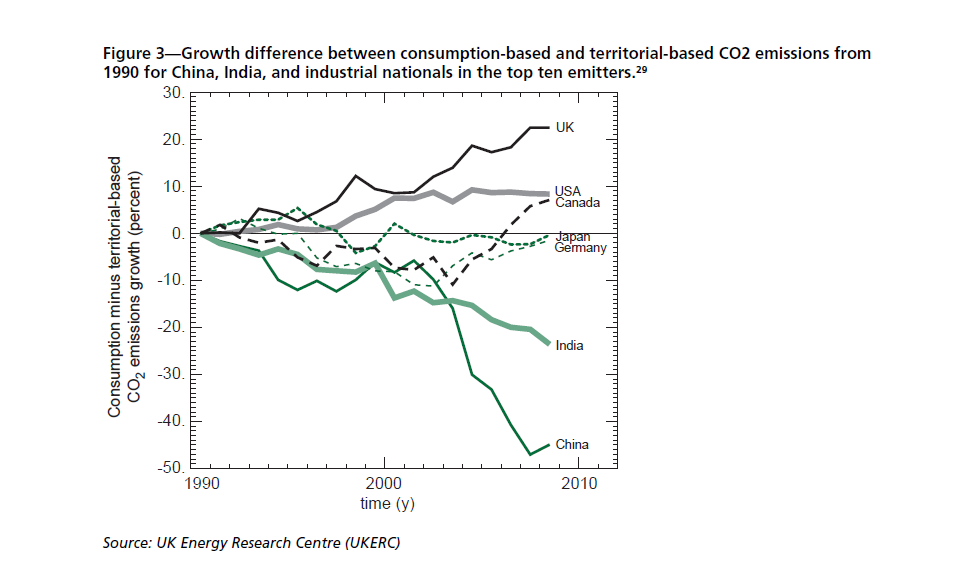
But the cut the UK has celebrated is an artefact of accountancy. When the impact of the goods we buy from other nations is counted, our total greenhouse gases did not fall by 19% between 1990 and 2008. They rose by 20%. This is despite the replacement during that period of many of our coal-fired power stations with natural gas, which produces roughly half as much carbon dioxide for every unit of electricity. When our “consumption emissions”, rather than territorial emissions, are taken into account, our proud record turns into a story of dismal failure.

There are two further impacts of this false accounting. The first is that because many of the goods whose manufacture we commission are now produced in other countries, those places take the blame for our rising consumption. We use China just as we use the population issue: as a means of deflecting responsibility. What’s the point of cutting our own consumption, a thousand voices ask, when China is building a new power station every 10 seconds (or whatever the current rate happens to be)?

But, just as our position is flattered by the way greenhouse gases are counted, China’s is unfairly maligned. A graph published by the House of Commons Energy and Climate Change Committee shows that consumption accounting would reduce China’s emissions by roughly 45%. Many of those power stations and polluting factories have been built to supply our markets, feeding an apparently insatiable demand in the UK, the US and other rich nations for escalating quantities of stuff.

gm1

The second thing the accounting convention has hidden from us is consumerism’s contribution to global warming. Because we consider only our territorial emissions, we tend to emphasise the impact of services – heating, lighting and transport for example – while overlooking the impact of goods. Look at the whole picture, however, and you discover (using the Guardian’s carbon calculator) that manufacturing and consumption is responsible for a remarkable 57% of the greenhouse gas production caused by the UK.

Unsurprisingly, hardly anyone wants to talk about this, as the only meaningful response is a reduction in the volume of stuff we consume. And this is where even the most progressive governments’ climate policies collide with everything else they represent. As Mustapha Mond points out in Brave New World, “industrial civilization is only possible when there’s no self-denial. Self-indulgence up to the very limits imposed by hygiene and economics. Otherwise the wheels stop turning”.

The wheels of the current economic system – which depends on perpetual growth for its survival – certainly. The impossibility of sustaining this system of endless, pointless consumption without the continued erosion of the living planet and the future prospects of humankind, is the conversation we will not have.

By considering only our territorial emissions, we make the impacts of our escalating consumption disappear in a puff of black smoke: we have offshored the problem, and our perceptions of it.

But at least in a couple of places the conjuring trick is beginning to attract some attention.

On April 16th, the Carbon Omissions site will launch a brilliant animation by Leo Murray, neatly sketching out the problem*. The hope is that by explaining the issue simply and engagingly, his animation will reach a much bigger audience than articles like the one you are reading can achieve.

(*Declaration of interest (unpaid): I did the voiceover).

On April 24th, the Committee on Climate Change (a body that advises the UK government) will publish a report on how consumption emissions are likely to rise, and how government policy should respond to the issue.

I hope this is the beginning of a conversation we have been avoiding for much too long. How many of us are prepared fully to consider the implications?

www.monbiot.com

oooOOOooo

So very difficult to pick out the sentence that carried the most power, for the essay is powerful from start to end.  But this one did hit me in the face, “The impossibility of sustaining this system of endless, pointless consumption without the continued erosion of the living planet and the future prospects of humankind, is the conversation we will not have.

Finally, I can’t resist reminding you, dear reader, of the point made by Prof. Guy McPherson in his book Walking Away from Empire, which I reviewed on March 6th.  particularly in the first paragraph of the first chapter; Reason:

At this late juncture in the era of industry, it seems safe to assume we face one of two futures. If we continue to burn fossil fuels, we face imminent environmental collapse. If we cease burning fossil fuels, the industrial economy will collapse. Industrial humans express these futures as a choice between your money or your life, and tell you that, without money, life isn’t worth living. As should be clear by now, industrial humans — or at least our “leaders” — have chosen not door number one (environmental collapse) and not door number two (economic collapse), but both of the above.

Maybe this is why we seem unable to have the conversation because to do so means we have to look at ourselves in the mirror.  Each one of us, you and me, has to address something so deeply personal.  Back to Prof. McPherson and page 177 of his book (my emphasis):

It’s no longer just the living planet we should be concerned about. It’s us. The moral question, then: What are you going to do about it?

For my money, Mr. Monbiot is yet another voice of reason in the wilderness; another voice that deserves to be followed.  I say this because by way of introduction to his philosophy, he opens thus:

My job is to tell people what they don’t want to hear. That is not what I set out to do. I wanted only to cover the subjects I thought were interesting and important. But wherever I turned, I met a brick wall of denial.

Denial is everywhere. I have come to believe that it’s an intrinsic component of our humanity, an essential survival strategy. Unlike other species, we know that we will die. This knowledge could destroy us, were we unable to blot it out. But, unlike other species, we also know how not to know. We employ this unique ability to suppress our knowledge not just of mortality, but of everything we find uncomfortable, until our survival strategy becomes a threat to our survival.

“… until our survival strategy becomes a threat to our survival.”

I sense the growing of this threat to the point where maybe within less than a year the vast majority of open-minded, thinking individuals know the truth of where we are all heading.

It really is a very simple message!

Repeat after me: We are of this planet!  It’s really very simple!

There are times when I look back at my writings on Learning from Dogs, now well over 1,500 posts (1,633 as of today, to be anal about it!) and ponder if the fundamental message behind the name of the blog often gets overlooked.  The Welcome page states:

As man’s companion, protector and helper, history suggests that dogs were critically important in man achieving success as a hunter-gatherer. Dogs ‘teaching’ man to be so successful a hunter enabled evolution, some 20,000 years later, to farming, thence the long journey to modern man. But in the last, say 100 years, that farming spirit has become corrupted to the point where we see the planet’s plant and mineral resources as infinite. Mankind is close to the edge of extinction, literally and spiritually.

Dogs know better, much better! Time again for man to learn from dogs!

Elsewhere on the blog, I underpin that proposition by listing the attributes of dogs:

Dogs:

  • are integrous ( a score of 210) according to Dr David Hawkins
  • don’t cheat or lie
  • don’t have hidden agendas
  • are loyal and faithful
  • forgive
  • love unconditionally
  • value and cherish the ‘present’ in a way that humans can only dream of achieving
  • are, by eons of time, a more successful species than man.

Now this is all fine and dandy but of what relevance is this to the mess that homo sapiens now finds itself in? Two parts to that answer come to mind.

The first part is that watching a dog out in the open countryside quickly brings home the fact that these animals are part of nature and, if push comes to shove, can live in the wild and fend for themselves.  Not saying that a domestic dog would enjoy the experience but that their wild dog and grey wolf roots still rest somewhere in a dog’s consciousness.

The second part of the answer is that all animals instinctively live in harmony, in balance, with their surroundings; with their environment.

For the incredibly obvious reason that dogs, as with all other animal species, are an evolutionary consequence of the natural history of Planet Earth.  That evolutionary journey from the Grey Wolf (Canis lupus) part of the Canidae family, a family including wolves, coyotes and foxes, thought to have evolved 60 million years ago.  That journey all the way to the domestic dog (Canis lupus familiaris).

That ancient journey where the African wild dog (Lycaon pictuspainted dog) came together with early man. No one knows when but the African wild dog was certainly around when man developed speech and set out from Africa, about 50,000 years ago!

Two vastly different natural species, dog and man, evolving compatibly with each other for so many thousands of years.

Back to the attributes of dogs, in particular a dog’s ability to cherish the present.  Earlier this week I was chatting with Kevin Dick, friend from Payson, AZ days, about the ‘interesting’ times we are living in.  Kevin thought there was a significant difference between the generations born in the 1940’s and 1950’s and those born in later times.  Most people over the age of, say 55, were brought up to save for ‘a rainy day’ and, possibly, be able to leave a legacy to their offspring.  Kevin then went on to reflect that more recent generations exhibit a ‘buy today, don’t delay’ mentality.

A by-product of this materialistic instant gratification approach is that the whole damn consumer machine has created a total disconnect with the fact that we humans are of this planet.

The earth is the mother of all people..

(Chief Joseph 1840 – 1904, leader of the Wallowa band, a Native American tribe

indigenous to the Wallowa Valley in northeastern Oregon)

Humans today fail to comprehend this fundamental fact: Our ability to harm the planet and think that it won’t affect our species is complete madness!  If only we could learn how to cherish the present in the way that our dogs do!

I’m now going to offer an essay from John Hurlburt.  I knew John had written this essay but didn’t get round to reading it properly until I had finished the introduction above.  I’m blown away by the resonance between the two but, as always, John’s words are so much more eloquent.

Inside Out

Climate change, religion, economics, government, politics and social issues are topics which create strong personal opinions and cultural divisions. We have difficulty accepting ideas which may conflict with our personal understandings. As usual, it’s an ego thing. The arrogance of our species is inclusive. We all suffer the consequences.

To counter our ego, we know that everything fits together. We exist in a unified cosmos with fluctuations and diversities that emerge around and through us.

Our present transformative state is as a biological form of energy and matter which possesses a conscious awareness of the natural order. We choose to ignore or deny the essential nature of our being at our own peril. Do we live only for the moment or do we live to insure our species future? That’s our fundamental choice.

Seek the truth and identify the common good.” Zoroaster [also known as Zarathustra, Ed.]

We are a consciously aware component of a living world in an isolated corner of a remote galaxy. Everything within and on the earth has an extraterrestrial origin. We live on an incubator we call the earth. We rarely truly communicate with or fully understand the energy of nature in our lives. Our critical thinking ability has become enveloped by an electronic cloud.

We generally agree that the actions of many religions and most politics are based upon short term human interests rather than upon the long term well being of our planet and its disappearing life forms. The fact is that we only began to emerge as a species about 100,000 years ago. Hubble telescope observations have dated our universal origin to roughly 13,002,000,000 years ago.

Could it be that we only imagine ourselves as independent beings? Could it be that beyond the mind games we play there is a vast reality greater that we can understand with our limited sensory apparatus and our finite minds?

Life is a transformative experience. All species, tribes, races and genders are united by the nature of life. We pass through a period of being selfish and ambitious during our journey. Many of us choose to move into these familiar ruts and furnish them. We do not always walk the way we talk.

Nature favors species which adapt to constant change in an emerging universe.

If we agree that our intelligence is judged by choices we make, there is some question about intelligent human life on earth. A recent Harvard University study of species in relation to change estimates that the life span of the human species is approximately 100,000 years. Sound familiar?

The wisdom of our brief human history tells us that we are on a careless and needless path to self destruction. All that’s necessary to verify this assertion is to turn on the news of the day. The systemic paradigm that has been imprinted on our psyches is in constant flux. As we live and learn, we realize that our purpose is to leave life better than we found it.

A delicate balance is necessary to maintain an even strain of faith in the natural process rather than dwelling upon our self centered fears of losing something we imagine we own or not attaining something we believe we want. The earth heals itself from the inside out. We can do the same as a species. Today is the tomorrow we dreamed of yesterday. What have we done to fulfill the true purpose of our lives?

an old lamplighter

So, yes, we have much to learn from dogs.

I will close as I started. We are of this planet!  It’s really very simple!

The Denial of Science: A review.

A review of the recently published book by Martin Lack.

denial of science

In many ways it would be terribly easy to find fault with this book. If it had been written as a book, been through the edits that a new book requires, then published, those faults would be a significant criticism.

But it was not written as a book! It was originally written as an academic text.  As Martin explains in the Preface:

This book is based on research originally undertaken – and a dissertation written – as part of my MA in Environmental Politics from Keele University in Staffordshire (in 2010-2011).

Then in the following paragraph goes on to say:

Academics generally disapprove of the publication of academic research via non-academic, non-peer-reviewed routes.  However, I am trying to reach more than just an academic audience.

Three sentences later:

However, this book retains many of the features of a piece of academic research, …. (All quotes from page viii of the preface)

To a person unaccustomed to reading academic research, as is this reader, the structural and presentational differences between a ‘normal’ non-fiction book and a dissertation are significant.  That needs to be borne in mind as you turn to page one.

OK, now that I have got that off my chest, on to the substance of the review.

Turning to the outside back cover, one sees Martin clearly explaining that the book is not about climate science, rather an analysis of why some people dispute “the reality, reliability and reasonableness of this science.”

That alone justifies the work that Martin put into his research and dissertation and his subsequent decision to adapt his findings into a book.

The pace and scale of the changes that are being visited on Planet Earth is truly frightening.  The number of feedback loops that we are locked into now don’t even bear thinking about.  Just take the continuing and accelerating loss of the Arctic ice-cap and extrapolate that for a couple of decades (touched on in my recent post More new tomorrows and see footnote.)

We are not talking of subtle changes over many generations. We are talking about irreversible and irrevocably massive changes to our environment within the lifetimes of just about every living person on this planet.  (I’m 70 next year and while I have no idea how many years I have left, I rate it as at least 50:50 that before I take my last breath, the coming destruction of biosphere will be blindingly obvious to me, Jean and 99.9% of the world’s population.)

Makes me want to shout out ……

There is not much time left to leave a sustainable world for future generations.  Come on politicians and power-brokers; start acting as though you truly understand the urgency of the situation!

Ah, that feels much better!

Back to the book!

Martin examines 5 categories that display denial behaviours, to a greater or lesser extent.  These categories are: Organisations; Scientists, Economists, Journalists and Politicians. Oh, and a 6th catch-all category: Others.

Each section dealing with a category is structured in the same way: Preliminary Research; Key Findings and Summary.  Tables are used extensively to allow easy review of the findings.

Again, what needs to be hammered out is that this format is very unlike a typical non-fiction book.  Because it’s fundamentally an academic dissertation!  But, so what!

What is important is for the widest possible audience to understand the breadth and extent of the denial going on.  Denial that is, literally, playing with the future of humanity on this planet; the only home we have.

Let me reinforce that last sentence by picking up on what Martin writes on his closing page (p.76):

Furthermore, there is strong circumstantial evidence to suggest that this scepticism is being fuelled by those with a vested interest in the continuance of “business as usual” by seeking to downplay, deny or dismiss the scientific consensus on the extent of ACD.

Martin Lack’s book may be unconventional in many ways.  But as a tool to show how those who deny the science of climate change deny the right of future millions to live in a sustainable manner, it is most powerful.  It is a valuable reference book that should be in every library and every secondary school across the globe!

The Denial of Science is published by AuthorHouse 02/23/2013

oooOOOooo

Footnotes:

  1. To add weight to the points made in this review, do look in on tomorrow’s post.
  2. I have no commercial links to Martin Lack; indeed, I purchased the copy of the book that I used for this review.

The new tomorrows.

When we are no longer able to change a situation – we are challenged to change ourselves.”  Viktor Frankl.

Like many bloggers I enjoy using a quotation to set the theme for a post.  Found this on the web; it seemed appropriate.

Over the next two days, I want to range across a number of ideas that, together, point to changes that are underway in every conceivable manner for the vast majority of the inhabitants of this planet.

My musings were prompted by a recent essay on Tom Dispatch.  Regulars will know that Tom Engelhardt generously granted me permission to republish essays that appear on his very widely-read blogsite.  This particular essay is about Phoenix in Arizona.

But first indulge me as I recount something rather personal, possibly silly but also mysteriously beautiful.

Many will know that Jean and I moved from San Carlos in Mexico to Payson, Arizona early on in 2010.  (My long comment to yesterday’s post about poor Lupe explains the background.)  Payson is 80 miles North-East of Phoenix and despite being up at 5,000 feet is very much in the same broad weather systems as Phoenix.

With our 14 dogs and 7 cats we quickly settled down and were made to feel very welcome by one and all.  Jean and I were married in Payson in November of 2010.  We were happy and contented.

One night in June last year, I had this vivid dream about going to the bathroom and finding that no water came from the tap.  Where we were living was out of town and our water supplies came from our own well (borehole in English speak!).  While the water level in the well was down by about 50 feet there was no question of the well failing; it was drilled to over 180 feet and flow tests were positive.

When I awoke the dream was still very much in the forefront of my mind.  I talked about it over breakfast with Jeannie.  By chance, we had a guest staying with us and when she heard the tale she said, “If you’re worried about water, you should go to Oregon.

Again, by chance, a couple of weeks later we had someone offer to house-sit.  With our menagerie of animals that was no casual offer!

We accepted, came up to Oregon and found this most beautiful home in Merlin, Southern Oregon complete with 13 acres and Bummer Creek running across the width of the property, a creek that flows for most of the year.

Pharaoh checking out our creek.
Pharaoh checking out Bummer Creek.

We quickly did the deal, sold the house in Payson and moved in on October 25th 2012, less than 5 months ago.

Keep all of that in mind as you read this TomDispatch essay.

oooOOOooo

Tomgram: William deBuys, Exodus from Phoenix

Posted by William deBuys at 7:58am, March 14, 2013.

We’re not the first people on the planet ever to experience climate stress.  In the overheating, increasingly parched American Southwest, which has been experiencing rising temperatures, spreading drought conditions, and record wildfires, there is an ancient history of staggering mega-droughts, events far worse than the infamous “dust bowl” of the 1930s, the seven-year drought that devastated America’s prairie lands.  That may have been “the worst prolonged environmental disaster recorded for the country,” but historically speaking it was a “mere dry spell” compared to some past mega-droughts that lasted “centuries to millennia.”

Such events even happened in human history, including an almost century-long southwestern dry spell in the second century AD and a drought that was at least decades long in the twelfth century.  These were all events driven by natural climate variation.  Climate change adds a human factor to the equation in a region already naturally dry and short on water.  It ups the odds of bad events happening.  In the coming century, how habitable will parts of the bustling desert Southwest turn out to be?  Already, in the face of heat and drought, small numbers of people from small towns in the region are leaving.  And this, too, has happened before.  There are sobering previous examples of what it means when extreme climate stress hits this area.

Chaco Canyon was abandoned by its native population during that twelfth-century drought, and 150 years later, the Hohokam native culture of what is now central Arizona, whose waterworks in the dry lands of that area were major and impressive, also abandoned its lands, possibly due to drought, as TomDispatch regular William deBuys recounts in his recent book A Great Aridness: Climate Change and the Future of the American Southwest.  “At some point,” he writes, “Hohokam society passed a threshold: the number of able-bodied workers it could muster was no longer sufficient to meet the challenge of rebuilding dams when they washed out and cleaning canals as they inevitably silted up. Eventually the hydraulic system collapsed, and the society that depended on it could no longer exist. The survivors turned their backs on their cities and scattered into the vastness of the land, doing what they could to survive.”

As you read deBuys’s latest post, it’s worth remembering that even the greatest hydraulic engineers have their limits when the water dries up.  When the Anglo farmers of the Phoenix Basin first started using the local rivers, they found themselves “reopening the canals the Hohokam had left behind.”  Who knows what monumental works we, too, might someday abandon? Phoenix, anyone? Tom

Phoenix in the Climate Crosshairs 
We Are Long Past Coal Mine Canaries 
By William deBuys

If cities were stocks, you’d want to short Phoenix.

Of course, it’s an easy city to pick on. The nation’s 13th largest metropolitan area (nudging out Detroit) crams 4.3 million people into a low bowl in a hot desert, where horrific heat waves and windstorms visit it regularly. It snuggles next to the nation’s largest nuclear plant and, having exhausted local sources, it depends on an improbable infrastructure to suck water from the distant (and dwindling) Colorado River.

In Phoenix, you don’t ask: What could go wrong? You ask: What couldn’t?

And that’s the point, really. Phoenix’s multiple vulnerabilities, which are plenty daunting taken one by one, have the capacity to magnify one another, like compounding illnesses. In this regard, it’s a quintessentially modern city, a pyramid of complexities requiring large energy inputs to keep the whole apparatus humming. The urban disasters of our time — New Orleans hit by Katrina, New York City swamped by Sandy — may arise from single storms, but the damage they do is the result of a chain reaction of failures — grids going down, levees failing, back-up systems not backing up. As you might expect, academics have come up with a name for such breakdowns: infrastructure failure interdependencies. You wouldn’t want to use it in a poem, but it does catch an emerging theme of our time.

Phoenix’s pyramid of complexities looks shakier than most because it stands squarely in the crosshairs of climate change. The area, like much of the rest of the American Southwest, is already hot and dry; it’s getting ever hotter and drier, and is increasingly battered by powerful storms. Sandy and Katrina previewed how coastal cities can expect to fare as seas rise and storms strengthen. Phoenix pulls back the curtain on the future of inland empires. If you want a taste of the brutal new climate to come, the place to look is where that climate is already harsh, and growing more so — the aptly named Valley of the Sun.

In Phoenix, it’s the convergence of heat, drought, and violent winds, interacting and amplifying each other that you worry about. Generally speaking, in contemporary society, nothing that matters happens for just one reason, and in Phoenix there are all too many “reasons” primed to collaborate and produce big problems, with climate change foremost among them, juicing up the heat, the drought, and the wind to ever greater extremes, like so many sluggers on steroids. Notably, each of these nemeses, in its own way, has the potential to undermine the sine qua non of modern urban life, the electrical grid, which in Phoenix merits special attention.

If, in summer, the grid there fails on a large scale and for a significant period of time, the fallout will make the consequences of Superstorm Sandy look mild. Sure, people will hunt madly for power outlets to charge their cellphones and struggle to keep their milk fresh, but communications and food refrigeration will not top their list of priorities. Phoenix is an air-conditioned city. If the power goes out, people fry.

In the summer of 2003, a heat wave swept Europe and killed 70,000 people. The temperature in London touched 100 degrees Fahrenheit for the first time since records had been kept, and in portions of France the mercury climbed as high as 104°F. Those temperatures, however, are child’s play in Phoenix, where readings commonly exceed 100°F for more than 100 days a year. In 2011, the city set a new record for days over 110°F: there were 33 of them, more than a month of spectacularly superheated days ushering in a new era.

In Flight From the Sun

It goes without saying that Phoenix’s desert setting is hot by nature, but we’ve made it hotter. The city is a masonry world, with asphalt and concrete everywhere. The hard, heavy materials of its buildings and roads absorb heat efficiently and give it back more slowly than the naked land. In a sense, the whole city is really a thermal battery, soaking up energy by day and releasing it at night. The result is an “urban heat island,” which, in turn, prevents the cool of the desert night from providing much relief.

Sixty years ago, when Phoenix was just embarking on its career of manic growth, nighttime lows never crept above 90°F. Today such temperatures are a commonplace, and the vigil has begun for the first night that doesn’t dip below 100°F. Studies indicate that Phoenix’s urban-heat-island effect may boost nighttime temperatures by as much as 10°F. It’s as though the city has doubled down on climate change, finding a way to magnify its most unwanted effects even before it hits the rest of us full blast.

Predictably, the poor suffer most from the heat.  They live in the hottest neighborhoods with the least greenery to mitigate the heat-island effect, and they possess the least resources for combatting high temperatures.  For most Phoenicians, however, none of this is more than an inconvenience as long as the AC keeps humming and the utility bill gets paid. When the heat intensifies, they learn to scurry from building to car and into the next building, essentially holding their breaths. In those cars, the second thing they touch after the ignition is the fan control for the AC. The steering wheel comes later.

In the blazing brilliance of July and August, you venture out undefended to walk or run only in the half-light of dawn or dusk. The idea for residents of the Valley of the Sun is to learn to dodge the heat, not challenge it.

Heat, however, is a tricky adversary. It stresses everything, including electrical equipment. Transformers, when they get too hot, can fail. Likewise, thermoelectric generating stations, whether fired by coal, gas, or neutrons, become less efficient as the mercury soars.  And the great hydroelectric dams of the Colorado River, including Glen Canyon, which serves greater Phoenix, won’t be able to supply the “peaking power” they do now if the reservoirs behind them are fatally shrunken by drought, as multiple studies forecast they will be. Much of this can be mitigated with upgraded equipment, smart grid technologies, and redundant systems.  But then along comes the haboob.

haboob is a dust/sand/windstorm, usually caused by the collapse of a thunderstorm cell. The plunging air hits the ground and roils outward, picking up debris across the open desert. As the Arabic name suggests, such storms are native to arid regions, but — although Phoenix is no stranger to storm-driven dust — the term haboob has only lately entered the local lexicon. It seems to have been imported to describe a new class of storms, spectacular in their vehemence, which bring visibility to zero and life to a standstill. They sandblast cars, close the airport, and occasionally cause the lights — and AC — to go out. Not to worry, say the two major utilities serving the Phoenix metroplex, Arizona Public Service and the Salt River Project. And the outages have indeed been brief.  So far.

Before Katrina hit, the Army Corps of Engineers was similarly reassuring to the people of New Orleans. And until Superstorm Sandy landed, almost no one worried about storm surges filling the subway tunnels of New York.

Every system, like every city, has its vulnerabilities. Climate change, in almost every instance, will worsen them. The beefed-up, juiced-up, greenhouse-gassed, overheated weather of the future will give us haboobs of a sort we can’t yet imagine, packed with ever greater amounts of energy. In all likelihood, the emergence of such storms as a feature of Phoenix life results from an overheating environment, abetted by the loose sand and dust of abandoned farmland (which dried up when water was diverted to the city’s growing subdivisions).

Water, Water, Everywhere (But Not for Long)

In dystopic portraits of Phoenix’s unsustainable future, water — or rather the lack of it — is usually painted as the agent of collapse. Indeed, the metropolitan area, a jumble of jurisdictions that includes Scottsdale, Glendale, Tempe, Mesa, Sun City, Chandler, and 15 other municipalities, long ago made full use of such local rivers as the Salt, Verde, and Gila. Next, people sank wells and mined enough groundwater to lower the water table by 400 feet.

Sometimes the land sank, too.  Near some wells it subsided by 10 feet or more. All along, everyone knew that the furious extraction of groundwater couldn’t last, so they fixed their hopes on a new bonanza called the Central Arizona Project (CAP), a river-sized, open-air canal supported by an elaborate array of pumps, siphons, and tunnels that would bring Colorado River water across the breadth of Arizona to Phoenix and Tucson.

The CAP came on line in the early 1990s and today is the engine of Arizona’s growth. Unfortunately, in order to win authorization and funding to build it, state officials had to make a bargain with the devil, which in this case turned out to be California. Arizona’s delegation in the House of Representatives was tiny, California’s was huge, and its representatives jealously protected their longstanding stranglehold on the Colorado River. The concession California forced on Arizona was simple: it had to agree that its CAP water rights would take second place to California’s claims.

This means one thing: once the inevitable day comes when there isn’t enough water to go around, the CAP will absorb the shortage down to the last drop before California even begins to turn off its faucets.

A raw deal for Arizona? You bet, but not exactly the end of the line. Arizona has other “more senior” rights to the Colorado, and when the CAP begins to run dry, you may be sure that the masters of the CAP will pay whatever is necessary to lease those older rights and keep the 330-mile canal flowing. Among their targets will be water rights belonging to Indian tribes at the western edge of the state along the lower reaches of the river. The cost of buying tribal water will drive the rates consumers pay for water in Phoenix sky-high, but they’ll pay it because they’ll have to.

Longer term, the Colorado River poses issues that no amount of tribal water can resolve. Beset by climate change, overuse, and drought, the river and its reservoirs, according to various researchers, may decline to the point that water fails to pass Hoover Dam. In that case, the CAP would dry up, but so would the Colorado Aqueduct which serves greater Los Angeles and San Diego, as well as the All-American Canal, on which the factory farms of California’s Imperial and Coachella valleys depend. Irrigators and municipalities downstream in Mexico would also go dry. If nothing changes in the current order of things, it is expected that the possibility of such a debacle could loom in little more than a decade.

The preferred solution to this crisis among the water mavens of the lower Colorado is augmentation, which means importing more water into the Colorado system to boost native supplies. A recently discussed grandiose scheme to bail out the Colorado’s users with a pipeline from the Mississippi River failed to pass the straight-face test and was shot down by then-Secretary of the Interior Ken Salazar.

Meanwhile, the obvious expedient of cutting back on water consumption finds little support in thirsty California, which will watch the CAP go dry before it gets serious about meaningful system-wide conservation.

Burning Uplands

Phoenicians who want to escape water worries, heat waves, and haboobs have traditionally sought refuge in the cool green forests of Arizona’s uplands, or at least they did until recently. In 2002, the Rodeo-Chediski fire consumed 469,000 acres of pine and mixed conifer on the Mogollon Rim, not far from Phoenix. It was an ecological holocaust that no one expected to see surpassed. Only nine years later, in 2011, the Wallow fire picked up the torch, so to speak, and burned across the Rim all the way to the New Mexico border and beyond, topping out at 538,000 charred acres.

Now, nobody thinks such fires are one-off flukes. Diligent modeling of forest response to rising temperatures and increased moisture stress suggests, in fact, that these two fires were harbingers of worse to come. By mid-century, according to a paper by an A-team of Southwestern forest ecologists, the “normal” stress on trees will equal that of the worst megadroughts in the region’s distant paleo-history, when most of the trees in the area simply died.

Compared to Phoenix’s other heat and water woes, the demise of Arizona’s forests may seem like a side issue, whose effects would be noticeable mainly in the siltation of reservoirs and the destabilization of the watersheds on which the city depends. But it could well prove a regional disaster.  Consider, then, heat, drought, windstorms, and fire as the four horsemen of Phoenix’s Apocalypse. As it happens, though, this potential apocalypse has a fifth horseman as well.

Rebecca Solnit has written eloquently of the way a sudden catastrophe — an earthquake, hurricane, or tornado — can dissolve social divisions and cause a community to cohere, bringing out the best in its citizenry. Drought and heat waves are different. You don’t know that they have taken hold until you are already in them, and you never know when they will end. The unpleasantness eats away at you.  It corrodes your state of mind. You have lots of time to meditate on the deficiencies of your neighbors, which loom larger the longer the crisis goes on.

Drought divides people, and Phoenix is already a divided place — notoriously so, thanks to the brutal antics of Maricopa County Sheriff Joe Arpaio. In Bird on Fire: Lessons from the World’s Least Sustainable City, Andrew Ross offers a dismal portrait of contemporary Phoenix — of a city threatened by its particular brand of local politics and economic domination, shaped by more than the usual quotient of prejudice, greed, class insularity, and devotion to raw power.

It is a truism that communities that do not pull together fail to surmount their challenges. Phoenix’s are as daunting as any faced by an American city in the new age of climate change, but its winner-take-all politics (out of which has come Arizona’s flagrantly repressive anti-immigration law), combined with the fragmentation of the metro-area into nearly two dozen competing jurisdictions, essentially guarantee that, when the worst of times hit, common action and shared sacrifice will remain as insubstantial as a desert mirage. When one day the U-Haul vans all point away from town and the people of the Valley of the Sun clog the interstates heading for greener, wetter pastures, more than the brutal heat of a new climate paradigm will be driving them away. The breakdown of cooperation and connectedness will spur them along, too.

One day, some of them may look back and think of the real estate crash of 2007-2008 and the recession that followed with fond nostalgia. The city’s economy was in the tank, growth had stalled, and for a while business-as-usual had nothing usual about it. But there was a rare kind of potential. That recession might have been the last best chance for Phoenix and other go-go Sunbelt cities to reassess their lamentably unsustainable habits and re-organize themselves, politically and economically, to get ready for life on the front burner of climate change. Land use, transportation, water policies, building codes, growth management — you name it — might all have experienced a healthy overhaul. It was a chance no one took. Instead, one or several decades from now, people will bet on a surer thing: they’ll take the road out of town.

William deBuys, a TomDispatch regular, is the author of seven books, most recently A Great Aridness: Climate Change and the Future of the American Southwest. He has long been involved in environmental affairs in the Southwest, including service as founding chairman of the Valles Caldera Trust, which administers the 87,000-acre Valles Caldera National Preserve in New Mexico.

Follow TomDispatch on Twitter and join us on Facebook. Check out the newest Dispatch book, Nick Turse’s The Changing Face of Empire: Special Ops, Drones, Proxy Fighters, Secret Bases, and Cyberwarfare.

Copyright 2013 William deBuys

oooOOOooo

Just to reinforce the magic of my dream and how Jean and I feel so blessed by our life changes, the photo below was taken on our property the day we arrived in Merlin.

Within arm's reach of the beauty of nature.
Within arm’s reach of the beauty of nature.

Musings continued tomorrow.  Hope you stayed with it so far.

E Pluribus Unum

From Many, One.

There were a great number of ‘Likes’ for John Hurlburt’s writings which were published most recently on the 1st March, Making sense of life? and on the 25th February, Fear versus Faith.

So it is with very great pleasure that I pass the baton for today’s post once more across to John.

oooOOOooo

E Pluribus Unum

We know we’re in trouble when we no longer pay serious attention to the weather, the foundations of our economy are imaginary, our pumps don’t work because our wells are running dry.  Then how we distract ourselves and loudly complain more often than we make a honest effort to maintain our balance and understand our inclusive situation.

We know we’re in trouble when we’ve moved into the rut of a manufactured illusion and furnished it, when we consume more than we produce, when equality has become a dirty word, when we believe that more guns reduce gun violence, when contempt of Congress has become a national pastime and when our supreme court has become a corporate political tool.

We know we’re in trouble when we fund both sides of a global oil war and neglect the needs of our war veterans, when we believe that we can adapt to change by standing still, when we’ve taken the culture out of agriculture, when we wage cyber war against our planetary neighbors, when an obsessive focus on money systemically corrupts our world and when democracy has a price tag.

We know we’re in trouble when there is virulent opposition to change, when a corporate backed element of our civilization insists upon obfuscation denial and obstruction, when ignorance has become more common than common sense, when a global religious faith and a major university are fractured by inappropriate physical conduct with children in the name of God and sports respectively, and when our primary purpose appears to be to consume our planet as cost effectively as practicable.

We know we’re in trouble when our rivers run dry, when our food is laced with pesticide residues, when our air is contaminated by fuel and chemical waste products, when living species are becoming extinct from the bottom of the food chain and up at a rapidly increasing rate, when we chose to ignore the realities of our natural condition as transitory inhabitants of a living planet and when we arrogantly choose to believe that we own planet earth either as a species or as individual members of a species.

We know that we’re in trouble when free speech is thought to include an unbalanced right to be aggressively ignorant, intolerant and uncompassionate despite all facts to the contrary, when we no longer believe in simple science and arithmetic and when we concentrate on undoing social issues which have been resolved in our lifetimes rather than honestly facing the confluence of problems we all share.

We know we’re in trouble when our politics are more about posturing than policy, when prisons have become a growth industry, when levels of state secrecy exceed open disclosure, when justice has a price tag, when bigotry is stronger than progress, when education is based upon opinion rather than fact and when one nation under God, with liberty and justice for all, has become a fractured nation with a dysfunctional government.

We know we’re in trouble when our legislatures have been purchased, when faith in our financial system has been willfully damaged, when political leaders engage in childish tantrums to get their way regardless of anything or anyone else, when awareness of moral reality has become meaningless and when we fail to appreciate the depths of a looming abyss. What do we gain by purposefully destabilizing our economy, reopening settled social issues and blatantly risking our inclusive future as a species for a mess of pottage?  Who do we think we are?

We know we’re on the right track when nature is more important to us than profit, when open mindedness is stronger than private interests, when media reports facts rather than conjecture and when freedom of speech is not taken to wretched excess as a psychological tool of cultural management employed for the exclusive benefit of an affluent minority.

We know we’re on the right track when our faith in power greater than our species is more significant than short-term profit, when we create equitable employment which benefits our environment, when we repair our crumbling infrastructure, when we make an effort to improve our inclusive quality of life, when war is no longer a first remedy for misunderstanding or disagreement and when we make an effort to reverse our established patterns of self destruction.

We know we’re on the right track when we tax our world stock markets because of our need for revenue based upon the fact that market trades are the only major form of financial transaction that remains untaxed, when we cultivate our cities and towns based on biological needs for clean air, water, food, and energy and when we begin to recognize the massive burden which world population growth places on our planet and take steps to balance our birth rate accordingly.

We know we’re on the right track when we realize that algae based bio-fuel will run every diesel engine in the world without modification, when we realize that our future must be beyond the earth and when we take further steps beyond our garden cradle on a journey of exploration to the stuff of the stars from which our life on earth emerges.

Change is a constant. Today is the tomorrow we dreamed of yesterday. We know we’re growing as a consciously aware life form when our faith is stronger than our fear, when we trust each other to do the next right thing and when the nature of the energy of our spiritual being is more important to us than the immediate comforts of our transitory material being. One day at a time. In God we trust.

Happy trails,

an old lamplighter

Going beyond the self.

Further reflections on reality and delusion.

I closed yesterday’s post with this quotation from Carl Sagan, “It is far better to grasp the universe as it really is than to persist in delusion, however satisfying and reassuring.

So easy to write.  Nay, a thousand times more easy to trot out than to embrace.  Even that word embrace is too warm and fuzzy.

I’m sure that the human psyche lives in a bubble of delusion.  Clearly, if the level of delusion is abnormal then we can’t function properly as social animals.  Just take a moment or two to muse over the ways that you ‘shelter’ from reality.  Trust me I don’t exclude myself.

However, there are times when reality with a capital ‘R’ smacks us in the face.  Death of a loved one, unanticipated break-up of one’s marriage are two that come to mind.  Undoubtedly, there are others.

In yesterday’s post where I wrote of my experiences from reading Guy McPherson’s book, Walking Away from Empire, I freely admitted the struggle of embracing the truth, the Reality of where we are; ‘we’ as in industrialised man.

Aristotle
Aristotle (384 BC – 322 BC)

Reflect on the relationship that hope has with reality.  Aristotle wrote, “Hope is a waking dream” and that comes from over 2,300 years ago!

More recently, the aforementioned Professor wrote of hope:

With respect to the question, I spoke and wrote about hope way back in August 2007, when this website was launched. In that long essay — the bloated, unedited, transcript of a presentation I had delivered a few days earlier — I described hope as follows:

I view hope as the left-brain product of love, analogous to democracy as the product of freedom, or liberty. Notably, Patrick Henry did not say, “Give me democracy or give me death.” Like the rest of the founding fathers, Henry knew that freedom was primary to democracy; without the guiding light of freedom, or liberty, democracy breaks up on the shoals. Love keeps our left brain in check — that’s the message of the world’s religions. But our right-brain love creates the foundation for hope: love for nature, love for our children and grandchildren, love for each other. Without love to light the way, hope breaks up on the shoals.

Staying with Guy McPherson for a tad longer, over on Transition Voice there was an essay from him under the title of Sadly, extinction is no laughing matter.

Picking up on the Carl Sagan quote again (“It is far better to grasp the universe as it really is than to persist in delusion, however satisfying and reassuring.“) McPherson writes:

Many people disagree with Sagan, choosing delusion over reality, believing we can have infinite growth on a finite planet with no consequences for people or other creatures, other life forms, other organisms. The people in this latter group seek hope, and many of them disparage me and my actions for inducing despair.

Finally, though, I’ve concluded that hope is hopeless. As Friedrich Nietzsche pointed out, “Hope is the most evil of evils, because it prolongs man’s torment.”

To put Ed Abbey’s spin on it, “Action is the antidote to despair.” So, even though I no longer think my actions matter for humans, I’ll take action.

A worthy pity party

Near-term human extinction is a difficult pill to swallow, as is economic collapse. But ignoring ugly truths does not make them any less true. Despair is an expected and appropriate response to this information. Recognizing, accepting, and moving beyond despair are important subsequent steps.

But first, let’s despair.

Ed Abbey’s idea that action is the antidote to fear reminds me of a recent essay from Alex Jones over at The Liberated Way.  (If you haven’t previously come across Alex’s writings trust me you will be inspired!)

That essay was How to change the world published on the 28th February last.  Here’s how it opens:

Changes to self acts as ripples of change to the world.

Throw a rock into a pool it creates ripples, eventually the pool grows still again.  Like the pool nature will move to a state of harmony if given the chance.

We all know that humanity and this planet suffer many challenges.  Many feel they need to change or improve the world.  Those people fail to realise that nature knows where the state of harmony is, and is attempting to get to that state of harmony, therefore one has no need to change or improve the world.

The reason those words jumped off the page at me (OK, screen!) was the key message that letting go of what man feels compelled to do and allowing the natural forces on this planet to reign supreme is the answer.  The message that we have to go back to the natural way of doing things.  Right back to the harmony that early man had with the planet before farming corrupted our values.

Alex’s essay continues:

The problem with the desire to change the world is it becomes a form of control, attempting to force others to do something they have no desire to do. One of the problems of humanity is control, everyone trying to control each other, self and nature, which ends in conflict where nobody but the strongest wins. The problem with control is choice, liberty and creativity is taken away from those being controlled, and there is no opportunity to gain wisdom from mistakes.

I have spent too many years of my life trying to change or improve the world. I won some battles, I lost others. Worse, I became sometimes no better than those I fought against. Often control made the situation worse. I am reminded of the Greek legend of King Sisyphus who was condemned to roll a boulder up a steep hill only to see it roll down again, an activity he was condemned to repeat for all of eternity. Trying to change or improve the world was my equivalent of King Sisyphus.

The answer is to be a ripple of change to the world by doing our own thing. By changing ourselves, by living our dreams, setting an example, we emanate ripples of change into the world. We transform the world by transforming ourselves. Remember that stone that splashed into the pool? We are the stone, our activities in making ourselves happy, healthy and abundant becomes the ripples of change into the world. We force nobody to do anything, since all our efforts are focused on ourselves, we show by example which others may copy. People will follow our example since they see what we do works.

It is hard to let go, but let go we must. Change is inside rippling outwards.

It’s the old adage about change.  It first has to start from within.  As I warned in yesterday’s post, “When you read this book brace yourself for what you see staring out of the mirror back at you. There will be no room left for delusion.

Ironically for a post that carries the title of ‘Going beyond the self” going out of oneself is the only way to see reality, to brush away delusion.  From which place one can then allow change from within to occur.

I shall close with a quote from one of my favourite authors Aldous Huxley:

“Experience is not what happens to you; it’s what you do with what happens to you.”

letgo1

Walking Away from Empire; a book review

“Once you eliminate the impossible, whatever remains, no matter how improbable, must be the truth.” Arthur Conan Doyle.

Ten days ago, I finished reading the book Walking Away from Empire: A Personal Journey. It had been sent to me by the author.

Let me explain how this came about.

A few weeks ago, I published an item under the title of Doggedly seeking the truth.  I included the video “The Twin Sides of the Fossil-Fuel Coin: Developing Durable Living Arrangements in Light of Climate Change and Energy Decline.“  That video was a presentation by Prof. Guy McPherson.

Subsequently, during an exchange of emails with Prof. McPherson there was an offer to receive a free copy of his book, Walking Away from Empire: A Personal Journey.  Naturally, I accepted.

Having finished reading the book it seemed only fair to write a review.

So far, so good!

I tried to marshal my thoughts for well over a week.   Couldn’t get started.  Strange, because when immersed in the book the messages were crystal clear.

Why the struggle to embrace Guy McPherson’s messages?  Then in a moment of insight I realised that I was struggling to understand why I was struggling!

walkingaway
Published by PublishAmerica, LLLP

Because the blunt truth of the matter is that this book spells out the bleedin’ obvious.  Humanity is between a rock and a hard place!

Look no further than the very first paragraph of the first chapter, Reason,:

At this late juncture in the era of industry, it seems safe to assume we face one of two futures. If we continue to burn fossil fuels, we face imminent environmental collapse. If we cease burning fossil fuels, the industrial economy will collapse. Industrial humans express these futures as a choice between your money or your life, and tell you that, without money, life isn’t worth living. As should be clear by now, industrial humans — or at least our “leaders” — have chosen not door number one (environmental collapse) and not door number two (economic collapse), but both of the above.

Sandy Krolick of Transition Voice wrote a review of Guy McPherson’s book in September, 2011.  His last sentence was, “This is a book you will not put down; and having read it, you’ll no longer be able to ignore its conclusions.

Again, what Sandy Krolick writes is perfectly correct. No argument.  Yet …. something about that sentence from Sandy doesn’t speak to me.  That struggle again.

Then I got it!

Let me go straight to page 177 of Prof. McPherson’s book and quote this:

It’s no longer just the living planet we should be concerned about. It’s us. The moral question, then: What are you going to do about it?

Then one paragraph later, come this:

There is simply no feeding the hollow spot in my gut and my psyche, as there was when I replaced my invisible, omnipotent friend in the sky with reason. Instead of abandoning the mirage of eternal life, I’m abandoning the mirage of globalization. Instead of giving up an everloving god, I’m giving up a comfortable life spent with my best friend. I’m taking yet another step in the path from make-believe to reality. And, as we all know, reality is a harsh, dispassionate mistress who doesn’t give a damn about the emptiness in my fragile little psyche. Fortunately, I still have the amusing memories of the absurdity of my former life, in which I believed I was saving the world by conducting and publishing mundane research and teaching irrelevant concepts to a largely disinterested audience.

I found the first step to be the most difficult. Simply recognizing the industrial economy as an omnicidal imperial beast forced me to cross a threshold most people find far too formidable to attempt.

Just reflect on those key words, “a threshold most people find far too formidable to attempt.”

Keep those words in mind as I quote the next paragraph from the book.

We’ve never been here as a species, much less as individuals. And every cultural message tells us we’re wrong, that the industrial age will last forever, that justice and goodness will prevail over every enemy (i.e., terrorist), that progress is a one-way street to industrial nirvana, that the harbinger of hope will keep the oil coming and the cars running and the planes flying so we can all soak up the sun on a sandy beach any time we need a break from our tumultuous lives in the cube farms of empire.

This, then, was the result of reading the book.  The realisation of the reality of our existence.  The immensity of the truth of where mankind is.  The here and NOW!

Sorry, let me amend those last sentences.  My realisation of the reality of my existence.  The immensity of the truth of where I am.  My here and NOW!

No wonder I struggled.

So not much of a book review, more a review of yours truly!  That is the power of this book.  Sandy Krolick was right; “This is a book you will not put down; and having read it, you’ll no longer be able to ignore its conclusions.

Be warned.  When you read this book brace yourself for what you see staring out of the mirror back at you. There will be no room left for delusion.

As Carl Sagan said, “It is far  better to grasp the universe as it really is than to persist in delusion, however satisfying and reassuring.

The instinct of trust.

Yet another learning message from our animal kingdom.

As I wrote in Monday’s post, this week I was going to “Enjoy the beauty of the world around me and offer a few essays on the meaning of life.

Hopefully the subsequent essays on Carl Sagan and how our beautiful planet can change our consciousness, under the title of To see is to understand, have partly achieved that aim.

We hear so much that is unsettling that it is easy to lose sight of the core qualities of a sustainable society.  And one of the most fundamental requirements is that of trust.

A loving dog owner will most likely take their dog’s trust for granted.

However, think of the incredible differences, at so many levels, between man and dog.  Then reflect on how a dog learns to trust a human.

P1120189

This picture is of Dhalia taken less than a couple of months ago.  She was found by Jean in 2005 running wild in the Mexican desert with a companion dog.  As Jean explains,

With friend, Suzann, I was driving out to a fishing village to medicate and feed the many starving dogs.  The two dogs were in a very desolate part of the desert prowling the roadside for road-kill. We stopped to feed them and give them water.  One of the dogs ran off but as I put down food, I saw the smaller brown dog walking slowly towards me.

She was emaciated and full of mange. She looked up at me, ignoring the food.  I reached out with my hand and she gently nudged it with her nose.

The food was irrelevant to her at this moment. She just seemed to know that I was there to help. I scooped her up and took her home, curled up in my arms as we drove away.

No better example of a dog instinctively trusting a human, almost immediately.

OK, from dogs to elephants.

I recently became aware of Lawrence Anthony.  Here’s a brief extract from WikiPedia:

Lawrence Anthony (17 September 1950 – 7 March 2012) was an international conservationist, environmentalist, explorer, and bestselling author.

He was the long-standing head of conservation at the Thula Thula game reserve in Zululand, South Africa and the Founder of The Earth Organization, a privately registered, independent, international conservation and environmental group with a strong scientific orientation. He was an international member of the esteemed Explorers Club of New York and a member of the National Council of the Southern Africa Association for the Advancement of Science, South Africa’s oldest scientific association.

Anthony had a reputation for bold conservation initiatives, including the rescue of the Baghdad zoo at the height of the US lead Coalition 2003 invasion of Iraq, and negotiations with the infamous Lord’s Resistance rebel army in Southern Sudan, to raise awareness of the environment and protect endangered species, including the last of the Northern White Rhinoceros.

Lawrence Anthony died of a heart attack at the young age of 62.  In just a short time that will be a year ago.

In doing research for today’s post, I quickly came across this story.

elephant-Lawrence-Anthony

Lawrence Anthony, a legend in South Africa and author of 3 books including the bestseller The Elephant Whisperer, bravely rescued wildlife and rehabilitated elephants all over the globe from human atrocities, including the courageous rescue of Baghdad Zoo animals during the US invasion in 2003.

On March 7, 2012 Lawrence Anthony died. He is remembered and missed by his wife, 2 sons, 2 grandsons and numerous elephants.

Two days after his passing, a remarkable thing happened! The wild elephants showed up at his home led by two large matriarchs. Separate wild herds arrived in droves to say ”goodbye” to their beloved man-friend. A total of 20 elephants had patiently walked over 12 miles to get to his South African house. [my emphasis.]

Was this true?  A quick web search came across this video, (overlook the last few seconds!)

Françoise Malby-Anthony, wife of the late Lawrence Anthony, talks about the entire herd of elephants returning to the main house to pay their respects to their rescuer and friend ‘The Elephant Whisperer’.

lawrence-anthony-tribute

oooOOOooo

We humans have so much to learn from our animals.

Fear versus Faith

“Fear comes from uncertainty. When we are absolutely certain, whether of our worth or worthlessness, we are almost impervious to fear.”  William Congreve, English playwright and poet.

It’s Sunday (i.e. yesterday).  I woke around 6am to a cold morning (28 deg F/-2.2 deg C), the result of a clear, moonlit night.

Then as the night sky lightened with the coming dawn, the green, forest-cloaked valleys, visible to the East through the bedroom windows filled with a white, morning mist.  In a metaphorical sense that descending mist matched a mood of gloom that was trying to descend on me.

Early morning mist, Merlin, Oregon
Early morning mist, taken 7:15 am Sunday, 24th Feb.

As I lay back against the headboard of the bed, Jean still sleeping close to me, dogs Cleo, Hazel and Sweeny snoozing on and around me, I pondered on my mood.  It came to me that I might be picking up the growing sense of anxiety, of uncertainty, that seems to be ‘in the air’.  Me reading too many blog articles about global warming, climate change, et al.  Being three-quarters through Professor Guy McPherson’s book Walking Away from Empire: A Personal Journey wasn’t helping either!

Then I recalled a recent conversation with dear friend and colleague from our Payson, AZ. days, John Hurlburt, who said that fear is the absence of faith.  That if we trust what will be will be, then we can counter the fear of the unknown and embrace the present day, one day at a time.  Living in the now as, you’ve guessed it, that dogs do so supremely well.  Something else to learn from dogs!

I made a decision to take a stroll in the forest, emotionally speaking, for this week, so far as Learning from Dogs is concerned.  Enjoy the beauty of the world around me and offer a few essays on the meaning of life. No blog posts at all about anything that engenders fear from any quarter!

And if that doesn’t slash the readership figures, I don’t know what will! So there! You have been warned.

So let me start by offering this essay from John.  John is one of those rare people who has been through more than his fair share of ‘challenges’ over the years, yet has grown from those experiences.

Here’s John – I’m turning over and going back to sleep!

oooOOOooo

Education, Formation and Transformation

Most Americans remain comfortably complacent despite world economic brinksmanship, the escalating deterioration of our planetary environment and raging world discontent. Although we may be caring and compassionate in our personal lives, we are often reluctant to take any risk of reducing our personal comfort.

Education is a process. A process of learning how to think life through in order to become aware of whom we are, what we are, where we are, and why we exist. Education has always been the human gateway to a better future.

Knowledge does not guarantee wisdom. Education, formation and transformation are an integrated process which includes studying to gain knowledge, making natural connections based on the best information available, and experiencing the higher levels of conscious awareness we recognize as wisdom. The educational process works best when it is open minded, factual and sustained. We learn best when we learn together.

The human wisdom tradition is rich in myth, mysticism, symbols, imagination and creativity. It tells a common story of emergence through centuries of sacred writings stretching back through time to the earliest human cave scratchings roughly 17,000 years ago, and the beauty of the prayers of the Rig-Veda 12,000 years ago which all begin with an homage to the natural energy of the Sun.

We’re conscious components of a living planet. We’re surface dwellers with exposure to universal and planetary energies. Our species is only 200,000 years old. The universe is roughly 13 billion years old. Our planet is deteriorating and we’ve lost our collective moral compass. What can we do to make a local difference?

We only recently learned to hunt woolly mammoths in packs using bows, arrows and spears as tools. A perception of God in relation to our responsibility to each other and creation exists as the foundation of a human wisdom tradition which, relatively speaking, has just began.

In many ways, nothing seems to have changed as we have passed through successive cyclic waves of emergence and contraction. It becomes simultaneously increasingly more complex and exquisitely simple to understand. That is as we begin to realize how our metanexus emerges, contracts and turns inside out without breaking … like a pulse.

The next ten years are more important than the next several thousand years in respect to the choices we make about our biosphere.

There seems to be little doubt that our world problems are steadily increasing. What’s the next right thing to do?  It’s time to grow our conscious connection in God. It’s time to share the spring of human wisdom from the ground up. It’s time to develop a world economy which is gentle to the earth.

The Clearing Rests in Song and Shade

The clearing rests in song and shade.
It is a creature made
By old light held in soul and leaf.
By humans joy and grief,
By human work,
Fidelity of sight and stroke,
By rain, by water on
The parent stone.
We join our work to Heaven’s gift,
Our hope to what is left,
That field and woods at last agree
In an economy
Of widest worth.
High Heaven’s Kingdom come on earth,
Imagine Paradise
O dust, arise!

Wendell Berry; 1909

oooOOOooo

The illiterate of the future will not be the person who cannot read. It will be the person who does not know how to learn.” Alvin Toffler