A reflection on WordPress that powers so many blogs.
All too often in life, it’s very easy to take things for granted. Such as the software that powers Learning from Dogs and so many other blogs right across the world, namely WordPress. What prompted this? Reading the February WordPress report.
ooOOoo
WordPress.com by the Numbers: The February Hot List
Ben Huberman, Editor at WordPress.com
February was another eventful month at WordPress.com. Here’s the lowdown on what we’ve all been up to.
It might be the shortest month of the year, but that certainly didn’t stop WordPress.com users from making February another month to remember. Frigid weather, suspenseful curling matches, The Lego Movie: nothing could keep you away from your sites. Enjoy this winter tale of blogging success.
The blog’s the thing
We were joined this month by no fewer than 1,670,000 new sites and blogs — that’s almost three times the population of Wyoming. Welcome, welcome, welcome.
Old bloggers or new, you set to work with zeal: you wrote nearly 40,000,000 posts this month (if each stood for an hour, it would be enough time to walk to the sun — and back). You made sure not to miss a beat by tapping away on your devices: 2,230,000 posts were published on iPhones and iPads, about a million on your Android devices, and nearly 200,000 came from the BlackBerry crowd.
A contribution to The Daily Post’s recent photo challenge, Threes, by rodocarda.
In case you were curious — we know you were! — you collectively wrote 9.4 billion words. That would roughly be the word count in Shakespeare’s collected plays — if the Bard had the stamina to write them 10,000 times.
As always, you weren’t exactly shy engaging with your fellow bloggers. You liked their posts 7,300,000 times, and left more than 48,000,000 comments.
Is that a widget that I see before me?
Your sidebars got some serious love this month, with 1,360,000 widgets added. The most popular ones? Text Widgets with 145,000, followed by 94,000 Image Widgets.
You also made your posts come alive, embedding 11,600,000 YouTube videos, 3,000,000 image galleries, and 265,000 SoundCloud tracks.
Now Is the Winter of Our Disco Tent
Yes, for those of us who live in the Northern Hemisphere, February was cold (please don’t gloat, Floridians). Which might explain the 24,659 posts tagged with winter and the 942 with polar vortex. The daydreamers among us wrote 4,861 posts about the sun, and 416 about Barbados (rumor has it the piña coladas are better in the latter).
Of course, winter is always coming for Game of Thrones fans, who, as loyal as direwolves, wrote 1,553 posts about a show that isn’t starting until April.
A contribution to The Daily Post’s recent photo challenge, Treasure, by theweeklyminute.
February was dominated by talk of Sochi (10,587 posts) and the Olympics (16,283). For some unfathomable reason, more bloggers published about hockey (a stunning 77,218 posts) than about curling (1,117). Then again, more posts were written about Lego (1,972) than about curling, probably because it’s harder to blog while vigorously brushing ice.
We can’t omit what’s possibly the most anticipated stat of all: in February, dogs (10,060 posts) still beat cats (5,729).
What else kept us warm last month? Laughter — 24,720 posts were added to the humor topic. Unsurprisingly, the month that gave us Valentine’s (6,988 posts) let itself be swept off its feet by love, with 103,147 posts. Please note that this is an odd number — isn’t it ironic? (Alanis Morissette: 40 posts.)
What feats we did last month
February was a hectic month behind the scenes, too, with Automatticians — including four new ones — working hard to make WordPress.com the best it can be (if that sounds like fun, join us!).
Finally, if you’re looking to update the look of your site, there’s no better time to try out some of our new themes. In the past month we introduced ten themes (four of them free!) to our Theme Showcase. Take a look at Axon,Mayer, Tuned Balloon, Yumblog, Lens, Hexa, Singl, MH Magazine, Circa, and Quadra — you won’t regret it.
Spring Equinox is right around the corner — we can’t wait to see what you accomplish this month!
ooOOoo
Now if all that isn’t amazing then take a look at the number of people who, like me, are ‘followers’ of WordPress.
You are following this blog
You are following this blog, along with 14,195,761 other amazing people
Those that know this blog know that posts of just eleven words coming from yours truly are as rare as hen’s teeth. So stay with me!
The number of LfD followers has just passed 900. To say that I am amazed, grateful and humbled still feels like an inadequate response. Thank you: to everyone of you.
One of those new followers left a recent comment that said, ” I love this blog, dedicated to dogs ..” It struck me that as the number of new followers has increased significantly in recent times that it wouldn’t do any harm to return to the principles behind Learning from Dogs.
For it’s not a blog about dogs per se but about the qualities that we, as in mankind, have to learn from dogs.
The starting point is truth; as in what is truth? Such a straightforward question of just three words requires many more words, indeed a book, to answer. A little over two years ago, I published a post called The evolution of the domestic dog, that included the following:
Way back in 2007 I was working with a good friend of mine, Jon, who lives in SW England. Anyway, Jon spoke of the philosophies of Dr. David Hawkins. David Hawkins has written a number of books including Truth vs Falsehood: How to Tell the Difference which I read a few years ago and found very convincing.
Dr David Hawkins of Veritas Publishing, Sedona, Arizona.
Here’s how Amazon describes the book,
The exploration into the truth of man’s activities is unique, intriguing, and provocative. From a new perspective, one quickly grasps the levels of truth expressed by the media, the arts, writers, painters, architecture, movies, TV, politics, and war, as well as academia and the greatest thinkers and philosophies through the ages and up to present-day science and advanced theories of the nature of the universe. Most importantly, the ego and its structure are revealed to facilitate the understanding of religious and spiritual truths expressed by the mystics and enlightened sages over the centuries. It becomes apparent why the human mind, unaided, has been intrinsically incapable of discerning truth from falsehood. A simple test is described that, in seconds, can solve riddles that have been irresolvable by mankind for centuries. This book delivers far more than it promises.
Reveals a breakthrough in documenting a new era of human knowledge. Only in the last decade has a science of Truth emerged that, for the first time in human history, enables the discernment of truth from falsehood. Presented are discoveries of an enormous amount of crucial and significant information of great importance to mankind, along with calibrations of historical events, cultures, spiritual leaders, media, and more.
A science of consciousness developed which revealed that degrees of truth reflect concordant calibratable levels of consciousness on a scale of 1 to 1,000. When this verifiable test of truth was applied to multiple aspects of society (movies, art, politics, music, sociology, religion, scientific theories, spirituality, philosophy, everyday Americana, and all the countries of the world), the results were startling.
Trust me, I am (slowly) getting to the point!
Dr. Hawkins created a ‘map’ of those calibrated levels of consciousness, see details of that map here. Also, it wasn’t too difficult to find a plain B&W version on the Web, reproduced below.
Map of Consciousness, copyright Dr. David Hawkins
As you can see when you study the map, the boundary between ‘truth’ and ‘falsehood’ is the calibrated level of 200, the blue line in the above described as ‘The beginning of integrity’.
Anyway, back to Jon. When I used to visit him, I always had Pharaoh with me and he would settle down behind my chair and let the human talk just flow over him, happy at some dog level to be included.
One day Jon was talking about the different levels of consciousness and looked over at Pharaoh asleep on the floor and said, “Do you that dogs are integrous!” I responded that I didn’t know that, please tell me more.
Jon continued, “Yes, dogs have been calibrated as having a level of consciousness in the zone of 205 to 210.”
So dogs, horses, cats and many other warm-blooded species of animals are fundamentally integrous creatures. Creatures that display the qualities of unconditional love, trust, courage, integrity and forgiveness. Just see where those emotions appear on David Hawkin’s ‘map’ above. However of all those animals, dogs have been man’s longest companion by far, perhaps all the way back to neolithic times.
So what gets written about Learning from Dogs is what we, as in society, have to learn from dogs. Because the time for mankind to place integrity, as in integrity of thought, word and deed, at the highest pinnacle of our domain is fast running out.
Going to close with a photograph taken yesterday afternoon here at home in Oregon, showing a pair of geese that are giving every indication of using our ‘island’ in our so-called pond as their base for having their goslings!
The integrity of Nature!
Some content on this page was disabled on August 23, 2017 as a result of a DMCA takedown notice from Susan Hawkins. You can learn more about the DMCA here:
Back on the 20th, just six days ago, I published a post under the title of Oregon wolves, and book writing!Frankly, it was a bit of a hotch-potch of a post but it did include a reference to Melinda Roth’s book Mestengo, that Jean adored and I was finding delightful before ‘circumstances’ caused me to put the book to one side. For ‘circumstances’ read an email from the said Melinda. That, in turn, was the result of a comment that Melinda left on that post, namely:
Just read and re-read your draft of Chapter 23. Extraordinary. I hope you’re not going to leave us hanging… (sending you a private email to further make my point).The draft of Chapter 23 is good, good stuff. I found myself totally caught up without even knowing what came before.
It would be wrong for me to share the whole of that email without Melinda’s prior permission but I am comfortable in revealing this:
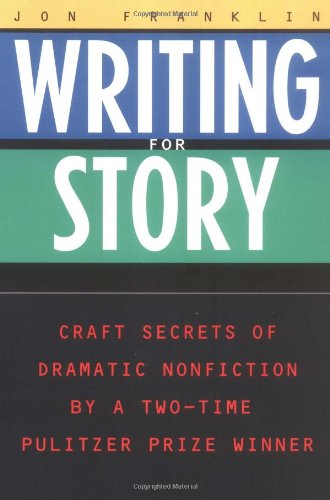
Another book you might consider (not that you have time if you’re going to get this book finished) is “Writing for Story” by Jon Franklin:
This a a very quick read, and I highly recommend it. There are a million books out there about writing, but this one gets straight to the point in a business-like manner and gives THE best advice about how to structure a non-fiction (or fiction) book. The author has won two Pulitzer prizes and uses his two winning pieces as examples – line by line – of how he structures a story.
This book is my bible. One day I was a ho-hum journalist writing mediocre stories. Then I read this book and the first story I wrote afterwards – following his guidelines – became a finalist for the Penn/Faulkner award. I don’t credit myself for this: I credit Jon Franklin and his book.
Jon Franklin’s book arrived last Monday and I’m already half-way through reading it. Wow, what a fantastic book. Because it sets out the power of the art of the short story, or more accurately, the power of the narrative non-fiction story. From page 23:
Then, in the ’60s, Truman Capote, a novelist, short-story writer, and playwright, performed a literary experiment that opened the way for a new kind of literature. Capote recognized and accepted the public’s growing interest in nonfiction but objected to the genre’s traditional dry style. What would happen, he asked, if a true story were told in the form of a novel.
If you go to Jon’s website, there’s a link to one of his short stories, Mrs. Kelly’s Monster, that is in the book. Do read it. Trust me, you will be impressed, enthralled and inspired.
So the logic and power of Jon’s argument slammed me full in the face. And, if you will forgive me, offered some comfort to this tyro author struggling with his first book; a nonfictional book. Because this approach of nonfiction drama resonated with me. For way back in the late 60s I had worked as a freelance journalist for a Finnish magazine, KotiPosti, writing about Finns all across Australia (long story in itself!) and much more by luck than anything else, had written stories in the style of a ‘true story told in the form of a novel.’
Moving on over 40 years, to when Jean and I were living in Payson, Arizona, we both attended a creative writing class held at the local college. One of my stories that came out of that class was published not so long ago on Learning from Dogs: Messages from the Night.
Which is all a long preamble to say that one of the many, many things that Jean and I share includes ‘putting pen to paper’ – story writing.
The following short story was also written by Jean when we were attending that writing course in Payson. Enjoy. I know you will.
ooOOoo
The Kiss
by
Jean Handover
She sat at the end of the bar. Her misery was palpable. An invisible shroud that hunched her shoulders and bent her head over the glass of wine. She peered into the pale liquid like it were a pool to drown in.
She was pretty in a faded way. Trying hard; skirt a little too short, blouse a little too low and blood red lipstick. Dark for a pinched mouth. A slim body the way I liked it! All around were drunken revellers whilst she remained in a bubble. I wanted to take her in my arms and crush her to my body and burst that bubble.
Hoisting my beer, I ambled to the stool beside her. She didn’t stir. Seemed unaware of my presence. I looked at our reflections in the mirror opposite. Then at Rose the barmaid. Rose of the buzzcut and tattoos. The tattoo on her neck. Then a small voice, “Why would anyone have lips tattooed on their neck?”
“Guess that’s where Rose likes to be kissed,” I said, taking a gulp of my beer and casting a glance in her direction.
“Yeah, that is a nice place for a kiss.”
She turned and a small smile twitched her lips. “I shouldn’t have come here. I’m not used to this scene,” she said.
“How long have you been divorced?” I asked.
“How can you tell I’m divorced?” she replied.
“Your ring finger has a wide indent.”
She fanned her fingers and looked. “Dead giveaway, isn’t it,” she wanely replied.
“What happened?” I asked.
“He came home one night and said he’d found someone else!”
“Younger woman?” I asked.
“No worse, a younger man!”
“Oops!” I said.
She swivelled in the stool and faced the crowd. The shroud was slipping perceptively. I finished my beer and beckoned for Rose to bring us another round. The divorcee was prettier that I thought at first. Her hand pushed a lock of hair behind an ear and trailed down her neck, then smoothing her skirt rested on a rounded knee. A fluid sensuous motion. I wanted to touch that hand.
“Oh God, no,” she gasped. Eyes large and face suddenly flushed. “It’s him with the boyfriend. They’ve just come in.”
“Don’t worry, Babe. Let’s just walk right past and get out of here.”
I took her hand and as we strolled past the two men I gently leaned over and kissed her on the neck. On the same place as Rose’s tattoo.
My lips lingered and with my arm around her waist, we drifted out into the night.
Just wanted to share some good news with you. Well, regarding Oregon’s wolves!
My so-called book has rather ground to a halt. Sturdy followers of this blog will recall that in November last year, I sat down and wrote the first draft of a book, under the umbrella of NaNoWriMo = write a minimum of a 50,000-word novel in the month of November. That I did write in excess of 50,000 words (53,704) in under thirty days felt a wonderful achievement.
But then reality set in!
I subscribed to a NaNoWriMo webinar on editing hosted by David Henry Sterry and Arielle Eckstut of The Book Doctors. To my horror, half-way through the webinar came the realisation that what I had written wasn’t even a fictional novel: It was a personal story on the theme of what dogs have taught me over a life of approaching 70 years.
So those 53,000 words had to be rewritten as non-fiction book!
The next boulder to cause me to fall was the issue of tense. The book had been written in the 3rd-person, as you can see from the draft of Chapter Twenty-Three. But the more that I thought about the story the more that it felt that it should be in the 1st-person; namely this first person! Reinforced by feedback from Jeannie and from reading Melinda Roth’s latest book Mestengo clearly written in the first-person.
Mestengo book cover.
Chapter One
I first smelled the smoke as I stood in the driveway of the farmhouse on the top of a hill in McHenry County in Northern Illinois that was, according to the man who leased it to me one month before, the highest point in all of Northern Illinois.
Damn, damn, damn! Now the rewrite not only has to go from fiction to non-fiction, it also has to change the tense from ‘Philip’ to ‘Paul’; from him to me! The words from The Book Doctors seminar rang louder and louder, “You write the first draft for yourself; you edit it for your readers!” (Smart arses!)
Then along came hope in the form of Kami Garcia, the author. It was a NaNoWriMo pep talk.
So you made it through NaNoWriMo, and you have 50,000 words… Now what? It’s the same question a lot of writers face when they finish a first draft. The good news is you finished the hard part: you have a draft.
I can hear some of you cursing me now: “But Kami, my first draft is totally crappy and worthless. It’s terrible. I wasted an entire month of my life, and all I have 50,000 terrible words to show for it.”
My answer: It doesn’t matter if you wrote the crappiest first draft in the history of all first drafts. You have something to work with, which means you can fix it, mold it, and bang it into whatever shape you want. Here are a few tips to get started:
Read Your First Draft (and Possibly Cry a Little)
After you put away the pint of ice cream and the tissues, take an objective look at your draft. What are the strongest points? The parts that kept you reading? Whether you print out your draft to make notes or use software (I love Scrivener), mark the best bits—circle, highlight, whatever works for you. These are the parts you’ll re-read whenever you start to lose hope (which will be often).
All of which is a long-winded way of me saying that I shouldn’t be spending time writing blog posts but have my head down in the big edit.
But, hey, already come this far so going to leave you with this wonderful news.
ooOOoo
Hello Paul,
Good news: For the first time since 2009, the Oregon Department of Fish & Wildlife has confirmed wolves south of the Eagle Cap Wilderness!
Based on recent evidence, it’s clear that at least five wolves are frequenting an area in Northern Baker County. It may not be a story as epic as Journey’s, but it’s another good sign wolves are continuing to retake their rightful place on the Oregon landscape.
Those of you who have been tracking wolf issues for a long time, may remember the iconic photo of a scraggly Oregon wolf in sagebrush. The young wolf and his partner frequented an area near the Keating Valley in Baker County.
Sadly, the “Keating Wolves”, as they came to be known, were killed in 2009. Despite some tantalizing reports, since that time, only one Oregon wolf is known south of the Wallowas.
Later today, we’ll revisit the story of the Keating Wolves on the Oregon Wild Blog and post it on the Oregon Wolves Facebook page. Wolf recovery still has a long ways to go. But today’s news is significant.
Since 2009 – with your help – we’ve stopped round after round of wolf kill bills in Salem. We’ve stood up for wolves in court. We’ve worked with responsible ranchers. We’ve educated the public, highlighted the positive impacts of having wolves back on the landscape, and shared news – good and bad – of wolf recovery.
Things are far from perfect. Old prejudices die hard and wolves continue to be at the center of a campaign of misinformation and fear. The Obama administration is stubbornly pushing a scheme to strip wolves of important protections, and the state can still kill wolves on behalf of the livestock industry.
But today’s news is a sign that we’re headed in the right direction here in Oregon. And there should be more on the horizon. Wolves are mating, pups should be on their way, and Oregon will announce an updated wolf population estimate soon. That’s more news we look forward to sharing.
For wolves and wildlife, Rob Klavins Wildlife Advocate, Oregon Wild
There are things that are beyond rational explanation.
Warning – this post is rather more ‘touchy-feely’ than you are used to seeing on Learning from Dogs. So if it wanders about in ways that you struggle to follow then just stifle your yawn and come back tomorrow!
It goes back to an earlier plan that I had in terms for a couple of posts. Both focussing on the myriad of examples of the appalling decline in our world. I had been collecting a number of essays to support the proposition that if we don’t learn from dogs the qualities of integrity and unconditional love then our world was doomed. I had collected the essay from Ellen Cantaro over on TomDispatch about the incredible stupidity of fracking. Or the one from Tom’s own pen in an essay about climate change being the new ‘Anti-News’. I had saved the recent essay from George Monbiot discussing the madness of the so-called dredging practices in the UK’s Somerset Levels. I had fumed at another George Monbiot essay Bring It On that included this incredible statement:
It is hard to think of a more serious allegation. For six months an undercover officer working for the Metropolitan Police was instrumental in planning a major demonstration, which ended up causing injuries and serious damage to property. Yet the police appear to have failed to pass this intelligence to the City of London force, leaving the target of the protest unprotected.
I had many more examples but you get the message!
So what stopped me?
I was chatting to Jon Lavin on Monday about a variety of things. Jon asked how the book was coming along. I replied by saying that a recent NaNoWriMo webinar had persuaded me that the book wasn’t a novel and should be re-written as a non-fiction story. Going on to add that I might include some of the appalling examples of what was going wrong in our society to strengthen the argument that we truly have much to learn from dogs.
Jon, who had read the first, very rough draft of the book that appeared on this blog, cautioned me against doing that. He went on to say that in the world of solutions focussed therapy, the area that Jon practices in professionally, the way forward was always to focus “on what’s working“. Jon continued by saying that while one would initially allow the problems to be voiced, this negativity would always be a tiny piece of the overall process, say less than 5% of the session. That even if a client’s whole world seemed to be failing, there would always be something that was alright, always a 1% that was working, and that would be the place to start. A quick web search endorsed that as the website of Good Therapy revealed, from where I read:
Solution focused brief therapy (SFBT) targets the desired outcome of therapy as a solution rather than focusing on the symptoms or issues that brought someone to therapy. This technique only gives attention to the present and the future desires of the client, rather than focusing on the past experiences. The therapist encourages the client to imagine their future as they want it to be and then the therapist and client collaborate on a series of steps to achieve that goal. This form of therapy involves reviewing and dissecting the client’s vision, and determining what skills, resources, and abilities the client will develop and use to attain his desired outcome. Solution focused therapy was developed by Steve De Shazer, Insoo Kim Berg, and their team at the Brief Family Therapy Family Center in Milwaukee, USA.
Thus coming back to the book rewrite, Jon said that people wanted to read ‘good news’ not negativity. It was a key reminder for me and an incredibly inspiring call that in these challenging times, whether on this blog or in a potential book, I need to write about all the powerfully, positive lessons that dogs, and all warm-blooded creatures, offer mankind. The lessons of integrity, love, trust, balance, loyalty, faithfulness, affection, forgiveness and more.
OK, moving on.
On the evening of February 7th Jean and I settled down to watch a YouTube video. It had been featured in a post from LadyBlueRose that had been published on the 6th. The post was called His Name is Spirit and it was the story of a woman, Anna Breytenbach, who has dedicated her life to what she calls interspecies communication.
We had reached the six-minute point in the film, already captivated by it, when the telephone rang. I paused the film and answered the phone. It was neighbour Dordie from next door ringing to say that when she had seen us earlier in the day she had forgotten to mention that there was this incredible film that we really had to watch …… yes, you guessed it! The film that Jean and I were watching at that moment.
Here is that film.
Now here is Anna’s website Animal Spirit where one learns:
ENHANCING THE RELATIONSHIP BETWEEN HUMANS, OTHER ANIMALS AND THE NATURAL WORLD
Welcome to an exploration of interspecies communication – a journey of discovering ways to restore a deep relationship with all of life.
Human and animal communication creates a valuable bridge between human and non-human animals. By connecting with our intuition, we can engage in meaningful dialogue and remember how to hear the subtle messages from those whose space we share in our lives and our natural environment. Coming from a place of respect and reverence for all life, we can learn to understand our wilder relatives, honour their truths and live in greater harmony.
and where one also can watch the short introductory film that is on her home page; as below.
A web search then came across a fascinating interview with Anna.
So where does this all end up?
Simply, that in a world dominated by media of all types that favour ‘doom and gloom’ it can be incredibly difficult to hang on to the message offered by Jon and by Anna, and by many others no doubt, the message that our individual health, and by implication the health of this planet, is afforded through staying positive.
Or put more basically, if you are feeling low go and hug a dog! So I can do no better than to close with the same picture that closed Tuesday’s post Meet the dogs – Dhalia.
In yesterday’s post about meeting Dhalia, I spoke about a story that was written three years ago. It was the Summer of 2011 and Jean and I had signed up to a Creative Writing course that was being run at our local college in Payson, Arizona where we were then living. This story was a course exercise. While it was published a couple of years ago on Learning from Dogs the fabulous response to the Meet the dogs – Dhalia post yesterday merits it being offered to you, dear reader, for a second time.
The story is fictional. However, the idea for the story was triggered by an event when we were living in Payson, AZ when Dhalia did run off and was lost for a couple of hours, thankfully finding her own way back to the house. Thus while the event did not take place, the location and names of all concerned are real! The photographs are genuine and selected because they seemed so apt for the story, fictional or otherwise. Hope you enjoy!
ooOOoo
Messages from the Night
by
Paul Handover
Dhalia heads for the hills!
“Jean, where’s Dhalia?”
“Don’t know. She was here just moments ago.”
“Jeannie, you take the other dogs back to the car and I’ll go and scout around for her. Oh, and you better put Pharaoh on the leash otherwise you know he’ll follow me.”
“Paul, don’t worry, Dhalia’s always chasing scents; bet she beats us back to the car. Especially as it’s going to be dark soon.”
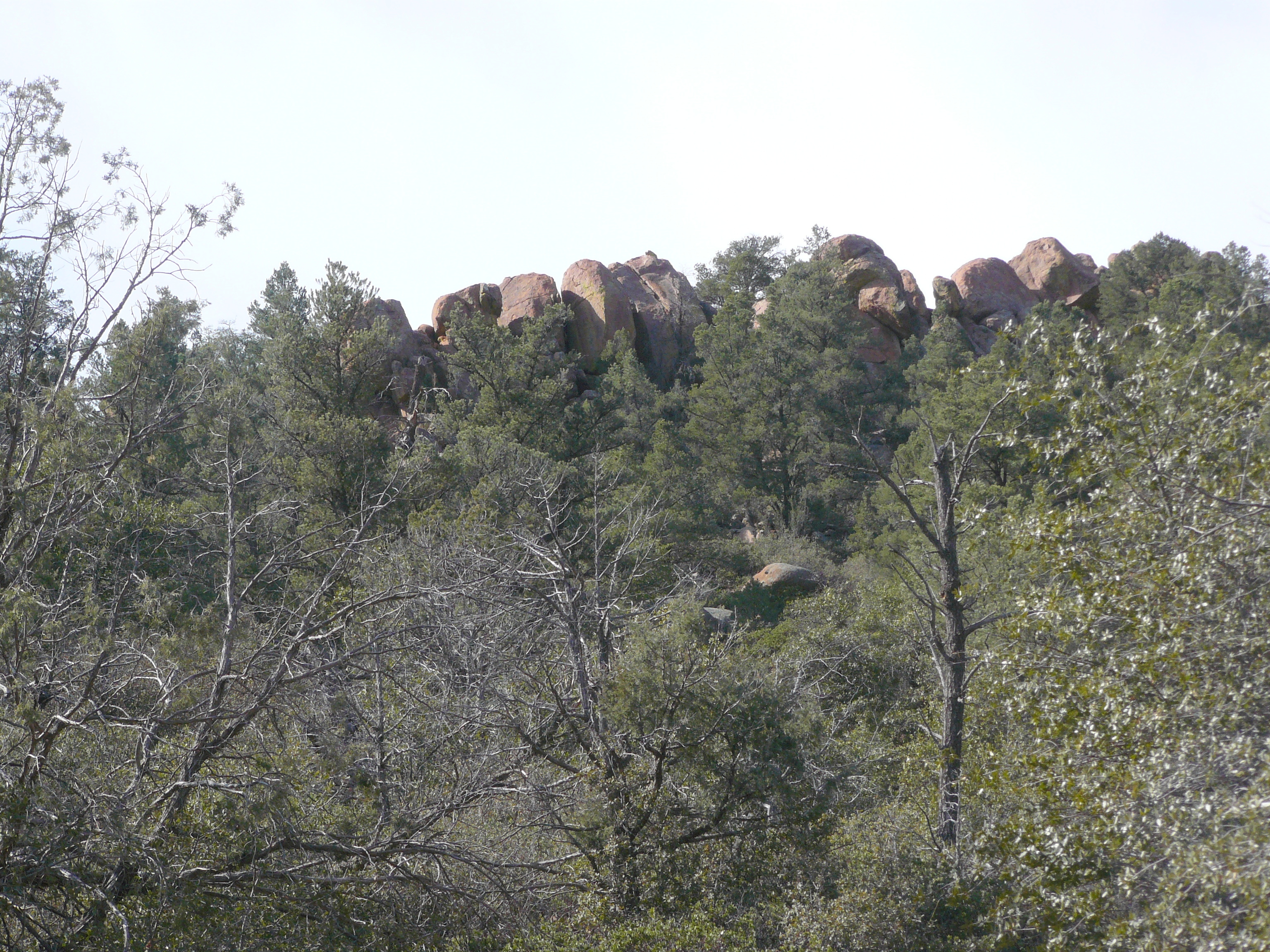
Nonetheless, he started back down the dusty, dirt road, the last rays of the sun pink on the high, tumbled cliffs of granite. This high rocky, forest plateau, known as the Granite Dells, just three miles from their home on the outskirts of Payson, made perfect dog-walking country and rarely did they miss an afternoon out here. However this afternoon, for reasons he was unclear about, they had left home much later than usual.
There was no sign of Dhalia ahead on the road so he struck off left, hoping she was somewhere up amongst the trees and the high boulders. Soon he reached the first crest, panting hard in the thin air. Behind him, across the breath-taking landscape, the setting sun had dipped beneath faraway mountain ridges; a magnificent sight. Suddenly, in the midst of that brief pause admiring this perfect evening, a sound echoed around the cliffs. The sound of a dog barking. He bet his life on that being Dhalia. Just as quickly the barking stopped.
Challenging walking country.
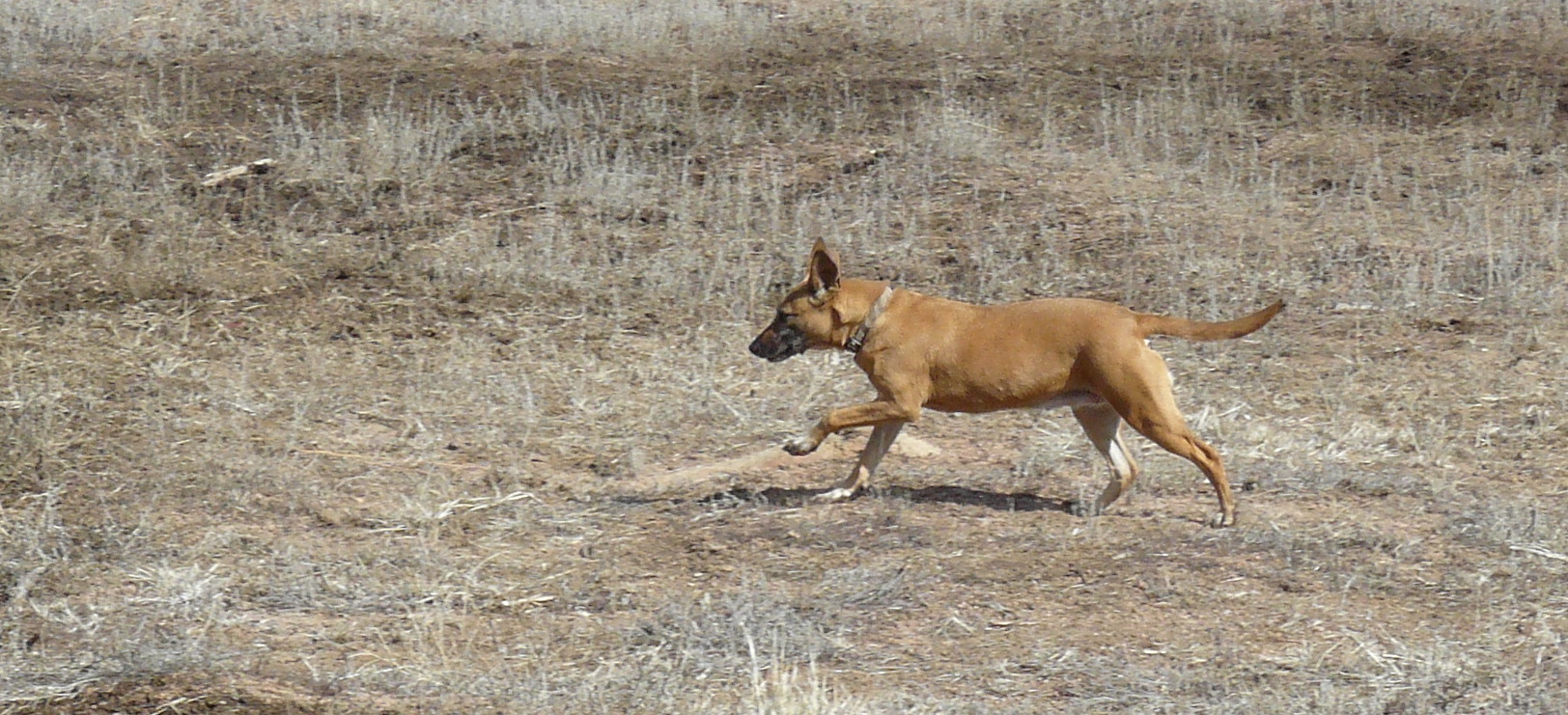
The barking started up again, barking that suggested Dhalia was hunting something. The sound came from an area of boulders way up above the pine trees on the other side of the small valley ahead of him. Perhaps, Dhalia had trapped herself. More likely, he reflected, swept up in the evening scents of the wilderness, Dhalia had temporarily reverted back to the wild, hunting dog she had been all those years ago. That feral Mexican street dog who in 2005 had tentatively turned away from scavenging in a pile of rubbish in a dirty Mexican town and shyly approached Jean. An approach that forever more changed the futures for both the dog and Jean. Jean had named her Dhalia.
He set off down to the valley floor and after fifteen minutes of hard climbing had reached the high boulders on the far side.
He whistled, then called “Dhalia! Dhalia! Come, there’s a good girl.” Thank goodness for such a sweet, obedient dog. He anticipated the sound of dog feet scampering through rough undergrowth. But no sound came.
He listened so intently. There were no sounds, no more barking. Where oh where had she gone? Perhaps past these boulders down in the next steep ravine beyond him, the one so densely forested with pine trees. With daylight practically gone he needed to find Dhalia soon.
He plunged down the slope, through tree branches that whipped across his face, then fell heavily as his foot found empty space instead of the expected firm ground. He cursed, picked himself up and paused. That fall had a message. The madness of continuing this search in the near dark. This terrain made very rough going even in daylight. At night, the boulders and plunging ravines would guarantee a busted body, at best! Plus, he ruefully admitted, he didn’t have a clue about finding his way back to the road from wherever he now was!
The unavoidable truth smacked him full in the face. He would be spending this night alone in the high, open forest. It had one hell of a very scary dimension.
He forced himself not to dwell on just how scary it all felt. He needed to stay busy, find some way of keeping warm; last night at home it had dropped to within a few degrees of freezing. He looked around, seeing a possible solution. He broke a small branch off a nearby mesquite tree and made a crude brush with which he swept up the fallen pine needles he saw everywhere about him. Soon he had a large stack of needles sufficient to cover him, or so he hoped. Thank goodness that when he and Jeannie had decided to give the four dogs this late afternoon walk, he was wearing jeans and a long-sleeved shirt, a pullover thrown over his shoulders. Didn’t make Dhalia’s antics any less frustrating but he probably wasn’t going to freeze to death!
He lay down, shuffled about, swept the pine needles across his body, tried to find a position that carried some illusion of comfort. The air temperature was sinking as if connected to those last rays of the sun. His confidence was sinking in harmony with the temperature. The isolation and loneliness of his predicament was enveloping him like some evil, dark cloud.
No matter the physical position that he adopted with his body, he couldn’t silence his mind. He couldn’t silence the screaming in his head; his deep, primeval fear of this dark forest about him, imagination already running away with visions of hostile night creatures, large and small, watching him, smelling him, biding their time. Perhaps he might sleep for a while and give his imagination a rest? A moment later he was struck by the absurdity of that last thought. Caused him to utter aloud, “You stupid old fool. There’s no way you’re going to sleep through this!” His words echoed back from unseen cliffs nearby in the darkness reinforcing his sense of isolation.
He was very frightened. Why so? Where in his psyche did that come from? He had spent many nights alone at sea without a problem; solo sailing a thousand miles from shore. But, of course, then he knew his location, always had a radio link to the outside world. Being lost in this dark, lonely forest touched something very deep in him. He started shivering.
The slightest movement caused the needles to slip from him and the cold night air began to penetrate his body. He mused about how cold it might get and, by extension, thanked his lucky stars that the night was early October not, say, mid-December. So far, not too cold. But soon it was the fear rather than the temperature that started to devour him. What stupid fool said, ‘Nothing to fear but fear itself!’ His plan to sleep under pine needles, fear or no fear, had failed; he couldn’t get warm. He had to move.
He looked around, faintly saw a boulder a few yards away, like some giant, black shadow. No details, just this huge outline etched against the night. He carefully raised himself, felt the remaining needles fall away from him, and gingerly shuffled across to the dark rock. He half-expected something to bite his extended hand as he explored the surface, ran his fingers down towards the unseen ground. Miracle of miracles, the granite gently emitted the warmth absorbed from the day’s sun. He slowly settled himself to the ground, eased his back against the rock-face, pulled his knees up to his chest and wrapped his arms around his legs. He felt a great deal less vulnerable than he had when laying on the forest floor and let out a long sigh. Moments later he burst into tears, huge heart-rending sobs coming from deep within him.
Gradually the tears washed away his fear, restored a calmer part of his brain. That calmer brain brought him the realisation that he hadn’t considered, well not up until now, what Jeannie must be going through. At least he knew he was alive. Jeannie, not knowing, would be in despair. He bet she would remember that time when out walking here in this area of the Granite Dells they had lost little Poppy, her adorable 10 lb poodle mix, never to be found again despite ages spent combing the area, calling out her name. A year later and Jeannie still said from time to time, “I so miss Poppy!”. First Poppy and now him! No question, he had to get through this in one piece, mentally as much as physically. Presumably, Jeannie would have called 911 and been connected to the local search and rescue unit. Would they search for him in the dark? He thought that unlikely.
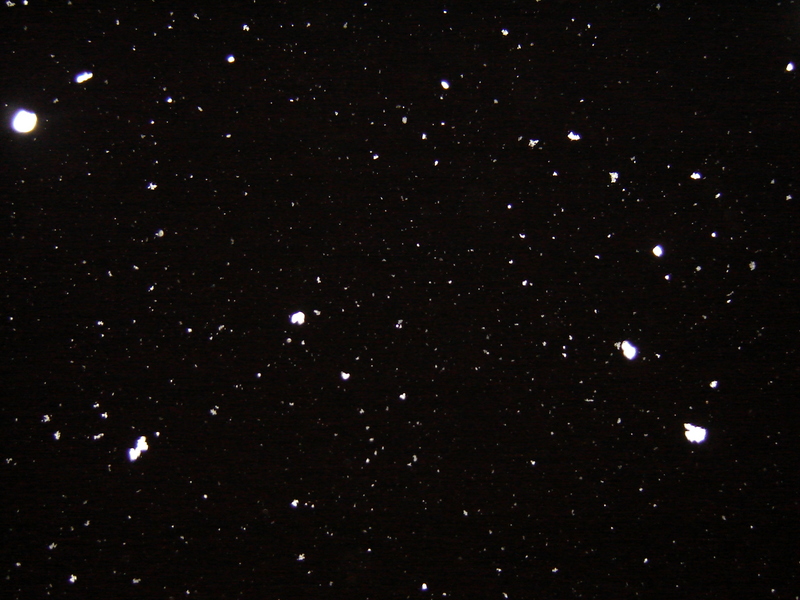
Thinking about Jean further eased his state of mind and at last his shivering stopped. Thank goodness for that! He fought to retain this new perspective. He would make it through, even treasure this night under the sky. This wonderful, awesome, night sky. Even the many crowns of the majestic pine trees that soared way up above him couldn’t mask a sky that just glittered with starlight. The Granite Dells, just outside Payson, were at an elevation of 5,000 feet and, frequently, had beautifully clear skies. Tonight offered a magical example of that.
A heavenly clock.
Often during his life the night skies had spoken to him, presented him with a reminder of the continuum of the universe. On this night, however, he felt more humbled by the hundred, million stars surrounding him than he could ever previously recall.
Time slipped by, his wrist-watch unread in the darkness. Above his head, however, was that vast stellar clock. He scanned the heavens, seeking out familiar pinpoints of light, companions over so much of his lifetime. Ah, yes! There was the Big Dipper; Ursa Major to give the constellation its formal name, and there the Big Dipper pointing the way to Polaris, the star that was so closely aligned to North Pole. Great! Now the rotation of the planet became his watch, the Big Dipper circling around Polaris, fifteen degrees for each hour.
What a situation he had got himself into. As with other challenging times in his life, lost in the Australian bush, at sea hunkering down through a severe storm, there was never a choice other than to work it out. He felt a gush of warm emotions that flowed from this changed perspective.
Far away, a group of coyotes started up a howl. What a timeless sound. How long had coyotes been on the planet? He sank into those inner places of his mind noting how the intense darkness raised such deep thoughts. What if this night heralded the end of his life, the last few hours of the life of Paul Handover? What parting message would he give to those that he loved?
Jeannie would know beyond any doubt how much he had adored her, how her love had created an emotional paradise for him beyond measure. Then his son and daughter, dear Alex and Maija. Oh, the complexities he had created in their lives by leaving their mother so many years ago. He knew that they still harboured raw edges, and quite reasonably so. He still possessed raw edges from his father’s death, way back in 1956. That sudden death, five days before Christmas, so soon after he had turned 12, that had fed a life-long feeling of emotional rejection. That feeling that had lasted for 51 years until, coincidentally, also five days before Christmas, he had met Jean in 2007.
His thoughts returned to Alex and Maija. Did they know, without a scintilla of doubt, that he loved them. Maybe his thoughts would find them. Romantic nonsense? Who knows! Dogs had the ability to read the minds of humans, often from far out of visual range. He knew Pharaoh, his devoted German Shepherd, skilfully read his mind.
He struggled to remember that saying from James Thurber. What was it now? Something about men striving to understand themselves before they die. Would that be his parting message for Alex and Maija? Blast, he wished he could remember stuff more clearly these days and let go of worrying about the quote. Perhaps his subconscious might carry the memory back to him.
He looked back up into the heavens. The Big Dipper indicated at least an hour had slipped by. Gracious, what a night sky in which to lose one’s mind. Lost in that great cathedral of stars. Then, as if through some stirring of his consciousness, that Thurber saying did come back to him: All men should strive to learn before they die, what they are running from, and to, and why. As last words they would most certainly do for Alex and Maija!
He reflected on those who, incarcerated in solitary confinement, had their minds play many tricks, especially when it came to gauging time. What a bizarre oddment of information to pop up in his head! Where had that come from? Possibly because he hadn’t a clue about his present time. It felt later than 11pm and earlier than 4am, but any closer guess seemed impossible. Nevertheless, from out of these terrible, heart-wrenching hours of being alone he found his calm, a calm that had gently arisen from within. He slept.
Suddenly, a sound slammed him awake. Something had made a sound. Something out there in the dark had made a sound fairly close to him. Now his whole body was totally alert, every nerve straining to identify what might be out there, so close to him. It sounded like animal feet moving through the autumn fall of dead leaves. He prayed it wasn’t a mountain lion. Surely such a wild cat preparing to attack him would be silent. Now the unknown creature had definitely paused, no sound, just him knowing that out there something waited. Now what? The creature had started sniffing. He hoped it was not a wild pig. Javelinas, those pig-like creatures that always moved in groups, could make trouble. He knew they had no qualms at attacking a decent-sized dog and crouched down like this he didn’t offer a much larger target.
Should he get to his feet and run? Almost immediately he answered his own question. In the dark and in this terrain he would harm himself within seconds and that would make him an attractive meal for any meat-eating animal out there. No, he chose to stay still. Feeling the ground around him he closed his right-hand around a small rock. The sniffing stopped. Nothing now, save the sound of his rapid, beating heart. He sensed, sensed strongly, the creature looking directly at him. It seemed very close; perhaps ten or twenty feet away. The adrenalin hammered through his veins.
He tried to focus on the spot where he sensed that the animal waited trying not to think what it might be waiting for. He pushed that line of thought straight out of his head. His ears then picked up a weird, bizarre sound. A flap, flap sound against something like the trunk of a small tree. Surely not! Had he lost his senses? It sounded like a dog wagging its tail. A dog’s tail flap, flap, flapping against a tree-trunk. If it was a dog, it just had to be Dhalia!
Then came that small, shy bark! A bark that he knew so well. Unbelievably, it was Dhalia. He softly called, “Dhalia, Dhalia, come here, there’s a good girl.”
With a quick rustle of feet Dhalia leapt upon him, her tail wagging furiously, her head quickly burrowing into his body warmth. He hugged her and, once more, tears streamed down his face. Despite the darkness, he could see her perfectly in his mind. Her tight, short-haired coat of light-brown hair, her aquiline face, her bright inquisitive eyes and those wonderful head-dominating ears. Lovely large ears that seemed to listen to the world. A shy, loving dog when Jean had rescued her in 2005 and all these years later still a shy, loving dog.
Dhalia licked his tears, her gentle tongue soft and sweet on his skin. He shuffled more onto his back which allowed her to curl up against his chest, still enveloped by his arms. His mind drifted away to an era immensely long ago. Back to an earlier ancient man, likewise wrapped around his dog under a dome of stars, likewise bonded in a thousand mysterious ways. He was unaware of slipping into a deep sleep.
The morning sun arrived as imperceptibly as an angel’s sigh. Dhalia sensed the dawn before Paul, bringing him out of his dreams by the slight stirring of her warm, gentle body.
Yes, there it came, the end of this night. That sun, ancient beyond imagination, galloping towards them across the desert lands; another beat of the planet’s heart. Dhalia slid off his chest, stretched herself from nose to tail, yawned and looked at him, as much to say it’s time to go home! He could just make out the face of his watch: 4.55am. He, too, raised himself, slapped his arms around his body to get some circulation going. The cold air stung his face, yet it couldn’t even scratch the inner warmth of his body, the gift from the loving embrace that he and Dhalia had shared.
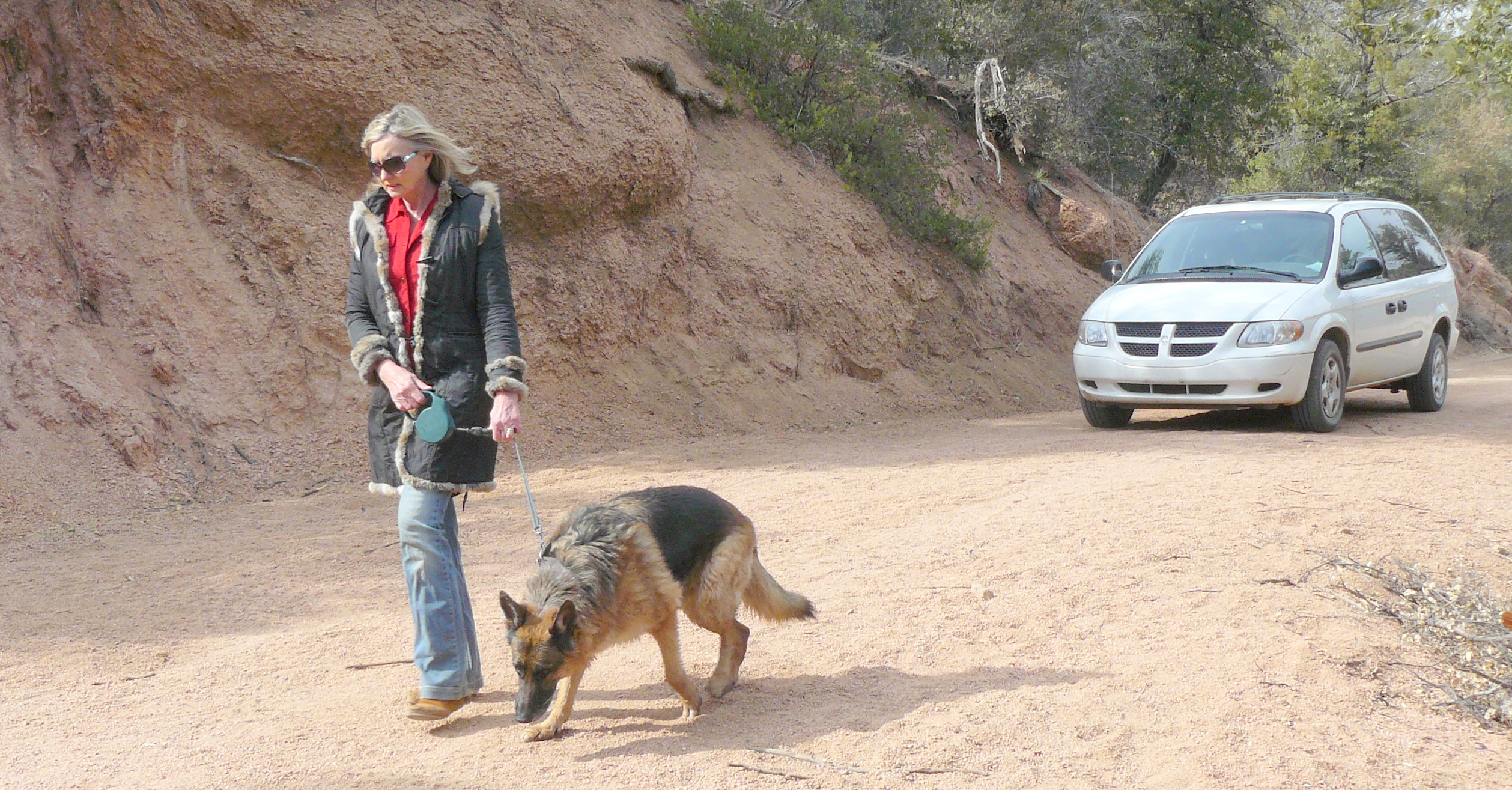
They set off and quickly crested the first ridge. Ahead, about a mile away, they saw the forest road busy with arriving search and rescue trucks. Paul noticed Jean’s Dodge parked ahead of the trucks and instinctively knew she and Pharaoh had already disappeared into the forest; undoubtedly Pharaoh sensing the way to them.
Pharaoh and Jean heading up the search.
They set off down the slope, Dhalia’s tail wagging with unbounded excitement, Paul ready to start shouting for attention from the next ridge. They were about to scrabble across a small, dry creek-bed when, across from them, Pharaoh raced out of the trees. He raced up to them, barking at the top of his voice in clear dog speak, ‘I’ve found them, I’ve found them, they’re safe, they’re safe’. Paul crouched down to receive his second huge face lick in less than six hours.
Later, when safely home, it came to him. When they had set off in that early morning light to return back to civilisation, Dhalia had stayed utterly pinned to him. It was so out-of-character for her not to run off ahead. Let’s face it, that’s what got them into the mess in the first place. What came to him was that Dhalia had known that during that long, dark night, it had been he who had been the lost soul.
The message from the night, as clear as the rays of the new day’s sun, the message to pass to all those he loved. If you don’t get lost, there’s a chance you may never be found.
There have been previous tales in this series of meeting our dogs. Firstly, Paloma and then Lilly. Now comes Jean’s story about how she found Dhalia.
ooOOoo
Dhalia
Dhalia – domesticated but still the wild dog shows through.
It was a Sunday around the middle of the month of September in the year 2005. My friend, Gwen, and I had set off for La Manga, a small fishing village three miles from San Carlos, Mexico. As the trip would take us through areas of desolate desert and the day was forecast to be a sizzler, we left early. The purpose of the journey was to feed a pack of dogs that were living on the outskirts of La Manga. These wild dogs were gradually getting used to our presence and with the aid of a humane trap we had previously caught two of them, a small puppy and her mother. Those two dogs were at my home and were gradually becoming tame so that good homes could be found for them.
Half-way to our destination, we saw two dogs running by the side of the road. It wasn’t unusual to see strays searching for road-kill. I stopped the car and prepared food and water for them. One dog took off almost immediately but the other just stood perfectly still looking intently at me. She was rail-thin and full of mange. Her ears and chest were scabbed with blood, and I could see that previously she had had pups. Tentatively, I pushed the food towards her. She took a bite and sat on her haunches; her eyes never leaving mine. Then she lifted a paw and reached out to me. Immediately, I burst into tears and scooped her into my arms. I carried her back to the car where she lay quietly in my lap whilst we went on to do our feeding. She was bloody and very smelly. However, I didn’t care.
I named her Dhalia and after treatments for mange she became quite beautiful. She was the pivotal part of a short story Paul wrote back in 2011. [Ed: see note] Under her sweet exterior remains that same will to survive so evident when I rescued her all those years ago. There has been more than one occasion that she has brought me a recently killed squirrel or an ancient bone. We love our Dhalia: she still reaches out with her front paw when she seeks attention. Dhalia will be ten-years-old this year.
Love and Trust – Grandson Morten hugging Dhalia, September 2013.
ooOOoo
NB: Tomorrow, I will publish the short story written three years ago Messages from the Night. Next week another account from Jean about one of our family members.
On the 24th January this year, I published a post called 20:20 self-awareness. To save you clicking the link and returning to that post, the essence was speaking clearly; not only to others but to ourselves. I quoted George Bernard Shaw, “The single biggest problem in communication is the illusion that it has taken place.”
Then went on to write:
Yet, what we hear and what we say are both modified, frequently unconsciously, by past events, experiences and trauma. That being the case, then it is key, critically so, that we achieve the best possible self-awareness. Because it is only through an understanding of our past that we come to learn of our sensitivities and our associated ‘tender spots’ and their potential for ‘pulling our strings’.
Closing the post by including a twenty-minute, documentary film about fear. (Here it is again for those that missed it.)
One of the comments to that post was from Sue who writes the blog Dreamwalker’s Sanctuary. (It’s a beautiful blog, by the way.)
This was the comment left by Sue.
Fear is inherent in us all for that Flight or Fight mode.. But the F word has now been used and abused as it has been used as a useful tool .. Self awareness comes when we wake up to what our world is generating and we have a choice. We can allow ourselves to get embroiled within the Fear.. Or we can see it for what it is and who and what is creating that fear and why?…. Once that awareness kicks in we can see there is nothing to Fear but Fear itself… Living in the Now of a moment prevents us also from fearing the future, and fearing what has passed..
Easier said than done, I guarantee you .. But once you can get your head around it all… We breathe deeper and evenly and let all fear go… ( I am still working on this, I am not perfect by any means ) for as your video states its been ingrained within us for so long we know no other way, and we are a creature of habit!..
Thought provoking post, Paul thank you
Sue then pointed me to one of her essays, that I have the great pleasure of republishing today.
ooOOoo
Do You Chose Love Over Fear?
One Love Heart.
Remember those Prophesies of “2012”? I posted many of my thoughts upon this timeline which I thought was to mark the end of one era and the beginning of the Next – Maybe those ancients teachers didn’t know whether we would rise or fall as they marked the end of their calendar.
Maybe that fate awaits us still depending upon our choices we make in the Now dependant upon our Next actions! But as we read through those teachings of ancient prophecy you will see also they speak of transformation. Transformation requires Change, and we are being urged now to Think! Think outside our boxes as our comfort zones are now being tweaked as we become ever more sensitive to the Energy Shifts within our World.
Whether we realise it or not we are incarnated with a ‘Soul Mission’ even though we caught amnesia after we were born. But more and more of us are thankfully waking up as we begin to remember who we are. It may have taken many life times and lessons to align with our present purpose as we pass through various stages on our journey, often not understanding the reasons for painful events and experiences. It isn’t until later that we look back and see the gifts and healing which were given to us and that through them we learn to grow, letting go of the past as we step into the Now.
Giving Birth is not without pain, and our new earth is only now going through her own birthing pains. We see it in the spasms of conflict, the wars, hunger, poverty, displacement of refugees and the destruction through pollution of Mother nature. Pains which are now being experienced which we humans have carried with us over many life times. Pains that emerge as a build-up of our Fear and Prejudices.
The choices are simple: we either choose Fear or Love.
Even while writing this a sense of peace has swept over me as I smile to myself. I recently read an article which said “…we incarnate with these wounds and at a soul-level choose to encounter those whose actions catalyse us to resolve and heal our soul wounding“. That made me smile even wider as I have long held the belief that our enemies are our greatest teachers helping serve our soul’s growth as we learn the various lessons such as patience, kindness, love, forgiveness, and compassion.
We are each of us now experiencing shifts in our emotions and lives, as we feel the ‘Shift’ in energy within our Mother Earth who is calling us to wake up and remember who we are; as our vibrations alter.
When I first started my blog back in 2007 I stumbled almost by accident to the opening post. But it was no accident! In fact my very first post was an experiment called Smile. I wanted to make a difference even if it was only through the words of a poem.
As we ‘Lighten Up’, letting go of what we no longer need, we lift our vibration higher; as we leave behind the wounds of the past. We are Energy Beings – and it’s time now to realise we each are a part of the Whole, that Oneness that permeates all things with the same Energy.
We are now ‘Shifting’ from duality to Unity Consciousness. This was brought home again to me on how many of us are thinking similar thoughts even here on WordPress. We see similar themes as we link into the Mass Consciousness, as we join together our thoughts, as we link subconsciously to the Cosmic web of thoughts.
We need to be aware of the Power of our thoughts and how we can assist in raising our planet’s vibration and our own collective Consciousness.
Much has been spoken upon The Ascension. First we need to ascend through our own layers as we climb ever higher, leaving behind the things that no longer serve us.
We do that by not getting swept up in conflict, by being more loving and tolerant, by being compassionate rather than being judgmental holding hate and anger.
We need to put the Care back in the world. If we embrace and choose Love over fear and stop looking who to blame but start to set examples of living in harmony and unity, then the true magnificence of who we really are can begin to manifest that ‘Golden Age’ that was once prophesied to bring about Peace.
It is up to each one of us to pledge to change our own lives, because only that way will those prophesies come to fruition.
We interrupt your life to bring you a moment of beauty, part two.
Last week I published the first set of pictures sent across by John Hurlburt. Here is the second set (but do look at the postscript).
oooo
oooo
oooo
oooo
oooo
oooo
oooo
oooo
oooo
oooo
Now a bonus.
I was reading Naked Capitalism earlier on Saturday and came across the link to a story in Huffington Post about a young man who jumped into a swollen river in Bangladesh to rescue a young fawn in danger of being swept away to it’s death. This how that story opens:
Courageous Teen Risks His Life To Save Drowning Baby Deer
This is pretty incredible.
A wildlife photographer visiting Noakhali, Bangladesh, was able to witness — and document — an amazingly courageous teen risk his own life to save a drowning fawn, Caters News Service reports.
The boy waded into the fast current of a surging, swollen river in Noakhali, holding the deer above his head, even as he, himself, disappeared beneath the water at times.
The link in the last sentence takes you to the article as it appeared in The Daily Mail newspaper (online version).
Two of the photographs from that article.
PIC FROM HASIB WAHAB / CATERS NEWS (Pictured: DEER RETURNED SAFELY) – A brave boy fearlessly risked his own life – to save a helpless baby deer from drowning. The boy, believed to be in his early teens, defiantly held the young fawn in one hand above his head as he plunged through the surging river. During the ordeal onlookers were unsure whether the boy was going to appear again. When he finally made it to the other side the locals cheered as the deer was reunited with its family. The incident took place in Noakhali, Bangladesh, when the young fawn became separated from its family during torrential rain and fast-rising floods.
oooo
PIC FROM HASIB WAHAB / CATERS NEWS (Pictured: DEER)
OK, I know I have a tendency to get a little sentimental but here’s my closing thought. That is that while there are people in the world such as young Belal who will not hesitate to rescue a vulnerable creature then there’s hope for all of mankind.
It’s fair to say that today’s guest author writes about a topic as far removed from yesterday’s eloquent post as one could imagine. Readers will recall that yesterday’s post from Georgiana was on the subject of Man’s best Friend. It was called Just love.
Today’s guest post is all about dog fences! As I said very different from Georgiana’s essay. Yet there is a link. Both guest posts are about dogs.
About a month ago, I received an email from a Rohit Agarwal offering to write “a well written and resourceful article on topic related to dogs.” When I discovered that the article was about underground fences, I was sceptical about the value of such an essay. Then when I read the essay it struck me as a very sensible topic; the one of keeping dogs safely within their own property.
I had no foreknowledge of Rohit, who described himself thus:
Author Bio: Rohit is a dog lover and pet enthusiast; he owns two adorable and wonderful dogs that include a German shepherd and a Labrador retriever. As work keeps him away from home, concerns arise about the safety and comfort of his pet friends, which made him try out various products that facilitate the same. Recently he was worried about leaving his dogs in the yard of his house and tried the underground fence for dogs, which worked great.
Rohit also made clear that he is a contributor to Petstek.com, the company behind the link in the last sentence of his bio. So here is the article.
ooOOoo
Five Reasons Why an Underground Fence is Right for Your Dog.
Most of us love the company of a cuddly and playful dog, as dogs are the considered to be the best pets since their very existence. While it’s great to keep the friendly and loyal canines in your house, one often needs to take care of the dog and protect them from their surroundings while still making sure that the dog gets adequate freedom within your house’s boundaries without it feeling like it has been incarcerated in a concrete prison. We all have tried using leashes, chains and cages, but we know that those methods to contain are not only old fashioned but also to a certain degree, inhuman, especially for the dog that is so friendly and loyal to you. Modern technology today has brought forth a new revolutionary technology called in-ground or underground fence for dogs.
The underground dog fence is a virtual fence which is installed using a special wire that is buried according to the perimeter you want to set for your pet. The wire is coded with signals, and a special collar is worn by the dog, as soon as the dog approaches the buried wire, the collar around its neck makes a warning signal, and as soon as the dog gets too close to the virtual fence, it receives a minor electric shock via the collar which is technically harmless to the pet. Let’s discuss the advantages of installing this system.
1. Freedom To The Dog
Well, we like to have our pets without leashes or chain bound, and we’re sure that no one gets a dog to keep it chained all the time, the underground fence not only provides the dogs adequate freedom of movement but also is more effective and ‘humane’ than chains and leashes. It’s a great solution for the busy pet owners who get a little less time to take their dogs for a walk, but one cannot keep the dog on a leash or in a cage all the time, making it an effective solution.
2. Cost Effective As Compared To Real Fencing
The underground fence for dogs is certainly more cost effective than installing a real fence, which in turn requires really expensive maintenance. Not to mention its increase in cost depending on the material you choose and the installation cost is just a cherry on top of the icing that can totally topple your budget into smithereens. To make sure your pocket doesn’t come between the relationship that you share with your dog, the underground fence is a great option to save you from the regret of ever adopting a pet.
3. A Perfect Solution For Zoning Laws
In many cities or townships there are zoning laws that prohibit you from building fences around your house. If not the laws, then many a times your beloved neighbour might not like you building huge fences around your house and is often backed by the neighbourhood associations. An underground fence for dogs is a great option to keep your loyal guard away from them nosey neighbours.
4. Protection For The Dog And The Environment
It not only keeps your dog protected from straying into places you wouldn’t want it to go, but also is a great solution to keep certain areas of the house such as pools and your wife’s kitchen garden protected and out of reach of the ever curious dogs. Especially from that trash can you don’t want your dog snooping around and creating a litter you might have to clean up. It’s also a great way to keep your neighbours who often complain about the dog strolling and littering their yard.
5. Well Hidden To Maintain The Look Of Your House
While fences might work great for some, most of the time they look ugly, especially when none of the houses in your neighbourhood have fences. The underground fence is a great solution to such a problem. It works as a virtual barrier to not only keep your pet protected from straying in the hostile outside world, but also maintain that great look of your beloved abode.
The underground pet fence with the aforementioned advantages is a great option to keep your pet safe and well contained while giving it freedom of movement which is entirely unhindered and free from any leashes, cages or visible boundaries as we all know that ‘happy pets make happy owners’.






.jpg) Those of you who have been tracking wolf issues for a long time, may remember the iconic photo of a scraggly Oregon wolf in sagebrush. The young wolf and his partner frequented an area near the Keating Valley in Baker County.
Those of you who have been tracking wolf issues for a long time, may remember the iconic photo of a scraggly Oregon wolf in sagebrush. The young wolf and his partner frequented an area near the Keating Valley in Baker County.
 For wolves and wildlife,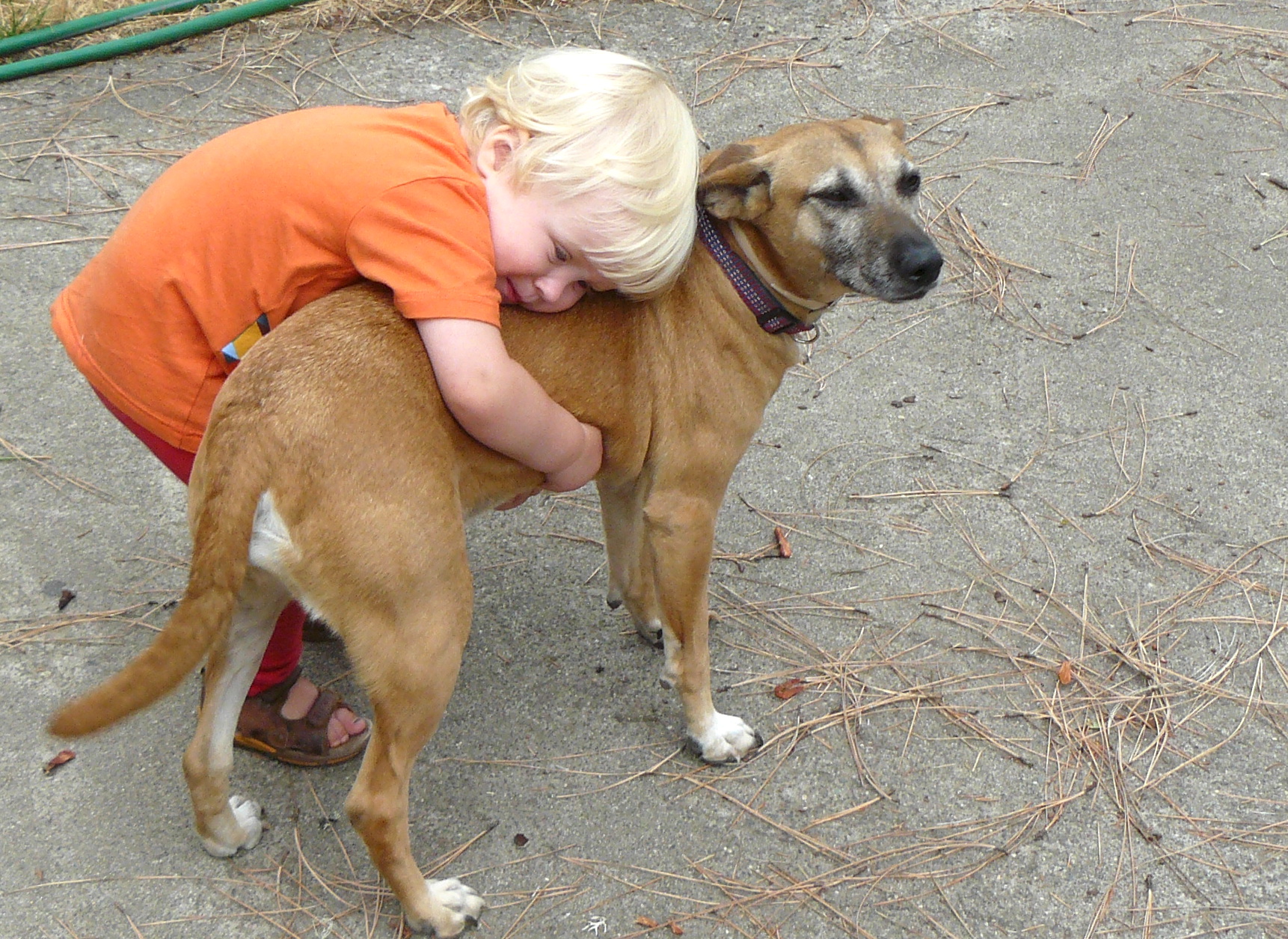



 Learning from Dogs