Category: Writing

Those solar flares

Plenty of news stories to choose from.

A massive solar storm is expected to hit Earth, possibly impacting our communication grids.

NOAA presented a report for May 12th that said:

EVENT:
A coronal mass ejection (CME) is an eruption of solar material. When they arrive at Earth, a geomagnetic storm can result. Watches at this level are very rare.
TIMING:
Several CMEs are anticipated to merge and arrive at Earth on May 12th.
EFFECTS:
The general public should visit our webpage to keep properly informed. The aurora mav become
visible over much of the northern half of the country, and maybe as far south as Alabama to
northern California.

Meanwhile, Earth.com presented the following (and it is a long but extremely interesting report):
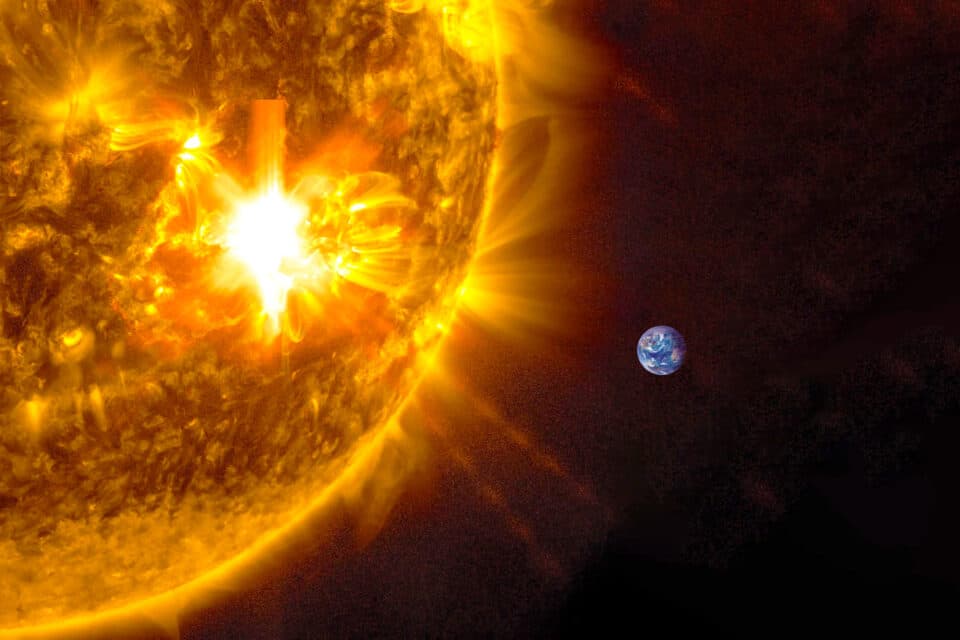
Update: New solar flare, secondary peak today in this “Extreme” solar storm

By Eric Ralls, Earth.com staff writer

Update — May 12, 2024 at 8:04 PM EDT

The Sun released another powerful burst of energy today, known as a solar flare, reaching its peak intensity at 12:26 p.m. Eastern Time. The flare originated from a region on the Sun’s surface called sunspot Region 3664, which has been quite active lately.

NASA’s Solar Dynamics Observatory, a spacecraft that keeps a constant eye on our nearest star, was able to capture a striking image of this latest solar outburst.

Solar flares are immense explosions on the Sun that send energy, light and high speed particles into space. They occur when the magnetic fields in and around the Sun reconnect, releasing huge amounts of stored magnetic energy. Flares are our solar system’s most powerful explosive events.

The NOAA’s Space Weather Prediction Center (SWPC) has extended the Geomagnetic Storm Warning until the afternoon of May 13, 2024.

Understanding different classes of solar flares

Today’s flare was classified as an X1.0 flare. Solar flares are categorized into classes based on their strength, with X-class flares being the most intense. The number provides additional information about the flare’s strength within that class. An X1 flare is ten times more powerful than an M1 flare.

These energetic solar eruptions can significantly impact Earth’s upper atmosphere and near-Earth space environment. Strong flares can disrupt high-frequency radio communications and GPS navigation signals. The particle radiation and X-rays from flares can also pose potential risks to astronauts in space.

Additionally, the magnetic disturbances from flares, if particularly strong, have the ability to affect electric power grids on Earth, sometimes causing long-lasting blackouts.

However, power grid problems are more commonly caused by coronal mass ejections (CMEs), another type of powerful solar eruption often associated with strong flares.

Scientists are always on alert, monitoring the Sun for these explosive events so that any potential impacts can be anticipated and prepared for. NASA’s Solar Dynamics Observatory, along with several other spacecraft, help provide this early warning system.

Stay tuned to Earth.com and the Space Weather Prediction Center (SWPC) for updates.

Update — May 12, 2024 at 9:41 AM EDT

The ongoing geomagnetic storm is expected to intensify later today, Sunday, May 12, 2024. Several intense Coronal Mass Ejections (CMEs), traveling from the Sun at speeds up to 1,200 miles per second, are anticipated to reach the Earth’s outer atmosphere by late afternoon.

Over the past two days, preliminary reports have surfaced regarding power grid irregularities, degradation of high-frequency communications, GPS outages, and satellite navigation issues. These disruptions are likely to persist as the geomagnetic storm strengthens.

Auroras visible across the continental United States

Weather permitting, auroras will be visible again tonight over most of the continental United States. This spectacular display of lights is a direct result of the ongoing geomagnetic storm.

The threat of additional strong solar flares and CMEs, which ultimately result in spectacular aurora displays, will persist until the large and magnetically complex sunspot cluster, NOAA Region 3664, rotates out of view of the Earth. This is expected to occur by Tuesday, May 14, 2024.

Solar activity remains at moderate to high levels

Solar activity has been at moderate levels over the past 24 hours. Region 3664 produced an M8.8/2b flare, the strongest of the period, on May 11 at 15:25 UTC. A CME signature was observed, but an Earth-directed component is not suspected.

Solar activity is expected to remain at high levels from May 12-14, with M-class and X-class flares anticipated, primarily due to the flare potential of Region 3664.

Energetic particle flux and solar wind enhancements

The greater than 10 MeV proton flux reached minor to moderate storm levels on May 10. Additional proton enhancements are likely on May 13-14 due to the flare potential and location of Region 3664.

The solar wind environment has been strongly enhanced due to continued CME activity. Solar wind speeds reached a peak of around 620 miles/second on May 12 at 00:55 UTC. 

A strongly enhanced solar wind environment and continued CME influences are expected to persist on May 12-13, and begin to wane by May 14.

Geomagnetic field reaches G4 “Severe” storm levels

The geomagnetic field reached G4 (Severe) geomagnetic storm levels in the past 24 hours due to continued CME activity. 

Periods of G3 (Strong) geomagnetic storms are likely, with isolated G4 levels possible, on May 12. Periods of G1-G3 (Minor-Strong) storming are likely on May 13, and periods of G1 (Minor) storms are likely on May 14.

Stay informed and enjoy the light show

As the geomagnetic storm rages on, we must remain vigilant and prepared for the potential consequences. Monitor official sources for updates on the storm’s progress and any further disruptions to our technological infrastructure. 

Take a moment to step outside tonight and marvel at the incredible auroras painting the night sky — a stunning reminder of the raw power and beauty of our Sun.

While these solar storms can cause temporary inconveniences, they also provide us with an opportunity to reflect on our place in the universe and the awe-inspiring forces that shape our world.

Stay tuned to Earth.com and the Space Weather Prediction Center (SWPC) for updates.

Understanding geomagnetic solar storms

Geomagnetic storms are disturbances in the Earth’s magnetic field caused by the interaction between the solar wind and the planet’s magnetosphere. These storms can have significant impacts on technology, infrastructure, and even human health.

Causes of geomagnetic storms

Geomagnetic storms typically originate from the Sun. They are caused by two main phenomena:

  • Coronal Mass Ejections (CMEs): Massive bursts of plasma and magnetic fields ejected from the Sun’s surface.
  • Solar Flares: Intense eruptions of electromagnetic radiation from the Sun’s surface.

When these events occur, they send charged particles streaming towards Earth at high speeds, which can take anywhere from one to five days to reach our planet.

Effects on Earth’s magnetic field

As the charged particles from CMEs and solar flares reach Earth, they interact with the planet’s magnetic field. This interaction causes the magnetic field lines to become distorted and compressed, leading to fluctuations in the strength and direction of the magnetic field.

Impacts on technology and infrastructure

Geomagnetic storms can have significant impacts on various aspects of modern technology and infrastructure:

  • Power Grids: Strong geomagnetic storms can induce currents in power lines, causing transformers to overheat and potentially leading to widespread power outages.
  • Satellite Communications: Charged particles can damage satellite electronics and disrupt communication signals.
  • GPS and Navigation Systems: Geomagnetic disturbances can interfere with the accuracy of GPS and other navigation systems.
  • Radio Communications: Storms can disrupt radio signals, affecting communication systems that rely on HF, VHF, and UHF bands.

Aurora Foundation

One of the most visually striking effects of geomagnetic storms is the formation of auroras, also known as the Northern and Southern Lights.

As charged particles collide with Earth’s upper atmosphere, they excite oxygen and nitrogen atoms, causing them to emit light in various colors.

Monitoring and forecasting

Scientists continuously monitor the Sun’s activity and use various instruments to detect and measure CMEs and solar flares.

This data helps them forecast the timing and intensity of geomagnetic storms, allowing for better preparedness and mitigation of potential impacts.

Historical geomagnetic storms

Some of the most notable geomagnetic storms in history include:

  • The Carrington Event (1859): The most powerful geomagnetic storm on record, which caused widespread telegraph system failures and auroras visible as far south as the Caribbean.
  • The Halloween Storms (2003): A series of powerful geomagnetic storms that caused power outages in Sweden and damaged transformers in South Africa.
  • The Quebec Blackout (1989): A geomagnetic storm that caused a massive power outage affecting millions of people in Quebec, Canada.

Understanding geomagnetic storms is crucial for protecting our technology-dependent world and mitigating the potential risks associated with these powerful space weather events.

—–

Like what you read? Subscribe to our newsletter for engaging articles, exclusive content, and the latest updates.

Check us out on EarthSnap, a free app brought to you by Eric Ralls and Earth.com.

This was a very lucky moment

A hiker in Arizona saw a dog hiding, and scared!

This is such a lovely tale and one that defies all the odds.

ooOOoo

Hiker Stops In His Tracks When He Sees ‘Amber Eyes’ Peeking Out From Crevice

No one has any idea how she got up there ⛰️

By Caitlin Jill Anders, Published on May 3, 2024

A Good Samaritan was hiking a narrow, slippery trail on Lookout Mountain in Phoenix, Arizona, and was very focused on his hike until something caught his eye. He was about half a mile up the mountain and a little off the beaten path when he caught a glimpse of light reflecting off of something — and was shocked to realize it was a pair of amber eyes.

The eyes belonged to a very scared dog huddled up in a tiny hole in the side of the mountain. She was completely blending in with her surroundings, and if she hadn’t had such piercing eyes, the hiker may not have noticed her. He had no idea how she’d managed to get up there, but it was clear that she’d been stuck for a while and might not be able to last much longer.

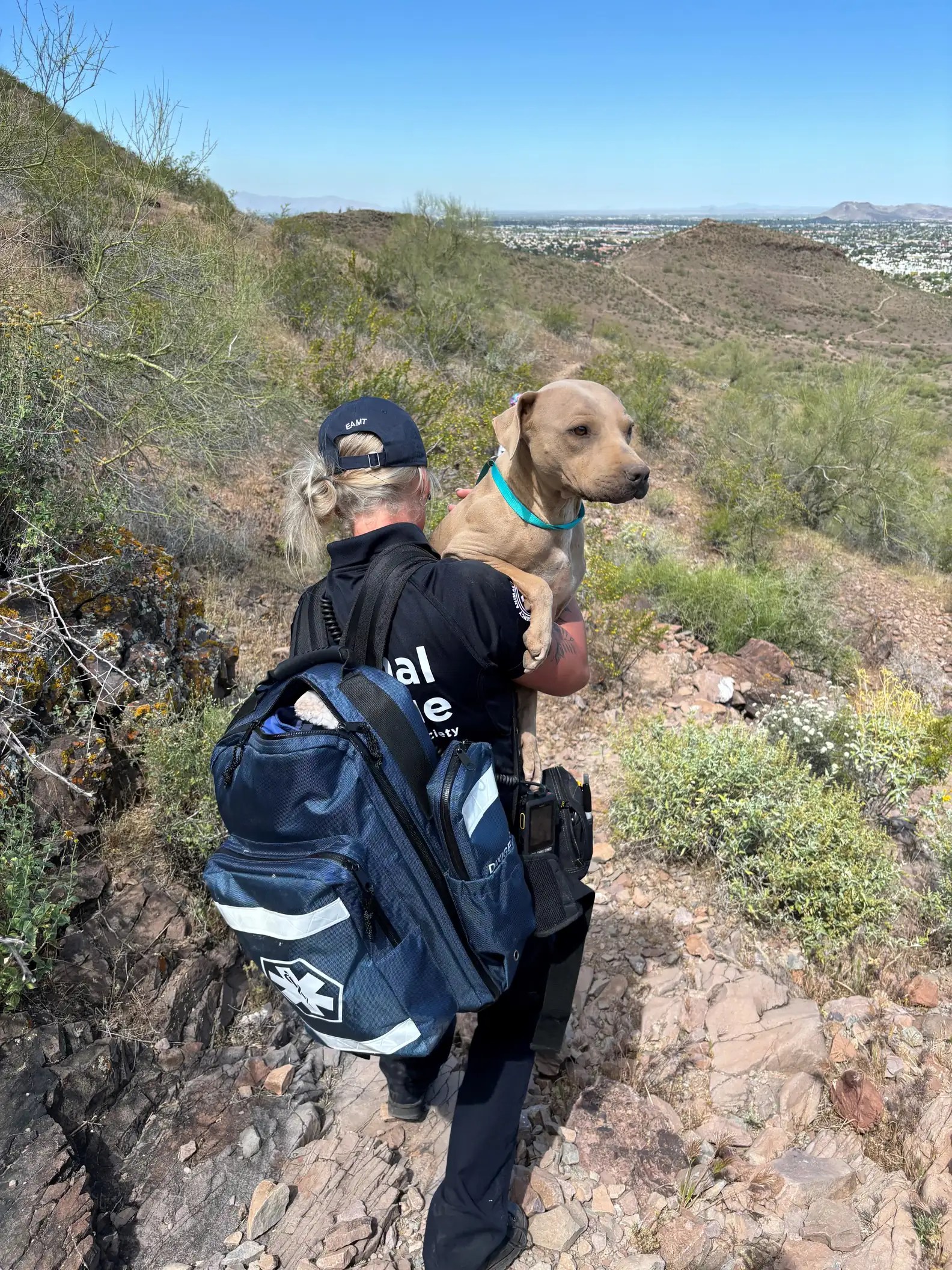
The Good Samaritan quickly contacted the Arizona Humane Society (AHS), who sent two emergency animal medical technicians, Tracey Miiller and Ruthie Jesus, out to help while he waited with the pup until they arrived. The dog was definitely scared but seemed open to getting help.

“This Good Samaritan waited probably almost two hours, and then we found this incredible dog, who incidentally is literally the same color as the dirt,” Jesus said in a press release. “She blends in so much, the complainant told us that he wanted to call her Bright Eyes because when he hiked past her, that was literally the only thing he saw was her amber bright eyes staring back at him.”

After a quick and careful assessment on the side of the mountain, the technicians determined that Bright Eyes was dangerously dehydrated with cut-up paws and a wound on her rear end.

“She was really sweet and letting me pet her head, but she absolutely did not want to come out of that den, so I kind of had to just sort of pull her out,” Jesus said.

She was definitely too weak to walk with her rescuers down the mountain, so the technicians took turns carrying her until they reached the ambulance. Bright Eyes was calm the whole time, so grateful to finally be safe.

“She actually really just relaxed and seemed to enjoy being carried down the mountain,” Jesus said. “But it was a very teeny-tiny rocky trail that was pretty slick, and so Tracey and I took turns carrying her down the mountain, and she was just an absolute angel. She knew we were getting her to safety.”

It’s still a mystery as to how or why Bright Eyes ended up on the mountain in the first place, but the important thing is someone found her and now she’s getting the care she needs.

“We were so elated to be able to get her,” Jesus said. “She was just so dehydrated. I think she’d probably been up there several days and that was probably her last day, and this Good Samaritan really just saved her life.”

ooOOoo

Frankly, there’s nothing more to add to this account. For it captured all that so many people do for dogs.

P.S. All the above photographs were supplied by the Arizona Humane Society. Please take a look at their website.

Our teeth

A recent post from The Conversation reveals all!

I have no excuse for not being better at looking after my teeth, for one of my elder sisters, Corinne, was a dental assistant and when I was in my mid-fifties I moved down to South-West England and bought a home just a few miles from Corinne’s home. Thereafter she looked after my teeth at the dental practice in Totnes.

But I was careless in following Corinne’s advice and it wasn’t until in my seventies, and living in Merlin, Oregon, that I saw the light; so to speak!

Read this!

ooOOoo

Healthy teeth are wondrous and priceless – a dentist explains why and how best to protect them

Healthy teeth are truly priceless. Moncherie/E+ via Getty Images

Samer Zaky, University of Pittsburgh

At an auction in England in 2011, one of John Lennon’s teeth sold for just over US$31,000.

How much are your teeth worth?

Teeth are amazing little miracles. They light up our smiles, we use them to speak and we chew with them more than 600 times at every meal.

Yet, in a society where 1 out of 5 Americans ages 75 and up live without their teeth, many people may not realize that teeth are designed to stay with us for a lifetime.

I’m a dentist and an assistant professor spanning clinical dentistry and craniofacial regeneration research. Researchers like me are still deepening our understanding of tooth development, with the ultimate goal of serving patients with on-demand regrown ones.

In the process, I have developed reverence for natural teeth and for the complex beauty of these biological and mechanical masterpieces.

Designed for lifelong function

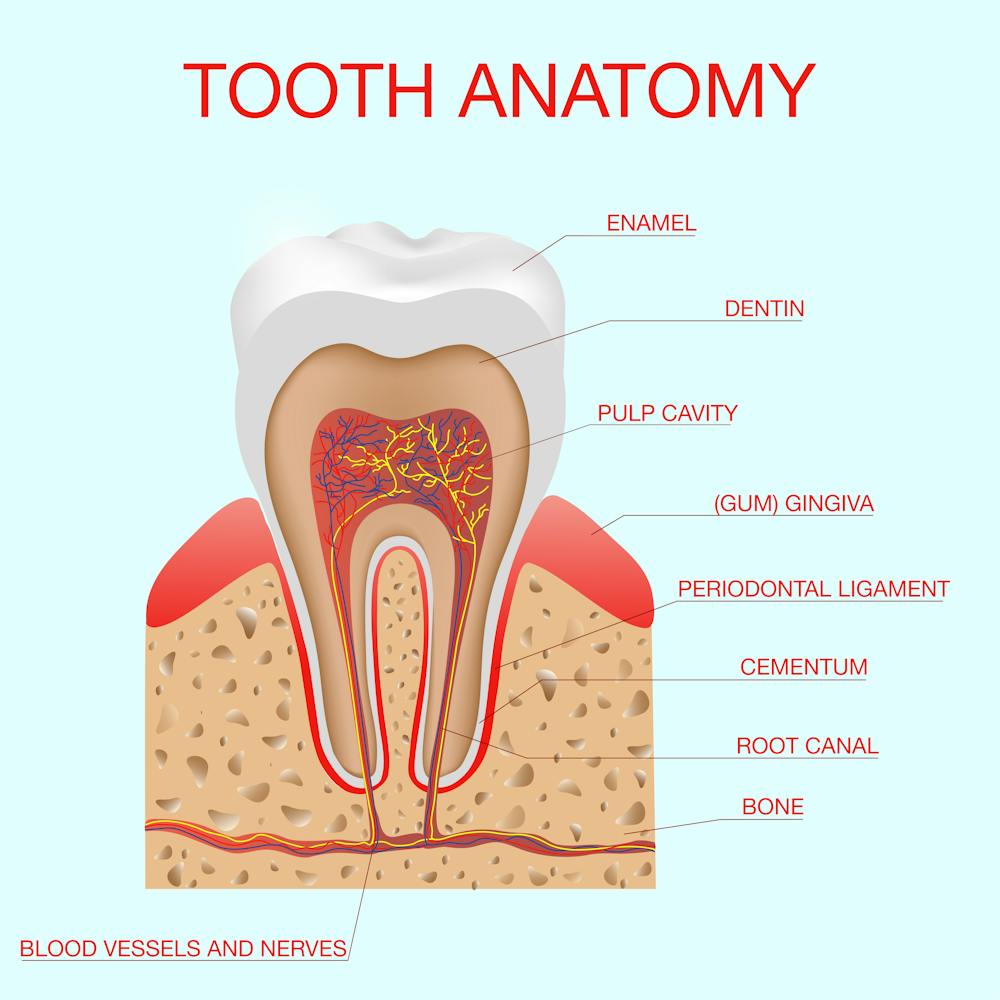
The secret of teeth longevity lies in their durability as well as in how they are anchored to the jaw – picture a hammer and its hand grip. For each tooth, durability and anchorage are functions of the complex interface between six different tissues; each alone is a biological marvel.

For anchorage, the cementum, ligament and bone grip the tooth at its root portion that is buried under the gum. The ligament, a soft tissue that is about 0.2 millimeters wide (about the diameter of four hairs), attaches the cementum of the root on one end to the bone of the jaw on the other end. It serves to anchor the tooth as well as to cushion its movement during chewing.

For durability, however, the secret lies in the enamel, dentin and pulp – our focus in this discussion.

An illustration of tooth anatomy
Dentin and pulp are the body and heart of the tooth. Anna Koroleva/iStock via Getty Images

Enamel – the shield

The enamel is the protective shell that covers the visible part of the tooth above the gum. Thanks to its high mineral content, enamel is the hardest tissue in the body. It needs to be, since it acts as a shield against the constant impact of chewing.

Enamel does not contain cells, blood vessels or nerves, so it is nonliving and nonsensitive. Enamel is also non-regenerating. Once destroyed by decay or broken by misuse such as ice chewing, nail biting or bottle opening – or touched by the dental drill – that part of our priceless enamel is gone for good.

Because it interfaces with a germ-laden world, the enamel is also where decay starts. When acid-generating bacteria accumulate on unbrushed or poorly brushed teeth, they readily dissolve the minerals in the enamel.

How bacteria invade the teeth and cause cavities.

Like hair or fingernails, the non-innervated enamel is not sensitive. The decay advances through the 2.5-millimeter thick (tenth of an inch) layer of enamel painlessly. When caught at that phase during a dental checkup visit, the dentist can treat the decay with a relatively conservative filling that hardly compromises the tooth’s structural integrity.

Because of its high mineral content, enamel is stiff. Its lifelong support is provided by the more resilient infrastructure – the dentin.

Dentin and pulp – body and heart

With less mineral content than enamel, dentin is the resilient body of the tooth. It is a living tissue formed of parallel tiny tubes housing fluid and cellular extensions. Both originate from the pulp.

The pulp is the tooth’s soft tissue core. Vastly rich in cells, blood vessels and nerves, it is the life source of the tooth – its heart – and the key to its longevity.

Like smoke detectors communicating with a remote fire station, the cellular extensions within the dentin sense decay as soon as it breaks through the nonsensitive layer of enamel into dentin. Once the extensions communicate the danger signal to the pulp, our tooth sensitivity alarm goes off: The tooth heart is in flames.

The inflamed pulp initiates two protective actions. The first is to secrete an additional layer of dentin to delay the approaching attack. The second is toothache, a call to visit the dentist.

The earlier the visit, the less the drilling and the smaller the filling. If caught in time, most of the tooth’s natural tissues will be preserved and the pulp will likely regain its healthy state. If caught too late, the pulp slowly dies out.

Without its heart, a nonliving tooth has no defense against further decay invasion. Without a hydration source, a dried-out dentin will sooner or later break under the forces of constant chewing. Besides, a tooth that has already lost a significant portion of its natural structure to decay, cavity preparation or root canal instrumentation becomes weak, with limited longevity.

In other words, the tooth is never the same without its heart. Pulpless, the tooth loses its womb-to-tomb endurance and mother nature’s lifelong warranty.

The tooth coming together

More complex – and more precious – than a pearl within an oyster, the formation of a tooth within our jawbone involves layered mineral deposition. As tooth development progresses in a process of ultimate cellular engineering, the cells of the six aforementioned tissues – enamel, dentin, pulp, cementum, ligament and bone – multiply, specialize and mineralize synchronously with each other to form uniquely interlocking interfaces: enamel to dentin, dentin to pulp, cementum to dentin and cementum to ligament to bone.

https://www.youtube.com/embed/xrebAYBnKw0?wmode=transparent&start=0 Tooth development – the ultimate process of cellular engineering.

In a progress akin to 3D printing, the tooth crown grows vertically to full formation. Simultaneously, the root continues its elongation to eventually launch off the crown from within the bone across the gum to appear in the mouth – the event known as teething. It is about that time, around 12 years of age, that our set of adult teeth is complete. These pearls are set to endure a lifetime and are undoubtedly worth preserving.

Save your teeth, visit the dentist

Tooth decay, the most prevalent disease in humans, is both predictable and preventable. The earlier it is caught, the more the tooth integrity can be preserved. Since the process starts painlessly, it is imperative to visit the dentist regularly to keep those insidious germs in check.

During your checkup visit, the dental professional will clean your teeth and check for early decay. If you are diligent with your daily preventive measures, the good news for you will be no news – enough to make anyone smile.

Samer Zaky, Research Assistant Professor in Oral and Craniofacial Sciences, University of Pittsburgh

This article is republished from The Conversation under a Creative Commons license. Read the original article.

ooOOoo

There’s that saying: “No news is good news.”

A new dog!

Another compelling story.

Yet another fantastic story of a dog being transformed, courtesy of The Dodo.

ooOOoo

Dog Is Completely Transformed After Groomers Give Her An Emergency Makeover

She’s unrecognizable.

By Stephen Messenger, Published on April 5, 2024

Recently, staff at the Wyandotte Animal Shelter in Michigan took in a dog whose condition was described as among the worst they’d ever seen. Pixie, as the dog is named, had fur so overgrown and matted that she could hardly move.

Gazing upon Pixie, one might never guess that an adorable dog existed beneath it.

Wyandotte Animal Shelter

According to staff at the shelter, Pixie was surrendered by her owner, who, regrettably, had neglected to give her the care and attention she needed — leading to her severely unkempt condition. Ultimately, though, his decision to surrender her is what Pixie needed most.

“He had a hard time letting her go but surrendered her to us so we could ensure she would go to someone who could give her the life she deserved,” the shelter wrote.

With that, Pixie’s world was about to change forever — and it would have to start with a much-needed haircut.

Wyandotte Animal Shelter

Staff at the shelter reached out to The Downriver Grooming Co. for what would be an emergency grooming session to help Pixie escape from her matted prison.

“[They got] her in within minutes of our call, and for [three] hours they spent freeing her from that matted fur,” the shelter wrote.

Wyandotte Animal Shelter

After all was said and done, the real Pixie had emerged.

She was totally unrecognizable from her former self.

Wyandotte Animal Shelter

“This little girl was only 5.5 pounds, but she seemed twice her size due to the matted fur,” the shelter wrote, adding that she was in remarkably good health, despite her ordeal beneath that overgrown coat.

Pixie’s world had changed for the better — but it wouldn’t be long until it improved even more.

Wyandotte Animal Shelter

Within days of Pixie’s transformation, thanks to the kindness of those who’d helped her, the little dog got the second chance she so desperately needed.

“Pixie was adopted,” a spokesperson for the Wyandotte Animal Shelter told The Dodo. “Her new family reports that she is doing very well in her new home.”

ooOOoo

We all need second chances from time to time, humans and dogs.

Stonehenge

A fascinating account of this English site.

Although I was born in London in 1944, as a result of an affair between my father and mother, my father had two daughters with his wife, Maud, and Rhona and Corinne, for they were their names, took me under their wing. In the 50s Maud, Rhona and Corinne all moved to Devon and I started going regularly to Totnes. When I started driving I usually stopped for a break close by Stonehenge so the site has a special interest to me.

So when I saw this article in The Conversation it had to be shared.

ooOOoo

Stonehenge may have aligned with the Moon as well as the Sun

Stonehenge during winter solstice sunset Chuta Kooanantkul/Shutterstock

Fabio Silva, Bournemouth University; Amanda Chadburn, Bournemouth University, and Erica Ellingson, University of Colorado Boulder

When it comes to its connection to the sky, Stonehenge is best known for its solar alignments. Every midsummer’s night tens of thousands of people gather at Stonehenge to celebrate and witness the rising Sun in alignment with the Heel stone standing outside of the circle. Six months later a smaller crowd congregates around the Heel stone to witness the midwinter Sun setting within the stone circle.

But a hypothesis has been around for 60 years that part of Stonehenge also aligns with moonrise and moonset at what is called a major lunar standstill. Although a correlation between the layout of certain stones and the major lunar standstill has been known about for several decades, no one has systematically observed and recorded the phenomenon at Stonehenge.

This is what we are aiming to do in a project bringing together archaeologists, astronomers and photographers from English Heritage, Oxford, Leicester and Bournemouth universities as well as the Royal Astronomical Society.

There is now an abundance of archaeological evidence that indicates the solar alignment was part of the architectural design of Stonehenge. Around 2500 BC, the people who put up the large stones and dug an avenue into the chalk seemed to want to cement the solstice axis into the architecture of Stonehenge.

Archaeological evidence from nearby Durrington Walls, the place where scientists believe the ancient people who visited Stonehenge stayed, indicates that of the two solstices it was the midwinter one that drew the largest crowd.

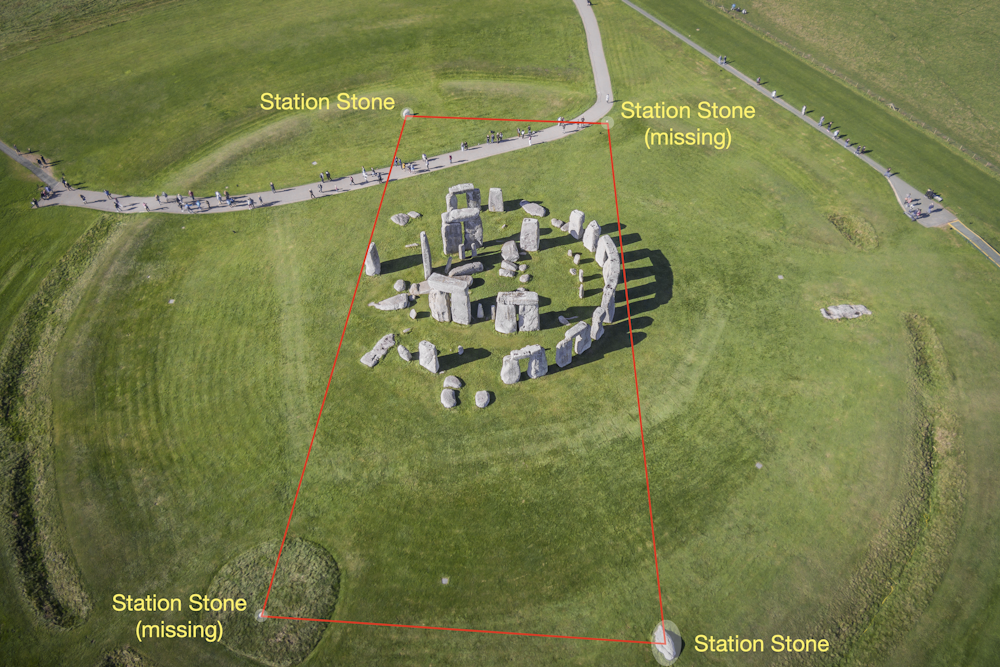
But Stonehenge includes other elements, such as 56 pits arranged in a circle, an earthwork bank and ditch, and other smaller features such as the four station stones. These are four sarsen stones, a form of silicified sandstone common in Wiltshire, that were carefully placed to form an almost exact rectangle encompassing the stone circle.

Only two of these stones are still there, and they pale in comparison to their larger counterparts as they are only a few feet high. So what could their purpose be?

Aerial view of Stonehenge
Only two of the station stones are still there. Drone Explorer/Shutterstock

Lunar standstill

The rectangle that they form is not just any rectangle. The shorter sides are parallel to the main axis of the stone circle and this may be a clue as to their purpose. The longer sides of the rectangle skirt the outside of the stone circle.

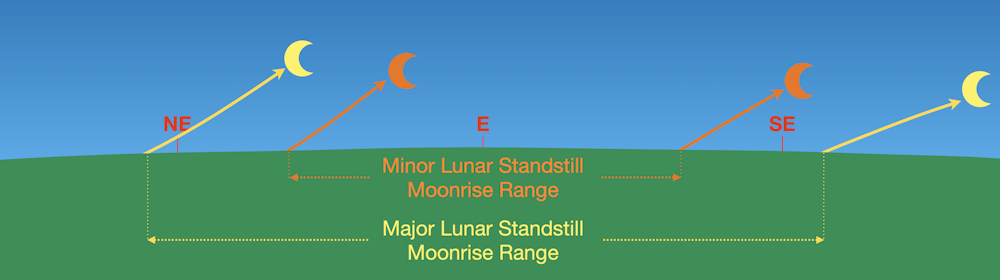
It is these longer sides that are thought to align with the major lunar standstill. If you marked the position of moonrise (or set) over the course of a month you would see that it moves between two points on the horizon. These southern and northern limits of moonrise (or set) change on a cycle of 18.6 years between a minimum and a maximum range – the so-called minor and major lunar standstills, respectively.

The major lunar standstill is a period of about one and a half to two years when the northernmost and southernmost moonrises (or sets) are furthest apart. When this happens the Moon rises (and sets) outside the range of sunrises and sets, which may have imbued this celestial phenomenon with meaning and significance.

Diagram showing Moonrise positions on a horizon.
The range of Moonrise positions on the horizon during minor and major lunar standstills. Fabio Silva, CC BY-NC

The strongest evidence we have for people marking the major lunar standstill comes from the US southwest. The Great House of Chimney Rock, a multi-level complex built by the ancestral Pueblo people in the San Juan National Forest, Colorado, more than 1,000 years ago.

It lies on a ridge that ends at a natural formation of twin rock pillars – an area that has cultural significance to more than 26 native American tribal nations. From the vantage point of the Great House, the Sun will never rise in the gap between the pillars.

However, during a major standstill the Moon does rise between them in awe-inspiring fashion. Excavations unearthed preserved wood that meant researchers could date to the year episodes of construction of the Great House.

Of six cutting dates, four correspond to major lunar standstill years between the years AD1018 and AD1093, indicating that the site was renewed, maintained or expanded on consecutive major standstills.

Returning to southern England, archaeologists think there is a connection between the major lunar standstill and the earliest construction phase of Stonehenge (3000-2500 BC), before the sarsen stones were brought in.

Several sets of cremated human remains from this phase of construction were found in the southeastern part of the monument in the general direction of the southernmost major standstill moonrise, where three timber posts were also set into the bank. It is possible that there was an early connection between the site of Stonehenge and the Moon, which was later emphasised when the station stone rectangle was built.

The major lunar standstill hypothesis, however, raises more questions than it answers. We don’t know if the lunar alignments of the station stones were symbolic or whether people were meant to observe the Moon through them. Neither do we know which phases of the Moon would be more dramatic to witness.

A search for answers

In our upcoming work, we will be trying to answer the questions the major lunar standstill hypothesis raises. It’s unclear whether the Moon would have been strong enough to cast shadows and how they would have interacted with the other stones. We will also need to check whether the alignments can still be seen today or if they are blocked by woods, traffic and other features.

The Moon will align with the station stone rectangle twice a month from about February 2024 to November 2025, giving us plenty of opportunities to observe this phenomenon in different seasons and phases of the Moon.

To bring our research to life, English Heritage will livestream the southernmost Moonrise in June 2024, and host a series of events throughout the year, including talks, a pop-up planetarium, stargazing and storytelling sessions.

Across the Atlantic, our partners at the US Forest Service are developing educational materials about the major lunar standstill at Chimney Rock National Monument. This collaboration will result in events showcasing and debating the lunar alignments at both Stonehenge and at Chimney Rock.

Fabio Silva, Senior Lecturer in Archaeological Modelling, Bournemouth University; Amanda Chadburn, Member of Kellogg College, University of Oxford and Visiting Fellow in Archaeology, Bournemouth University, and Erica Ellingson, Professor in Astrophysics, Emeritus, University of Colorado Boulder

This article is republished from The Conversation under a Creative Commons license. Read the original article.

ooOOoo

Well I learnt something from this, which just goes to show that we are never too old to learn.

To come back to the article, the skills of those ancient peoples were just awe-inspiring.

Picture Parade Four Hundred and Twenty-Nine, not!

It is about Whale songs and is just a fabulous sound!

Last Friday there was an item on the BBC about whale song. It appears I can publish the article for you all. It is my choice over my regular Sunday Picture Parade. I hope you agree! Update: The track just 26 seconds long cannot be reproduced in this post.

ooOOoo

Whale song mystery solved by scientists

21 February 2024, By Helen Briggs and Victoria Gill,Science correspondents, BBC News

Humpback whale breaching near Bering Island, Kamchatka, Russia – Olga Filatova, University of Southern Denmark

Scientists have worked out how some of the largest whales in the ocean produce their haunting and complex songs.

Humpbacks and other baleen whales have evolved a specialised “voice box” that enables them to sing underwater. 

The discovery, published in the journal Nature, has also revealed why the noise we make in the ocean is so disruptive for these ocean giants. 

Whale song is restricted to a narrow frequency that overlaps with the noise produced by ships. 
“Sound is absolutely crucial for their survival, because it’s the only way they can find each other to mate in the ocean,” explained Prof Coen Elemans, of the University of Southern Denmark, who led the study. 

Blue whales return to ‘safe’ tropical haven
Orcas ‘learning from adults’ to target boats
Study to measure the oceans’ ‘year of quiet’

“[These are some] of the most enigmatic animals that ever lived on the planet,” he told BBC News. “They are amongst the biggest animals, they’re smart and they’re highly social.”

Humpback whale song (For whatever reason the track cannot be listened to on this blog. That is a great shame as the song is magnificent. So please go to the BBC website for this; the link is https://www.bbc.com/news/science-environment-68358414 )

Baleen whales are a group of 14 species, including the blue, humpback, right, minke and gray whale. Instead of teeth, the animals have plates of what is called baleen, through which they sieve huge mouthfuls of tiny creatures from the water.

Exactly how they produce complex, often haunting songs has been a mystery until now. Prof Elemans said it was “super-exciting” to have figured it out.

A diver descends between three juvenile humpback whales the size of buses – Karim Iliya

He and his colleagues carried out experiments using larynxes, or “voice boxes”, that had been carefully removed from three carcasses of stranded whales – a minke, a humpback and a sei whale. They then blew air through the massive structures to produce the sound. 

In humans, our voices come from vibrations when air passes over structures called vocal folds in our throat. Baleen whales, instead, have a large U-shaped structure with a cushion of fat at the top of the larynx.

This vocal anatomy allows the animals to sing by recycling air, and it prevents water from being inhaled.

Artwork indicating the cartilages of the larynx in a humpback whale – Patricia Jaqueline Matic, Vienna

The researchers produced computer models of the sounds and showed that baleen whale song is restricted to a narrow frequency which overlaps with noise produced by shipping vessels. 

“They cannot simply choose to, for example, sing higher to avoid the noise we make in the ocean,” explained Prof Elemans. 

His study demonstrated how our ocean noise could prevent whales from communicating over long distances. That knowledge could be vital for the conservation of humpbacks, blue whales and other endangered giants of the sea.

It also provides insight into questions that researchers have been asking for decades about these eerie songs, which some sailors used to attribute to ghosts or mythical sea creatures.

Whale communication expert Dr Kate Stafford, from Oregon State University, called the study “groundbreaking”. 

“The production and reception of sound is the most important sense for marine mammals, so any studies that elucidate how they make sounds has the potential to move the field forward,” she told BBC News.

Researchers say evidence of the harm ocean noise pollution can do has been building for decades –
Alamy

The research also paints an evolutionary picture – of how the ancestors of whales returned to the oceans from the land, and the adaptations that made it possible to communicate underwater.

The way so-called toothed whales produce sound is better understood, because the animals are easier to study. These marine mammals, which include dolphins, orcas, sperm whales and porpoises, blow air through a special structure in their nasal passages.

Dr Ellen Garland, from the Sea Mammal Research Unit at the University of St Andrews, said: “I’ve always wondered exactly how baleen whales – especially humpbacks, which my research is focused on – actually produce the variety of sounds they do.

“Studying large whales is extremely challenging at the best of times, but trying to uncover how they produce sound when you may not even be able to see them underwater while vocalising is an added level of difficulty, so these researchers have been very creative.”

Dr Stafford added that the mammals’ ability to make such complex vocal signals was “remarkable” and highlighted “how special these animals are”.

ooOOoo

There! I do hope you all agree that this was very worthwhile. Plus, you all got to listen to those twenty-six seconds of the very beautiful sound.

We humans!

No clear reaction comes to mind.

I came across this post yesterday and thought that it would make a good article for today. But the truth is that I, and I expect many other readers, do not understand the article.

ooOOoo

Employees Heartbroken When They See Someone Tied To ‘Do Not Abandon Animals’ Sign

She waited there 11 hours 💔

By Caitlin Jill Anders, Published on the 11th April, 2024.

Outside the front door of the Harbor Humane Society sits a sign. “Do not abandon an animal here,” the sign reads. “Wait until business hours. No fee for bringing an animal to HHS. For the sake of the animal, please be humane.” An older, outdated version of the same sign sits at the back of the shelter, too, near some picnic tables where employees can take a break. When they arrived at work one morning recently, there were no animals waiting for them out front.

Harbor Humane Society

Sadly, the same could not be said for the sign in the back.

Tied to the base of the “do not abandon animals” sign was a tiny dog who had been abandoned there the night before. Security footage showed the dog, later named Trixie, had been tied to the sign around 9 p.m. and wasn’t found until 7:30 a.m. the next morning, meaning she’d waited there for 11 hours.

Harbor Humane Society

“Our team member was just about to unarm the building (had just arrived to start their morning shift) when she noticed the dog tied to the signpost near our intake door located toward the back side of the shelter,” Jen Nuernberg, director of marketing and strategic initiatives at Harbor Humane Society, told The Dodo. “Initially, she was nervous and scared, barking at her. But once she crouched down and gave her some time, she quickly warmed up and crawled right into her lap. She has been very friendly ever since!”

Harbor Humane Society

Trixie was terrified out there all alone, wondering why she’d ended up there. As soon as she met her rescuer, though, all was well. She was rushed inside and eventually met the rest of the staff members, who were just as heartbroken by the situation. Thankfully, Trixie seemed to be pretty healthy, just a little confused — as was everyone at the shelter.

“When someone abandons an animal without any information, we are just left to guess,” Jen Self Aulgur, executive director at Harbor Humane Society, told The Dodo. “So we can assume she is about 3 to 4 years old, but we don’t know her story, her name, her likes, her favorite treats or toys. This is all information we try to get on animals when they are surrendered to the shelter.”

Harbor Humane Society

The shelter employees are still hoping someone might come forward to give them some information about Trixie before she’s adopted, just to make sure she’s getting the best care possible.

“This pup deserves to have her story and history known,” Self Aulgur said. “We do not want to shame or get you in trouble — we just want to help this poor pup.”

Harbor Humane Society

Trixie is safe now and will be available for adoption in about a week or so. Until then, she’s getting as many kisses and cuddles as the staff can give her while she dreams of her loving forever family.

ooOOoo

Let me add my wishes to the Harbor Humane Society in hoping that very soon Trixie will be adopted by that loving family.

A good night’s sleep?

This article has some deeper implications.

As 99% of you know, Jean, my wife, has Parkinson’s Disease. One of the characteristics of the disease is the effect it has on sleeping; Jean frequently has a bad night. Plus, our two dogs, Cleopatra and Oliver sleep in the bedroom on dog beds.

But if I was on my own I would find it difficult not to encourage our dogs to sleep on our double bed. That’s my assessment, at least! Over to The Conversation on the topic.

ooOOoo

Could sharing a bedroom with your pets be keeping you from getting a good night’s sleep?

Your dog may not be the best sleep partner. gollykim/E+ via Getty Images

Brian N. Chin, Trinity College

Sleeping with your dog in the same room could be negatively affecting your sleep quality, according to my team’s recently published research in Scientific Reports.

We recruited a nationally representative sample of more than 1,500 American adults who completed questionnaires assessing their sleep habits. Overall, about half of the participants reported co-sleeping with pets – defined in our study as sleeping in the same room with your pet for at least part of the night.

Next, our research team compared the sleep habits of people who did and didn’t co-sleep with pets. Our analyses revealed that participants who co-slept with pets had poorer sleep quality and more insomnia symptoms than those who did not. These findings persisted even after accounting for demographic differences between these groups. When considering pet type, we found evidence for a negative effect on sleep when co-sleeping with dogs but no evidence for a negative effect on sleep when co-sleeping with cats.

Orange and white cat sleeping against the covered legs of their owner sleeping in bed
Cats may have less of a negative effect on sleep than dogs when sharing the same room with their owners. Lewis Tse Pui Lung/iStock via Getty Images Plus

Surprisingly, 93% of people in our study who co-slept with their pets believed that their pets had either a positive or neutral overall effect on their sleep. Although more research is needed, these findings could suggest that most people are unaware of the potential negative effects their pets may have on their sleep.

Why it matters

Most pet owners report that their pets have a generally positive effect on their mental health. Pets can improve their owners’ health in numerous ways during the day, such as by encouraging physical activity, promoting a daily routine and providing love and companionship.

However, our study fills an important knowledge gap by indicating that co-sleeping with pets can affect sleep quality. Good sleep is a pillar of health and wellness. Even though pets may have an overall positive effect on mental health, it is possible that some of this benefit may be undermined if they are also causing you to lose sleep at night.

Although some people report that co-sleeping with their pets can provide them with a sense of comfort or intimacy, it is important for people sharing a bedroom with their pets to be aware of their potential to serve as a source of nighttime noise, heat or movement that can disrupt your ability to fall or stay asleep.

What still isn’t known

Survey-based studies like ours are unable to prove that co-sleeping with pets causes disrupted sleep, although there is some evidence suggesting that this could be the case.

One important factor that our study did not assess was whether participants were also co-sleeping with other people like a spouse or child. Previous research suggests that sharing a bed with other people can also affect our sleep and that the mental health benefits of pet ownership could be stronger for people with a romantic partner.

Chocolate Labrador dog sleeping on owner's bed, sunlight streaming in through window
Pets provide many health benefits during the day, but consider keeping them out of your bed at night. Justin Paget/DigitalVision via Getty Images

What’s next

It probably isn’t realistic for most people to just stop co-sleeping with their pets. So, what should someone do to improve their sleep if they already share a bed with their pets?

Some expert tips include choosing a mattress that is large enough for you and your pets, washing and changing your bedding regularly, and establishing and maintaining a consistent bedtime routine with your pets. Further research is needed to identify more specific habits and routines that pet owners can adopt to ensure a good night’s sleep when sharing the bedroom with their pets.

The Research Brief is a short take about interesting academic work.

Brian N. Chin, Assistant Professor of Psychology, Trinity College

This article is republished from The Conversation under a Creative Commons license. Read the original article.

ooOOoo

Coming back to Jean and me at least we have a pretty regular routine with us going to our bedroom around 7pm to 8pm. In the morning over our daily coffees I always ask Jean what sort of night she had. Yesterday morning Jean replied that she had had a poor night. My judgement is that Jean has roughly one in two poor nights.

To state the obvious, it’s in the numbers!

A wonderful, and educational, item on The Conversation.

I was listening to an item on the BBC yesterday morning and counting came up. The need for counting was incredibly early on in our history. Here is a copy of the part of the introduction to The Universal History of Numbers: From Prehistory to the Invention of the Computer.

A riveting history of counting and calculating from the time of the cave dwellers to the late twentieth century, The Universal History of Numbers is the first complete account of the invention and evolution of numbers the world over. As different cultures around the globe struggled with problems of harvests, constructing buildings, educating their citizens, and exploring the wonders of science, each civilization created its own unique and wonderful mathematical system. 

Dubbed the “Indiana Jones of numbers,” Georges Ifrah traveled all over the world for ten years to uncover the little-known details of this amazing story. From India to China, and from Egypt to Chile, Ifrah talked to mathematicians, historians, archaeologists, and philosophers. He deciphered ancient writing on crumbling walls; scrutinized stones, tools, cylinders, and cones; and examined carved bones, elaborately knotted counting strings, and X-rays of the contents of never-opened ancient clay accounting balls. Conveying all the excitement and joy of the process of discovery, Ifrah writes in a delightful storytelling style, recounting a plethora of intriguing and amusing anecdotes along the way.

Now to that article on The Conversation.

ooOOoo

From thousands to millions to billions to trillions to quadrillions and beyond: Do numbers ever end?

The number zero was a relatively recent and crucial addition − it allows numbers to extend in both directions forever. pixel_dreams/iStock via Getty Images Plus

Manil Suri, University of Maryland, Baltimore County

Curious Kids is a series for children of all ages. If you have a question you’d like an expert to answer, send it to curiouskidsus@theconversation.com.


Why don’t numbers end? – Reyhane, age 7, Tehran, Iran


Here’s a game: Ask a friend to give you any number and you’ll return one that’s bigger. Just add “1” to whatever number they come up with and you’re sure to win.

The reason is that numbers go on forever. There is no highest number. But why? As a professor of mathematics, I can help you find an answer.

First, you need to understand what numbers are and where they come from. You learned about numbers because they enabled you to count. Early humans had similar needs – whether to count animals killed in a hunt or keep track of how many days had passed. That’s why they invented numbers.

But back then, numbers were quite limited and had a very simple form. Often, the “numbers” were just notches on a bone, going up to a couple hundred at most.

How numbers evolved throughout the centuries.

When numbers got bigger

As time went on, people’s needs grew. Herds of livestock had to be counted, goods and services traded, and measurements made for buildings and navigation. This led to the invention of larger numbers and better ways of representing them.

About 5,000 years ago, the Egyptians began using symbols for various numbers, with a final symbol for one million. Since they didn’t usually encounter bigger quantities, they also used this same final symbol to depict “many.”

The Greeks, starting with Pythagoras, were the first to study numbers for their own sake, rather than viewing them as just counting tools. As someone who’s written a book on the importance of numbers, I can’t emphasize enough how crucial this step was for humanity.

By 500 BCE, Pythagoras and his disciples had not only realized that the counting numbers – 1, 2, 3 and so on – were endless, but also that they could be used to explain cool stuff like the sounds made when you pluck a taut string.

Zero is a critical number

But there was a problem. Although the Greeks could mentally think of very large numbers, they had difficulty writing them down. This was because they did not know about the number 0.

Think of how important zero is in expressing big numbers. You can start with 1, then add more and more zeroes at the end to quickly get numbers like a million – 1,000,000, or 1 followed by six zeros – or a billion, with nine zeros, or a trillion, 12 zeros.

It was only around 1200 CE that zero, invented centuries earlier in India, came to Europe. This led to the way we write numbers today.

This brief history makes clear that numbers were developed over thousands of years. And though the Egyptians didn’t have much use for a million, we certainly do. Economists will tell you that government expenditures are commonly measured in millions of dollars.

Also, science has taken us to a point where we need even larger numbers. For instance, there are about 100 billion stars in our galaxy – or 100,000,000,000 – and the number of atoms in our universe may be as high as 1 followed by 82 zeros.

Don’t worry if you find it hard to picture such big numbers. It’s fine to just think of them as “many,” much like the Egyptians treated numbers over a million. These examples point to one reason why numbers must continue endlessly. If we had a maximum, some new use or discovery would surely make us exceed it.

The symbols of math include +, -, x and =.

Exceptions to the rule

But under certain circumstances, sometimes numbers do have a maximum because people design them that way for a practical purpose.

A good example is a clock – or clock arithmetic, where we use only the numbers 1 through 12. There is no 13 o’clock, because after 12 o’clock we just go back to 1 o’clock again. If you played the “bigger number” game with a friend in clock arithmetic, you’d lose if they chose the number 12.

Since numbers are a human invention, how do we construct them so they continue without end? Mathematicians started looking at this question starting in the early 1900s. What they came up with was based on two assumptions: that 0 is the starting number, and when you add 1 to any number you always get a new number.

These assumptions immediately give us the list of counting numbers: 0 + 1 = 1, 1 + 1 = 2, 2 + 1 = 3, and so on, a progression that continues without end.

You might wonder why these two rules are assumptions. The reason for the first one is that we don’t really know how to define the number 0. For example: Is “0” the same as “nothing,” and if so, what exactly is meant by “nothing”?

The second might seem even more strange. After all, we can easily show that adding 1 to 2 gives us the new number 3, just like adding 1 to 2002 gives us the new number 2003.

But notice that we’re saying this has to hold for any number. We can’t very well verify this for every single case, since there are going to be an endless number of cases. As humans who can perform only a limited number of steps, we have to be careful anytime we make claims about an endless process. And mathematicians, in particular, refuse to take anything for granted.

Here, then, is the answer to why numbers don’t end: It’s because of the way in which we define them.

Now, the negative numbers

How do the negative numbers -1, -2, -3 and more fit into all this? Historically, people were very suspicious about such numbers, since it’s hard to picture a “minus one” apple or orange. As late as 1796, math textbooks warned against using negatives.

The negatives were created to address a calculation issue. The positive numbers are fine when you’re adding them together. But when you get to subtraction, they can’t handle differences like 1 minus 2, or 2 minus 4. If you want to be able to subtract numbers at will, you need negative numbers too.

A simple way to create negatives is to imagine all the numbers – 0, 1, 2, 3 and the rest – drawn equally spaced on a straight line. Now imagine a mirror placed at 0. Then define -1 to be the reflection of +1 on the line, -2 to be the reflection of +2, and so on. You’ll end up with all the negative numbers this way.

As a bonus, you’ll also know that since there are just as many negatives as there are positives, the negative numbers must also go on without end!


Hello, curious kids! Do you have a question you’d like an expert to answer? Ask an adult to send your question to CuriousKidsUS@theconversation.com. Please tell us your name, age and the city where you live.

And since curiosity has no age limit – adults, let us know what you’re wondering, too. We won’t be able to answer every question, but we will do our best.

Manil Suri, Professor of Mathematics and Statistics, University of Maryland, Baltimore County

This article is republished from The Conversation under a Creative Commons license. Read the original article.

ooOOoo

This article was written for those a great deal younger than I am. But, to be honest, it is a fascinating account of something so utterly basic to humans and human cognition.

Enjoy!

A dog train, no less!

Looking after their ex-rescue dogs.

This was an article on The Dodo and I thought it should be shared with you because it is a wonderful way of transporting their dogs.

ooOOoo

Couple Builds A ‘Dog Train’ To Take Their Rescue Pups Out On Little Adventures

“They just love it. They absolutely love it.”

By Stephen Messenger Published on the 15th March, 2022.

On Friday evenings, just before sunset, the din of traffic on the roads around Lehigh Acres, Florida, gives way to a sound far more pleasing — the cheerful chorus of happy pups on the move.

It’s at this time, like clockwork, a dog train takes to the streets just to brighten the lives of its furry passengers.

Alice E. Herrick

Alice Johnston and her husband, Paul, moved to Lehigh Acres about eight years ago, after years spent operating an animal rescue shelter in Costa Rica. But they didn’t relocate alone. They also brought along the more than a dozen dogs under their care there — all of whom had been saved from the streets.

Now in the suburbs, the Johnstons decided to get creative.

Alice E. Herrick

“We have so many dogs, of course we couldn’t walk them all or put them in the car to take them for a ride,” Alice Johnston told The Dodo. “So, my husband build a train so that we could take them out, drive around the community. He pulls the train with a lawnmower, and I ride a little scooter behind him to keep an eye on things, to make sure they’re safe.”

The happy gang is a sight to behold.

The idea for the Wonderland Express, as its known, was inspired by a Texas man who built a dog train for his own rescue pups. And the Johnstons’ dogs love it just as much.

“The dogs get so excited. They just love it. They absolutely love it,” Johnston said. “They know it’s Friday better than we do. It’s amazing how they know.”

But the pups aren’t the only ones thrilled about their weekly trips.

“We have people who wait for us every week [to pass by on the street],” Johnston said. “Some people come out and give the dogs treats. They really enjoy it.”

The Johnstons have put all that attention the train gets to some very good use.

“My husband has signs all over the train encouraging people to adopt, and not shop,” Johnston said. “There are so many homeless dogs, and they make wonderful pets. Anything we can do to encourage people to give these dogs a chance, we are happy to do it.”

The Johnstons don’t aim to publicize their Wonderland Express dog train, though they are glad people are happy to see it. For them, it’s all about their dogs’ enjoyment — and spreading the word about the joy of adopting.

“It gives us so much joy to know that dogs are getting a second chance,” Johnston said. “And it really gives us satisfaction knowing we’re giving our dogs a good life.”

ooOOoo

That last image I had real trouble with but I left it in the post just in case when it is published it comes out. But even without that photograph one gets the clear idea of the pleasure the Johnstons give to their dogs.

Perfect!