There is no question the world’s weather systems are changing. However, for folk who are not trained in this science it is all a bit mysterious. So thank goodness that The Conversation have not only got a scientist who does know what he is talking about but also they are very happy for it to be republished.
ooOOoo
Atmospheric rivers are shifting poleward, reshaping global weather patterns
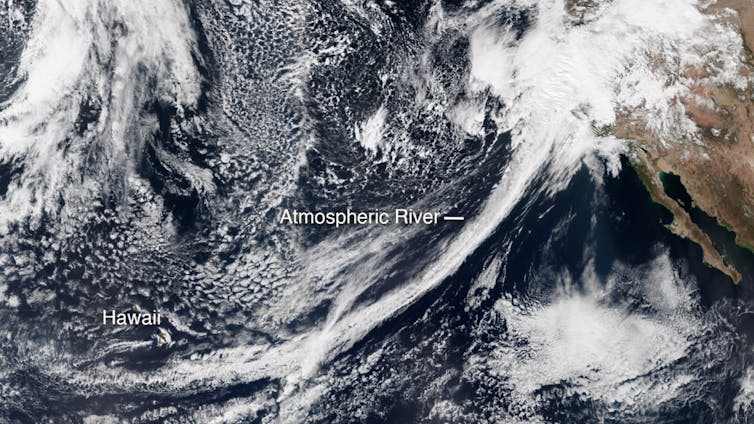
Atmospheric rivers are long filaments of moisture that curve poleward. Several are visible in this satellite image. Bin Guan, NASA/JPL-Caltech and UCLA
Atmospheric rivers – those long, narrow bands of water vapor in the sky that bring heavy rain and storms to the U.S. West Coast and many other regions – are shifting toward higher latitudes, and that’s changing weather patterns around the world.
The shift is worsening droughts in some regions, intensifying flooding in others, and putting water resources that many communities rely on at risk. When atmospheric rivers reach far northward into the Arctic, they can also melt sea ice, affecting the global climate.
In a new study published in Science Advances, University of California, Santa Barbara, climate scientist Qinghua Dingand I show that atmospheric rivers have shifted about 6 to 10 degrees toward the two poles over the past four decades.
California relies on atmospheric rivers for up to 50% of its yearly rainfall. A series of winter atmospheric rivers there can bring enough rain and snow to end a drought, as parts of the region saw in 2023.
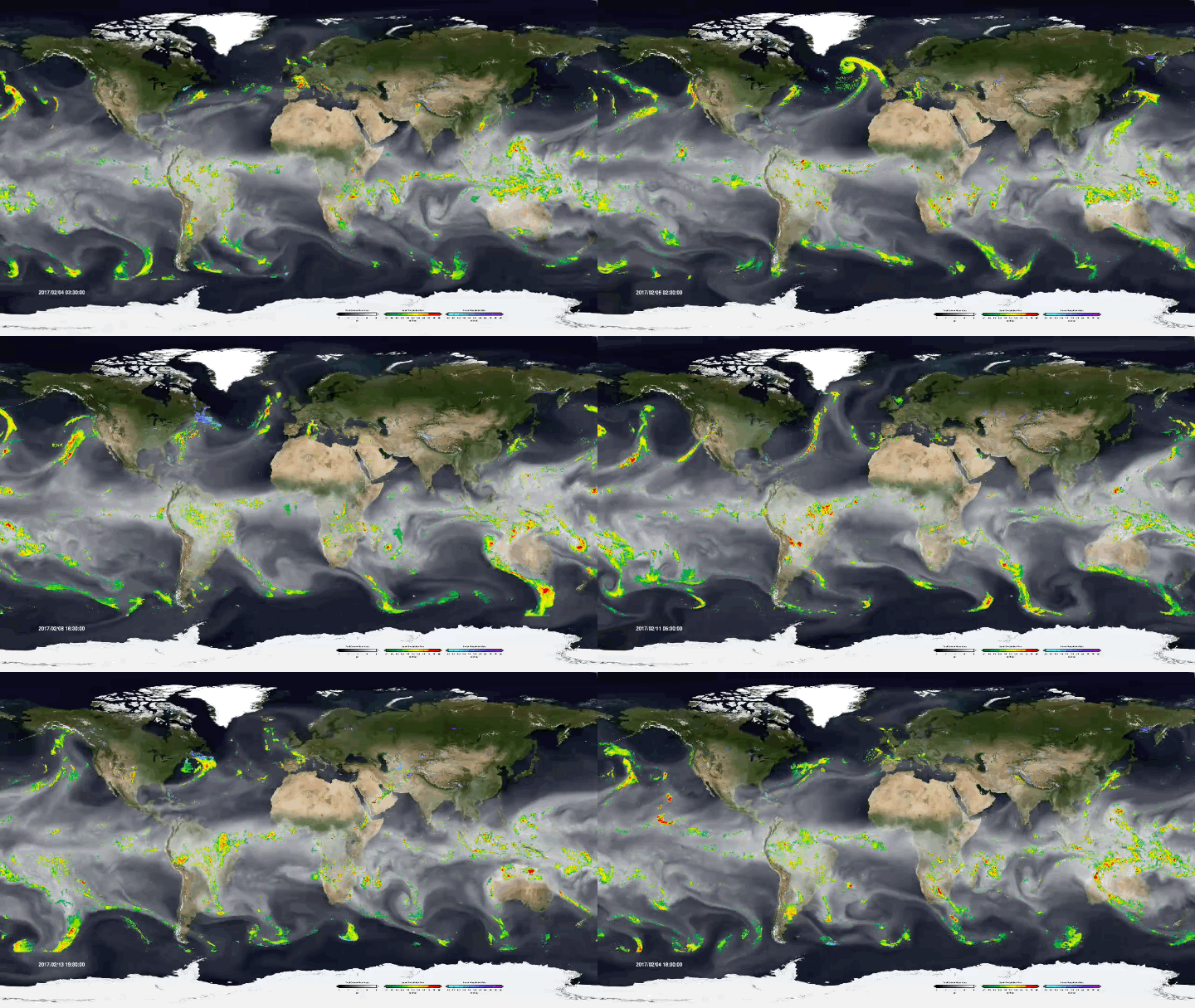
Atmospheric rivers occur all over the world, as this animation of global satellite data from February 2017 shows. NASA/Goddard Space Flight Center Scientific Visualization Studio
While atmospheric rivers share a similar origin – moisture supply from the tropics – atmospheric instability of the jet stream allows them to curve poleward in different ways. No two atmospheric rivers are exactly alike.
What particularly interests climate scientists, including us, is the collective behavior of atmospheric rivers. Atmospheric rivers are commonly seen in the extratropics, a region between the latitudes of 30 and 50 degrees in both hemispheres that includes most of the continental U.S., southern Australia and Chile.
Our study shows that atmospheric rivers have been shifting poleward over the past four decades. In both hemispheres, activity has increased along 50 degrees north and 50 degrees south, while it has decreased along 30 degrees north and 30 degrees south since 1979. In North America, that means more atmospheric rivers drenching British Columbia and Alaska.
The poleward movement of atmospheric rivers can be explained as a chain of interconnected processes.
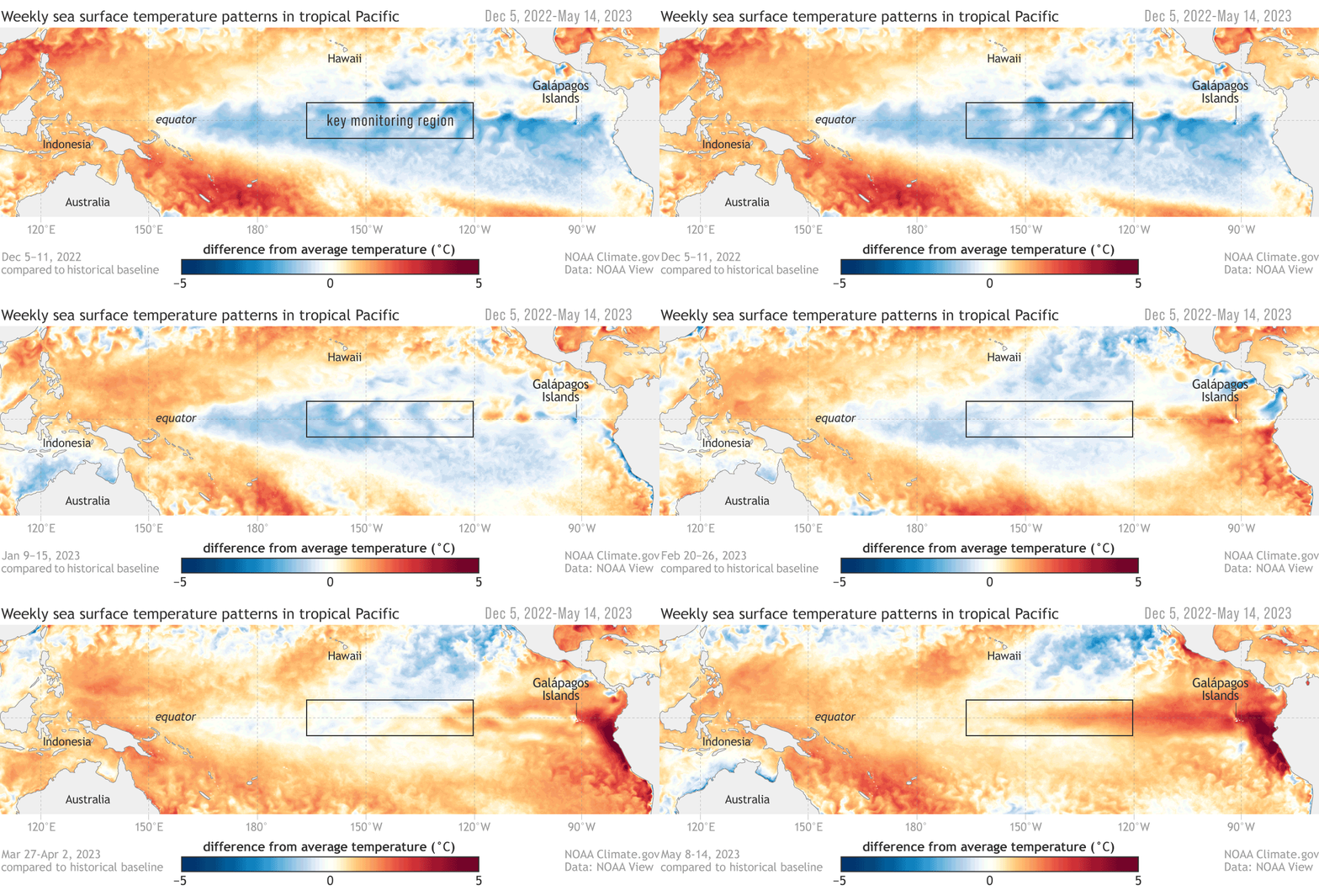
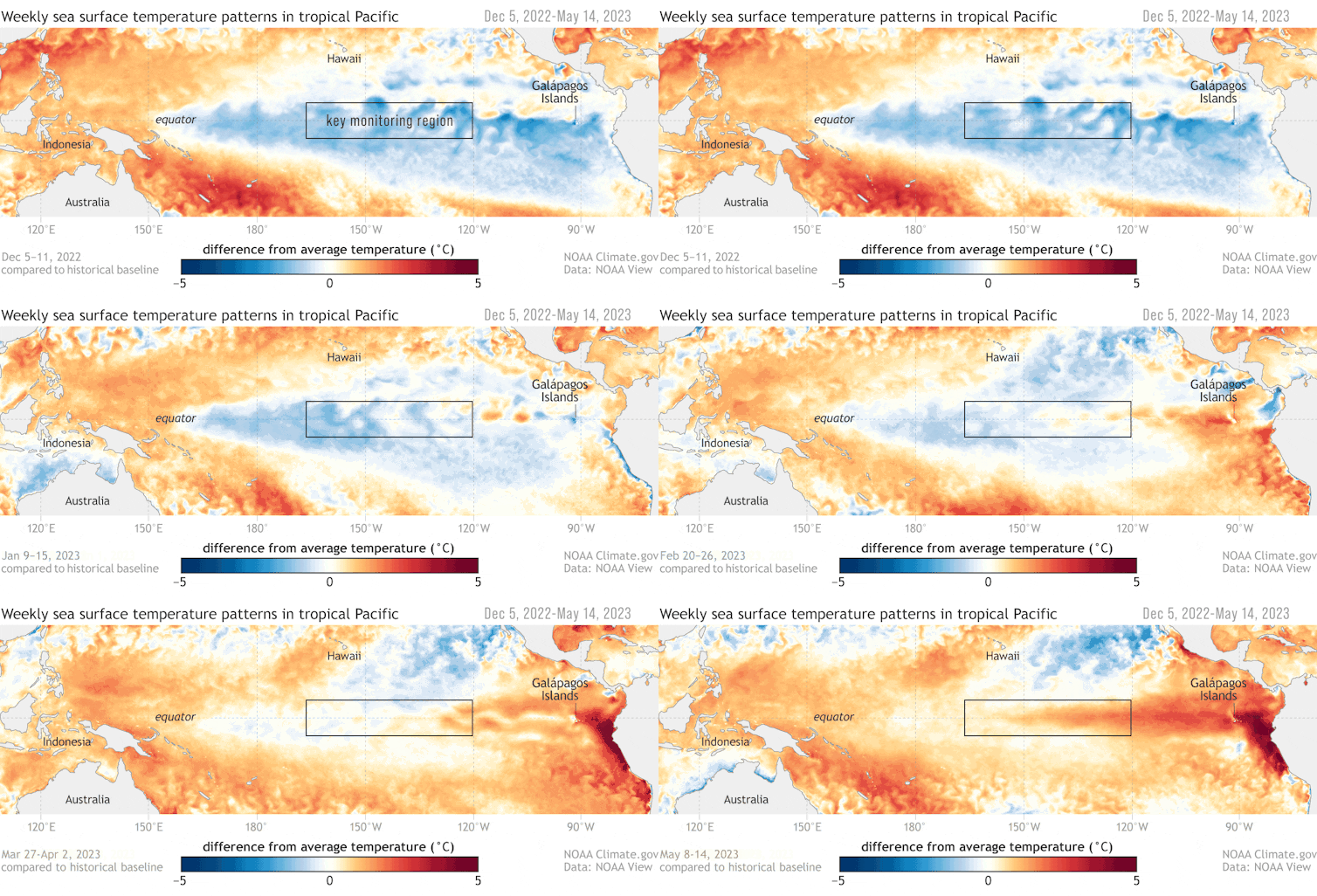
During La Niña conditions, when sea surface temperatures cool in the eastern tropical Pacific, the Walker circulation – giant loops of air that affect precipitation as they rise and fall over different parts of the tropics – strengthens over the western Pacific. This stronger circulation causes the tropical rainfall belt to expand. The expanded tropical rainfall, combined with changes in atmospheric eddy patterns, results in high-pressure anomalies and wind patterns that steer atmospheric rivers farther poleward.
La Niña, with cooler water in the eastern Pacific, fades, and El Niño, with warmer water, starts to form in the tropical Pacific Ocean in 2023. NOAA Climate.gov
Conversely, during El Niño conditions, with warmer sea surface temperatures, the mechanism operates in the opposite direction, shifting atmospheric rivers so they don’t travel as far from the equator.
The shifts raise important questions about how climate models predict future changes in atmospheric rivers. Current models might underestimate natural variability, such as changes in the tropical Pacific, which can significantly affect atmospheric rivers. Understanding this connection can help forecasters make better predictions about future rainfall patterns and water availability.
Why does this poleward shift matter?
A shift in atmospheric rivers can have big effects on local climates.
In the subtropics, where atmospheric rivers are becoming less common, the result could be longer droughts and less water. Many areas, such as California and southern Brazil, depend on atmospheric rivers for rainfall to fill reservoirs and support farming. Without this moisture, these areas could face more water shortages, putting stress on communities, farms and ecosystems.
In higher latitudes, atmospheric rivers moving poleward could lead to more extreme rainfall, flooding and landslides in places such as the U.S. Pacific Northwest, Europe, and even in polar regions.
A satellite image on Feb. 20, 2017, shows an atmospheric river stretching from Hawaii to California, where it brought drenching rain. NASA/Earth Observatory/Jesse Allen
In the Arctic, more atmospheric rivers could speed up sea ice melting, adding to global warming and affecting animals that rely on the ice. An earlier study I was involved in found that the trend in summertime atmospheric river activity may contribute 36% of the increasing trend in summer moisture over the entire Arctic since 1979.
What it means for the future
So far, the shifts we have seen still mainly reflect changes due to natural processes, but human-induced global warming also plays a role. Global warming is expected to increase the overall frequency and intensity of atmospheric rivers because a warmer atmosphere can hold more moisture.
How that might change as the planet continues to warm is less clear. Predicting future changes remains uncertain due largely to the difficulty in predicting thenatural swings between El Niño and La Niña, which play an important role in atmospheric river shifts.
As the world gets warmer, atmospheric rivers – and the critical rains they bring – will keep changing course. We need to understand and adapt to these changes so communities can keep thriving in a changing climate.
Those last two paragraphs of the above article show the difficulty in coming up with clear predictions of the future. As was said: ‘How that might change as the planet continues to warm is less clear. Predicting future changes remains uncertain due largely to the difficulty in predicting thenatural swings between El Niño and La Niña, which play an important role in atmospheric river shifts.‘
For most dogs, their friend groups usually consist of a mix of humans and other dogs. But Lili, a 3-year-old dog who lives on a French Polynesian atoll called Fakarava, isn’t like most other dogs. She prefers friends who have gills and fins. In fact, her very best friend is a shark.
Ever since Lili’s mom, Emmanuelle Larchet, adopted Lili, she’s known that her dog has an affinity for all things aquatic. She started swimming in the lagoon near Larchet’s house when she was only a month old.
“She’s really a water dog,” Larchet told The Dodo.
There are around 100 sharks who live in this lagoon near Larchet’s house. So when Lili swims in the water there, she’s surrounded by them. While many dog parents would be terrified to see their dog swimming amongst sharks, Larchet knows that the sharks Lili swims with are nurse sharks, who are actually very docile creatures.
“We call them sea puppies because [they’re] like dogs, actually … They are very nice,” Larchet said.
Larchet likes to joke that when Lili swims around with her shark friends, it’s sea puppies meeting earth puppies.
Over the years Lili has been swimming in the lagoon, there’s one shark in particular she’s grown especially close with. His name is Sharky, and he and Lili visit each other almost every day. Larchet and Lili are able to recognize Sharky because he has a special marking on one of his fins.
Lili and Sharky like to explore their lagoon together. They enjoy splashing around in the warm, clear water.
“He comes to say hello every time she sees him,” Larchet said.
Even though Lili and Larchet are best friends themselves, Larchet is more than happy to share her Lili with Sharky. And even though Larchet watches Lili hang out with her shark friends all the time, it never gets old seeing them spend time together.
“[When] I see her swimming with Sharky, [I’m] so happy,” Larchet said.
The drawing depicts a turbaned cavalry soldier facing off against an English dragoon. It’s a bit trippy: The British soldier sits astride a carrot, and the turbaned soldier rides a grape. Both carrot and grape are fitted with horses’ heads and stick appendages.
‘The Battle of the Fruit and Vegetable Soldiers,’ a drawing on the back of a manuscript page from Charles Darwin’s ‘On the Origin of Species,’ attributed to Darwin’s young son Francis. Cambridge University Library, CC BY-ND
It’s thought to be the work of Francis Darwin, the seventh child of British naturalist Charles Darwin and his wife, Emma, and appears to have been made in 1857, when Frank would have been 10 or 11. And it’s drawn on the back of a page of a draft of “On the Origin of Species,” Darwin’s masterwork and the foundational text of evolutionary biology. The few sheets of the draft that survive are pages Darwin gave to his children to use for drawing paper.
Darwin’s biographers have long recognized that play was important in his personal and familial life. The Georgian manor in which he and Emma raised their 10 children was furnished with a rope swing hung over the first-floor landing and a portable wooden slide that could be laid over the main stairway. The gardens and surrounding countryside served as an open-air laboratory and playground.
Play also has a role in Darwin’s theory of natural selection. As I explain in my new book, “Kingdom of Play: What Ball-bouncing Octopuses, Belly-flopping Monkeys, and Mud-sliding Elephants Reveal about Life Itself,” there are many similarities – so many that if you could distill the processes of natural selection into a single behavior, that behavior would be play.
Through natural selection, the rock pocket mouse has evolved a coat color that hides it from predators in the desert Southwest.
In contrast to foraging and hunting – behaviors with clearly defined goals – play is likewise undirected. When a pony frolics in a field, a dog wrestles with a stick or chimpanzees chase each other, they act with no goal in mind.
Natural selection is utterly provisional: The evolution of any organism responds to whatever conditions are present at a given place and time. Likewise, animals at play are acting provisionally. They constantly adjust their movements in response to changes in circumstances. Playing squirrels, faced with obstacles such as falling branches or other squirrels, nimbly alter their tactics and routes.
Natural selection is open-ended. The forms of life are not fixed, but continually evolving. Play, too, is open-ended. Animals begin a play session with no plan of when to end it. Two dogs play-fighting, for instance, cease playing only when one is injured, exhausted or simply loses interest.
Keepers noticed that Shanthi, a 36-year-old elephant at the Smithsonian national zoo, liked to make noise with objects, so they gave her horns, harmonicas and other noisemakers.
Play is likewise profligate. It requires an animal to expend time and energy that perhaps would be better devoted to behaviors such as foraging and hunting that could aid survival.
And that profligacy is also advantageous. Animals forage and hunt in specific ways that don’t typically change. But an animal at play is far more likely to innovate – and some of its innovations may in time be adapted into new ways to forage and hunt.
Competing and cooperating
As Darwin first framed it, the “struggle for existence” was by and large a competition. But in the 1860s, Russian naturalist Pyotr Kropotkin’s observations of birds and fallow deer led him to conclude that many species were “the most numerous and the most prosperous” because natural selection also selects for cooperation.
Scientists confirmed Kroptokin’s hypothesis in the 20th century, discovering all manner of cooperation, not only between members of the same species but between members of different species. For example, clown fish are immune to anemone stings; they nestle in anemone tentacles for protection and, in return, keep the anemones free of parasites, provide nutrients and drive away predators.
Play likewise utilizes both competition and cooperation. Two dogs play-fighting are certainly competing, yet to sustain their play, they must cooperate. They often reverse roles: A dog with the advantage of position might suddenly surrender that advantage and roll over on its back. If one bites harder than intended, it is likely to retreat and perform a play bow – saying, in effect, “My bad. I hope we can keep playing.”
River otters at the Oregon Zoo repeatedly separate and reunite while playing in a tub of ice.
Natural selection and play also may both employ deception. From butterflies colored to resemble toxic species to wild cats that squeal like distressed baby monkeys, many organisms use mimicry to deceive their prey, predators and rivals. Play – specifically, play-fighting – similarly offers animals opportunities to learn about and practice deception.
And since natural selection shares so many features with play, we may with some justification maintain that life, in a most fundamental sense, is playful.
It was a sunny spring day in Compton, California, when a group of residents spotted something white bolt across an unused canal. It’s not uncommon to find discarded items strewn along the canal, known as Compton Creek, but this was the first time they’d seen a dog trapped inside.
Situated tens of feet below ground level, the worried onlookers were unsure how a tiny pup made it into the canal in the first place.
“[T]here was no way in except to climb down,” Suzette Hall, founder of Logan’s Legacy 29 dog rescue, wrote on Facebook.
Instagram – La Fine Street Repair
The Good Samaritans rushed to help the pup, later named Sammy, but he was too scared to let anyone get close.
“There were people who went to try to get the dog, but they were unable to secure [him],” Kristina Ross, one of Sammy’s original helpers, wrote in a Facebook comment.
Facebook – Kristina Ross
Ross posted footage of Sammy sprinting down the canal on Facebook and pleaded for someone to save him. After three days of failed attempts, they contacted Logan’s Legacy, and Hall was eager to help.
Hall soon arrived with a humane dog trap in hand. As she figured out a way to lower herself into the canal to set up the trap, another pair of Good Samaritans descended.
“I [saw] the post today and jumped down the sewer with a rope,” one of the Good Samaritans wrote on Instagram. “[I] felt the need to rescue this poor baby.”
Instagram – La Fine Street Repair
The pair trudged through muddy sewer water and trash to reach Sammy. As dangerous and uncomfortable as wading through the canal was, they knew that Sammy’s experience was even worse.
Hall watched as the men tried to catch Sammy multiple times. On their final attempt, one of the guys, Nelson, successfully cornered Sammy and threw a net around him to stop him from bolting again.
Nelson then carefully gathered up the net with Sammy still in it, and his partner lifted the pup out of the canal. They handed Sammy over to Hall, who gave the dog a big, triumphant hug before loading him up in her car.
“He literally melted in my arms,” Hall wrote. “He knew he was finally safe.”
Suzette Hall
Ross, the woman who had originally posted about Sammy, offered to foster him for the night. The grateful pup slept through the night in a cozy bed before heading to the veterinary clinic the next day, where he was immediately treated for a rotten tooth and an injured paw.
The tiny dog was soon on the mend, but his rescuers still couldn’t believe what he’d been through.
“I can’t imagine how scared he was down here in that big, huge canal, all by himself,” Hall wrote on Facebook. “He’s in recovery and doing just fine.”
Suzette Hall
While Sammy recovered at the vet clinic, he stole the heart of one of the vet techs caring for him. Instantly smitten with the pup, the loving vet tech decided to give him the best forever home he could’ve ever dreamed of.
“She said, ‘We have fallen in love … can we please adopt him?’” Hall wrote on Facebook. “[It’s] just so meant to be. He is beyond loved and getting spoiled.”
Suzette Hall
Over a month after his rescue, Sammy is thriving in his new home alongside his equally tiny Chihuahua sibling. His days are filled with cozy beds, walks with his family and play sessions with his doting sibling — and he wouldn’t have it any other way.
For his rescuers, it seems like Sammy’s journey through the canal was just yesterday. But for Sammy, his days of feeling alone and scared are far in the past. Now, he only knows love.
To help pups like Sammy get the care they need, you can donate to Logan’s Legacy 29 here.
ooOOoo
I have included the link to Logan’s Legacy 29 just in case you wanted to help Sammy as well. We have made a small donation.
This is the most perfect outcome one can imagine. Beautiful Sammy!
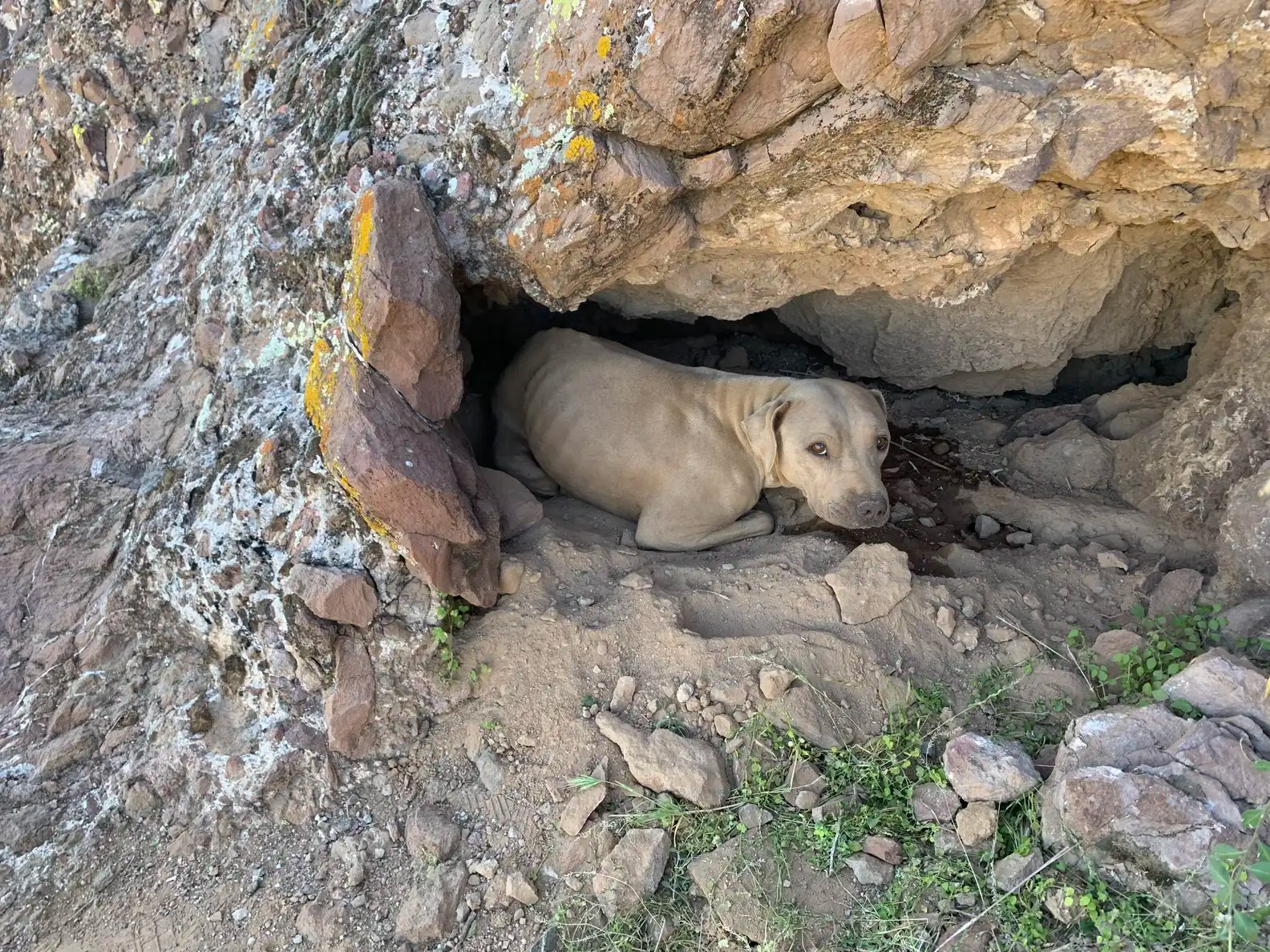
A Good Samaritan was hiking a narrow, slippery trail on Lookout Mountain in Phoenix, Arizona, and was very focused on his hike until something caught his eye. He was about half a mile up the mountain and a little off the beaten path when he caught a glimpse of light reflecting off of something — and was shocked to realize it was a pair of amber eyes.
The eyes belonged to a very scared dog huddled up in a tiny hole in the side of the mountain. She was completely blending in with her surroundings, and if she hadn’t had such piercing eyes, the hiker may not have noticed her. He had no idea how she’d managed to get up there, but it was clear that she’d been stuck for a while and might not be able to last much longer.
The Good Samaritan quickly contacted the Arizona Humane Society (AHS), who sent two emergency animal medical technicians, Tracey Miiller and Ruthie Jesus, out to help while he waited with the pup until they arrived. The dog was definitely scared but seemed open to getting help.
“This Good Samaritan waited probably almost two hours, and then we found this incredible dog, who incidentally is literally the same color as the dirt,” Jesus said in a press release. “She blends in so much, the complainant told us that he wanted to call her Bright Eyes because when he hiked past her, that was literally the only thing he saw was her amber bright eyes staring back at him.”
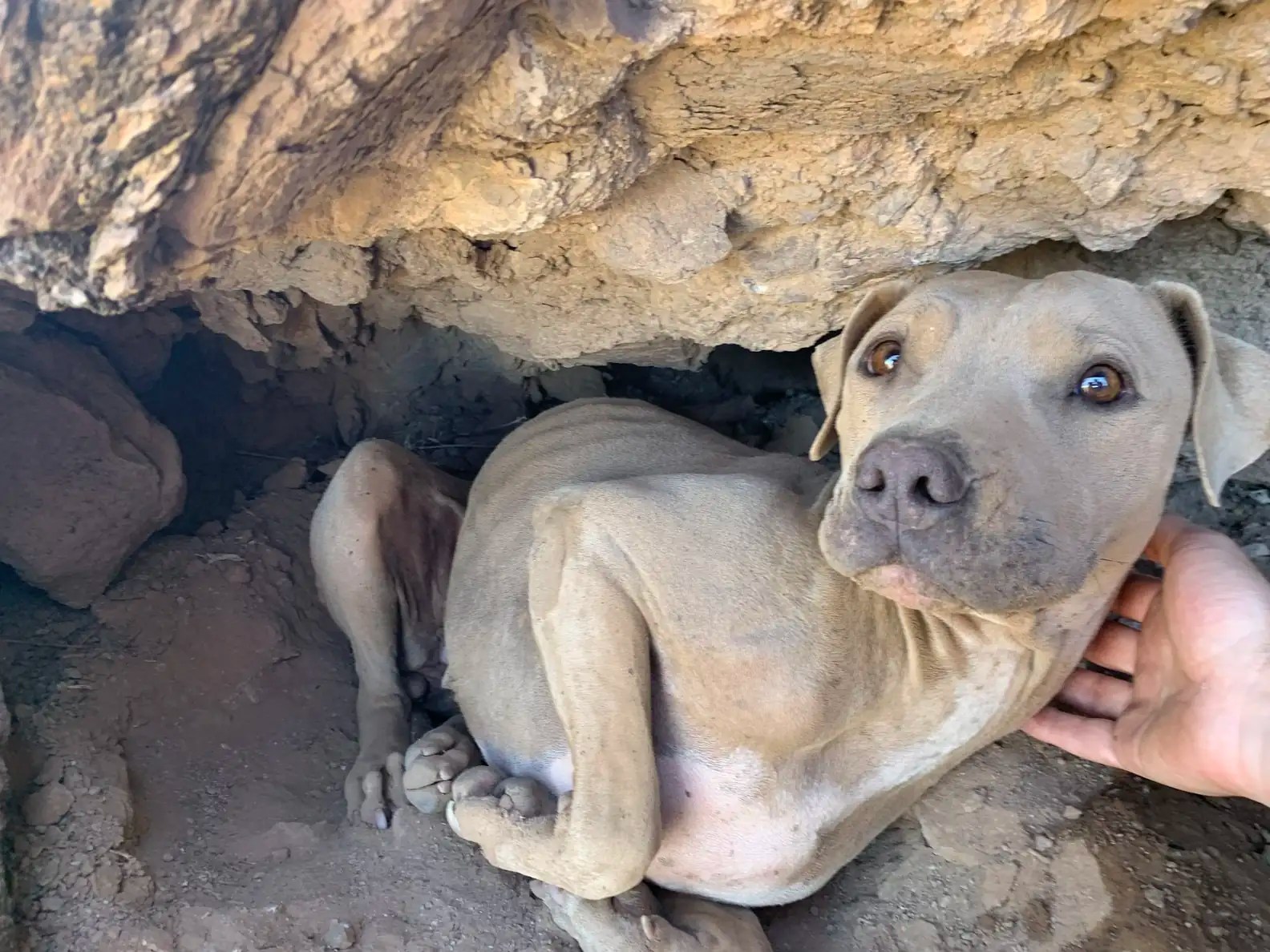
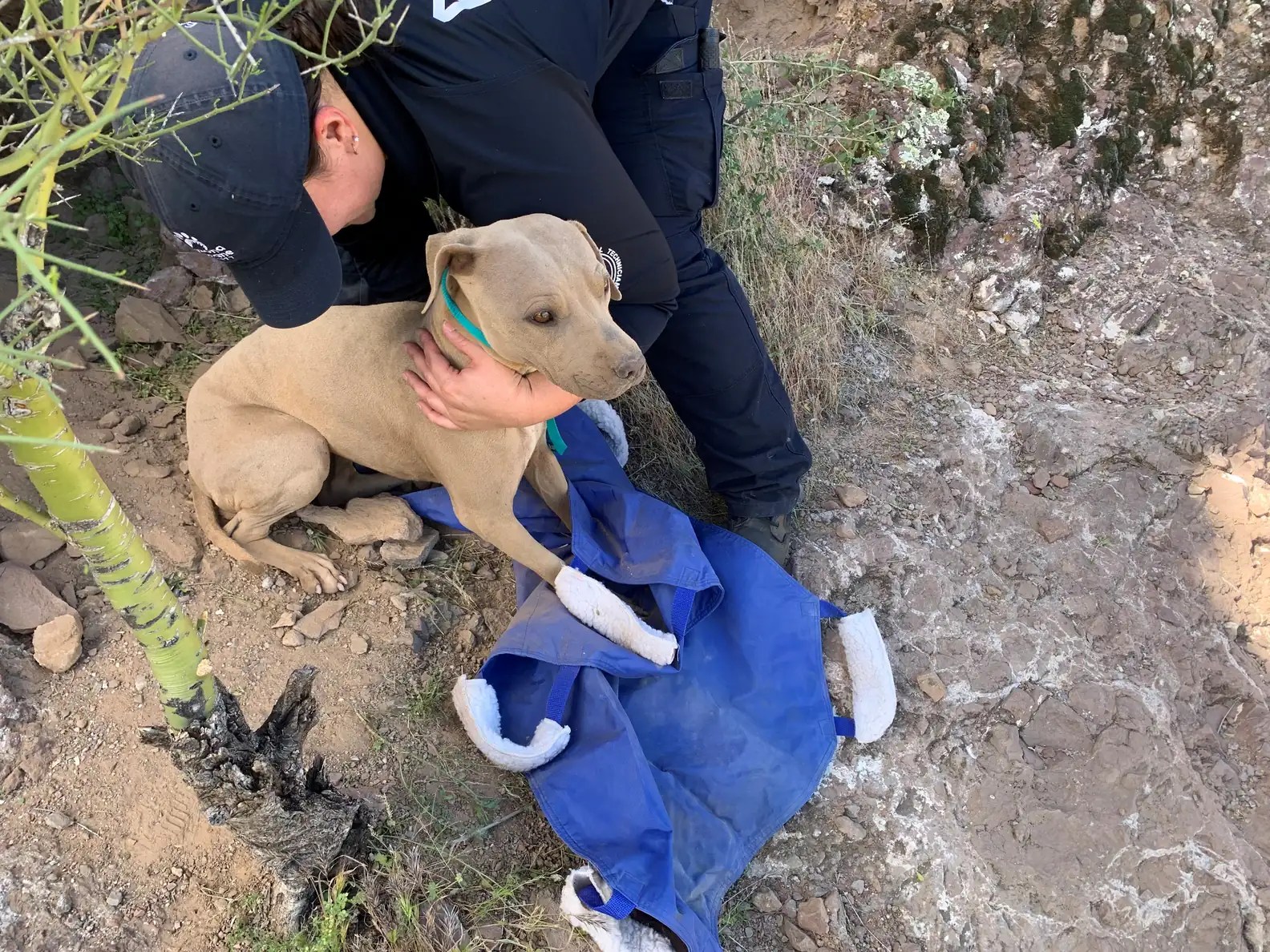
After a quick and careful assessment on the side of the mountain, the technicians determined that Bright Eyes was dangerously dehydrated with cut-up paws and a wound on her rear end.
“She was really sweet and letting me pet her head, but she absolutely did not want to come out of that den, so I kind of had to just sort of pull her out,” Jesus said.
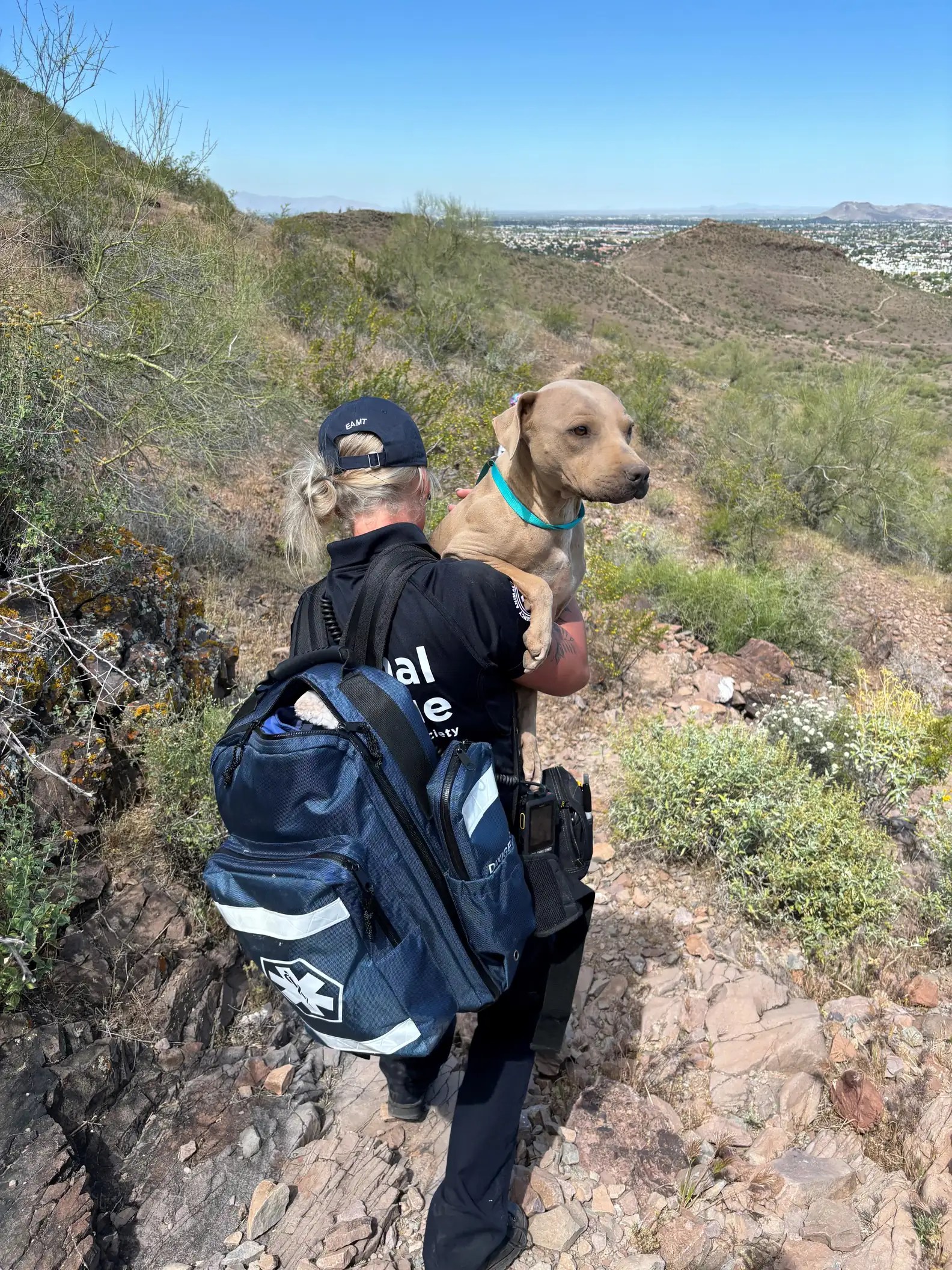
She was definitely too weak to walk with her rescuers down the mountain, so the technicians took turns carrying her until they reached the ambulance. Bright Eyes was calm the whole time, so grateful to finally be safe.
“She actually really just relaxed and seemed to enjoy being carried down the mountain,” Jesus said. “But it was a very teeny-tiny rocky trail that was pretty slick, and so Tracey and I took turns carrying her down the mountain, and she was just an absolute angel. She knew we were getting her to safety.”
It’s still a mystery as to how or why Bright Eyes ended up on the mountain in the first place, but the important thing is someone found her and now she’s getting the care she needs.
“We were so elated to be able to get her,” Jesus said. “She was just so dehydrated. I think she’d probably been up there several days and that was probably her last day, and this Good Samaritan really just saved her life.”
ooOOoo
Frankly, there’s nothing more to add to this account. For it captured all that so many people do for dogs.
It is about Whale songs and is just a fabulous sound!
Last Friday there was an item on the BBC about whale song. It appears I can publish the article for you all. It is my choice over my regular Sunday Picture Parade. I hope you agree! Update: The track just 26 seconds long cannot be reproduced in this post.
ooOOoo
Whale song mystery solved by scientists
21 February 2024, By Helen Briggs and Victoria Gill,Science correspondents, BBC News
Humpback whale breaching near Bering Island, Kamchatka, Russia – Olga Filatova, University of Southern Denmark
Scientists have worked out how some of the largest whales in the ocean produce their haunting and complex songs.
Humpbacks and other baleen whales have evolved a specialised “voice box” that enables them to sing underwater.
The discovery, published in the journal Nature, has also revealed why the noise we make in the ocean is so disruptive for these ocean giants.
Whale song is restricted to a narrow frequency that overlaps with the noise produced by ships. “Sound is absolutely crucial for their survival, because it’s the only way they can find each other to mate in the ocean,” explained Prof Coen Elemans, of the University of Southern Denmark, who led the study.
“[These are some] of the most enigmatic animals that ever lived on the planet,” he told BBC News. “They are amongst the biggest animals, they’re smart and they’re highly social.”
Humpback whale song (For whatever reason the track cannot be listened to on this blog. That is a great shame as the song is magnificent. So please go to the BBC website for this; the link is https://www.bbc.com/news/science-environment-68358414 )
Baleen whales are a group of 14 species, including the blue, humpback, right, minke and gray whale. Instead of teeth, the animals have plates of what is called baleen, through which they sieve huge mouthfuls of tiny creatures from the water.
Exactly how they produce complex, often haunting songs has been a mystery until now. Prof Elemans said it was “super-exciting” to have figured it out.
A diver descends between three juvenile humpback whales the size of buses – Karim Iliya
He and his colleagues carried out experiments using larynxes, or “voice boxes”, that had been carefully removed from three carcasses of stranded whales – a minke, a humpback and a sei whale. They then blew air through the massive structures to produce the sound.
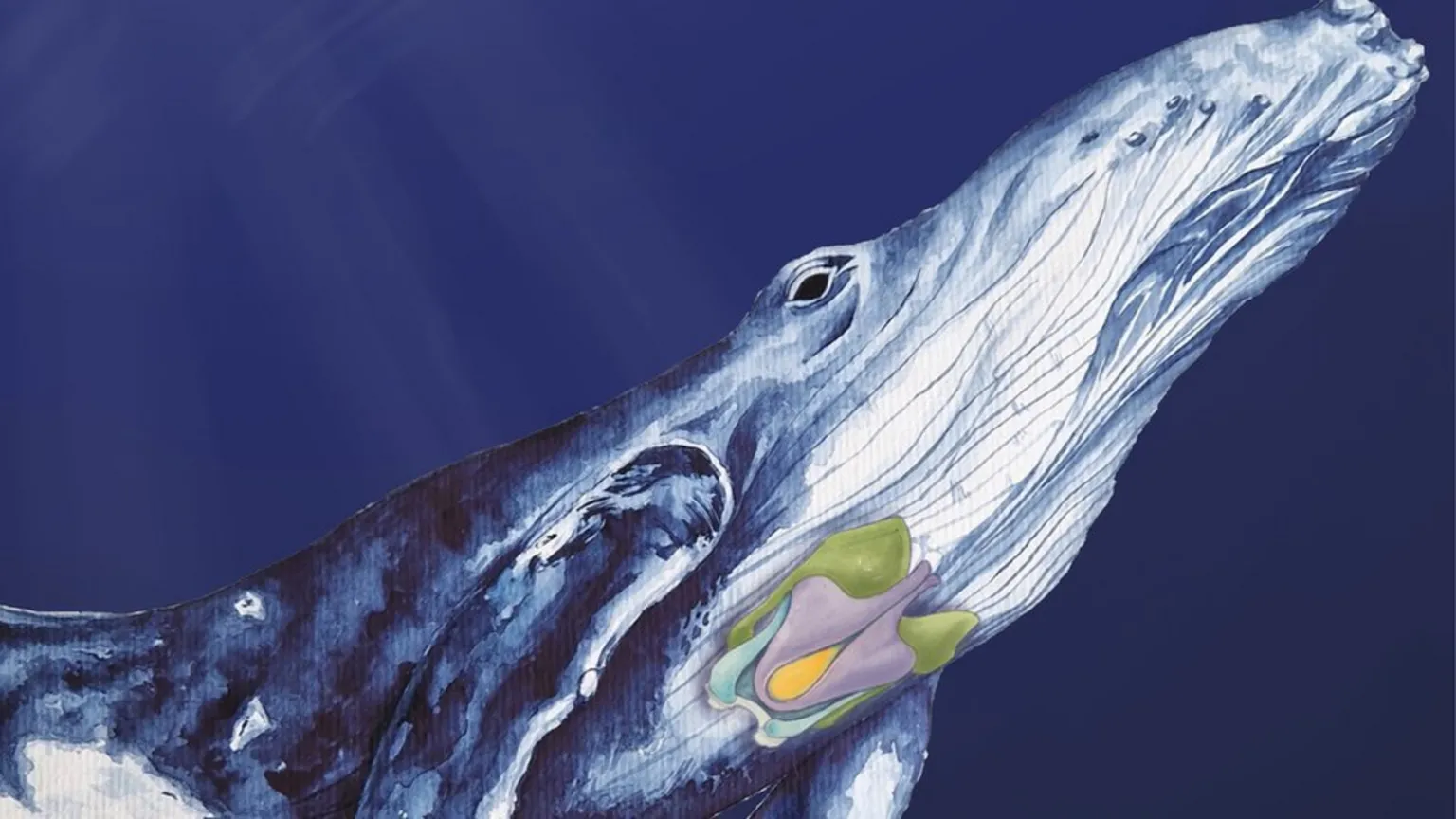
In humans, our voices come from vibrations when air passes over structures called vocal folds in our throat. Baleen whales, instead, have a large U-shaped structure with a cushion of fat at the top of the larynx.
This vocal anatomy allows the animals to sing by recycling air, and it prevents water from being inhaled.
Artwork indicating the cartilages of the larynx in a humpback whale – Patricia Jaqueline Matic, Vienna
The researchers produced computer models of the sounds and showed that baleen whale song is restricted to a narrow frequency which overlaps with noise produced by shipping vessels.
“They cannot simply choose to, for example, sing higher to avoid the noise we make in the ocean,” explained Prof Elemans.
His study demonstrated how our ocean noise could prevent whales from communicating over long distances. That knowledge could be vital for the conservation of humpbacks, blue whales and other endangered giants of the sea.
It also provides insight into questions that researchers have been asking for decades about these eerie songs, which some sailors used to attribute to ghosts or mythical sea creatures.
Whale communication expert Dr Kate Stafford, from Oregon State University, called the study “groundbreaking”.
“The production and reception of sound is the most important sense for marine mammals, so any studies that elucidate how they make sounds has the potential to move the field forward,” she told BBC News.
Researchers say evidence of the harm ocean noise pollution can do has been building for decades – Alamy
The research also paints an evolutionary picture – of how the ancestors of whales returned to the oceans from the land, and the adaptations that made it possible to communicate underwater.
The way so-called toothed whales produce sound is better understood, because the animals are easier to study. These marine mammals, which include dolphins, orcas, sperm whales and porpoises, blow air through a special structure in their nasal passages.
Dr Ellen Garland, from the Sea Mammal Research Unit at the University of St Andrews, said: “I’ve always wondered exactly how baleen whales – especially humpbacks, which my research is focused on – actually produce the variety of sounds they do.
“Studying large whales is extremely challenging at the best of times, but trying to uncover how they produce sound when you may not even be able to see them underwater while vocalising is an added level of difficulty, so these researchers have been very creative.”
Dr Stafford added that the mammals’ ability to make such complex vocal signals was “remarkable” and highlighted “how special these animals are”.
ooOOoo
There! I do hope you all agree that this was very worthwhile. Plus, you all got to listen to those twenty-six seconds of the very beautiful sound.
Bob Derham is someone I met many years ago, when I was living on my yacht in Larnaca, Cyprus, and I can do no better than to repeat what I wrote in my autobiography.
ooOOoo
I negotiated what I thought was a good deal and sold the company. Inevitably I resigned from what was now not my company; it was the end of November in the year of 1988.
In Tollesbury, I had my annual tax returns done by Peter Michael, also living in the village. Peter was an accountant who also taught accountancy at the nearby Essex University. I saw Peter and we discussed the recent agreement for the sale of the business.
“Paul, there is not a lot you can do, to be honest. You will be liable in broad terms for the tax in the difference between the opening price and the closing price. In your case the opening price was near enough zero and the closing price…” Peter did not need to finish the sentence. I got the picture and stood up to leave. Just has I was going out of the room, Peter added: “Unless you can leave the country before April 15th next year, and stay away for a minimum of four tax years. In other words, leave before April 15th, 1989.”
I walked home from Peter Michael’s house that November, 1988 with the advice I had been given ringing in my ears. I would worry about the tax implications in a day or two. But once again fate intervened.
I was a subscriber to the boating magazine Practical Boat Owner (PBO). In a late 1988 issue I read in the classifieds:
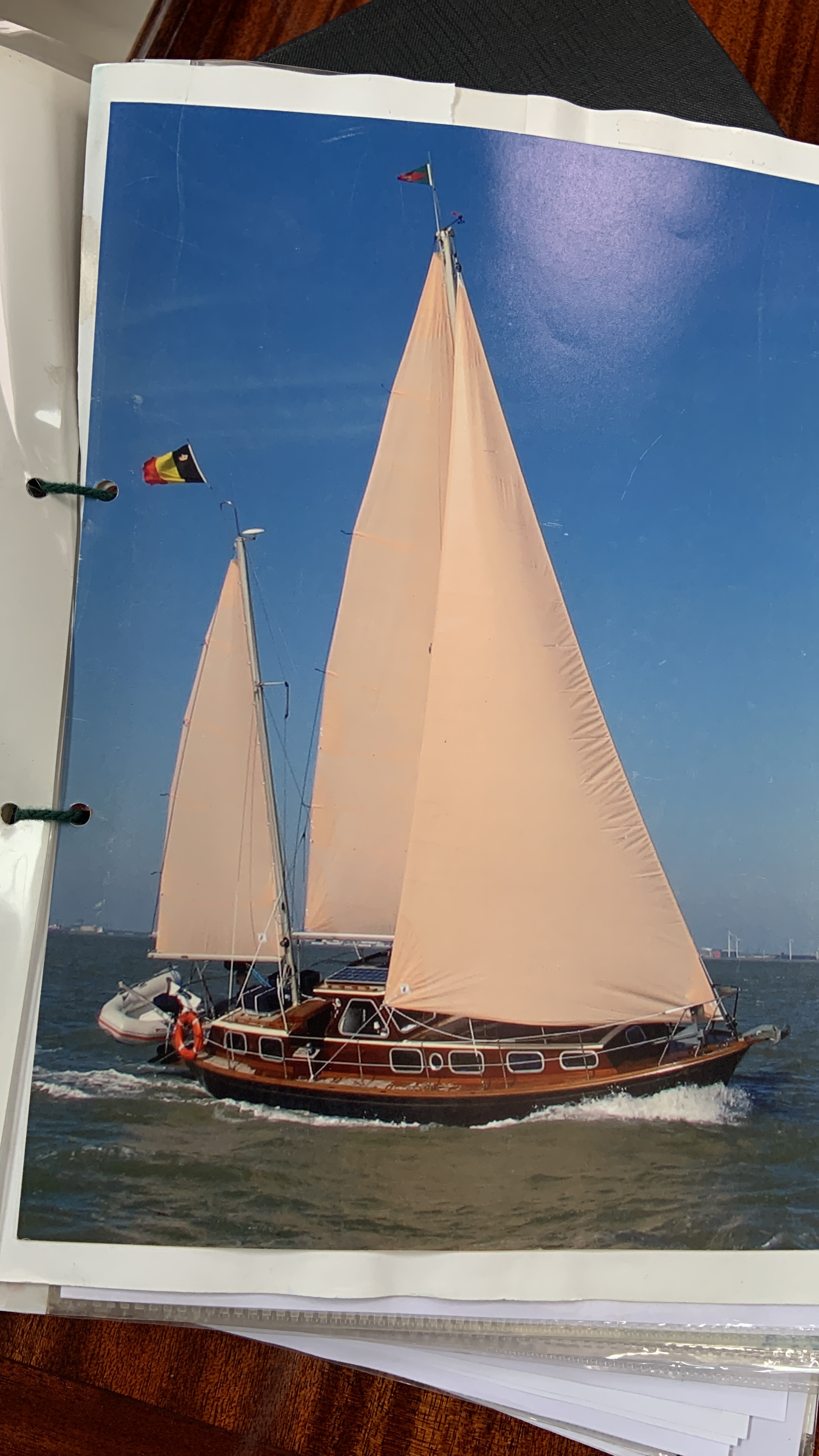
Songbird of Kent – Tradewind 33
Great opportunity to purchase a long-distance ocean yacht designed by John Rock for sea-kindly short-handed sailing.
Well kitted out, continually updated and maintained Songbird of Kent is the yacht for you if you dream of blue waters and serious long distance cruising.
Lying Larnaca, Cyprus.
I knew about Tradewind yachts, was familiar with John Rock. (As the designer of Tradewind yachts he had been featured several times in Practical Boat Owner magazine), and knew how many of his yachts had made world circumnavigations, and, finally, I deserved a holiday. I arranged to go out to Larnaca as soon as I could.
About a week later I caught a flight to Larnaca International Airport; upon arriving I rented a car and drove the few miles to the Marina.
The yacht was easy to find as it was out of the water. I met the owners, Michael and Betty Hughes, who were still living onboard Songbird of Kent. They explained why they were selling. Simply because, as Michael put it, they had been living on the boat for many years and it was time to return to their native Wales. Songbird had been extensively cruised the length of the Mediterranean Sea using Larnaca Marina as the base.
I quietly inspected the boat. Because it was lifted out viewing the boat in detail was much easier than had it still been floating. It was in good condition; very good condition in fact. Then I climbed up the ladder and entered the boat. Again I found everything that I expected, and more. It was clear to me that Michael and Betty had had the boat as their home and, consequently, everything was in order. Or to use the phrase; shipshape and Bristol fashion!
I excused myself, left the yacht and went and sat on a nearby seawall. I wanted to think. To be honest, it was pretty easy thinking. I loved the boat; it was a purchase I could afford, and if everything went to plan and I left the UK before April 15th, 1989, and stayed away for four tax years, there would be no UK tax to pay on the sale of my company Dataview. Nothing: Nada!
So that is exactly what I did!
I went back to Songbird, where Michael and Betty were still sitting in the cockpit, and told them I would buy it. They drew up a contract there and then and I signed it!
My autobiography
ooOOoo
Here is Bob’s story:
Paul and I first met in 1992, when I was working as a contract pilot on the BAC 1-11 for Cyprus Airways.
My last flying post was down in New Zealand, a wonderful place to be, with it’s natural beauty, and lack of aggression and oppression. The joy of life is set around being outdoors, so road trips, camping, sailing, and skiing all feature, but less on big houses, and possessions.
Although I have travelled widely in my career, I now want a simple life, and that amounts to being free of ties to a property, such that all I really need is a warm, dry place to sleep, a suitable place to prepare food, and a place to relax, it is no longer about the big house, which brings it’s own issues, and expenses.
Following on from my time living on Paul’s boat, I was then drawn to living on a boat. I owned a smaller Westerley Centaur, for a few years, and even though small, I had a very happy time when I lived on that. It was down in Lymington, a small market town on the south coast of England opposite Yarmouth, on the Isle of Wight, that I kept my first boat.
The reason for this was simple 🙂
One of the interesting people I met in Cyprus was a man called Les Powles. Paul and I would regularly go out and have a mezze in a side street of Larnaca. Les would be very easy company, and found fun in the most silly situations. I was invited to call by on his boat any time, and have a “ cuppa” What I was intrigued with onboard was a picture of the globe, but cut in half, and opened up. There were a series of lines around the world. I asked Les what this was. His reply was “It’s where I have been when sailing round the world.“
So why I asked are their three lines ?
“Because I have done it three times!“
Les was a most unusual character in that he had started building his boat in 1970. It took him 5 years to complete, and apart from a few short sea trials, Les actually had no other sailing experience, but in 1975, with barely enough rice and water onboard, he headed west. Actually he had intended to go to the Caribbean, but he had applied the variation to his navigation the wrong way, and made land fall 1500 miles from his intended destination. Les only died last year, 96, and his home had been his boat for all those years.
It’s that bit that has been the big thing for me.
Having a home has been ongoing hassle, the fun and enjoyment has been removed, because you are in a trap.
It is important to have a home, but I started to question the point of having a physical building. That brings all the ongoing costs and expenses, where the authorities can milk you for a lot of money!
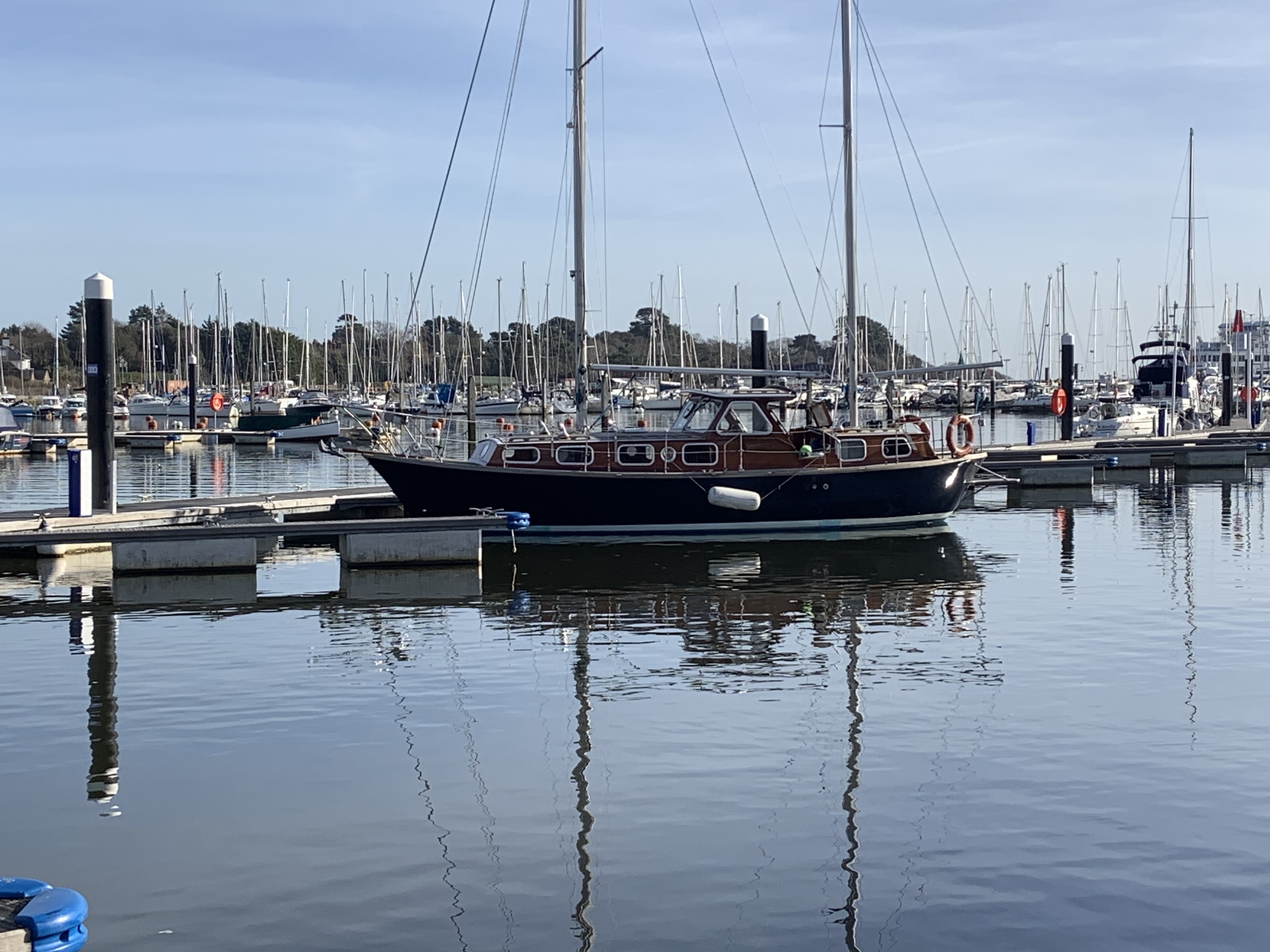
I first saw Antoinette, in Lymington, and from the first moment I saw the boat, I knew I could make the boat my “home.”
She went to Southwold in Suffolk, England for a major refit, and so there is a new engine, gearbox, and propeller, replaced decking, and repairs have been carried out to the hull.
Inside, I can stand up, and although only 37 foot long, being beamy, there is a lot of room.
There are double cabins both fore and after, with “heads” (bathrooms). The main cabin and galley is very comfortable. It has a lot of mahogany wood, so looks homely, and the “dog house” (bit in the middle), is a very open useable space, either enclosed when cold and wet, or if the weather permits, opened up to enjoy the sun.
The key is that this is “my home”.
I can now travel, and go where I like, but I have my home with me. It has heating, but normally when you arrive somewhere, part of the mooring fees offer a shower unit and facilities. I have space to entertain, but above all, I am free of all the ties that we adopt by following the life society offers us as “the norm“.
It is only now that I see the traps that others face, because I can up anchor and head off, and can see where Les Powles got his freedom, and lived his dream.
In the cabin of Antoinette with Finn the dog belonging to Natalie (on the left).
The collie is “Finn”, Natalie’s dog. I think Paul was one of the first to see her when she was born, so 31 years later, Natalie wants to enjoy the alternative life.
As for Finn, he loves it. Fresh air, plenty going on, and a lot to see.
“Tiny living”, but the release from the way most people live is amazing.
No speeding tickets for me. 🤪
ooOOoo
Thank you, Bob for the story of you and me. That last thirty years have flown by and those years on Songbird of Kent were really special albeit the end of my cruising days were pretty scary.













 Learning from Dogs