Category: Uncategorized

Embracing all those who care for our wild animals!

So many who devote so much time and energy, and money no doubt!

Let me state quite clearly my position with regard to hunting wild animals – I abhor it! Technically speaking if someone’s only means of feeding themselves, as in staying alive, is through hunting then I guess that is acceptable. But hunting for any other purposes is beyond the pale. I know that many people, including friends, who live in this part of America would heartedly disagree with my position on hunting. So be it.

Thus when Jean and I look at those who work so hard to protect, sustain and support wild animals we are almost speachless with our admiration for them.

So what’s brought all this on today?

For a long time I have been a follower of the blogsite Canis Lupus 101. On the home page of Canis Lupus 101, on the left-hand sidebar, one can read a plea from Maggie Caldwell, Press Secretary for @Earthjustice, that, in part, says:

For centuries, wolves have been viewed with suspicion and hostility, based in humankind’s deep-rooted fear of the unknown and need to control the natural world.

“The Fable of the Wolf,” a new animated short film produced by Earthjustice, explores this idea, celebrating the wild nature of a deeply misunderstood species.

The film offers an abbreviated history of the relationship between wolves and people—told from the wolf’s perspective—from a time when they coexisted to an era in which people began to fear and exterminate the wolves.

The return of wolves to the northern Rocky Mountains has been called one of America’s greatest conservation stories. But wolves are facing new attacks by members of Congress who are gunning to remove Endangered Species Act protections before the species has recovered.

The film encourages viewers to “join the pack” and sound the alarm about the political threats to this species. Please help us spread the message that wolves are to be celebrated, not feared, by watching this film and sharing it with your friends.

Sincerely,

Maggie Caldwell

Our millions of magnificient and adorable dogs owe their place in today’s world to the wolf. The fact that those who care are still fighting hard to save the wild wolf shows how disgraceful it is for those that see no harm in hunting wolves. Hunting a wolf in my book is hardly any different than going out and hunting a dog!

So with all that out of me, now read about the following glorious efforts to save the wild Mexican wolf. Originally published over on Canis Lupus 101.

ooOOoo

Thursday, January 28, 2016

Poaching slows Mexican wolf population recovery (video)

Brandon Loomis, The Republic | January 27, 2016

After the wild Mexican wolf population tops 100 for the first time, 15 illegal shootings may slow recovery.

(Photo: Mark Henle, Mark Henle/The Republic)

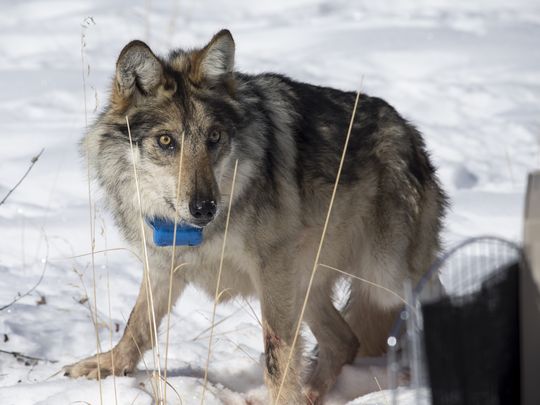
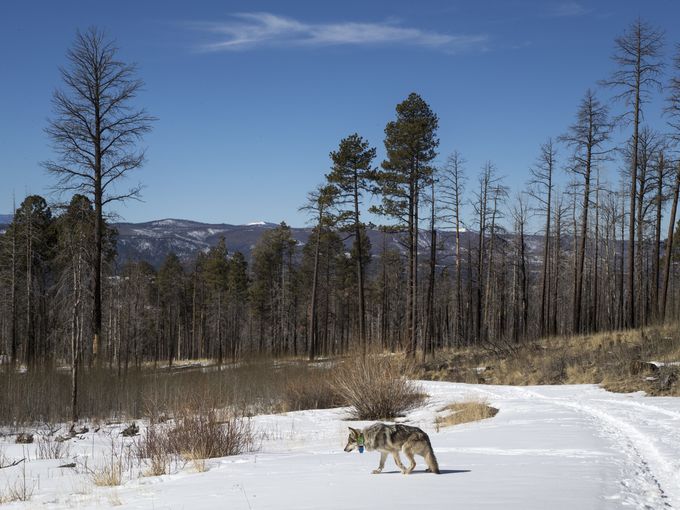
ALPINE — Biologists hauled a 60-pound Mexican gray wolf from the chopper on Monday, limp but healthy with a lush winter mane. They called it the wolf’s worst day in months — dazed from having been darted from above, still rapidly licking his nose through a blindfold muzzle — but the male wolf was one of the fortunate among a divisive and still-embattled breed that has weathered an especially perilous year of poachings.

Unknown shooters have illegally killed at least 15 Mexican wolves since officials reported a year ago that a record 110 were roaming wild in eastern Arizona and western New Mexico, according to a lead state biologist on the recovery program.

The poaching losses tripled from 2014, and were likely unprecedented in the 18 years since the first captive-bred lobos brought their once-exiled howls back to the Blue Range spanning the Apache and Gila national forests.

Wolf-recovery specialists, like those in Alpine this week, are working to make sure the survivors flourish instead of backsliding to a more critically endangered status.

The team of federal and state biologists carried Wolf No. M1342 on a mesh sling. They brought the wolf inside their pine-ringed Alpine field station and slid him onto a slab wooden table for a checkup and shots to keep him robust for an important breeding season this spring. They injected a second sedative that would put the wolf out cold for about an hour.

The scientists gathered round the Elk Horn pack’s would-be alpha male, prodding veins for intravenous fluids and pushing an oxygen tube up his black nostrils.They were counting on the wolf to return healthy to his young mate on snowy Escudilla Mountain, and produce their first successful litter to help extend recent annual gains in a slow-recovering population.

As recently as five years ago, there were an estimated 50 Mexican wolves in the wild, less than half of last year’s count. Whether this year’s survey finds the population continuing to grow will depend on the 40 or so pups observed since last spring. Historically, about half of pups have survived their first year.

Besides the wolves that were shot, about a dozen more adults are missing, “fate unknown.”
M1342 was lucky to have a dart dangling from his paw, and not a trail of lead fragments through his chest. Shootings have always been a key threat since the 1998 reintroduction.

The anti-wolf mentality commonly known as “shoot, shovel and shut up” is hard to combat. Bullets typically pass through a wolf’s body and leave little useful evidence, said Jeff Dolphin, Mexican wolf field supervisor for the Arizona Game and Fish Department. “You just can’t be everywhere at once,” Dolphin said.

Only a handful of what may be dozens of shooters have faced charges related to killing one of the protected wolves since 1998. Federal, state and non-governmental organizations offer a combined reward of up to $58,000 for information leading to the arrest and conviction of a wolf poacher.

A controversial task

Susan Dicks, a U.S. Fish and Wildlife veterinarian examines Wolf No. M1342. (Photo: Mark Henle/The Republic)

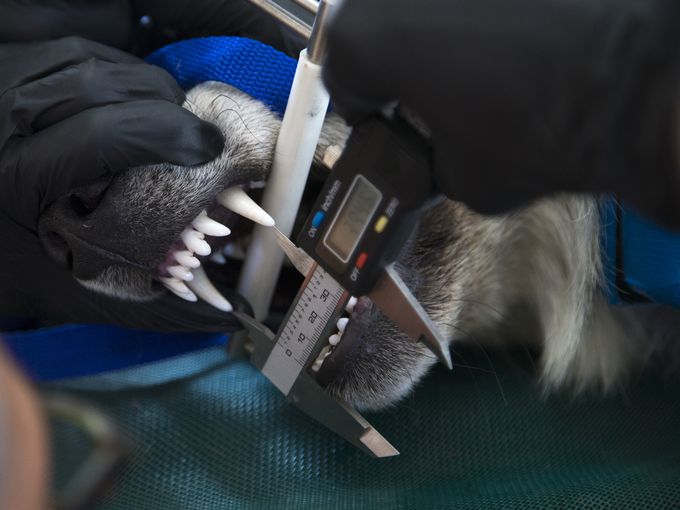
U.S. Fish and Wildlife Service veterinarian Susan Dicks coached the team of biologists and field technicians tending to M1342: how to draw blood for DNA and other tests; where to inject a rabies vaccine; how to determine age by measuring teeth; how to increase fluids or pour cooling alcohol on the paws if his temperature rises past 103 or so.

Besides the preventive medicine and data collection, the prime objective for M1342’s capture during a yearly aerial wolf survey was to fit it with a new transmitter collar. The collar he had received in a similar operation last year hadn’t functioned, so biologists only knew the wolf’s whereabouts by occasional observation. Uncollared wolves are difficult to track to ensure they’re not getting into trouble, such as by attacking livestock.

Not every wild Mexican wolf is collared, but scientists like to have them on a wolf of every generation in a pack. Last year’s survey counted 19 packs, including eight known to have a breeding pair.

Studies show that these free-ranging wolves eat elk upward of 80 percent of the time, but cows are also occasionally on the menu. A government and non-profit fund pays for the losses. So far, the wolf program has paid out $68,000 for 50 confirmed livestock losses in 2015, and another $25,000 in claims is awaiting action by a compensation council. “It’s such a controversial program, and (people) want us to manage these animals,” Dicks explained. “The way we manage is with that collar. It communicates and tells us what they’re doing.”

The latest in a string of political struggles over the lightweight cousin of more plentiful northern gray wolves involves where they should be allowed.
Wolf advocates say they need unoccupied territory such as the forests around the Grand Canyon to sustain a population large and dispersed enough to withstand sudden die-offs. The governors of Arizona, New Mexico, Colorado and Utah recently co-signed a letter to the federal program opposing such a northern expansion into previously undocumented wolf territory and instead backing a push south into Mexico.

The number of wolves needed to ensure long-term survival also is in dispute. Some want to hold the line around today’s numbers, but others say at least a sevenfold increase is needed.

Picture parade one hundred and thirty.

Speaking of dogs and cats …

(With huge thanks to John H. for sending these on to me.)

Image[139]oooo

Image[140]oooo

Image[141]oooo

Image[142]oooo

Image[143]oooo

Image[144]oooo

Image[145]oooo

Image[146]Another set of these gorgeous photographs next week.

Stay happy and stay warm all of you!

Subscription process change

Please read this carefully.

Regular followers and readers will have noticed some recent changes in the look and feel of Learning from Dogs. Much of this has been to do with bringing the blog up to speed, so to speak, so that the millions of smartphone and tablet users out there can easily view and navigate their way around the blog.

One of the improvements being implemented is to do with subscribers, both existing and new ones.

At present, when you choose to follow this blog, that process is one of the applications that WordPress provide.

However, I am minded to make some special offers to all of you loyal followers from time to time and not want those offers displayed as an open blog post.  The only way to achieve that is to implement a change to the subscription process.

In a nutshell, within the next few hours the subscription application will be changed from WordPress to MailChimp. The MailChimp ‘app’ is widely used on WordPress blogs.

If you have any queries or questions, please offer them as a comment to this post.

I am certain that the change will be practically seamless to all of you.

Many thanks,

Paul H.

Thoughts about the future.

“Predictions are so difficult – especially when they concern the future.”

That witticism in the sub-title is not my invention, far from it, but, nonetheless, it seemed appropriate for today’s post. For today’s post is the republication of a recent essay that appeared over on TomDispatch. Tom Engelhardt, as with George Monbiot, gave me blanket permission to republish his essays some time ago and his latest essay, or rather the essay from TomDispatch regular Michael Klare, seemed worthy of being shared with the many dear readers of this place.

So with no further delay, let me offer you: Are Resource Wars Our Future? (NB: there were too many links to carry across in the essay so I have indicated each link by changing the text colour to red. If you skip across to the TomDispatch page, you can link through to the relevant item.)

ooOOoo

Tomgram: Michael Klare, Are Resource Wars Our Future?

Posted by Michael Klare at 7:24am, November 3, 2015.
Follow TomDispatch on Twitter @TomDispatch.

These days, all you have to do is look around if you want your hair to stand on end on the subject of our future on this planet. Here’s just a little relatively random list of recent news on climate-change-related happenings.

Mexico was recently hit by the most powerful hurricane ever recorded in the Western Hemisphere. According to the National Oceanic and Atmospheric Administration, average global temperatures for September ran off the rails. (“This marks the fifth consecutive month a monthly high temperature record has been set and is the highest departure from average for any month among all 1,629 months in the record that began in January 1880.”) It was the seventh month of 2015 to be “record shattering” and the year itself looks as if it might cumulatively be the same. (By now, this story is considered so humdrum and expectable that it didn’t even make the front page of my hometown newspaper!) The cataclysmic civil war, terror war, and international conflict in Syria is being reclassified as the first climate-change war based on the staggering drought that preceded it. That, in fact, has been called “the worst long-term drought and most severe set of crop failures since agricultural civilizations began in the Fertile Crescent many millennia ago.” Turning to colder climes, ice in Antarctica is melting so unexpectedly quickly that, according to the latest research, the continent’s ice shelves might be heading for collapse by 2100, guaranteeing a future rise in sea levels of potentially staggering proportions. Meanwhile, last week you could go online and watch dramatic video evidence of the melting of Greenland — rivers of water raging across a dissolving ice shelf that, one of these decades, will raise sea levels by an estimated 20 feet globally. And oh yes, for those of you curious about the hotter regions, a new study indicates that heat waves in the Persian Gulf may be so fierce before or by the end of this century that, in some of parts of the oil heartlands of the planet, they might quite literally endanger human survival.

Need I go on? Need I mention why the upcoming climate change confab in Paris in a few weeks matters big time? Need I add that, whatever agreements may be reached there, they are essentially guaranteed not to be enough to bring global warming truly under control. And in that context, if you think that a Greater Middle East with five failed states in it since 2001 is already a nightmare, consider TomDispatch regular Michael Klare’s vision of a resource-war-torn planet in a “record-shattering” future of abysmal heat and climate tipping points. If you want to know what’s at stake for our grandchildren and great-grandchildren, read this article. Tom

Why the Paris Climate Summit Will Be a Peace Conference Averting a World of Failed States and Resource Wars

By Michael T. Klare

At the end of November, delegations from nearly 200 countries will convene in Paris for what is billed as the most important climate meeting ever held. Officially known as the 21st Conference of the Parties (COP-21) of the United Nations Framework Convention on Climate Change (the 1992 treaty that designated that phenomenon a threat to planetary health and human survival), the Paris summit will be focused on the adoption of measures that would limit global warming to less than catastrophic levels. If it fails, world temperatures in the coming decades are likely to exceed 2 degrees Celsius (3.5 degrees Fahrenheit), the maximum amount most scientists believe the Earth can endure without experiencing irreversible climate shocks, including soaring temperatures and a substantial rise in global sea levels.

A failure to cap carbon emissions guarantees another result as well, though one far less discussed. It will, in the long run, bring on not just climate shocks, but also worldwide instability, insurrection, and warfare. In this sense, COP-21 should be considered not just a climate summit but a peace conference — perhaps the most significant peace convocation in history.

To grasp why, consider the latest scientific findings on the likely impacts of global warming, especially the 2014 report of the Intergovernmental Panel on Climate Change (IPCC). When first published, that report attracted worldwide media coverage for predicting that unchecked climate change will result in severe droughts, intense storms, oppressive heat waves, recurring crop failures, and coastal flooding, all leading to widespread death and deprivation. Recent events, including a punishing drought in California and crippling heat waves in Europe and Asia, have focused more attention on just such impacts. The IPCC report, however, suggested that global warming would have devastating impacts of a social and political nature as well, including economic decline, state collapse, civil strife, mass migrations, and sooner or later resource wars.

These predictions have received far less attention, and yet the possibility of such a future should be obvious enough since human institutions, like natural systems, are vulnerable to climate change. Economies are going to suffer when key commodities — crops, timber, fish, livestock — grow scarcer, are destroyed, or fail. Societies will begin to buckle under the strain of economic decline and massive refugee flows. Armed conflict may not be the most immediate consequence of these developments, the IPCC notes, but combine the effects of climate change with already existing poverty, hunger, resource scarcity, incompetent and corrupt governance, and ethnic, religious, or national resentments, and you’re likely to end up with bitter conflicts over access to food, water, land, and other necessities of life.

The Coming of Climate Civil Wars

Such wars would not arise in a vacuum. Already existing stresses and grievances would be heightened, enflamed undoubtedly by provocative acts and the exhortations of demagogic leaders. Think of the current outbreak of violence in Israel and the Palestinian territories, touched off by clashes over access to the Temple Mount in Jerusalem (also known as the Noble Sanctuary) and the inflammatory rhetoric of assorted leaders. Combine economic and resource deprivation with such situations and you have a perfect recipe for war.

The necessities of life are already unevenly distributed across the planet. Often the divide between those with access to adequate supplies of vital resources and those lacking them coincides with long-term schisms along racial, ethnic, religious, or linguistic lines. The Israelis and Palestinians, for example, harbor deep-seated ethnic and religious hostilities but also experience vastly different possibilities when it comes to access to land and water. Add the stresses of climate change to such situations and you can naturally expect passions to boil over.

Climate change will degrade or destroy many natural systems, often already under stress, on which humans rely for their survival. Some areas that now support agriculture or animal husbandry may become uninhabitable or capable only of providing for greatly diminished populations. Under the pressure of rising temperatures and increasingly fierce droughts, the southern fringe of the Sahara desert, for example, is now being transformed from grasslands capable of sustaining nomadic herders into an empty wasteland, forcing local nomads off their ancestral lands. Many existing farmlands in Africa, Asia, and the Middle East will suffer a similar fate. Rivers that once supplied water year-round will run only sporadically or dry up altogether, again leaving populations with unpalatable choices.
klarepbk2012As the IPCC report points out, enormous pressure will be put upon often weak state institutions to adjust to climate change and aid those in desperate need of emergency food, shelter, and other necessities. “Increased human insecurity,” the report says, “may coincide with a decline in the capacity of states to conduct effective adaptation efforts, thus creating the circumstances in which there is greater potential for violent conflict.”

A good example of this peril is provided by the outbreak of civil war in Syria and the subsequent collapse of that country in a welter of fighting and a wave of refugees of a sort that hasn’t been seen since World War II. Between 2006 and 2010, Syria experienced a devastating drought in which climate change is believed to have been a factor, turning nearly 60% of the country into desert. Crops failed and most of the country’s livestock perished, forcing millions of farmers into penury. Desperate and unable to live on their land any longer, they moved into Syria’s major cities in search of work, often facing extreme hardship as well as hostility from well-connected urban elites.

Had Syrian autocrat Bashar al-Assad responded with an emergency program of jobs and housing for those displaced, perhaps conflict could have been averted. Instead, he cut food and fuel subsidies, adding to the misery of the migrants and fanning the flames of revolt. In the view of several prominent scholars, “the rapidly growing urban peripheries of Syria, marked by illegal settlements, overcrowding, poor infrastructure, unemployment, and crime, were neglected by the Assad government and became the heart of the developing unrest.”

A similar picture has unfolded in the Sahel region of Africa, the southern fringe of the Sahara, where severe drought has combined with habitat decline and government neglect to provoke armed violence. The area has faced many such periods in the past, but now, thanks to climate change, there is less time between the droughts. “Instead of 10 years apart, they became five years apart, and now only a couple years apart,” observes Robert Piper, the United Nations regional humanitarian coordinator for the Sahel. “And that, in turn, is putting enormous stresses on what is already an incredibly fragile environment and a highly vulnerable population.”

In Mali, one of several nations straddling this region, the nomadic Tuaregs have been particularly hard hit, as the grasslands they rely on to feed their cattle are turning into desert. A Berber-speaking Muslim population, the Tuaregs have long faced hostility from the central government in Bamako, once controlled by the French and now by black Africans of Christian or animist faith. With their traditional livelihoods in peril and little assistance forthcoming from the capital, the Tuaregs revolted in January 2012, capturing half of Mali before being driven back into the Sahara by French and other foreign forces (with U.S. logistical and intelligence support).

Consider the events in Syria and Mali previews of what is likely to come later in this century on a far larger scale. As climate change intensifies, bringing not just desertification but rising sea levels in low-lying coastal areas and increasingly devastating heat waves in regions that are already hot, ever more parts of the planet will be rendered less habitable, pushing millions of people into desperate flight.

While the strongest and wealthiest governments, especially in more temperate regions, will be better able to cope with these stresses, expect to see the number of failed states grow dramatically, leading to violence and open warfare over what food, arable land, and shelter remains. In other words, imagine significant parts of the planet in the kind of state that Libya, Syria, and Yemen are in today. Some people will stay and fight to survive; others will migrate, almost assuredly encountering a far more violent version of the hostility we already see toward immigrants and refugees in the lands they head for. The result, inevitably, will be a global epidemic of resource civil wars and resource violence of every sort.

Water Wars

Most of these conflicts will be of an internal, civil character: clan against clan, tribe against tribe, sect against sect. On a climate-changed planet, however, don’t rule out struggles among nations for diminished vital resources — especially access to water. It’s already clear that climate change will reduce the supply of water in many tropical and subtropical regions, jeopardizing the continued pursuit of agriculture, the health and functioning of major cities, and possibly the very sinews of society.

The risk of “water wars” will arise when two or more countries depend on the same key water source — the Nile, the Jordan, the Euphrates, the Indus, the Mekong, or other trans-boundary river systems — and one or more of them seek to appropriate a disproportionate share of the ever-shrinking supply of its water. Attempts by countries to build dams and divert the water flow of such riverine systems have already provoked skirmishes and threats of war, as when Turkey and Syria erected dams on the Euphrates, constraining the downstream flow.

One system that has attracted particular concern in this regard is the Brahmaputra River, which originates in China (where it is known as the Yarlung Tsangpo) and passes through India and Bangladesh before emptying into the Indian Ocean. China has already erected one dam on the river and has plans for more, producing considerable unease in India, where the Brahmaputra’s water is vital for agriculture. But what has provoked the most alarm is a Chinese plan to channel water from that river to water-scarce areas in the northern part of that country.

The Chinese insist that no such action is imminent, but intensified warming and increased drought could, in the future, prompt such a move, jeopardizing India’s water supply and possibly provoking a conflict. “China’s construction of dams and the proposed diversion of the Brahmaputra’s waters is not only expected to have repercussions for water flow, agriculture, ecology, and lives and livelihoods downstream,” Sudha Ramachandran writes in The Diplomat, “it could also become another contentious issue undermining Sino-Indian relations.”

Of course, even in a future of far greater water stresses, such situations are not guaranteed to provoke armed combat. Perhaps the states involved will figure out how to share whatever limited resources remain and seek alternative means of survival. Nonetheless, the temptation to employ force is bound to grow as supplies dwindle and millions of people face thirst and starvation. In such circumstances, the survival of the state itself will be at risk, inviting desperate measures.

Lowering the Temperature

There is much that undoubtedly could be done to reduce the risk of water wars, including the adoption of cooperative water-management schemes and the introduction of the wholesale use of drip irrigation and related processes that use water far more efficiently. However, the best way to avoid future climate-related strife is, of course, to reduce the pace of global warming. Every fraction of a degree less warming achieved in Paris and thereafter will mean that much less blood spilled in future climate-driven resource wars.

This is why the Paris climate summit should be viewed as a kind of preemptive peace conference, one that is taking place before the wars truly begin. If delegates to COP-21 succeed in sending us down a path that limits global warming to 2 degrees Celsius, the risk of future violence will be diminished accordingly. Needless to say, even 2 degrees of warming guarantees substantial damage to vital natural systems, potentially severe resource scarcities, and attendant civil strife. As a result, a lower ceiling for temperature rise would be preferable and should be the goal of future conferences. Still, given the carbon emissions pouring into the atmosphere, even a 2-degree cap would be a significant accomplishment.

To achieve such an outcome, delegates will undoubtedly have to begin dealing with conflicts of the present moment as well, including those in Syria, Iraq, Yemen, and Ukraine, in order to collaborate in devising common, mutually binding climate measures. In this sense, too, the Paris summit will be a peace conference. For the first time, the nations of the world will have to step beyond national thinking and embrace a higher goal: the safety of the ecosphere and all its human inhabitants, no matter their national, ethnic, religious, racial, or linguistic identities. Nothing like this has ever been attempted, which means that it will be an exercise in peacemaking of the most essential sort — and, for once, before the wars truly begin.

Michael T. Klare, a TomDispatch regular, is a professor of peace and world security studies at Hampshire College and the author, most recently, of The Race for What’s Left. A documentary movie version of his book Blood and Oil is available from the Media Education Foundation. Follow him on Twitter at @mklare1.

Follow TomDispatch on Twitter and join us on Facebook. Check out the newest Dispatch Book, Nick Turse’s Tomorrow’s Battlefield: U.S. Proxy Wars and Secret Ops in Africa, and Tom Engelhardt’s latest book, Shadow Government: Surveillance, Secret Wars, and a Global Security State in a Single-Superpower World.

Copyright 2015 Michael T. Klare

ooOOoo

Thank goodness I offer a change of scenery, so to speak, tomorrow.

With power comes responsibility.

“The price of greatness is responsibility.”

So said Sir Winston Churchill. It applies equally to the price of power.

There was an essay recently written and published by Hariod Brawn over on her blog Contentedness.net that was incredibly thought-provoking and very beautiful besides. Hariod has given me permission to republish it and it follows shortly.

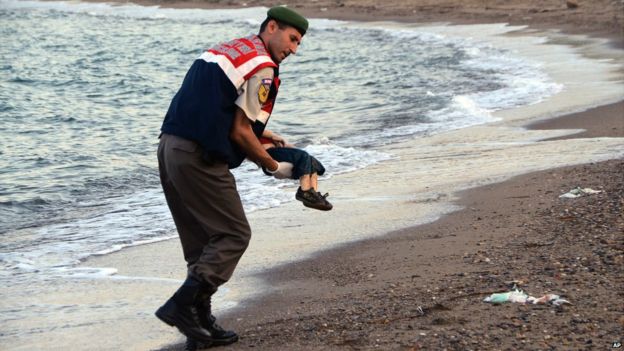
I have no doubt that Hariod’s essay was, in part, inspired by that terrible photograph that has been circulated and commented upon by thousands around the world.

_85332393_full-pic

In the words of the BBC, “The pictured boy is reported to be three-year-old Aylan, who drowned along with his five-year-old brother Galip and their mother, Rihan. Their father, Abdullah Kurdi, survived.”

The emotions created by this and other tragic photographs are disturbing, and I am no exception to having those same emotions. But as friend, Chris Snuggs, mentioned in a telephone call between us yesterday morning, what has been happening in Syria is no less terrible, perhaps even more so when one looks at the blood that is, metaphorically, on the hands of a number of western governments. The old saying of reaping what we sow comes to mind.

None of which takes away the intense beauty of Hariod’s essay: Empathetic apes.

ooOOoo

Empathic apes

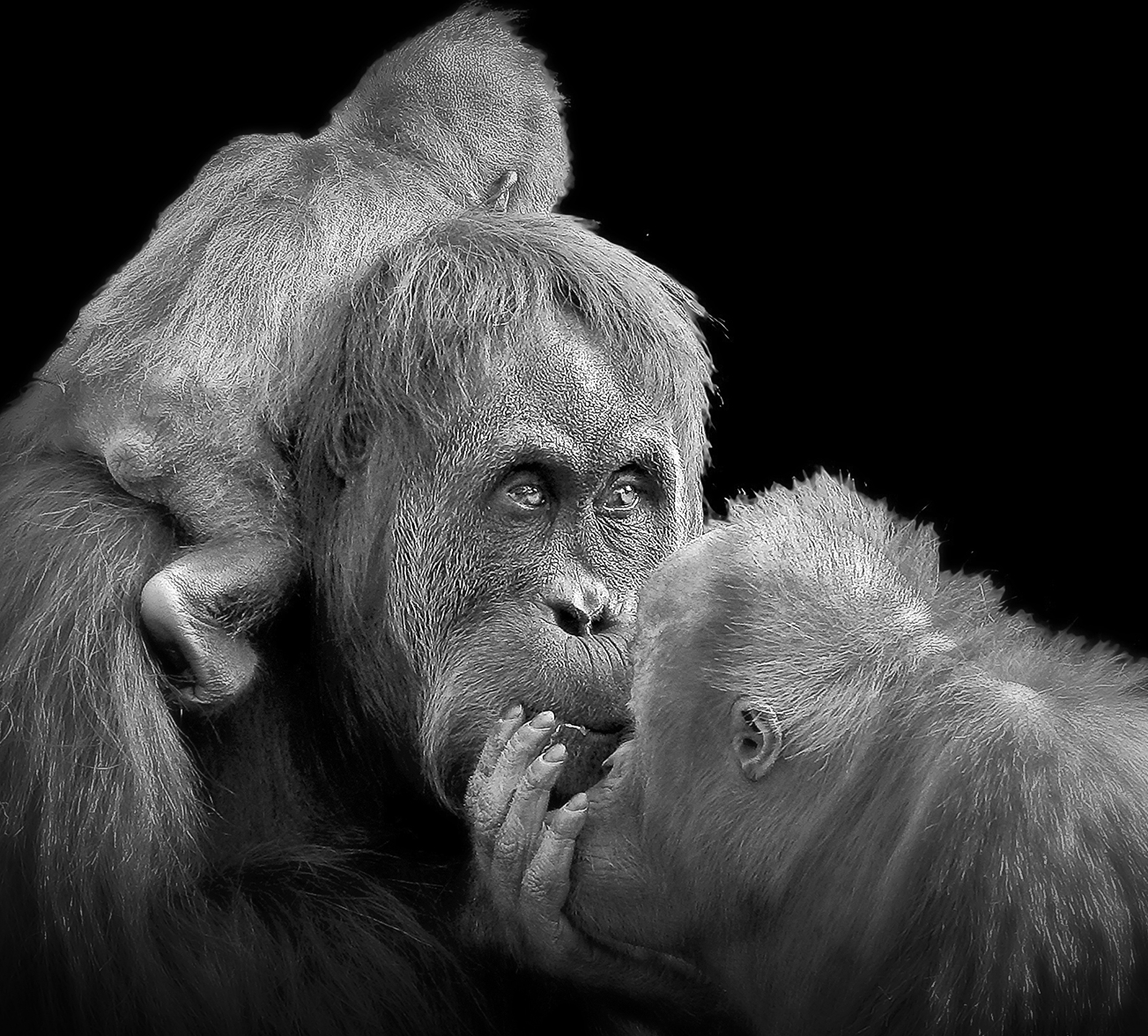
Orangutan mother and kids. By Patrick Bouquet, Chantilly.

The year is 1955, and far from the nearest village, somewhere within the Northwestern jungle region of Thailand, a 48 year-old Englishman and ordainee to the Buddhist monkhood sits quietly in studious attention. A few feet away, a female ape sits, arms carefully wrapped around some precious possession. The monk first chanced upon her the previous day, and due to the curiosity roused in observing her melancholic countenance, has remained respectfully nearby to her. A trust has developed, the ape sensing the monk’s gentle disposition and harmlessness. He really ought to be making his way to the village for alms, yet somehow senses that he should stay. A silent, palpable communication has developed between the two, and slowly, carefully and deliberately, the ape, her sadness still etched upon her face, finally unfolds her arms and offers a first sight of what she has been protecting. The monk slowly approaches to within a pace or two, sensing the invitation, only to catch sight of her lifeless and terribly deformed baby.

Two empathic apes, ancestrally and psychologically speaking, separated by little more in this moment than a distant, lineage-splitting, speciation event. Opposable thumbs, one hers and one his, in turn chase away a monk’s tear and a delicately mottled butterfly as it alights from the baby’s forehead, though cannot do the same for their conjoined feelings. Eyes meet, evincing as they do a deepening rush of sadness. Nothing can be done – is this what she is thinking in her way? In his unknowing, the saffron-robed wanderer radiates compassion, yet knows he has nothing to do with it; an offering from wisdom, not from the self. All that need be known arrives in the fullest of measures. What use now the venerable elder’s sagacity, his knowledge of emptiness, renunciation, equanimity, the void? She inhabits the void, is the void, her bleak knowing piercing its veils. Without turning, the monk slowly retreats, still reverently holding her gaze alongside a shared understanding. A slight suggestion of a bowing head betokens what passes between them.

It is the ability to empathise which in part distinguishes the psychopathic mind from its otherwise healthy state, and the primary orbit of empathy is that of feeling, not the mere gyrations of intellect. This is why many species of sentience can empathise, and we human animals are but one of them. We may erroneously presume that an ability to reflect upon others’ situations facilitates human empathic capacity; yet the state of those others and their situations need not be known as verbally abstracted objects in the mind – little stories packaged in words. We may just as well occupy others’ frames of reference by intuited means; and vitality, morbidity, distress and joy may all be recognised across species in differing ways; one need not indulge any anthropomorphisation, for clear evidence abounds. What is intuited here, or instinctively known, is the nature of the other’s felt emotional condition; and in this way, 60 years ago, the grieving mother ape and mendicant monk shared that intense experience – a wordless world of deep, primate feeling.

Engraving of Orangutan. By Willem Piso (1611-1678). Courtesy Wellcome Trust

Was the mother ape empathic? Well, she came to appreciate the monk’s amity; she felt able to extend trust; she intuited the monk’s concern for her as well as his desire for understanding as to the reasons for, and significance of, her sadness; and finally, she recognised that the monk would feel something of that sadness in revealing its causes to him. This is all to say that she significantly placed herself within the monk’s frame of reference and innately understood that emotions can be matched in shared experience – the personal does not expire at the boundary of the body. Her empathic appreciation was sophisticated, certainly moreso than any psychopathic human ape. Now, one way to cheat the system is to mimic expressions and gestures, which results in a like proprioceptive sense. This means our feelings echo the other’s, so affecting an emotional contagion of sorts, whether volitionally induced or not. Yet neither jungle dweller did so, their empathic link being forged in mind purely intuitively, and silently.

Empathy subsists in knowledge; it is in part to know the mind of the other, and whilst its currency is both cognitive (knowing) and emotional (feeling) in nature, it is the latter that strengthens the connective link to altruistic and prosocial leanings, as well as ameliorating aggressive traits. Primates’ mirror-neuron systems help forge innate empathic leanings, with research suggesting that empathy evolved in part as a survival mechanism. Right now, tens of thousands of refugees are fleeing war-torn regions of Africa and the Middle East so as to seek sanctuary, and survival, in Europe. A few hours ago, a three year-old Syrian boy, Aylan Kurdi, drowned and was washed up on the shores of the Greek island of Kos. Equally tragically, his five year-old brother met a similar fate. Whilst Europe’s politicians exhibit an ongoing empathy gap, innocent children are dying. We live, not literally, though metaphorically, in a jungle, sharing the empathic faculties of the monk and bereaved mother ape. Are we wise enough to nurture the same?

ooOOoo

We need leaders who understand the integrity that is required from them. We need leaders that accept and understand the responsibilities that they have embraced, indivisible from the power that society has lent to them. We need leaders that understand a different aspect of their power, the power of those unanticipated consequences from their actions.

Until we the people understand that electing leaders who do not embrace integrity then Aylan Kurdi and thousands of others in those ‘hot spots’ around the world will continue dying in vain.

Integrity equates to being truthful, to being honest. It doesn’t mean being right all the time, of course not, but integrity does mean accepting responsibility for all our actions, for feeling remorse and apologising when we make mistakes. Integrity means learning, being reliable, being a builder rather than a destroyer. It means being authentic. That authenticity is precisely and exactly what we see in our dogs.

The starting point for what we must learn from our dogs is integrity.

Apologies to you all!

Internet service is unreliable for a few days!

We connect with the internet via a wireless link to a mast just over the next set of hills.

Apparently there is a fault in the equipment on the mast that prevents a reliable ‘handshake’. The effect is to cause the link to drop out without notice at any time of the day.

It is scheduled to be fixed around the middle of next week.

Please, dear reader, if my normal pattern of posting isn’t maintained for the next few days, please bear with me.

Will close with this!

All together now! A'hhh.
All together now! A’hhh.

Our speaking dogs

A great follow-on to Marc Bekoff’s essay.

Yesterday’s post was the concluding part of Professor Bekoff’s essay about the world of the dog’s mind. (Part One is here.)

I do hope you all read the essay because it revealed just how complex and wonderful is the brain of man’s oldest friend.

A couple of week’s ago, the UK Daily Mail newspaper published an item with the heading of: What’s your dog trying to tell YOU? Scientists discover animals’ bark can reveal whether it is scared or lonely…and can even be used to tell its gender and age.

This is how the article opened:

Ever wondered what your dog’s trying to tell you with its bark? Well, now there is a computer program able to do just that – and you’d be surprised at just what your pet is able to communicate.

Scientists developed the program after discovering dogs aren’t just trying to attract attention, or scaring off intruders when they bark.

Amazingly, the bark could also let you know the gender and age of your pet – as well as whether it is scared, happy or even lonely.

The Daily Mail quoted a very similar article that appeared in The Independent newspaper on the 29th May. The Independent article included this:

A dog bark may sound like one loud, irritating racket but scientists have discovered that they actually give away information about the animal.

Researchers have developed a computer program which can determine the sex and age of a dog through its bark – a development they say has the potential to help vets diagnose pets.

Scientists analysed 800 barks recorded from eight dogs in seven different situations and developed complex algorithms that were able to predict the gender, age and context of the barker.

The researchers said “canine communication” has been heavily studied over the past decade. However, most of the research has focused on studying how dogs understand human communication, such as hand gestures and voice recognition. This is the first time that the sex and age of domestic dogs have been predicted with the help of sound analysis, they said.

Of the two articles, the one in The Independent seems easiest on the eye so I recommend you read it in full if the subject piques your interest. However, The Daily Mail did include the following video:

http://www.youtube.com/watch?v=UjIrbAUpaAs

They are such remarkable animals!

A repeat for today.

Apologies, just ran out of time to write a new blog post for today.

So going to repost what has been a top favourite of readers for nearly two years.

oooo

Remembering that Monday, 22nd April is Earth day, 2013. Like many others, I subscribe to Mother Nature Network. Recently published on MNN were twelve stunningly beautiful photographs.  There are reproduced below, hopefully without infringing any copyrights.  I just wanted to share them with readers of Learning from Dogs ahead of next Monday.

oooOOOooo

Earth Day photos: Celebrating the beauty of our planet

From the rolling hills of Tuscany to the surreal glacial formations of Patagonia, here are 12 stunning photos showcasing the diverse collection of landscapes found across the planet. By: Catie Leary Fri, Apr 19 2013 at 11:40 AM

Horseshoe Bend, Glen Canyon, Arizona, U.S.

 Photo: poorpoor/Flick

Snæfellsnes-og Hnappadalssýsla, Iceland

Photo: Greg Annandale/Flick

Hamilton Pool, Austin, Texas, U.S.

Photo: Stuck in Customs/Flickr

Glacier Grey, Torres del Paine National Park, Chile

Photo: Dietmar Temps/Flickr

Pansarine, Tuscany, Italy

Photo: hippydreams/Flickr

Muir Woods, California, U.S.

Photo: kern.justin/Flickr

Minnehaha Falls, Minnesota, U.S.

Photo: Mary JI/Flickr

Mount Blanc, France
Mount Blanc, France

Photo: OneEighteen/Flickr

Star Trails, Rio Negro, Argentina

Photo: lrargerich/Flickr

Sicily, Italy
Sicily, Italy

Photo: gnuckx/Flickr

Tereia Beach, Maupiti, Leeward Islands

Photo: SF Brit/Flickr

Namib Desert, Namibia

Photo: mariusz kluzniak/Flickr

oooOOOooo

So you all have a great week-end, wherever you are in the world, and do something, however small, for the one and only planet that nourishes all the life of the world. Planet Earth 1

The book! Part Four: The importance of hope.

The night is always darkest before the dawn.

That very well-know saying rings in my ears the word: hope. Hope! What a short, little word that carries on its back, so to speak, so much promise, so many reasons for staying with it, whatever ‘it’ might mean at any particular moment.

For countless times for countless numbers of people, the importance of hope has been incalculable! But first let’s dip into the dictionary as a way of clearly understanding the word.

Hope: as a noun, in part: “the feeling that what is wanted can be had or that events will turn out for the best”; as a verb, in part: “to look forward to with desire and reasonable confidence”.

Yes, there are other definitions of the word ‘hope’; both as a noun and an adjective. But I selected the two above because they resonated with me and past experiences. Or more accurately, a past experience. My prelude to another story from my past that seemed an appropriate way of opening this chapter; this chapter on hope.

In 1986 I had the opportunity to take a few years off. Off from the working life, that is. I had started my own company in 1978 after eight years of being a salesman for the Office Products Division of IBM UK. In 1986, the successful sale of my company meant that for a while I could go and play. By chance, I went on a vacation to Larnaca on the Island of Cyprus; Larnaca being on the Greek side of what was a divided island(and still is!) between Greece and Turkey.

Larnaca struck me as a lovely place on a lovely island in the Eastern part of the Mediterranean Sea. Again, quite by chance, one day during my vacation, when strolling around Larnaca Marina, I noticed a yacht with a For Sale notice on the yacht’s pulpit. The yacht, named Songbird of Kent, was a Tradewind 33, a type that I had heard about previously from reading yachting magazines. I vaguely recalled that the type had been designed in the UK by John Rock, himself an experienced deep-water yachtsman, for the purpose of serious ocean sailing and that many Tradewinds had completed vast ocean crossings.

I was still looking at the yacht, lost in some dream about sailing the seas, when a call from a man who had just come up from the cabin caught my attention. He had spotted me looking at the yacht.

Hi, my name is Ken and I’m the owner of Songbird. Did you want to come onboard and have a look around?” I couldn’t resist!

It transpired that Ken, and Betty his wife, an English couple, had been living on Songbird for some years, cruising the Mediterranean each Summer, and now wanted to return to England.
It was obvious that Songbird had been cared for in every possible way and that the yacht was offered for sale in a manner that meant she could become my permanent new home with little or no effort on my behalf.
Three hours later Ken and Betty and yours truly had agreed terms for the sale of Songbird of Kent. One of those spur of the moment things that we do in our lives that, so often, make being alive such a reward.

I should explain that as a younger man (I was 42 when I agreed to buy Songbird) I had devoured the books written by such round-the-world solo sailors as Francis Chichester and Joshua Slocum and others and harboured this silly, naive dream of one day doing a solo transatlantic crossing. Later on in life, when living in Wivenhoe in Essex, I bought my first yacht but never achieved anything more than local coastal sailing and a couple of overnight sailings to Holland; all with others I should hasten to add – never solo! However, I knew for sure that if there was one yacht that was perfect for open ocean sailing it was the Tradewind.

Thus it wasn’t long before my home in Great Horkesley, near Colchester, had been sold and I was adjusting to a new life as a ‘live aboard yachtie’ out in Cyprus.

I loved living in Larnaca for a whole bundle of reasons that I won’t go into here. Except one! That was that in my years of living and working near Colchester, which was where my business was based, I had been introduced to gliding and eventually had ended up becoming a gliding instructor. So imagine my delight at finding that there was an active gliding club on a British ex-military airfield thirty minutes away from Larnaca. It was not long before I was fully back to gliding.

One day, I was doing gliding experience flights for some visitors. Early in the afternoon, up came a quietly spoken Englishman who wanted to get an idea of what it was like to fly in a glider. Les, for that was his name, settled himself in, I checked his straps were secure, pointed out the canopy release and jumped into the seat behind him, and within moments we were airborne.

Later on, when back on the ground and sitting to one side of the old runway, Les and I started chatting about our backgrounds and what had brought each of us to Larnaca. I learned that Les was not only Les Powles, the famous solo sailor, but that he was living on board his yacht, Solitaire, right here in Larnaca Marina.

Over the following days, often with a beer or two in our hands, I heard Les’ tales about him having been in his 50s when he built Solitaire, with little prior knowledge of boatbuilding. That he had just eight hours of sailing experience when he decided to sail solo around the world. That remarkably, he had made it across the Atlantic, albeit discovering that his navigation skills didn’t quite match up to his boatbuilding abilities. This translating to his first landfall being the coast of Brazil, a 100 miles south of (and a different hemisphere) the Barbados he had been aiming for!

I listened for hours, in utter rapture of what Les had achieved. This quiet, unpretentious man that had achieved so much. Including how after solo circumnavigation number one, Les ended up completing three solo circumnavigations, all of them full of incidents. Particularly, the last one, with Les being given up for dead when he hadn’t been heard from for over four months. When eventually he sailed up the Lymington River in Hampshire, in a skeletal state, his arrival caused a media frenzy. Lymington Marina subsequently gave him a free berth for life. Les’ boat had been damaged in a storm, he had lost all communications and had virtually run out of food by the time he made it back to England.Oh, and Les was 70 at the time!

It’s OK readers, I haven’t forgotten I was promising you an anecdote on the subject of hope! Stay with me a little longer; it’s coming!

At one point, Les asked me about my own sailing ambitions. I remarked that I had this tired old idea of a solo sailing across the Atlantic.

Have you done any solo sailing?”, Les asked.

I replied, “At the start of most Summers, I sail alone from Larnaca across to the Turkish coast to meet up with family and friends who want to cruise along with me.

Continuing, “Generally I head for Alanya or a little further along the Turkish coast; to Antalya. It takes me two or three days to get there non-stop, most often with me going west-about Cyprus, and then straight up to Turkey. But I am embarrassed to admit that I hate both that trip, and the return solo trip at the end of the Summer. Detest would be a better word than hate.

Pausing before adding a moment later, “If I can’t stomach solo sailing for three days then there’s no chance, no chance at all, that I could sail solo across the Atlantic ocean.

It was then that Les said something both profound and deeply inspiring.

Paul, guess what! The first three days of being alone are just as terrible for me, too. Indeed, I have never met a solo sailor who doesn’t say the same. Those early days of adjusting to your new world, your new world of being alone out on the ocean, are the worst. But never lose hope that from some point around the third or fourth day, you will have worked through that transition and found an unbelievable state of mind; a freedom of mind that has no equal.

Years later, with Les’ words still ringing in my ears, I set out from Gibraltar for the Westward crossing of the Atlantic and lived the truth of Les’ prediction.

Sorry if that turned into a longer trip down memory lane than you were anticipating. However, I knew of no better way of telling you about how I learned the real meaning of hope, courtesy of dear Les.

Now a purely anecdotal tale on gaining the meaning of hope would be no way to end this chapter. We need to seek a professional view as well.

Scott Barry Kaufman is the Scientific Director of The Imagination Institute in the Positive Psychology Center at the University of Pennsylvania. (See footnote)

Back in December of 2011 he was the author of an essay published in the journal Psychology Today. The essay was called: The Will and Ways of Hope, with the subheading: Hope involves the will to get there, and different ways to get there.

It opened:

Talent, skill, ability — whatever you want to call it — will not get you there. Sure, it helps. But a wealth of psychological research over the past few decades shows loud and clear that it’s the psychological vehicles that really get you there. You can have the best engine in the world, but if you can’t be bothered to drive it, you won’t get anywhere.

Psychologists have proposed lots of different vehicles over the years. Grit, Conscientiousness, self-efficacy, optimism, passion, inspiration, etc. They are all important. One vehicle, however, is particularly undervalued and underappreciated in psychology and society. That’s hope.

Professor Kaufman went on to say that, “Put simply: hope involves the will to get there, and different ways to get there.” It struck me that those words seemed to resonate strongly with the multi-stage process of change that was covered in the previous chapter: The process of change.

The good Professor then adding:

Why is hope important? Well, life is difficult. There are many obstacles. Having goals is not enough. One has to keep getting closer to those goals, amidst all the inevitable twists and turns of life. Hope allows people to approach problems with a mindset and strategy-set suitable to success, thereby increasing the chances they will actually accomplish their goals.

Thus what Professor Kaufman seemed to be saying, well to my ears anyway, was that hope was not some wishy-washy emotion, some vaguely defined way of giving oneself a good talking to but “a dynamic cognitive motivational system” to use his words. That people who have clear goals in their lives, especially goals that demand learning, that in themselves are related positively to success, whatever success means specifically to an individual, that those goals are critically dependent on hope.

More from Kaufman:

Under this conceptualization of hope, emotions follow cognitions, not the other way round. Hope-related cognitions are important. Hope leads to learning goals, which are conducive to growth and improvement. People with learning goals are actively engaged in their learning, constantly planning strategies to meet their goals, and monitoring their progress to stay on track.

While reading Professor Kaufman’s essay, I found myself quietly wondering about where hope fitted in with other psychological attitudes, such as optimism and self-confidence. I didn’t have to wonder for much longer because, towards the end of the Professor’s essay, he specifically addresses my wonderings:

Hope can be distinguished from other psychological vehicles, such as self-efficacy and optimism. Self-efficacy refers to your belief that you can master a domain. Optimism refers to a general expectation that it’ll all just ‘be alright’. Hope, self-efficacy, and optimism are all incredibly important expectancies and contribute to the attainment of goals. Even though they all involve expectations about the future, they are subtly, and importantly, different from each other. People with self-efficacy expect that they will master a domain. Optimism involves a positive expectancy for future outcomes without regard for one’s personal control over the outcome. In contrast to both self-efficacy and optimism, people with hope have both the will and the pathways and strategies necessary to achieve their goals.

For the first time in many decades of reflection and introspection into aspects of success, motivation and achievement, I saw the sense of seeing hope in a two-dimensional manner: the will and the ways! Fascinating!

Reinforced so clearly in Professor Kaufman’s closing words:

We like to think that current ability is the best predictor of future success. We’ve built up the importance of existing ability because the testing and gating mechanisms are so well established to suit this belief. Important psychological studies show that ability is important, but it’s the vehicles that actually get people where they want to go. Oftentimes, the vehicles even help you build up that ability you never thought you had. And hope — with its will and ways — is one of the most important vehicles of them all.

Is there a connection between learning the “first three days are the worst’ from dear Les Powles and the academic eminence of Professor Scott Barry Kaufman?

I think so. For one could interpret Les’ advice about working through that initial three days at sea as containing both the Will – I am determined to keep going through those transitional days – and the Way – one can only achieve the peace of mind of being alone at sea by sailing onwards for three or four days.

I cannot close this better than by quoting Aristotle, “Hope is a waking dream.”

2,361 words Copyright © 2014 Paul Handover

—–

Footnote: Scott Barry Kaufman is Scientific Director of The Imagination Institute in the Positive Psychology Center at the University of Pennsylvania. Kaufman investigates the development and measurement of imagination, and the many paths to greatness. He has six books, including Ungifted: Intelligence Redefined and The Philosophy of Creativity(with Elliot Samuel Paul). Kaufman is also co-founder of The Creativity Post. Kaufman completed his doctorate in cognitive psychology from Yale University in 2009 and received his masters degree in experimental psychology from Cambridge University in 2005, where he was a Gates Cambridge Scholar.

Space for Nature

Last day of September

I was mulling over the fact that tomorrow sees the start of October and, inevitably, pondering what sort of winter we are in for. At the same time, I was reflecting on how beautiful this last month has been.  Wonderful ‘easy-on-the-body’ temperatures, an inch or more of much-needed rain, wonderful Autumn colours; all being shared for the last ten days with our guests: Reggie and Chris.

I was unsure what to write about to reflect my thoughts and was then saved by the September Digest from Transition Culture back in the old country.  I started to read it and immediately wanted to share it with you; dear reader.

First, to set the tone, here is a photograph taken just before I sat down to write today’s post.

Space for Nature - all around us!
Space for Nature – all around us!

ooOOoo

Transitioners’ Digest (September 2014)

This month we have been exploring the theme of “Making Space for Nature” from a wide range of different angles. We started with an editorial piece which argued that one of the key things that digest2nature can bring our work doing Transition is a sense of wonder. Something to do with glowworms apparently. We grabbed George Monbiot before he went on stage and talked about his book Feral and the concept of rewilding.

Writer and founder of the charity Write to Freedom, Caspar Walsh, talked about the vital role nature can play in the healing of young men. “She, it, whatever it is”, he told us, “works on them and softens them up so I don’t have to do all the work”. Ecopsychologist Mary-Jayne Rust talked about the impacts being separated from nature can have on us, and the benefits we get from making space for it. “When was the last time you heard of an activist going on a pilgrimage for eight months?” she asked.

Isabel Carlisle introduced us to Community Charters, and the potential they have for making space for nature at the community scale. Richard Louv, author of Last Child in the Woods, and of the theory of Nature Deficit Disorder, talked to us via Skype. “If we’re not careful”, he told us, “environmentalists and others who care about the future of nature will carry nature in their briefcases, not in their hearts”. Mike Jones, who builds natural play spaces for kids, talked about the need to make space for “the primodial nature of kids”.

Sept14

Aniol Esteban of New Economics Foundation reflected on why we need to make space for nature in economics. He told us:

Nature contributes to our mental health. It delivers mental health benefits and physical health benefits. It delivers a wide range of societal benefits. It contributes to our education. It can help reduce levels of crime. It can help urban regeneration. There is a huge range of areas and ways in which nature contributes to our wellbeing – individual wellbeing and collective wellbeing.

2782613807-300x212
David Nobbs

TootingHayley Spann, one of the participants in One Year in Transition, reflected on “what nature taught me”. We had a review of the first mainstream novel about Transition, The Second Life of Sally Mottram by David Nobbs (see right). We also talked to the author about where the idea came from, and what makes a good story. We had a recipe for “Transition Plum and Almond Cake”. Mark Watson reflected on the importance of ‘Making Space for Flowers’, and the many ways in which his Transition initiatives, Sustainable Bungay, create opportunities for people to encounter and benefit from nature.

Rob Hopkins reflected on how different our approach to managing water and drought would be if we took forests as the model on which we based it. He also responded to a critique of Transition by Ted Trainer and explored why the language we use to talk about this stuff really matters. He also went on the Peoples’ Climate March in London and reflected on how that was.

We heard from Transition initiatives about their experience of making space for nature in what they do. Hilary Jennings of Transition Town Tooting talked about the Tooting Foodival. Chris Bird wrote about the Transition Homes initiative in Totnes. Cara Naden discussed the many ways in which Transition Langport make space for nature. “I believe we all have an inherent bond with nature”, she wrote. “It makes us feel happy and healthy and makes us feel we are doing something positive and worthwhile for the benefit of wildlife, each other and ourselves”.

A very rich and thought-provoking month we hope you’ll agree. Our theme for October will be Transition and development. We hope you enjoy that too.

ooOOoo

(Note: there were many links in the original digest so do please check there as well.)

Can’t resist a couple more pictures from home to underline how we feel so strongly about having space for nature.

oooo

A misty October morning from a year ago.

oooo

Trust between deer and Jean.
This is what making space is all about!

Let’s all have a great month of October embracing the natural world around us howsoever it can be done.