Category: Technology

Droning on!

With thanks to Monika for the title of today’s post!

My father was born in 1901. He had two wives. Me and my sister, Elizabeth, are the result of the relationship between our father and his second wife; Betty. Our father died in 1956; December 20th.

My father first was married to Maud and they had two daughters, Rhona and Corinne. Rhona died in 2003 and Corinne died in 2014. Although Rhona and Corinne were half-sisters I prefer to think of them as sisters!

Both had children. But I want to concentrate on Rhona. She and Reider, Norwegian by birth, had four children: Rolv; Greta; Rikard; Marit.

As is the way in this modern world, Rikky who lives near Torquay in South Devon, recently called in to see my brother-in-law, John, and John remarked to me that Rikky’s new wife, Jazz, was gorgeous. I asked Greta for a telephone number and, hey presto, Rikky and I were in contact with each other.

This is a little bit from Rik’s bio.

So you may remember I was with Amanda at the time of Mother’s passing, seems a long time ago now. Well that ultimately came to nothing and I ended up living alone with a couple of huskies in a small flat in Torquay. I had invested a large chunk of Mother’s inheritance into a PA system and set up and ran a sound engineering business for years as well as running quite a successful tribute band to ‘The Doors’. The PA company eventually ended after going into a partnership with a friend who also invested a chunk of cash allowing major upgrades to the kit.

Unfortunately I soon found out he was more interested in holidays to Spain than actual PA work, the problem being I had now sold vital parts of my rig which was replaced by his. We went separate ways and he took his gear with him leaving me without a full system, BIG lesson learnt.

At that point I went back to employment as an engineer for a company servicing and repairing lifting hoists to the health care industry. Four years in and the company went into administration.

Later Rikky says:

Back to work again this time to DPD as a delivery driver for a couple of years following in Rolv’s (Ed: brother) tyre tracks. This was when I also met Jazz on a random night out with friends. We immediately realised that we had many mutual friends and had actually met before many years ago when I was playing in her Dad’s Jazz band! This was around 19 years ago when I was 30 and Jazz was only 16. I only have a vague memory of her then sitting in a corner of the rehearsal room furiously scribbling in a sketch book.

Not much has changed there except she now holds a degree in Art and Design. She is also a Holistic Therapist and has trained in many holistic therapies including Reilki, Reflexology and Massage and is a very talented and beautiful woman. I feel incredibly blessed. She has two daughters Sanije and Latoja (nine and eleven) who I consider as mine; their father left the country last year and went back to Albania which actually has been a blessing for the girls as he is a difficult man to say the least.
So the driving job became another engineering position this time with a company specialising in fire alarms, a couple of years in and the contract I was working on was TUPED over to LiveWest which is one of the largest social housing companies in the South West. Two years after that and the company merged with another housing company, the role changed slightly so I was offered voluntary redundancy which I took giving me the financial opportunity to retrain as a commercial drone pilot and so here we are today.

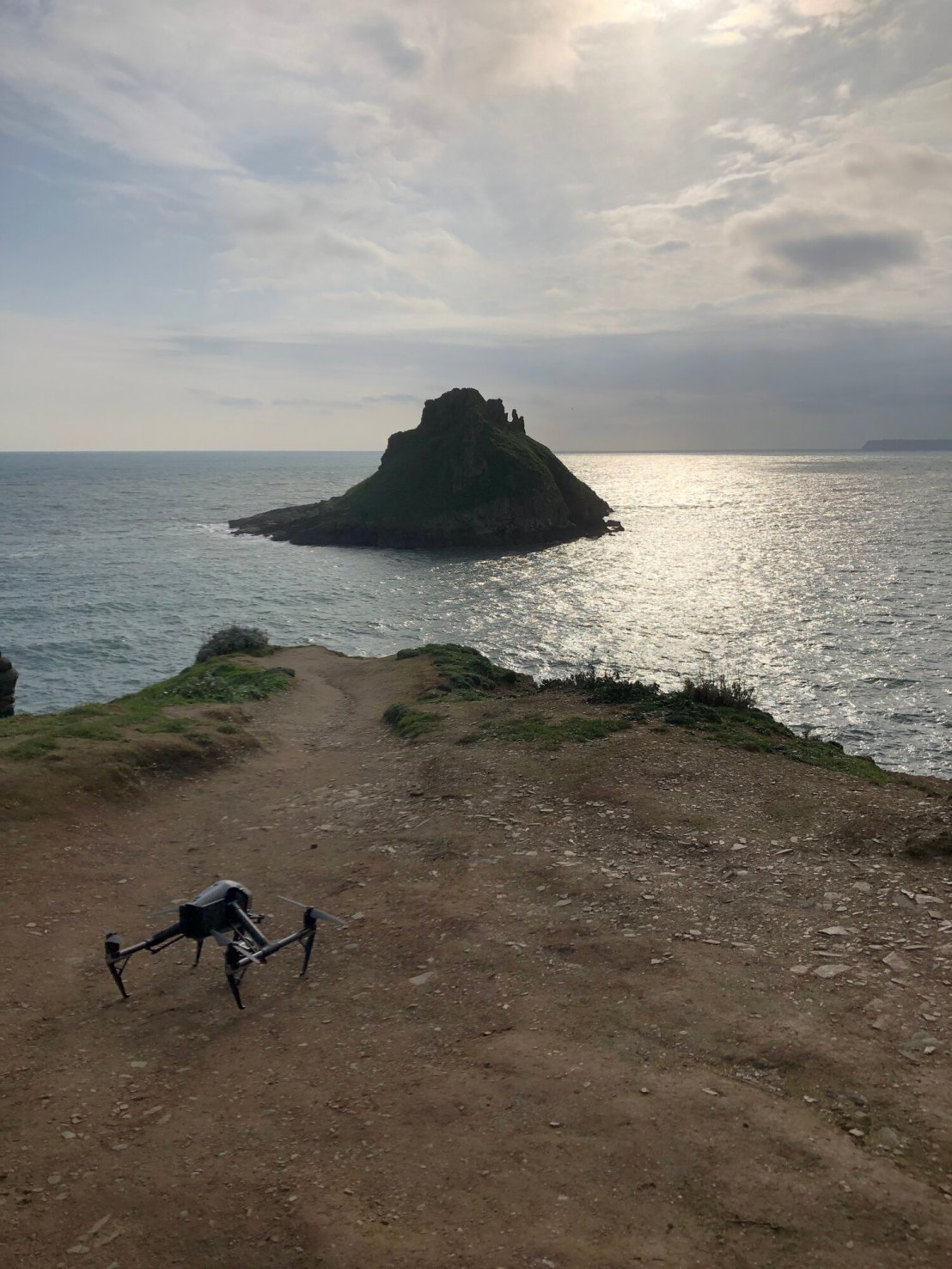
Thus Rik became a commercial drone pilot and as the home page of his website declares:

We can accommodate all your aerial requirements from photography to cinematography, inspections to 3d mapping.

The name of Rik’s website is Ahead4Heights which strikes me as apt. And from the About page of that website, one reads:

Here at Ahead4Heights we have a passion for flying drones and creating visually stunning aerial films and photography. We are PfCO certified by the Civil Aviation Authority and hold full public liability insurance giving you complete confidence in us to provide the service you require.
With our post production studio facility we are able to add voice overs and original music written to your brief if required as we have our own in house composer and audio recording engineer.
Our UAV fleet consists of a variety of drones from the market leading DJI Inspire 2, capable of filming in incredible  5.2k resolution and producing the RAW file format standard for the film industry to our Pixhawk based quadcopter (equipt with a 4k camera) which we use for autonomous flight taking photos used to generate 3d mapping of locations useful for the construction industry.
Finally we have a heavy lift Tarot 680 hexacopter which is used as a backup drone and also for specialised  payloads such as thermal cameras and high power lighting.
If you simply want aerial photos for property sales, photos and footage for weddings and events we will be happy to offer our services to you.
We can also carry out inspection work on roofs, tower masts and bridges etc where specialised safety equipment and scaffolding would otherwise be required. Utilizing both the high resolution and thermal imaging cameras we are able to identify problems with the insulation of properties, stress points in structures and damage to roofs and guttering.
Ahead4Heights also holds certificates in the building and setting up of drones so if you require a drone built to your special requirements we would be happy to discuss. We would also offer a full maintenance package with any build projects.

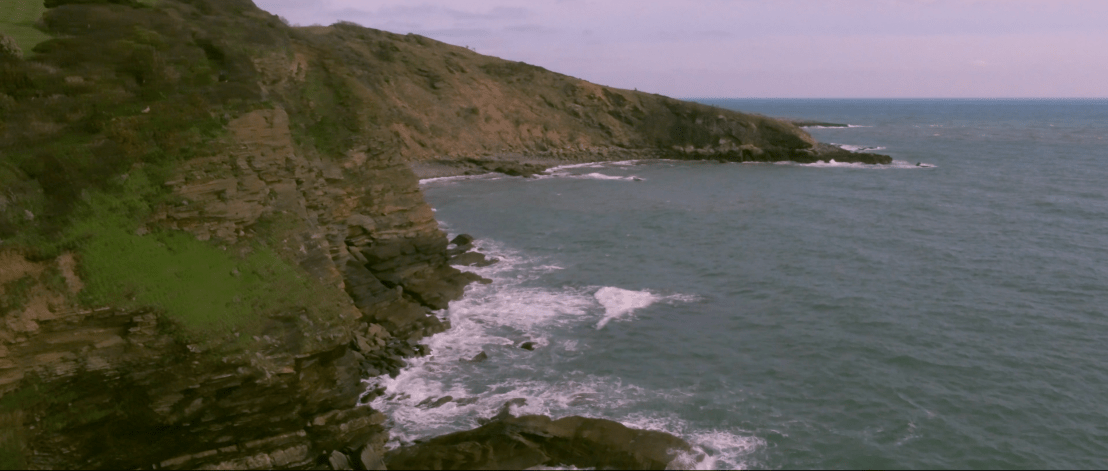
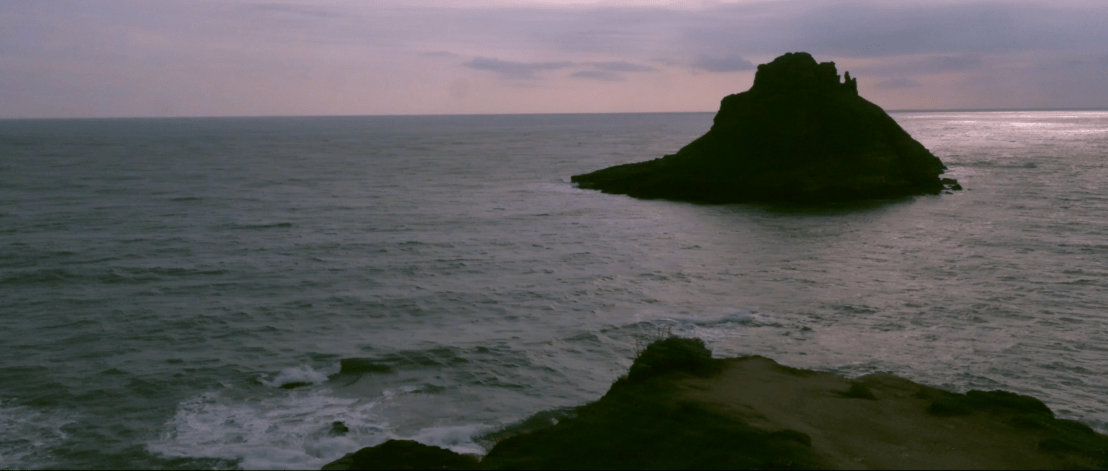
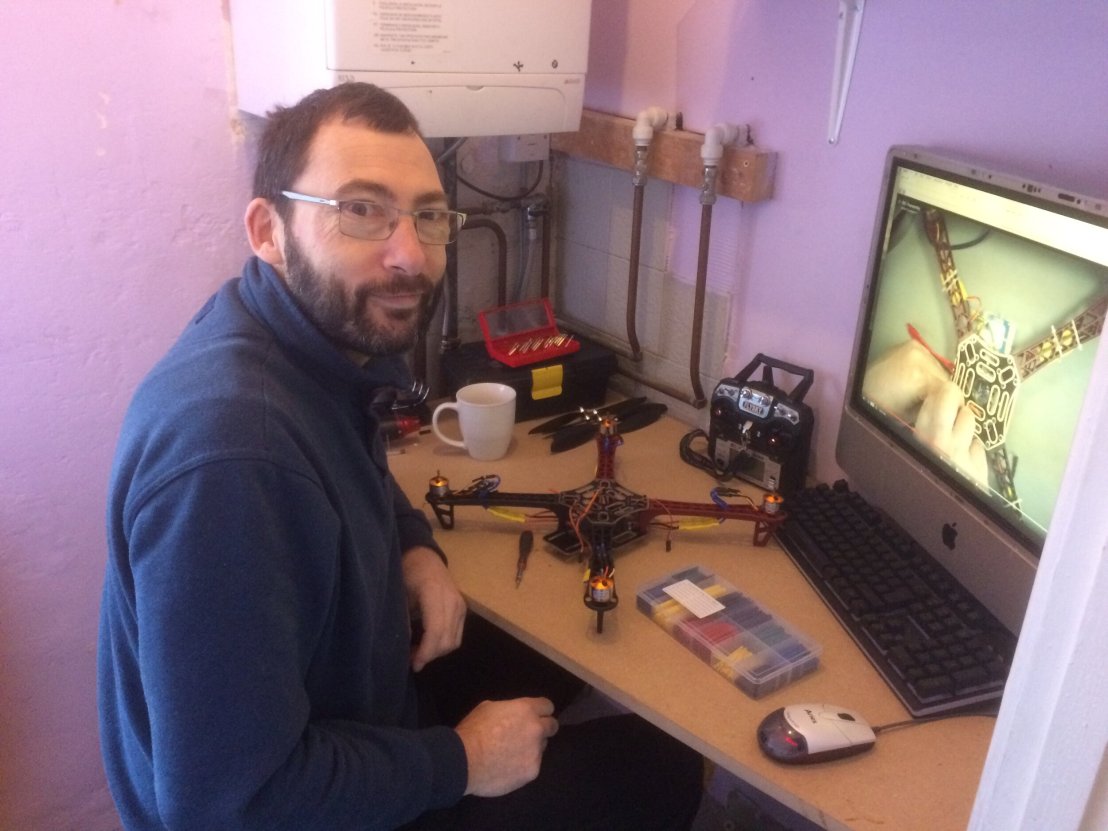
A couple more photographs.

oooo
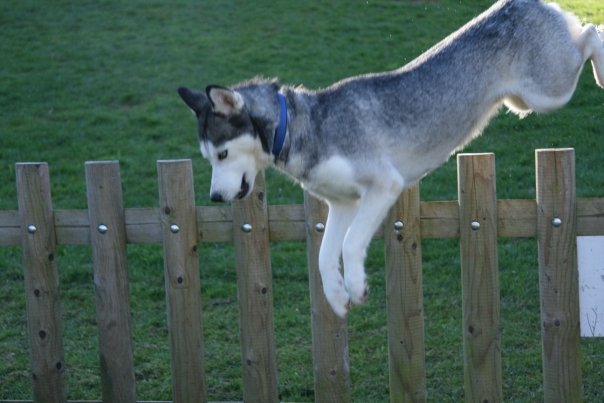
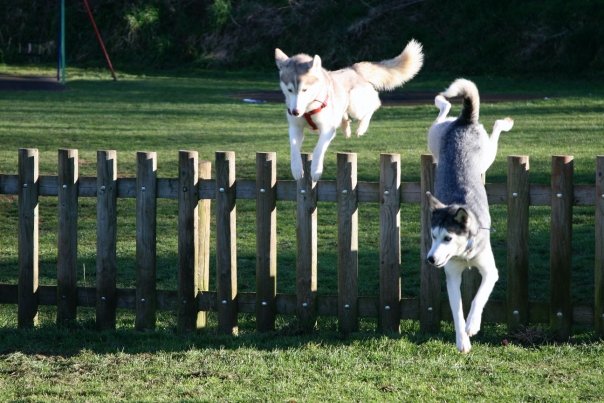
And, of course, one more of the dogs! That is Storm and Tia.
More tomorrow!

Picture Parade Three Hundred and Forty-Eight

I won’t explain more until tomorrow!

oooo

oooo

oooo

oooo

oooo

oooo

There’s quite a story behind this!

And behind this one!

“I have a dream”.

The Golden Circle.

This, again, is not about our beloved animals; in other words, this is not about our dogs.

But it is about something of supreme importance: The role of innovation. That’s innovation in all aspects of our human lives. Think of it as a process of innovation.

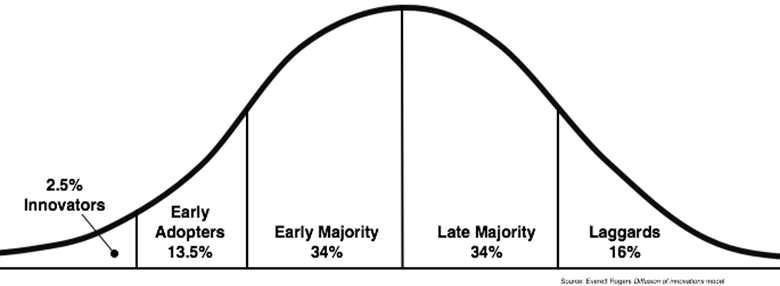
There was the Diffusion of Innovation (DOI) Theory developed by E.M. Rogers in 1962. There is a comprehensive explanation of DOI here, from where I take the following diagram, but before explaining, from that same site, the meanings behind the definitions, I would like to emphasize one important point: “It works better with adoption of behaviors rather than cessation or prevention of behaviors.“.

So here is that diagram:

Distribution.png

Here are the meanings of those terms (my emboldening):

Adoption of a new idea, behavior, or product (i.e., “innovation”) does not happen simultaneously in a social system; rather it is a process whereby some people are more apt to adopt the innovation than others.

Researchers have found that people who adopt an innovation early have different characteristics than people who adopt an innovation later. When promoting an innovation to a target population, it is important to understand the characteristics of the target population that will help or hinder adoption of the innovation.

There are five established adopter categories, and while the majority of the general population tends to fall in the middle categories, it is still necessary to understand the characteristics of the target population. When promoting an innovation, there are different strategies used to appeal to the different adopter categories.

  1. Innovators – These are people who want to be the first to try the innovation. They are venturesome and interested in new ideas. These people are very willing to take risks, and are often the first to develop new ideas. Very little, if anything, needs to be done to appeal to this population.
  2. Early Adopters – These are people who represent opinion leaders. They enjoy leadership roles, and embrace change opportunities. They are already aware of the need to change and so are very comfortable adopting new ideas. Strategies to appeal to this population include how-to manuals and information sheets on implementation. They do not need information to convince them to change.
  3. Early Majority – These people are rarely leaders, but they do adopt new ideas before the average person. That said, they typically need to see evidence that the innovation works before they are willing to adopt it. Strategies to appeal to this population include success stories and evidence of the innovation’s effectiveness.
  4. Late Majority – These people are skeptical of change, and will only adopt an innovation after it has been tried by the majority. Strategies to appeal to this population include information on how many other people have tried the innovation and have adopted it successfully.
  5. Laggards – These people are bound by tradition and very conservative. They are very skeptical of change and are the hardest group to bring on board. Strategies to appeal to this population include statistics, fear appeals, and pressure from people in the other adopter groups.

Now there’s a TED Talk that I hadn’t seen, and yet nearly 51 million people had! It came to me as an email from TED and yesterday, while we were sitting up in bed  early in the morning, I watched it. It ‘spoke’ to me and I felt that I just had to share it with you.

Because so many of the problems that face our society today are global issues and if humans are to have a future on this planet then we need great leaders who will inspire us.

Now watch the following video, it’s just over 18 minutes long, but it says it all.

Continue reading ““I have a dream”.”

More on the dog’s nose!

A new sense recently discovered in the dog’s nose.

I subscribe to AAAS and their last email newsletter contained this fascinating information.

ooOOoo


An infrared photo of a golden retriever in a functional magnetic resonance imaging scanner reveals the cold temperature of a dog’s nose versus its glowing, warm body.
Anna Bálint

New sense discovered in dog noses: the ability to detect heat

Dogs’ noses just got a bit more amazing. Not only are they up to 100 million times more sensitive than ours, they can sense weak thermal radiation—the body heat of mammalian prey, a new study reveals. The find helps explain how canines with impaired sight, hearing, or smell can still hunt successfully.

“It’s a fascinating discovery,” says Marc Bekoff, an ethologist, expert on canine sniffing, and professor emeritus at the University of Colorado, Boulder, who was not involved in the study. “[It] provides yet another window into the sensory worlds of dogs’ highly evolved cold noses.”

The ability to sense weak, radiating heat is known in only a handful of animals: black fire beetles, certain snakes, and one species of mammal, the common vampire bat, all of which use it to hunt prey.

Most mammals have naked, smooth skin on the tips of their noses around the nostrils, an area called the rhinarium. But dogs’ rhinaria are moist, colder than the ambient temperature, and richly endowed with nerves—all of which suggests an ability to detect not just smell, but heat.

To test the idea, researchers at Lund University and Eötvös Loránd University trained three pet dogs to choose between a warm (31°C) and an ambient-temperature object, each placed 1.6 meters away. The dogs weren’t able to see or smell the difference between these objects. (Scientists could only detect the difference by touching the surfaces.) After training, the dogs were tested on their skill in double-blind experiments; all three successfully detected the objects emitting weak thermal radiation, the scientists reveal today in Scientific Reports.

Next, the researchers scanned the brains of 13 pet dogs of various breeds in a functional magnetic resonance imaging scanner while presenting the pooches with objects emitting neutral or weak thermal radiation. The left somatosensory cortex in dogs’ brains, which delivers inputs from the nose, was more responsive to the warm thermal stimulus than to the neutral one. The scientists identified a cluster of 14 voxels (3D pixels) in this region of the dogs’ left hemispheres, but didn’t find any such clusters in the right, and none in any part of the dogs’ brains in response to the neutral stimulus.

Together, the two experiments show that dogs, like vampire bats, can sense weak hot spots and that a specific region of their brains is activated by this infrared radiation, the scientists say. They suspect dogs inherited the ability from their ancestor, the gray wolf, who may use it to sniff out warm bodies during a hunt.

“The study is consistent with other research that describes the combined dog nose and brain as a sophisticated platform for processing a broad range of signals,” says Gary Settles, an emeritus professor of mechanical engineering at Pennsylvania State University, University Park, who has studied dogs’ sniffing abilities. He doubts, however, “that the dog rhinarium can distinguish patterns of hot and cold objects at a distance,” suggesting dogs’ thermal detection skills may not be useful for long distance hunting. “[T]hat needs further study.”

If nothing else, the work suggests the extraordinary skills of the sled dog Buck, who tracked prey “not by sight or sound or smell, but by some other and subtler sense” in Jack London’s Call of the Wild, aren’t completely fictional after all.

ooOOoo

Dogs are in the news again. For their incredible noses; this time we are learning how they track heat.

Brilliant animals!

Off line for maybe a few days

My iMac needs an upgrade!

I have been having some tiny problems mainly with the Apple Photos app and the good folks over at Ugly Hedgehog were incredibly helpful. This led to me taking my machine into Dick Webster Computers here in Grants Pass for a potential upgrade.

So I am going to republish some earlier posts for the next two days, which I hope will be long enough to come to a conclusion about whether this machine may be upgraded or whether I am looking at a new iMac.

Footnote:

I called in to Dick Webster, a good, local computer repair shop, earlier today. Took my iMac with me.

They told me that that particular iMac cannot have the RAM upgraded to 16GB but they could install a SSD. However, they looked up the Apple Photos app and said there were a number of complaints from others that it was freezing.

I was told to save my money, the iMac was perfectly good and to choose a photo editing application that supplied my needs.

My only outstanding query is whether all the relevant software programs, i.e. the photo editing apps, will run without any bother on 8GB.

Picture Parade Three Hundred and Thirty-Seven

My grandson comes to the rescue!

A week ago I had no idea where more dog pictures were coming from.

Then in an email conversation with my grandson, Morten, up came this: Pixabay and their folder of dog photos!

oooo

oooo

oooo

oooo

oooo

oooo

oooo

Hopefully, thanks to Morten, this will run and run!

Hubble into music.

Back to the space telescope!

I cannot stop engaging in Hubble stories and republishing them in this place.

The latest is an account, published here, of how scientists turned an image of a galaxy into music! Or rather added music to the video.

Here it is!

ooOOoo

Cool! A Hubble photo translated to music

Posted by in | May 10, 2020

There’s no sound in space. But – working with NASA – musicians and scientists turned a Hubble Space Telescope image of a galaxy cluster into music.

We stumbled on this video via a May 3, 2020, re-post at ScienceAlert. Matt Russo and Andrew Santaguida of System Sounds in Toronto – which calls itself “a sci-art outreach project” – created the video. It’s part of NASA’s Astrophysics Visualizations series. NASA explained the video this way:

Space becomes sonified in this visualization of a cluster of galaxies imaged by NASA’s Hubble Space Telescope. Time flows left to right, and the frequency of sound changes from bottom to top, ranging from 30 to 1,000 hertz. Objects near the bottom of the image produce lower notes, while those near the top produce higher ones. Most of the visible specks are galaxies housing countless stars. A few individual stars shine brightly in the foreground. Stars and compact galaxies create short, clear tones, while sprawling spiral galaxies emit longer notes that change pitch. The higher density of galaxies near the center of the image – the heart of this galaxy cluster, known as RXC J0142.9+4438 – results in a swell of mid-range tones halfway through the video. Hubble’s Advanced Camera for Surveys and Wide Field Camera 3 acquired this image on August 13, 2018.

Cool!

Here’s the original Hubble image of galaxy cluster RXC J0142.9+4438, later “sonified” by Russo and Santaguida. NASA wrote: “Galaxies abound in this spectacular Hubble image; spiral arms swirl in all colors and orientations, and fuzzy ellipticals can be seen speckled across the frame as softly glowing smudges on the sky. Each visible speck of a galaxy is home to countless stars. A few stars closer to home shine brightly in the foreground, while a massive galaxy cluster nestles at the very center of the image; an immense collection of maybe thousands of galaxies, all held together by the relentless force of gravity.” Read more about this image, which is via ESA/ Hubble & NASA, RELICS.

Here’s the original Hubble image of galaxy cluster RXC J0142.9+4438, later “sonified” by Russo and Santaguida. NASA wrote: “Galaxies abound in this spectacular Hubble image; spiral arms swirl in all colors and orientations, and fuzzy ellipticals can be seen speckled across the frame as softly glowing smudges on the sky. Each visible speck of a galaxy is home to countless stars. A few stars closer to home shine brightly in the foreground, while a massive galaxy cluster nestles at the very center of the image; an immense collection of maybe thousands of galaxies, all held together by the relentless force of gravity.” Read more about this image, which is via ESA/ Hubble & NASA, RELICS.

Bottom line: Musicians and scientists turned a Hubble Space Telescope image – of galaxy cluster RXC J0142.9+4438 – into music.

ooOOoo

That is so lovely.

It’s only just over half a minute long but is still precious!

And I learnt a new word: sonification!

More on the magnificent Hubble!

More on the magnificent Hubble!

The BBC have published an excellent article.

There was such a good response to the article on the Hubble that I published on April 27th that it was an easy decision to republish the article that was presented on the BBC website on the 24th, and this time the photographs can be downloaded.

ooOOoo

Hubble telescope delivers stunning 30th birthday picture

By Jonathan Amos, Science correspondent, 24 April 2020

It’s 30 years ago to the day that the Hubble telescope was launched – and to celebrate its birthday, the veteran observatory has produced another astonishing image of the cosmos.

This one is of a star-forming region close to our Milky Way Galaxy, about 163,000 light-years from Earth.

The larger object is the nebula NGC 2014; its companion is called NGC 2020.

But astronomers have nicknamed the scene the “Cosmic Reef” because it resembles an undersea world.

[There is an audio by Antonella Nota that is a little under 10 minutes long. I cannot embed it into this post for some unclear reason. Go here if you want to listen to it! It’s well worth listening to.]

Antonella Nota: “It’s called the people’s telescope because it brought the Universe to the people”

Famously blighted by blurred vision at the outset of its mission in 1990, Hubble was eventually repaired and upgraded.

The remarkable pictures it has taken of planets, stars, and galaxies have transformed our view of the cosmos.

Indeed, there are those who think Hubble is the most important scientific tool ever built.

It’s still far from retirement.

The US space agency (Nasa), which runs the observatory in partnership with the European Space Agency (Esa), says operations will be funded for as long as they remain productive.

Last year, its data resulted in almost 1,000 scientific papers being published – so it continues to stand at the forefront of discovery.

For its 25th birthday, Hubble imaged a giant cluster of stars called Westerlund 2

Engineers obviously keep a watching brief on the health of Hubble’s various systems. Pleasingly, all four instruments onboard – the two imagers and two spectrographs – work at full tilt.

In the past, the telescope’s Achilles heel has been the six gyroscopes that help turn and point the facility, maintaining a rock-steady gaze at targets on the sky.

These devices have periodically failed down the years, and during their final servicing mission in 2009 space shuttle astronauts were tasked with replacing all six.

Three have subsequently shut down again, but Nasa project scientist Dr Jennifer Wiseman says this is not yet an issue for serious concern.

“Nominally, we need three gyroscopes, but we can operate on just one due to the ingenuity of the engineers,” she asserted.

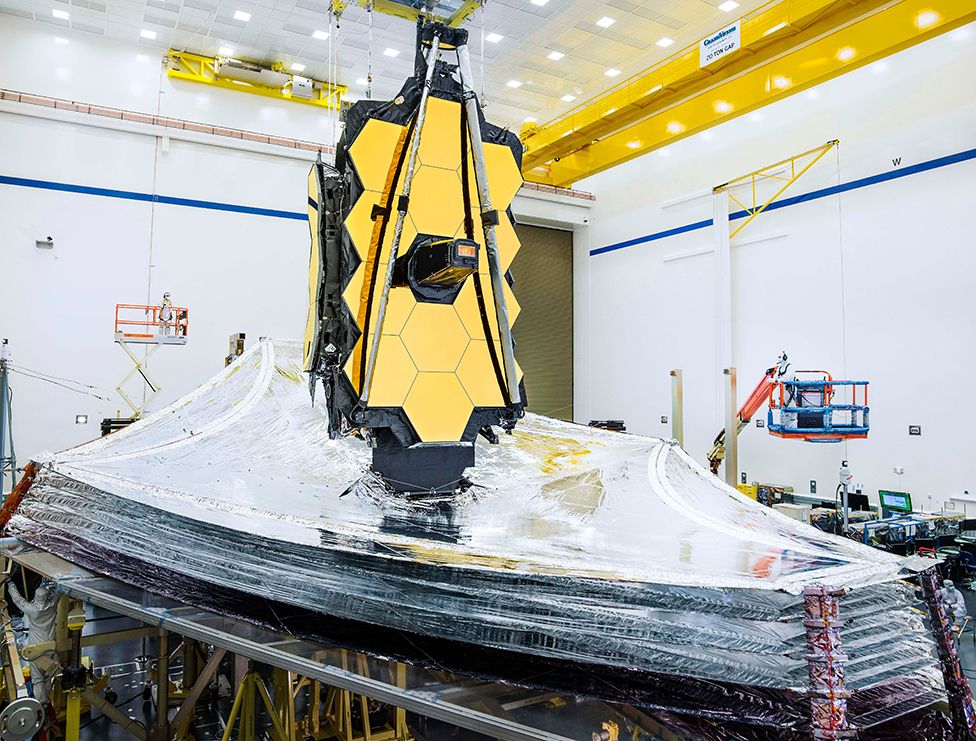
There’s a quiet confidence that Hubble can keep working well into the 2020s. Its supposed “successor” – the James Webb Space Telescope (JWST) – is due for launch next year, but the presence in orbit of this more modern observatory will in truth merely just extend capability; it won’t make Hubble redundant.

That’s because the new facility has been designed to see the cosmos at longer wavelengths of light than Hubble. The duo will be complementary and will on occasion actually pursue targets together to get a fuller perspective.

This is an exciting prospect for astronomers everywhere – but especially for those in Europe where Hubble has been such a rewarding endeavour, says Esa project scientist Dr Antonella Nota.

“From the memorandum of understanding there was a guarantee that European astronomers would get 15% of observing time for the duration of the mission. If I look back at how much time European astronomers got – on average it’s 22%. And it is a peer-reviewed process so we never needed to put a finger on the scales. European astronomers are creative; they’re smart; they’re doing leading-edge science,” she told BBC News.

What has Hubble contributed to science?

It’s a bit of a cliche, but Hubble has truly been a “discovery machine”.

Before the telescope launched in 1990, astronomers didn’t know whether the Universe was 10 billion years old or 20 billion years old.

Hubble’s survey of pulsating stars narrowed the uncertainty, and we now know the age extremely well, at 13.8 billion.

The observatory played a central role in revealing the accelerating expansion of the cosmos – a Nobel Prize-winning breakthrough – and it provided the definitive evidence for the existence of super-massive black holes at the centre of galaxies.

The Deep Field images require Hubble to stare at the same patch of sky for days on end

It’s amazing to think that when Hubble launched, scientists had yet to detect the first exoplanet, the name given to a planet orbiting a star other than our Sun. Today, Hubble is pioneering the study of these far-off worlds, examining their atmospheres to try to gauge their nature.

And although the sparkling eight-metre-class ground-based telescopes can now match – and even exceed – Hubble’s skill in certain fields of study, the space telescope remains peerless in going super-deep.

Its so-called Deep Field observations in which it stared at a small patch of sky for days on end to identify the existence of very distant, extremely faint galaxies is one of the towering achievements in astronomy.

These studies have shown us what the Universe was like just a few hundred million years after the Big Bang. Only JWST, with its finely-tuned infrared detectors, will go deeper still.

A Hubble classic: The Veil Nebula is the expanding debris of an exploded star

Kathryn Sullivan was one of the astronauts onboard Space Shuttle Discovery when it released Hubble into its 612km-high orbit on 25 April, 1990 – a day she recounts in a recent book, Handprints On Hubble.

“Hubble’s scientific impact has just been immense. But what I had not really appreciated until I started writing my book was the extent to which Hubble – because of its gorgeous images and their mind-bending implications – has really permeated popular culture,” she told BBC News.

“I see Hubble on the side of U-Haul (rental) trailers, on tattoos, on lunchboxes, on shirts, in advertisements, almost ubiquitously.

“And I think part of that is down to Hubble coming into service just as the internet was becoming the thing we now know it to be.

“That’s put the pictures right in front of people.”

JWST will study the Universe at longer wavelengths of light

ooOOoo

This is the most amazing invention and regular missions to service the telescope including regular updates to the technology have kept it current.

It has produced the most distant and beautiful photographs. It has also refined our knowledge of when the universe came into existence – 13.8 billion years ago.

Staggering!

Returning to a theme – May!

The years click by!

We are coming up to the month of May!

Then in a very short time it will be May 8th. Not only my half-birthday but considerably of more note the anniversary of the end of World War II.

I am certain that I am the only one who puts meaning into these dates. I can do no better than to re-post something that I published on May 1st, 2017.

ooOOoo

For all my life this has felt like a very special month.

And, dear friends, at the risk of repeating myself to many of you, this is why the month of May is special for me.

Simply that I was born in London during the closing months of the Second World War. Inevitably, I was unaware of the number of German bombs that were falling on London during those last few months. But there were thousands.

On May 8th. 1945, the day that WWII ended and six months to the day from when I was born, my mother looked down at me and said aloud to me: “You are going to live”. Despite the fact that I don’t recall my mother saying that, it was verified many times later when I was growing up.

Now here we are approaching May 8th. 2017 (now May, 2020) and in a very real sense it seems that we are in another war.

A war of consequence.

A war that we have been engaged in for many, many years.

A war where we are inadvertently fighting on a global battlefield.

A war where 99.99% of us don’t consciously identify the weapons we are using. Weapons that are incredibly effective. So much so that we are in sight of winning the last battle; winning the war.

Yet a war where winning is no win at all. Indeed, where winning this war, this global war, spells the end. The end of life for 99.99% of us humans (and much else besides).

Now what on earth has got me so fired up?

Two things have:

The first is that I am living in my 73rd year of life. (Now 75th.) I have no idea of when my life comes to an end. But that death is a guarantee. Indeed, if one takes note of the average life expectancy of a male today in the USA (75.6 years) , it may not be that far away.

The second thing is that before my death I truly want to know that humankind has laid down its weapons of war against our planet and that there really is an unstoppable mission, a united wave of passion, to live in peace on this planet. Perhaps better put to live in peace with this planet.

Or in the words of an organization that I now want to introduce:

A mission which will require the hard work and dedication of each and every one of us as we do everything in our power as individuals, but also as we galvanize businesses, entrepreneurs, innovators, city planners, communities, people and politicians—all those who share our purpose.

OK! Thank you if you are still reading this! (Someone give Fred in that soft arm-chair over there a nudge; I can hear his snores from here!)

In the last Smithsonian electronic newsletter that I was reading yesterday morning there was a reference to an organization that I hadn’t previously come across. Here is the link to that item on The Smithsonian website. I am republishing it in full in this place. As you read it you will understand why I am republishing it.

ooOOoo

Using a New Roadmap to Democratize Climate Change

A new tool aims to bypass governments and put the power of climate action in the people’s hands

By Anne Glusker Smithsonian.com April 28, 2017

Olafur Grimsson, who was president of Iceland from 1996 to 2016 and saw his country through the worst economic crisis in its history, making headlines all over the world as banks collapsed and the country fell into a depression, is the very picture of an urbane statesman. Collected and poised, with a striking full head of white hair, as comfortable in English as in his native Icelandic, he seems an unlikely revolutionary, not the sort of person you’d look at and immediately find yourself thinking: “Power to the People.”

But Grimsson is one of the primary architects of a quietly radical new idea whose aim is to facilitate action on climate change without any of the usual suspects—governments, countries, international bodies, negotiating parties.

He and several other veterans of the historic 2015 Paris Agreement on climate change were in Washington, D.C., last year, just before COP22, the climate meeting held in Marrakesh in 2016. They were pondering next steps when the conversation took a new and interesting turn, Grimsson says, addressing the question: “Was it possible to have the success of Paris without governments necessarily being in the leading role?”

The group included movers and shakers such as Peter Seligmann, the chairman of Conservation International; Laurene Powell Jobs, president of the philanthropic organization the Emerson Collective; and Andy Karsner, an assistant energy secretary during the administration of George W. Bush. Galvanized by their own query, they decided to try to answer it—to set about creating a new tool to aid in achieving the goals of the Paris accord.

At the Smithsonian’s Earth Optimism Summit, a gathering this past weekend of conservation-minded citizens, scientists and activists, Grimsson explained: “You get governments that are opposed or even hostile to climate action. We decided to bring together in Marrakesh a gathering of thinkers and scientists and innovators and policymakers from different countries in order to discuss a new model of securing the success of the future of the climate movement.”

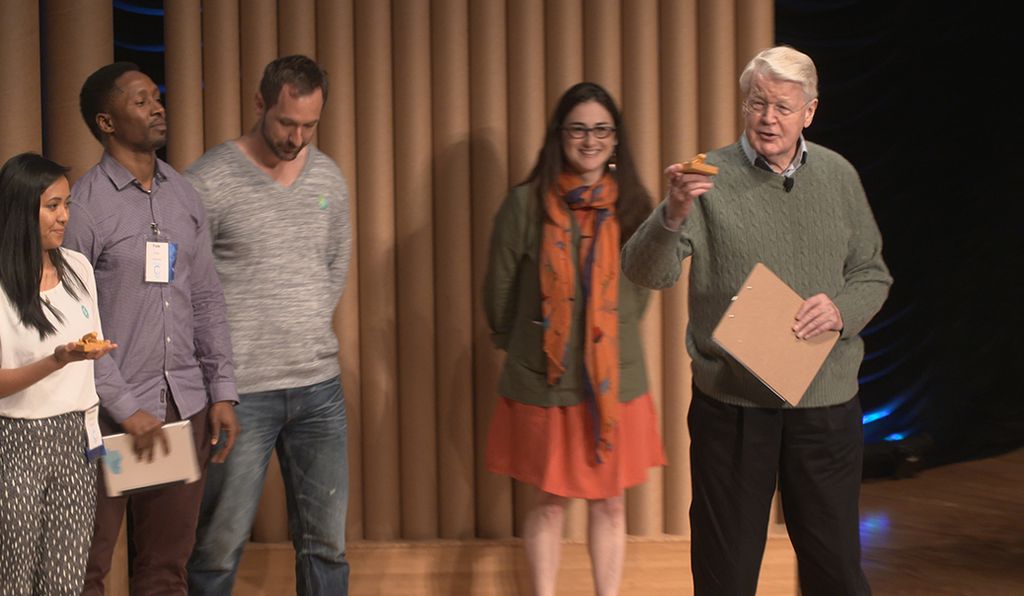
At the Smithsonian’s Earth Optimism Summit, the former president of Iceland Olafur Grimsson encouraged new solutions to climate change, awarding cash prizes to the winners of the “Make for the Planet” challenge. (The Roadmap)

Grimsson’s group felt that due to changes in information technology and social transformations, the large organizations and structures that used to be necessary to effect change were now not needed. And thus was born Roadmap, a new crowdsourcing tool for anyone and everyone interested in climate action. Still in its very early stages, Roadmap’s founders envision it as a platform for those working on climate issues—from scientist and policymaker to farmer and fisherman—to facilitate the sharing of knowledge and ideas, methods and techniques.

“A new political model is possible—where everyone can be a doer, where you no longer need big government or big enterprises to bring about success,” Grimsson says.

This new model for social change that skips the usual cumbersome channels and processes has been seen everywhere from public health, where the Bill & Melinda Gates Foundation has redefined the sector, to the hospitality industry, which is working to combat the human trafficking that plagues its businesses, to perhaps most famously the Arab Spring, where the role of social media in bringing about political change is still being debated today.

And this new model is complemented by technological changes. “The innovation in energy technology is such that we no longer have to wait for the big energy breakthrough,” Grimsson says. “We already have the available technologies. Every individual, home, village, community, town and region can execute change. The good news from the climate point of view is that, in addition to the information technology revolution, there has now also taken place an energy revolution. A house can be a power station: If the people who live in that house have extra energy, they can sell their energy through the smart grid. The notion that every house can be a power station is as revolutionary as saying that every mobile phone can be a media company.”

Grimsson admits that it may seem odd for someone in his position to be advocating that ordinary citizens take action apart from the conventional corridors of governmental power.

“For me to say that these traditional political organizations and positions are somewhat outdated is perhaps a strange statement: I was a professor of political science, I’ve been a member of parliament, I’ve been a minister of finance, I was president for 20 years,” he says.

It was during Iceland’s financial meltdown that he first experienced this new kind of social change: “I saw this very strongly through the financial crisis in my own country, which led to a big social economic uprising. All those activities were engineered by unknown people, people who were not part of a big organization, who used Facebook and the information media to bring thousands of people together in one day.”

Right now, Roadmap consists of a website and a lofty manifesto that speaks of raising the value of “moral currency” and creating a “best practices warehouse.” Visitors to the site can fill out a form if they want to become part of its community of “doers.” The practical part of the manifesto speaks of identifying the best methodologies and models; implementing a “real-time system of measurement” and a way to “gauge and understand what is working, what is not, and exactly what is being achieved.” As the platform develops, it will be interesting to see exactly what form these gauges, measurement systems, and warehouses take.

After the Paris Agreement, Grimsson says of himself and his Roadmap co-founders, “We were all optimistic, but we are all also realists.” It is his belief that if you “give people the tools, they can execute the transformation and the change—without governmental leadership.” Perhaps Roadmap will be one of those tools.

ooOOoo

Here’s a video that spells it out in ways that I find impossible to ignore.

Because in hundreds of years time I want others to look at the following picture of Troutbeck Valley in England and know how precious is this one and only planet we live on.

Or in the words of Sue Dreamwalker that I read yesterday evening:

We are witnessing more storms, more unseasonal weather patterns, and I just hope that we wake up soon to the damage we are doing to our beloved Mother that has held us in her eternal arms for so long..

Photo credit: Getty Images

Enjoy the month of May wherever you are in the world!

Closing by repeating a key pronouncement in that RoadMap video above:

Why We?

Who Else!

A blast from the past!

A friend from long ago writes of his dog!

Too many years ago, indeed when I had my own company back in the late 70s, I came in contact with Keith Edmunds. He was a Linux expert; still is!  He runs a company in the U.K., Tiger Computing, based in Monmouthshire.

The other day Keith posted a story about his dog and I asked for permission to republish. Keith very quickly said “Yes”. He added: “With a link to https://www.tiger-computing.co.uk/not-clever/, yes.”

Here it is:

ooOOoo

Rhys!

My wife is deaf. She caught meningitis when she was four years old, and one of the side effects can be deafness.

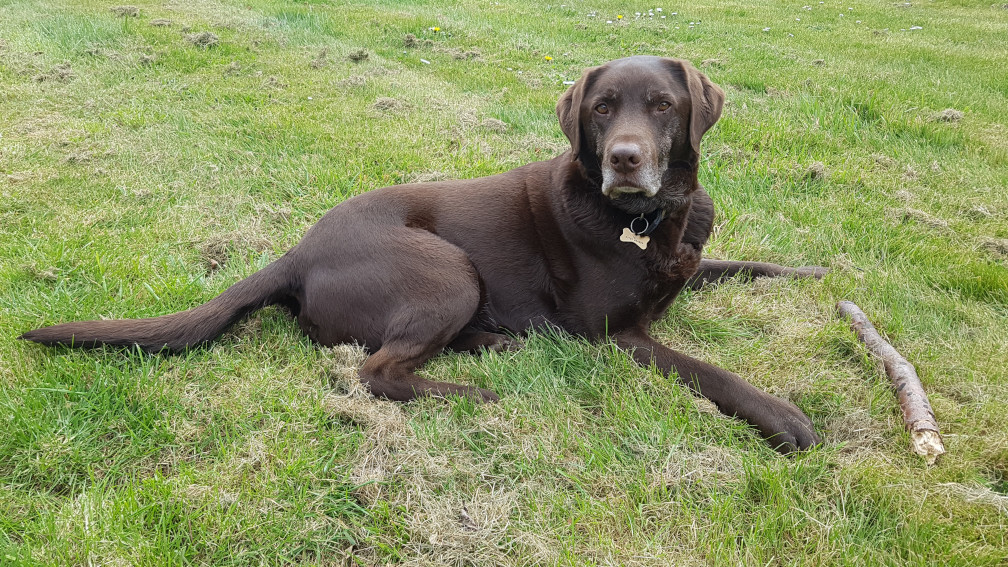
But this isn’t a sob story. It’s a joyful story of a chocolate brown Labrador called Rhys. My wife’s hearing dog.

People often ask what he can do. Well, he alerts Cecilia to the doorbell ringing, the kitchen timer going off, voice commands to “fetch mum” and the smoke alarm.

Some people ask whether he responds to the phone. But the answer is no. Cecilia can’t use the phone (she’s deaf); Rhys can’t use the phone (he’s a dog – he can’t speak). Between them you’d think they’d be able to come up with some kind of plan…but nothing so far.

“He’s very clever!,” people say. But really he’s not. I have, in moments of disrespect, mentioned that if he had an IQ one point higher he’d be a tomato.

You see we mustn’t confuse “highly trained” with “clever”.

Yes, Rhys has learnt how to respond to certain triggers. “If this happens, then do that” – It’s very basic.

If the smoke alarm sounds, then find Cecilia, nudge her, lie down and get a treat.

He doesn’t do it because he’s smart enough to know that the smoke alarm means danger. No. That would be clever.

He does it simply because he’ll get a treat for doing this task. He is a Labrador after all…

Clever is the ability to devise or select an appropriate solution to a problem. Clever – at least in adults – is a combination of intelligence, knowledge and experience.

If we apply this to business, then clever might be knowledge and experience in your domain. Right now, a lot of clever people are investigating a little virus called SARS-CoV-2 (the cause of COVID-19).

But clever can also mean knowing when to pull in the experts.

I’m no expert on immunology or virology so I’m leaving the SARS-CoV-2 problem to the talented (and knowledgeable, experienced and intelligent) bio-scientists.

Rhys is leaving the intellectual challenge of pretty much everything to others.

But I am quite clever when it comes to Linux, so if you need a little help with that then be sure to let me know…

Keith

P.S. If you’ve got a question about how to best use Linux in your business, book a free, 30 minute, no obligation Linux Strategy Call and let’s talk about it.

ooOOoo

Rhys is a lovely looking Labrador! Highly trained, of course. But some, including me, would also say clever!

What a beautiful dog!