Category: Technology

Little boys never grow up!

Who didn’t enjoy playing with model trains!

So try this for size!

The official video about Miniatur Wunderland Hamburg, the largest model railway in the world, and one of the most successful tourist attractions in Germany. On the 1.300 m² large layout, far more than a thousand trains, aircrafts, cars and ships move about. A wonder of the world in miniature. Please, find more information here.

The wind doth blow!

Maybe even blowing trucks over!

OK, that sub-heading must seem a tad bizarre!  Let me explain.  On Tuesday, Jean had an important visit to make down in Mesa, AZ on the outskirts of Phoenix.  The first 65 miles, give or take, from Payson to Mesa are down along Highway 87.

At 11.20 we started on our return from Mesa planning on being early back home, say by 1pm at the latest.  But 31 miles up the Northbound carriageway of Highway 87, we came to a halt.  The road was closed due to an accident with a tanker.  As our local newspaper, the Payson Roundup, put it,

The driver of the truck was taken by ambulance to a Scottsdale hospital with non life-threatening injuries. DPS has not ruled out speed as the cause of the crash. Photo by Andy Towle.

Due to a hazardous spill, Highway 87 was closed most of Tuesday, but reopened Wednesday morning after overnight clean up efforts, according to the Arizona Department of Public Safety.

Officials initially thought the roadway could be closed as many as two days due to the amount of oil spewed across both sides of the highway.

The highway closed down after a semi truck carrying oil used for paving rolled Tuesday afternoon near milepost 228, at the bottom of Slate Creek.

That resulted in us having to take a 170 mile detour and not arriving back until 4.30pm!

So what’s that got to do with the post for today?  Simply that the implications of Tuesday spilled, like the tanker’s oil cargo, across into Wednesday and the long, thoughtful post I had in my mind to write got put on hold.  Thus in its place is this republication of a recent release by Stanford School of Engineering at Stanford University.  Apologies for another republished item but the article is relevant and interesting.

oooOOOooo

WIND COULD MEET WORLD’S TOTAL POWER DEMAND – AND THEN SOME – BY 2030

Wind turbines near Livermore, CA.

HIGH RESOLUTION MODELS

In their study, Jacobson and Archer adapted the three-dimensional, atmosphere-ocean-land computer model known as GATOR-GCMOM to calculate the theoretical maximum wind power potential on the planet taking into account wind reduction by turbines. Their model assumed wind turbines could be installed anywhere and everywhere, without regard to societal, environmental, climatic or economic considerations.

The new paper contradicts two earlier studies that said wind potential falls far short of the aggressive goal because each turbine steals too much wind energy from other turbines, and that turbines introduce harmful climate consequences that would negate some of the positive aspects of renewable wind energy.

The new model provides a more sophisticated look than previously possible by separating winds in the atmosphere into hypothetical boxes stacked atop and beside one another. Each box has its own wind speed and weather. In their model, Jacobson and Archer exposed individual turbines to winds from several boxes at once, a degree of resolution earlier global models did not match.

“Modeling the climate consequences of wind turbines is complex science,” said Jacobson. “This software allows that level of detail for the first time.”

With a single model, the researchers were able to calculate the exposure of each wind turbine in the model to winds that vary in space and time. Additionally, the model extracts the correct amount of energy from the wind that gets claimed by the turbines, reducing the wind speed accordingly while conserving energy. It then calculates the effect of these wind speed changes on global temperatures, moisture, clouds and climate.

POTENTIAL APLENTY

Among the most promising things the researchers learned is that there is a lot of potential in the wind—hundreds of terawatts. At some point, however, the return on building new turbines plateaus, reaching a level in which no additional energy can be extracted even with the installation of more turbines.

“Each turbine reduces the amount of energy available for others,” Archer said. The reduction, however, becomes significant only when large numbers of turbines are installed, many more than would ever be needed.

“And that’s the point that was very important for us to find,” Archer said.

The researchers have dubbed this point the saturation wind power potential. The saturation potential, they say, is more than 250 terawatts if we could place an army of 100-meter-tall wind turbines across the entire land and water of planet Earth. Alternatively, if we place them only on land (minus Antarctica) and along the coastal ocean there is still some 80 terawatts available—about seven times the total power demand of all civilization. Hypothetical turbines operating in the jet streams six miles up in the atmosphere could extract as much as an additional 380 terawatts.

“We’re not saying, ‘Put turbines everywhere,’ but we have shown that there is no fundamental barrier to obtaining half or even several times the world’s all-purpose power from wind by 2030. The potential is there, if we can build enough turbines,” said Jacobson.

Mark Z. Jacobson, professor of civil and environmental engineering. Photo: Linda Cicero / Stanford News Service

HOW MANY TURBINES?

Knowing that the potential exists, the researchers turned their attention to how many turbines would be needed to meet half the world’s power demand—about 5.75 terawatts—in a 2030 clean-energy economy. To get there, they explored various scenarios of what they call the fixed wind power potential—the maximum power that can be extracted using a specific number of wind turbines.

Archer and Jacobson showed that four million 5-megawatt turbines operating at a height of 100 meters could supply as much 7.5 terawatts of power—well more than half the world’s all-purpose power demand—without significant negative affect on the climate.

“We have a long way to go. Today, we have installed a little over one percent of the wind power needed,” said Jacobson.

In terms of surface area, Jacobson and Archer would site half the four million turbines over water. The remaining two million would require a little more than one-half of one percent of the Earth’s land surface—about half the area of the State of Alaska. However, virtually none of this area would be used solely for wind, but could serve dual purposes as open space, farmland, ranchland, or wildlife preserve.

Rather than put all the turbines in a single location, Archer and Jacobson say it is best and most efficient to spread out wind farms in high-wind sites across the globe—the Gobi Desert, the American plains and the Sahara for example.

“The careful siting of wind farms will minimize costs and the overall impacts of a global wind infrastructure on the environment,” said Jacobson. “Regardless, as these results suggest, the saturation of wind power availability will not limit a clean-energy economy.”

Funding sources include National Science Foundation, U.S. Environmental Protection Agency, and National Aeronautics and Space Administration high-end computing.

Andrew Myers is associate director of communications for the Stanford University School of Engineering.

Monday, September 10, 2012

oooOOOooo

Let me close by pointing you to Mark Jacobson’s website.

Postscript to the memory of Neil Armstrong

An afterthought about the adventurous spirit of man.

While the focus on the manned exploration of space has declined significantly since those days of the Apollo missions, the spirit to explore has not diminished.  This was underlined in spades by a recent post from the British blog Earth & Solar System that I have been subscribing to since a few weeks ago.

First some background to Earth & Solar System.

This blog reflects the research interests of the Isotope Cosmochemistry and Geochemistry Group at the University of Manchester.  In our laboratories we study samples from comets, interstellar dust, interplanetary dust, Mars, the moon and asteroids to understand how the Earth and the Solar System were formed, how they evolved and became what we see today.  We study the Earth and its chemistry to understand how it works, its mantle, crust, oceans and how we change it.  We want to share and discuss what we find with everyone.

The blog is for sharing science and what we and other research groups discover as we do science in real time.  Discussion, questioning and enquiry are good, but politics, and opinion that can’t be backed up by published scientific work are strictly off-limits and will be removed.

Yet another example of why integrity is the only way forward.

Anyway, the recent post that was published came into my ‘in-box’ on Monday and I wanted to share it with you.  Primarily because the mainstream media have moved on and there is little ‘news’ about NASA’s Curiosity rover.  That’s why this post is so fascinating and it’s reproduced on Learning from Dogs with the permission of Ashley King, the author.

oooOOOooo

A busy week

Posted on September 3, 2012 by Ashley King.

The past week has seen NASAs Curiosity rover return more amazing images of the Gale crater, fire up its DAN and SAM instruments, and take its first steps towards Mt. Sharp.

Mastcam view south-west from the Bradbury landing site. The foreground is boulder-strewn and contains the edge of an impact crater. The layered rocks in the background form the base of Mt. Sharp (NASA/JPL-Caltech/MSSS).

The new images, captured using the 100mm telephoto lens of the Mastcam, provide a glimpse of the geological treats that await scientists at the base of Mt. Sharp.  Of particular interest has been the identification of an unconformity, where two rocks in contact but of different ages indicate a break in the geological record. Satellite data suggests that the rocks lying below the unconformity contain hydrous minerals whilst those above are “dry”. It appears these rock units formed under very different environmental conditions.

Unconformity (marked by white dots) at Mt. Sharp (NASA/JPL-Caltech/MSSS).

Next, Curiosity had another driving lesson, this time positioning itself over one of the scour marks created during landing. This allowed the rover to continue testing the ChemCam and turn on the Dynamic Albedo of Neutrons (DAN) instrument, which will be used to search for water below the Martian surface. The Sample Analysis at Mars (SAM) instrument, comprising of a mass spectrometer, gas chromatograph and tunable laser spectrometer, was also gently woken up. SAM can measure the abundance of C compounds, H, N and O, elements associated with life, in atmospheric and powdered rock samples. A quick test of some Earth air trapped in the instrument since launch confirmed that it is working well and should soon be ready for Martian samples.

Curiosity has now completed four drives and is heading for Mt. Sharp. However, the first target is Glenelg, a rock outcrop 400m to the east of the Bradbury landing site, where it’s hoped Curiosity will start using its drill. Although the journey will take several weeks, Glenelg contains at least three different rock types that will help scientists piece together the geological history of Gale crater.

Leaving the Bradbury landing site. This Navcam image shows the tracks left in the Martian soil by Curiosity (NASA/JPL-Caltech).

oooOOOooo

Makes a nice change to forget about the goings-on here on Planet Earth!

In memory of Neil.

There will only ever be one Neil Armstrong.

Like millions of others on this planet, I was held spellbound by the historic and epic moment of man placing his mark on another heavenly body, the Moon.  I had been so wrapped up in NASA’s space missions that I took a holiday from work (I was working at the time for ICIANZ in Sydney, Australia) for the week of July 16th, 1969.

It was, of course, July 16th when the Apollo 11 Mission launched from the Kennedy Space Center culminating at precisely 20:17:39 UTC on July 20, 1969, the moment when the Lunar Module made lunar contact.

But in terms of me writing my own obituary for Neil, what could I offer?

Then a couple of items changed my mind.

Neil Armstrong (August 5, 1930 – August 25, 2012)

The first was reading the obituary printed in The Economist.  I have long admired the many, many beautiful obituaries that have been published by this newspaper and this one was no exception.  Take this extract from the Neil Armstrong obituary,

He had an engineer’s reserve, mixed with a natural shyness. Even among the other astronauts, not renowned for their excitability, he was known as the “Ice Commander”. Mike Collins, one of his crew-mates on the moon mission, mused that “Neil never transmits anything but the surface layer, and that only sparingly.” He once lost control of an unwieldy contraption nicknamed the Flying Bedstead that was designed to help astronauts train for the lunar landing. Ejecting only seconds before his craft hit the ground and exploded, he dusted himself off and coolly went back to his office for the rest of the day. There was work to be done.

Then the beautiful words that bring the obituary to a close,

Earth’s beauty

Over half a century, the man who never admitted surprise was surprised to observe the fading of America’s space programme. The Apollo project was one of the mightiest achievements of the potent combination of big government and big science, but such enterprises came to seem alien as well as unaffordable. Mr Armstrong, who after his flight imagined bases all over the moon, sadly supposed that the public had lost interest when there was no more cold-war competition.

Yet the flights had one huge unintended consequence: they transformed attitudes towards Earth itself. He too had been astonished to see his own planet, “quite beautiful”, remote and very blue, covered with a white lace of clouds. His reserve, after all, was not limitless. One photograph showed him in the module after he and Buzz Aldrin had completed their moon-walk, kicking and jumping their way across the vast, sandy, silver surface towards the strangely close horizon. He is dressed in his spacesuit, sports a three-day beard, and is clearly exhausted. On his face is a grin of purest exhilaration.

” … they transformed attitudes towards Earth itself. He too had been astonished to see his own planet, “quite beautiful”, remote and very blue, covered with a white lace of clouds.”   For that reason alone, we need to celebrate the achievement of the Apollo 11 mission for putting our own planet into perspective within the enormity of the universe.

The second item that persuaded me to write this was a wonderful historic insight into how a potential catastrophy on the surface of the Moon would have been handled by President Nixon.  This historic item was published on Carl Milner’s blog the other day, the specific item being  What if the Moon Landing Failed?  Republished with the very kind permission of Carl.

What if the Moon Landing Failed?

Posted on September 1, 2012 by 

When Richard Nixon was the President of the United States, they had a speech ready for him to deliver to the world just in case the 1969 moon landing had ended in disaster. In fact many experts believed there was a big chance that Neil Armstrong and Edwin ‘Buzz’ Aldrin could have really gotten stuck on the moon. It’s something we don’t really think about now because we all know it was such a success. American Archives have unearthed the speech that would have been delivered if the late great Armstrong and Aldrin had never made it back to earth. This is such a great piece of history that I thought I might never see.

Give it a read, It’s such a moving and well prepared speech, and such a good thing that President Nixon never had to delivered it.

So, as with millions of others, I am delighted that this speech remained unspoken and instead we experienced: “At 5:35 p.m. (US EDT), Armstrong and Aldrin successfully docked and rejoined Collins, and at 12:56 a.m. on July 22 Apollo 11 began its journey home, safely splashing down in the Pacific Ocean at 12:50 p.m. on July 24.

Neil Armstrong’s legacy is not only being part of the wonderful team that allowed man to make the first footprint on the Moon but also bringing into our human consciousness that this blue, wonderful planet we all live on is the only home we have.

First Full-View Photo of Earth
Photograph courtesy NASA Johnson Space Center
This famous “Blue Marble” shot represents the first photograph in which Earth is in full view. The picture was taken on December 7, 1972, as the Apollo 17 crew left Earth’s orbit for the moon. With the sun at their backs, the crew had a perfectly lit view of the blue planet.

Strikes me that celebrating July 20th each year as Blue Planet Day might not be a bad idea!  Any takers?  Now that would be a legacy for Neil!

A new NEON light beckons.

A wonderful investment in studying America’s ecology is just starting.

I am indebted to The Economist for including in their issue of the 25th August a story about NEON, something I had previously not heard about.

It was then an easy step to locate the main website for the National Ecological Observatory Network, or NEON.  (Just an aside that I can’t resist – NEON is such a fabulous acronym that one wonders how much push and shove there was to come up with the full name that also fitted the word ‘NEON’!  Sorry, it’s just me!)

Anyway, back to the plot.  The following video gives a very good idea of the projects aims.  When I watched it, I found it inspiring because it seemed a solid example of how the nation, that is the USA, is starting to recognise that evolving to a new, sustainable way of life has to be  built on good science.  NEON strikes me as excellent science.  You watch the video and see if you come to the same conclusion.

There’s also a comprehensive introduction to the project from which I will republish this,

In an era of dramatic changes in land use and other human activities, we must understand how the biosphere – the living part of earth – is changing in response to human activities. Humans depend on a diverse set of biosphere services and products, including air, water, food, fiber, and fuel. Enhancements or disruptions of these services could alter the quality of human life in many parts of the world.

To help us understand how we can maintain our quality of life on this planet, we must develop a more holistic understanding of how biosphere services and products are interlinked with human impacts. This cannot be investigated using disconnected studies on individual sites or over short periods of observation. Further, existing monitoring programs that collect data to meet natural resource management objectives are not designed to address climate change and other new, complex environmental challenges.

NEON, the first continental-scale ecological observatory, will provide comprehensive data that will allow scientists to address these issues.

Later on there’s more detail, as follows,

NEON has partitioned the U. S. into 20 eco-climatic domains, each of which represents different regions of vegetation, landforms, climate, and ecosystem performance. In those domains, NEON will collect site-based data about climate and atmospheresoils and streams and ponds, and a variety of organisms. Additionally, NEON will provide a wealth of regional and national-scale data from airborne observationsand geographical data collected by Federal agencies and processed by NEON to be accessible and useful to the ecological research community. NEON will also manage a long-term multi-site stream experiment and provide a platform for future observations and experiments proposed by the scientific community.

The data collected and generated across NEON’s network – all day, every day, over a period of 30 years — will be synthesized into information products that can be used to describe changes in the nation’s ecosystem through space and time. It will be readily available in many formats to scientists, educators, students, decision makers and the general public.

For some reason I couldn’t find on the NEON website the informative map that was included in The Economist so I grabbed that one, and offer it below:

These eco-climatic domains are fully described here on the NEON website.

The benefits of this fabulous project are described thus, “The data NEON collects and provides will focus on how land use change, climate change and invasive species affect the structure and function of our ecosystems. Obtaining this kind of data over a long-term period is crucial to improving ecological forecast models. The Observatory will enable a virtual network of researchers and environmental managers to collaborate, coordinate research, and address ecological challenges at regional, national and continental scales by providing comparable information across sites and regions.

As they say in business, if you can’t measure it, you can’t manage it!  So reading in the above the sentence, ‘Obtaining this kind of data over a long-term period is crucial to improving ecological forecast models.‘ is cheering to the soul.

The United States quite rightly gets a huge bashing over it CO2 emissions but to condemn the USA for that and not to applaud this sort of wonderful research is utterly unjustified.  As I have hinted before, America has, more than any other country in the world, the energy to make things better over the coming years.

As Professor Sir Robert Watson highlighted here recently said, ‘… deep cuts in CO2 emissions are possible using innovative technologies without harming economic recovery.’

Amen to that!

Future of the car?

The mistake we all make is to look behind us and think the future will be the same.

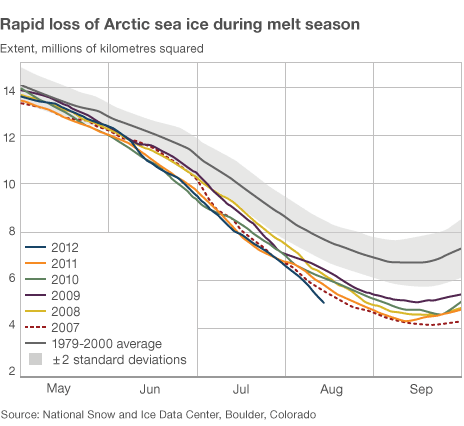
Let me start with something that is not really news.  Not news in the sense that it has been very widely reported.  I’m speaking of the probability, the high probability, that this year’s summer ice area in the Arctic will be a record low, with all the implications that this carries.  Let me refer to a recent BBC news item that included a stunningly powerful chart.

Scientists at the US National Snow and Ice Data Center said data showed that the sea ice extent was tracking below the previous record low, set in 2007.

Latest figures show that on 13 August ice extent was 483,000 sq km (186,000 sq miles) below the previous record low for the same date five years ago.

The ice is expected to continue melting until mid- to late September.

“A new daily record… would be likely by the end of August,” the centre’s lead scientist, Ted Scambos, told Reuters.

“Chances are it will cross the previous record while we are still in ice retreat.”

The US National Snow and Ice Data Center may be found here.

So to the piece that generated the title of this post, the future of the car.

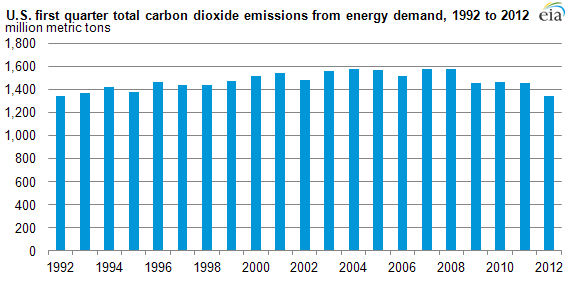
On the 17th August, I wrote an article highlighting the fact that the U.S. leads the world in cutting CO2 emissions.  That was endorsed by an item published on the U.S. Energy Information Administration’s (EIA) website, that said,

U.S. carbon dioxide (CO2) emissions resulting from energy use during the first quarter of 2012 were the lowest in two decades for any January-March period. Normally, CO2 emissions during the year are highest in the first quarter because of strong demand for heat produced by fossil fuels. However, CO2 emissions during January-March 2012 were low due to a combination of three factors:

  • A mild winter that reduced household heating demand and therefore energy use
  • A decline in coal-fired electricity generation, due largely to historically low natural gas prices
  • Reduced gasoline demand

It was the last item that caught my eye.  Because it resonated with an article on Chris Martensen’s Peak Prosperity blog just over a week ago.  That article, written by Gregor Macdonald, was called The Demise of the Car.

About a third of the way into the article, Gregor writes,

But it’s not just India that has incorrectly invested in automobile transport. The other giant of Asia, China, has also placed large resources into auto-highway infrastructure.

It appears that at least a decade ago, the developing world made the same assumption about future oil prices as was made in Western countries. The now infamous 1999 Economist cover, Drowning in Oil, reflected the pervasive, status-quo view that the global adoption of the car could continue indefinitely. A decade later, however, we find that after oil’s extraordinary price revolution, the global automobile industry is now starved for growth.

Then a little further down in this interesting article there is this,

More broadly, however, global governments are captured by sunk-cost decision making as the past 60-70 years of highway infrastructure investment is now a legacy just too painful to leave behind. Interestingly, whether citizens and governments want to face this reality or not, features of the oil economy are already going away as infrastructure is increasingly stranded. Moreover, there are cultural shifts now coming into play as young people are no longer buying cars – in the first instance because they can’t afford them, and in the second instance because it’s increasingly no longer necessary to own a car to be part of one’s group. See this piece from Atlantic Cities:

Young People Aren’t Buying Cars Because They’re Buying Smart Phones Instead

Youth culture was once car culture. Teens cruised their Thunderbirds to the local drive-in, Springsteen fantasized about racing down Thunder Road, and Ferris Bueller staged a jailbreak from the ‘burbs in a red Ferrari. Cars were Friday night. Cars were Hollywood. Yet these days, they can’t even compete with an iPhone – or so car makers, and the people who analyze them for a living, seem to fear. As Bloomberg reported this morning, many in the auto industry “are concerned that financially pressed young people who connect online instead of in person could hold down peak demand by 2 million units each year.” In other words, Generation Y may be happy to give up their wheels as long as they have the web. And in the long term, that could mean Americans will buy just 15 million cars and trucks each year, instead of around 17 million.

If future car sales in the US will be limited by the loss of 2 million purchases just from young people alone, then the US can hardly expect to return to even 15 million car and truck sales per year. US sales have only recovered to 14 million. (And that looks very much like the peak for the reflationary 2009-2012 period)

Indeed, the migration from suburbs back to the cities, the resurrection of rail, and the fact that oil will never be cheap again puts economies – and culture – on a newly defined path to other forms of transport and other ways of working.

It’s a long and interesting article that demonstrates an old truth, no better put than in this quotation reputed to have been said by John F. Kennedy,

Change is the law of life. And those who look only to the past or present are certain to miss the future.

Cutting CO2 emissions – who leads the world!

The U.S. leads the world in cutting CO2 emissions — so why aren’t we talking about it?

On the 31st July, I republished a TomGram from William deBuys that showed some pretty frightening aspects of climate change in the South-West USA.  Then there was the video on the 10th August, last Friday, that spelt out in very clear ways how the world is in a new, unfamiliar place.  It would be so easy to think it’s all going to hell in a handbasket.  So a change of tone.

There was an article on Grist by David Roberts about the US leading the world in cutting CO2 emissions.  David kindly gave me permission to republish it on Learning from Dogs.

U.S. leads the world in cutting CO2 emissions — so why aren’t we talking about it?

By David Roberts
Contrary to popular belief, the U.S. is making progress on climate change.We have cut our carbon emissions more than any other country in the world in recent years — 7.7 percent since 2006. U.S. emissions fell 1.9 percent last year and are projected to fall 1.9 percent again this year, which will put us back at 1996 levels. It will not be easy to achieve the reductions Obama promised in Copenhagen — 17 percent (from 2005 levels) by 2020 — but that goal no longer looks out of reach, even in the absence of comprehensive legislation.

Why isn’t this extraordinary story a bigger deal in U.S. politics? You’d think Obama would be boasting about it! Turns out, though, it’s a little awkward for him, since several of the drivers responsible are things for which he can’t (or might not want to) take credit.

Awkward: that whole recession thing

First off there’s the Great Recession, which flattened electricity demand in 2008. It has never recovered — in fact, in part due to 2011′s mild winter, it has even declined slightly:

US electricity consumption, 2000-2011

Click to embiggen.

For obvious reasons, boasting about the environmental benefits of the recession is not something Obama’s eager to do.

Awkward: frack-o-mania

The second big driver is the glut of cheap natural gas, which is currently trading at the 10-year low of about $3 per million British thermal units. This is absolutely crushing coal, the biggest source of CO2 in the electric sector:

The share of U.S. electricity that comes from coal is forecast to fall below 40% for the year, its lowest level since World War II. Four years ago, it was 50%. By the end of this decade, it is likely to be near 30%.

Here’s U.S. electricity generation from 2000-2012. Look how dramatic coal’s recent plunge is:

EIA: electricity generation by source, 2000-2012

Click to embiggen.

In April, coal and natural gas both contributed 32 percent to the U.S. electricity mix — equal for the first time since EIA started collecting data in the ’70s. This is, as Alexis Madrigal emphasizes, an extraordinary shift, unprecedented in the history of the U.S. electrical system.

It’s helpful to Obama to be able to point to cheap natural gas when people accuse his EPA of killing coal. And it’s helpful in his effort to claim “all of the above.” But fracking’s potential environmental and health impacts has quickly made it a flash point with his environmental base (and his Hollywood base), so it’s at the very least a fraught subject.

Awkward: Kenyan socialist EPA sharia tyranny

A less significant driver of the switch from coal to natural gas is the EPA’s long overdue rollout of new or tightened clean-air rules on mercurySO2 and NOx, and CO2. Those rules may do more work later on down the line when/if natural gas prices rise again, but for now the best analysis [PDF] shows that natural gas is doing most of the work killing coal. Nonetheless, EPA regs have proven a source of potent right-wing attacks on Obama and he’s probably not eager to call undue attention to them.

Thus: silence in the political world

So: given the fact that the decline in emissions is driven, at least in the conventional narrative, by an explosion in fossil fuel production, a recession, and a series of EPA regulations, it’s not hard to see why Obama isn’t eager to put it front and center. It’s got a little something for everyone to hate.

And of course the right isn’t eager to talk about it either, since conservative dogma tells us that there’s no way to grow the economy and shrink CO2 emissions at the same time … and yet, uh, that’s what’s happening. At the end of 2012, our economy will be much larger than it was in 1996, yet its carbon emissions will be the same. If conservatives acknowledge that it’s possible to loosen the link between climate pollution and economic growth, they’ll have to explain why we shouldn’t do a whole lot more of it.

Still, while the story has remained largely sub rosa in political media, there are several overlooked details that paint a happier picture than the conventional one above. There’s more to this story than natural gas and recession.

Happy: Coal’s getting its ass kicked by activists

First, it isn’t just natural gas and EPA taking coal out — it’s the kick-ass anti-coal movement! Fighting tooth-and-nail, plant-by-plant, it has blocked new construction and shut down over 100 existing plants.

Beyond Coal: 112 down

The campaign has been so disciplined and successful that it’s drawn the support of NYC Mayor Michael Bloomberg, who does not typically invest his own money in feel-good symbolism. He expects accountability and he’s getting it. Like the man said, “Ending coal power production is the right thing to do.”

Happy: Clean energy is happening

Renewable energy still represents a small portion of U.S. electricity generation, but that fact obscures its outsized impact. The U.S. doesn’t need to add a ton of renewables for things to start shaking loose.

Here’s growth over the last decade:

EIA: renewable energy share, 2001-2011

Click to embiggen.

One thing that jumps out is that renewables are growing much faster in some places than others. South Dakota now gets 22 percent of its electricity from wind, Iowa 19 percent. The top two states in total installed wind are Kansas and Texas. The top two for wind jobs are Iowa and Texas. That’s three red states and a deeply purple one — a wedge separating clean energy from the climate culture wars. That portends accelerating changes in the political economy.

Also driving changes in political economy: 29 states and D.C. now have mandatory renewable energy standards.

FERC: renewable energy standards, 2011

Click to embiggen.

Installed wind and solar have doubled in the U.S. since Obama took office. Costs for solar are plunging like crazy and onshore wind power may be competitive with fossil fuels without subsidies by 2016. The National Renewable Energy Laboratory says the U.S. could get 80 percent of its power from renewables by 205o. Given that “official” projections of renewable energy growth have been consistently beneath the mark, it’s not unreasonable to think we may be underestimating future growth.

And renewables don’t have to get that big to start making waves. The sun shines most when the most electricity is being used — “peak demand” — so it serves to sharply reduce peak prices. Turns out that’s where utilities make a lot of their money. U.S. utilities are being forced to crank off coal plants when peak prices drop and then crank them back on afterwards.

It is no fun to turn coal plants on and off — it’s slow, laborious, and kills their economics. More and more, utility managers are turning toward upgraded, smarter grids and more flexible, responsive “mid-load” plants (i.e. natural gas). By hacking off peak prices, renewables will make the dynamics even worse for coal, well before they reach a large proportion of total electricity.

So renewables are a bigger part of this story than they appear, and getting bigger.

Happy: Demand is leveling off long-term

It’s not just the recession that’s bringing down U.S. energy demand — the leveling off of demand is a long-term trend. The U.S. Energy Information Administration (EIA) projects energy use will grow quite slowly through 2035:

EIA: energy demand to 2035

Click to embiggen.

And this is almost certainly conservative: EIA doesn’t model policy changes, underestimates the role of technology, ignores rising fossil fuel prices, and is incapable of predicting cultural shifts.

For instance, few projections anticipated the sharp decline in driving in the U.S., which has been driven (ahem) as much by cultural and demographic factors as by economics.

Or consider the dramatic progress in energy use in buildings, which was also not anticipated by EIA. From Architecture 2030 comes this graph, which compares the EIA Annual Energy Outlook (AEO) projections on U.S. building stock from 2005 with the ones from 2012:

EIA projections for building energy consumption, 2005 vs 2012

Click to embiggen.

The growth in U.S. building stock is slowing (in part — but only in part! — due to the recession), but growth in building energy consumption is dramatically slowing, thanks to advances in energy efficiency technology. EIA now expects CO2 emissions from the building sector to decline by 2035. That’s a pretty big change from going up by over 50 percent!

And that’s just with straight-line projections. If “best available demand technologies” are deployed, it looks like this:

EIA projections for building energy consumption, best available tech, 2005 vs 2012

Click to embiggen.

It’s within our reach to reduce the CO2 emissions of the building sector almost 22 percent! Given that building standards are one of the few areas of bipartisan agreement on energy these days, it’s not crazy to think that we’ll get closer to the latter projections than the former.

And the EIA projections for building energy consumption, Architecture 2030 notes, do not incorporate “sustainable planning applications or passive heating and cooling, natural ventilation, daylighting, or spatial configuration and site design strategies,” all of which are gaining in popularity and sophistication.

In short, there’s reason to think the demand-side story is similar to the supply-side story: official projections are dramatically underestimating potential.

Worry, but be happy

To sum up: yes, the explosive growth of natural gas and the Great Recession played a big part in U.S. climate emissions declining in recent years. And either of them could reverse in years to come. But they are not the whole story. There are real transitions underway — seedlings that can be watered and fertilized.

As Brad Plumer notes, America’s modest progress to date still leaves the world on a pathway to climate catastrophe. But it also shows that projections are not destiny. Things can change, and quickly.

Let me just pick out two sentences from near the end, “But they are not the whole story. There are real transitions underway — seedlings that can be watered and fertilized.”

It serves as a very good reminder that many people are voting with their feet, so to speak, and making a difference.

Thinking outside the box

Strange theory reveals secrets of the universe, the logic of sycamore leaves and why even smart people struggle with new ideas.

A guest post from Pete Aleshire, Editor, Payson Roundup.

Introduction

The Payson Roundup is our local newspaper here in Payson, AZ.  I first saw this article by Pete a couple of weeks ago and was just utterly engrossed by it.  Not just the tantalising peek into a physics I know so little about but the beautiful prose.  The latter is not surprising because as well as being editor of the paper, Pete also teaches the creative writing course at our local college.  Jean and I had the benefit of attending the course, I guess about a year ago, and therefore can speak from experience.

So settle down and enjoy.

oooOOOooo

I finally got Drake Larson together with both sycamore leaves and Payson Mayor Kenny Evans. Moreover, I have been entrusted with a formula that may win me an invitation to Oslo if Drake gets a Nobel Prize.

But even if that don’t work out, I did get to eavesdrop on Drake and Evans. Quite the event, from my bemused point of view, since it shed light on dangerous delights of outside-the-box thinking and the Nature of the Universe.

But wait. You look confused.

Let me back up — and start somewhere closer to the beginning. Be patient with me — by the time we’re done, you’ll realize why God’s a math nerd, one surprising secret of Dark Energy, why farmers become original thinkers and what sycamore leaves tell us about the universe.

But first, I have to explain about Drake.

We grew up together, getting into (and mostly out of) various varieties of trouble. Very early on, I realized that he was much (much) smarter than me. This initially really irritated me, as I was previously inclined to vanity about my intelligence. Turns out, I love learning stuff other people have discovered, but Drake only gets truly excited when he has hold of a completely new idea that no one else can quite grasp. This prepared me, as it turns out, for meeting Kenny Evans — but that’s getting ahead of the story.

Drake and I grew up doing math homework together, before I wandered off into a career in newspapers. He got his degree in mathematics, turned down a job with the RAND Corporation and took up growing table grapes.

But he never quit picking at the lock of the universe.

Years ago when I was the science writer for the Oakland Tribune, he came to me all excited about a set of formulas he had. I did my best to follow the two pages of calculations, but all I can tell you is that they described instabilities of any sphere with uniform density. He predicted that when the Voyager spacecraft reached Jupiter, it would report inexplicable turbulence at a certain depth in the atmosphere. I ran his numbers past various top-level physicists and mathematicians who couldn’t find a flaw in his formulas — but concluded that it had to be wrong since it led to a violation of the keystone laws of conservation of mass and energy.

But I took note some months later when the Voyager spacecraft reported mysterious levels of turbulence deep within the atmosphere of Jupiter.

The years passed. Drake kept growing grapes, flowers, dates and vegetables — and working on his calculations. He wrote a book, “The Cults of Relativity,” in which he described a few of his theories, delighted in the conundrums of mathematics and pondered the curious resistance of even smart people to unconventional ideas.

We got together again recently. I took him down to Fossil Creek, all overhung with sycamores with the rustle of floppy, five-pointed leaves. Drake was his old self on our Fossil Creek tour as he tried to show me math’s beauty around us, although I was but a blind man clutching the tail of his mathematical elephant.

He had now connected his formulas to dark energy, a still hypothetical form of energy invoked by desperate cosmologists to explain the startling observation that the expansion of the universe is actually accelerating. To explain this seeming impossibility, they invented “dark energy” — which they figure pervades the universe and at certain densities creates a repulsive force stronger than the attractive force of gravity.

Anyhow, here’s the point: Drake was in awe that his mathematical wanderings offered a way to calculate dark energy’s cap within earth — it happened to be an “inside is now outside” inversion of Isaac Newton’s simplest integral. No. Please. Don’t ask me to explain that. But earth’s dark energy cannot exceed 17 pounds per square inch at a depth of about 1,500 miles. He’s been working with University of Southern California computer crunching guru professor Barry Boehm, and the University of California at Riverside geophysics professor Shawn Biehler on its implications. Among other things, it could explain the perplexing observation that major earthquakes increase the earth’s rotation rate.

No one knows how to measure such a quantity at present. Someday they will. If it turns out that 17 pounds per square inch is a relevant benchmark for earth’s dark energy, then this column will maybe win Drake the Nobel — and I’ll get to dress up and attend the ceremony.

So Drake and I spent the day wandering along the banks of Fossil Creek as he kept trying to come up with metaphors so I could grasp math’s secret within the beauty of Fossil Creek’s sycamore leaves. The well-designed sycamore leaves adhere to the Fibonacci sequence, a mysterious progression of numbers that crops up throughout nature — from the spiral of a nautilus shell to the layout of the ruins of Chaco Canyon.

So I figured I’d just write this — and get earth’s 17 PSI cap for dark energy out there in the time/date/ stamped world.

Oh, yeah: And about Kenny Evans.

So that night, I took Drake to the Payson council meeting. Turns out, Drake’s family was growing grapes in the Coachella Valley at the same time Evans was farming 10,000 acres in Yuma. They both managed to survive that tempestuous time when the United Farm Workers union organized agriculture workers.

I introduced them and listened as they recalled events and figured out whom they knew in common.

It was then that I decided to blame Drake for my faith in Evans’ ridiculous conviction that a university will build a campus here in this itty bitty tourist town — complete with a research center and convention hotel. No sensible small-town mayor would risk public ridicule while spending thousands of hours on such an outside-the-box notion … unless he’d learned to gamble on dreams and hard work during all those years as a farmer.

Evans’ notion is almost as silly as a farmer who calculates the amount of dark energy emanating from earth, while credentialed experts scratch their collective heads.

Still, I’m thinking maybe I’ll get a nice suit jacket — something I can wear to both the university’s groundbreaking and the ceremonies in Oslo.

Hey, never hurts to be prepared.

oooOOOooo

A big thank-you for the permission to republish this on Learning from Dogs. I have no doubt that many LfD readers enjoyed it as much as I did!  Stay with me for tomorrow when the theme of thinking, innovation and craziness is explored a touch more.

The Curiosity Mission.

Just a personal muse!

This has very little to do with anything other than my lifelong fascination in exploring space, which is why just over 21 hours ago I published the taster for this Post.  That ‘Earthrise’ photograph and the one below changed forever how we feel about the home we all live on.

The famous “Blue Marble” shot.

First Full-View Photo of Earth
Photograph courtesy NASA Johnson Space Center

This famous “Blue Marble” shot represents the first photograph in which Earth is in full view. The picture was taken on December 7, 1972, as the Apollo 17 crew left Earth’s orbit for the moon. With the sun at their backs, the crew had a perfectly lit view of the blue planet.

December 7th, 1972.  Coming up to 40 years ago. I was in my late-20s.  This photograph touched me in ways that I still don’t understand.  This is such a beautiful planet.

Thus Curiosity: NASA’s latest Mars rover is due to touch down at 05:31 UTC Monday 6th August.  I decided to publish this at 04:31 UTC on the 6th one hour before the crucial and novel landing, or in terms of local time here in Payson, Arizona, 9.31 pm on the 5th August.

Wishing the Mission and all the hard-working people who have spent so many years working towards this critical point in time in space history the very best of luck!  It will be wonderful wherever one is on this Planet to wake up on the 6th and hear that Curiosity has landed safely! And if you want to follow the Mission then NASA have a website devoted to the latest news.

Let me close by offering you a couple of videos from the fabulous BBC Horizon science series, full hour-long programme about NASA’s latest Mission to Mars.

NASA Engineer Adam Stelzner describes how he hopes the Curiosity rover will land.

Chief Project Scientist John Grotzinger talks about Curiosity’s scientific instruments.

Stop, read, reflect and Act!

The latest from Bill McKibben has to be read and shared.

Introduction

We live in a world where there’s a great fondness for shortness, whether it’s headlines, soundbites, Twitter length ‘conversations’, text messages, and the rest.  However, I’m introducing an essay from Bill McKibben that is long.  When I use the word long I mean both literally, the essay is a shade under 6,200 words, and subjectively, the essay is long, very long, on meaning.

It was published in the August 2nd, 2012 issue of Rolling Stone.  As Allyse of the 350.org team wrote in a widely distributed email,

Here at 350.org, we do a lot of our internal communication via online chat, and our written shorthand for “YES!” and “totally awesome!” and “you rock!” is “++”. Which is why I say to you: ++ Social Media Team, ++. You all rock.

Bill McKibben’s article in Rolling Stone—which we asked you to spread around the internet last week—has been shared on Facebook almost 100K times and seen by hundreds of thousands of people. Great work. If you haven’t read it yet, please do.

This article really lays out the intellectual framework for much of our work in the weeks, months, and years ahead. We want to keep pushing these ideas out there, especially this one: our objection to the fossil fuel industry is structural—these businesses are in fact planning to wreck the planet!

So we took a quote from Bill’s article and made it into a graphic that’s already been shared almost 2,500 times on Facebook. Will you help us push it past 5,000? Click here to share.

As you know if you’ve read the article, this is really an all-hands-on-deck moment for humanity. Thanks for doing your part—in ways both large and small.

Onward,

Allyse

Will you put aside some time, settle down in a comfortable chair, and read the article?  Please do!

It crossed my mind to split it over a couple of days but I decided against that.  But I have inserted a ‘click to reveal more’ about 1,100 words into the article – please do read on when you reach that point.  And just as important, do comment!

Oh, want to see that image on Facebook that has been shared so widely?  Here it is:

A’int that the truth!

Finally, feel free to share this as far and wide as you want.  Thank you.

oooOOOooo

(Apart from the first image from Edel Rodriguez, all the other photographs have been inserted by me and are not in the original Rolling Stone production – I decided to insert them to make reading the article more visually attractive on a screen.)

Global Warming’s Terrifying New Math

Three simple numbers that add up to global catastrophe – and that make clear who the real enemy is

Illustration by Edel Rodriguez

By Bill McKibben
July 19, 2012 9:35 AM ET

If the pictures of those towering wildfires in Colorado haven’t convinced you, or the size of your AC bill this summer, here are some hard numbers about climate change: June broke or tied 3,215 high-temperature records across the United States. That followed the warmest May on record for the Northern Hemisphere – the 327th consecutive month in which the temperature of the entire globe exceeded the 20th-century average, the odds of which occurring by simple chance were 3.7 x 10-99, a number considerably larger than the number of stars in the universe.

Meteorologists reported that this spring was the warmest ever recorded for our nation – in fact, it crushed the old record by so much that it represented the “largest temperature departure from average of any season on record.” The same week, Saudi authorities reported that it had rained in Mecca despite a temperature of 109 degrees, the hottest downpour in the planet’s history.

Not that our leaders seemed to notice. Last month the world’s nations, meeting in Rio for the 20th-anniversary reprise of a massive 1992 environmental summit, accomplished nothing. Unlike George H.W. Bush, who flew in for the first conclave, Barack Obama didn’t even attend. It was “a ghost of the glad, confident meeting 20 years ago,” the British journalist George Monbiot wrote; no one paid it much attention, footsteps echoing through the halls “once thronged by multitudes.” Since I wrote one of the first books for a general audience about global warming way back in 1989, and since I’ve spent the intervening decades working ineffectively to slow that warming, I can say with some confidence that we’re losing the fight, badly and quickly – losing it because, most of all, we remain in denial about the peril that human civilization is in.

When we think about global warming at all, the arguments tend to be ideological, theological and economic. But to grasp the seriousness of our predicament, you just need to do a little math. For the past year, an easy and powerful bit of arithmetical analysis first published by financial analysts in the U.K. has been making the rounds of environmental conferences and journals, but it hasn’t yet broken through to the larger public. This analysis upends most of the conventional political thinking about climate change. And it allows us to understand our precarious – our almost-but-not-quite-finally hopeless – position with three simple numbers.

Continue reading “Stop, read, reflect and Act!”