Category: Spirituality

Phoebe, RIP

Now we are down to nine.

Back on the 18th January we had a scare in that we lost Hazel for a few hours; I wrote about that here.  The reason that comes to mind so clearly is that on the 19th we took our dog, Phoebe, down to see a specialist vet in Phoenix.

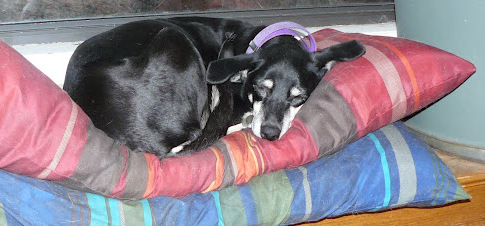
Phoebe in healthier times

Phoebe had been showing signs of blood in her stools but otherwise was a fit and happy dog and still eating well.  Our local vet thought that a colonoscopy might throw some better light on the problem.  In fact, the specialist in Phoenix rapidly identified swollen lymph glands, gave Phoebe a scan and diagnosed lymphoma.  It was a bombshell, more so as the specialist didn’t give Phoebe’s chances at much more than 7 to 10 days.

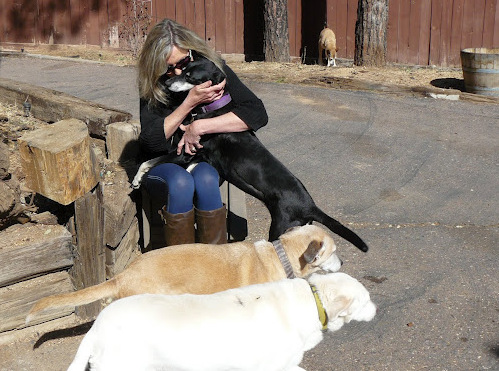
A loving Phoebe right to the end.

One of the recommendations from the specialist was to put Phoebe immediately on a grain-free diet and we have subsequently learnt the dangers of many grain-based dog foods.  We declined chemotherapy as her liver had already been compromised.

The change of diet plus boundless love and attention extended Phoebe’s life until yesterday morning when, around 3.15 am she had a seizure and entered a coma.  By 7.30 am Phoebe was very weak and not registering the world around her.  But she wasn’t in pain, and to the best of our knowledge, had not experienced pain during her last journey.

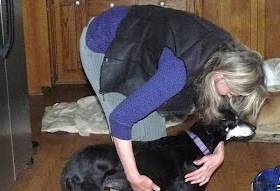
Last hugs before the last sleep.

Sometime around 9am Phoebe slipped away and Jean and I buried her a little later.  She lies in peace, under the shade of a tall Ponderosa pine.

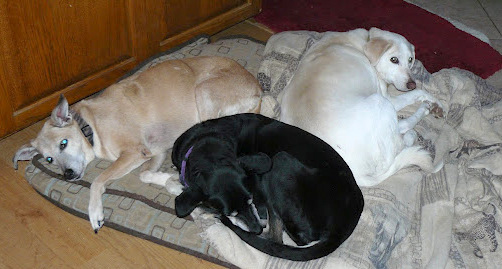
Lilly, Phoebe and Paloma - Phoebe will live on in their memories.

Phoebe was such a sweet, loving dog.  Jean found her back in the Summer of 2004 when Jean was living, with her late husband Ben, in the coastal Mexican town of San Carlos.  Jean had been running a dog rescue operation for years just out of her love for dogs.

Jean came across this young, female dog, about 4 months old, running through the village of Santa Clara about 12 miles from San Carlos.  The dog was really thin and didn’t seem to belong to anyone so Jean brought her back to San Carlos and placed her in the lot where she looked after her rescue dogs while they were waiting for adoption by caring humans.  Jean found that this little black dog was totally friendly and loving to all.  But within a few weeks some of the bigger dogs in the lot started to pick on her and, Phoebe, as she was now known was taken back to Jean’s house and that was that.

And a final footnote.

Back to Phoebe’s seizure around 3am on Thursday morning.  Something woke me around 3.10am and I rolled out of the bed to make tracks for the bathroom.  Pharaoh sleeps on his blanket just inside the door to the bedroom and is always dead to the world until 7am, give or take.

But not yesterday morning.  He was sitting on his haunches, facing the closed door and totally alert.  He knew something was wrong in the room where Phoebe was, despite there being no sound at all.  Jean and I like to think that the last message that Phoebe sent out to her world was heard by Pharaoh.

Reaching out across nations.

An unanticipated reward from Blogging.

When I started writing Learning from Dogs, way back on July 15th 2009, I didn’t have a clue as to the world I was entering, figuratively speaking.  But there have been many unanticipated rewards including the great pleasure of the way that this strange virtual world of the Internet brings people together.  One connection recently made was with a young Bangladeshi living in the city of Dhaka, more of his background here.

Nakib recently published a powerful and moving Post and has been gracious in allowing me to republish it, as follows:

The vulture that waited for the child to die

Given below is the 1994 Pulitzer price-winning photograph taken by Kevin Carter during the Sudan famine of 1994.

The photo shows a famine-stricken child crawling towards a United Nations food camp, which was located at least one kilometer away from the place shown. The vulture on the other hand is waiting eagerly for the child to die so that it can devour it.

I do not know what message the photograph revokes on your head but every time I look at it I feel blessed that I have been provided enough at least to satisfy my hungry stomach and keep me energetic enough to write blogs. I feel small and humble when I think of all the people suffering out there— homeless and starved— yet trying their best to make some sense of the complex notion known as life. It tells me that I have been blessed for a reason, for a purpose, and whatever I have been provided with should not go in vain. I can infer that my powers should be used well, at least for that little kid on the above photograph for whom Fate had sealed a quicksand of reality too hard to acknowledge for many of us hedonists out here.

Most importantly, to me the photograph conveys an emotion; a reality that many of us are too blind to grasp. I think of how people throughout the world are suffering to no ends yet amidst everything trying again and again to find the silver lining associated with the black cloud. I realize that there is a lot happening outside my comfortable apartment and Biology textbook that needs looking after, that there is a lot of people who strive hard yet achieve nothing in return. It amazes me when I try to ponder God’s sense of justice and egalitarianism.

So is it okay for the blessed 25% of the population in this world to waste everything that life has given them while the the rest 75% live amidst severe poverty, oppression and inequality?  Is it okay to go overboard with New Year parties while exactly at the same hour millions of people across the globe are suffering from the fangs of social deprivation? Is it okay to let things be as they are and forget about everything so as to harmoniously embrace useless ambitions and lustful desires?

Have we all truly forgotten to share our wealth and about the latent human being that exists inside everyone of us? Have we truly gottten rid of all those emotions that make us human beings? Is this what the world is for: for some to live lavishly while for the rest to suffer endlessly?

Three months after he took the photograph Kevin Carter, after suffering from several periods of depression, committed suicide.

Dated on the day the photo was taken, the following note was found from his diary:

Dear God, I promise I will never waste my food no matter how bad it can taste and how full I may be. I pray that He will protect this little boy, guide and deliver him away from his misery. I pray that we will be more sensitive towards the world around us and not be blinded by our own selfish nature and interests. I hope this picture will always serve as a reminder to us that how fortunate we are and that we must never ever take things for granted.

As for the child, no one really knows what happened to him; not even the South African photographer who had left the place immediately after the photo was taken. I try to appease myself by saying that the child never existed in the first place. God simply intended to provide us with a glimpse of the truth of life, to remind us how blessed we are. I hope this is true.

oooOOOooo

Very, very moving and beautifully expressed.

Ecology and faith

The National Preach-In held the week-end of February 11th/12th.

Some while ago, I signed up for a week-end organised by the Arizona Interfaith Power & Light.  It was part of a national programme inviting faith leaders from across the country to give sermons and reflections on climate change over the weekend of February 10-12, 2012.  My interest was simply to learn more about the week-end.

Then I quickly discovered that Father Dan from our church, St. Paul’s, had also signed up.  In my innocence I offered to help in any way which was quickly met by a response that bowled me over, “Well, you can be the homilist and give the sermon!”  Thus it came about that at yesterday’s 8am and 10am services yours truly rather uncertainly delivered the sermon.  John H., who with my dear wife Jeannie, did so much to turn my rambling thoughts into a coherent theme, encouraged me to publish the sermon as today’s Post on Learning from Dogs.  It now follows.

oooOOOooo

St. Paul’s Episcopal Church, Payson, Arizona

The 6th Sunday after the Epiphany

Year B

February 12th, 2012

2 Kings 5:1-14 X Psalm 30 1:13 X 1 Corinthians 9:24-27 X Mark 1:40-45

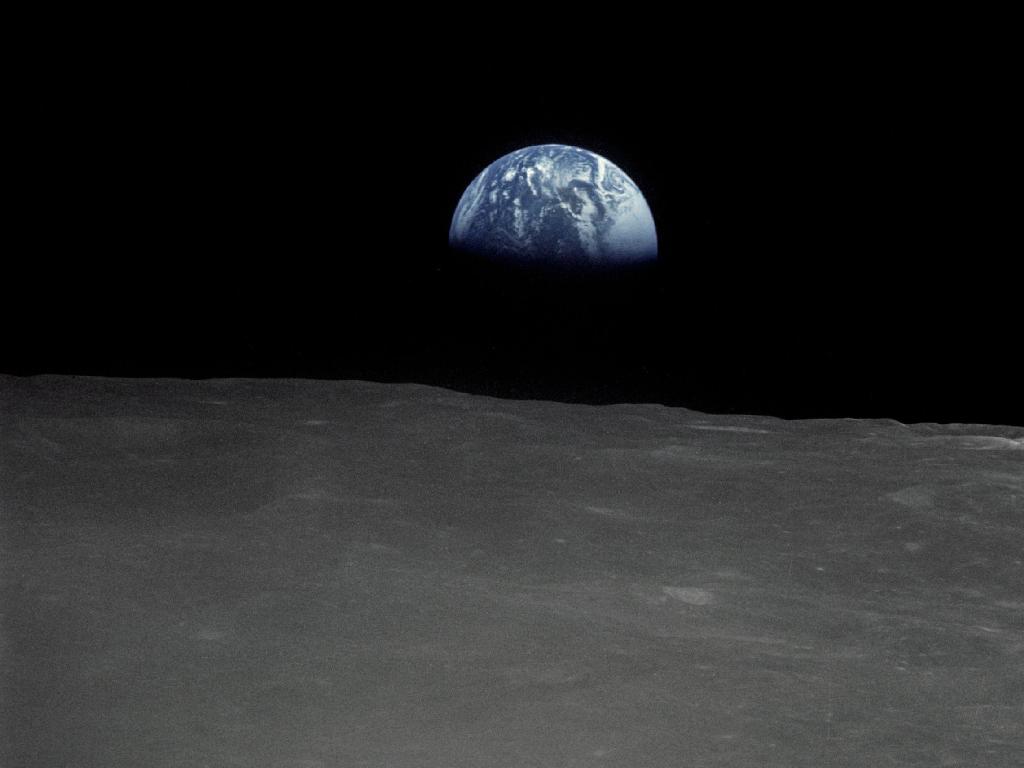
It was just a photograph. OK, one taken 43 years ago but, so what! Well, the late Galen Rowell, the famous Californian wilderness photographer called it, “the most influential environmental photograph ever taken.”

We are talking about the photograph called ‘Earthrise’ taken from Apollo 8 on December 24th, 1968 during the first manned mission to the Moon. Each of you should have a copy of that picture close by. Look at it now and let your imagination be carried back to that Apollo 8 capsule and that momentous experience.

As the Earth rose above the horizon of the moon, NASA astronaut Frank Borman uttered the words, “Oh my God! Look at that picture over there! Here’s the Earth coming up. Wow, is that pretty.” Bill Anders then took the ‘unscheduled’ photograph.

Then recall that evening, Christmas Eve 1968, when the three NASA crew members took turns reading from the book of Genesis to what was probably the biggest audience ever in the history of television, Frank Borman finishing with the words, “God called the dry land earth, and the gathering of the waters He called seas; and God saw that it was good.

Our planet is good, and so beautiful, and so precious to life. Life that arose in just a fraction of time after the Solar System formed 3.7 billion years ago; the oldest traces of life have been found in fossils dating back 3.4 billion years. That miracle of life.

Who hasn’t gazed into a clear, Arizonan, night sky and been lost in the beauty above our heads. Or felt the wind, flowing across ancient lands, kiss our face. We stand so mite-like, so insignificant in all this immensity of creation; God’s creation.

Our dreams, our hopes and failures, everything we are, have ever been and ever will be, nothing more than a swirl of dust across a desert track.

Jeremiah was called to be a prophet in 626 BC, some 2,638 years ago. In Jeremiah 12:4 he wrote, “How long will the land mourn, and the grass of every field wither? For the wickedness of those who live in it, the animals and the birds are swept away…

Words from so long ago! But Jeremiah would, surely, have gasped with disbelief had he realised how, some 2,600 years later, ‘the land now mourns and the grasses so wither’.

Jeremiah reveals much that we all could learn about ourselves. The other prophets couldn’t be accused of hiding behind their work but Jeremiah, out of all of them, allowed us to see the evidence of his own spiritual condition. He was a man of deep feelings and sensibilities and in his book there are five laments over the serious spiritual and moral condition of God’s people. That’s us, by the way!

In that time of Jeremiah, the world population was 100 million persons; slightly less than the population of Mexico today.

Some 1,350 years later, 1,000 A.D., the global population was 265 million.

But by the year 2,000 A.D., our population had increased to 6,000 millions! Put another way, that’s an increase of 5.7 million people every year for a 1,000 years !

Any guesses on the increase in the last 12 years, since 2,000? Well, the global population has increased by 990 million. About 90 million every year!

It is utterly unsustainable at present levels of Western consumption, let alone with poorer nations trying to ‘catch up’.

Last September, our House of Bishops issued A Pastoral Teaching. Our Bishops believe those ancient words of Jeremiah describe these present times. They call us to repentance, to change.

That Pastoral Teaching, in part, says, “Christians cannot be indifferent to global warming, pollution, natural resource depletion, species extinctions, and habitat destruction, all of which threaten life on our planet. Because so many of these threats are driven by greed, we must also actively seek to create more compassionate and sustainable economies that support the well-being of all God’s creation.

Our bishops refer to The Anglican Communion Environmental Network that calls to mind the dire consequences that our environment faces, again I quote: “We know that we are now demanding more than the earth is able to provide. Science confirms what we already know: our human footprint is changing the face of the earth and because we come from the earth, it is changing us too. We are engaged in the process of destroying our very being. If we cannot live in harmony with the earth, we will not live in harmony with one another.

Let those words enter our souls: “If we cannot live in harmony with the earth, we will not live in harmony with one another.” Planet Earth mirrors our souls! Nothing new about that. In 1975, Berkeley physicist Fritjof Capra wrote in his book The Tao of Physics, “we can never speak of nature without, at the same time, speaking about ourselves”.

Fr. Dan reflected in his January 22nd sermon on the questions, “Am I really free? Can I really change?” ….. and continued with the words from Jesus, “The time is fulfilled, the Kingdom of God has come near, Repent.” Fr. Dan reminded us that the word ‘repent’ indicates that we can change. We can change, we must, and we will.

Otherwise we will learn the truth of that Cree prophecy, “When all the trees have been cut down, when all the animals have been hunted, when all the waters are polluted, when all the air is unsafe to breathe, only then will you discover you cannot eat money.

OK, from out of the mouths of North American Braves to out of the mouths of English babes.

The ‘eat money’ phrase reminds me of a story I heard years ago, back in England. You need to imagine a dilapidated, rural Anglican church with a dwindling congregation. A young boy was given a five pound note to put in the collection plate. When the offering came around, he didn’t put it in. However, after the end of the service, he went up to the vicar, shook his hand and gave him the five pound note. The vicar asked him, “Why are you giving me this money? Why didn’t you put it in the collection plate?”

The young boy answered, “Because my Mummy told me you’re the poorest vicar we’ve ever had!”

Let me stay in Britain. Martin Rees is a British cosmologist and astrophysicist and has been Britain’s Astronomer Royal since 1995.

Sir Martin Rees, indeed Lord Rees as he is now, has been Master of Trinity College, Cambridge since 2004 and was President of the Royal Society between 2005 and 2010.

In a presentation in 2005, he said this, “We can trace things back to the earlier stages of the Big Bang, but we still don’t know what banged and why it banged.

Lord Rees continued, “But the unfinished business for 21st-century science is to link together cosmos and micro-world with a unified theory. And until we have that synthesis, we won’t be able to understand the very beginning of our universe. You want to not only synthesise the very large and the very small, but we want to understand the very complex. And the most complex things are ourselves, midway between atoms and stars.”

Hang on to that word ‘midway’ as I continue reading from Rees’ presentation.

We depend on stars to make the atoms we’re made of. We depend on chemistry to determine our complex structure. We clearly have to be large, compared to atoms, to have layer upon layer of complex structure. We clearly have to be small, compared to stars and planets — otherwise we’d be crushed by gravity.

And in fact, we are midway. It would take as many human bodies to make up the sun as there are atoms in each of us. The geometric mean of the mass of a proton and the mass of the sun is 50 kilogrammes (110 lbs), within a factor of two of the mass of each person here. Well, most of you anyway!

Back to me! Just reflect on the magnificence of that fact! Science and poetry so beautifully woven together. We, as in humankind, the poetic manifestations of God’s unbelievable creation. Our relationship with the atoms perfectly balanced with our relationship with the sun. Brings a whole new meaning to seeing starlight in the eyes of the one you love!

It is all so beautiful, so magical, so spiritual, so God-like. It is also so fragile and vulnerable.

There is a copy of that Pastoral Teaching available for you on your way out of Church. I implore you to read it, nay more than read it, hold it close to your heart. Within that teaching all of us are invited to join our Bishops in a 5-point commitment for the good of our souls and the life of the world, our beautiful planet; the essence of those 5 points being:

That we, as brothers and sisters in Christ, commit ourselves:

  • To repent all acts of greed, over-consumption, and waste;
  • To pray for environmental justice, for sustainable development;
  • To practice environmental stewardship and justice, energy conservation, the use of clean, renewable sources of energy; and wherever we can to reduce, reuse, and recycle;
  • To uproot the political, social, and economic causes of environmental destruction and abuse;
  • To advocate for a “fair, ambitious, and binding” climate treaty, and to work toward climate justice through reducing our own carbon footprint and advocating for those most negatively affected by climate change.

As our Bishops wrote, “May God give us the grace to heed the warnings of Jeremiah and to accept the gracious invitation of the incarnate Word to live, in, with, and through him, a life of grace for the whole world, that thereby all the earth may be restored and humanity filled with hope.”

I started with the taking of a photograph 43 years ago that forever changed our view of our planet. Now is the time to change our relationship with our planet, to love it and cherish it; it’s the only one we have. Otherwise, we may not have another 43 years left.

Or in the words from today’s Psalm, “O LORD my God, I cried out to you, and you restored me to health.

Amen.

Climate, truth and integrity, part two

Continuing from Part One last Friday.

Last Friday I started re-publishing the wonderful comments that had appeared on Climate Sight in response to a question that I had raised, namely,

While in every way that I can think of, I support the premise of mankind affecting global climate, I would love to hear from someone who could reconcile the Post above with these recent items:” and then included the links to the WSJ and Daily Mail items.

If you are not familiar with those WSJ and Daily Mail items, then you will need to go back to Friday’s Post.

So moving on.

The third response was from chrisd3, here’s what he wrote,

Paul, here is the Met Office’s response, which begins, “[The Daily Mail] article includes numerous errors in the reporting of published peer reviewed science undertaken by the Met Office Hadley Centre and for Mr. Rose to suggest that the latest global temperatures available show no warming in the last 15 years is entirely misleading.”

Here is Deltoid taking David Rose apart on some earlier pieces:

And NASA never said anything about the Thames freezing over. Rose just made that bit up.

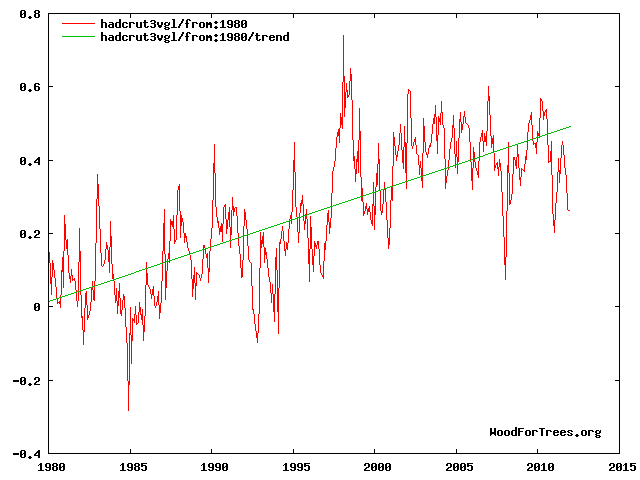
Finally, here is a chart of global temps from HadCRU:

From this, it is pretty clear why Rose chooses 15 years as his starting point: 1997-1998 was the time of the largest El Nino ever recorded, resulting in a huge temperature spike. Using that as the starting point for a temperature comparison is absolutely classic cherry-picking.

And in any event, you can’t say anything about trends in noisy data by simply comparing two arbitrary points. That is not a valid way to analyze the data (especially if you pick an obvious outlier as your starting point!). It is like trying to say whether the tide is coming in or going out by looking at the height of two waves. It just doesn’t work that way. You have to look at the long-term trend to remove the noise.

Let me take you to that Met Office response (and I’m republishing it in full).

Met Office in the Media: 29 January 2012

Today the Mail on Sunday published a story written by David Rose entitled “Forget global warming – it’s Cycle 25 we need to worry about”.

This article includes numerous errors in the reporting of published peer reviewed science undertaken by the Met Office Hadley Centre and for Mr. Rose to suggest that the latest global temperatures available show no warming in the last 15 years is entirely misleading.

Despite the Met Office having spoken to David Rose ahead of the publication of the story, he has chosen to not fully include the answers we gave him to questions around decadal projections produced by the Met Office or his belief that we have seen no warming since 1997.

For clarity I have included our full response to David Rose below:A spokesman for the Met Office said: “The ten year projection remains groundbreaking science. The complete period for the original projection is not over yet and these projections are regularly updated to take account of the most recent data.

“The projections are probabilistic in nature, and no individual forecast should be taken in isolation. Instead, several decades of data will be needed to assess the robustness of the projections.

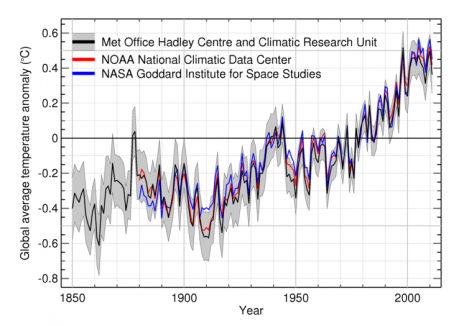
“However, what is absolutely clear is that we have continued to see a trend of warming, with the decade of 2000-2009 being clearly the warmest in the instrumental record going back to 1850. Depending on which temperature records you use, 2010 was the warmest year on record  for NOAA NCDC and NASA GISS, and the second warmest on record in HadCRUT3.”

Global average temperatures from 1850 to 2011 from the three individual global temperature datasets (Met Office/UEA HadCRUT3, NASA GISS and NOAA NCDC)

Furthermore despite criticism of a paper published by the Met Office he chose not to ask us to respond to his misconceptions. The study in question, supported by many others, provides an insight into the sensitivity of our climate to changes in the output of the sun.

It confirmed that although solar output is likely to reduce over the next 90 years this will not substantially delay expected increases in global temperatures caused by greenhouse gases. The study found that the expected decrease in solar activity would only most likely cause a reduction in global temperatures of 0.08 °C. This compares to an expected warming of about 2.5 °C over the same period due to greenhouse gases (according to the IPCC’s B2 scenario for greenhouse gas emissions that does not involve efforts to mitigate emissions).  In addition the study also showed that if solar output reduced below that seen in the Maunder Minimum – a period between 1645 and 1715 when solar activity was at its lowest observed level – the global temperature reduction would be 0.13C.

Back to that response from chrisd3.  He offered this, “Finally, here is a chart of global temps from HadCRU.”  Here is that chart, remember we are looking at Global temperatures.

Global temperature trend

OK, between this Post and my Post last Friday, you probably get the message!  There were many other contributions and I could go on and on quoting the great responses I got, all of them uniformly saying there IS global warming unprecedented in recent years.  The message is crystal clear and those who wish to deny the evidence … well, I can’t come up with a polite term, so will just leave it at that!

My final contribution is from Martin Lack, author of the Blog Lack of Environment, and a good friend of Learning from Dogs.  Here is what he wrote in a recent email,

You may have seen my latest response to How much is most?

When I eventually saw your earlier comment, I was surprised and disappointed in equal measure because I almost feel that I have failed in some way. Let me explain:  Unlike ClimateSight and SkepticalScience, which both do an excellent job of focusing on the science of climate change, my blog is deliberately focused on the politics underlying the denial of all environmental our problems; including 2 key aspects to my MA dissertation, namely the political misuse of scepticism; and the psychology of denial.  See my How to be a Climate Change ‘Sceptic’  for more detail.

Therefore, although not specifically categorised as such, just about everything I have posted is traceable back to Paul and Anne Ehrlich’sBetrayal of Science and Reason (1996) and/or Naomi Oreskes and Erik Conway’s Merchants of Doubt (2010).  For someone who does not currently go to any Church, I am remarkably fond of quoting Scripture so, if necessary, please forgive me but, as the Good Book says:  “What has been will be again, what has been done will be done again; there is nothing new under the sun” (Ecclesiastes 1:9).

Therefore, I do not think you should be surprised by the amount of misinformation and misrepresentation contained in the original WSJ Sixteen’s article; and/or the fact that denialist arguments are repeated no matter how many times they have been shown to be false.  Furthermore, I would warn against trying to summarise it all on Learning from Dogs.  This is definitely Book territory and, in addition to the two mentioned above, the market is already saturated by the likes of Climate Change Cover-up by James Hoggan and Climate Change Denial by Haydn Washington and John Cook.

With very best wishes for a fog-free future,

What to say to close these two Posts off?  Frankly, it’s difficult to know how to pitch it.  The science seems clear beyond reasonable doubt.  But if you are reading this and disagree, then PLEASE offer the science to refute the conclusions presented here.  I promise you that I will present it on Learning from Dogs.

So let me end with a simple photograph.

Earthrise

This is the photograph that wilderness photographer Galen Rowell called, “the most influential environmental photograph ever taken.”

The now world-famous photograph was taken by Astronaut William Anders from Apollo 8, the first manned mission to the Moon, a little over 43 years ago on December 24th, 1968.

As the Earth rose above the horizon of the moon, NASA astronaut Frank Borman uttered the words, “Oh my God! Look at that picture over there! Here’s the Earth coming up. Wow, is that pretty.”  Bill Anders then took the ‘unscheduled’ photograph.

Now project forward 43 years to the year 2055 and play with the idea of what ‘pretty‘ planet Earth will be like for mankind and so many other species, including our longest companion, the dog, if we don’t get our act together pretty soon!

Another reflection

Thanks to family member Freyja D. for this piece.

I saw this on Freyja’s Facebook account and thought it would be appropriate for a Saturday reflection along with Random Notes 2.  I’m sure many have seen it already but it was new to me!

There was a blind girl who hated herself because she was blind. She hated everyone except her loving boyfriend. He was always there for her. She told her boyfriend, ” If I could see the world, I’d marry you”.

One day someone donated eyes to her. When the bandages came off, she was able to see everything, including her boyfriend. He asked her, “Now that you can see the world, will you marry me?”

The girl looked at her boyfriend and saw that he was blind. The sight of his closed eyelids shocked her. She hadn’t expected that.  The thought of looking at him for the rest of her life led her to refuse his offer of marriage.  Her boyfriend left her in tears and days later wrote a note to her saying; “Take good care of your eyes, my dear, for before they were yours, they were mine.”

Having just cut and pasted that from the Facebook page, I thought that I would do a web search on ‘There was a blind girl who hated herself‘ and the first link on the results page was Stories from the Heart from the A View on Buddhism website.  So that was a lovely find and a web site that deserves more browsing.

At the top of the ‘Home Page’ was the following quote:

Don’t try to use what you learn from Buddhism to be a Buddhist;
use it to be a better whatever-you-already-are.

His Holiness the 14th Dalai Lama

Nothing much to argue with there!

May our eyes open our heart.

Money and morality

Money must be guided by morality. – A powerful essay courtesy of Resurgence Magazine

(Because the essay, by Satish Kumar, is so well-worth reading, let me postpone my background chit-chat until later!)

Here it is.

If we take care of people and Nature, then the economy will take care of itself.

Money was a clever and convenient invention; it was designed as a means of exchange and a measure of wealth. But somehow that has changed; what was once solely a means to an end has become the end itself, and what was a measure of wealth has become wealth itself.

Take for example agriculture, the purpose of which was to produce nutritious food whilst ensuring that the land remained in good heart for all future generations and for the good health of biotic communities. Agriculture was a way of life that gave farmers their dignity, and in turn they cultivated the crops with tender loving care and considered their work intrinsically good.

Then came money, which changed everything: agriculture turned into agribusiness and the paramount purpose of it became the making of money. Food became a commodity and yet another means of making large profits. As a result British farmers – even those with 2,000 acres of land – cannot make a living, and farm labourers are paid £10 an hour whilst bankers are paid £1,000 an hour.

The example of agriculture turned to agribusiness is only one illustration of how our society has lost sight of right and wrong. We can cut down the rainforest to make money, we can pollute the rivers and over-fish the oceans for profit, we can destroy the local economy in search of cheaper goods, no matter how much CO2 is omitted in the process. The bottom line always comes first. We can hire and fire people at will for the sake of boosting the economy; people have become little more than the instruments of making money. GM crops, nuclear energy, cloning and animal experimentation – nothing is forbidden, just as long as it adds to GDP and increases the share value of corporations and companies.

Ethics, morals and human dignity are all secondary and subservient to the profit margin. Bankrupt bankers have to be bailed out even though we can all see that they and other business leaders are utterly incapable of solving the economic crisis. Politicians and policymakers have to obey their desires. No wonder then that our governments are completely incapable of creating conditions for the stability and wellbeing of people – because all social, political, educational and communal values exist solely to serve economic growth, which simply means growth in money supply, in GDP and in consumption.

As long as we are wedded to this financial paradigm and its money model, the strong will exploit the weak, and our social and environmental fabric (and morals) will continue to fall apart.

The current economic crisis gives us an opportunity to look deeper and examine the consequences of confusing the means with the ends. Money has a place, of course, but we must keep it in its place and not allow it to dominate our lives in such a manner that we lose all our bearings and become its slaves. Money was made to serve people, not the other way around. Unfortunately, we have allowed money to become the master and override all other moral, ethical and ecological values. There is more to life than an endless pursuit of money and profit.

Money is not wealth; real wealth is land, forest, rivers, animals and people. Wealth is created by the imagination, creativity and skill. Bankers and business leaders in search of ever-increasing profit are not the wealth creators; at best they are wealth counters and at worst wealth destroyers. So let’s honour the true wealth creators: skilled workers, architects and artists, craftsmen and women, teachers and doctors, builders and farmers; the economy is safe in their hands. Let us respect the generous Earth and wild Nature, the eternal source of wellbeing and prosperity. If we take care of people and Nature, then the economy will take care of itself.

Some people might say that this is too idealistic; but what have the realists done? They have made a complete mess of the world economy. Normally, we need idealism and realism in equal measure, but for the time being a little extra idealism will be helpful. We have had far too much realism.

Money must be guided by morality. And we are delighted to present this ideal in this issue of Resurgence, the first of a brand-new year.

Satish Kumar is Editor-in-Chief at Resurgence magazine.

with written permission from Resurgence magazine – at the heart of earth, art and spirit
published by The Resurgence Trust, Ford House, Hartland, Bideford, Devon EX39 6EE

oooOOOooo

OK, back to me!

I hope you enjoyed the essay, it certainly jumped off the page, as it were, for me hence my email to Emma Cocker, Picture Researcher & Assistant Editor at Resurgence Magazine which resulted in a very prompt approval for re-publishing on Learning from Dogs.

Satish Kumar

Satish Kumar is an extraordinary person as a dip into his biographical details here will underline.  Please do read about Satish; you will be amazed by his background!  It includes this fact,

During this time, he has been the guiding spirit behind a number of now internationally-respected ecological and educational ventures including Schumacher College in South Devon where he is still a Visiting Fellow.

Schumacher College was well-know to me, 2006 and before, as I lived in the small village of Harberton, just outside Totnes in South Devon, England and Schumacher College at Dartington was less than 5 miles away.  The College description includes,

People from all over the world, of all ages and backgrounds, have been informed, inspired and encouraged to act, by our 20 years of transformative courses for sustainable living.

Then later, this,

It is precisely at this time of global upheaval that we want you to come to the College to share with us the ways in which you are moved to live and act differently.

No wonder that Bill McKibben of 350.org fame and often quoted on this Blog is quoted on the Schumacher website,

Schumacher is a very special place. As we try and figure out what on earth we’re going to do with this unraveling planet, it’s become a thinktank for hope, a battery for positive vision!

Bill McKibben, founder of 350.org

Finally, there are a number of videos presented by Satish that I propose to include in subsequent Posts on Learning from Dogs.

The breathtaking Grand Canyon

Powerful prose, stunning pictures and an insight into the last 1.8 billion years of our planet.

The Payson Roundup is the local newspaper for Payson.  To be frank, most weeks it’s a fairly quick read.  That’s not a reflection of the quality of the newspaper, just an acknowledgement that Payson is a small American city some 80 miles NE of Phoenix up in the high desert.  Indeed, the Roundup has a good record of winning awards.

However on the 6th January, there was a stunning article about the Grand Canyon, less than 4 hours driving from Payson.  It was written by Pete Aleshire, a Staff Reporter with the Roundup.  I can vouch for Pete’s literary skills as he teaches the creative writing course at the local college that Jean and I attended last term (semester) and will be restarting  tomorrow.

I am very grateful to the Payson Roundup for their permission to republish this wonderful work.  So here it is.

Woe and beauty on an ancient edge

by Pete Aleshire

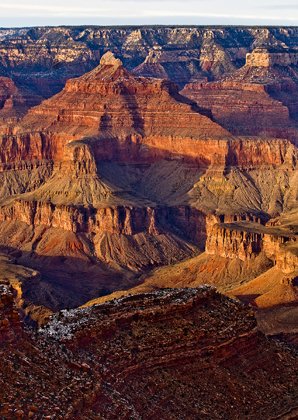
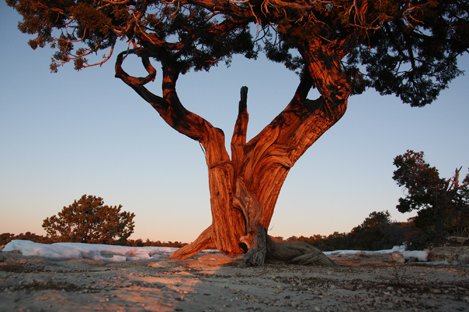
This view of the canyon reveals the layers of limestones and sandstones that testify to vanished seas and deserts. Note the strong, narrow white layer of Coconino Sandstone near the top, composed of 260-million year-old sand dunes. Also note in the center of the photo the 500-foot-tall cliff of Redwall Limestone formed on a seabottom 300-400 million years ago. Photo Tom Brossart/Roundup

I took a step — a long step — a million years step. Then I stopped, turned and faced north. Perched on the jagged edge of my life, I looked down deep into the shadowed layers of lost worlds — terrible deaths, fractured continents, vanished seas, mass extinctions.

Taking a breath, I took another step — a long step — another million years.

Curiously, I felt better — my troubles for the moment shrunk to no more than a ledge of Tapeats Sandstone in the wall of the Grand Canyon opposite. A layer of fossilized beach sand laid down 570 million years ago, the Tapeats Sandstone lies atop a mystery of missing stone — dubbed the “Great Unconformity.”

I studied that light, crumbling layer of sandstone in the canyon wall just across the way, knowing that all the great, riotous thrust of life that took us from pond scum to troubled writers has taken place since the lapping waves of a vanished sea left that layer of crumbling gray stone on a barren beach.

Perched on the wind-tormented branch of a twisted juniper nearby, a glossy black raven croaked at me.

“Nevermore,” he gurgled in my mind’s ear.

“You raise a good point,” I said to the raven and the wind that rose up out of the canyon’s 1.8-billion-year gash of time. I let loose a breath, a sigh, a puff of steam — frail and fleeting as life in the shadow of so much time. It should have depressed me, to stand so mite-like on the edge of such immensity. All I had dreamed or hoped or failed to do would not amount to a swirl of dust on this crumbling edge. I ought to have felt insignificant. Instead, I felt obscurely better.

So I took another step. A long step — a million years.

They had not built the Trail Through Time along the edge of the Grand Canyon between the El Tovar and Yaqui Point the last time I lingered on this edge. Now, it offers the most exciting crash course in geology I’ve ever encountered, although I’ve sought after rocks and unconformities all my life — and have even written geology books for confused people.

The 1.2-mile-long trail presents sliced and polished rocks representing almost all of the 24 major rock layers laid bare in the canyon wall from the 240-million-year-old limestone, siltstone, gypsum and chert layers of the Kaibab Formation to the 1.8-billion-year-old Vishnu Schist in the canyon bottom, among the oldest exposed rock’s on the planet’s surface.

Each step along the 1.2-mile path represents a million years, starting in the present and ending up at the 1.8-billion-year-old start of everything.

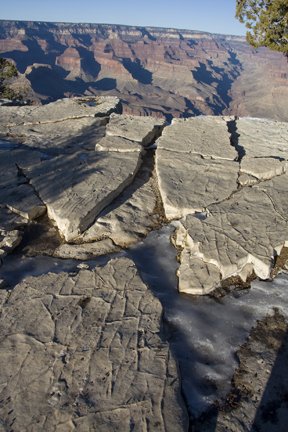
The Grand Canyon reveals a 1.8-billion year glimpse into Earth’s past from views like these along the 1.2-mile-long Trail of Time, with displays of rocks from each of the two dozen rock layers in the mile-deep canyon. A juniper catches the last light. Photo by Pete Aleshire

The Grand Canyon represents the most vividly revealed slice of Earth’s history anywhere on the planet. That makes the canyon one of the few places a person can grasp both the astonishing violence and the tormented timescale of the planet that sustains us all. This unique cross-section of time comes as a result of the relatively level uplift of the Colorado Plateau in the past 5 million to 8 million years. In most places, such a vast uplift would jumble the buried rock layers. But much of the 130,000 square miles of the Colorado Plateau rose at the rate your fingernails grow without deforming the miles-deep layers of sandstones, limestones and shales laid down on the bottoms of long-vanished seas and deserts.

As the Colorado Plateau rose, the northern edge crumpled into the Rocky Mountains. The southern edge dropped away along a 200-mile-long chain of 1,500-foot cliffs — which north of Payson forms the Mogollon Rim. Oak Creek cut back into that rising edge of the plateau to uncover the striking red rock formations of Sedona.

The Colorado River did the same thing, but on a grand scale. Many geologists believe the Colorado River originally ran north into a vast, interior sea. But as the Colorado Plateau rose, another river that ran south cut backward until it captured the north-flowing ancestral Colorado River, reversing the flow so that it now ran south into the Gulf of California.

This capture some 6 million years ago began the process of carving out the Grand Canyon. As the plateau rose, the flood-prone Colorado River cut down through it, like pressing a log up against a chain saw. Meanwhile, the steep tributaries widened the canyon by carrying those soft layers of sedimentary rock down to the main stem of the Colorado.

A layer of 230-million year old Kaibab Limestone caps the rim. The Grand Canyon reveals a 1.8-billion year glimpse into Earth’s past from views like these along the 1.2-mile-long Trail of Time, with displays of rocks from each of the two dozen rock layers in the mile-deep canyon. Photo by Pete Aleshire

That process started at about the time the genetic evidence suggests humans, chimps and gorillas last shared a common ancestor and continues to this day.

As a result of this vast uplift, the relatively young Colorado River has revealed in the walls of the Grand Canyon the long buried history of the Earth going back nearly halfway to its creation. That encompassed the entire period in which life progressed from single celled organisms in the ocean to its present, dazzling complexity.

The meander down that Trail Through Time reveals much of that history, preserved in the rock layers and the fossils they contain. Of course, erosion has already removed more than 200 million years of that history, so that the youngest rocks on the rim of the canyon are older than the dinosaurs.

A few dominant layers stand out.

Near the top, the fossilized desert sand dunes of the light Coconino Sandstone bear witness to a vast desert that covered the Southwest some 260 million years ago. At that time, what would become North America was part of a “supercontinent” that gathered almost all the dry land on the planet into a single mass.

In the middle of the canyon, lies the great, blood-red wall of Redwall Limestone, formed on the bottom of a shallow sea between 300 million and 400 million years ago. Today, the fused layers of microscopic skeletons of ancient sea creatures forms a sheer 500-foot-tall band of cliffs that pose the greatest single barrier to reaching the canyon bottom from the rim. All of the trails to the bottom must pass through fault lines in the Redwall Limestone, stained red by iron oxides leaching out of the layers above.

Farther down, the easily eroded Bright Angel Shale forms the shelf above the 1,800-foot-deep inner gorge. Shales form on shallow sea bottoms, compared to the deeper marine environments that create limestones. Most of the trails in the canyon run along its wide shelf. Formed 530 million years ago, the Bright Angel Shale represents the era when trilobites ruled the world.

Just below the Bright Angel Shale lies the Great Unconformity, where erosion in the inconceivably distant past removed 1.2 billion years worth of rock. This records another period of uplift, when erosion carried off layers of rock many times higher than Mt. Everest.

Below that unconformity, the story continues — down through a dozen more layers in the inner gorge, each one mounted alongside the trail and polished smooth. The Grand Canyon Supergroup spans the period between 570 million and 1.2 billion years ago, again recording the meanderings of the continents and the ebb and flow of oceans, as the planet breathes in, breathes out.

After another, smaller unconformity, the river finally reveals the inconceivably ancient Vishnu Schist and Zoraster Granite. The schists started as sandstone, limestone and shale, before they were buried, reheated and fused into this dense, primordial rock. The Zoraster Granite ooze up from the molten depths of the Earth, forming veins revealed finally by the relentlessly downcutting river.

I could not see the metamorphosed Vishnu Schist from my perch atop the rim, but I have seen it on raft trips in the dark heart of the canyon where it has been fluted and carved and sandblasted by eons of floods.

Finally I stood stock still, my breath coming still in moist, warm, puffs as the planet spun so that the dust of the atmosphere gave the sun’s long light a warm red glow, reflected off the ancient worlds across the way.

My raven friend — or one of his kin — flew past with an audible whoosh of his wings, then banked to consider the possibilities. He croaked, that guttural warble that only ravens dare.

Odds are, he noted my proximity to the edge and so paused to ponder my potential as carrion.

But I prefer to think that he felt our shared pulse of life and caught the updraft of my yearning.

In either case, he settled on the branch of a weirdly stunted ponderosa pine nearby and we shared the sunset.

The shadows rose up out of the canyon, swallowing continents and oceans.

I kept my gaze on the glow of the Redwall Limestone until the shadow took it, then shifted to the luminous yellow of the Coconino Sandstone.

For I came to the canyon full of woe holding my life in my fingernails, my heart in the shadows. But now my troubles seemed fleeting, the world full of marvels, my life aglow like that desert turned to sandstone in the last light of day.

My breath came in a puff, transparent but warm in the still, cold air.

“Nevermore,” quoth the raven, “nevermore.”

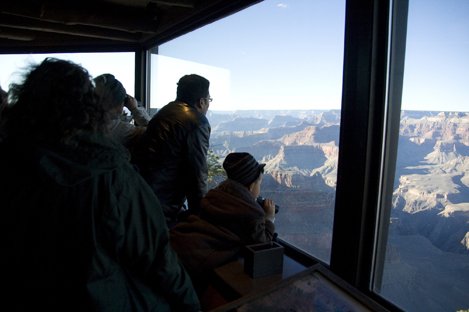
Visitors study the colorful layers of the Grand Canyon from the observation window in the geology museum at Yaqui Point. Photo by Pete Aleshire

oooOOOooo

Such beautiful words. Any additional thoughts from yours truly are utterly superfluous.

The coming new year!

Be warned, one of my more reflective muses!

Tomorrow is the last day of the year 2011.

For reasons that I am not clear about, there is a mood of pessimism about my person.  Whether it is the scale of global issues that I see ahead that drags me down, whether the year of an American Presidential election will remind me of the loss of reason that afflicts so many modern democracies, whether the messages in Kunstler’s book The Long Emergency still resonate in my mind well, who knows?

But when one does look at the broader picture of modern society, there is much that troubles.

So forgive me if I provide a couple of examples of these troubles.  I do so on the grounds of communication – the more that understand the risks ahead of us, the more likely we, as in the peoples of this planet, will say to our leaders, “Enough of this!  For the sake of my children, my grandchildren and all of humanity we have to change our priorities, and soon!”

Here’s my first example.

The US National Resources Defense Council recently published an item about severe weather including an interactive Extreme Weather Map, introduced thus,

Climate change increases the risk of record-breaking extreme weather events that threaten communities across the country. In 2011, there were at least 2,941 monthly weather records broken by extreme events that struck communities in the US.

That was backed up by an article on the Onearth website that opened,

By many measures, 2011 was the most extreme weather year for the United States since reliable record-keeping began in the 19th century — and the costs have been enormous. According to the National Oceanic and Atmospheric Administration, 2011 set a record for the most billion-dollar disasters in a single year. There were 12, breaking the old record of nine set in 2009. The aggregate damage from these 12 events totals at least $52 billion, NOAA found.

And that just for the USA.  But will climate change be the Number One political issue in 2012?  And if not in 2012, when will it be?

Let me move on to my second example, very different from the one above but, in a sense, just as scary.  This is an interview that was in a recent article on the Food Freedom website ( brilliant website, by the way).  Dr. Joseph Mercola, the leading natural health practitioner, interviews Dr. Don M. Huber, one of the senior scientists in the U.S about the area of science that relates to genetically modified organisms (GMO). Here’s an extract from the article on Food Freedom,

Toxic botulism in animals linked to RoundUp

Dr Mercola recently interviewed Dr Don Huber, whose letter to the USDA warning that Monsanto’s RoundUp, a broad-spectrum “herbicide” that has been linked with spontaneous abortion in animals, continues to be ignored by food and environmental safety authorities. In this important hour-long discussion, Huber, a plant pathologist for over 50 years, explains how RoundUp is destroying our healthy soils by killing needed microorganisms.

Not only did his team discover a new soil pathogen, but he reports that animals are coming down with over 40 new diseases, like toxic botulism. Huber explains that before the widespread use of herbicides, pesticides and genetically modified food and feed, natural probiota would have kept Clostridium botulinum in check

The video, below, of the interview is included in the article.  Please don’t be put off by the length, the material covered is riveting and critical to our general knowledge about the threats to our society.

So that’s enough from me for one day!  On Monday, I shall include another video relating to the RoundUp issue that reveals, both directly and metaphorically, how the only solution to pessimism is to embrace the need to make change happen.  Be inspired by this poem by Sam Keen, included in the latest Sabbath Moment from Terry Hershey,

I Want to Surrender

God, I want to surrender
to the rhythm of music and sea,
to the seasons of ebb and flow,
to the tidal surge of love.

I am tired of being hard,
tight, controlled,
tensed against tenderness,
afraid of softness.
I am tired of directing my world,
making, doing, shaping.

Tension is ecstasy in chains.
The muscles are tightened to prevent trembling.
Nerves strain to prevent trust,
hope, relaxation….

Surrender is a risk no sane man may take.
Sanity never surrendered
is a burden no man may carry.

God give me madness
that does not destroy
wisdom,
responsibility,
love.

Sam Keen

The Versatile Blogger Award

My rather slow response to my Versatile Blogger award!

Last Friday morning, the 16th, I turned on my PC to discover that lovely Kathryn Johnston of 4amWriter had nominated Learning from Dogs for the Versatile Blogger Award.  I was blown away especially as since then the connections I have made with other writers have been wonderful.

However, a more prompt acknowledgement on LfD seems to have escaped me until today.  I quickly learnt that there is a proper protocol associated with the response to the award.

  1. Thank the award-giver and link back to them in your post.
  2. Share 7 things about yourself.
  3. Pass this award along to 15 blogs you enjoy reading.
  4. Contact your chosen bloggers to let them know about the award.

So here goes!

Award logo

So first, a very big thank you to Kathryn of 4amWriter for including me in her list.  As she said on her post, “This title says it all! If you love dogs, this is a must-visit!”  That’s generous of Kathryn.  Dogs are a very powerful reminder of an uncomplicated way to live, as described on the Home Page.  The Vision behind the Blog is:

  • Our children require a world that understands the importance of faith, integrity and honesty
  • Learning from Dogs will  serve as a reminder of the values of life and the power of unconditional love – as so many, many dogs prove each and every day
  • Constantly trying to get to the truth …
  • The power of greater self-awareness and faith …

Seven things about me!

H’mm, what to say.

  1. Born in London 6 months before the end of WWII,
  2. Been a business-to-business salesman most of my life,
  3. Started my own business in 1978 and remained in ‘self-employment’ until quite recently,
  4. Lived on my own boat, based in Larnaca, Cyprus, for 5 years,
  5. A keen glider pilot for many years at Rattlesden Gliding Club in Suffolk, later a private pilot,
  6. Always wanted to write,
  7. And, finally, happier than I have ever been being married to Jean, having met in Mexico in 2007, moving out there with Pharaoh, my GSD, in 2008 and subsequently arriving in Payson, Arizona in 2010 with 11 dogs and 6 cats!

So here are the 16 Blogs (I use that description loosely) that I wish to pass this award to:

  • Yves Smith of Naked Capitalism.  How Yves finds the time to produce the huge volume of articles and website links every day is beyond me.
  • James Kwak and Simon Johnson of Baseline Scenario.  James and Simon were, for me, an early source of openness about the key issues affecting the global economy that slammed into our collective faces in 2008.
  • Patrice Ayme of the Blog of his own name.  Patrice’s sub-heading on his Blog reads, “Intelligence at the core of humanism.”  Again, a prolific writer with a huge intellect that he puts to wonderful use.  Just pick anything that he has written to see that proved in spades.
  • Patrick Smith of Patrick Smith Photography. Just breath-taking photographs.  Do visit his website.
  • Bill McKibben of 350.org.  The headline on the website says, “We’re building a global movement to solve the climate crisis.”  Say no more!
  • Michelle of Dog Kisses’s blog.  Wonderful blog – just go there and enjoy it.
  • Sue of Sue Dreamwalker. Again, just a wonderful Blog – do please visit.
  • Vlatko, the owner of Top Documentary Films.  We do not subscribe to any television channels at home so Vlatko’s resource is so valuable for us.  Huge selection of free documentary films to watch.
  • Deanna Raeke and Andrea Rosebrock of the Blog For The Love of a Dog.  Very active in fighting all corners on behalf of man’s oldest companion.
  • Rob Hopkins and his team at Transition Network.  Rob is one of the leading voices for changing to a sustainable relationship with this planet.  He is based in Totnes, Devon, my local town for many years when I lived in the village of Harberton.  His books on Transition are masterpieces.
  • Victoria Brown, Daniel Honan and team at Big Think.  As their headline says, “A forum where top experts explore the big ideas and core skills defining the 21st century.”  Fabulous resource.
  • All the Directors and team at Sustainable Arizona.  As is described on their site, Sustainable Arizona is about, “Our nonprofit organization is made up of volunteers and professionals committed to making sustainable development possible. We accomplish this by encouraging businesses that add true value to our communities while preserving the environment.
  • Anthony Watts of Watt’s Up With That. With over 9,000 followers and over 98 million viewers this very reasonably can be regarded as the world’s most viewed climate website.  Anthony’s 3 million monthly visitors puts my 40,000 into perspective!
  • The whole team at the US-based National Wildlife Federation.  Their MissionAs America’s largest conservation organization, National Wildlife Federation works with more than 4 million members, partners and supporters in communities across the country to inspire Americans to protect wildlife for our children’s future!
  • Peter Russell of Spirit of Now.  Peter writes on his Blogsite, “There are many observations I make in daily life—some profound, some mundane—mostly concerning the natural world around, or the nature of the inner world of mind. Some incline us to wonder and awe. Others make us think, and question our assumptions.”  Never before have we needed so much to think about the way we think!
  • Nakibul Hoq, blogging from Bangladesh in the city of Dhaka under the Blog name of Freedom to Survive.

I shall be passing on the ‘award’ to all bloggers today.

Let me close again by saying such a big thank you to Kathryn of 4amWriter and, from that, how quickly I came across Limebird Writers who, I know, will be a great source of support as I face 2012 and ‘the novel’!

The power of truth

Three things cannot be long hidden: the sun, the moon, and the truth.

The above is a quote attributed to the Buddha.  It is perfect as an introduction to today’s piece.

When I sat down at my PC yesterday afternoon I was planning to finish off a Post about the BBC’s fabulous Frozen Planet TV series.  But a check of my email changed all that.  Because there was an email from Merci O., someone in Payson that Jean and I know well.  Merci had sent me an email with a link to the following YouYube video.

Watch and be moved.

This is a non-commercial attempt to highlight the fact that world leaders, irresponsible corporates and mindless ‘consumers’ are combining to destroy life on earth. It is dedicated to all who died fighting for the planet and those whose lives are on the line today. The cut was put together by Vivek Chauhan, a young film maker, together with naturalists working with the Sanctuary Asia network (www.sanctuaryasia.com).

Content credit: The principal source for the footage was Yann Arthus-Bertrand’s incredible film HOME http://www.homethemovie.org/. The music was by Armand Amar. Thank you too Greenpeace and http://timescapes.org/